
During the early months of the Easter Term of 1925, the long serving and popular School Gardener, Mr Kidd, was taken seriously ill. He had worked at the High School for thirty-seven years, and “must have been seen by thousands of boys at his work in front of the school.” Mr Kidd was not well enough to carry on with his job and, poor man, was eventually to succumb to his illness during the early part of the Summer Term. He was duly succeeded as the School Gardener by Mr Wragg, whom the “Nottinghamian” called “a footballer and cricketer of great prowess”.
Mr Wragg was paid £3 per week, which was a decent wage in 1925. At the same time, my own Grandad was more than happy to earn £2.20 as his weekly wage in a clay works in South Derbyshire. I have done quite a lot of research about who exactly Mr Wragg was. Of course, nearly a century after the event, it is impossible to establish the truth without the slightest shred of doubt whatsoever, but I am now 99.9% certain that the High School’s new Gardener was William Arthur “Willie” Wragg.

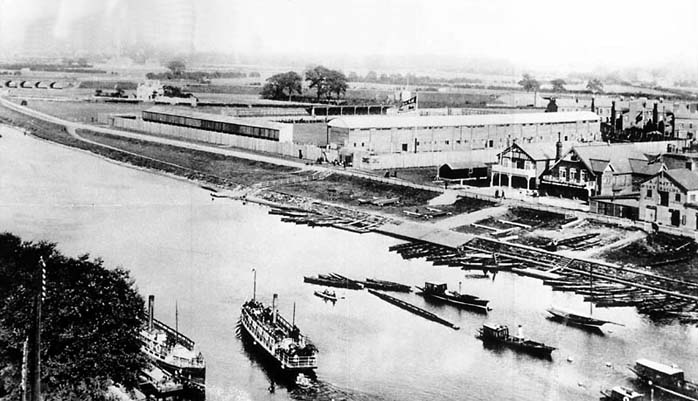
Willie Wragg was born in Radford, Nottingham in 1875, and initially played local football for Notts Olympic, Sutton-in-Ashfield, Newstead Byron and then Hucknall Portland. He was soon signed by Nottingham Forest and played for them as a professional footballer from 1896-1899. Appearing usually as a left-half, Willie made 48 League appearances in the First Division for Forest and scored one goal. Overall, he played 58 times for Forest in all competitions. This photograph shows the home of Nottingham Forest, the City Ground, during the 1898-1899 season:
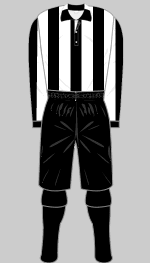
Willie made his début at home to Liverpool on November 28th 1896 in a comfortable 2-0 victory. He went on to play a further twelve times in the First Division that season, with a further four appearances in the F.A.Cup. He scored a single goal in a friendly match, a 2-1 victory over Dundee United at Crystal Palace. The following season of 1896-1897, Willie Wragg made 24 appearances in Division One and six in the F.A.Cup. He scored a single goal in the First Division in a 1-1 draw at home to Sunderland. The next season of 1897-1898 was his last at Forest. He played 13 times with most of his games coming as a left fullback. His final appearance came as a left half in a 0-0 draw at home to local rivals Notts County in front of a crowd of some 16,000 spectators. Here is Notts County’s magpie kit on that long ago Saturday, September 4th 1897. The crowd was a very respectable 15,000 spectators:
As far as the boys are concerned the School Gardener can be a rather anonymous figure, working away quietly at the front of the school, a man whom the majority of pupils would not even notice. They were probably unaware of his lengthy pedigree as a professional footballer, but many hundreds of those unknowing little boys would have given a great deal to get their hands on what Willie Wragg had won during his three years at Forest, namely a Winner’s Medal from an F.A.Cup Final.
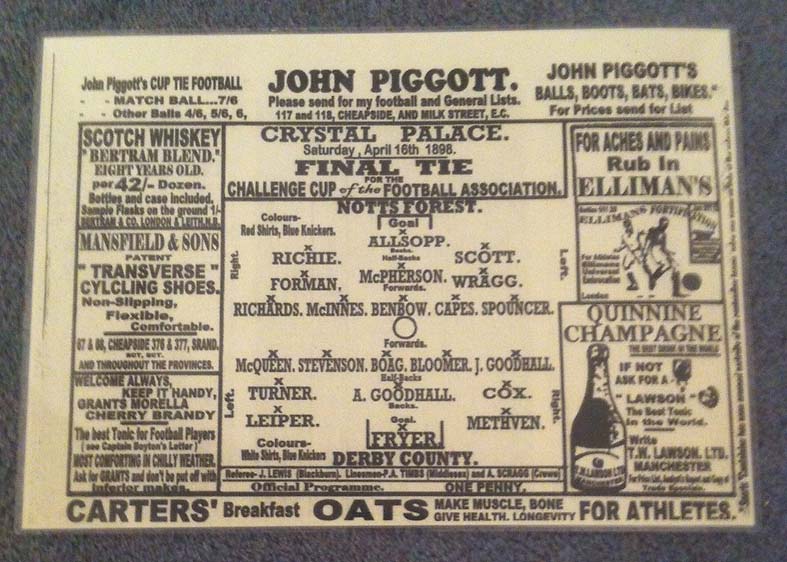
Willie had played at Crystal Palace on April 16th 1898 in front of a crowd of 62,017 spectators, when Nottingham Forest beat Derby County, Steve Bloomer and all, by three goals to one. Here is the front of the programme:
And here is the back: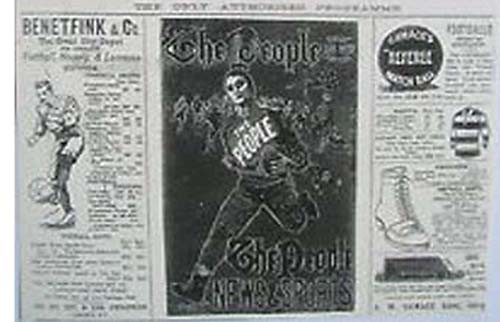
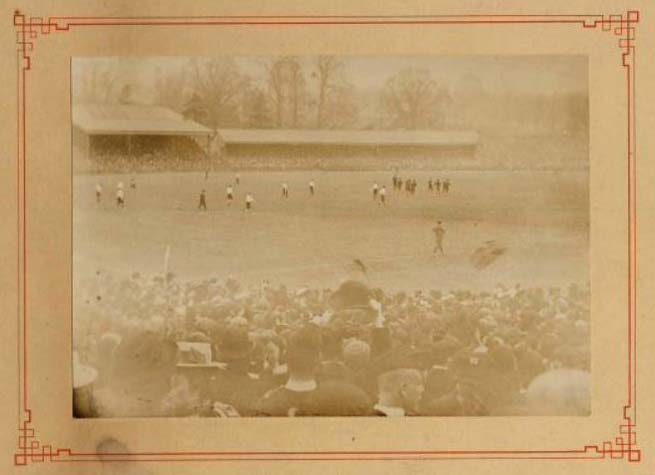
From his position as a left-half, Willie actually created Forest’s first goal, for it was from his free kick on the left near the touchline, that the ball eventually reached Arthur Capes who hit the back of the net through a crowd of defenders. Here is a picture of the game in progress…
And here is a second photograph from a little further back…
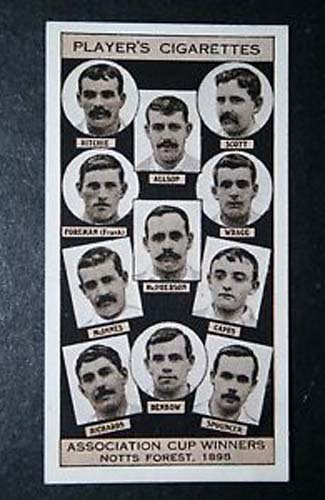
Later in the game, Wragg aggravated an injury suffered in the first-half, and, in the days before substitutes, was forced to move out on to the wing, not taking much further part in the game.That did not stop his appearance on the souvenir cigarette card…
Willie then left Forest, to go and play for Leicester Fosse in the Second Division. He spent two seasons at Leicester, making 50 appearances and scoring four goals. He was perhaps a little slower now and played at full back. Willie also became the club’s free kick specialist. He went on to appear just once for Small Heath (later to become Birmingham City), but he was unfortunately unable to displace George Adey from the team. His footballing career then rather petered out as he played for Watford in the Southern League and then Hinckley Town in the Midland League. His Football League career began again with Chesterfield Town (20 appearances, no goals) before a final return to non-League football with Accrington Stanley, Doncaster Rovers and finally Brighton & Hove Albion. Overall, Willie Wragg had made 119 appearances in the Football League.
Personally I believe that Willie Wragg may well have acquired his job as School Gardener at the High School through his past career at Nottingham Forest. At the time of the Cup win in 1898, the club’s then Chairman was Mr William Thomas Hancock, a prominent Old Boy of the High School, who had retired as Chairman of Nottingham Forest in 1920, only five years before Willie Wragg was appointed as the School Gardener. In 1925 Mr Hancock was still a Life Member of the football club.
Most romantically of all though, perhaps ex-Chairman Hancock still remembered his day of glory when he posed on the Official Photograph of the F.A.Cup Winners of 1898 and knew exactly who had done more than his share to make possible that unique and unrepeatable thrill of being a winner. Mr Hancock is the gentleman third from the left on the back row.
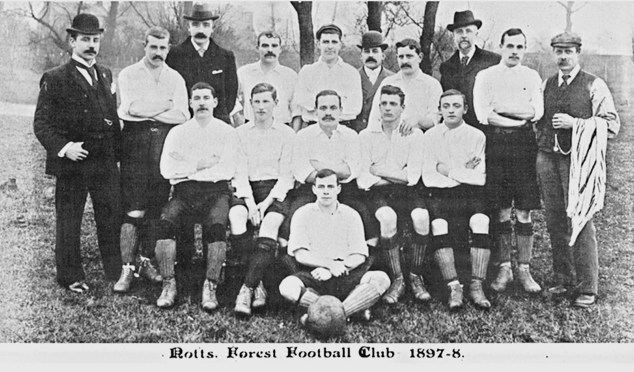
Indeed, in 1898, when this photograph was taken of the players in the victorious team at Crystal Palace, how proud Mr Hancock must have been to stand with them:
back row: H.Hallam (Secretary), T.McInnes, Mr W. T. Hancock (Chairman), A.Ritchie, D.Allsop, unknown, A.Scott, unknown, A.Spouncer, G.Bee (Trainer)
front row: C.H.Richards, Frank Forman, J.McPherson, W.A.Wragg, A.Capes
sitting: L.Benbow
The photograph is, in itself, quite interesting, because it is one of two very similar photographs. In one of them, Forest posed with the cup, and in the other, they were photographed without it. The reason for this was that the crowd for the F.A.Cup Final was 62,000 spectators and almost all of them invariably invaded the playing area after the end of the game. This made it quite impossible to take a proper photograph of the winning team. And certainly the crowds do look huge and they seem to be pretty much left to their own devices…
The usual convention, therefore, was that both teams were photographed before the match, in conditions of complete calm, the photographers taking two pictures of each, one as victors with the trophy, the other as losers without it. Afterwards, the two irrelevant photos were destroyed, although this has clearly not happened in this case.
It is also known that in this particular year, enormous problems were experienced with Forest’s red shirts and blue shorts, which did not show up particularly well in the comparatively dull weather conditions.

The photographers therefore asked them to pose in Derby’s kit, wearing white shirts and black shorts. Perhaps this is why they look especially miserable, although, of course, Forest were certainly to have the last laugh.
Whatever the reason for Willie Wragg becoming the School Gardener, though, there was certainly an enormous connection between the football club and the High School. Almost forty Old Nottinghamians had already played for Forest, especially in the 1880s, and many of them had represented the club in important cup games, including semi-finals. By 1925, they were all just of the age to occupy important administrative posts in the club and certainly Tinsley Lindley had been a Committee member at Forest.
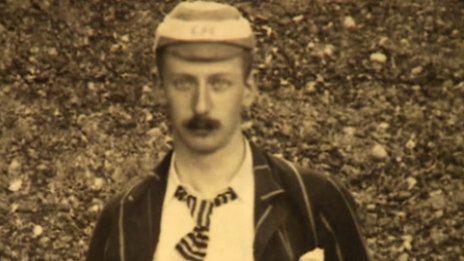
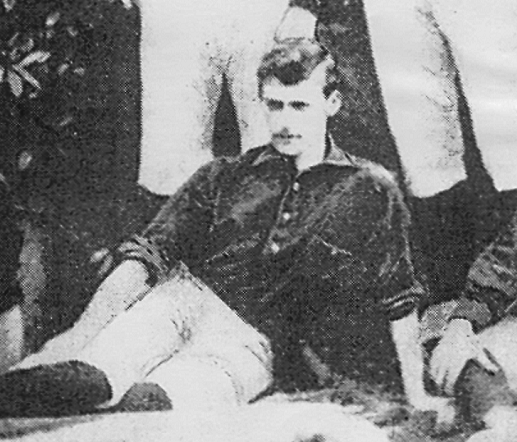
Another familiar face at the City Ground was an Old Nottinghamian who had made his England début alongside Tinsley Lindley in a 6-1 victory over Ireland in Belfast. This was John Edward Leighton, called “Teddy” when he was at school, or, when he played for Forest, “Kipper”, because of his incredible ability to fall asleep in the dressing room before games. Indeed, old Mr Leighton was to fall asleep for the very last time at the City Ground, on the afternoon of Saturday, April 15th 1944, at the age of seventy-nine after a fatal seizure. His sudden demise occurred during a Wartime Cup tie between Nottingham Forest and Northampton Town, a fixture in which the Reds were eventually to triumph by 1-0. Here is “Kipper” though, on a better, and younger, day, sitting with all his pals, it is thought, in the Church Cemetery on Forest Road. They are all wearing the same bright scarlet shirts, and they are universally known as “The Garibaldi Reds” One day they will win the European Cup. Twice.




 John Knifton