
When I am writing blog posts, just like David Bowie and Jimi Hendrix, I don’t normally do requests. On the other hand, I did feel a little bit guilty that, months ago, somebody contacted me and said, very politely, “Maybe one day you could tell us a bit more about Brincliffe School, please?”. Regrettably, I did not record their name. On the other hand, the Hairy Godmother has granted their wish………
Brincliffe School was situated in Balmoral Road in Nottingham, immediately to the east of the High School. This Grammar School for Girls occupied the area between the western corner of the junction with Forest Road East, as far south as No 23, the first house of a row of three storey Edwardian properties. The Orange Arrow tells the tale, indicating precisely the southern boundary of the now demolished school:

Here’s the Victorian equivalent of the same area. The Brincliffe building is south west of the “B-A-L” of “Balmoral Road”.:

Brincliffe didn’t really look much like a school. It was more like a school housed in a private dwelling house:
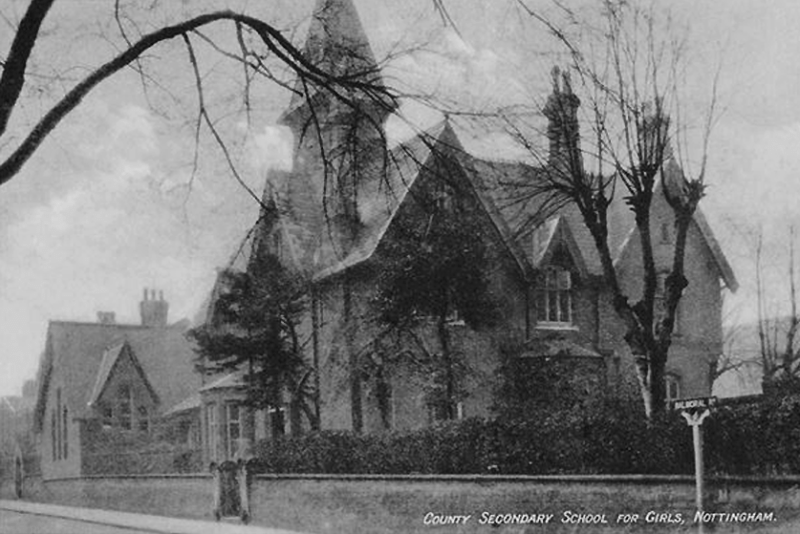
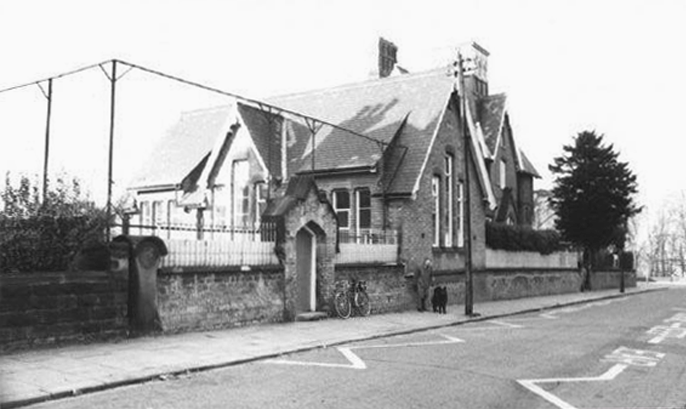
At one time, when it was a private house, Dame Laura Knight, the artist, had lived there. Not many pictures of the building are left nowadays. It was demolished in the late 1970s. Here is the view from the south. The key to linking up the two photographs is the bottom left of the photograph above, and the centre right of the photograph below. The three windows and the gate with a portico are crucial links. Don’t miss one man and his dog who have stopped for eternity next to the telegraph post.
Brincliffe was an all girls’ grammar school, which operated from 1907-1974. Entry was by passing a competitive examination. Unlike Nottingham Girls’ High School, no fees were payable. Such selective, and free, schools were a fantastic source of social mobility and an excellent examination for the poor. Everybody in the school had a talent and the schoolwork they did was of a very high standard. At Brincliffe, girls had a genuine opportunity to do what they wanted to do with their lives, with little interferece, except from their own families.
The school produced a Gold Medallist in the 1974 Commonwealth Games, an Oxford don, a member of the D’Oyley Carte Opera Company, any number of students at Oxford and Cambridge Universities, and innumerable doctors, dentists, solicitors and politicians. And all of them came from an ordinary background. If you doubt that, then go and look at their Facebook page.
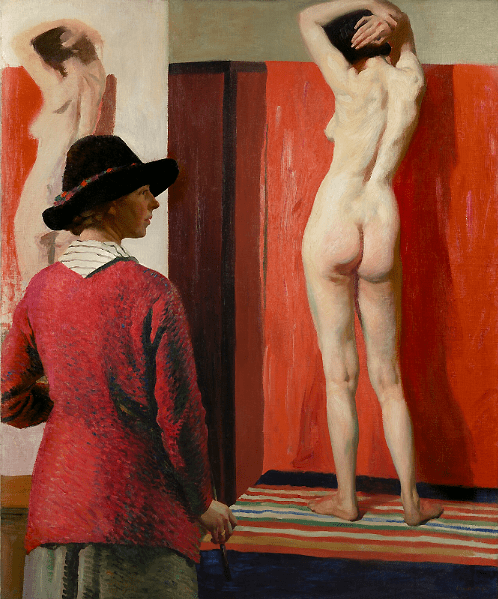
The most famous high achiever from Brincliffe was surely Dame Laura Knight, the painter. One of her most famous paintings was “Self portrait with a nude”. It caused a right fuss:
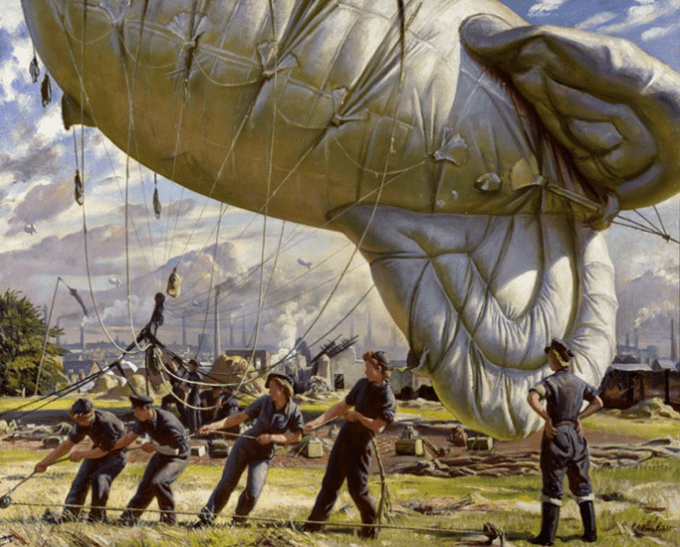
She also did a lot of paintings of World War Two. They included “A Balloon Site, Coventry” in 1943:
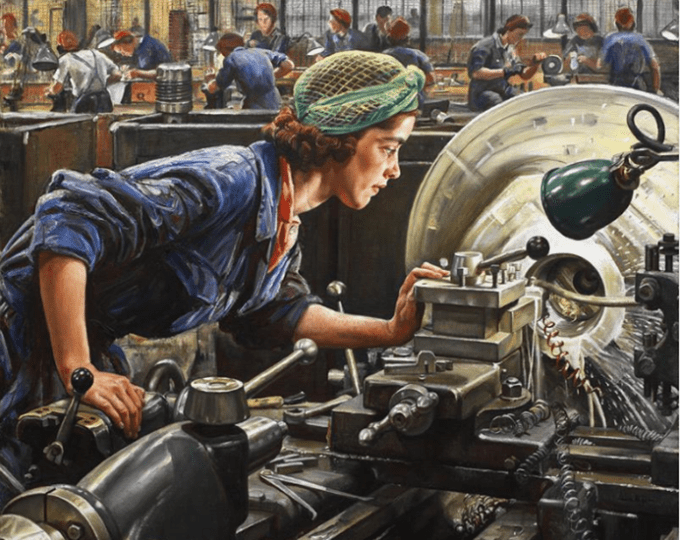
The superbly composed “Ruby Loftus Screwing a Breech-ring” in the same year of 1943:
And a portrayal of the crew of a Short Stirling bomber in 1943. It is entitled “Take Off “, and I found in one account that the poor young wireless operator had been killed almost before the paint on the painting had dried :

Dame Laura was one of a very few female artists during her era. Another famous Old Brincliffian was Enid Bakewell who played for the English women’s cricket team in twelve Tests between 1968 and 1979. Her batting and bowling averages show that she could well be regarded as the best all-rounder that the English women’s game has ever produced.
The Brincliffe School ran from 1907 onwards, for almost seventy years. There was only a single thirty girl form in each year, so everybody knew each other. The pupils used to wear dark green blazers and berets. Here is a typical green blazer of the period:

Brincliffe had only five Headmistresses during its history, the Misses Randall, Yates, Yonge, Lloyd and Carter. Teaching at Brincliffe came to an end in 1974 and I can remember still seeing the typical Victoria building during my first few years at the High School, from 1975 onwards. I have vague memories that, as the school was so close to the High School, we were allowed to use the empty classrooms for some of our smaller classes, such as Sixth Form groups. Brincliffe didn’t die in 1974, but it was severely wounded by a Labour Council’s decisions. It was merged with another school for girls on Gregory Boulevard. This was the Manning School, formally opened by Alderman Manning in April 1931. (Aren’t local politicians just shameless?)
When Brincliffe and Manning merged, they also became a comprehensive school catering for girls aged between 11 and 16 years. In 1983 the school moved to new buildings in Aspley, a suburb further to the west, whilst the old school buildings on Gregory Boulevard became the Forest Comprehensive School. In September 2011, the Manning School became the Nottingham Girls’ Academy, the first all girls’ academy in Nottingham. It catered for girls aged between 11 and 18 years old.


 John Knifton
Well done, John. I hope the questioner reads this
That’s a thought that crossed my mind too, Derrick. I was really stupid not to have kept his details somewhere, but hopefully, he may be a regular reader.
I certainly liked Dame Knight’s paintings. Good job here, John.
Thank you, you are very kind. Dame Laura Knight is actually a good example of the way that women were treated at the time. She was married to Harold Knight, himself a prominent artist who, at the time was always reckoned to be better than his wife. Many would argue, though, that this was because he was a man and that Laura was actually the better of the two. The passage of the years has tended to confirm this judgment.
Some of Harold’s paintings are here….
https://www.google.co.uk/search?q=pictures+of+harold+knight+nottingham&tbm=isch&sa=X&ved=2ahUKEwj7sujIiMD_AhXJfMAKHX7BBAIQ0pQJegQICBAB&biw=1920&bih=929&dpr=1#imgrc=T7CvuRLlOmrJhM
After looking at his and then relooking at Laura’s, I also say that she was the more talented artist.
Believe me, you are not the first person to say that!!
Thanks John, I remember the School, having started in the prep in 1972, and vague memories of green uniformed students attending. I never attended any classes in the buildings, but do remember College House (?) next to the Dining Room, and that small block of maybe four classrooms. I may even have had classes with you in there, I certainly remember classes with foreign exchange French students employed for us to practice speaking with, in that block. Do you know anything further about College House. My now deceased mother went there for a short time as a girl I do believe, likely around late 1930s early 1940s. All best wishes to you and yours!
To be honest, I don’t remember many exact details about what took place as regards small classes in Brincliffe, other than they were most probably Sixth Form.
The details are made all the more difficult to be certain about because this was not the only very large Victorian house next to the High School to play host to small Sixth Form groups. On the northern side of Waverley Mount, at the High Schoool end, there was a very large house called “Dr Dixon’s House” which had been lived in by Dr Dixon, the Headmaster of NHS from 1867-1885. It was also used as a Sixth Form Centre and had a magnificent Batman and Robin painting on one of the walls. I definitely taught classes in here, but Brincliffe, I am a lot less certain about.
Replying to Nick, I would have semi-guessed ‘University House’. In my memory it was a modern-ish structure and I didn’t realise it had a separate life. If you’re on Facebook I suggest you join the ONSoc group, which is low volume and friendly, and you may well find there are people who know more about it
Those paintings are amazing. Thank you for this post.
My pleasure, Lakshmi! Arguably, Laura Knight was one of the greatest women artists in the history of art.
And everything she achieved, as you might imagine, she had to fight for.
Quite an accomplished female artist.
She certainly was, and her status seems to have improved over the years, as the status of women in society has risen.
Last night, Guyana was on TV again, as Gordon Buchanan presented his “Lost Land of the Jaguar (2008)” all about the largest remaining rain forest in the world. What a place!! Snakes thirty feet long and spiders the size of car tyres,
Excellent, John! I watched the documentary some years ago. Exploring Guyana’s tropical rain forest is not for the faint of heart.
Fascinating John, as an NHS pupil from 1983-90 I’m embarrassed to say I had never heard of Brincliffe Grammar until today. It looks like the bricked-up stone gateposts on Balmoral Road are all that is left of the school. Thanks for the content.
I’m glad you enjoyed it. Brincliffe was a major step forward for women in Nottingham. Always run by a Headmistress, with female staff and female pupils, the school gave every girl in the city the chance to excel, either as an artist, a cricketer or a student at Oxbridge. And money did not enter into the equation, as there were no fees and only an exam to pass.
I have always been a passionate believer in social mobility, and Brincliffe could not have done more, offering a chance to excel to every girl in the place.
I absolutely love the girl on the lathe. They oughta hang a copy in every middle school classroom. For boys and girls to see but for different reasons.
I agree.
Yes, Brincliffe did its very best to break down the barriers put there by men to ensure that women do not succeed. Our Western society is a lot better than it used to be, but even so, we still have a long way to go to achieve equality of the sexes.
A wonderful slice of history. Well done John.
Thank you, I’m glad you enjoyed it. And there are still three more sections to come……
What an excellent and interesting post John. The school obviously produced many talented young ladies who went on to do great things. It’s just a shame there is so little known about them. The paintings though, are quite well known, certainly the woman at the lathe (or a copy of it) has been used in propaganda posters (unless I’m mistaken!).
I’m sure you’re right. I’ve always thought of it as a kind of English “Rosie the Riveter”. You can find information about how Ruby, Rosie and millions like her won the war at…..
https://en.wikipedia.org/wiki/Rosie_the_Riveter
Thank you John. The likeness certainly is uncanny.
Ruth Kennedy was a Brincliffe pupil when she won a Commonwealth Games gold in the 4×400 relay in Christchurch in 1974. Her younger brother Tim was an ON. He was a good hockey player.
Thank you for that information, Gary, Brincliffe seems to have achieved so much with its pupils, whose parents would probably not have been able to afford the fees at NGHS.
Although in the city, Brincliffe was a county grammar school. It closed in 1974 as part of the reorganisation and the switch to comprehensive secondary education that also saw the end of the NHS and NGHS scholarship pupils. The NHS did use the building and the art annexe for lessons and finally as a bare-bones VIth Form centre prior to demolition.
I came to the HIgh School in 1975 and at that time, some classes seemed to have up to 50% scholarship pupils, with Nottingham City and county and Derbyshire and maybe Leicestershire and Lincolnshire. It would be nice to think that one of the pupils who had used the art annexe for lessons was the artist who produced Batman and Robin.
Thanks for giving us your attention, but Dame Laura Knight never lived or taught at Brincliffe. Her mother did give Art lessons at the school for a time and a couple of her younger girls did get some education there in return for that. Dame Laura Knight herself was teaching at the Art College from her early teens(!!), taking the place of her mother who became ill, when all the daughters had to start working as teachers. We had a Face book page for the school at one time – it collapsed and disappeared, probably under the weight of all the discussion and photos – and this was thoroughly thrashed out. For one thing the time lines do not work out with what is known and published in biographies. They were living in France and other parts of Nottingham prior to her mother going to work at the Art College, and Brincliffe House had been a private school from the 1880s, then a Pupil teaching establishment under the eye of the Bishop of Southwell, before it became a County Grammar School. In my time we always used to enjoy staring at the High School Boys out of an upper window in a classroom named ‘The High School Room’, because of the view. I personally enjoyed the days when marching and bugle blowing by the cadets helped to drown out the feeble voice of our Latin mistress! Regards to all. and Douglas Burgess specially who got a scholarship to go to the High School in my day, and who used to sit next to me in our old Junior school.
PS Enid Turton/Bakewell, the outstanding cricketer, is the most famous of our Old Girls I would say – inducted into the Cricketing Hall of Fame a few years ago and still playing in her 80s!
Thank you again for your input. I took the details about Dame Laura Knight from the Nottingham Women’s History Group page at….
Click to access Dame-Laura-Knight.pdf
Obviously, I do not have the time to do my own original research for every single detail but this website seemed very serious so I made use of the details it provided.
PS From the early 1960s the school expanded to Upnah House on the opposite side of Balmoral Road, now the NGHS Junior school. Previous to our using the building it had been used by the Army in various ways – for issuing supplies to soldiers moving into billets locally or on their way through during WWII – there was still a stock of dusty tins of corned beef in the attics in the 60s. RAF cadets were using it immediately before Brincliffe took it over.
Thank you for our input. I have always wondered what an “Upnah” is. Do you have any idea? It has always sounded like an acronym to me.
An interesting description of the school I attended 1959-1966 and my mother also attended 1929 -1935 ish. I did not know about Dame Laura Knight’s association with the building – perhaps the staff didn’t want to mention her paintings! It was an academic and yet cosy school as the numbers of pupils were so small – one class of 30 each year except for every fourth year when they took 2 classes of 20 girls – that number fitted into the available classrooms. A lovely building – only sixth formers were allowed to use the front door and the the tiny tower room.
All the 30-pupil classes moved from room to room each year. The Lawn Room was the nicest, although the High School Room was always popular, for obvious reasons!
However I have to dispute that the school produced numerous doctors and dentists. It certainly didn’t. Brincliffe produced bright young women who either took Arts or Social Science degrees or became Primary school teachers as their most popular career choices. My own leaver’s year (1966) produced the school’s first ever 3 girls who became a dentist, doctor and biochemist (I was one of them). It was struggle to do sciences, as the school only offered Biology at A level and only 8 of us even took Chemistry there at O level. The Chemistry teacher was also the Domestic Science teacher (Mrs Parker) and she was a fantastic teacher. All the staff were women, many unmarried. We 3 had to attend the Nottingham Girls High School round the corner for Physics and Chemistry A levels, and take 2 O grades a year early to find the time. And take Physics from scratch to A level in 3 years, ouch. A triumph of timetabling! and we were not altogether popular for it either. I think the staff thought us rather odd to want to study sciences. Changed times!
By the way I don’t know what Upnah is either, although I do remember the school acquiring the building and the dusty sports hall at the back. And rounders on the Forest over the road.
Thank you very much for that interesting comment. I didn’t realise that the school did not produce many doctors or dentists. I suppose that I am so used to that being the modern way of measuring a school’s academic successes that I forgot that the necessary subjects may not have been in place to make this possible.