
A few months ago, after probably years of intermittent searching, deep, deep in the loft, I found the battered green cardboard box which I had always used to store my slides. It was hiding in plain sight, mixed in with around fifteen cardboard boxes of varying sizes and colours.
“What are slides ?”, I hear everybody under forty five thinking to themselves.
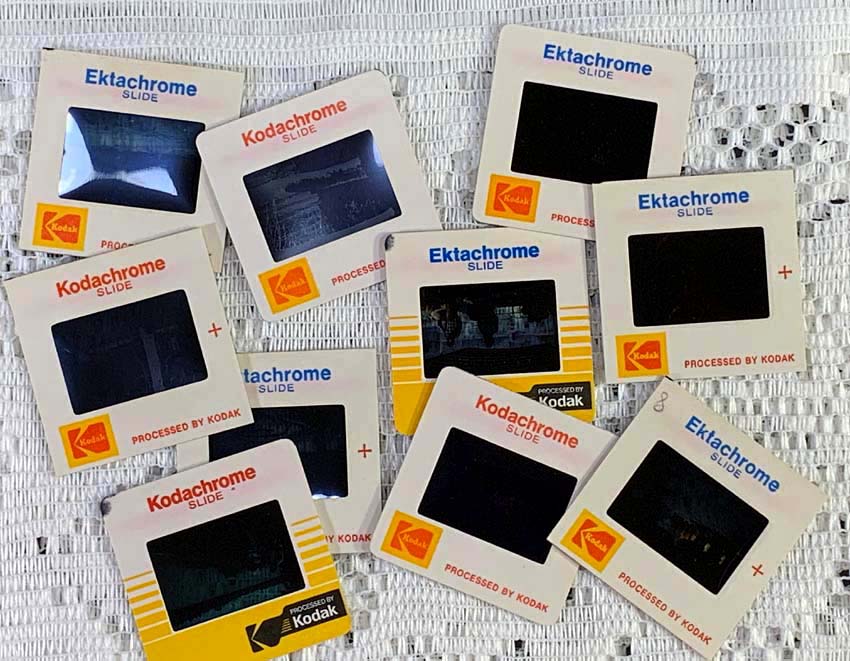
Well, fifty or sixty years ago, cameras were not at all like they are nowadays, and they required that the photographer did his or her fair share to make them actually take photographs. I was very keen on photography and I soon joined the ranks of those who took slides. Here are some random slides, in this case Kodak, which could be quite expensive. I preferred to use the much cheaper East German slides manufactured by Orwo. The frame of the slide is either cardboard or plastic, and and the slides themselves are merely a roll of photographic film which has been developed and then cut into 36 pictures:
Once I had two or three boxes of slides, I could then bore both friends and family rigid with interminable slide shows about “What we did on our holidays”. If you didn’t want to project your slides onto a screen, then you could buy a tiny “slide viewer” which allowed you to view your slides on what was more or less a four inch TV screen.
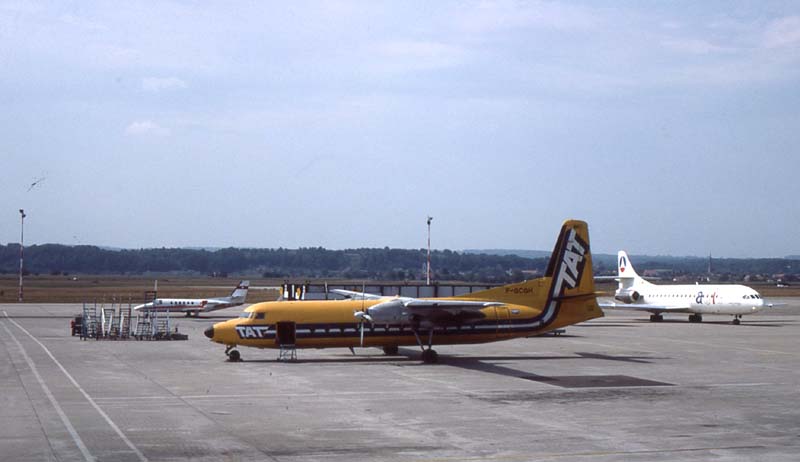
The first slide in this selection is a plane spotter’s dream, as I took a golden opportunity to photograph a foreign airport. I actually find passenger aircraft rather tedious, but I reckon that in this one slide there’s a Caravelle on the right, and perhaps a Fokker Friendship in the centre:
All of the cameras which I could afford were the kind where it was impossible to look through the lens to see what your eventual picture might be. Instead, there was just a view finder. Here’s a picture of a camera pretty much like mine, in the early 1970s. It’s a Voigtländer, a German camera, although I had originally bought mine more because it had a Leica lens:

To take photographs, you also had to use a light meter. Here’s one quite like mine, although I’m afraid I have only the vaguest idea of how I used to operate it. First of all, I think I used to set the overall controls on the meter for whether the camera was using a fast or a slow film. This means whether the film worked best in bright sunlight or in darker conditions, such as inside a church, for example. Then I used to insert the light reading I had taken into the various dials on the meter and then choose how I wanted to proceed. That would depend on the distance away from the camera of the subject and whether it was bright or dull weather, and whether the subject of the photograph was moving quickly or slowly.
The best results came when bright light made it possible to set the camera at 1/500th at “f22” with the lens of the camera focussed on infinity, marked as “∞”.
Here’s a link on how to use a light meter,
And here’s a light meter:

There were one or two further difficulties with slides, though. They always seemed to pick up lots of dust and grime, all of which would be magnified when it was projected onto the screen.
Last June I was overjoyed to find that long lost medium sized green cardboard box. I recognised it immediately. It was the very box where I used to store all those yellow and blue plastic boxes full of slides. And there they were. Hundreds, if not thousands, of slides, none of which I had seen for the best part of forty or fifty years.
And then I remembered about our latest scanner. It had a setting for turning slides into digital images. I didn’t know anything whatsoever about how that worked but I gave it a go, and, sure enough, it reproduced all of the dust and grime absolutely perfectly, with the occasional added bonus of changing the overall colours of a slide into something quite bizarre such as purple or dark green. There was a setting on the scanner which suggested that I might wish to “Rectify the bizarre colours of your age old slides” and I chose this, but fairly frequently it just brought in a different weird colour. Here’s an example, taken in Switzerland :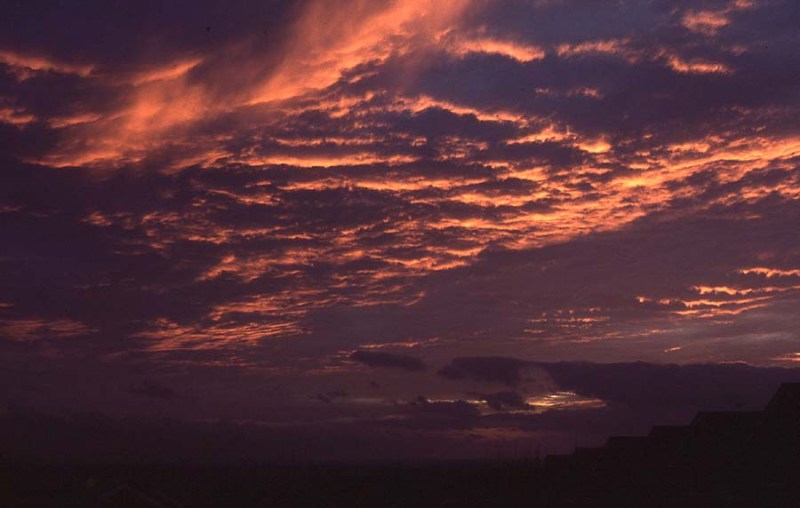
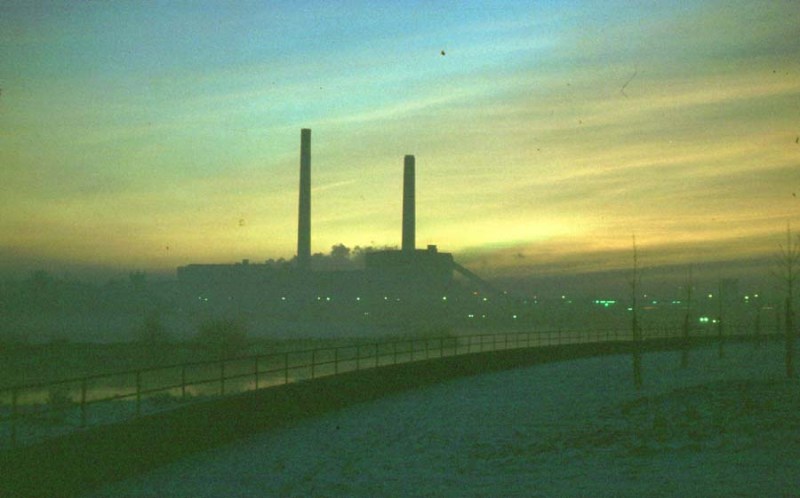
And here’s another. This is the River Trent at Nottingham, with the old Wilford Power Station still standing proudly in the gloaming. Nowadays, it is long demolished, replaced by the Retail Park:
Rather naively, I had expected that all of the particles of grime, dust, grease and common household insects would be taken care of by the magic of the scanner’s technology, but, alas, I was wrong. So, enjoy the “Flying Harp of Old Oireland” :

Were you able to spot it? Here’s an enlargement…..
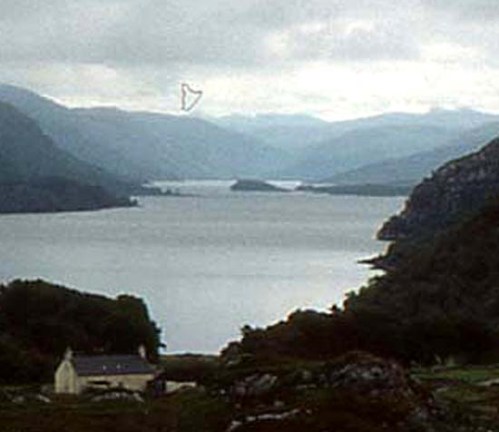
The “Artist formerly known as “Prince” possessed his very own breeding pair of Scottish Flying Snakes. Here they are, pictured at the height of their mating dance among the Purple Mountains and the Purple Haze in the very north of Scotland :
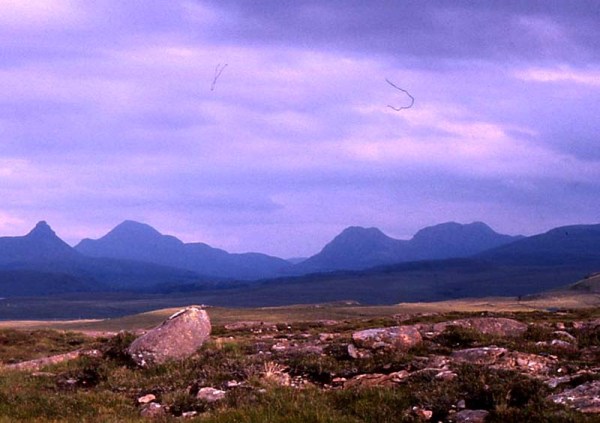
Here are just a few of the Exploding Gas Bombs used by the Scottish Liberation Army:

My next slide I call “UFOs over the mountains”. It’s the largest gathering of extra-terrestrial craft ever photographed. Or, it’s a tornado hitting the Glencoe Municipal Landfill site:

And thank goodness, after a good deal of practice, I have become quite adept at cleaning up the extraneous details. to produce a reasonably decent final version :

And finally, here is the slide I was offered well over $50, 000, 000 for………
“The Loch Ness Pterodactyl”

Did you manage to find it? Here’s an enlargement…..

It took me ages and ages and ages to rectify the dirt and grease on so many of my slides. A lot of the colour problems I was unable to solve. And I still have around twenty boxes of slides still to do.
What I intend to do now is to use some of my old slides in my blog posts. I’ve taken them in a number of different places including the Netherlands, Scotland, Switzerland and West Germany as well as Nottingham and the village where I grew up, namely Woodville in South Derbyshire. You have been warned!!


 John Knifton
I enjoyed reminiscing over my early days of photography through your historic post, John. I had an add-on rangefinder at one point. You probably know that I have published many slides and negatives going back to 1950s. I look forward to more of yours.
Yes, Derrick, I do remember your slides of the past, especially London in the 1970s. I don’t think many of my slides will come up to your standards. Switzerland in summer with brilliant light reflected off the snow was easy enough to do, but I must admit that I struggled with Scotland in late March at 3.00pm, with extra 3,000 foot mountains all around.
We had thousands of slides – none of which made the trip down here to Florida – a fact I am very sorry about.
You would have thought like I did, though. In 1990, it was virtually impossible to buy a slide projector. There were no machines where you could put in five slides and get digital images back within 30 seconds. There was no Photoshop to correct any errors in the process.
By 2020 though, the whole thing was so much easier, and I was very lucky. If I had refound the slides in 1990, like you, I might well have thrown them all away!
You brought to mind the many fascinating slide shows I watched in my youth. Ignoring the dust particles, I find the copies pretty good for their age. Look forward to seeing more 🙂
I’m glad you liked the slides I included. What with those and the hundreds of pictures of my friend Widdle, I feel I’m doing myself out of a job!
By the way, John, did you see the Netflix 2018 movie “Kodachrome” with Ed Harris in the leading role?
No, I didn’t, sorry. We don’t have Netflix because we decided that we already spend more than enough on Sky and also the Channel that carries European football (soccer). Satellite TV is very expensive in England compared to the USA, apparently.
My daughter bought me all of “Breaking Bad” which I really enjoyed, especially in my capacity as an ex-teacher.
We also don’t subscribe to all the options available.
What a great discovery. Hope you do show more of these.
That is definitely the plan. I don’t think that there’s anything as interesting as pictures of places forty, fifty years ago. So, as I wrote above to Rosaliene Bacchus, in the future it will be old slides, a fox from the past and perhaps some selected bits of history. What is there not to like?
Gosh the memories come flooding back. In those days you were a little more careful how many photos you took, not just taking a dozen ‘just in case’. Just in case of what I don’t know, but it seems to be a thing with modern cameras. I could never get to grips with light meters. My dad taught me a trick, he said take your reading through the lens in 2/3 ground and and 1/3 sky, then set your camera to that. When taking a photo of an aircraft flying for example, it would expose it pretty much right. Oddly, and even with all the finicky gizmos we have today, I still use it and it generally works.
You are right about taking slides. I went to Scotland for a fortnight on several occasions ans came back with perhaps two or three boxes of slides. With a digital camera, it would have been closer to two or three thousand photographs!
Your Dad;s trick seems an excellenrt one. I always found that taking slides was pretty much a hit or miss affair, and far more dependent on the weather on the day than it should have been!
Such a treasure 🙂 Thank you for sharing. I remembered my father, he too had loved photography 🙂 His love has come to me too.
Yes, I think you are right. I saw tat batered box as a pirate treasure chest, full of treasures from forty or fifty years ago.
I used to love slide photography, although I do think that digital cameras are superior, not least because they guarantee a photograph to even the least gifted of photographers.
Discovering old family slides and photographs can bring back so many wonderful memories; what is challenging, of course, is realising that so many memories are already gone, forever. I wish I might have recorded the names of the people in this images; I wish I knew who they were, and how they knew my parents.
You are absolutely right. Sanjay. We lose so very many of our memories, or alternatively, we forget so much without ever remembering it in the first place. One other thing that intrigues me is something that occurred to Homer Simpson in the cartoon series….” Was I really there? Or did some television programme tell me I was?” That last thought is kind of scary in a way!
Thank you browsing memories and for sharing the great photos!.. thinking about old cameras brought to mind the old Polaroid instant camera my folks had….looking forward to more photos, fingers crossed you have a photo of Nessie.. 🙂 🙂
Hope all is well in your part of the world and until we meet again..
May your troubles be less
Your blessings be more
And nothing but happiness
Come through your door
(Irish Saying)
My goodness! I’d forgotten the Polaroid camera completely. It was much used in England for taking pictures of drunken people at teenage parties. Those were the days!
I haven’t got a picture of Nessie, I’m afraid, although I have written a blog post called “A strange photograph (3)” which shows how I may have inadvertently captured a UFO. I only noticed it when I enlarged the photograph back home, to try and identify the birds of prey in it. I soon realised that at least one of them was not a bird of prey!
The happy days of knowing the roll of 12, maybe 24 exposures, had to last the whole of your holiday.
Absolutely. I am still amused at how few pictures I took back then, even during two weeks in the wildernesses of Scotland, for example.