
I haven’t written very often about World War 1, but this particular subject, the Battle of the Somme, really attracted me……..
I have chosen the time to publish this blog post with great care.
On July 1st 1916 tens of thousands of British soldiers stood in the trench opposite the German lines.
When the officers blew their whistles, they “went over the top”, climbing up short ladders into no-man’s land, and walking sedately off, into battle.
Some 19,240 men of the British forces would be killed.
Some 38,230 of them would be wounded.
It was the worst day in the history of the British Army.
So……..what brought about this catastrophe? Well ……..
By the end of December 1915, the Germans and the Western Allies had fought each other to a stalemate, a complete standstill. The latter therefore, resolved to organise massive co-ordinated attacks in 1916 in an effort to change the face of the war. The Russians and Italians, for example, would attack their respective German opponents and the British would carry out their “Big Push” into Belgium.
Things had to be completely changed in February 1916, though, when the Germans attacked the French at Verdun. The French were soon losing men in large numbers and they asked the British to attack not Belgium, but instead, to attack the Germans at the point where their two respective armies, French and British, were next to each other. This was the valley of the River Somme.
During the months of fighting on the Somme, the Allies would lose 623,907 men, including 146,431 killed or missing.
The Germans would lose 465,181 men including 164,055 killed or missing.
Allied casualties were huge……

And so were the German casualties……….
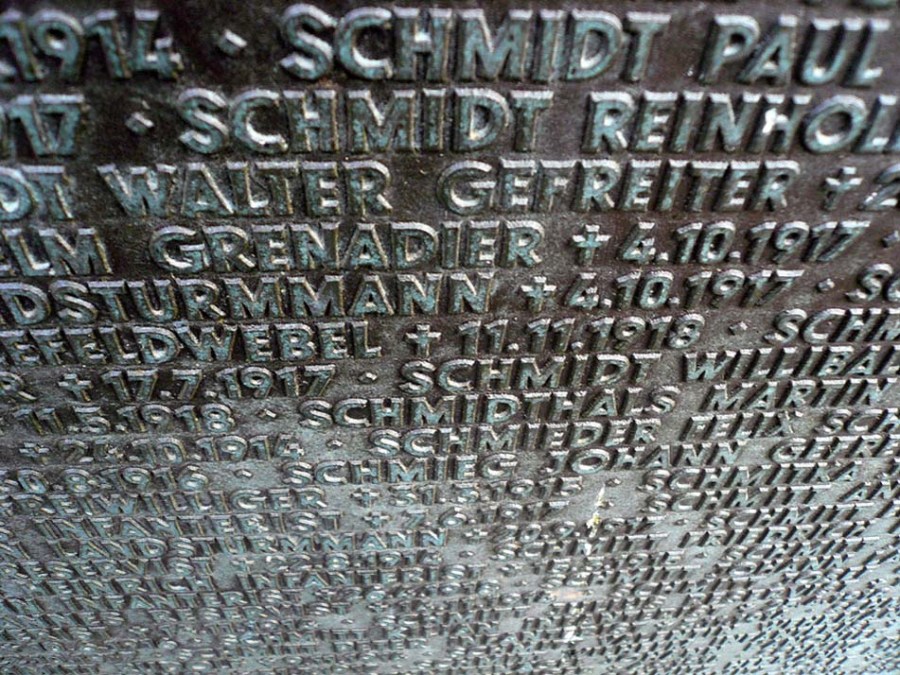
For the Allies, it was the British who fought the first day of the Battle of the Somme on July 1st 1916. These were the highest losses in any one day in the history of the British Army. The Germans, therefore, safe behind their defences, killed 19,240 men of the British forces and wounded 38,230 of their men. In just one day.
For the last century, analysts have argued why such a disaster occurred. I recently watched a three part series about the first seven months of the Somme Campaign. The programmes were based on the researches of an English historian. Peter Barton, who has spent many years as a “battlefield guide” in the Somme area……..

He carried out many of his initial researches largely because of the huge numbers of casualties involved. He felt the first place to look would be the German language archives and he was amazed to discover that he was the first person ever to do so, and that not a single English historian had consulted them in a whole century.
Peter Barton’s overall conclusion was that the British had suffered so many casualties because of “recklessness, foolhardiness and treachery”. All three will be explained in due course.
The cunning British plan for the forthcoming Battle of the Somme was simple……
Firstly, bombard the Germans with your artillery until they don’t know their own names.
That same artillery will destroy the barbed wire defences the Germans have in front of their lines.
Assemble huge numbers of Allied troops in their forward trenches, ready to go.
The officers blow their whistles.
The soldiers emerge into no-man’s-land and make their way towards the German trenches.
Walk, don’t run !!!!!
Take possession of the enemy trenches.
In due course, more Allied troops will arrive and any remaining Germans will surrender.
Then, all of the Allied armies will make their way deep into German held territory……… infantry, artillery, cavalry, everybody.
Repeat until you reach Berlin.
The whole thing could well be a perfect example of the strongly held British belief that “the artillery conquers, the infantry occupies”.
Peter Barton, though, found a completely different story in the German archives……
On June 30th 1916, the Germans were outnumbered by at least four to one and were completely out-gunned. Despite that, the following day, the British suffered 57,470 casualties with 19,240 killed.
Such a catastrophe is rather difficult to explain, but Peter Barton found the German Archives had plenty of suggestions.
Firstly, the Germans had been shelled for an entire week. The guns could be heard in London if the wind was right. The result, though, was quite simply unsatisfactory.
The enemy’s defences and guns had not been destroyed because a huge proportion of the shells had failed to go off. The barbed wire in front of the German trenches remained therefore largely intact.
The British troops, meanwhile, had been told to walk over to the German lines and quietly take possession of them. It would be easy, they were told, because by now the Germans would all have been killed by the bombardment.
When the attacking troops arrived at the German trenches, though, they were slaughtered……
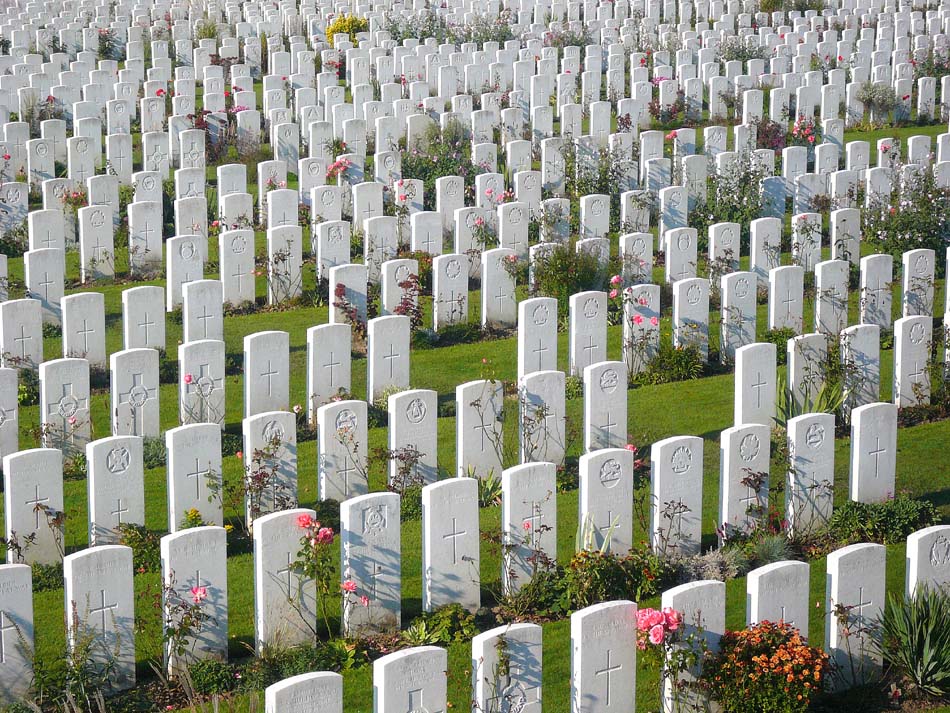
The Germans were inordinately well informed about the British attack. For months they had been using a machine called “Moritz” which intercepted British radio broadcasts and created a huge mass of intelligence. By July 1st, the Germans knew absolutely everything there was to know, except the exact time of the attack. This they found out at 7.10 am, just twenty minutes before the whistles were blown, and the men went “over the top”.
The German Archives also proved that the British prisoners of war they had captured before the beginning of the battle had revealed every single detail of the British plans. By the time the battle began, hundreds of them had divulged everything there was to know about the British attack, including the British Order of Battle and the identity and location of every unit in the British forces. Much of it came from one particularly talkative British deserter.
19,240 men killed and 38,230 wounded

Next time, more details about all the advantages handed on a plate to the Germans, before those fatal whistles blew, at 7.30 am on July 1st 1916.


 John Knifton
“Peter Barton, though, found a completely different story in the German archives……” It is a pity that so much history has been written, accepted, studied, and regurgitated from a one-sided view. Thanks for this post, John.
Absolutely right, Allen. How on earth can you call yourself a World War I historian, if you never look at the enemy’s archives? It’s ridiculous, and a sad indictment of how many academics cannot understand a foreign language.
Three more posts to come, and this pattern will be repeated over and over again.
Such an important memorial post, John. Have you spotted 1917 in the third sentence?
Thank you very much for the news about the typo, Derrick. I suppose it’s because I’m always in a hurry!
I have wanted to do a post about the first day of the Somme for a long while now. When I was a boy, I knew an old man who had two false legs, after being crippled for life on July 1st 1916. He was so pleased though, that he was found by the Germans whose medical care was superb compared the British hospitals. That remark alone was enough to intrigue me for the next fifty years!
These numbers are just monopoly figures, incomprehensible in terms of what it means. Totally shocking it was a complete disaster as was so much of the First World War. Those poor men.
I am 100% in agreement with you. What is worst of all, as you will see in future posts, is the total incompetence of the officer class and the army top brass. It really was lions led by donkeys.
The German archives will show the extent of their incompetence, with the Germans themselves saying that the British would have won the day and the battle, but for one thing. That one thing was a specific order, given over and over and over again to the men “Walk, don’t run”.
I cannot for the life of me see why such an order would be given. Even with the considered ‘ease’ of the takeover, you wouldn’t walk into an enemies front line. It beggars belief doesn’t it.
I visited the Somme in 1988. The German defenses were very deep, up to 40 feet below ground. They were well prepared. Now I understand why. Ludendorff summed in up in his famously caustic phrase. On a personal note, my paternal grandfather fought there but his period of engagement came to an end in late May 1916. He was offered a commission. He had the good sense to decline the offer. Had he not, I doubt I would be here now.
You may not be wrong there, Chris. A Second Lieutenant in WW1 had the same life expectancy as a sailor in a WW2 U-boat or a mamber of a Bomber Command crew in WW2 in 1942-1943.
On a local note, do you remember the old chap who always used to sit on that seat at the Tollgate?
I always used to talk to him, and we were good pals, but now I’d settle for just knowing his name!
(see my reply to derrickjknight for the full story)
I do remember him but never knew who he was. Incidentally, that seat was dedicated to Arthur Wood, my mother’s uncle, who had been a despatch rider for T E Lawrence.
Presumably the same TE Lawrence who used to ride Brough motor cycles, made some 200 yards or so from where I now sit, typing away.
What slaughter! How dispensable are our lives in times of war. We humans have changed so little since that day on July 1, 1916.
Amen to that! Selfishness and violence seem to be the strongest emotions in humans unless we are dealing with either family or immediate friends. And even then we’re not 100% solid when it comes to choosing to act charitably rather than badly.
Where do you start? In 1914 the British Army was tiny compared to the German and French, and was pretty much destroyed in the war’s opening months. By 1915, with the creation of Kitchener’s all-volunteer army it was still undersized and inexperienced. The introduction of conscription allowed the Army to grow but still lacked experience at all levels. The Generals had to find ways of integrating huge numbers of men into a fighting machine and cope with advances in military technology. Lessons had to be learned the hard way. By 1918 the British Army had gone from being a heavily armed colonial police force into a million-man organisation that incorporated tanks, aircraft, long range artillery and radio communications into a war-winning combination. Hardly lions led by donkeys – a phrase Alan Clarke admitted to coining to support his myth peddling.
You are obviously entitled to your point of view, but I shall never share it. Peter Barton’s researches, for me, merely confirm what the veterans of WW1 told me as a boy.
Suffice it to say that Haig presided over the loss of two million men during his time in charge. Had his wife not been a maid of honour to Queen Alexandra, the wife of George V, he would never have got the job in the first place.
Thank you for this post. I am glad you are writing it. At the same time I think of the tragedy of war that is still happening.
Yes, the Russians are still smashing the Ukraine into lots of tiny pieces, and in South and Central America and Africa, almost countless wars still drag on.
I just feel that it needs to be said, if necessary over and over again, that war is always the worst option when disputes need to be settled.
Yes, why don’t those people in power understand it? Must be their egos at work.