
The colour and texture of a fox’s coat may vary due to the change in seasons. It will be richer and denser in the colder months and lighter in the warmer months. To get rid of the dense winter coat, foxes moult once a year around April. The moult begins from the feet, up the legs, and then along the back, finishing with the neck and head.
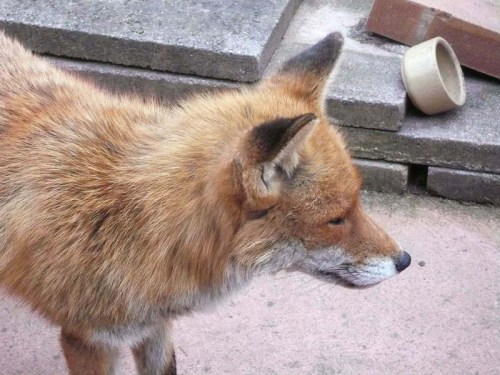
Widdle was a fox who came to us, apparently around two years old, one day in 2007. He was looking for affection and for help. He came to us from a desire to understand nice human beings, and most of all, for unlimited access to good quality sausages:

Over the three to four years that we knew Widdle, his appearance changed a great deal. He was certainly not always what our American friends call a “red fox”, because in the spring and summer months, he was the hapless victim of his single annual moult.

According to Wikipedia, quoted above, a fox’s moult “begins from the feet, up the legs, and then along the back”. Sometimes in June, in the middle of the moult, Widdle looked rather like he’d been down to the pub the night before, and had a few too many:

In May, he had tried stretching exercises, but that didn’t last long:
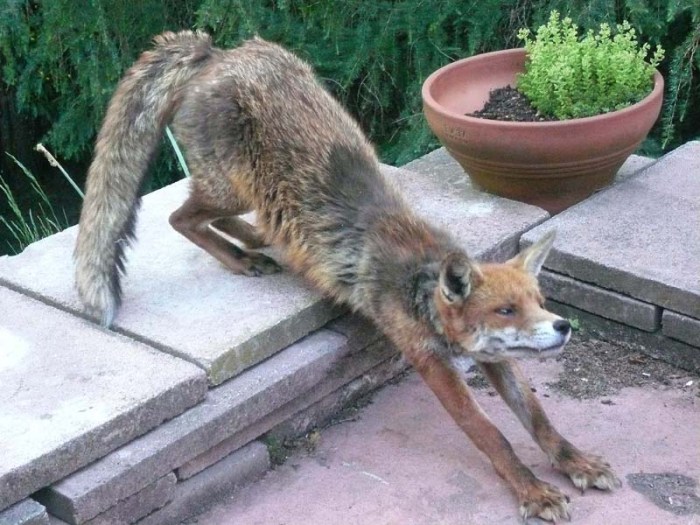
No, the only remedy is a couple of sausages. Or so we thought. It was actually more complicated than that.
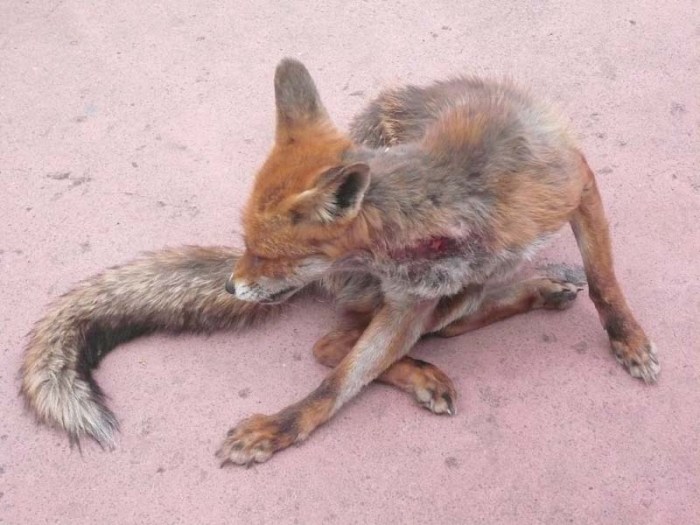
Widdle’s main problem with his coat was fleas, particularly during the moult. Here he is, scratching away. As far as we were aware, it was impossible for humans to be infected by fox fleas, and in up to four years with him, we never thought we had. I did once inquire about trying to give him something against fleas, but we were told it was pointless. Something for a dog and its fleas probably wouldn’t work. It might give him an allergic reaction and kill him. And, as soon as he went back to Mrs Widdle, he would be re-infected:

Male foxes fight quite a lot and here he is with part of his coat ripped off, I remember saying to him “That look’s a very painful wound.”, and he said “Well, you should have seen the other fella’.”
By winter, though, Widdle has acquired that magnificent coat that we all know and love. In this photograph, he shows that certainly as far as he is concerned, the neck is the last section to change.
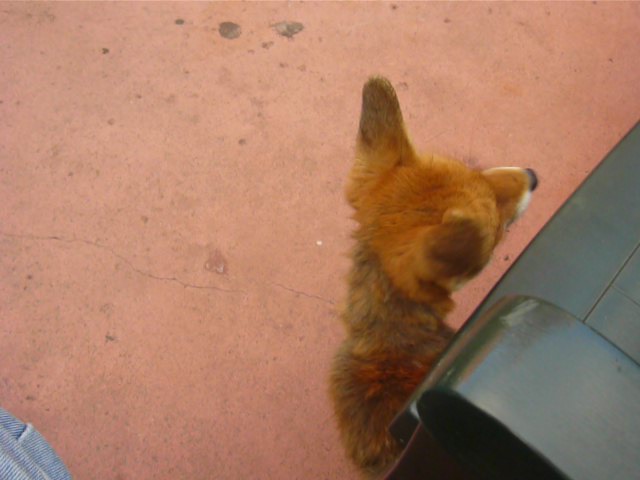
Anyway, by early September, the transformation is complete. All that is missing is the white tip to his tail, which, as far as I recall, Widdle never had. Well, not in full anyway:

And certainly, by November, it is as if he had been spray painted “fox-red”. He has lost all the black bits on his legs and the black and white stripes on the upper sides of his paws. He is Red Red Red:
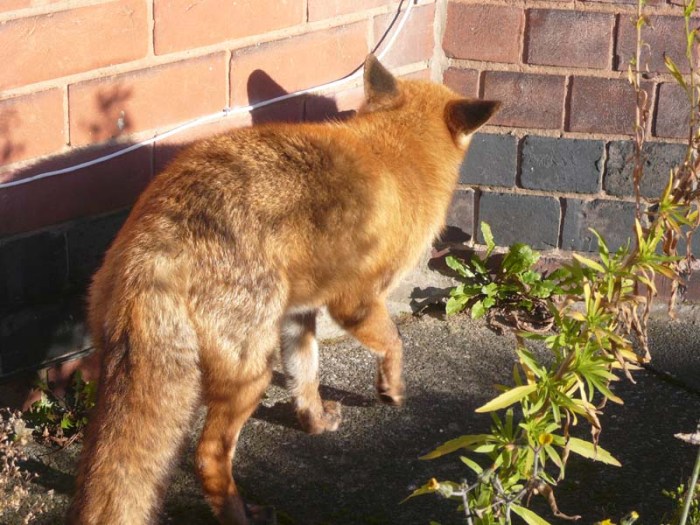
The last picture comes from April 2010 when the very first signs of the Great Itching Time are beginning to appear. Even so, the coat still looks exceptionally thick and is standing on end to trap the warm air:


 John Knifton
Every time you write about Widdle, all I can think is how lucky you have been to have had such a friend.
Indeed, I was very lucky to have been able to share Widdle’s life and it taught me more than anything I have ever done, before or since.
On the other hand, Widdle was himself very lucky that when he was down on his luck and starving hungry, he picked me to ask for help. Before long, I had become an expert in value for money in the world of sausages, and was feeding him two or three times a day.
Another wonderful, well photographed, and informative Widdle story, John. He was also lucky to have found you
I have always thought that having Widdle appeal to us for help, was a little bit like those 1950s war films where the crew of the shot-down Lancaster are wandering the freezing countryside, desperate for food, but finally have to knock on the door of a random house and ask for help.
And what would you know? They knock on the door and they are greeted by the President of the local Anglo-Dutch Friendship Society!
He is just beautiful and what a joy to have him in your garden sharing your endless supply of sausages. Have you ever seen the cubs he and Mrs Widdle produced?
Yes, we saw the majority of the fifteen or so cubs that the Widdles produced. Like all fox fathers, Widdle tried very hard to educate his children, and he trained them all in hunting techniques.
Mind you, that was not too difficult, when all they had to do was “Stand there around 7.00pm, and when a big bloke with grey hair comes along with a plate full of sausages, look cute!”
And it worked beautifully!
I’m always jealous when I read about Widdle. How nice you must be for a feral animal to trust you like that.
I don’t see myself as being particularly nice, but I always try to treat people courteously unless there is reason to change that. Certainly, Widdle always seemed to trust me, and my wife reckoned that it was because he could sense that there was neither malice nor fear inside me.
He wasn’t a feral animal, though. He was 100% wild although I did always reckon that he had perhaps been looked after by an animal hospital at some point in his life.
Feral animals are ones which were originally pets, or farm animals but have now gone wild. I saw a documentary in which they looked at the packs of feral dogs who lived in Detroit because people were too poor to feed them. They were up to 40-50 strong and, I would have thought, extremely damgerous.
Widdle was never dangerous, except if you were a sausage, of course.
I would imagine any animal would become dangerous when hungry enough.
Yes, they would, I suppose. The most difficult thing is trying to guess just how hungry your pet tiger is!
haha, good one, John!
Fascinating post, John! Widdle is definitely not a pleasant sight during his moulting period. What an amazing transformation!
It certainly is, and yet another item on the list of things which may well indicate a celestial watchmaker.
I love hearing about Widdle. What a great friend to have.
It was a privilege to have known him. I always felt that he was so much closer to God than any human being could be.
I am certain that you are a Leicester City fan.
No, afraid not! Years ago it was Derby, but now I have chosen Manchester City because they may well win things. With Derby, I got fed up with them snatching disaster from the jaws of victory.
Manchester City. I am shocked!
Oh John, I am so delighted to read this. Native animals should be cherished. Out of their natuaral world they become a nuisance, It is so good to get your POV.
I try not to be over sentimental. A fox living in Australia and eating koalas is clearly not right and if they caught a kangaroo shoplifting in our local supermarket, I’d like to see him sent home immediately.
That wound does look painful. Thank you for all the photos. My father-in-law used to say that when dogs have some discomfort, they chew lemon grass if they can find it. I have seen this happen. It is believed to give comfort.
That is very interesting, Lakshmi, thank you. I’m afraid I don’t know if lemon grass is something we get here in England or not!
Thank you for sharing your memories of your friend Widdle!! .. after reading your thoughts about your adventures with Widdle, I thought about a poem by Gene Hill;
JUST MY DOG
He is my other eyes that can see above the clouds;
My other ears that hear above the winds.
He is the part of me that can reach out into the sea.
He has told me a thousand times over that I am his reason for being:
By the way he rests against my leg
By the way he thumps his tail at my smallest smile
By the way he shows his hurt when I leave without taking him.
(I think it makes him sick with worry when he
is not along to care for me.)
When I am wrong, he is delighted to forgive.
When I am angry, he clowns to make me smile.
When I am happy, he is joy unbounded.
When I am a fool, he ignores it.
When I succeed, he brags.
Without him, I am only another person. ,With him, I am all-powerful.
He is loyalty itself., He has taught me the meaning of devotion.
With him, I know a secret comfort and a private peace.
He has brought me understanding where before I was ignorant.
His head on my knee can heal my human hurts.
His presence by my side is protection against, my fears of dark and unknown things.
He has promised to wait for me…, whenever…wherever–in case I need him.
And I expect I will–as I always have.
He is just my dog.
(Author Gene Hill…)
Hope all is well in your part of the universe and until we meet again….
May your troubles be less
Your blessings be more
And nothing but happiness
Come through your door
(Irish Saying)
What an absolutely beautiful poem. The sentiments could well be extended to Widdle the Fox.