
This post continues the story of the disastrous First Day of the Battle of the Somme, using the details discovered by the English historian. Peter Barton, in his careful studies of the German Archives. We now know, for example, that every single German knew about the ten minute delay between the end of the British artillery barrage and the beginning of their infantry attack…….

This allowed them to emerge from their concrete bunkers to prepare their machine guns and their artillery for action. And when the fighting started, thousands of young British soldiers would die unnecessarily……
Peter Barton also discovered that the Germans possessed copies of the British textbook used to teach every aspect of British military tactics to would-be officers on special six-week courses. This wonderful find meant that Germans now had a minimum of a ten-week period to get to know, and how to combat, every single tactic likely to be used in the forthcoming Battle of the Somme, before the battle even began. Unbelievable! But very useful if you were a German.
As well as the book of British tactics, historian Peter Barton also found out from the German Archives that the Germans had in their possession all of the British plans overall and the detailed timetable of their individual attacks.
Part of those plans was to detonate the nineteen mines placed underneath many of the German front trenches. The British timetables the Germans possessed revealed that the mines were due to go off exactly twenty minutes before the main attack. This provided the Germans with a splendid reserve alarm clock, telling them how long they had to prepare their defences.

The Germans also knew all the details of the British artillery and the calibre of all the shells that they were firing.
The British soldiers who crossed no-man’s-land were the “New Model Army”. Recruited by Kitchener, they were very inexperienced and not particularly professional. Hardly any of the men had ever seen a German, and many of them were operating in “Pals” battalions. These were men from the same occupations or the same town and they had all joined up together, trained together, attacked together and, given their inadequacies, they might well all die together. You can probably imagine the effect of hundreds of local casualties on a small Lancashire or Yorkshire town.
Most of those casualties were the direct result of the tactics the British soldiers had been given by their officers….
“There is no need to charge. The Germans will have all been killed by the barrage.”
“Do not stop and try to shoot the Germans.
They will all have been destroyed by the British artillery.
Just walk over and take possession of the enemy’s trenches.”
The German Archives gave Barton further details about how they had managed to engineer such a slaughter of the young British lads.
Firstly, the German positions were physically higher up than the British. This allowed them to look out over the British front trenches and to see the Pals battalions much further back, preparing for their attack. And the German artillery could then prepare, at their leisure, when and where to fire as the Pals set off across no-man’s-land.
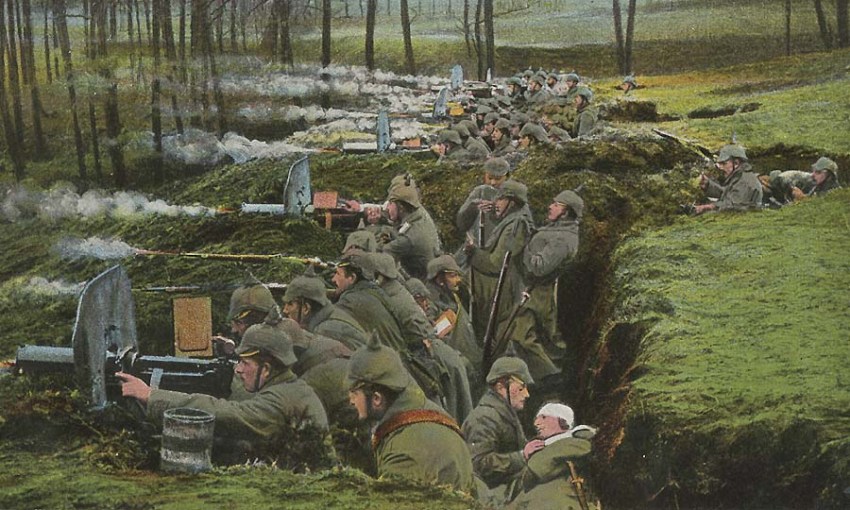
In similar fashion, the Germans were careful to set up their machine guns so that they could kill huge numbers of the British. The latter were slaughtered as they walked (as ordered) across no-man’s land.
Indeed, in many places, the location of the German machine guns, which were higher up than the British front trenches, allowed the Germans to fire over the heads of the troops in the British front line as they waited to attack. In this way, many of the British reserves and support troops much further back were killed before they had even reached their own front line, the departure point for the attack.
These more detailed researches go a long way to explaining why the first day of the Battle of the Somme was the worst day ever in the long history of the British Army.
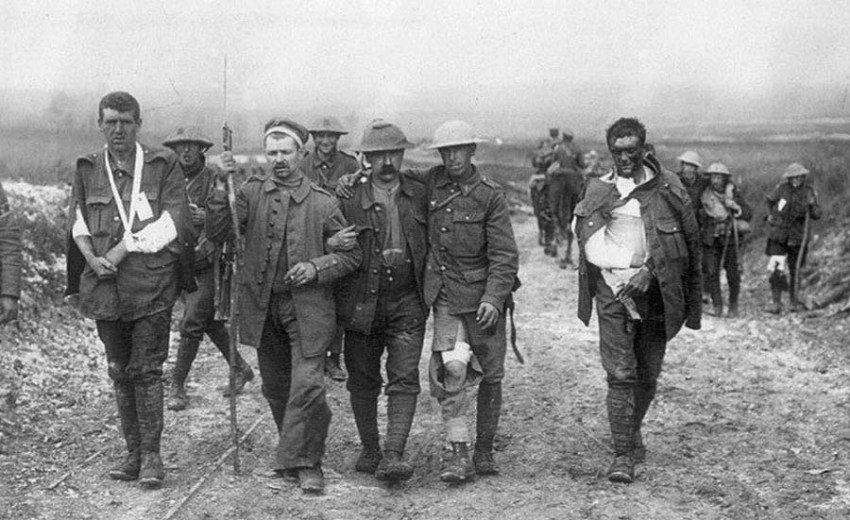
The German archives revealed clearly, for example, that the week-long bombardment had been a complete waste of time and money. British prisoners of war revealed to their German captors that most of the German barbed wire was still intact when they finally arrived in front of the German trenches. The Germans already knew that as few as 40% of most British shells actually went off.
The British top brass had expected around 10,000 casualties among the attackers. There were 57,470. One could even argue that the Germans would have had to have made catastrophic errors not to have achieved the best part of 60,000 British casualties in only 17 hours of battle.
Most ironic of all was the statement that Barton found in the German Archives which stated that the Germans were 100% sure that the British, had they attacked by charging them, would have overwhelmed the German defenders easily because of their numbers. As it was, the ridiculous tactic of walking across no-man’s-land as if they were taking the dog for a walk, ensured that the Germans were able to kill most of the young British attackers.


 John Knifton
My uncle,from Donisthorpe,died on July 1 1916 in the battle of the Somme.He was a former pit-pony boy who worked at a local colliery.
I visited the Thiepval monument a few years ago,very moving.The top Generals had a lot of explaining to do,which they never did.
As an aside were you related to Miss Knifton(actually a Mrs.) who lived on Hartshorne Lane,Woodville?She taught at,I think,Woodville Church of England School,Moira Road,either there or Woodville Infants School.This would be in the early 1950s.
“The top Generals had a lot of explaining to do, which they never did.”
And that is the reason that so many royal families disappeared for ever in the early 1920s. In Germany and in Russia and in Austria-Hungary, they were all kicked out and disappeared for ever. Our own royal family just hung on, but British troops mutinied in north Wales, and in Dover, where they refused to go and fight against the Russin Communists in St Petersburg.
It would take the Second World War though, to complete the process, as the Labour Party won the General Election by a landslide, and set up the National Health Service.
The Mrs Knifton you mention incidentally was my mother, who came originally from Wigan. She died in the year 2000 in the care home at Bretby, mainly as a result of food particles infecting her lungs.By then she had had Alzheimer’s for a number of years.
So sorry to hear of your mother’s passing,please accept my condolences.
I can’t remember your mother’s maiden name but I think,before she was married,she also taught at Woodville Church of England Junior School.I believe your father also taught there.I was a pupil there from about 1951 to 1956.I remember Mrs.Simpkin(nature visits to her house just past the bridge),Miss Cartwright the Misses.Shuttleworth,Mr.Faulkner(who lived in the house just past the Church Room)and of course the headmaster Mr.Carter(who was a film buff).Memories,what memories!!
REPLY
Thank you for your kind thoughts. My mother was Miss Hilton, but I think that she was always Mrs Knifton while she was working in Woodville. I also went to Woodville School on Moira Road where I was taught by Miss Cartwright, my Dad, Fred Knifton, Mrs Burman who was the ex-Miss Shuttleworth who married late in life, and Mrs Vera Simkin. Other teachers were Mr Faulkner, I think Miss Wilkinson for the littlest kids in the school, and a lady whose name I forget,. She was quite plump and taught a lot of Art lessons. The Head was Mr Unwin.
At the Infants there was Mrs Gibbs, Mrs Room, Mrs Butler and Miss Smith with Miss Gilbert as Headmistress and Mrs Grindrod takling over when she retired.
More valuable insight, John. If you scroll down to the paragraph beginning “My main time for listening to music” in his post https://derrickjknight.com/2012/05/29/the-bees/ you will see my take on the other real casualties.
You are so right, Derrick. In my own family, Leonard Bott was killed in early 1917. His childless young wife, Christina, was griefstricken for the next seventy or eighty years, never remarrying, never having the children she would have loved, but satisfying herself by providing the overworked women in her street with a free childminding service. And for what?
Quite, John. Thanks very much
Those statistics are horrifying. Fifty-seven thousand casualties in 17 hours works out at almost one per second – what the Americans grimly call a ‘turkey shoot’. To calmly expect 10,000 casualties suggests a certain indifference by the British high command to the lives of its men. Why did they not call off the attack? Did they not see it was going horribly wrong?
I don’t think that they knew what to do, Chris. My Grandad, Will, had already explained that to his son. Such casualties were inevitable and happened in every battle….
“On one occasion in the 1930s, Fred went with his father, Will, to watch a football match at the Baseball Ground. They stood on the terraces, waiting for the game to begin, as the ground slowly filled up, with spectators filing in through the turnstiles. About ten minutes or so before the game began, Will turned to his son and said, “Fred, just take a look around you at all these people.” Somewhat puzzled, Fred did as he was asked, craning his neck round to see all the men standing quietly in their collars and ties, waiting for the kick-off. “Well, Fred,” said Will, “in the war, this is just as many men as we lost in an attack one morning. And then we all stopped for breakfast.”
Men like Haig thought that the only answer was “pluck” and that it was a pity that the cavalry could never get at the Huns. My Grandad certainly thought that the Generals in their chateaux miles behind the lines did not care a jot about the fate of these working class men, and the Legless Man at the Tollgate agreed with that 100%.
He told me that the British officers cared a lot more for their horses, and that, if he was ever given the choice, he would prefer to be looked after by the British vets, whose standards were a lot higher than those of the doctors in the hospitals behind the lines.
That’s just horrible the way they attacked. Such a waste of life.
It absolutely was, and there was no need for it, given that such losses of life were 100% typical for attacks which took place in that way.
In 1917-1918, the Americans under Pershing experienced losses of the same kind of magnitude, because when the British, at long last capable of some degree of understanding, explained what happens when fifty men with a rifle each run towards ten men with a machine gun each, Pershing refused to take their advice. A number of record casualties in nAmerican military history date from this period.
The American Army had a bad habit of not listening to the British Army. This happened again in WWII.
A sad reminder that we the people are but numbers to decision-makers on the battle front. Did the historian Peter Barton ever find out how the Germans came to have such detailed knowledge of the British strategic attack plans?
Yes, he did, and you may well find out in Parts 3 and 4 what they all were. Among the main reasons were…….
Disgruntled deserters told the Germans everything harmful to the British that they knew
Officers were given instructional booklets to study, which had a big sign on the cover reading “NOT TO BE TAKEN BEYOND THE FRONT LINE” but they took absolutely no notice.
Sophisticated German interrogation methods such as being extremely sympathetic, plying them with hot tea and packets of biscuits and cakes and so on. As we all know, food is invariably the best method to gain control over adult men and most dogs.
Thanks for the info, John. I look forward to reading Parts 3 and 4.
I went to school in Ballarat and one of the ex-students was Brigadier Harold Edward “Pompey” Elliott. After serving in the Gallipoli disaster he was tasked with organising and training the newly formed 15th Brigade as part of the 5th Division, which arrived France just days before participating in the battle of Fromelles.
Elliott was of the opinion that the attack at Fromelles was doomed to fail. He felt that the artillery was inexperienced, that the space to be travelled across no man’s land was too wide, and that the German army’s elevated and well-defended area known as the Sugar Loaf gave the enemy a strong advantage. He argued unsuccessfully to cancel the attack, but at 6pm on 19 July 1916 his brigade launched its attack with the other units of the 5th Division. He was known as an inspirational leader whose outspoken manner and criticisms of his colleagues and their decision-making, and of the way that some men were selected for awards over others, led at times to clashes with his superiors.
And I don’t think that “Pompey” Elliott was the only one. The man who had most impact was the Canadian commander, Arthur Currie. Wikipedia says….
“He had the unique distinction of starting his military career on the very bottom rung as a pre-war militia gunner before rising through the ranks to become the first Canadian commander of the Canadian Corps. Currie’s success was based on his ability to rapidly adapt brigade tactics to the exigencies of trench warfare, using set piece operations and bite-and-hold tactics. He is generally considered to be among the most capable commanders of the Western Front, and one of the finest commanders in Canadian military history.”
Currie introduced a lot of really quite obvious innovations to the Canadian Army. Above all, he brought in the use of triangulation to allow specific pieces of German artillery to be pinpointed and destroyed. He also put an end to the “truce” between the Allied and German artilleries, whereby they never fired on each other as a kind of “gentleman’s agreement”. Currie also had his men rehearse future attacks.
He was unpopular among most of the top brass because he was Canadian (only a couple of steps up from being black, obviously). He was from a dreadfully poor background, and, above all, he was cleverer than all of his fellow officers.
I will read more about him John. Thanks for the link.
My Grandad was wounded at the Somme in July 1916 at Mametz Wood another monumental cockup. He was part of the Leeds Pals and told me that when he returned home to Armley (a suburb of Leeds of mainly terraced houses) there wasn’t a man left for dozens of streets just hundreds of widows. The really sad thing is that the same action was repeated again and again and each time they expected a different outcome.
I told my wife what my next blog post was about, and how things went on July 1st 1916, and she came up with the idea that the top brass perhaps just didn’t care about the fate of the working class men who did all of the attacking in such battles.
And I agreed with her.
After so many battles with the same ghastly outcome, you have to ask yourself the question “Did they actually care about their men or did the class system of the day ensure that men would die in their thousands day after day after day, and as long as they could be replaced, it did not matter at all.
My Grandad certainly told me that the generals in their chateaux miles behind the lines never visited the front trenches because of the smell of the rotting corpses.
Secondly, he said, never, ever, buy a poppy. They are just the blood soaked conscience of the top brass who organised the deaths of thousands of men every day.
In actual fact, the lettering on the middle of the first poppies, with its two words “HAIG FUND” had to be changed after a few years, because sales were so low.
John, my soul-felt prayer is that this world LEARNS from the past, especially wars and what exactly unfolded, so that these atrocities never happen again. War goes against all I believe. May this world understand that war brings nothing but pain and sorrow so deep that it goes on for generations.
I agree with you 100%, but there seems to be something in the make-up of men which drives them to want violence and a feeling of power in their lives.
We are currently seeing the Russian army plumb new depths of savagery with its attacks on hospitals and women and children. And what is worst, is that they seem always to want more and more violence, more and more deaths.
Honestly, when you look back at the whole picture you can see why it was such a disastrous slaughter of human life. Inadequate equipment, inadequate generals, ridiculous orders based on myth, and of course, superior planning, based on prior knowledge and information on the German side. It was doomed before it even started. The German infantry must have been laughing as the ‘Tommie’s’ walked across no man’s land and they mowed them all down. Poor souls.
“Poor souls” indeed. Still, it was because of all these battles which showed up the upper classes for the fools they were, that the working class men realised that they had little reason to be deferential and that the men at the top were no better than they were.
And gradually, rule by the upper class passed away, as one big house after another had to be sold, on many occasions because the owners could not find anybody willing to work for them. Instead they preferred to work in the factories in the big cities, where money was better and hours were shorter. And by 1924, there was even a Labour government in office……
What did the British government say about this? Countless Indians were made to fight in the wars of the British.
https://www.theguardian.com/books/2018/dec/14/indian-empire-at-war-george-morton-jack-india-empire-and-first-world-war-santanu-das-review
On the other side of the coin, during the Second World War, the Indians formed the largest volunteer army in history, with more than two million men ready to fight the Japanese, who were, of course, a far worse proposition than the British.
Even in the First World War, I think it is correct to say that all of the Indians involved would have signed up to fight, rather than being conscripted. I am not 100% certain of this, though.
Yes. War is terrible and I felt sick on reading this about Ukraine.
https://www.bbc.com/news/world-europe-66242446