
After the First World War, London began to expand as a city, particularly to the north and west. What had been farmland was now purchased and then built on. Many, but not all, of the woods were chopped down, the trees and branches were burnt, and new houses were then built on the site. The people who lived in those new houses for the most part worked in the centre of London and new words had to be invented to describe what they had to do in order to get to work. They took the train. Suburban, local trains, whose only purpose was to carry people who were now being called “commuters”, on their way to work. What they did was called “commuting”, and it obviously paid them to do it. Their salaries must have been high enough to justify adding a couple of hours to every one of their working days.
The very best paid commuters lived in what were called the “leafy suburbs”. They could even afford to buy a detached house near the golf course, with four or five bedrooms and a large private garden all the way round it:
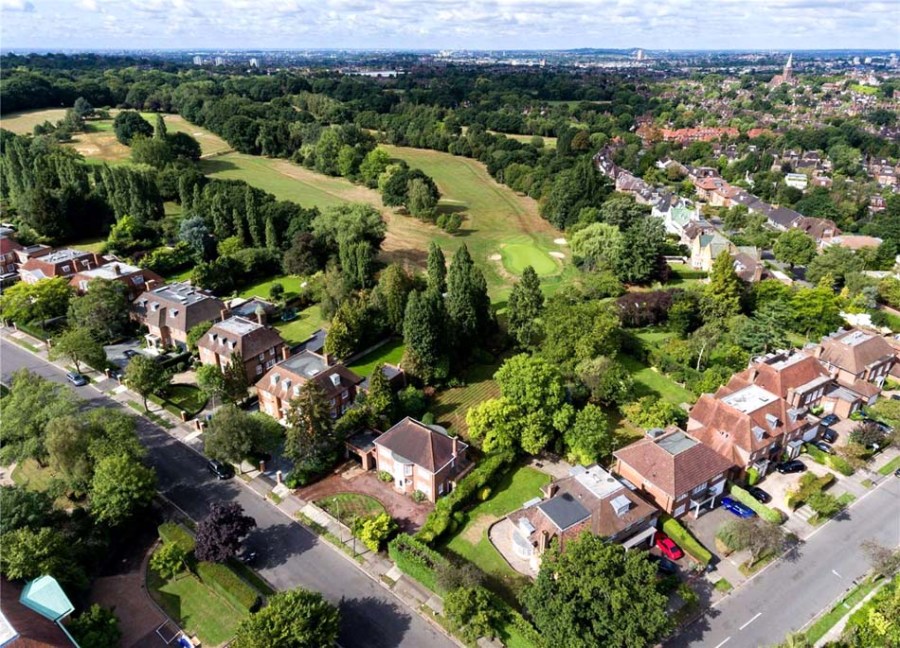
In some cases, the leaves of the new leafy suburbs were attached to trees which pre-dated the building of the new houses. Builders with a bit of vision had soon realised that they could save themselves a lot of cash, and finish up with a much better product if they kept as many of the mature trees as possible. All they had to do was to build the houses between them and to do the same with the streets, if they could. Look at the age of these trees:

That slight change in approach by the builders had quite an effect on the suburbs created at the ends of the hundreds of the suburban railway lines which linked the centre of London with the houses where their office workers lived. And, to their credit, instead of just moving on elsewhere, the creatures which had lived in the woods before the developers arrived, made enormous efforts to stay in their homes and not be forced out.
In some cases badger setts survived the building process and remained unnoticed behind the park-keeper’s new storage sheds.

Hedgehogs hunted slugs and snails in rockeries and vegetable gardens, just as they had in spinneys, copses and woods.

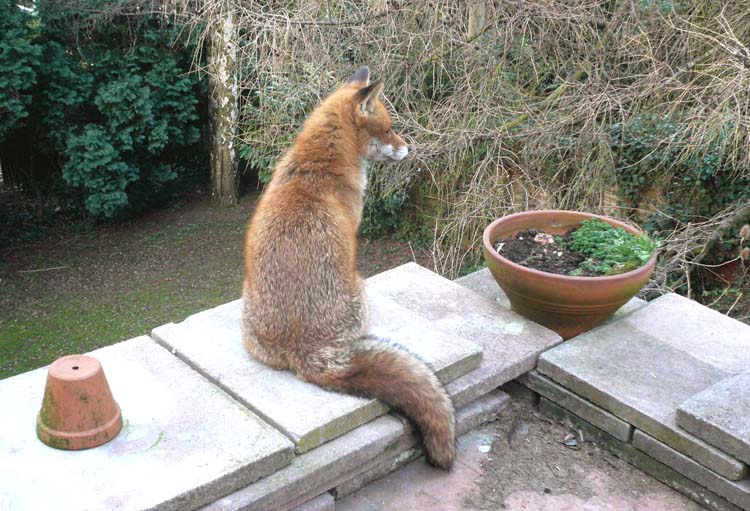
Mice, shrews and rats went unnoticed, as they always have. But above all, one animal benefited enormously. That was “vulpes vulpes”, better known as the fox. They carried on their lives pretty much as they always had done, taking little or no notice of human beings and their machines. If anything, life was considerably easier, and food more plentiful now that they lived in a city suburb, which was always a few degrees warmer than the bleak countryside. And very soon London had in excess of 10,000 urban foxes. And many other cities experienced the same process. Bristol. Birmingham. Sheffield. And Nottingham, the home of the most famous fox of them all…….
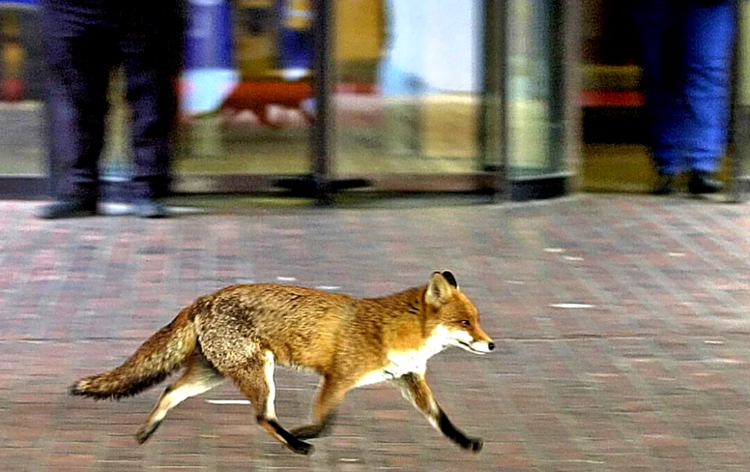
Here’s another of them, hurrying to the fish and chip shop to see if anybody couldn’t eat all of what are, hopefully, generous portions:
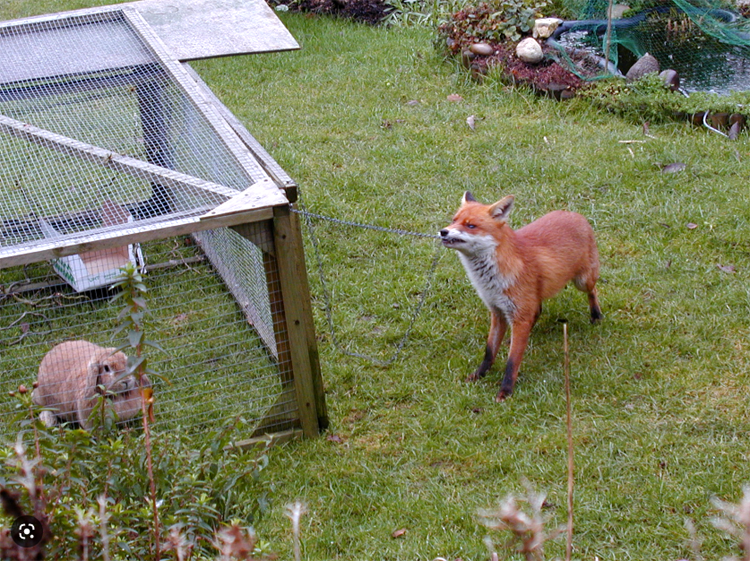
Foxes, like all undomesticated canids, are extremely intelligent. Once they have made a friend such as a big, fat rabbit, they always like to see if they can get even closer to him, perhaps by pulling a likely chain:
And here’s one of the very few photographs of Banksy Fox”…….
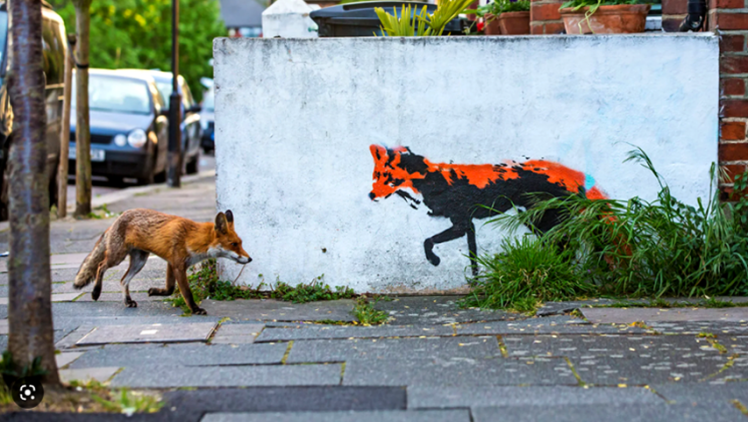
Next time, we take a look at the quality of the sausages available in the Iceland supermarket chain, exploring the views of one of their keenest consumers…………



 John Knifton
You have informatively broadened the saga of Widdle – the Banksy shot is splendid
Thank you, Derrick. I borrowed the Banksy shot from the Internet. I do wonder how much it owes to Photoshop, though.
An interesting backstory of the fox’s adaptation to living with the human invaders of their natural habitats. Our neighborhood was once coyote territory. Many still live among us but are smart enough to come out only at nights.
I hadn’t realised that coyotes were so much a “hotter and drier climate” version of the ordinary fox, which is itself very often little bigger than a big domestic cat.
It’s good how nature has a way of saying ‘no’ to us humans. And thank goodness they do!
It certainly is, although, arguably, as Nature says what is perhaps it’s biggest ever “No” to us in the form of climate change, we may yet come regret our attempts to push her around.
I r hi k nature always gets her revenge in the end. Time is not on our side with that one.
Not that more than one politician in a hundred seems to have realised that…….
Not that more than one politician in a hundred seems to have realised that……
Here we have horses and coyotes in the neighborhoods. Some of the places higher up in the mountains get bears. People do seem to forget that the wildlife lived here first.
Absolutely. And talking of bears, I saw recently how their sense of smell is several million times better than that of a bloodhound, which does explain why they can smell food on your lips at half a mile, and hardly ever lost contact with their cubs. Statistically though, bears do kill far fewer people than elevators or escalators do.
Thank you. I always learn so much from your posts.
Thank you, Lakshmi. I’m so pleased that you enjoy my blog posts.
Thank you for sharing!!.. glad to see that the people decided to live along side nature to some degree, unlike other places in this world… as far as threats and danger goes, I find that, for the most part, dealing with most of natures creatures are less hazardous than dealing with another human… 🙂
Hope all is well in your part of the world and until we meet again….
May your troubles be less
Your blessings be more
And nothing but happiness
Come through your door
(Irish Saying)
You are 100% right. Animals are so much easier to deal with than human beings. That is provable by the simplest detail, of course. “What is the most dangerous bite?” Lion? Tiger? No! It’s a human bite, which has so many bad things in it that you are bound to get some kind of infection. A wolf bite is a walk in the park compared to that !
A fox seen on a street just doesn’t seem right, John. How clever, however of these guys to adjust to their benefit. I say good for them for man has in so many cases taken from wildlife with their buildings and such. Loved your post and I thank you for what you shared.
I’m glad you enjoyed it, Amy. Over in Europe, wolves and bears feed at dumps in various cities including Berlin, and I once saw a film of two wolves playing together on a soccer pitch in Belgium, having a great time at 4.30 on a summer’s morning!