
Last time, I tried to explain why and how there came to be a healthy population of urban foxes living in the leafy suburbs of London. Within a decade, there were large populations of urban foxes in other cities with extensive leafy suburbs, such as such as Bristol, Manchester, Birmingham and Nottingham. One of these sophisticated city foxes even came to be a personal friend of Banksie:
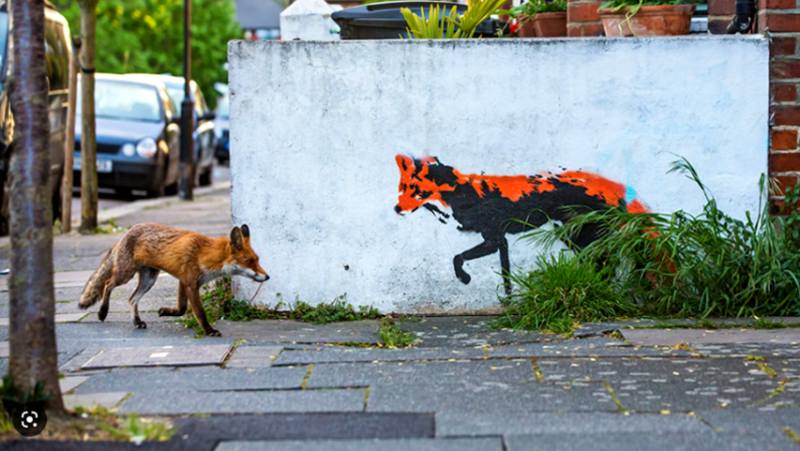
There was nothing to stop the urban foxes. On average, councils found that for every letter of complaint, there were 25 which said “Hands off our foxes”. And killing them off was very expensive. anyway. And unpopular. The Daily Express reported that…….
“Hackney Council ordered the removal of traps in a popular park within hours of animal lovers reacting angrily to the idea of the inner city foxes being destroyed.”
Nottingham, of course, has its urban foxes. On one occasion. long before I got to know Widdle, I found traces of them near a path between the Ring Road and the tennis courts. Here’s the path, which seems to be Nottingham’s first Linear Litter Bin. The tennis courts are to the left behind the chainlink fencing, and the ringroad is behind the heavy black metal fence on the right:

Something seems to have crawled underneath the chain link fencing which protects the tennis courts:
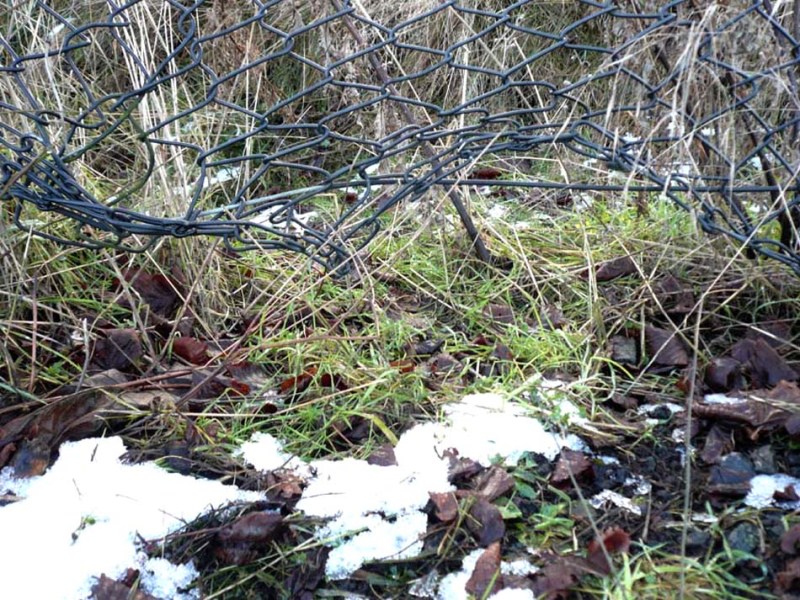
At one point I found this carefully excavated hole, which I believe to be a fox’s den.

In a city, there are literally hundreds, if not thousands, of possible places for a fox family to live, such as disused sheds and out buildings and underneath garden decking. There’s plenty of food, especially if there is a fast food restaurant nearby. Indeed, news was released recently that foxes in cities have begun to have broader, stronger muzzles than their country cousins, because a certain amount of strength is needed to open the discarded food containers. Once the containers are open, though, the food that they contain will contain many more calories than the usual diet of a fox out there in the countryside, eating mice, hedgehogs, beetles and other insects.
It was Kevin Parsons, a senior lecturer at the University of Glasgow, who recently announced that investigators had found that “urban foxes had wider, shorter muzzles than those in rural areas. Diet plays a large part in some of the changes. Urban foxes need a stronger bite for the food they eat in cities.
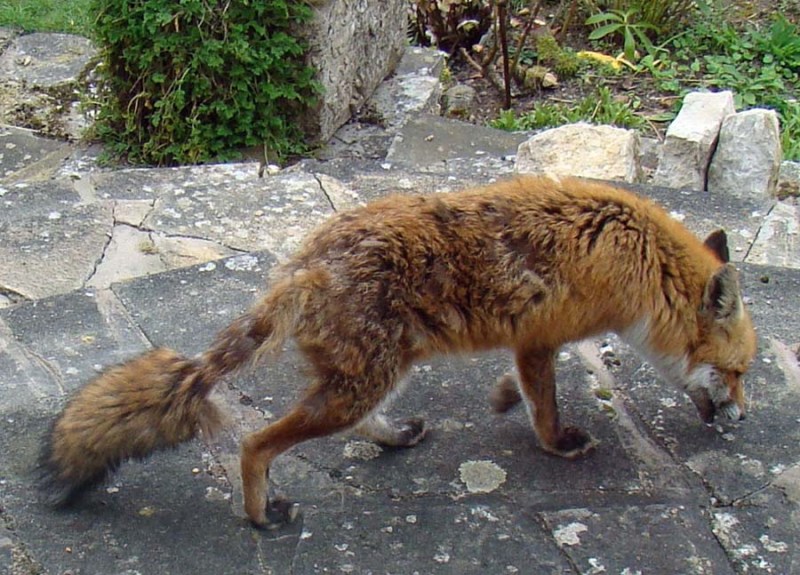
Foxes have all they might need in the city. Even their life expectancy is better than country foxes. The only fly in the ointment is mange which is a disease which can sweep through a city’s fox population and kill nearly every single one. Here’s a fox with the early stages of mange. Look at his tail ! :
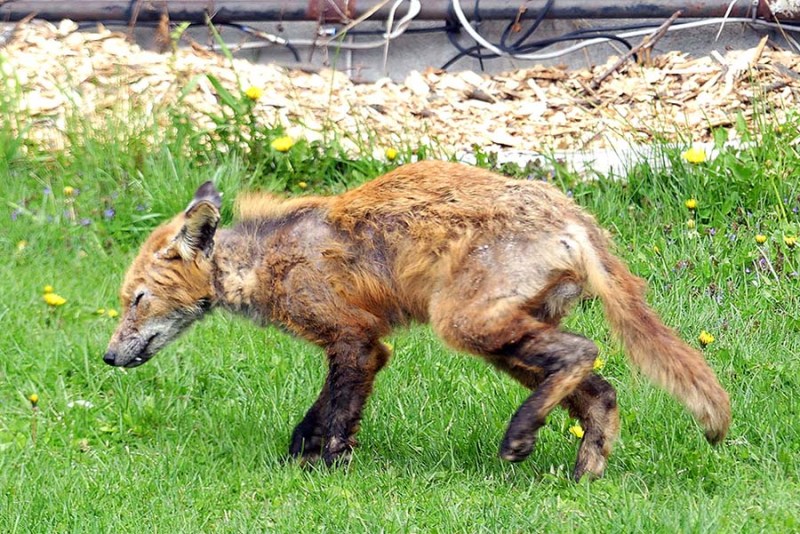
Here’s a fox who is past the point of no return. He looks, and is, a terminally sick animal:
Don’t be fooled though! Sometimes a perfectly healthy fox can look as if he is at Death’s Door, when he is moulting, which is, of course, a perfectly normal stage of his life:
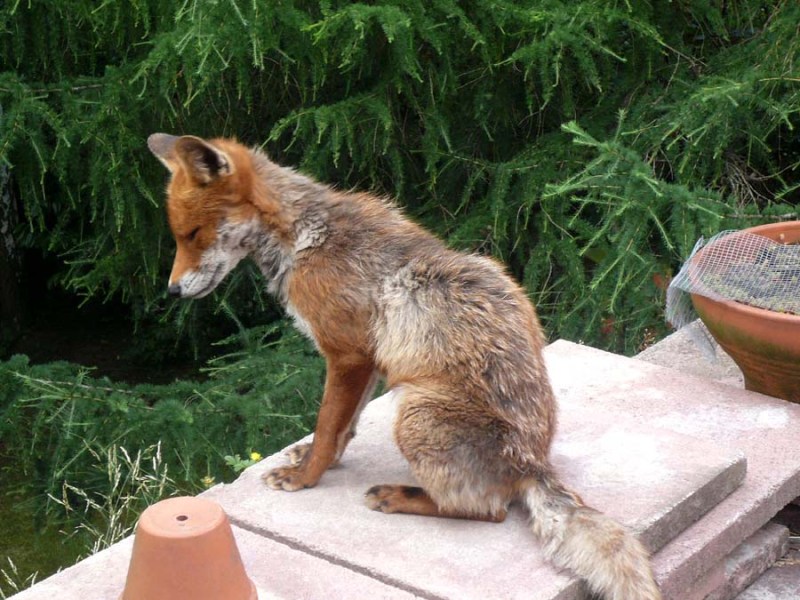
Surely you will recognise this rather tatty chap. He is called “Widdle” and was a personal friend of mine. He could look extremely ill when he was moulting, but there was a difference. If a fox is basically healthy, his moult starts at the tail and then spreads up towards the head, which is usually the last to go. Other body extemities, such as the legs, may also stay rich red rather than turn to that tatty fawn-pale orannge-black. And in the three photographs, one of a healthy Widdle and the other two of a fox with mange, that is exactly what is happening.



 John Knifton
Interesting article. 🙂
Thank you very much. I’m glad you enjoyed it!
Fascinating and informative, John. Here is an extract from an early post of mine: “I suppose urban foxes don’t need to go to earth, because people think they are so cute. Some time ago I was consultant to an adoption agency in Putney. There the foxes lived in an Andersen shelter. Every spring the staff gathered at the upstairs window to watch the cubs gambolling on the lawn.” (https://derrickjknight.com/2012/05/18/a-cultural-experience/) – before I was adding photographs.
Funnily enough, we too used to watch Widdle, Mrs Widdle and the Kids playing on our lawn. On one occasion, there were three normal sized ones and a tiny (runt) cub, who was bullied by the other three.
The cubs’ play was always the same thing. A good game of “Bite your bum”, with lots of wrestling and snapping at the base of the others’ tails. In an emergency, Mrs Widdle would give her “Mum’s Alarm Call”, which means “RUN!!!!” and sounded a little like a large dinosaur trying to clear a large piece of meat out of its throat.
BBC Bristol, Eat your heart out !!
City Councils in Greater Melbourne claim that at any time of the day any person in Melbourne is probably at least 50 metres from a fox. They are an imported animal a legally declared feral pest. But they survive.
No doubt they do survive, but I have nothing against the destruction of alien species. American Mink have virtually wiped out the water vole, and grey squirrels have wiped out the red squirrels.
We have red-necked wallabies over here as our Australian alien species, but they are apparently such sweeties that everybody loves them!
Fascinating, John!
Thank you for your kind words! I’m glad you enjoyed meeting my best friend ever.
One day, I’m going to feed him sausages in heaven.
🙂
I remember Widdle. Can imagine how many sausages he scoffed down!
I’ve only seen one fox since I moved down here 52 years ago – and I think that’s sad.
It may not be as sad as you think. Since Widdle left us, we have only ever seen foxes on our trailcam. (And if you want to see wildlife, that’s an excellent way of capturing the creatures of he night)
Widdle himself was extremely adept at appearing and disappearing, and I remember how on one occasion, he came into the house and sat next to me in the dining room as I used the computer. He must have been fascinated by what I was doing, but the first time I saw him was when I looked down, and there he was! I remember, it really startled me!
hahaha, I can only imagine. The closest I ever came to that was when a snake decided to take a nap between my feet! (I do not care for snakes!!!!!)
From Adam down on through history, I don’t think anybody really likes snakes!
Fascinating reading as always John. I lived in Wimbledon (of the tennis fame) as a student and we had a family of urban foxes in the very over grown garden at the time. They were a delight to watch and were no bother at all.
Absolutely….foxes don’t really seem to cause anybody any harm and they cause no damage whatsoever. Contrary to popular belief they don’t attack cats either.
To be honest I have always thought that there were a lot of people who did not like wild animals because they could not control them, in the same way that they used to control their flower beds!
Thank you for sharing a interesting part of your world!!.. I suspect that if one would do enough research, one would be amazed at how many creatures would share a life with us humans, live and let live… glad your were able to have some time with Widdle..“Life gives us brief moments with another, but sometimes in those brief moments we get memories that last a lifetime, So live that your memories will be part of your happiness.” (Author Unknown)… 🙂
Hope life is all that you wish for it to be and until we meet again…
May love and laughter light your days,
and warm your heart and home.
May good and faithful friends be yours,
wherever you may roam.
May peace and plenty bless your world
with joy that long endures.
May all life’s passing seasons
bring the best to you and yours!
(Irish Saying)
Yes, my family and I were all delighted to share our lives with Widdle for just a few short years. They seemed only brief moments, but they were a blessing given to very few.