
Surprisingly, throughout the whole First World War, the British were unbelievably lax on what could be termed “personal security”. In the German Archives, therefore, battlefield expert, Peter Barton, seen below,………
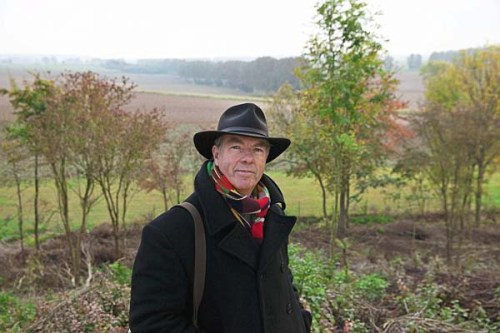
………found that literally hundreds of lower ranked British officers had been captured by the Germans with top secret plans in their possession, including many labelled “not to be taken into the front line”.
Not surprisingly, the Germans found these maps extremely useful and once they had seen them, they would quickly change their defensive plans and tactics to fit in with them. For example, on one occasion, they resited all of their heavy machine guns out of range of the Allied creeping barrage. Here they are, the schweinhunds……

During the very harsh winter of 1916-1917, the morale of the British troops plunged, in large part because of the lack of success on the Somme and the huge casualties suffered there.
According to the German Archives, hundreds of British POWs shared that very same opinion. The POWs were only too ready to tell the Germans that anxiety, depression and pessimism were rife among the men in the British trenches. A war which was going to be a “walkover” had now become a very long steeplechase with an almost infinite number of obstacles.
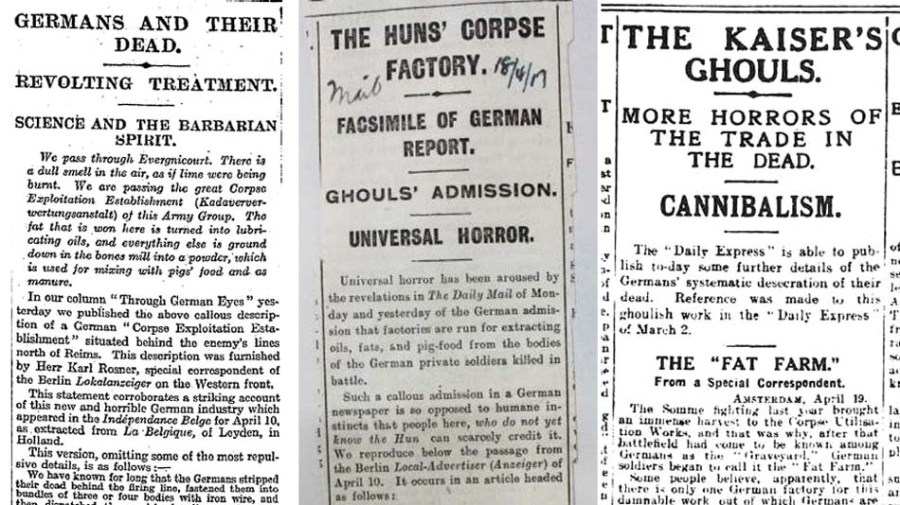
Indeed, war weariness was such that both officers and soldiers were frequently delighted to become POWs in German captivity. There was also widespread disgust at how the British press told blatant lies about the progress of the war, especially the Daily Mail. Here are headlines about how a desperate German population was now eating the corpses of their dead soldiers…..
By 1916-197, divisions were also beginning to appear between the British and the Dominions of the Empire, with the Australians, Canadians and New Zealanders only too willing to slate the British leadership on the Somme.
The numbers of men who wanted to go on fighting were increasingly small and the Australians in particular, who were no fools and were 100% aware that they were “always used in tough battles” were beginning to see their role as the “White Slaves of the Somme”. The same would happen to them in World War Two, and the Canadians would also suffer in a similar way in both wars. In World War 2, the Poles and the French speaking Canadians could also added to the list.
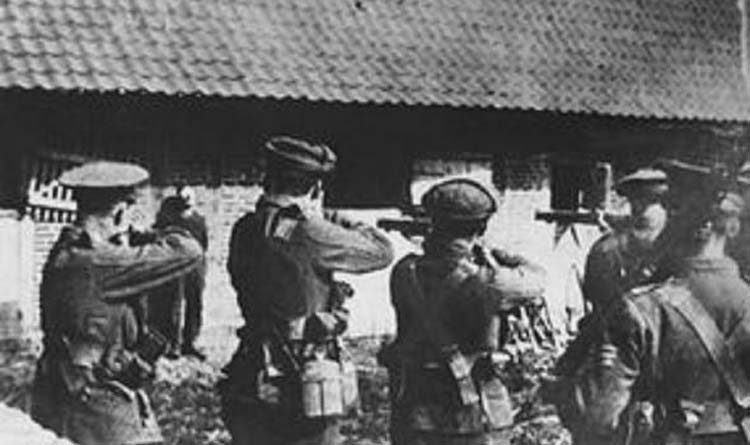
Mental illness, shell shock and desertion were increasing by leaps and bounds. Haig showed them no mercy and nine times out of ten opted to have them shot. It was carried out in the most ill considered of ways, with the members of the firing squad always selected from the condemned man’s unit. On many occasions, therefore, they were being asked to shoot somebody who they may have known personally, quite possibly as a friend. Here’s a British Army firing squad, hard at work…….
Both sides tried wrongdoers at courts martial. The British did not give the accused access to a lawyer, but instead they had an officer to give them advice and to fight their corner.
The Germans made it much more like a civil trial. There was a jury whose job was to decide the guilt of the prisoner, and he had access to a fully qualified lawyer.
The Germans used physical punishments and these were carried out in the local area.
When dealing with captured German soldiers, the British constantly harassed them and tended to be very fierce and very nasty to them. The result was that they hardly ever discovered any useful intelligence information.
The Germans, though, were always very pleasant with the British POWs, who soon became much more relaxed. The two sides would begin to chat to each other, and share a cup of tea, sometimes with biscuits. Those simple aids would usually persuade the British to give up their secrets, often in very great detail. Here are prisoners in a German Prisoner-of-War camp. Some of these men might have been here for four years, since being captured, for example, at the Battle of Mons….



 John Knifton
I do wish some of the leadership could see these posts, John
I am sure that they are all looking up at us from their hottest seats in Hell, Derrick, wishing sincerely that they had made a much greater effort to come up with some imaginative plans for attacks, and had cared so much more for all the lives of the young men which they had squandered.
Very interesting as always John. It’s interesting that ‘being nice’ to prisoners gets more information, this I think this was also played in the Second World War allowing Germans to freely meet and talk to each other, thus revealing operational secrets. The Germans as we know however, had a brutally sadistic approach and probably obtained a lot less in comparison. It’s interesting too that both the Aussies and Canadians were basically gun fodder in both wars, perhaps someone somewhere should have stood up for them and made amends.
I’m glad you enjoyed it! In WW1 the Germans were alwys very generous with the choccy biscuits and reaped the rewards, whereas their more macho attitudes in WW2 were a lot less successful. Even so, they often surprised the downed British pilots they interrogated with what they had found out. I remember one German amazing the squadron leader with his question, “You must have been very upset yesterday when you smashed your favourite teamug at breakfast?”
The British upper classes ran the armed forces of WW1 and I think that they looked down on the “colonials” from Australia, Canada and New Zealand because they had not been able to make their fortune in England, but had had to go half way round he world in an effort to shine.
As regards some other groups the strict upper class English rules on race and colour may have had something to say. In whaling ships of the late 19th century, the Spanish crewmembers were classified as “black or coloured” and they ate and slept with any African members of crew. What implications would that have had for French Canadians?
Likewise, any suspicion that an ethnic group were exclusively working class, with no officer class men present as members, may have generated similarly horrible ideas about their abilities.
Would that I could go back and speak to some primary sources from these horrific years of history.
Very true John. I do think though, that it’s something we should not wipe from the history books as some would suggest. Our history is what has made us and, good or bad, it should be remembered and told. How else do we learn from it.
With sentiments like that, you get my vote!!
Catching up John on the Somme.
Some very interesting posts on the war to end all wars.
There certaily are, and Peter Barton’s TV programme is well worth keeping your eyes open for. After that, it may be worth trying to track down one of his books listed on Amazon such as “Fromelles” and “Vimy Ridge and Arras: The Spring 1917 Offensive in Panoramas”.
Looking at my family history and the large number of casualties it’s obvious that the men in charge didn’t value the lives of the rank and file soldiers. I think the words of the hymn “I vow to thee my country” just about sums it up. The recruits were almost expected to lay down their lives no matter how stupid the plan.
I would largely agree with you about this, although one other factor to take into account is the role played by rank and social class.
I have never thought that Field Marshal Douglas Haig, 1st Earl Haig, KT, GCB, OM, GCVO, KCIE, was concerned one way or the other about the eventual fate of the working class miners, roadmenders and bricklayers who made up the infantry of the British Army. Such men were quite simply of very little value indeed compared to the top ranking officers with whom Haig shared his port every evening.
How very damned unsporting of the Hun to move his guns having seen our plans. That’s just not cricket! This is yet another harrowing account of what Pankaj Mishra described as ‘the malign incompetence of the British ruling class’. One wonders why the British troops didn’t mutiny.
To be honest, some of them did, but it was kept ultra secret, and much of it came after the end of the war. This included Kinmel Park in north Wales in 1919, where Canadian troops mutinied against being kept in England for no good reason. If you search for “Kinmel Park”, I have written about this in two separate blog posts.
I have also read about troops in Dover and elsewhere refusing to board ships in 1918 and to go to northern Russia to fight the Red Army. (excellent book “Churchill’s Secret War With Lenin: British and Commonwealth Military Intervention in the Russian Civil War, 1918–20”)
You could also argue that telling the Germans everything you knew about a forthcoming British attack was also a kind of mutiny, but one where it was difficult to prove the guilt of the individual soldier.
You might find it interesting to go to Google and to search for “British Army Mutinies WW1” and then”British Army Mutinies 1919″…..there’s plenty to go at!
I’m constantly amazed at the overall incompetence of military leadership.
Perhaps the wrong people are getting the top jobs? I have no idea if that would apply to the American Armed Forces, but it has been a constant theme at the top end of the British Army.
Earl Haig was in charge of the British forces during the Battle of the Somme, in 1916-1917. Complete coincidence that he was married to a woman whose chief job in life was working as one of the Queen’s Ladies In Waiting. And the Queen, of course, had the ear of the King, George V, who may not have been in charge of the British Army top brass, but he had enormous influence over it.
I think part of it is that the people smart enough to do the job right are smart enough to realize they don’t want that job and manage to stay out of it.
Looking at POWs of the Germans and then POWs of the Japanese, you can’t help but seen a huge difference.
Absolutely, although the Japanese in WW1 were, as far as I know, a lot less like they were to be in WW2. The WW1 Germans were real charmers, armed with their tea and biscuits, again a sharp contrast with the Germans of WW2, where if they thought murdering prisoners was necessary, they did it without compunction,
Many human beings are evil. Thank you for the post. It made me imagine those days. And unfortunately there is no end to wars.
Alas, I fear you are right. Not many human conflicts have been settled without a bullet being fired.
Yes, clearly, you cannot suffer losses on this scale without needing to search very thoroughly for replacements for the next “Big Push”. The British army first used the extra troops recruited by Kitchener and his famous “Your country needs you” poster, but after that there were Australians, Canadians, New Zealanders and then Indians, West African troops for transport duties, both of them followed by the Americans in late 1917.