
As a young man, I used to go camping around Scotland with my friend, Bill. We used to travel around the perimeter of the country in a clockwise direction, beginning in Glasgow, and then northwards to the top left hand corner of Scotland at Cape Wrath. After that we headed eastwards for John O’Groats and then returned home southwards along the east coast to Edinburgh and England.
I used to take slides with my trusty Voigtländer camera. I was then able to bore people silly on wet Thursday evenings. I recently found all my slides, packed away in a very large box in the attic, but unfortunately, there were a good few which I could not identify. When I got round to doing it, one or two of the slides also suffered during the conversion process into digital images, usually acquiring either an overall blue or purple cast, or, on other occasions, with the image being much darker than it had originally been. Even so. many of these fifty year old slides had a certain value of their own.
Going northwards on the west coast, seeing the extremely steep road at Applecross is an absolute must. Here is a view of it, relatively close to the top. The white dots are sheep……

Not every part of Scotland is hard volcanic rock. This area was mainly limestone which, around 10,000 B.C., enabled the water from the melting ice cap to carve out hundreds of caverns and tunnels underneath the slowly moving glacier. When the glaciers had finally departed, any tunnels or caverns might well collapse, leaving this rather bizarre landscape of roof supports……

The mountains in the very north west are not as high as they are further south around Ben Nevis or further east in the Cairngorms. Once again, the pattern is a landscape scrubbed clean by vast sheets of ice with just a few moderate mountains sprinkled on it…….
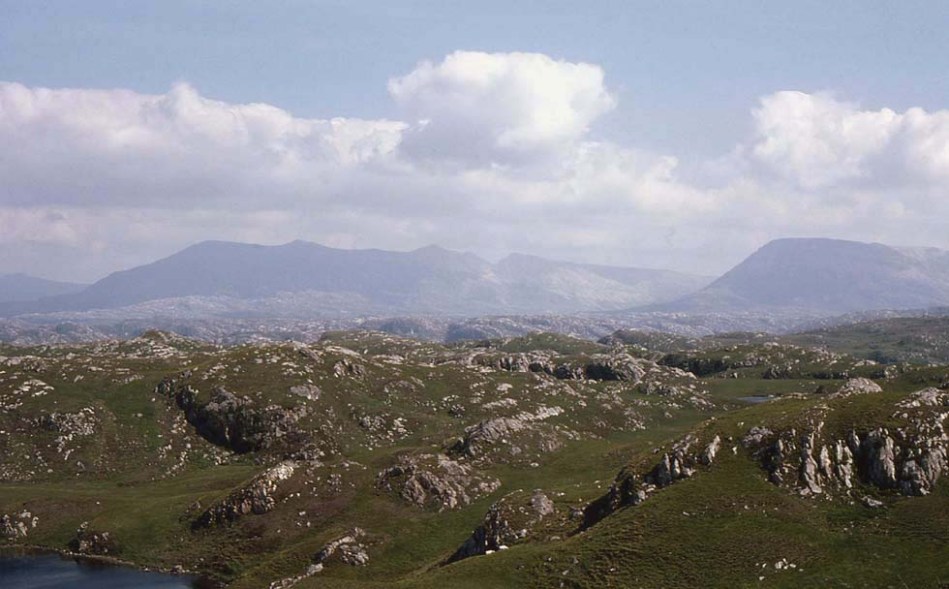
I have wondered for a number of years, given the number of people who leave the Highlands for the big cities, how many of these peaks will have had their names forgotten in ten or twenty years’ time. These are quite a lot of mountains in this area. Who will live near them to remember their names? And who will still speak Gaelic to pronounce those names?
The language still spoken by many in the Highlands belongs to the Celtic family of languages and is called Gaelic, pronounced “G-A-L-L-I-C” and certainly not “G-A-R-L-I-C”.
Another spectacular mountain I liked a lot was Suilven, the so-called “Sugar Loaf Mountain”…..
Here it is from a rather spectacular angle. Just look how many cars are filling the one street of the village. Climbers must have been queuing to attempt the summit, a bit like Everest nowadays….

Let’s finish with one or two of the more famous landmarks in this region of Scotland. First of all, here is the entrance and some of the interior of Smoo Cave, near Durness. The cave itself is simply gigantic, a fine example of how well limestone can dissolve in glacial water. Nowadays the cave is lit up with a selection of coloured floodlights. When I was there, you needed to have brought your own torch……

Perhaps the second most famous mountain in this area is Stac Polliaidh (pronounced “Stac polly”). It is a fantastic viewpoint over the rest of the mountains in the region. It has this rather dishevelled look to it, as if it were the first ever Punk Mountain. Stac Pollaidh is not particularly high but it can be dangerous if you aren’t careful. There are paths to the top, but the are all very steep and they give you a excellent chance of falling to your death…..

Right in the very, very north west corner of Scotland the countryside can be extremely unexpected. It has many enormous sand dunes and I wish I had taken more photographs of them. Here’s the only one I could find…..

My last slide for today shows the view at sunset from the north of the Isle of Skye, looking beyond the Outer Hebrides towards the Faroes, Iceland, Greenland and Canada.

It is worth pointing out that this particular slide did did not acquire that reddish-pink cast during some conversion course on the computer. This was 1975, one of the hottest, driest and best summers of the late twentieth century,


 John Knifton
The area still looks pristine.
It is more or less, but don’t forget that all of those slides are from, at the latest, 1980 or even earlier.
Beautiful and without people. I wonder how all those places are now? Thank you.
I have no idea to be absolutely honest, although they are still by no means overpopulated which is always a good first step towards keeping a beautiful piece of countryside beautiful!
Yesterday, I watched for the first time ever live Test Cricket from India. They were playing England and the result was a very surprising one, not least to myself!
My wife did a camping trip through Scotland back in the 60’s and we’re currently planning a trip to Scotland sometime this year.
My only piece of advice would be to read a very good guide book before setting off. I always liked WA Poucher’s “The Best Of Poucher’s Scotland”, “The Magic of Skye” and anything else by this writer from the 1960s.
And take excellent quality waterproofs, which you are then guaranteed not to need!
I will get a good guide. I’m not sure how much time we’ll have so I’ll have to make every day count.
I’m sure you will enjoy it !
Very rugged landscape. The sand dune seems so out of place.
My friend Bill and I were absolutely amazed to see it!
A lot of these photographs suffer from the lack of scale. mainly because of the absence of man and the buildings he cannot resist strewing over the landscape.
The entrance to Smoo Cave, foe example, must be at least seventy feet or more off the ground, and the sand dune, always on the move because of the high winds, is about to overwhelm the single track road (25 feet) in the foreground. And climbing the sand dune would leave the average person seriously our of breath.
I imagine that such natural grandeur would put our insignificance as humans into perspective.
Absolutely….and to prove it, there is a steady stream of casualties taken off the mountains during every part of the year, having grossly over-estimated their own capabilities. The mountains of Scotland, I’m afraid, don’t extend any mercy to anybody.
How tragic, John!
Another good selection John.
Thank you, Andrew. I used to enjoy the scenery of western Scotland, which would be a major tourist attraction without the frequent rain and mist, and the midges.
Most interesting!
Glad you enjoyed it, Doug!
What a beautiful collection of photos. You couldn’t possibly bore anyone with pictures like that, surely you can never tire of Scottish scenery.
No, you’d have to be pretty unhappy to be fed up with the landscape of western Scotand !
With my slides, I just wish that they were a little sharper, but that kind of almost digital detailing is never anything you used to get with slides.
I guess that’s one of the bonuses of the digital age. Along with more control over what the camera does.
My gosh John, I visited Scotland in December 1973 and I wish I had taken more notice. I absolutely loved it, But now I’ve got a post to write about the trip – so thanks for spiking my memory.
Also, somehow of other I stopped getting notifications from you and a lot of others. I think WP gets the blame so I am going through my half a dozen valiant followers to make sure I re-follow.
Most things in the world are down to WP……exorbitant interest rates and street violence…….they’re all their fault!
Oh my goodness, John, you fed my photographer’s heart! Wow on the vistas and the glorious scenes you shared with us here. There is so much untamed lands on this earth and you captured some of them. Thank you so much for sharing the pictures of the slides you took back in the 70’s. I so appreciate your efforts!! ❤️
I’m so glad you enjoyed my slides, Amy. Much of Scotland is untamed. with a steady stream of casualties throughout the year from mountains such as the Cuillins on the Isle of Skye.
Thank you for sharing your adventures and wonderful photos!!.. helps us see things that in the past we could only imagine what your part of the world looks like!.. “Life gives us brief moments with another, but sometimes in those brief moments we get memories that last a lifetime, So live that your memories will be part of your happiness.” (Author Unknown)… 🙂
Hope life is all that you wish for it to be and until we meet again…
And nothing but happiness
Come through your door
May the kindness you spread
Keep returning to you
(Irish Saying)
The landscape is remarkably rugged, yet there’s an intriguing contrast with the solitary sand dune.
Yes, both my friend, Bill, and I were extremely surprised to see a sanddune among the rocky landscapes of northern Scotland. On the other hand. the northern coast, from east to west, is entirely made up of a four hundred foot thick layer of highly compacted sandstone, so hard that they can easily make pavements out of it.