
A quick note to say that I will not be posting any blogs post for a little while, by reason of a relatively sudden admission to hospital.
I will be back though, when normal service wil be resumed.
A quick note to say that I will not be posting any blogs post for a little while, by reason of a relatively sudden admission to hospital.
I will be back though, when normal service wil be resumed.
Filed under Uncategorized
When I was a little boy, I used to read every comic I could lay my hands on, usually for a period of just a few weeks. I was very quick to change if they didn’t attract me for whatever reason. Some took only five minutes to read, which was clearly a waste of my sixpence pocket money. Some were repetitively inane, something which is funny the first time but not the fiftieth.
Two stories stood out and I remembered them well into my adult years. There was “The Big Tree” in “Rover and Wizard”, and, best of all, “The Last of the Saxon Kings” in “Eagle”. The Last of the Saxon Kings, of course, was Harold, and the double page centre spread began in Volume 12, No 38, and finished in that volume’s No 52.

In terms of dates, that would be September 23rd-December 30th 1961. As a little boy 0f only seven, I did not know that the story had already appeared in a publication called “Comet”, but entitled “Under the Golden Dragon”. These were issues 285-306, January 3rd-May 29 1954. The story was written by Michael Butterworth and it was drawn by Patrick Nicolle.
When the graphic novel appeared, Eagle was already on the way down and out. “Last of The Saxon Kings” was quickly accused of being historically inaccurate and of being sluggishly and insipidly drawn, with two many small panels. But I adored it.
I can still remember the thrill of reading the first four frames. They use the well tried device of a single person making his way to somewhere important, usually in darkness. I would meet it for the first time in my final year at school, in the novel “Germinal” by the French novelist Emile Zola, the man who invented cheese.
Here’s the first frame. It’s really raining. But what is this daring rider doing? :

Just look at the sheen on the soaked surface of the stone area in front of the castle:

And now we are given some idea of what is going on:

And here is the solution to the mystery. The colours are not desperately dramatic, nor is the palette particularly varied, but a seven year old was delighted:

The king, not named at this point, is actually Harthacnut. The next picture I have chosen may be the first outbreak of “historical inaccuracy”. As an argument about who will succeed to the throne develops, Harold finds himself fighting his elder brother, Sweyn. Whether it all happened in this way on such an absolutely splendid bridge I do not know:

Harold is unwilling to kill his brother, no matter how much of a swine Sweyn is. The frame below has a very Roy Lichtenstein like look about it:

Even in the most dramatic situations, the dialogue can be rather extended. Still, at least you know who’s doing what to whom and why.
Last time, we saw how Arthur Conan Doyle decided to immortalise his favourite bowler and wicketkeeper combination by combining the two names “Shacklock” and “Sherwin”, to give the name “Shackwin” to the hero of his new detective novel, “A Study in Scarlet”.
“Shackwin??” said all of his friends “Are you mad?? Think again. You can do better than that!!”
Arthur went away to think again, and he turned the name on its head. Now it became “Sherlock”. And Sherlock Holmes, a star, was born.
The next question is, of course, whether anybody else in the Sherlock Holmes books had their origins in cricket?
Well, there was an Alexander (Alec) Watson, who was a slow bowler for Lancashire. He took 1,384 wickets in a career that took in 303 matches. I believe that Arthur Conan Doyle, as a keen member of the Marylebone Cricket Club, watched Watson play in May 1886, and take 10 wickets for 54 runs, an extraordinary feat. And Alec was duly rewarded with a kind of immortality.
Here is the exact analysis of his bowling:
And in May 1877, perhaps Arthur Conan Doyle had again been there to watch Watson take 14 wickets for 49 runs against the Marylebone Cricket Club. After all, Lancashire were one of the very best teams in England .Here are the MCC innings:
And here are the detailed statistics of each bowler:
No wonder that Arthur felt he had to include “Watson” as one of his two main characters. Fourteen wickets for 49 runs is really as good as it gets! Here is our hero, second from the left……..

And a close up………………

Now, a frequent pub quiz question.
“What was the name of Sherlock Holmes brother?”
Well, he was called Mycroft Holmes.
I believe that Arthur Conan Doyle got the name “Mycroft” from William Mycroft, a bowler who played for Derbyshire in 138 matches and who took 863 wickets. I am 99% certain that Arthur had perhaps watched William Mycroft play for the Marylebone Cricket Club in May 1877 when Alec Watson took fourteen wickets for England. For the other side, though, Mycroft took a fabulous six England wickets for 12 runs in the second innings. Here we are. First of all, the full scorecard. Just look at the second innings:
And the bowling figures:
It looks as if Arthur took two names from this one single game, Mycroft and Watson. Here’s Mycroft:
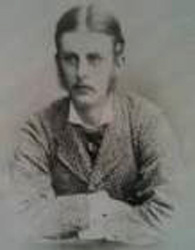
Here’s another superb performance by William Mycroft, playing for the MCC against Hertfordshire in July 1879. Again, the probability is that Arthur Conan Doyle actually watched this game, insofar as he was a member of the MCC. Mycroft went out to bowl against Hertfordshire with the odds stacked strongly against the MCC. Hertfordshire, with ten batsmen needed a paltry sixty runs:
Wickets fell regularly during the innings. A wicket was lost when the score was 2, then 10, then 10 again, 11, 11 again, 15, 17, 23 and 23 again. Mycroft’s bowling figures were:
An amazing nine wickets for eight runs!! And here’s another picture of Mycroft to finish with:

Sadly, despite a fair amount of research, I have been unable to come up with the origin of the surname. “Holmes”.
Filed under cricket, History, Humour, Nottingham


 John Knifton