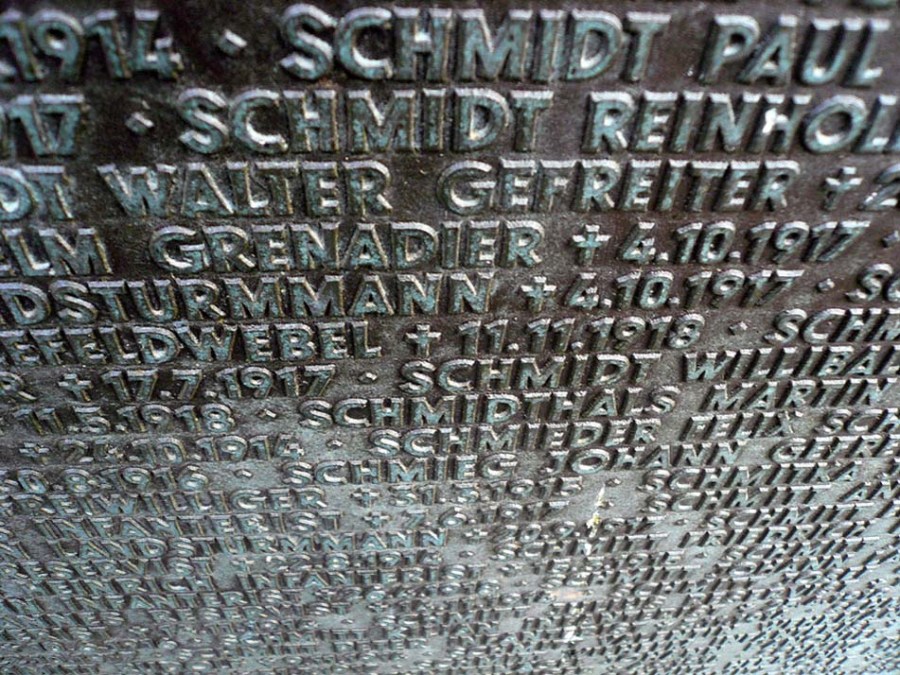
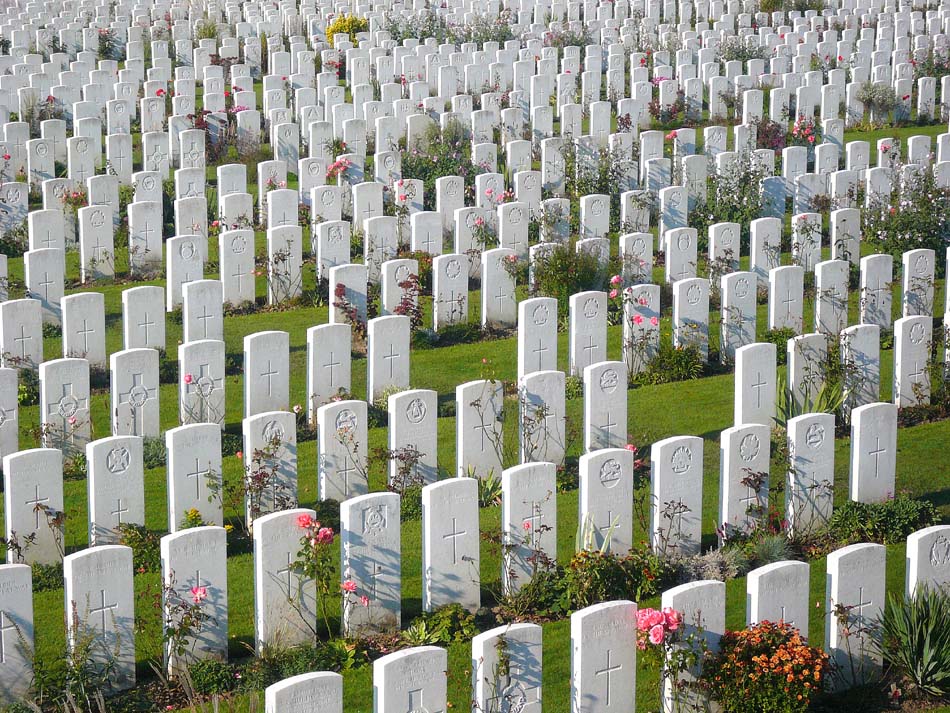
Author Archives: jfwknifton

The next few months of the Battle of the Somme with more revelations about British stupidity (Part 5)

Surprisingly, throughout the whole First World War, the British were unbelievably lax on what could be termed “personal security”. In the German Archives, therefore, battlefield expert, Peter Barton, seen below,………

………found that literally hundreds of lower ranked British officers had been captured by the Germans with top secret plans in their possession, including many labelled “not to be taken into the front line”.

Not surprisingly, the Germans found these maps extremely useful and once they had seen them, they would quickly change their defensive plans and tactics to fit in with them. For example, on one occasion, they resited all of their heavy machine guns out of range of the Allied creeping barrage. Here they are, the schweinhunds……

During the very harsh winter of 1916-1917, the morale of the British troops plunged, in large part because of the lack of success on the Somme and the huge casualties suffered there.

According to the German Archives, hundreds of British POWs shared that very same opinion. The POWs were only too ready to tell the Germans that anxiety, depression and pessimism were rife among the men in the British trenches. A war which was going to be a “walkover” had now become a very long steeplechase with an almost infinite number of obstacles.

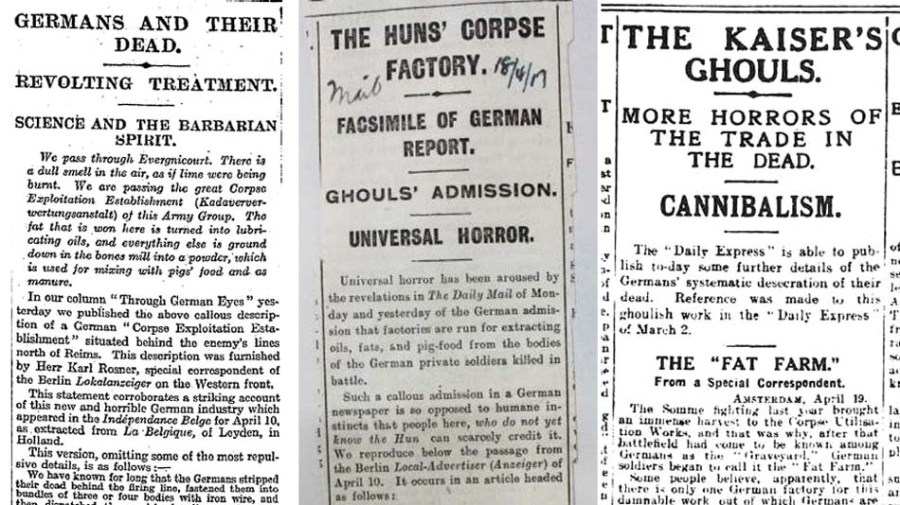
Indeed, war weariness was such that both officers and soldiers were frequently delighted to become POWs in German captivity. There was also widespread disgust at how the British press told blatant lies about the progress of the war, especially the Daily Mail. Here are headlines about how a desperate German population was now eating the corpses of their dead soldiers…..
By 1916-197, divisions were also beginning to appear between the British and the Dominions of the Empire, with the Australians, Canadians and New Zealanders only too willing to slate the British leadership on the Somme.

The numbers of men who wanted to go on fighting were increasingly small and the Australians in particular, who were no fools and were 100% aware that they were “always used in tough battles” were beginning to see their role as the “White Slaves of the Somme”. The same would happen to them in World War Two, and the Canadians would also suffer in a similar way in both wars. In World War 2, the Poles and the French speaking Canadians could also added to the list.

Mental illness, shell shock and desertion were increasing by leaps and bounds. Haig showed them no mercy and nine times out of ten opted to have them shot. It was carried out in the most ill considered of ways, with the members of the firing squad always selected from the condemned man’s unit. On many occasions, therefore, they were being asked to shoot somebody who they may have known personally, quite possibly as a friend. Here’s a British Army firing squad, hard at work…….
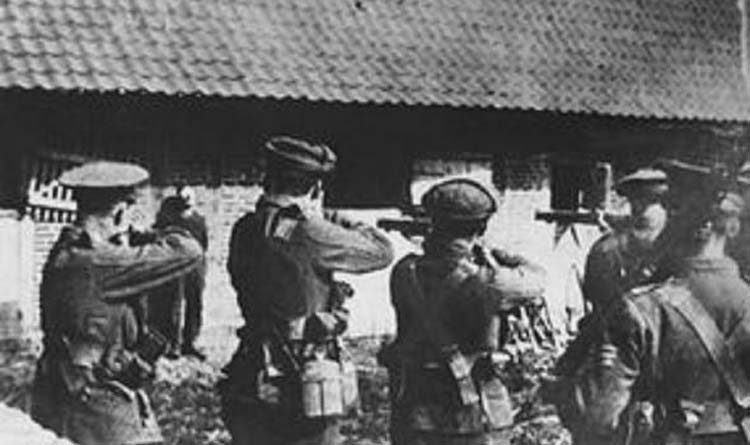
Both sides tried wrongdoers at courts martial. The British did not give the accused access to a lawyer, but instead they had an officer to give them advice and to fight their corner.

The Germans made it much more like a civil trial. There was a jury whose job was to decide the guilt of the prisoner, and he had access to a fully qualified lawyer.

The Germans used physical punishments and these were carried out in the local area.

When dealing with captured German soldiers, the British constantly harassed them and tended to be very fierce and very nasty to them. The result was that they hardly ever discovered any useful intelligence information.

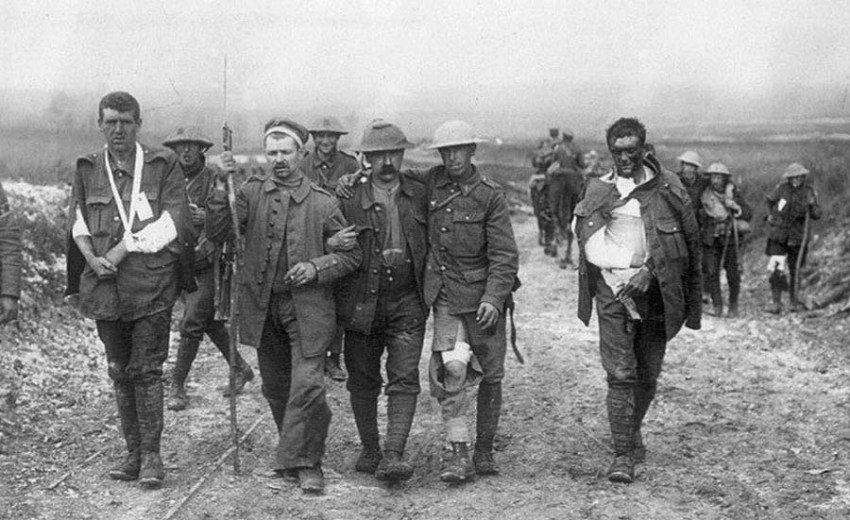
The Germans, though, were always very pleasant with the British POWs, who soon became much more relaxed. The two sides would begin to chat to each other, and share a cup of tea, sometimes with biscuits.  Those simple aids would usually persuade the British to give up their secrets, often in very great detail. Here are prisoners in a German Prisoner-of-War camp. Some of these men might have been here for four years, since being captured, for example, at the Battle of Mons….


20 Comments

Filed under Canada, History, military

Widdle (8)

Last time, I tried to explain why and how there came to be a healthy population of urban foxes living in the leafy suburbs of London. Within a decade, there were large populations of urban foxes in other cities with extensive leafy suburbs, such as such as Bristol, Manchester, Birmingham and Nottingham. One of these sophisticated city foxes even came to be a personal friend of Banksie:

There was nothing to stop the urban foxes.  On average, councils found that for every letter of complaint, there were 25 which said “Hands off our foxes”. And killing them off was very expensive. anyway. And unpopular. The Daily Express reported that…….

“Hackney Council ordered the removal of traps in a popular park within hours of animal lovers reacting angrily to the idea of the inner city foxes being destroyed.”

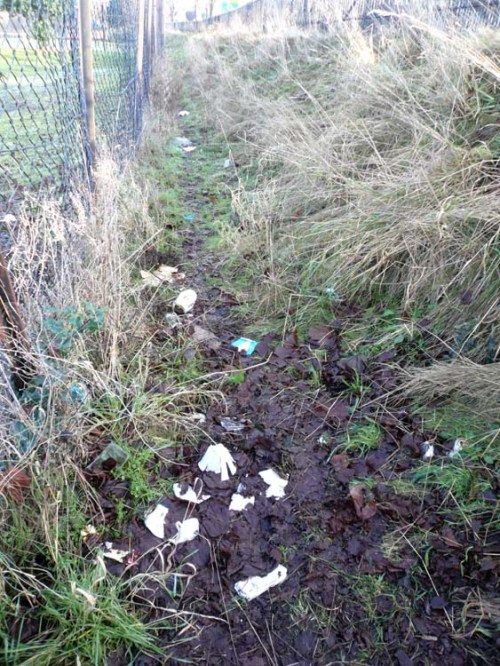
Nottingham, of course, has its urban foxes. On one occasion. long before I got to know Widdle, I found traces of them near a path between the Ring Road and the tennis courts. Here’s the path, which seems to be Nottingham’s first Linear Litter Bin. The tennis courts are to the left behind the chainlink fencing, and the ringroad is behind the heavy black metal fence on the right:

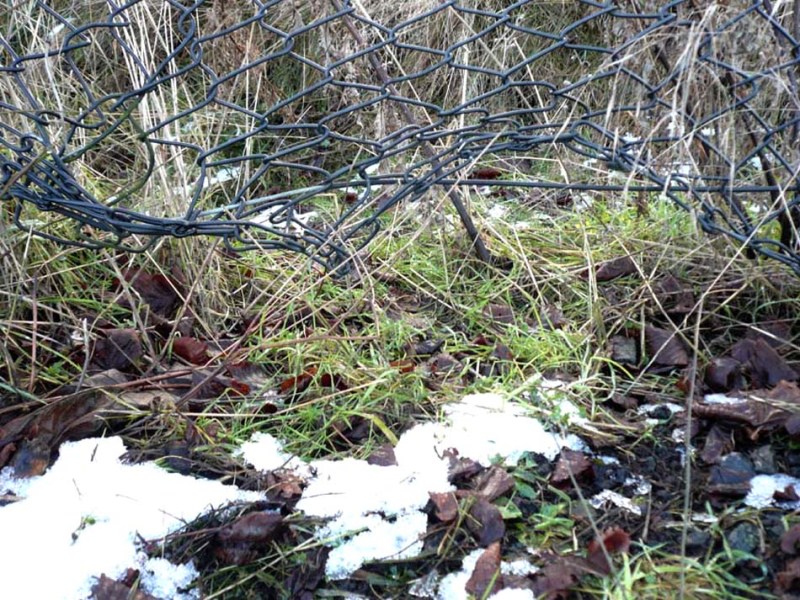
Something seems to have crawled underneath the chain link fencing which protects the tennis courts:

At one point I found this carefully excavated hole, which I believe to be a fox’s den.

In a city, there are literally hundreds, if not thousands, of possible places for a fox family to live, such as disused sheds and out buildings and underneath garden decking. There’s plenty of food, especially if there is a fast food restaurant nearby. Indeed, news was released recently that foxes in cities have begun to have broader, stronger muzzles than their country cousins, because a certain amount of strength is needed to open the discarded food containers. Once the containers are open, though, the food that they contain will contain many more calories than the usual diet of a fox out there in the countryside, eating mice, hedgehogs, beetles and other insects.

It was Kevin Parsons, a senior lecturer at the University of Glasgow, who recently announced that investigators had found that “urban foxes had wider, shorter muzzles than those in rural areas. Diet plays a large part in some of the changes. Urban foxes need a stronger bite for the food they eat in cities.

Foxes have all they might need in the city. Even their life expectancy is better than country foxes. The only fly in the ointment is mange which is a disease which can sweep through a city’s fox population and kill nearly every single one. Here’s a fox with the early stages of mange. Look at his tail ! :

Here’s a fox who is past the point of no return. He looks, and is, a terminally sick animal:

Don’t be fooled though! Sometimes a perfectly healthy fox can look as if he is at Death’s Door, when he is moulting, which is, of course, a perfectly normal stage of his life:

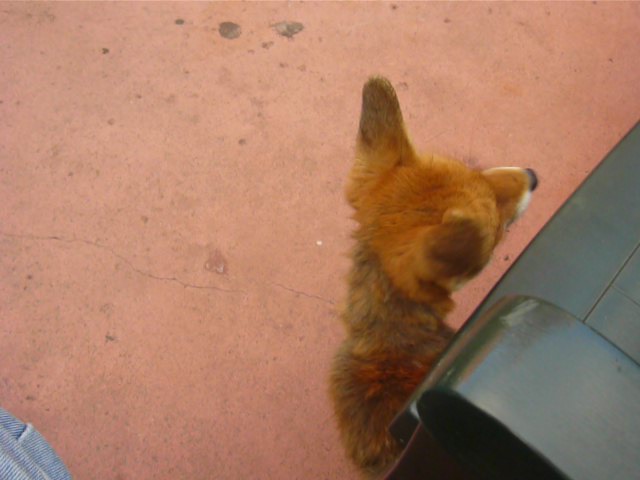
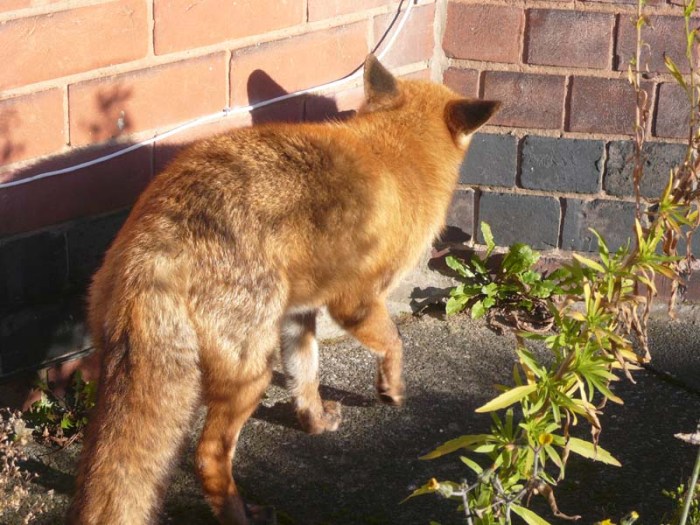
Surely you will recognise this rather tatty chap. He is called “Widdle” and was a personal friend of mine. He could look extremely ill when he was moulting, but there was a difference. If a fox is basically healthy, his moult starts at the tail and then spreads up towards the head, which is usually the last to go. Other body extemities, such as the legs, may also stay rich red rather than turn to that tatty fawn-pale orannge-black. And in the three photographs, one of a healthy Widdle and the other two of a fox with mange, that is exactly what is happening.


17 Comments

Filed under Humour, My Garden, My House, Nottingham, Personal, Widdle, Wildlife and Nature

The next few months of the Battle of the Somme; a change in German tactics (Part 4)

My three previous blog posts about the Battle of the Somme were all based on the extensive researches of the English historian, Peter Barton, who has spent many years as a “battlefield guide” in the Somme area. He was the first person ever to consult the German language military archives and I was amazed to find that he was the only English historian who had looked at them in a whole century.

He discovered, for example, that the Germans from August 1916 onwards, were beginning to change their tactics, with many of the changes heavily reliant on skilful camouflage. Here’s a genuine 100 year old camouflage scheme from an aeroplane called the  Rumpler Taube……

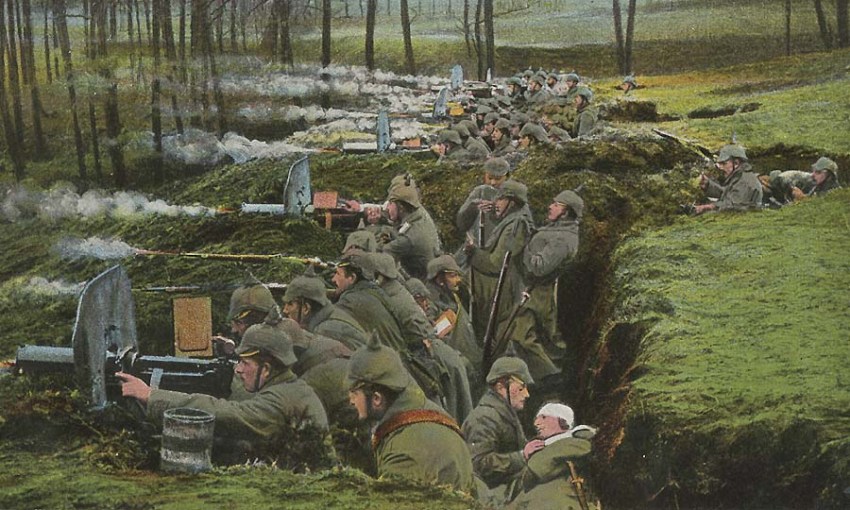
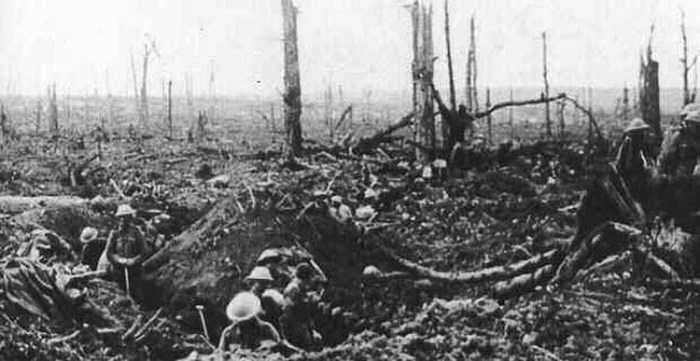
From late 1916 onwards, the Germans began to renounce their previous doctrines of heavily fortified defensive lines with numerous bunkers forty foot underground and countless tons of concrete protecting their troops. Instead, they began to start making extensive use of shell holes, with a man in each, hidden by a tarpaulin over him. In this way, whole machine gun crews might become almost completely invisible. And the Germans, of course, always had huge numbers of machine guns……

This more simple arrangement would go on to take the place of trenches and to replace what had gone before with what was called “defence in depth” with “every position defended to the last man”.

You’ve seen this picture before, but I make no excuses for re-using an image with such unbelievable numbers of machine guns in it. What’s the collective name? A rattle of machine guns? A maximum of Maxim guns?

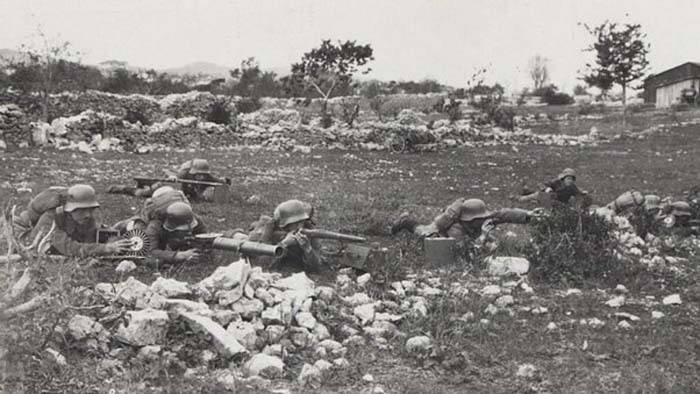
Frequently, the German soldiers operated in teams with each team responsible for the defence of a specific area. Within the team, each man usually had his own job, such as flame thrower, mortar crew and so on. This made immediate counter attack much easier, and arrangements were constantly being revised. Eventually, the members of the defensive teams would begin to be called “stormtroopers”. Here is a platoon of them, with a selection of different weapons……….

The Germans always studied the tactics of their opponents, particularly when the latter were using their tanks in combat. The Germans did not particularly favour tanks, but the Australians, British and Canadians did, and every German soldier, even those in the lowest ranks, was encouraged to analyse what had occurred in an engagement, and, if necessary, to make criticism of it themselves. Anything particularly significant could be circulated around the army in hours. Here’s a German tank. I wonder what a “Schnuck” is?

Let’s finish withj two more Funfacts…..

Funfact One

In battle, the British always attacked in enormous numbers, but the Germans seemed to have better communication and always to be completely aware of what was going on, and to be completely capable of dealing with anything the British or French got up to.

Funfact Two

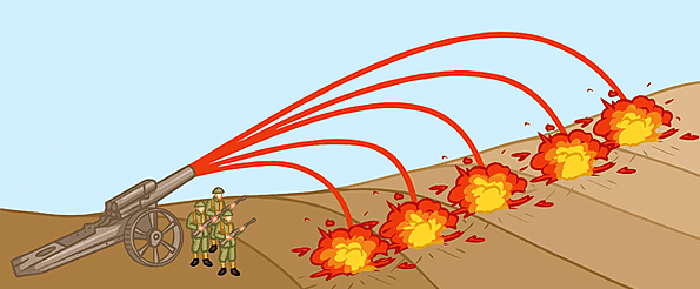
An innovation based, I believe, on the Canadian tactics at Courcelette in 1916, the Allies’ so-called “creeping barrage”, was an effort to cut casualties among their own troops attacking over no-man’s-land. It was, though, frequently difficult for the advancing troops to keep up with the barrage and they were often left vulnerable to enemy fire. Equally frequently, friendly fire would take a heavy toll.

Here’s a diagram. As the troops go forward, the artillery is fired at whichever enemy troops are directly in their way. The attackers are relatively safe behind the carpet of shells as it creeps gradually forward…..

Funfact Three

In the attack on Boom Ravine on February 17th 1917, around 2,000 Allied troops were killed. From the way the German artillery operated over the course of the day, and the timing of their use, it was widely believed at the time that they had been informed by treachery on the previous day, by British POWs already in German hands and by British deserters who preferred to surrender rather than risk their own lives going “over the top”. Other similar events were not unheard of, but what made it an important first was that they had never previously been described in any written accounts published later about the battle.

And that’s it. And I would strongly recommend that you record and watch Peter Barton’s “From Both Sides of the Wire” if you ever get a chance to do so in the future. It is a refreshing look at the First World War by a man who has literally, tramped every inch of the fields where the war took place, explaining carefully to his battlefield visitors the real truth of how events unfolded. Channels such as Discovery, PBS, and Smithsonian frequently dedicate a whole day to programmes on the same subject, often for public holidays or weekends. That’s your best chance if you want to see all three programmes.

Funfact Four

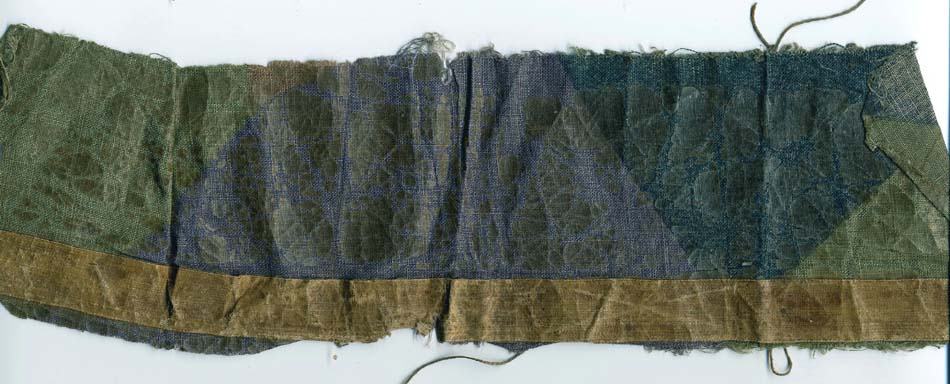
I actually have a piece of World War 1 aircraft fabric taken from a crashed German aircraft. It comes to me via my Grandfather, Will Knifton, who served with the 19th Canadian Field Artillery. The aircraft in question was shot down, and the Canadian soldiers all rushed straight out of their trenches to cut a souvenir from the wreckage with their bayonets. Here is the piece of fabric that Will managed to grab. Note the relatively complex use of different colours for camouflage purposes, unlike the planes of the RFC…..

13 Comments

Filed under Uncategorized

Brincliffe Grammar School for Girls (4) A cry from history

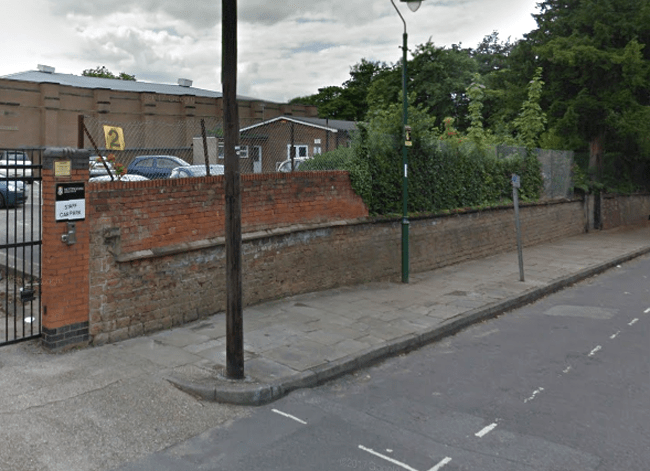
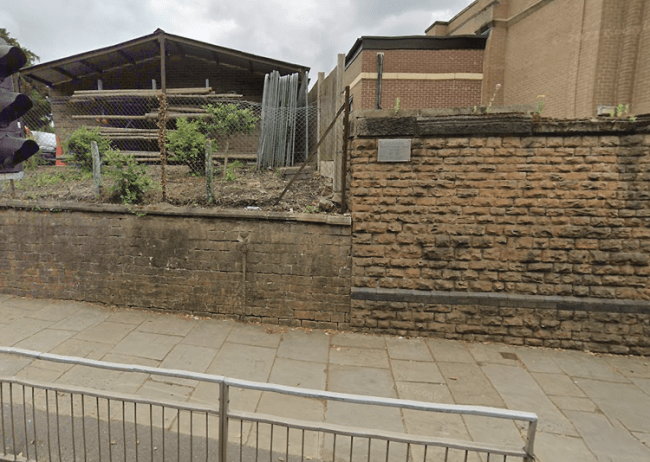
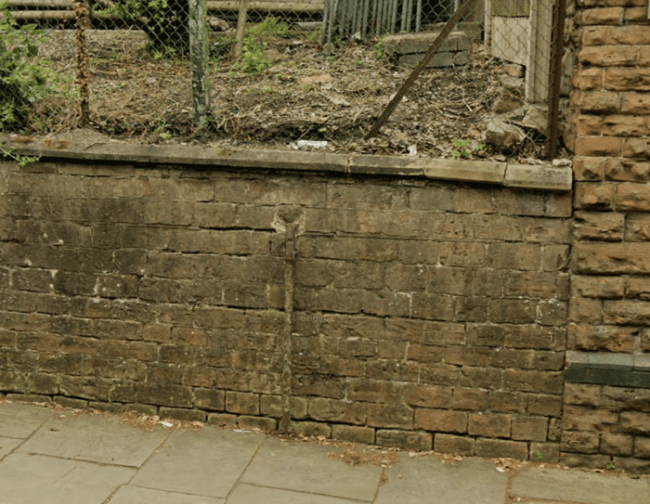
What traces remain of Brincliffe Grammar School for Girls? Well, in Balmoral Road, the front wall still remains, running from No 23 Balmoral Road, all the way to the corner with Forest Road East and then past that for a few yards. It’s easy to see and it is virtually untouched. It’s a sandstone wall which continues round the corner and runs as far as what would have been the old boundary of the High School in, say, 1895. The wall continues for all this distance and the fact that it matches both of the two remaining Victorian photographs of the school is proof enough for me.

Here are the two pictures of Brincliffe still in existence. This is the older of the two:

And here is the one where the bike has been invented:

And here is a sample of the wall. The brighter, red one is modern, the tan coloured lower wall dates from 1870 at least. At the same time, you can see how, in modern times, it was thought wiser to make the original wall much higher.

The sandstone Brincliffe wall stretches all the way round onto Forest Road East and meets the old boundary line of the old High School (right). Here we are:

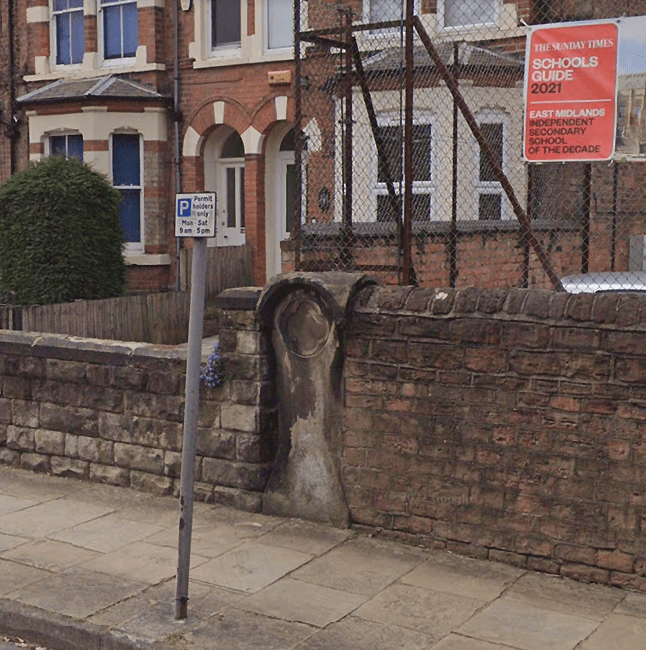
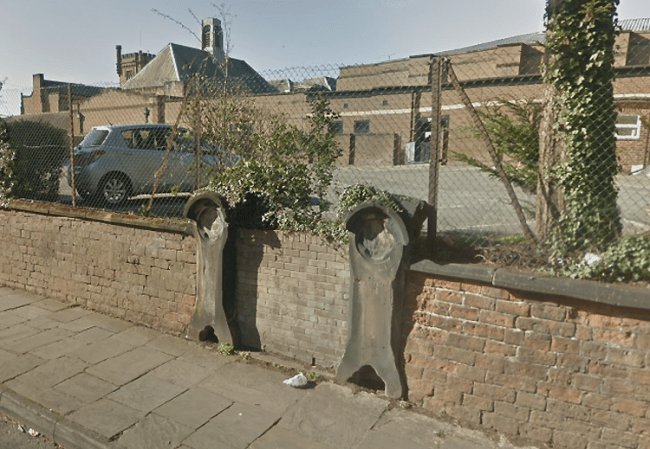
But what is this Victorian remnant? Some kind of fire hydrant?

At the side of No 23 Balmoral Road there is a pillar which clearly dates from the turn of the 20th century or earlier, and is visible in the second of the old photographs above. Here it is:

Further down, what has clearly been a gate to the school is still visible. In the controversial “pushbike-and-dog” photograph, it is down near the fir tree, but difficult to see. In the “Welcome, Munsters” postcard, it is the first gate you see in the wall and the ornate tops are clearly visible.  Here it is:

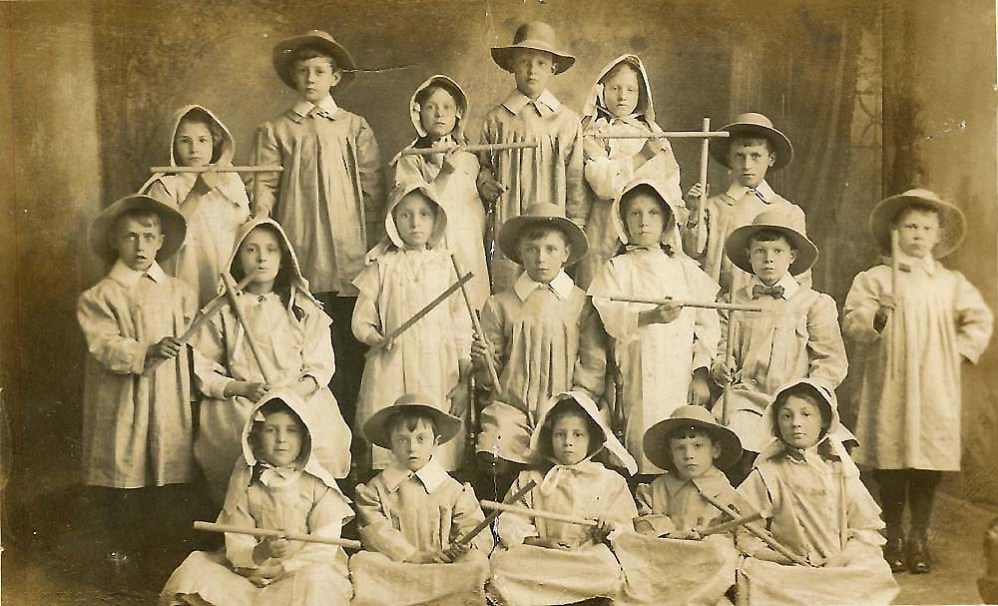
As  you know, I sometimes buy articles connected with the High School from ebay. A while back I produced seven blog posts called “Nottingham High School on ebay”. This link should take you to No 1 if you are interested. Sometime after #7 was published world wide, I bought this:

It shows a group of unknown children from what was called “Brincliffe School” although the presence of little boys must mean that events took place before 1907 when the Girls’ Grammar  School started up. I have no idea whatsoever what is going on with all their sticks and costumes. But the picture and the words that go with it really amount to a cry which comes from well over a century ago. And that wordless cry says

Here I am. I used to be alive like you.”

And those sentiments are present in the picture but they are also written on the back of the postcard:

It reads, as far as I can see:

“Yours Truly

Bernard Raven

as

A Farmers Boy

First boy on top row to the left”

Just have a look at him. The back row, the boy on the left. He can’t even be trusted to carry a stick, and appears to have lost his. But he is the one we can look at and we know his name. Bernard Raven. He grew up, perhaps he fell in love, perhaps he married, perhaps he had children of his own. I suspect we will never know. But with a little bit of luck, he will be read about, if only for a few seconds, in Australia, India, the USA, all over the world. I hope he was happy with his life.

24 Comments

Filed under History, Nottingham, Politics, The High School

The next few months of the Battle of the Somme, July, August, September, October 1916 (Part 3)

My previous blog posts about the Battle of the Somme were based on the “Both sides of the wire”” series of TV programmes, which were themselves based on the extensive researches of the English historian, Peter Barton, who has spent many years as a “battlefield guide” in the Somme area. He was the first person ever to consult the German language archives and was amazed to discover that he was the only English historian who had looked at them in a whole century. Here he is…..

My previous blog posts concentrated on the famous “First Day of the Somme”, July 1st 1916, the British Army’s most disastrous ever day, which  was portrayed in the first programme of the three. The remaining two programmes followed the campaign until the Battle of Boom Ravine between February 17th–18th 1917. This was when the Allies attacked the Germans troops on the Ancre Heights near Courcelette and to the north of the Ancre valley. That was the end, more or less, of the Somme Campaign. Overall, the British had casualties of 420,000 men, the French 200,000 and the Germans 512,000. If my Maths serves me well, that is 1,132,000 poor souls killed or wounded, many of them horrifically disfigured for life.

Rather than take you through these two remaining TV programmes in immense detail, I would prefer to tell you about the most striking details Peter Barton found. Although they are often unrelated to each other, these details are all really interesting and might well persuade you to set the recorder for all three hours of programming on the next occasion these ground-breaking documentaries are shown. So don’t expect a bedtime story, rather a list of unusual, quirky truths that Peter Barton found in his researches in the German Archives. I decided to label them “Fun facts” in case anybody wanted to have a test afterwards.

Funfact One

In the fighting from July 14th onwards, the excellent fighting qualities of the Germans were often completely underestimated, particularly their defensive organisation. Advances which were anticipated to take a few hours, instead took the British several weeks. The Germans had by now developed new tactics, there was extremely fierce resistance and the British attack just petered out. It took an unexpected two weeks to capture Longueval, and the Germans in nearby Delville Wood were to remain there until August 27th. What a pretty little wood it was! …….

Funfact Two

Overall, the Germans had always preferred to be defensive and the British were forced to be offensive. According to the German Archives, though, the British POWs had told their German captors that the British feared open warfare and very much preferred a war based on a defensive system with trenches, barbed wire and minefields.

Not all the British generals shared these views, however, and differences of opinion were frequently marked. Rawlinson was the second in command and he was an infantry man. He believed in what was popularly called “Bite and hold”, or the acquisition of enemy territory in cautious, tiny steps. Haig, however, the British No 1, was a cavalry man, who believed in great thrusts of advance. Haig had the derring-do of a cavalry man and was considered to be a “thruster”, a man who would always unleash the cavalry when the opportunity arose. Here’s Haig, wearing his “Anti-Gas trousers”….

Funfact Three

During the July 14th attack during the Somme campaign, there was a cavalry charge which involved some Indian troops of the 20th Deccan Horse. Peter Barton discovered that German POWs in British hands had reported, when they spoke to their own officers much later, that many of the British cavalrymen were feeding and watering their horses at the very same time when senior British officers had told the press that their derring-do charge was taking place.

In other words, the charge could not possibly have taken place as the newspapers described it. This was further emphasised by the fact that it could not have happened as early in the day as the newspapers reported, because the ground at that time would have been too hard and slippery for the horses’ hooves. Only later would conditions have been suitable. The inference is, of course, that direct lies were being told about events to make the British attack and their meagre achievements look more impressive.

Funfact Four

The Germans were aware of every single detail about the British because of their enormous number of telephone intercepts. They must been aware too, therefore, that the German army was only one fifth the size of the Allied forces.

Funfact Five

Again, the fact was emphasised that the British may actually have been very pleased to turn to defensive, trench warfare. Open warfare requires great flexibility, lots of different techniques and lots of different skills, but the German Archives revealed that the British troops seemed to have received no battlefield training whatsoever. Their basic tactic remained a massive heavy bombardment by thousands of mortars and field guns, and then a charge across no-man’s-land in large numbers. They had presumably learnt nothing from July 1st 1916, except that it was okay to run rather than having always to walk.

Even so, the Germans had enormous respect for the British, who attacked and then attacked again, even when it was obviously pointless. This, of course, produced enormous casualties for very little gain but that did not seem to matter a huge amount. With the Allied forces five times as numerous as their opponents, the war became very much a “war of attrition”. The effectiveness of attrition as a tactic was made to look all the better by using optimistic, or possibly, even false, German casualty figures.

Funfact Six

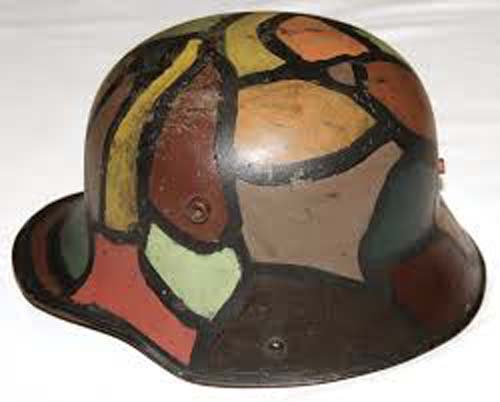
In the skies, the Royal Flying Corps, the RFC, were always dominant but the Germans were very adept at protecting themselves with camouflage, and very good at hiding themselves, and their weaponry. Most striking, perhaps, was their use of “dazzle camouflage”, as on this possibly early Bauhaus chamber pot from 1918…..


20 Comments

Filed under Aviation, France, History, military

Widdle (7) or, more accurately, the Rise of the Urban Fox

After the First World War, London began to expand as a city, particularly to the north and west. What had been farmland was now purchased and then built on. Many, but not all, of the woods were chopped down, the trees and branches were burnt, and new houses were then built on the site. The people who lived in those new houses for the most part worked in the centre of London and new words had to be invented to describe what they had to do in order to get to work. They took the train. Suburban, local trains, whose only purpose was to carry people who were now being called “commuters”, on their way to work. What they did was called “commuting”, and it obviously paid them to do it. Their salaries must have been high enough to justify adding a couple of hours to every one of their working days.

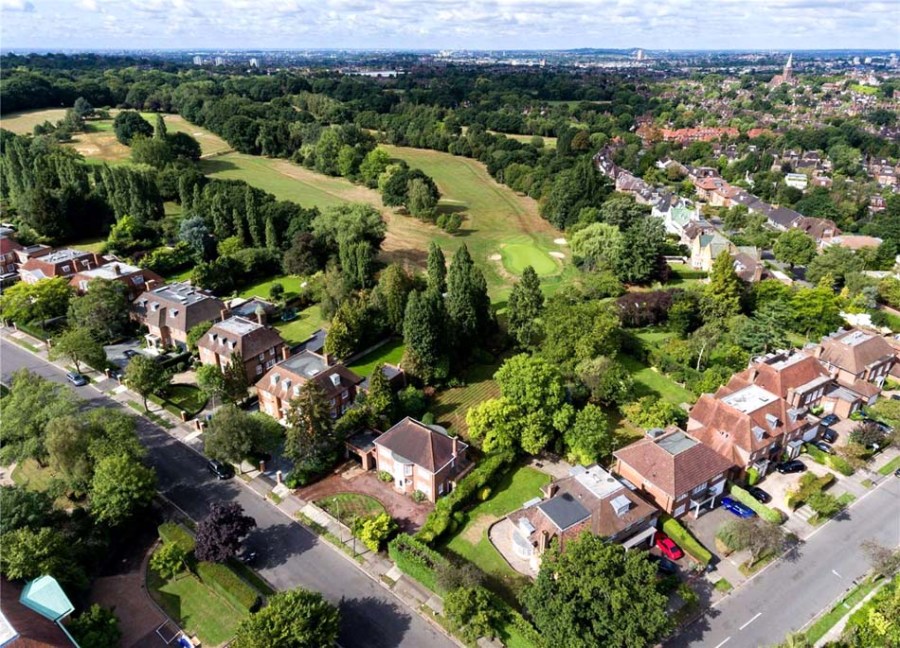
The very best paid commuters lived in what were called the “leafy suburbs”. They could even afford to buy a detached house near the golf course, with four or five bedrooms and a large private garden all the way round it:

In some cases, the leaves of the new leafy suburbs were attached to trees which pre-dated the building of the new houses. Builders with a bit of vision had soon realised that they could save themselves a lot of cash, and finish up with a much better product if they kept as many of the mature trees as possible. All they had to do was to build the houses between them and to do the same with the streets, if they could. Look at the age of these trees:

That slight change in approach by the builders had quite an effect on the suburbs created at the ends of the hundreds of the suburban railway lines which linked the centre of London with the houses where their office workers lived. And, to their credit, instead of just moving on elsewhere, the creatures which had lived in the woods before the developers arrived, made enormous efforts to stay in their homes and not be forced out.

In some cases badger setts survived the building process and remained unnoticed behind the park-keeper’s new storage sheds.

Hedgehogs hunted slugs and snails in rockeries and vegetable gardens, just as they had in spinneys, copses and woods.

Mice, shrews and rats went unnoticed, as they always have. But above all, one animal benefited enormously. That was “vulpes vulpes”, better known as the fox. They carried on their lives pretty much as they always had done, taking little or no notice of human beings and their machines. If anything, life was considerably easier, and food more plentiful now that they lived in a city suburb, which was always a few degrees warmer than the bleak countryside. And very soon London had in excess of 10,000 urban foxes. And many other cities experienced the same process. Bristol. Birmingham. Sheffield. And Nottingham, the home of the most famous fox of them all…….

Here’s another of them, hurrying to the fish and chip shop to see if anybody couldn’t eat all of what are, hopefully, generous portions:

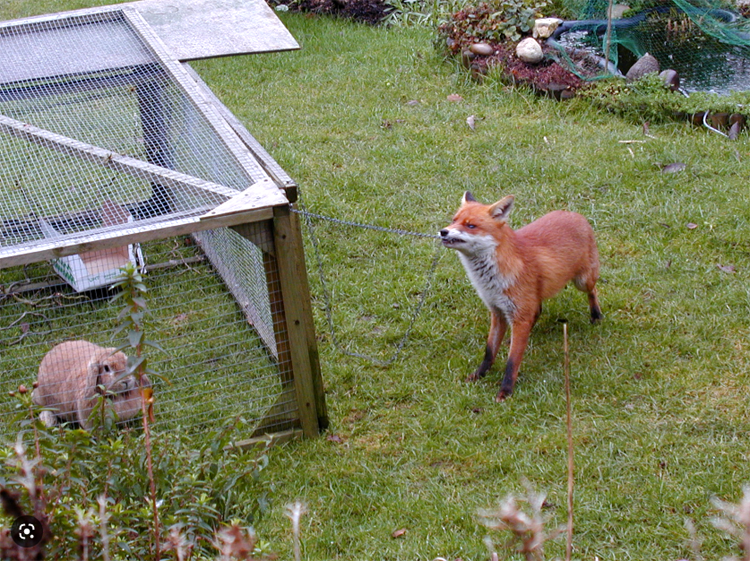
Foxes, like all undomesticated canids, are extremely intelligent. Once they have made a friend such as a big, fat rabbit, they always like to see if they can get even closer to him, perhaps by pulling a likely chain:

And here’s one of the very few photographs of Banksy Fox”…….

Next time, we take a look at the quality of the sausages available in the Iceland supermarket chain, exploring the views of one of their keenest consumers…………

17 Comments

Filed under History, My Garden, My House, Nottingham, Personal, Science, Widdle, Wildlife and Nature

Brincliffe Grammar School for Girls (3)

There was a strong connection between Brincliffe School and the High School but not, as you might expect, between the boys and the girls. Instead, the connection was a sporting one, and consisted of a number of football matches, all of them played between 1877-1880, when the physical building on Balmoral Road accommodated “Porter & Jones, boys’ school (Tudor House)”.

The High School had played their first match against another school seven years previously. News of the game appeared in the new school magazine, “The Forester”, which introduced a section entitled “Our Chronicle”, which was designed to allow reports about “the sports… of the School.”

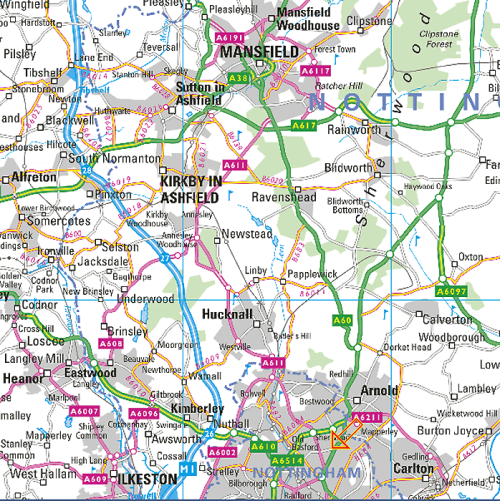
Thus, on November 19th 1870, having travelled to Mansfield, the Nottingham High School First XI played a Mansfield Grammar School XV at football, beating them 3-0. Around 110 years later I took the First XI to Mansfield, not in a steam train, but by minibus, and we played them on a darkish Wednesday afternoon. We lost, although by then they had changed their name to Brunt’s School, now changed again to Brunt’s Academy. The Orange Arrow shows the High School, Mansfield is in the middle of the top edge of the map, and then see if you can find Eastwood, the birthplace of DH Lawrence, ex-pupil at the High School (1898-1901).

History always likes to puzzle us with the fogs of confusion that it loves to create, though. Just as we were digesting the fact that the High School played its first ever football match on November 19th 1870, when the First XI beat a Mansfield Grammar School XV by 3-0, I found that there is a some evidence that organised football was played by the High School even before this.

In just one edition of “The Forester”, there is an allusion to a football game between the High School and a Tudor House School XV on February 27th 1878. Charles Edwin Attenborough, the son of a hosier from Bilbie Street, was unlucky enough to break his leg and dislocate his ankle. It was reported at the time that, with the exception of one broken collar bone in, probably, the 1872-1873 season, this was the the first injury of any consequence “since the new school opened in 1868”.

This intriguing phrase might conceivably be taken to imply that football matches had taken place in that short interim period of just over two years between April 1868 and December 1870, when “The Forester’s” first reports appeared. This is so long after the event, though, that we may never know the exact truth.

Seven years after their first ever game against any other other school, the First XI played Mr Porter and Mr Jones’ “Tudor House” on October 31st 1877, probably on a pitch on the nearby Forest Recreation Ground.  The First XI won 15-0 and “The Forester” recorded that Tudor House did not once get the ball into the High School half, at any point in the game…..

“Goals were obtained as fast as the ball was kicked off.”

Fifteen had been scored “when time was called”.

Four months later, on February 27th 1878, again probably on a pitch on the nearby Forest Recreation Ground, the First XI beat a Tudor House XV by 3-2 (as already mentioned above). During this game, thirteen year old Charles Edwin Attenborough was unlucky enough to break his leg and dislocate his ankle. Despite our modern perceptions of the roughness of Victorian football, “The Forester” reported that, with the exception of one broken collar bone four seasons previously, this was the first injury of any consequence “since the new school opened” in April 1868.

And here it is, a photograph thought to have been taken on April 16th 1868, the school’s first day. The first lesson to be learnt was that more toilets would be needed if queuing was to be avoided:

A week or so after the glorious triumph over 15 boys in the Tudor House XV, on March 6th 1878, on the Forest, the First XI again played a Tudor House XV. and beat this slightly more numerous team by 2-0. These two games were the last two fixtures of the season 1877-1878.

During the following season, Tudor House scored their first ever victory over the High School. On a day misprinted in “The Forester” as October 60th 1878, on the Forest, the reporter said that “This was a very even game, but the fact that Bramwell and four other first team members were absent probably tipped the balance in favour of Tudor House.” They won by 1-0. We don’t know what colours the High School played in. In both these photographs, the colours are black and white. They come from 1897 and 1910, approximately:

This slideshow requires JavaScript.

A year later, on March 12th 1879, at an unknown venue, but probably the Forest , the First XI played out a skilfully planned 0-0 draw with Tudor House. This fixture took place in an extremely high wind, which encouraged the Tudor House players merely to kick the ball out of play as far as possible at every opportunity. “The Forester” lamented….

“….Unfortunately there is no rule which provides for occurrences of this kind, but we should have thought there would have been a better spirit prevailing to prevent such unsatisfactory proceedings.”

When I was in charge of the First XI, around 2000, I employed this tactic and it was extremely effective. Even better is to kick the ball into the road, the busier the road the better. Boys are not allowed to pursue a ball in such circumstances and it has to be the teacher/referee who has to go and fetch it. Invariably, he always takes ages.

Seven months later, on October 15th 1879, and back on the Forest, the two teams met again, and this time the wind had dropped and the game finished 6-1 to the High School. Only five of the regular First Team were in what “The Forester” called the “motley crew” who won this game. Now, Mötley Crüe are an American heavy metal band formed in Los Angeles in 1981. Please don’t confuse them with the Victorian footballers. It’s easily done:

Being sensible, and playing Tudor House with a weakened team which lacked many of the regular First XI players didn’t last long, though. The very last fixture ever against Tudor House came on February 11th 1880. Again at an unknown venue, the High School triumphed. The score was recorded as

Nottingham High School “at least 12” Tudor House 0

“The Forester” wrote that

“the difficulty in this game was “not to get goals”, so weak were the opposition. Goal followed goal in quick succession, so that it was rather hard to keep a correct account. It was certainly not less than 12 goals, and may have been more.”

I once coached the Second Team in such a match. It finished 13-0 (referee). 14-0 (me) or 15-0 (several of the players). We lost, of course.

We once lost to another school team who had a nine-year old girl in goal. Their member of staff asked me if it was OK for her to play and I agreed, not knowing that she was Spider Woman in her spare time. We lost 3-2.

STOP PRESS

Elsewhere I have spoken about how, in the attic, I stumbled upon the box containing all of my slides from the 1970s and early 1980s.

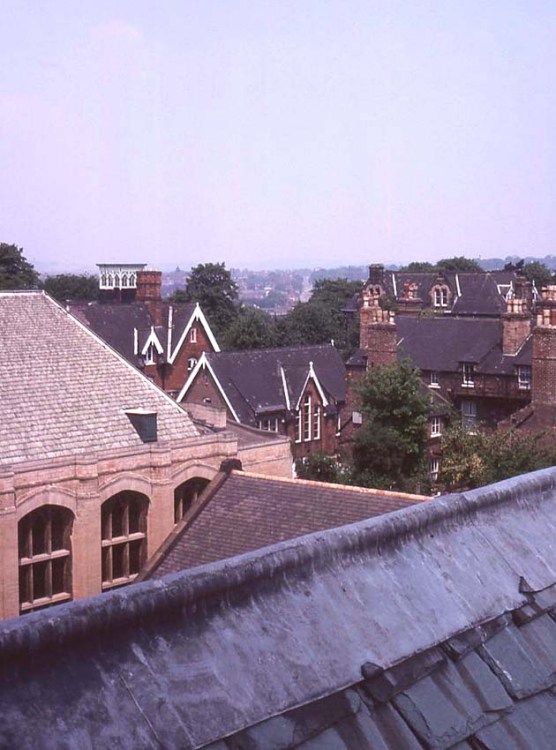
The photograph below I took around 1976. It was taken from the corridor which ran down towards the then E13, and you can see the roof of the Old Gymnasium and the Assembly Hall, sometimes called the Player Hall. Directly behind that are the two buildings of Brincliffe. To help you identify them, they both have gables picked out in bright white……..

15 Comments

Filed under Football, History, Humour, Nottingham, Politics, The High School

The First Day of the Battle of the Somme, July 1st 1916 (Part 2)

This post continues the  story of the disastrous First Day of the Battle of the Somme, using the details discovered by the English historian. Peter Barton, in his careful studies of the German Archives. We now know, for example, that every single German knew about the ten minute delay between the end of the British artillery barrage and the beginning of their infantry attack…….

This allowed them to emerge from their concrete bunkers to prepare their machine guns and their artillery for action. And when the fighting started, thousands of young British soldiers would die unnecessarily……

Peter Barton also discovered that the Germans possessed copies of the British textbook used to teach every aspect of British military tactics to would-be officers on special six-week courses. This wonderful find meant that Germans now had a minimum of a ten-week period to get to know, and how to combat, every single tactic likely to be used in the forthcoming Battle of the Somme, before the battle even began. Unbelievable! But very useful if you were a German.

As well as the book of British tactics, historian Peter Barton also found out from the German Archives that the Germans had in their possession all of the British plans overall and the detailed timetable of their individual attacks.

Part of those plans was to detonate the nineteen mines placed underneath many of the German front trenches. The British timetables the Germans possessed revealed that the mines were due to go off exactly twenty minutes before the main attack. This provided the Germans with a splendid reserve alarm clock, telling them how long they had to prepare their defences.

The Germans also knew all the details of the British artillery and the calibre of all the shells that they were firing.

The British soldiers who crossed no-man’s-land were the “New Model Army”. Recruited by Kitchener, they were very inexperienced and not particularly professional. Hardly any of the men had ever seen a German, and many of them were operating in “Pals” battalions. These were men from the same occupations or the same town and they had all joined up together, trained together, attacked together and, given their inadequacies, they might well all die together. You can probably imagine the effect of hundreds of local casualties on a small Lancashire or Yorkshire town.

Most of those casualties were the direct result of the tactics the British soldiers had been given by their officers….
“There is no need to charge. The Germans will have all been killed by the barrage.”

“Do not stop and try to shoot the Germans.

They will all have been destroyed by the British artillery.

Just walk over and take possession of the enemy’s trenches.”

The German Archives gave Barton further details about how they had managed to engineer such a slaughter of the young British lads.

Firstly, the German positions were physically higher up than the British. This allowed them to look out over the British front trenches and to see the Pals battalions much further back, preparing for their attack. And the German artillery could then prepare, at their leisure, when and where to fire as the Pals set off across no-man’s-land.

In similar fashion, the Germans were careful to set up their machine guns so that they could kill huge numbers of the British. The latter were slaughtered as they walked (as ordered) across no-man’s land.

Indeed, in many places, the location of the German machine guns, which were higher up than the British front trenches, allowed the Germans to fire over the heads of the troops in the British front line as they waited to attack. In this way, many of the British reserves and support troops much further back were killed before they had even reached their own front line, the departure point for the attack.

These more detailed researches go a long way to explaining why the first day of the Battle of the Somme was the worst day ever in the long history of the British Army.

The German archives revealed clearly, for example, that the week-long bombardment had been a complete waste of time and money. British prisoners of war revealed to their German captors that most of the German barbed wire was still intact when they finally arrived in front of the German trenches. The Germans already knew that as few as 40% of most British shells actually went off.

The British top brass had expected around 10,000 casualties among the attackers. There were 57,470. One could even argue that the Germans would have had to have made catastrophic errors not to have achieved the best part of 60,000 British casualties in only 17 hours of battle.

Most ironic of all was the statement that Barton found in the German Archives which stated that the Germans were 100% sure that the British, had they attacked by charging them, would have overwhelmed the German defenders easily because of their numbers. As it was, the ridiculous tactic of walking across no-man’s-land as if they were taking the dog for a walk, ensured that the Germans were able to kill most of the young British attackers.


26 Comments

Filed under Uncategorized

My best friend, Widdle (6)

The  colour and texture of a fox’s coat may vary due to the change in seasons.  It will be richer and denser in the colder months and lighter in the warmer months. To get rid of the dense winter coat, foxes moult once a year around April. The moult begins from the feet, up the legs, and then along the back, finishing with the neck and head.

Widdle was a fox who came to us, apparently around two years old, one day in 2007. He was looking for affection and for help. He came to us from a desire to understand nice human beings, and most of all, for unlimited access to good quality sausages:

Over the three to four years that we knew Widdle, his appearance changed a great deal. He was certainly not always what our American friends call a “red fox”, because in the spring and summer months, he was the hapless victim of his single annual moult.

According to Wikipedia, quoted above, a fox’s moult “begins from the feet, up the legs, and then along the back”. Sometimes in June, in the middle of the moult, Widdle looked rather like he’d been down to the pub the night before, and had a few too many:

In May, he had tried stretching exercises, but that didn’t last long:

No, the only remedy is a couple of sausages. Or so we thought. It was actually more complicated than that.

Widdle’s main problem with his coat was fleas, particularly during the moult. Here he is, scratching away. As far as we were aware, it was impossible for humans to be infected by fox fleas, and in up to four years with him, we never thought we had. I did once inquire about trying to give him something against fleas, but we were told it was pointless. Something for a dog and its fleas probably wouldn’t work. It might give him an allergic reaction and kill him. And, as soon as he went back to Mrs Widdle, he would be re-infected:

Male foxes fight quite a lot and here he is with part of his coat ripped off, I remember saying to him “That look’s a very painful wound.”, and he said “Well, you should have seen the other fella’.”

By winter, though, Widdle has acquired that magnificent coat that we all know and love. In this photograph, he shows that certainly as far as he is concerned, the neck is the last section to change.

Anyway, by early September, the transformation is complete. All that is missing is the white tip to his tail, which, as far as I recall,  Widdle never had. Well, not in full anyway:

And certainly, by November, it is as if he had been spray painted “fox-red”. He has lost all the black bits on his legs and the black and white stripes on the upper sides of his paws. He is Red Red Red:

The last picture comes from April 2010 when the very first signs of the Great Itching Time are beginning to appear. Even so, the coat still looks exceptionally thick and is standing on end to trap the warm air:


25 Comments

Filed under Humour, Nottingham, Personal, Widdle, Wildlife and Nature

The First Day of the Battle of the Somme, July 1st 1916 (Part 1)

I haven’t written very often about World War 1, but this particular subject, the Battle of the Somme, really attracted me……..

I have chosen the time to publish this blog post with great care.

On July 1st 1916 tens of thousands of British soldiers stood in the trench opposite the German lines.

When the officers blew their whistles, they “went over the top”, climbing up short ladders into no-man’s land, and walking sedately off, into battle.

Some 19,240 men of the British forces would be killed.

Some 38,230 of them would be wounded.

It was the worst day in the history of the British Army.

So……..what brought about this catastrophe?  Well ……..

By the end of December 1915, the Germans and the Western Allies had fought each other to a stalemate, a complete standstill. The latter therefore, resolved to organise massive co-ordinated attacks in 1916 in an effort to change the face of the war. The Russians and Italians, for example, would attack their respective German opponents and the British would carry out their “Big Push” into Belgium.

Things had to be completely changed in February 1916, though, when the Germans attacked the French at Verdun. The French were soon losing men in large numbers and they asked the British to attack not Belgium, but instead, to attack the Germans at the point where their two respective armies, French and British, were next to each other. This was the valley of the River Somme.

During the months of fighting on the Somme, the Allies would lose 623,907 men, including 146,431 killed or missing.

The Germans would lose 465,181 men including 164,055 killed or missing.

Allied casualties were huge……

And so were the German casualties……….

For the Allies, it was the British who fought the first day of the Battle of the Somme on July 1st 1916. These were the highest losses in any one day in the history of the British Army. The Germans, therefore, safe behind their defences, killed 19,240 men of the British forces and wounded 38,230 of their men. In just one day.

For the last century, analysts have argued why such a disaster occurred. I recently watched a three part series about the first seven months of the Somme Campaign. The programmes were based on the researches of an English historian. Peter Barton, who has spent many years as a “battlefield guide” in the Somme area……..

He carried out many of his initial researches largely because of the huge numbers of casualties involved.  He felt the first place to look would be the German language archives and he was amazed to discover that he was the first person ever to do so, and that not a single English historian had consulted them in a whole century.

Peter Barton’s overall conclusion was that the British had suffered so many casualties because of “recklessness, foolhardiness and treachery”.  All three will be explained in due course.

The cunning British plan for the forthcoming Battle of the Somme was simple……

Firstly, bombard the Germans with your artillery until they don’t know their own names.

That same artillery will destroy the barbed wire defences the Germans have in front of their lines.

Assemble huge numbers of Allied troops in their forward trenches, ready to go.

The officers blow their whistles.

The soldiers emerge into no-man’s-land and make their way towards the German trenches.

Walk, don’t run !!!!!

Take possession of the enemy trenches.

In due course, more Allied troops will arrive and any remaining Germans will surrender.

Then, all of the Allied armies will make their way deep into German held territory……… infantry, artillery, cavalry, everybody.

Repeat until you reach Berlin.

The whole thing could well be a perfect example of the strongly held British belief that “the artillery conquers, the infantry occupies”.

Peter Barton, though, found a completely different story in the German archives……

On June 30th 1916, the Germans were outnumbered by at least four to one and were completely out-gunned. Despite that, the following day, the British suffered 57,470 casualties with 19,240 killed.

Such a catastrophe is rather difficult to explain, but Peter Barton found the German Archives had plenty of suggestions.

Firstly, the Germans had been shelled for an entire week. The guns could be heard in London if the wind was right. The result, though, was quite simply unsatisfactory.

The enemy’s defences and guns had not been destroyed because a huge proportion of the shells had failed to go off. The barbed wire in front of the German trenches remained therefore largely intact.

The British troops, meanwhile, had been told to walk over to the German lines and quietly take possession of them. It would be easy, they were told, because by now the Germans would all have been killed by the bombardment.

When the attacking troops arrived at the German trenches, though, they were slaughtered……

The Germans were inordinately well informed about the British attack. For months they had been using a machine called “Moritz” which intercepted British radio broadcasts and created a huge mass of intelligence. By July 1st, the Germans knew absolutely everything there was to know, except the exact time of the attack. This they found out at 7.10 am, just twenty minutes before the whistles were blown, and the men went “over the top”.

The German Archives also proved that the British prisoners of war they had captured before the beginning of the battle had revealed every single detail of the British plans. By the time the battle began, hundreds of them had divulged everything there was to know about the British attack, including the British Order of Battle and the identity and location of every unit in the British forces. Much of it came from one particularly talkative British deserter.

19,240 men killed and 38,230 wounded 

Next time, more details about all the advantages handed on a plate to the Germans, before those fatal whistles blew, at 7.30 am on July 1st 1916.


18 Comments

Filed under France, History, military