Author Archives: jfwknifton

Brincliffe Grammar School for Girls (2) Before and After

Having started my researches abou the Brincliffe Grammar School for Girls on Balmoral Road, I could not resist trying to find out more, and more, and more……..

Using my very sad collection of Kelly’s Directories of Nottingham, I was able to trace just a little bit of history, not so much for the Brincliffe School, but for the site where it would eventually be situated.

And so, in 1876, (the year of Custer’s Last Stand), on the corner of Balmoral Road and Forest Road, on the western side, was “Porter & Jones, boys’ school (Tudor House)”. In other words, the same building which would, one day in 1907, house Brincliffe Grammar School for Girls, had been, thirty years earlier, a private school run for profit, inside what had originally been a private house. The two partners in the business were Messrs Porter & Jones, and they had given the school the name of “Tudor House”.
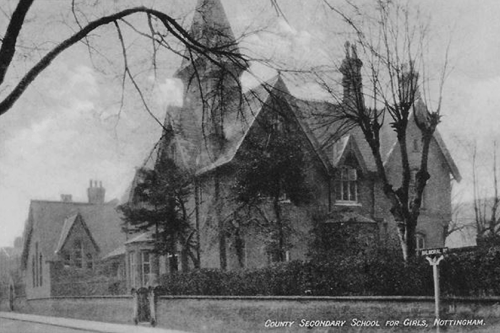
Three years later, in 1879, the entry reveals that Tudor House had become a boarding and day school and that, of the original partnership of Porter & Jones, Mr Gregory Porter seemed to be the Head Honcho.

In 1881, the house, now apparently the property of Mr Gregory Porter alone, was now No 25 Balmoral Road. No 23 is still standing, the house immediately to the left of the main entrance to the High School staff car park. In 1885, the situation was exactly the same.  Tudor House, and Gregory Porter, were still in business. Here’s Nos 19, 21 and 23 today, complete with original Victorian sandstone wall:
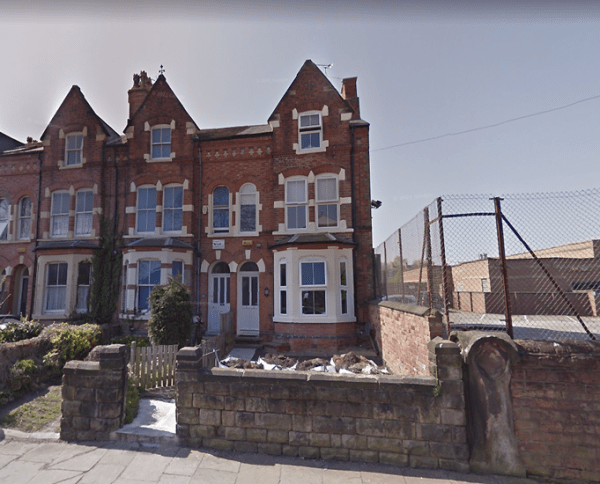
Alas, by 1891, Tudor House was no more, and the school became “a ladies’ school” for ladies. under its Headmistress, Miss Blanche Hall.

By 1894-1895, the Misses B. & K. Hall were running a boarding and day school at No 25. The house was now called “Brincliffe”. Why they had chosen this name, I do not know. Presumably, it refers to the “brink” or edge of a “cliff”, a reference perhaps to the small area of steeply sloping ground to the northwest of the Church Cemetery, overlooking the much flatter and much lower, Forest Recreation Ground.

Here is that “brink of a cliff”:

The slope is actually quite steep and, while not a cliff, it would have seemed a lot more precipitous 140 years ago because there were no trees then. The trees are quite young for trees, only around 80-100 years old. Here is a view inside the trees on a very familiar path down from the High School (and Brincliffe) :

The slope is certainly steep enough to sunbathe on. Here is a lovely Sunday afternoon with people in their Sunday best, relaxing around the long gone bandstand. See if you can solve “Where’s Walter?” and can you spot Robin Hood?
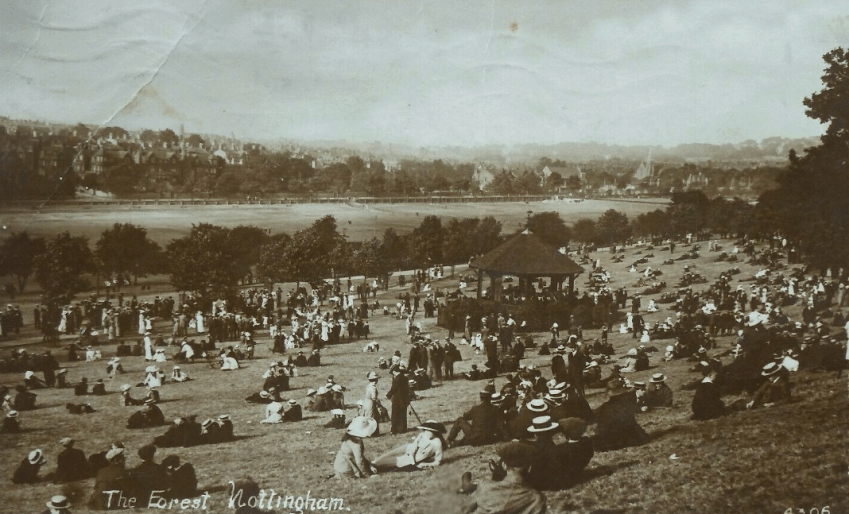
And here is the much lower flat area, which has always hosted any number of football/soccer pitches. In 1865, they had seen the birth of Nottingham Forest, nicknamed at the time, the “Garibaldi Reds”:

So, by 1894-1895, the Misses B. & K. Hall were running a boarding and day school at No 25. It was called “Brincliffe”. And now you know why!

By 1898-1899, “Brincliffe” had been acquired by the Misses Koppel & Hall. It was still No 25. In 1904, Miss Amy Koppel was running the boarding & day school on her own, the premises still with the same name and number.
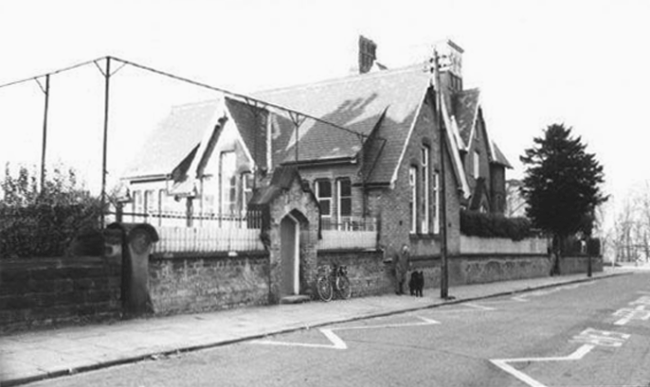
In 1907, the City Council made it a Girls’ Grammar School, but from 1913 onwards it is listed as just “Notts County Secondary School, Miss Sybil Randall, head-mistress”

I have not been able to find any pictures of the girls in their green blazers and Green Berets, “à la John Wayne”. That crumpled, baggy 1950s blazer is still the only thing I’ve found:

One final detail.

The very first mention of a school on the Brincliffe site was “Porter & Jones, boys’ school (Tudor House)”. We know this already, but one thing I did find was that in 1862, a Miss Sarah Porter was running a “school” on distant Woodborough Road. In 1864 she was named as Miss Sophia Elizabeth Porter, presumably the same person (or perhaps sisters), still in an un-numbered location on Woodborough Road.  Unfortunately I have no directories available for the period 1864-1876.

13 Comments

Filed under History, Nottingham, Politics, The High School

A discovery in the loft

A few months ago, after probably years of intermittent searching, deep, deep in the loft, I found the battered green cardboard box which I had always used to store my slides. It was hiding in plain sight, mixed in with around fifteen cardboard boxes of varying sizes and colours.

“What are slides ?”, I hear everybody under forty five thinking to themselves.

Well, fifty or sixty years ago, cameras were not at all like they are nowadays, and they required that the photographer did his or her fair share to make them actually take photographs. I was very keen on photography and I soon joined the ranks of those who took slides. Here are some random slides, in this case Kodak, which could be quite expensive. I preferred to use the much cheaper East German slides manufactured by Orwo. The frame of the slide is either cardboard or plastic, and and the slides themselves are merely a roll of photographic film which has been developed and then cut into 36 pictures:

Once I had two or three boxes of slides, I could then bore both friends and family rigid with interminable slide shows about “What we did on our holidays”. If you didn’t want to project your slides onto a screen, then you could buy a tiny “slide viewer” which allowed you to view your slides on what was more or less a four inch TV screen.

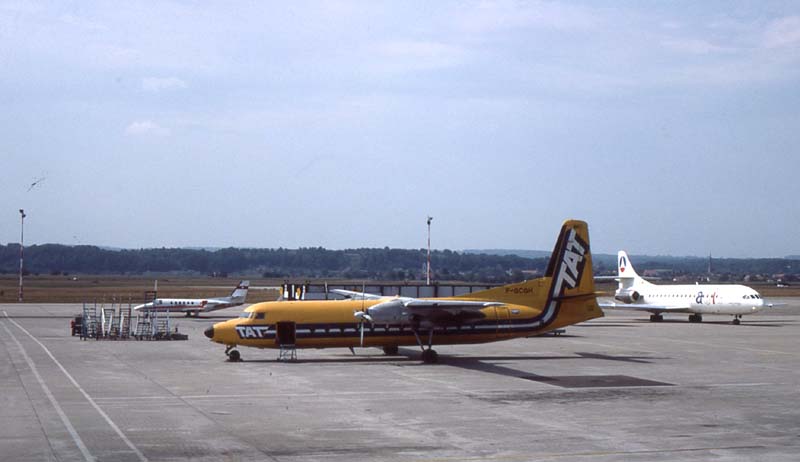
The first slide in this selection is a plane spotter’s dream, as I took a golden opportunity to photograph a foreign airport. I actually find passenger aircraft rather tedious, but I reckon that in this one slide there’s a Caravelle on the right, and perhaps a Fokker Friendship in the centre:

All of the cameras which I could afford were the kind where it was impossible to look through the lens to see what your eventual picture might be. Instead, there was just a view finder. Here’s a picture of a camera pretty much like mine, in the early 1970s. It’s a Voigtländer, a German camera, although I had originally bought mine more because it had a Leica lens:

To take photographs, you also had to use a light meter. Here’s one quite like mine, although I’m afraid I have only the vaguest idea of how I used to operate it. First of all, I think I used to set the overall controls on the meter for whether the camera was using a fast or a slow film. This means whether the film worked best in bright sunlight or in darker conditions, such as inside a church, for example. Then I used to insert the light reading I had taken into the various dials on the meter and then choose how I wanted to proceed. That would depend on the distance away from the camera of the subject and whether it was bright or dull weather, and whether the subject of the photograph was moving quickly or slowly.

The best results came when bright light made it possible to set the camera at 1/500th at “f22” with the lens of the camera focussed on infinity, marked as “”.

Here’s a link on how to use a light meter,

And here’s a light meter:

There were one or two further difficulties with slides, though.  They always seemed to pick up lots of dust and grime, all of which would be magnified when it was projected onto the screen.

Last June I was overjoyed to find that long lost medium sized green cardboard box. I recognised it immediately. It was the very box where I used to store all those yellow and blue plastic boxes full of slides. And there they were. Hundreds, if not thousands, of slides, none of which I had seen for the best part of forty or fifty years.

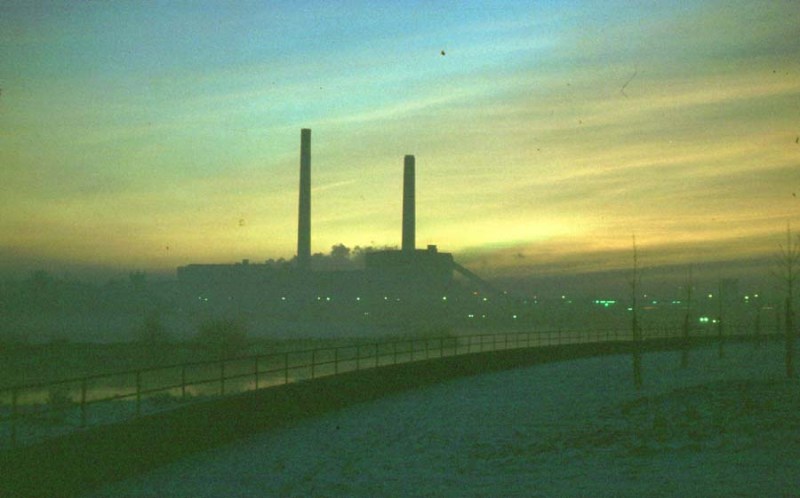
And then I remembered about our latest scanner. It had a setting for turning slides into digital images. I didn’t know anything whatsoever about how that worked but I gave it a go, and, sure enough, it reproduced all of the dust and grime absolutely perfectly, with the occasional added bonus of changing the overall colours of a slide into something quite bizarre such as purple or dark green. There was a setting on the scanner which suggested that I might wish to “Rectify the bizarre colours of your age old slides” and I chose this, but fairly frequently it just brought in a different weird colour. Here’s an example, taken in Switzerland :

And here’s another. This is the River Trent at Nottingham, with the old Wilford Power Station still standing proudly in the gloaming.  Nowadays, it is  long demolished, replaced by the                                                                                                                Retail Park:

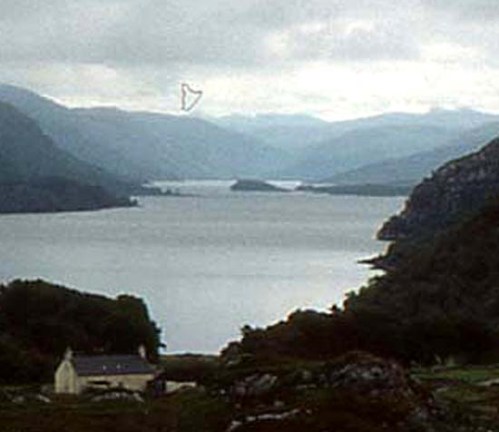
Rather naively, I had expected that all of the particles of grime, dust, grease and common household insects would be taken care of by the magic of the scanner’s technology, but, alas, I was wrong.  So, enjoy the “Flying Harp of Old Oireland” :

Were you able to spot it? Here’s an enlargement…..

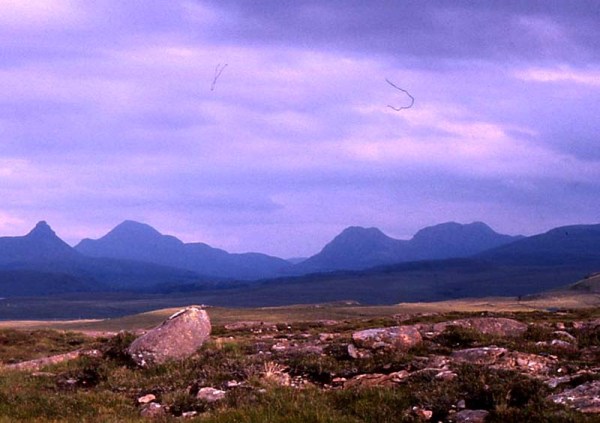
The “Artist formerly known as “Prince” possessed his very own breeding pair of Scottish Flying Snakes. Here they are, pictured at the height of their mating dance among the Purple Mountains and the Purple Haze in the very north of Scotland :

Here are just a few of the Exploding Gas Bombs used by the Scottish Liberation Army:

My next slide I call “UFOs over the mountains”. It’s the largest gathering of extra-terrestrial craft ever photographed. Or, it’s a tornado hitting the Glencoe Municipal Landfill site:

And thank goodness, after a good deal of practice, I have become quite adept at cleaning up the extraneous details. to produce a reasonably decent final version :

And finally, here is the slide I was offered well over $50, 000, 000 for………

“The Loch Ness Pterodactyl”

Did you manage to find it? Here’s an enlargement…..

It took me ages and ages and ages to rectify the dirt and grease on so many of my slides. A lot of the colour problems I was unable to solve. And I still have around twenty boxes of slides still to do.

What I intend to do now is to use some of my old slides in my blog posts. I’ve taken them in a number of different places including the Netherlands, Scotland, Switzerland and West Germany as well as Nottingham and the village where I grew up, namely Woodville in South Derbyshire. You have been warned!!


21 Comments

Filed under Aviation, History, Personal, taking slides

An impossible Beatles Quiz (1….the Answers)

Hi there! Here are the answers to the first Beatles quiz. To be fair, I think that most of you have worked out what they are, but in the interests of completeness,  here they are.

1       Who stands in front of me in my hour of darkness?

When I find myself in times of trouble
Mother Mary comes to me
Speaking words of wisdom
Let it be

And in my hour of darkness
She is standing right in front of me
Speaking words of wisdom
Let it be

2       Who will never walk down Lime Street any more?

Oh dirty Maggie Mae they have taken her away
And she’ll never walk down Lime Street any more
Oh, the judge he guilty found her, for robbing a homeward bounder,
That dirty no good robbing Maggie Mae

3        She came in through the bathroom window, but what was her protection?

Well, in the song of that name, “She came in through the bathroom window”………..

She came in through the bathroom window

Protected by a silver spoon

But now she sucks her thumb and wanders

By the banks of her own lagoon

Didn’t anybody tell her?

Didn’t anybody see?

Sunday’s on the phone to Monday

Tuesday’s on the phone to me

Some fans supposedly took a ladder from Paul McCartney’s garden, climbed into his house in London, and stole a precious picture. The internet names the bathroom criminal as Diane Ashley.

4       Who thought she was a cleaner? But what was she really?

The answer/s is/are from “Get Back”. …….

Sweet Loretta Fart. She thought she was a cleaner
Sweet Rosetta Martin
But she was a frying pan.

Alternatively………

Sweet Loretta Martin thought she was a woman
But she was another man

Either answer is fine. Both answers and you have won a holiday in Liverpool.

This picture shows all the usual accoutrements of a kitchen except the frying pan. I told you the quiz would be difficult.

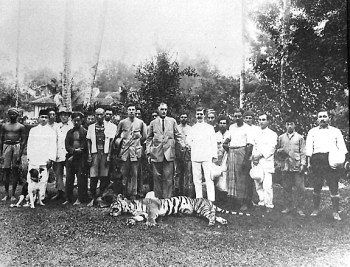
5        In “The Continuing Story of Bungalow Bill”,  who did the the all American bullet-headed Saxon mother’s son take with him when he went out tiger hunting with his elephant and gun?

What did you kill, Bungalow Bill?

He went out tiger hunting with his elephant and gun
In case of accidents he always took his mum
He’s the all American bullet-headed Saxon mother’s son

6       With whom does Paul McCartney spend his days in conversation?

Martha my dear though I spend my days in conversation
Please
Remember me Martha my love
Don’t forget me Martha my dear

Hold your head up you silly girl look what you’ve done
When you find yourself in the thick of it
Help yourself to a bit of what is all around you
Silly girl

Take a good look around you
Take a good look you’re bound to see
That you and me were meant to be for each other
Silly girl

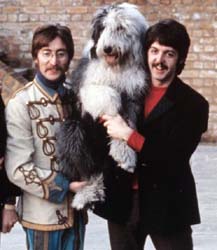
The photograph was a clue to an even greater truth. Yes, the song is about a girl, but it was inspired by “Martha” (1966-1982), Paul McCartney’s pet Old English sheepdog.

7       What is happiness?

Not, as Ken Dodd sang, “the only gift that I possess”, but a warm gun……..

Happiness is a warm gun (Happiness bang, bang, shoot, shoot)
Happiness is a warm gun, mama (Happiness bang, bang, shoot, shoot)
When I hold you in my arms (Oo-oo oh yeah)
And I feel my finger on your trigger (Oo-oo oh yeah)
I know nobody can do me no harm (Oo-oo oh yeah)

“Happiness is a warm gun” was the slogan of the National Rifle Association. John Lennon saw an article in a gun magazine in Texas with this phrase.

The picture-clue shows a Mother Superior because the chorus…………

Mother Superior jump the gun

….is a very dominant part of the song.

“Mother Superior” was one of the names that John Lennon used with Yoko Ono and “jump the gun” was possibly a sexual metaphor. Anyway, here’s a warm gun. And he looks about as happy as you can get :

8       Now, a question about the girl of his fancy. What was her surname, what did she call herself and what did everyone know her as?

It all comes,of ourse, fom the song entitled “Rocky Raccoon”………

His rival, it seems, had broken his dreams
By stealing the girl of his fancy
Her name was Magill, and she called herself Lil
But everyone knew her as Nancy

Now she and her man, who called himself Dan
Were in the next room at the hoedown
Rocky burst in, and grinning a grin
He said, “Danny boy, this is a showdown”

But Daniel was hot, he drew first and shot
And Rocky collapsed in the corner, ah

D’da d’da d’da da da da
D’da d’da d’da da d’da d’da d’da d’da
Do do do do do do

The clue to the song title was in the picture:

9       How many holes in Blackburn, Lancashire?

Well, according to the song, “A Day in the Life”……….

“I read the ews today, oh boy
Four thousand holes in Blackburn, Lancashire
And though the holes were rather small
They had to count them all
Now they know how many holes it takes to fill the Albert Hall

I’d love to turn you on”

This particular song was contained a series of images that had all been on John Lennon’s mind. He said:

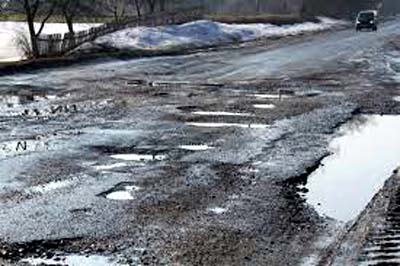
“I was reading the paper one day and noticed two stories. One was about the Guinness heir who killed himself in a car. That was the main headline story. He died in London in a car crash. On the next page was a story about four thousand potholes in the streets of Blackburn, Lancashire, that needed to be filled.”

10    Who made a fool of everyone ? Why did we give her everything we owned?

Two answers. The first one, from the White Album song of the same name:

Sexy Sadie what have you done
You made a fool of everyone

And here’s the answer to “Why did we give her everything we owned?”  :

We gave her everything we owned just to sit at her table
Just a smile would lighten everything
Sexy Sadie she’s the latest and the greatest of them all”

There’s a fairly complex explanation of who Sexy Sadie was at this website

The Beatles had been in India with the Maharishi Mahesh Yogi.  Lennon’s friend Alexis Mardas, aka “Magic Alex” arrived. He had been Lennon’s guru and he started a rumour to discredit the Maharishi.  He alleged that the latter had made sexual advances to one of the women who was there. Hence Lennon came up with the line which was originally “‘Maharishi, what have you done? You made a fool of everyone.”

Any score at all in this pesky quiz is an excellent achievement.

21 Comments

Filed under the Beatles

Brincliffe Grammar School for Girls (1)

When I am writing blog posts, just like David Bowie and Jimi Hendrix, I don’t normally do requests. On the other hand, I did feel a little bit guilty that, months ago, somebody contacted me and said, very politely, “Maybe one day you could tell us a bit more about Brincliffe School, please?”. Regrettably, I did not record their name. On the other hand, the Hairy Godmother has granted their wish………

Brincliffe School was situated in Balmoral Road in Nottingham, immediately to the east of the High School. This Grammar School for Girls occupied the area between the western corner of the junction with Forest Road East, as far south as No 23, the first house of a row of three storey Edwardian properties. The Orange Arrow tells the tale, indicating precisely the southern boundary of the now demolished school:

Here’s the Victorian equivalent of the same area. The Brincliffe building is south west of the “B-A-L” of “Balmoral Road”.:

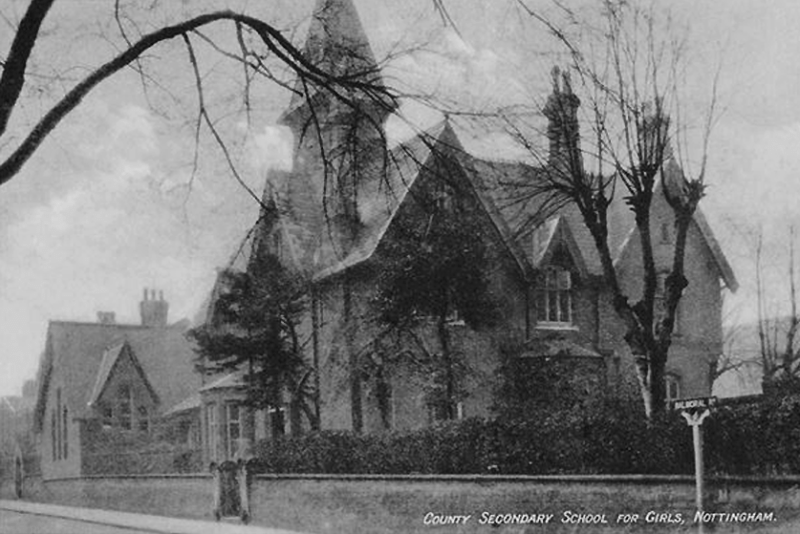
Brincliffe didn’t really look much like a school. It was more like a school housed in a private dwelling house:

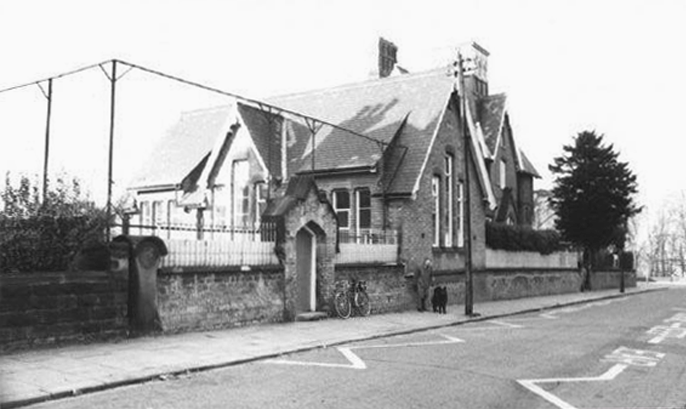
At one time, when it was a private house, Dame Laura Knight, the artist, had lived there. Not many pictures of the building are left nowadays. It was demolished in the late 1970s. Here is the view from the south. The key to linking up the two photographs is the bottom left of the photograph above, and the centre right of the photograph below. The three windows and the gate with a portico are crucial links. Don’t miss one man and his dog who have stopped for eternity next to the telegraph post.

Brincliffe was an all girls’ grammar school, which operated from 1907-1974. Entry was by passing a competitive examination. Unlike Nottingham Girls’ High School, no fees were payable. Such selective, and free, schools were a fantastic source of social mobility and an excellent examination for the poor.  Everybody in the school had a talent and the schoolwork they did was of a very high standard. At Brincliffe, girls had a genuine opportunity to do what they wanted to do with their lives, with little interferece, except from their own families.

The school produced a Gold Medallist in the 1974 Commonwealth Games, an Oxford don, a member of the D’Oyley Carte Opera Company, any number of students at Oxford and Cambridge Universities, and innumerable doctors, dentists, solicitors and politicians. And all of them came from an ordinary background. If you doubt that, then go and look at their Facebook page.

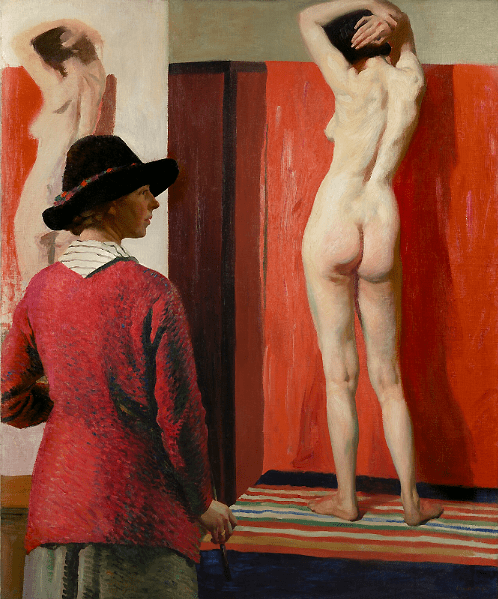
The most famous high achiever from Brincliffe was surely Dame Laura Knight, the painter.   One of her most famous paintings was “Self portrait with a nude”. It caused a right fuss:

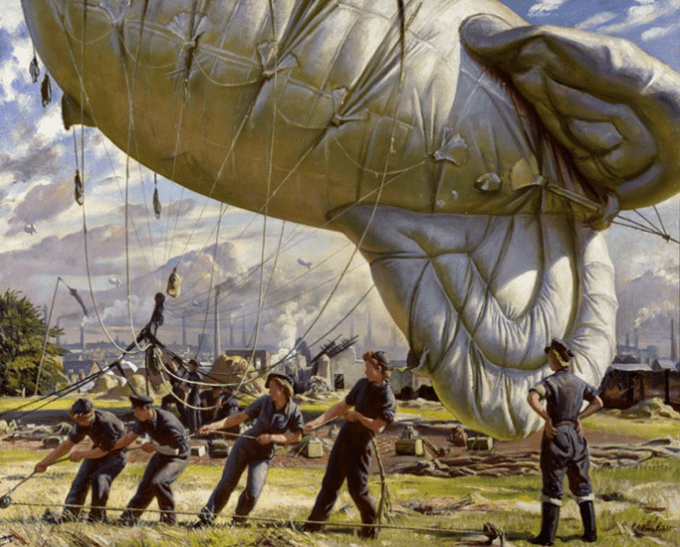
She also did a lot of paintings of World War Two. They included “A Balloon Site, Coventry” in 1943:

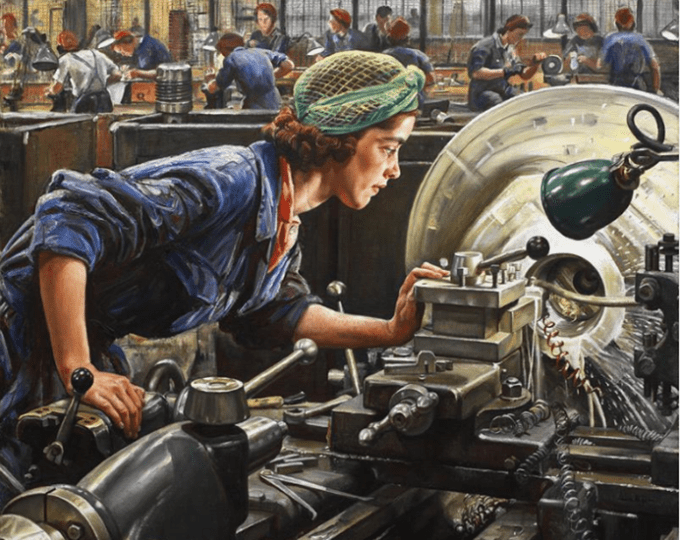
The superbly composed “Ruby Loftus Screwing a Breech-ring” in the same year of 1943:

And a portrayal of the crew of a Short Stirling bomber in 1943. It is entitled “Take Off “, and I found in one account that the poor young wireless operator had been killed almost before the paint on the painting had dried :

Dame Laura was one of a very few female artists during her era. Another famous Old Brincliffian was Enid Bakewell who played for the English women’s cricket team in twelve Tests between 1968 and 1979. Her batting and bowling averages show that she could well be  regarded as the best all-rounder that the English women’s game has ever produced.

The Brincliffe School ran from 1907 onwards, for almost seventy years. There was only a single thirty girl form in each year, so everybody knew each other. The pupils used to wear dark green blazers and berets. Here is a typical green blazer of the period:

Brincliffe had only five Headmistresses during its history, the Misses Randall, Yates, Yonge, Lloyd and Carter. Teaching at Brincliffe came to an end in 1974 and I can remember still seeing the typical Victoria building during my first few years at the High School, from 1975 onwards. I have vague memories that, as the school was so close to the High School, we were allowed to use the empty classrooms for some of our smaller classes, such as Sixth Form groups. Brincliffe didn’t die in 1974, but it was severely wounded by a Labour Council’s decisions.  It was merged with another school for girls on Gregory Boulevard. This was the Manning School, formally opened by Alderman Manning in April 1931. (Aren’t local politicians just shameless?)

When Brincliffe and Manning merged, they also became a comprehensive school catering for girls aged between 11 and 16 years. In 1983 the school moved to new buildings in Aspley, a suburb further to the west, whilst the old school buildings on Gregory Boulevard became the Forest Comprehensive School. In September 2011, the Manning School became the Nottingham Girls’ Academy, the first all girls’ academy in Nottingham. It catered for girls aged between 11 and 18 years old.

34 Comments

Filed under History, Nottingham, The High School

An impossible Beatles Quiz (1….the Questions)

Hello there, sad children of the sixties!

I’d like to cheer you up with another quiz in my series of Beatles quizzes. The answers will be published in another blog post in a few days’ time.

The questions all refer to albums, including “Sergeant Pepper” and those coming after that.  If you want to look up the answers on Google and do it that way, then good for you, but you might enjoy the questions more if you tried to do them yourself without any help from the Internet. I have tried to make the questions doable, but clearly, one or two are meant to be difficult. Incidentally, the questions do not necessarily relate 100% to the illustrations, although the illustrations are meant to be a very large clue to the correct answers. On the other hand, the answer to Question 1 is not “A bald man with a tattooed head”

1       Who stands in front of me in my hour of darkness?             

2       Who will never walk down Lime Street any more?  

3       She came in through the bathroom window, but what was her protection?

4        She thought she was a cleaner,  but what was she really? And what was her polite name?

5        Who did the “all American bullet-headed Saxon mother’s son” take with him when he went out tiger hunting with his elephant and gun?

6       With whom does he spend his days in conversation?

7       What is happiness ?

8       Now, a question about the girl of his fancy. What was her surname, what did she call herself and what did everyone know her as? 

9       How many holes in Blackburn Lancashire?  
10    Who made a fool of everyone ? And why did we give her everything we owned?

34 Comments

Filed under the Beatles

Enigma 4

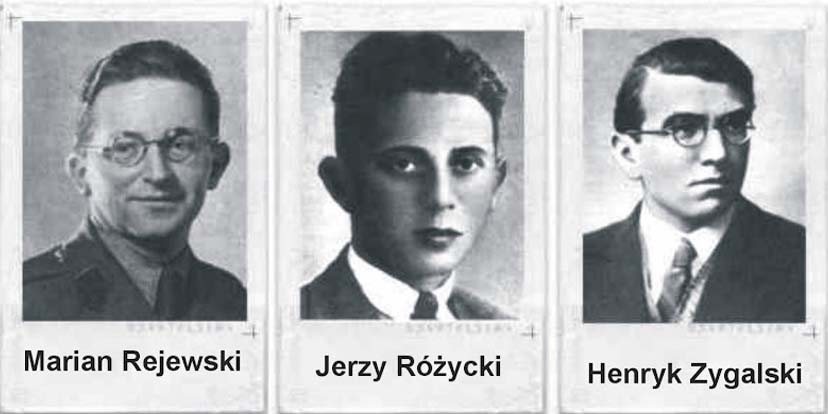
Last time, I was telling the story of how the three Polish whizz kid mathematicians, Marian Rejewski, Jery Rozycki and Henryk Zygalski, had told the British and the French, everything they had discovered about Enigma. Here they are:

That generous act enabled the British to begin decrypting German messages almost straight away, and, very soon, to start affecting the outcome of the war. In March-April 1941, Enigma revealed, for example, that Crete was going to be invaded from the air, using gliders and paratroopers. Everybody was ready for them and the German invasion force suffered heavy casualties, with as many as 4,000 men killed.

I also talked last time about how, in May 1941, the Royal Navy was told the whereabouts of all the supply ships that were servicing the Bismarck. They also ascertained on one particular occasion, that the Bismarck was headed to a harbour in France, rather than in Germany.

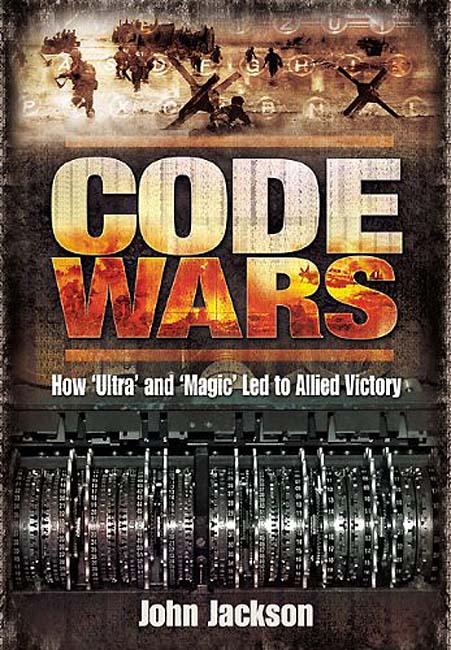
The stories all came from the book by John Jackson which relates the story of Enigma, the German encrypting machine used throughout the entire Second World War, the Germans always confident that their codes could never be cracked….

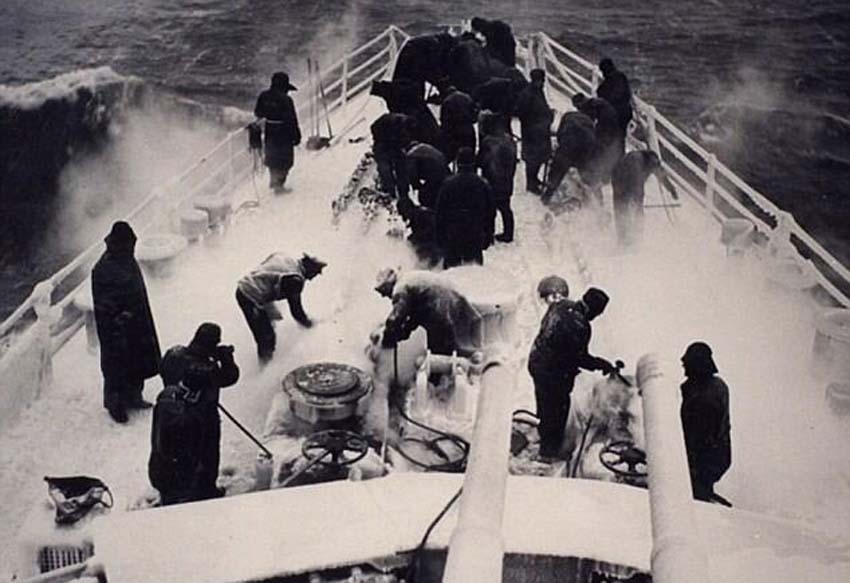
In July 1942, if the Royal Navy had been clever enough to believe the Enigma decrypt given to them, they would not have told the Arctic convoy PQ17 to scatter, an act which condemned 24 ships to a watery grave and 153 sailors to an early death. Arctic convoys were dreadful:

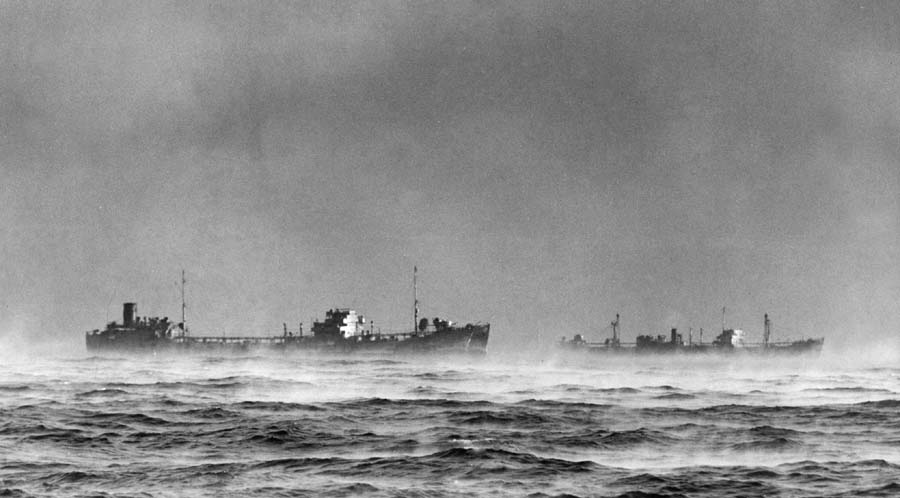
Temperatures were always unbelievably low, and the ships were  attacked more or less constantly:                                                                                                                                                                                                                                                                                                                               

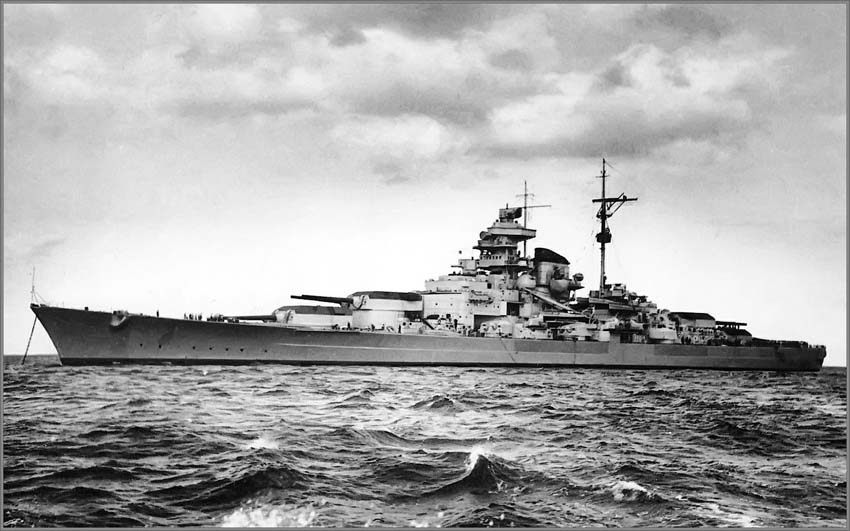
There was very little air cover, and the one constant threat was the mighty battleship, the Tirpitz:

Even Enigma cannot overcome the arrogance of unintelligent senior officers. And what was the reason for the mix-up?

Well, the great men at the top end of the Royal Navy believed that the Tirpitz had left port to attack the convoy. But, unbelievable as it may seem, they were actually mistaken and the biggest naval disaster of the Second World War ensued.

In April 1944, General Guderian went on a tour of the various armoured units that the Germans had stationed in Normandy. This enabled the Allies to know exactly which Germans were where, and gave them…….

“a splendid insight into the distribution of the armour a month before the landing.”

Here is General Guderian. He was the author of the definitive book on tank warfare called “Panzer”. If only one of the senior English officers had read it before the Panzers rolled into France in 1940:

Further Enigma decrypts in 1944 revealed exactly the strength of the Germans in northern France, with six top quality divisions in France and Belgium, along with fourteen divisions of lesser quality. Worryingly, perhaps, the Cotentin Peninsula, to the west of the D-Day beaches, was being heavily reinforced, although it was music to Churchill’s ears to hear the large number of complaints from a large number of various German units that petrol and oil were again in very short supply. The Prime Minister was also extremely pleased to hear that, day by day, Hitler and his generals were beginning to believe more and more strongly that the Allies would land not in Normandy, but in the Pas de Calais.

Enigma decrypts also revealed that in, May 1944, the Luftwaffe had a thousand aircraft including 650 fighters, although Allied numbers were much, much, higher. Interestingly, given that the weather satellite had not yet been invented, the Allies were delighted that on D-Day, thanks to Enigma, they would be able to use what were probably far more accurate forecasts than anything they had themselves, namely the Germans’ own weather forecasts.

In June 1944, Enigma also managed to decipher encrypted messages between Peenemünde and Blizna, a testing ground for the V1 and V2. Before long, everybody at Bletchley Park was familiar with the name of Werner von Braun, soon to give up being a career war criminal and to move to a cushy well paid job in the United States.

Here’s a V2 rocket:

They were tested initially at Peenemünde and then at Blizna. Not a lot went on without the Enigma decrypts letting the RAF know something about it. Peenemünde was heavily damaged after a huge number of RAF bombers bombed every square foot of the site. They included 103 Squadron, starring my Dad. The RAF were particularly keen to blast and obliterate Peenemünde, because they’d all been told……

“Destroy the secret weapon site tonight, or you’ll all have to go back tomorrow evening.” 

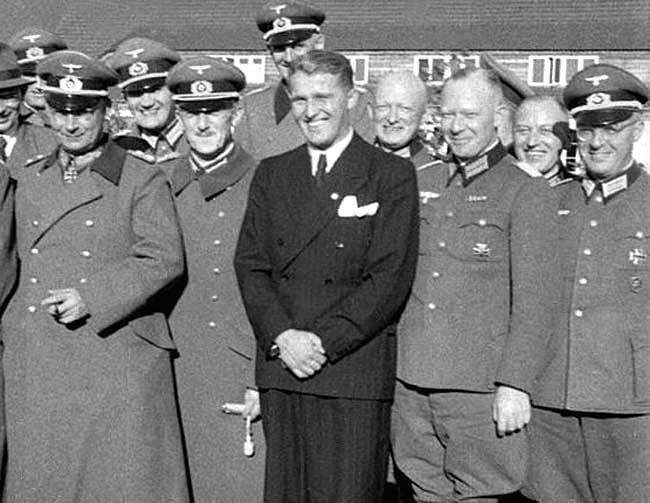
The main scientist in charge at Peenemünde was, of course Werner von Braun, not an SS war criminal who used slave labourers to build whatever he required but a helpful scientist who took Mankind to the Moon. Here he is, sharing one or two Slave Labourer jokes with his pals:

At the time, the people deciphering the Enigma messages were absolutely amazed at what the Germans were doing. They had never anticipated what were, after all, artillery shells, being propelled around a hundred miles to blow up either London or Antwerp. By late 1944, the so-called “Rocket Bradshaw” decrypts were providing everybody with the Germans’ timetable of all the V2 launches from the Hague area of the Netherlands, all of them targeted on London. The exact target was always Tower Bridge although they never got within a mile of it.

One final thought, which does not actually come from John Jackson’s book but from a TV programme I saw about the Final Solution. I hadn’t realised that there were still Enigma encrypts which had defied all attempts to decipher them. One of them was deciphered as recently as 2020. It was a careful record of how many Jews had been rounded up from the ghettoes in a score or more towns and cities in central and eastern Poland and had now been transported to Auschwitz-Birkenau and murdered. They were apparently using their strongest encryptions for that one.

18 Comments

Filed under Aviation, Bomber Command, History, military, Russia

My Dad’s cars (3)

I have already told you about the love of my Dad’s motoring life, his Hillman Minx De Luxe, Registration Number BLT 141B. He gave it to me after he retired, and I had it for about two or  three years. Here is a picture of it in the car park of the old Savoy Hotel in 1980, on our wedding day. That’s why the picture’s so shaky:

Here I am driving this 1964 car, as it gradually began to get rustier and rustier :photo 4

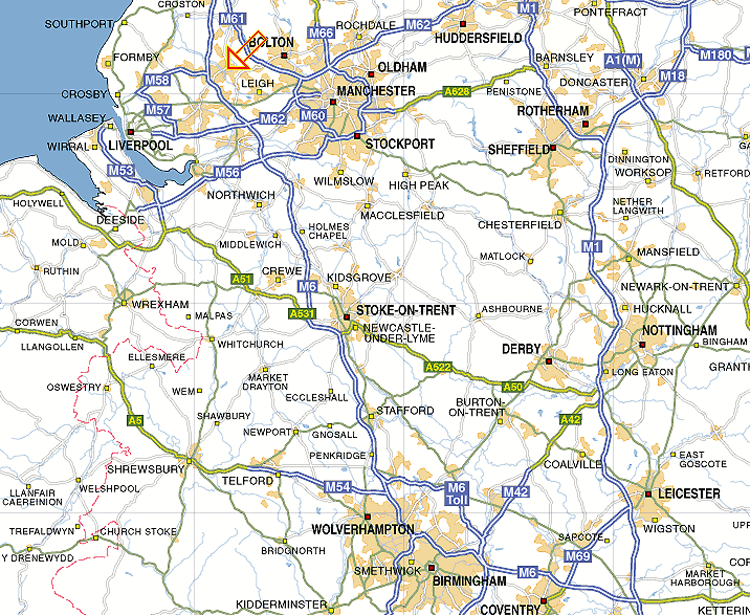
It was in this Hillman Minx that, back in 1968, Fred was returning from Wigan down the M6, when, because the motorway was still in the throes of construction, he failed to see the tiny hand-painted direction signs, and finished up in a building site in Birmingham, having missed his turn off in Stoke-on-Trent. That sounds incredible, but he’d never been on  a motorway before. Wigan is a town in Lancashire and is indicated by the Orange Arrow. My Mum’s parents lived there. The other towns and cities are in capital letters. Fred was aiming at Burton-on-Trent near Derby, which is south east of Stoke:

He was driving the same car in Leicester (south east of Derby) when he got lost and was forced to ask a policeman the way. Realising that he was dealing with somebody from out-of-town, this eminently sensible officer told Fred to avoid a rather horrific one-way system by driving fifty yards the wrong way down a one way street, while he promised to turn a blind eye to the whole thing.

It was again in this very same Hillman Minx that, three years later, Fred again missed his way in that very same city of Leicester, and went the wrong way up another one way street. Instead of being able to solve the problem by the previous method, however, Fred was forced on this second occasion to extricate himself from the situation by executing a three point turn in the face of a rapidly advancing four lanes of densely packed vehicles.

I have vague memories too, of getting lost as we went on holiday for the first time to the Yorkshire coast at either Bridlington or Scarborough. We stopped at, I think, Pontefract, somewhere near a power station, to ask the way.

The man that Fred approached spoke with an accent which was completely incomprehensible, and after a few frustrated minutes, Fred just drove off at top speed, angrily spinning the wheels on his rather sedate family saloon. At the time, he insisted that, against all the apparent mathematical odds, he had managed to find the local village idiot at his very first attempt.

Incidentally, above, you can see the Britain’s Lead Soldier version of the village idiot which usually reaches £200 at auction.

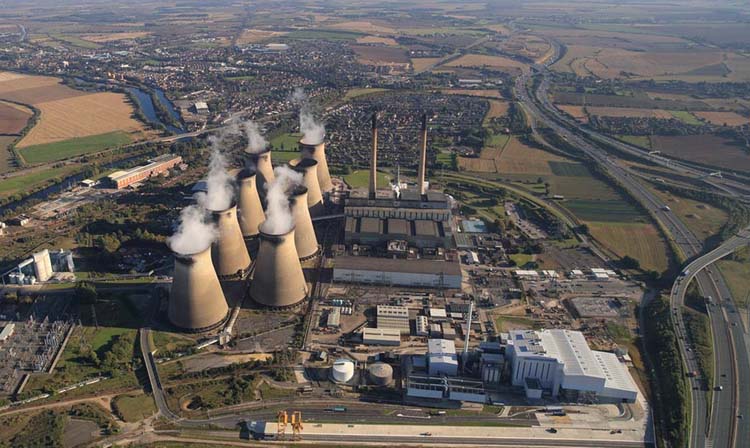
Nowadays, I think, in calm retrospect, that the man’s Yorkshire accent may well have been beyond us. It is difficult, though, even to best guess the location of these events. Perhaps it was near the huge power station at Ferrybridge where the A64 to the east coast Yorkshire holiday resorts left the main A1 trunk road, as it would have been at that time. The power station was demolished a long time ago:

Whenever Fred left his car anywhere unfamiliar, such as when he was away on holiday, or for any length of time in his own local area, he would always immobilise it by removing part of the carburettor . On occasion, Fred would even immobilize the car when he parked it on his own drive. It was years after his death that I realized that in this apparently bizarre zeal for crime prevention, Fred was only carrying out the orders that he would have been given in the early part of World War Two, in 1939-1940, when it was a serious criminal offence to leave a vehicle without totally immobilising it. There was a very real fear of imminent invasion, and the arrival of Nazi paratroopers, many of them disguised as nuns. And even in 1975, the Soviet Spetsnaz forces would have drunk a bottle of vodka each in celebration to have found such a fast and classy vehicle as a 1964 Hillman Minx. Here’s their badge in case your car is ever stolen. Spetsnaz are everywhere:

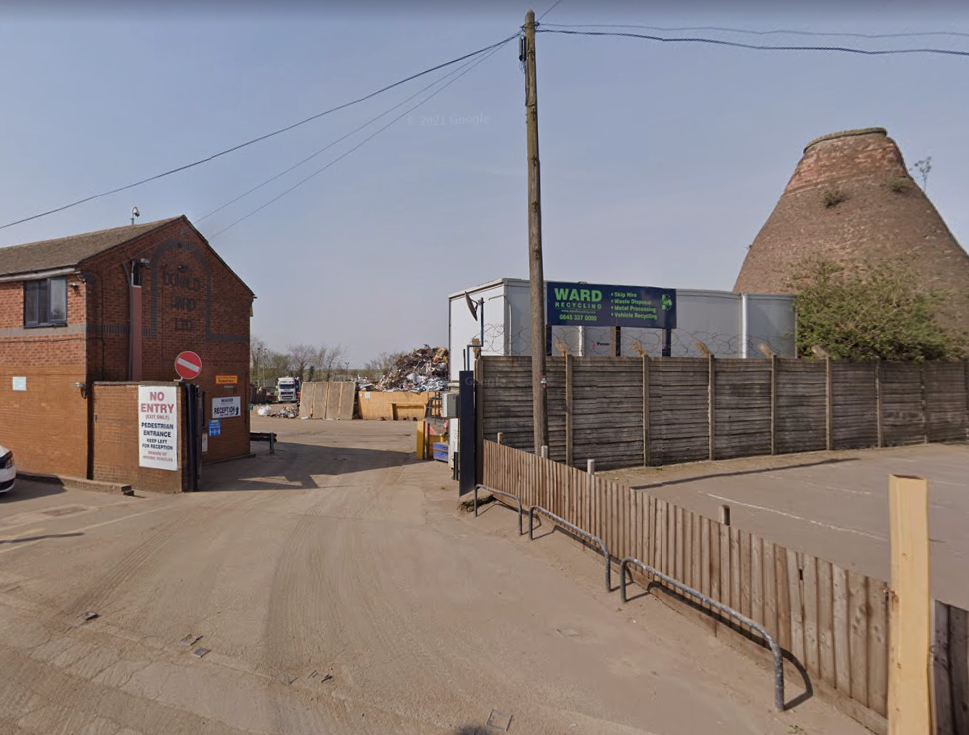
This Hillman Minx was THE car of Fred’s life. He had it for more than sixteen years, before, around 1980, he passed it on to me as a newly qualified driver. I in my turn used the car until it failed its MOT test by a very wide margin, some £300 when my annual salary was £500. I then duly drove it back from Nottingham to Woodville, where my family lived. Fred was then able to drive “that Hillman” as he always called it, on its last ever journey, the short distance from 9 Hartshorne Road to Donald Ward’s scrapyard in Moira Road. Here it is, complete with Victorian bottle kiln:

16 Comments

Filed under History, Humour, my Dad, My House, Nottingham, Personal, Russia

Hendon objects 3

In my last blog post about the non-flying exhibits in the museum at Hendon in north London, we were looking at some of the objects and various pieces of metal which had been rescued from aircraft as they awaited their turn in the scrapyard. These treasures were all housed in the RAF Museum which my family and I visited as long ago as 2010.

In my first two blog posts, I made an effort to include mostly things that were associated with the ground, such as a battleship, medals and the metal cross from a dog’s collar. This time, though, the objects are supposed to be connected more closely with the air.

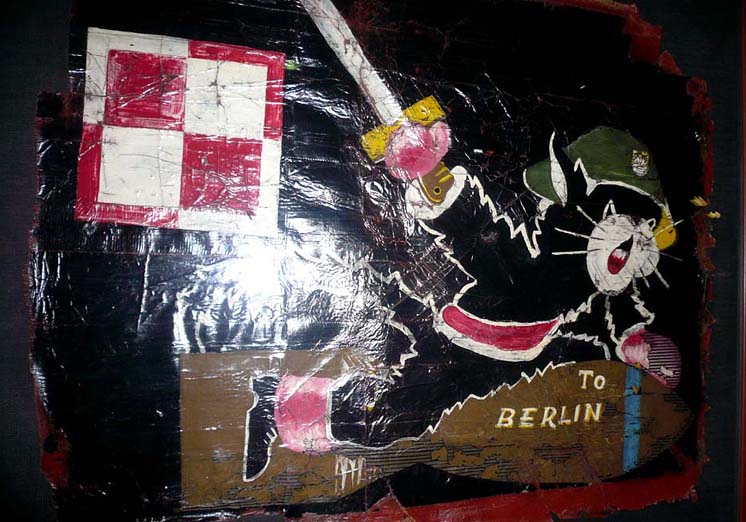
We have therefore, some examples of the nose art on RAF Lancasters and other Bomber Command bombers.

This one comes from an aircraft in one of the Polish squadrons of the RAF:

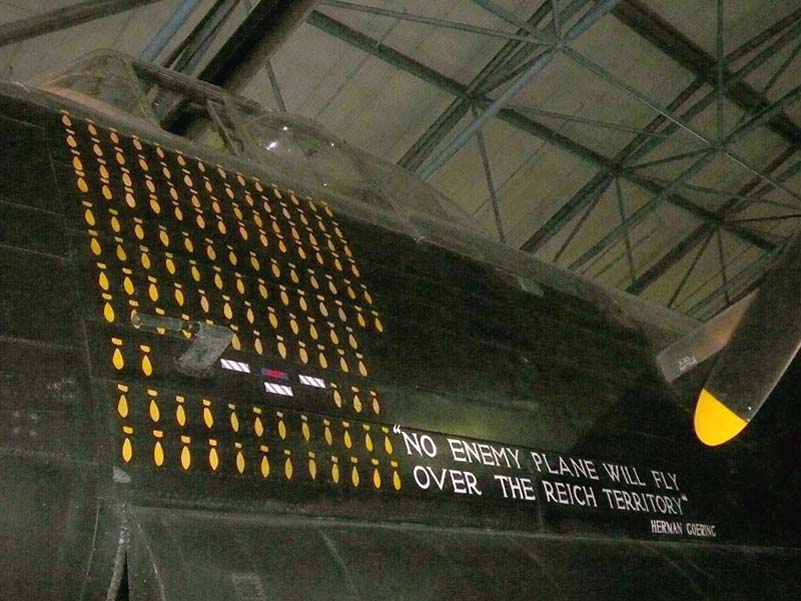
This aircraft has all of its missions marked carefully, although I do not know whether the white or yellow colouration has any significance:

This is the artwork on a Boeing B-17 Flying Fortress. In general, American artwork tended to be less inhibited than in the RAF:

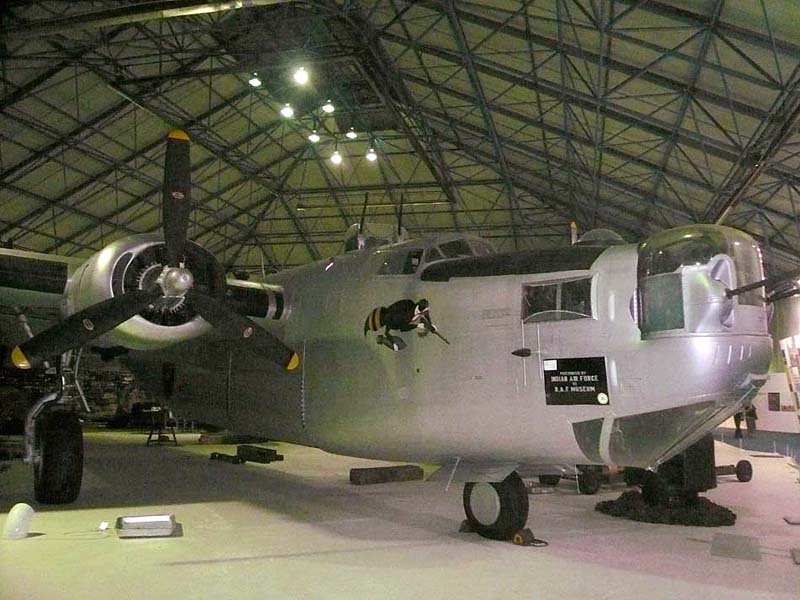
Here’s what looks like a wasp type creature on a B-24 Liberator of the Indian Air Force:

These bombing raid symbols are just about the neatest that you could ever get. Note the quotation from Herman Goering underneath them:

“No enemy plane will fly over the Reich Territory.”     Herman Goering

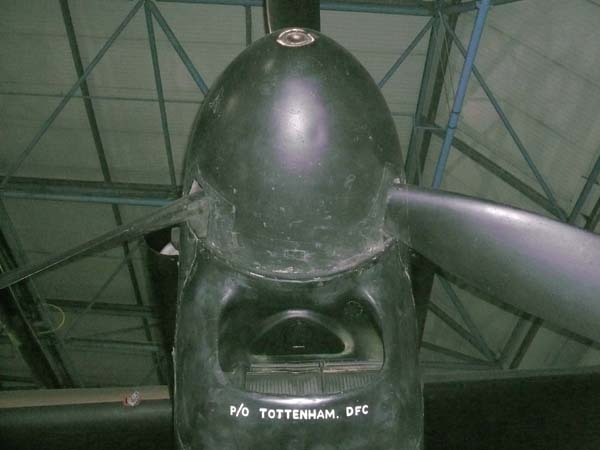
The bombing raid symbols also contain three medal ribbons for the Distinguished Flying Crosses or Distinguished Flying Medals won by members of the crew. The one with blue and red in the medal I do not know. The name of the medal recipient was painted underneath the engine nacelles. Here is Pilot Officer Tottenham:

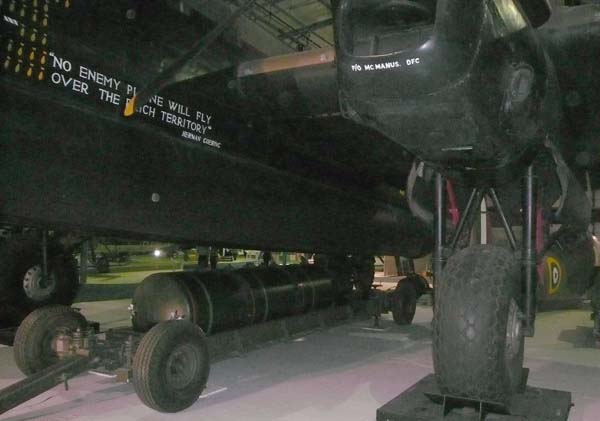
And Pilot Officer McManus:

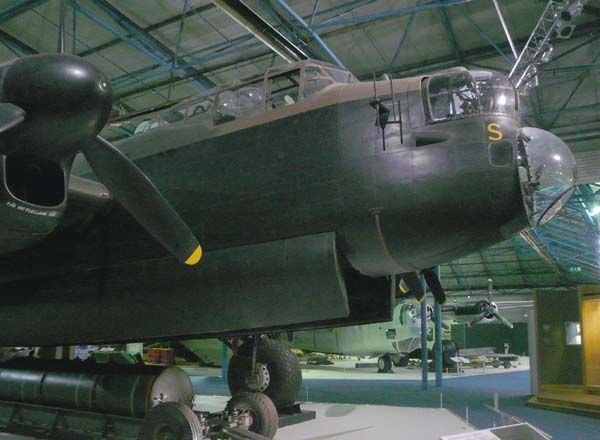
This aircraft was “S-Sugar” within the squadron. As well as on the side of the fuselage, the single letter appears on the nose:

And also on the tailfins:

I don’t know what the little aircraft is. Possibly, it is a training aircraft. If you know its identity, please indicate in the Comments Section.

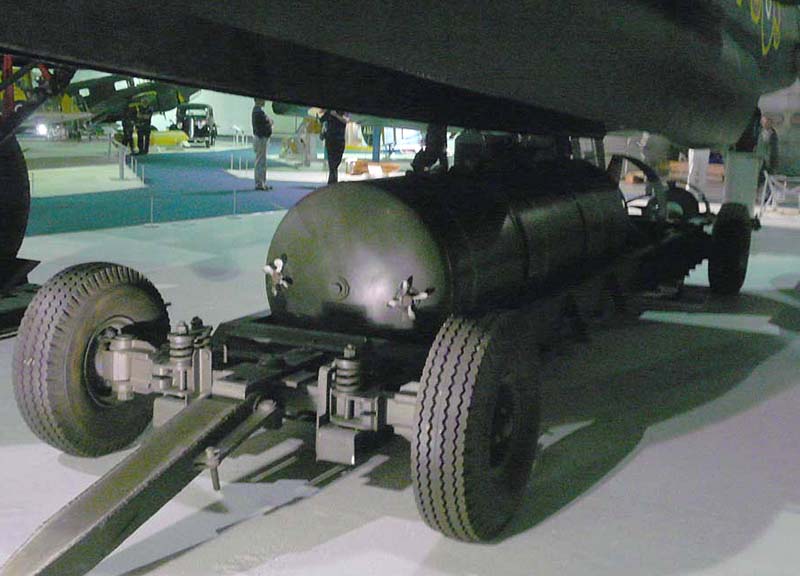
The museum has a couple of bombs on show.

This appears to me to be a standard 4,000lb “cookie” which carried the maximum bombload inside a very thin skin so as to create the biggest blast possible. That would blow the roofs off and allow the incendiaries to get inside the buildings and start their work:

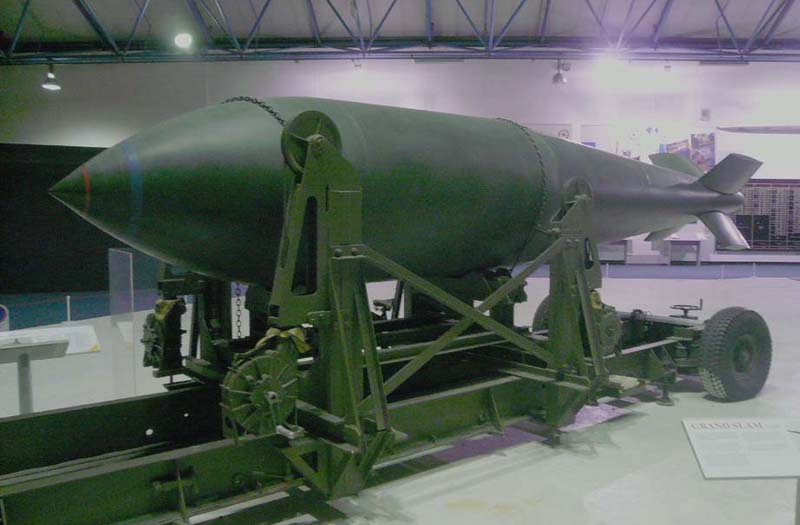
This is a “Grand Slam” ten ton bomb, designed to penetrate the ground at more than the speed of sound and then to explode, creating a vast empty space deep in the ground. The technical term for this is a camouflet, an artificial cavern created by an explosion. Whatever is above it, buildings, railways, bridges, whatever, can then collapse into the void.

It was an incredible sight, my Dad always said, to see a Lancaster getting off the runway carrying this enormous weight. The aircraft would invariably struggle and he always described its wings as “being like a huge crescent”, although somehow, the gallant aircraft always managed to get into the sky:

It was when he was with 617 Squadron in late 1944 and 1945 that Fred had seen Lancasters staggering into the air armed with these gigantic bombs. I did ask him in the latter stages of his life if he remembered any of the places he had bombed, but, alas, he was too old by then. He added that from his point of view, so many of the targets were names he had never heard before. And I suppose with “Mimoyecques” he does have a point!  The only target he did in fact remember were the U-boat pens in Brest. The crews were all told to make sure that they dropped their bombs well in the middle of each protective concrete roof. Otherwise, they would stand little chance of doing very much damage.

These extraordinary ten ton weapons were used operationally by 617 Squadron from March 14th 1945 onwards.

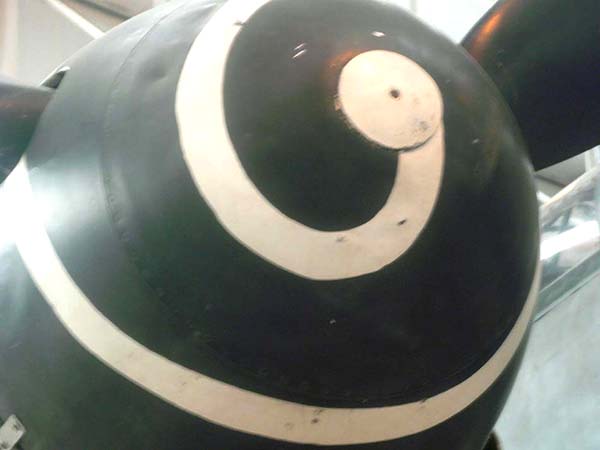
And finally, here’s one of those hypnotic spinner patterns beloved of the Luftwaffe. They always seem to appear in the newsreels from the early part of the war:

PS :  Forgive the weird colours in the previous photographs, but this entire floor was lit with special lighting to preserve the original Bomber Command matt black.

Here is some modern nose art from the 1970s. This was on the nose of a Handley Page Victor V-Bomber which had been preserved without the rest of the aircraft:

And finally, here is an English Electric Lightning fighter of the early sixties, proudly displaying its tiger badges. Firstly, on the nose itself, there are the two stylised versions either side of the RAF roundel:

And here is the  animal proper on the aircraft’s tail:

This Mach-2 fighter was operated by 74 Squadron and this is the Tiger scheme from the days when they were the RAF display team in 1962.

20 Comments

Filed under Aviation, Bomber Command, History, military, my Dad, Personal

Enigma 3

Last time, I had told the story of how the three Polish whizz kid mathematicians, Marian Rejewski, Jery Rozycki and Henryk Zygalski, had told the British and the French, everything they had discovered about Enigma.  The stories all came from the book by John Jackson which relates the story of Enigma, the German encrypting machine used throughout the entire Second World War…..

From these Polish beginnings, many, many aspects of the war were affected….. for the better. There was, however, a Golden Rule always in operation.

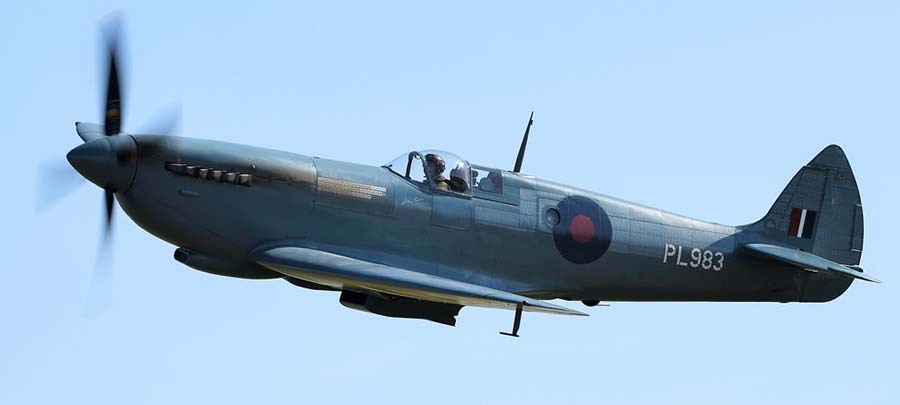
If the only information about a future event came from Enigma, then other sources had to be created as well. The rule resulted, for example, in a lot of photo-reconnaissance aircraft being sent to take photographs of a place already mentioned by the Enigma decrypt and which was going to be bombed  The pilot was always told to fly the aircraft around a lot of other nearby places as well, and to make it look as if the trip was completely routine. Here is a photo-reconnaissance Spitfire. They were usually entirely blue, although  I’m sure that they were also painted pink, a colour which was frequently nicknamed in North Africa especially, “Mountbatten pink”:

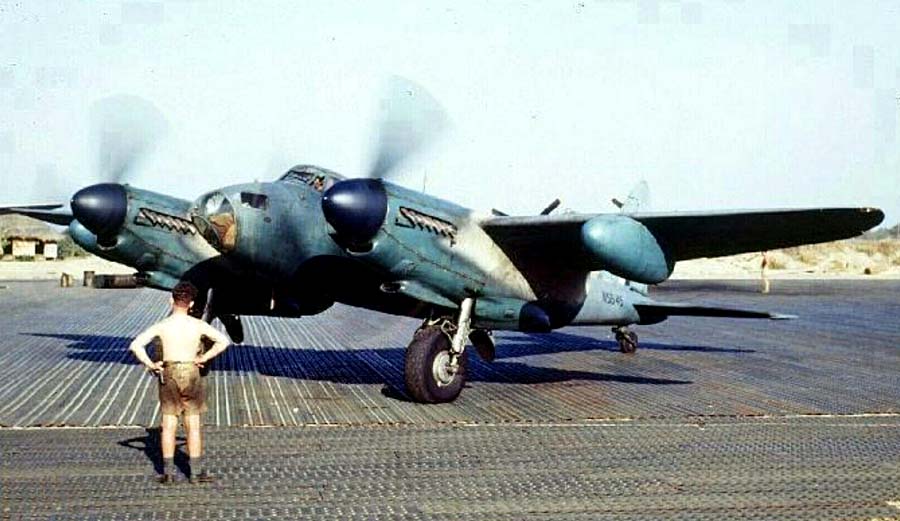
Mosquitoes were also used, especially for the longer trips:

If Enigma was the only source of a piece of information, of course, then any action taken by the British would prove to the Germans that the code had been cracked. For this reason, if there was only one source of information, and that was Enigma decrypts, then no action was taken.

The system worked so well that right until the very end of the war, the Germans continued to believe that Enigma was uncrackable and that only they had the secret of deciphering it.

In May 1941, Enigma was able to tell the Royal Navy the whereabouts of all the supply ships that were servicing the Bismarck. They also ascertained that the Bismarck was headed to France, not Germany, after a particular phase of the battle.  Here’s the German “Pocket Battleship of the Month”:

The Bismarck was one of my very few Airfix ships kits. That and HMS Tiger, a Royal Navy destroyer.  The way this piece of informnation from Enigma worked was that the ships carrying fuel and ammunition were all sunk, and so too was any other ship carrying supplies that added to the Bismarck’s capabilities as a ship destroyer.  Supply ships carrying records, newspapers, and a change of library books were all left alone, as were the ships carrying food and drink.

On November 1940, a major air-raid might have been opposed more thoroughly if the people at the top had used their brains and guessed which city in England was being referred to in a mildly encoded sequence of the names of cities about to be bombed back into the Stone Age………..

For example…..

“LOge” was “LOndon”

Do you see how it works? Nothing particularly Enigma-inspired at this point. The first two letters give it away.  So, what was “BRuder” ?

No, it wasn’t Brisbane, or Brighton & Hove or Bradford. It was…..

“BRistol”

So, now, what was “BIld”

No, it wasn’t Bicester, or Bishop Auckland or Bilston. It was…….

“BIrmingham”

So, a more difficult one, now. A city with its own name in German. And it’s actually easier than you might think. If the Air Vice Marshall had  taken his road atlas out of his bag, he would have realised that, of the 1, 165 cities, towns and villages of Great Britain, not a single one begins “Ko-“.

And no,  “Konchester” is not the German for “Manchester”, and “Korwich” is not the German for “Norwich”.

The correct answer is…..

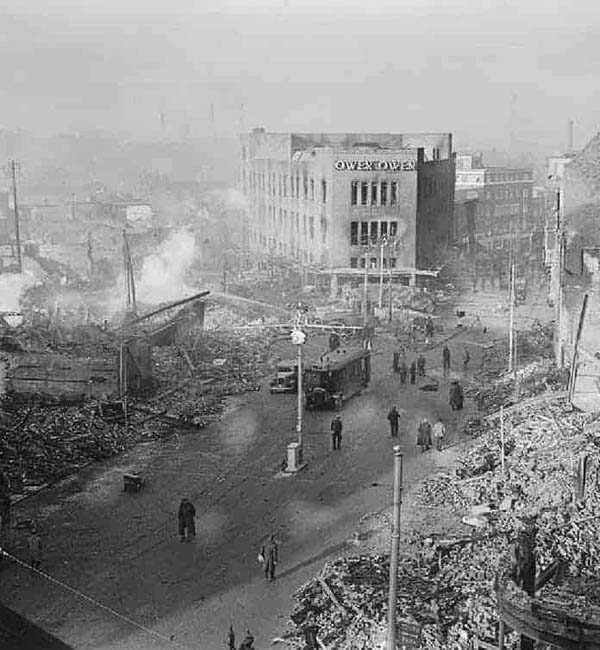
“KOventry”

The  only city of the four with its own name in German. The city was flattened……

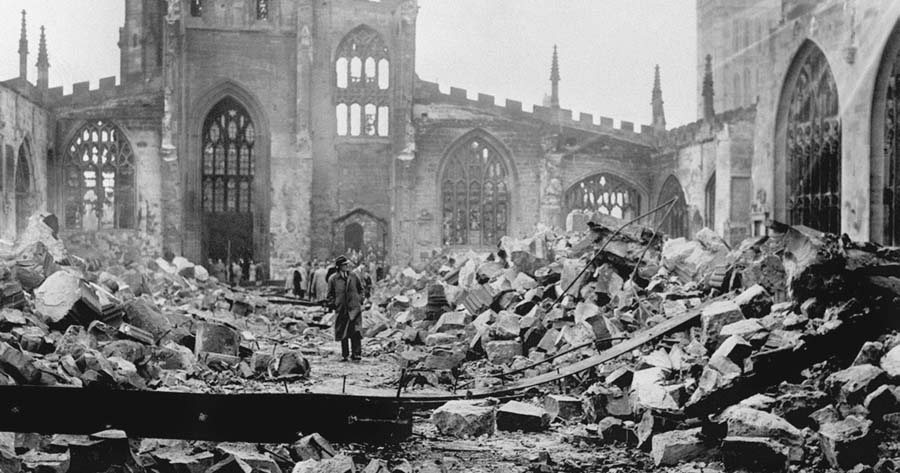
…..especially the cathedral……

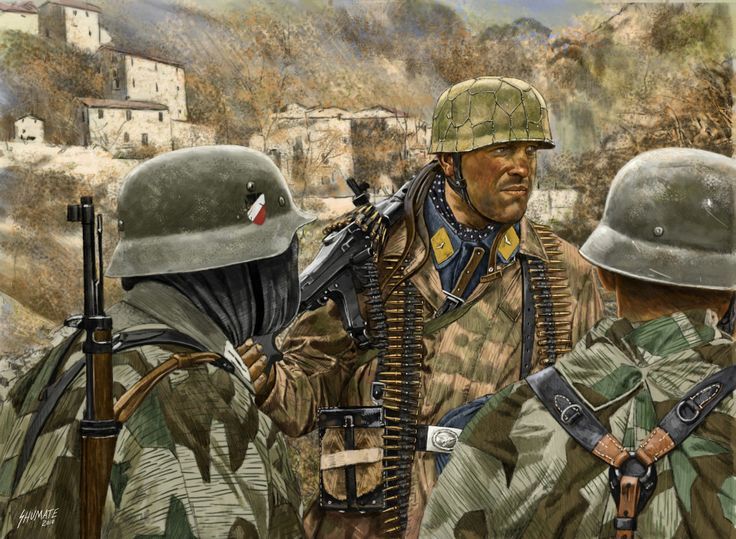
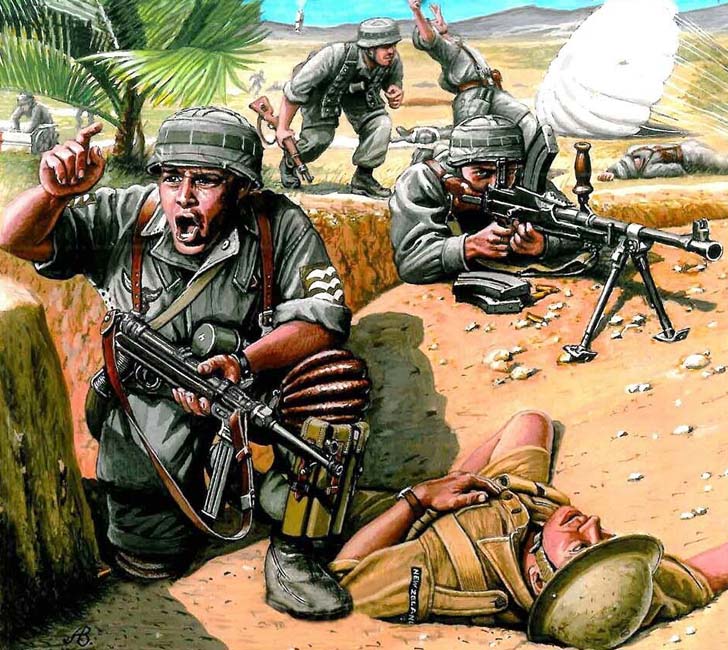
In March-April 1941, Enigma revealed that Crete was to be invaded from the air, in the glider towing and troop carrying aircraft that the Germans had been assembling in Bulgaria and Greece for some time now. It was easy enough to pass off the information the British possessed as the product of the hundreds of spies in every city in this part of the world. The German paratroopers were called “Fallschirmjäger” and they wore helmets and smocks which were different from the uniform of the Wehrmacht……..

Preparations were made to give the German paratroopers a warm welcome, and as a result of the fierce resistance from both Allied forces and civilian Cretan locals, the invasion force suffered heavy casualties. Hitler then forbade further operations of this type for the rest of the war. Here they are in action……..

Overall, nearly 4,000 German paratroopers were killed.

In June 1941, the Germans invaded the Soviet Union. Stalin had been told time and time again by the British, the Americans and the Japanese that this was going to happen but he thought it was all some vast capitalist plot to upset his non-aggression pact with that nice man Hitler.

For Churchill, it had all become much likelier as a forecast when a series of Enigma decrypts revealed that three Panzer divisions had been moved to the Polish frontier, next to the Russian held zone of Poland. Overall, Churchill thought that Stalin and his Sycophants were…..

“the most completely outwitted bunglers of the Second World War.”

In August 1941, the RAF and the Royal Navy were told all about the German supply ships which were  transporting whatever Rommel required for the war in North Africa across the Mediterranean. Such precision made it easy to target and sink the oil tankers, the petrol carriers and the ammunition/weapons ships, even if that meant letting through the odd ship carrying savoury sausages or bottles of schnapps or a further change of library books for everybody. Ultimately. by supplying this kind of information, Enigma would make victory in the Battle of El Alamein a great deal more likely.

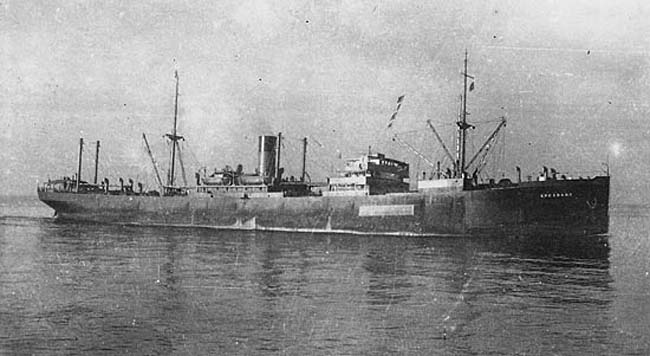
Here’s the ship with the library books:


17 Comments

Filed under Aviation, History, military, Russia

My Dad’s cars (2)

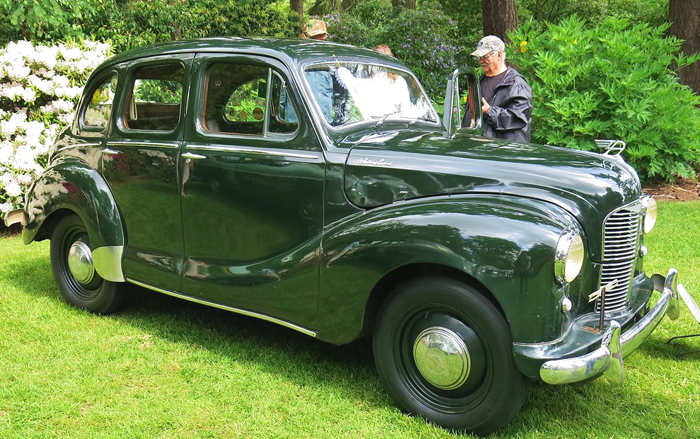
My Dad’s first car was an Austin A40 Devon, in Connaught green, with the registration leters of LXJ 701…..

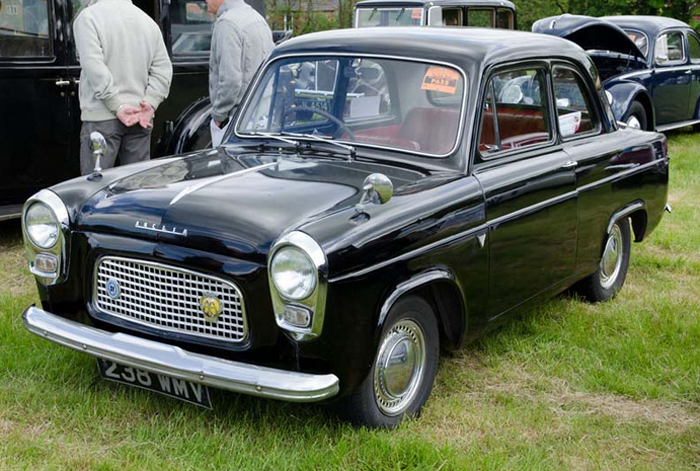
After the Austin A40 Devon, Fred had a 1959 Ford Anglia, registration number SNR 863, which he bought from a garage in nearby Ashby-de-la-Zouch. It was exactly like this:

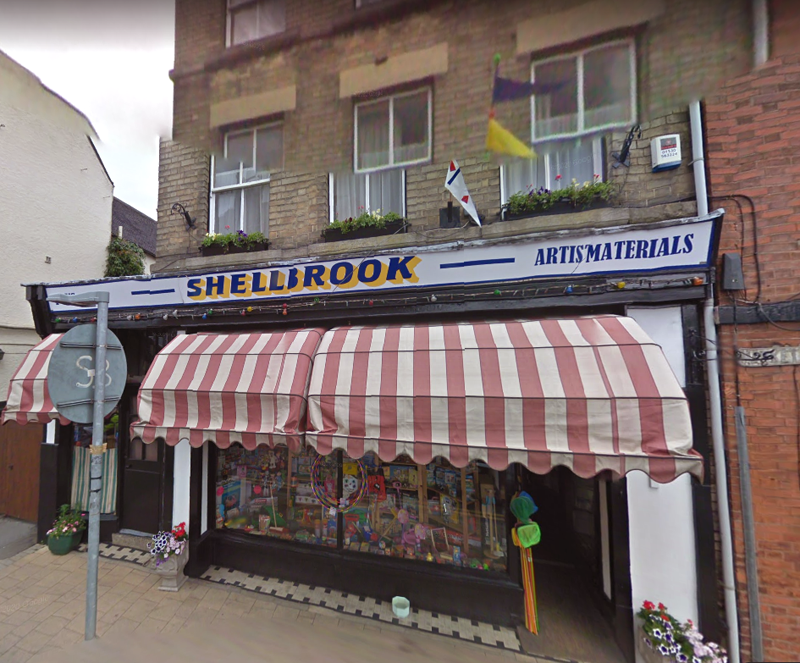
When I was around eleven or twelve we used to go and visit a nearby toy shop, “Shellbrook Motors” which used to sell Dinky and Corgi die-cast models of cars and larger vehicles, Airfix and Frog aircraft kits, and Hornby model electric railways. By 2017, they had changed a little and were selling artists’ materials, although they did refuse to pay the signwriter’s bill on this occasion:
There were no Ford Anglia type problems of low level criminality and cheap plastic with Fred’s next car, an English Hillman Minx De Luxe, BLT 141B. This beautiful blue car with the metallic chrome side stripe was “the one” as far as Fred’s motoring career was concerned.
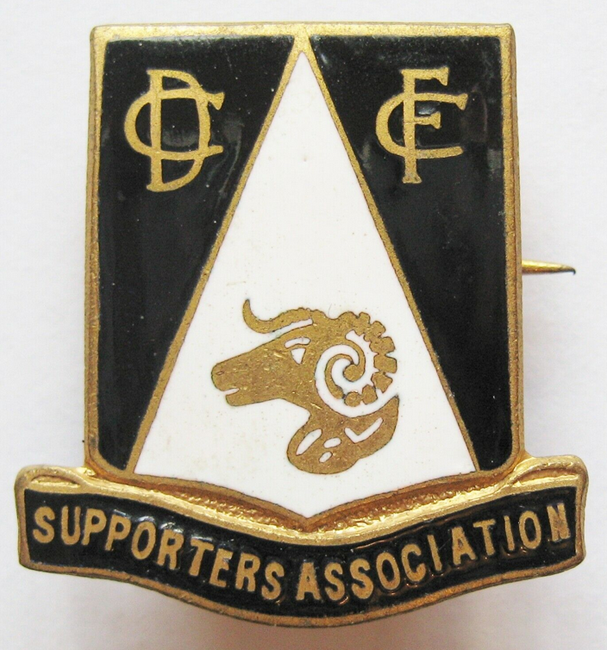
He had taken me to Derby one day, and we visited Peveril Garage, on Friar Gate, near the headquarters of the Derby County Supporters’ Club:

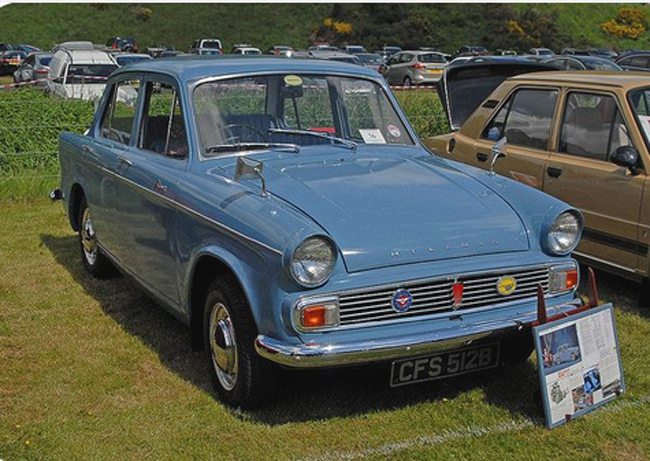
Fred told me not to mention anything whatsoever about the day to my mother, under any circumstances. Without consulting her at all, therefore, he bought the car, priced at £510, which was, in those days, a princely sum. Indeed, the price was such a total royal that, when my mother did eventually find out how much the car had cost, she would have had Fred beheaded if she could have organised it. The car was a rich pale blue, half way between sky blue and navy blue. Here is one today:

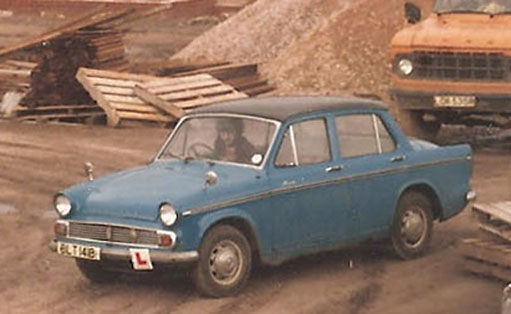
In later years, when he had problems with rust on one of the wings, Fred was to opt for a total respray, which allowed him to retain the same colour blue for the body, but to incorporate a black roof which added that extra, unique, little detail. Here it is, with James Bond driving it, back in the days when I was 28. I had always wanted a personalised number plate, and this was the time when I changed my name to “BLT 141B”:

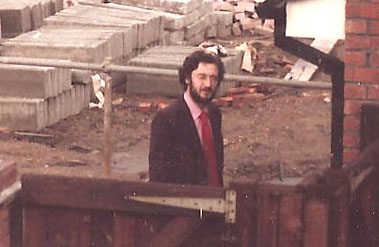
This was also the day that I caught both Francisco Scaramanga and Auric Goldfinger hiding together on a building site:

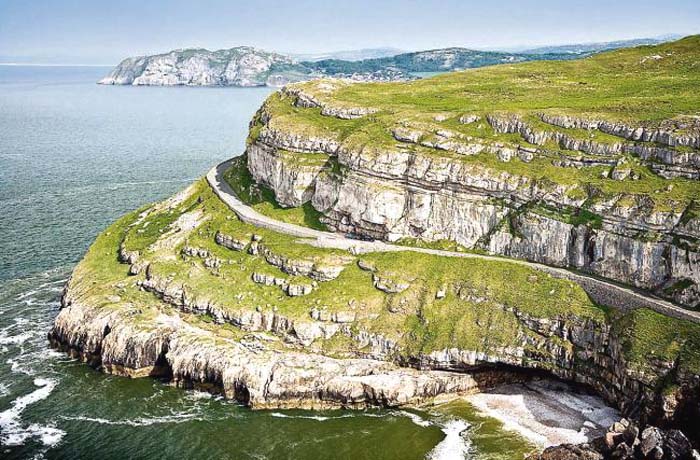
It was in this car that Fred had what were probably the most outstanding motoring experiences of his life. I can still recall, for example, just how scared he was, and indeed, we all were, when he drove a circuit of the Alpine like road which ran around the Great Orme near Llandudno in North Wales.

Indeed, some thirty years later, I returned to look at this road for myself, to see whether it was quite the challenge that it had seemed in the late 1960s. And, of course, the circuit had been considerably watered down since then. All the sheer drops down to the sea had now been fenced off, and, most significant of all, perhaps, a narrow road which I remember as having been two way, had been limited nowadays to just one way traffic. Gentrified, I think the word is:

10 Comments

Filed under Criminology, History, Humour, my Dad, Nottingham, Personal