Category Archives: History

Brincliffe Grammar School for Girls (4) A cry from history

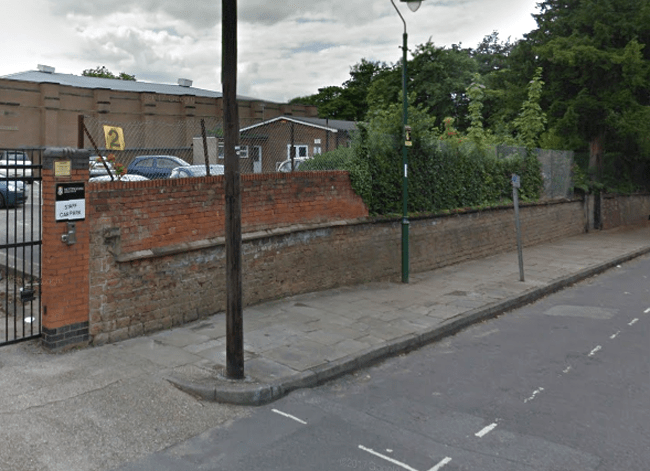
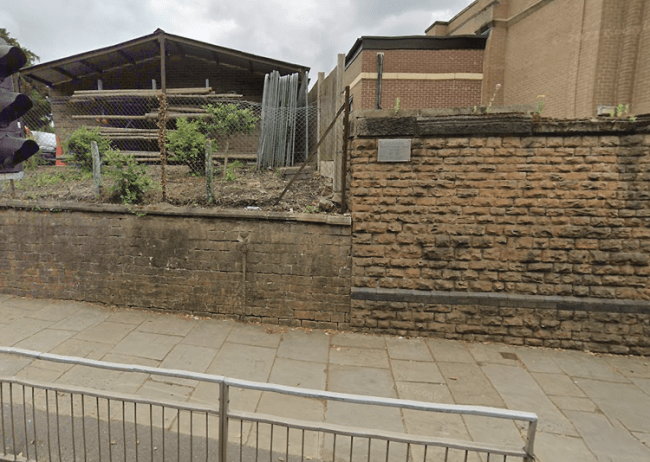
What traces remain of Brincliffe Grammar School for Girls? Well, in Balmoral Road, the front wall still remains, running from No 23 Balmoral Road, all the way to the corner with Forest Road East and then past that for a few yards. It’s easy to see and it is virtually untouched. It’s a sandstone wall which continues round the corner and runs as far as what would have been the old boundary of the High School in, say, 1895. The wall continues for all this distance and the fact that it matches both of the two remaining Victorian photographs of the school is proof enough for me.

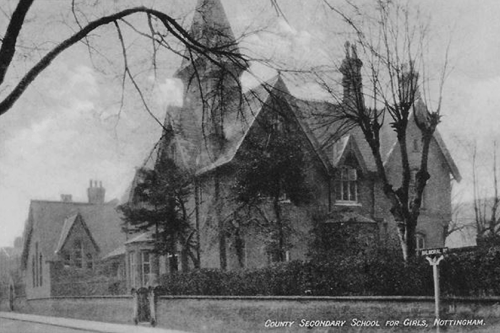
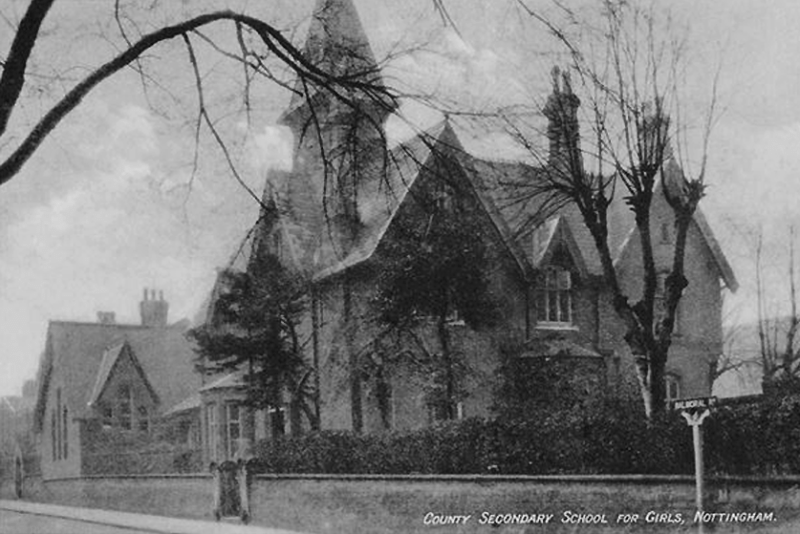
Here are the two pictures of Brincliffe still in existence. This is the older of the two:

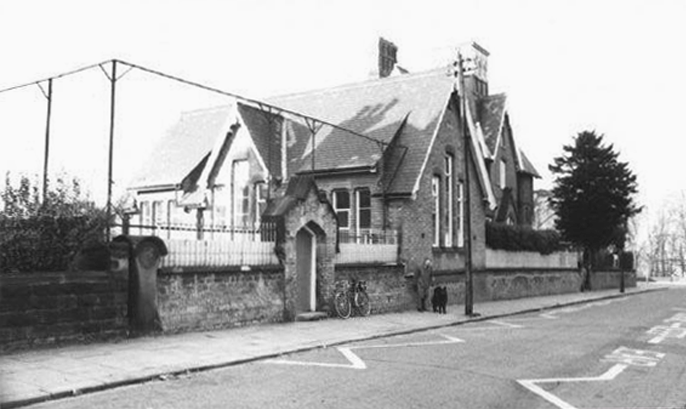
And here is the one where the bike has been invented:

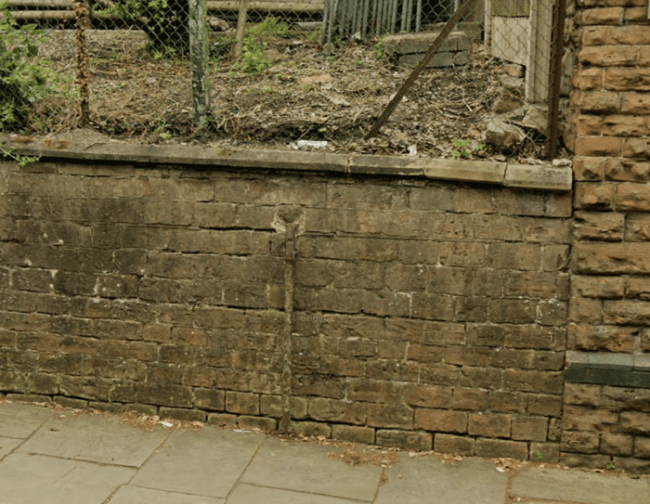
And here is a sample of the wall. The brighter, red one is modern, the tan coloured lower wall dates from 1870 at least. At the same time, you can see how, in modern times, it was thought wiser to make the original wall much higher.

The sandstone Brincliffe wall stretches all the way round onto Forest Road East and meets the old boundary line of the old High School (right). Here we are:

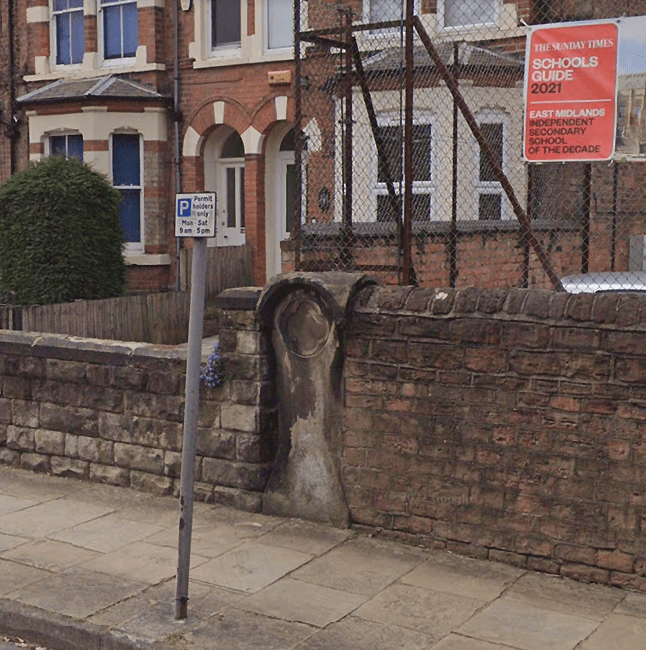
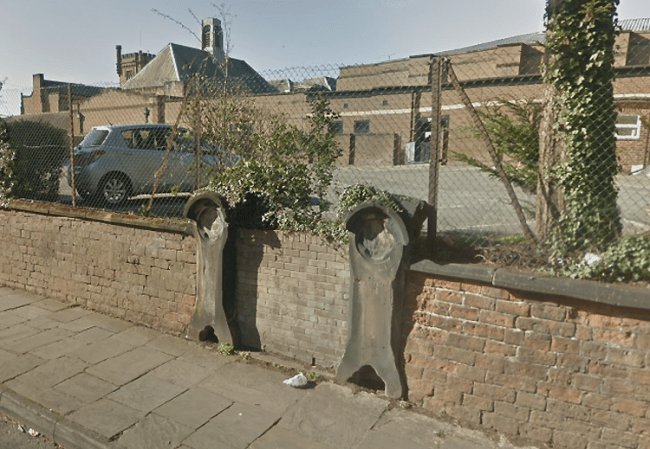
But what is this Victorian remnant? Some kind of fire hydrant?

At the side of No 23 Balmoral Road there is a pillar which clearly dates from the turn of the 20th century or earlier, and is visible in the second of the old photographs above. Here it is:

Further down, what has clearly been a gate to the school is still visible. In the controversial “pushbike-and-dog” photograph, it is down near the fir tree, but difficult to see. In the “Welcome, Munsters” postcard, it is the first gate you see in the wall and the ornate tops are clearly visible.  Here it is:

As  you know, I sometimes buy articles connected with the High School from ebay. A while back I produced seven blog posts called “Nottingham High School on ebay”. This link should take you to No 1 if you are interested. Sometime after #7 was published world wide, I bought this:

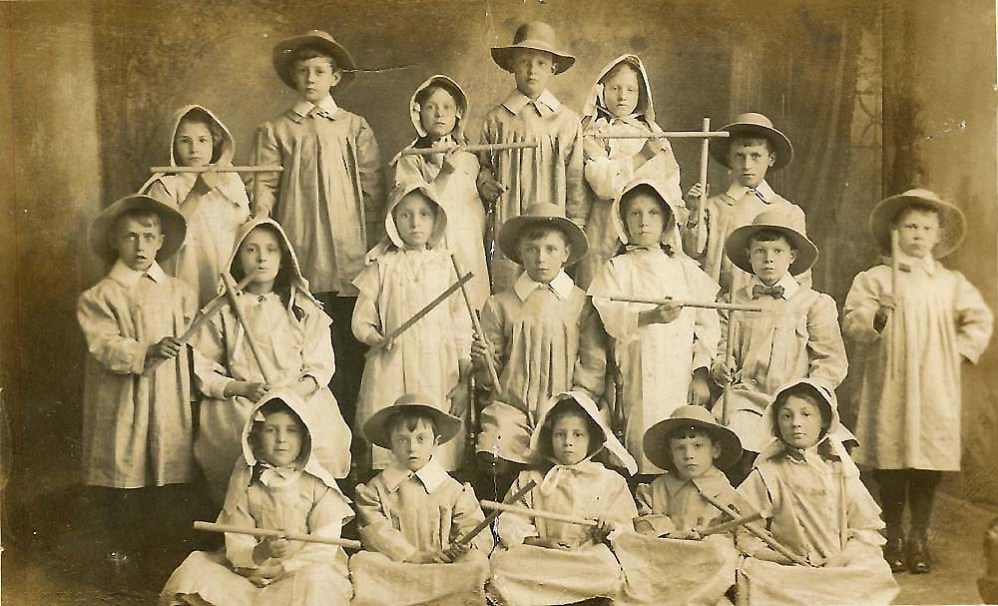
It shows a group of unknown children from what was called “Brincliffe School” although the presence of little boys must mean that events took place before 1907 when the Girls’ Grammar  School started up. I have no idea whatsoever what is going on with all their sticks and costumes. But the picture and the words that go with it really amount to a cry which comes from well over a century ago. And that wordless cry says

Here I am. I used to be alive like you.”

And those sentiments are present in the picture but they are also written on the back of the postcard:

It reads, as far as I can see:

“Yours Truly

Bernard Raven

as

A Farmers Boy

First boy on top row to the left”

Just have a look at him. The back row, the boy on the left. He can’t even be trusted to carry a stick, and appears to have lost his. But he is the one we can look at and we know his name. Bernard Raven. He grew up, perhaps he fell in love, perhaps he married, perhaps he had children of his own. I suspect we will never know. But with a little bit of luck, he will be read about, if only for a few seconds, in Australia, India, the USA, all over the world. I hope he was happy with his life.

24 Comments

Filed under History, Nottingham, Politics, The High School

The next few months of the Battle of the Somme, July, August, September, October 1916 (Part 3)

My previous blog posts about the Battle of the Somme were based on the “Both sides of the wire”” series of TV programmes, which were themselves based on the extensive researches of the English historian, Peter Barton, who has spent many years as a “battlefield guide” in the Somme area. He was the first person ever to consult the German language archives and was amazed to discover that he was the only English historian who had looked at them in a whole century. Here he is…..

My previous blog posts concentrated on the famous “First Day of the Somme”, July 1st 1916, the British Army’s most disastrous ever day, which  was portrayed in the first programme of the three. The remaining two programmes followed the campaign until the Battle of Boom Ravine between February 17th–18th 1917. This was when the Allies attacked the Germans troops on the Ancre Heights near Courcelette and to the north of the Ancre valley. That was the end, more or less, of the Somme Campaign. Overall, the British had casualties of 420,000 men, the French 200,000 and the Germans 512,000. If my Maths serves me well, that is 1,132,000 poor souls killed or wounded, many of them horrifically disfigured for life.

Rather than take you through these two remaining TV programmes in immense detail, I would prefer to tell you about the most striking details Peter Barton found. Although they are often unrelated to each other, these details are all really interesting and might well persuade you to set the recorder for all three hours of programming on the next occasion these ground-breaking documentaries are shown. So don’t expect a bedtime story, rather a list of unusual, quirky truths that Peter Barton found in his researches in the German Archives. I decided to label them “Fun facts” in case anybody wanted to have a test afterwards.

Funfact One

In the fighting from July 14th onwards, the excellent fighting qualities of the Germans were often completely underestimated, particularly their defensive organisation. Advances which were anticipated to take a few hours, instead took the British several weeks. The Germans had by now developed new tactics, there was extremely fierce resistance and the British attack just petered out. It took an unexpected two weeks to capture Longueval, and the Germans in nearby Delville Wood were to remain there until August 27th. What a pretty little wood it was! …….

Funfact Two

Overall, the Germans had always preferred to be defensive and the British were forced to be offensive. According to the German Archives, though, the British POWs had told their German captors that the British feared open warfare and very much preferred a war based on a defensive system with trenches, barbed wire and minefields.

Not all the British generals shared these views, however, and differences of opinion were frequently marked. Rawlinson was the second in command and he was an infantry man. He believed in what was popularly called “Bite and hold”, or the acquisition of enemy territory in cautious, tiny steps. Haig, however, the British No 1, was a cavalry man, who believed in great thrusts of advance. Haig had the derring-do of a cavalry man and was considered to be a “thruster”, a man who would always unleash the cavalry when the opportunity arose. Here’s Haig, wearing his “Anti-Gas trousers”….

Funfact Three

During the July 14th attack during the Somme campaign, there was a cavalry charge which involved some Indian troops of the 20th Deccan Horse. Peter Barton discovered that German POWs in British hands had reported, when they spoke to their own officers much later, that many of the British cavalrymen were feeding and watering their horses at the very same time when senior British officers had told the press that their derring-do charge was taking place.

In other words, the charge could not possibly have taken place as the newspapers described it. This was further emphasised by the fact that it could not have happened as early in the day as the newspapers reported, because the ground at that time would have been too hard and slippery for the horses’ hooves. Only later would conditions have been suitable. The inference is, of course, that direct lies were being told about events to make the British attack and their meagre achievements look more impressive.

Funfact Four

The Germans were aware of every single detail about the British because of their enormous number of telephone intercepts. They must been aware too, therefore, that the German army was only one fifth the size of the Allied forces.

Funfact Five

Again, the fact was emphasised that the British may actually have been very pleased to turn to defensive, trench warfare. Open warfare requires great flexibility, lots of different techniques and lots of different skills, but the German Archives revealed that the British troops seemed to have received no battlefield training whatsoever. Their basic tactic remained a massive heavy bombardment by thousands of mortars and field guns, and then a charge across no-man’s-land in large numbers. They had presumably learnt nothing from July 1st 1916, except that it was okay to run rather than having always to walk.

Even so, the Germans had enormous respect for the British, who attacked and then attacked again, even when it was obviously pointless. This, of course, produced enormous casualties for very little gain but that did not seem to matter a huge amount. With the Allied forces five times as numerous as their opponents, the war became very much a “war of attrition”. The effectiveness of attrition as a tactic was made to look all the better by using optimistic, or possibly, even false, German casualty figures.

Funfact Six

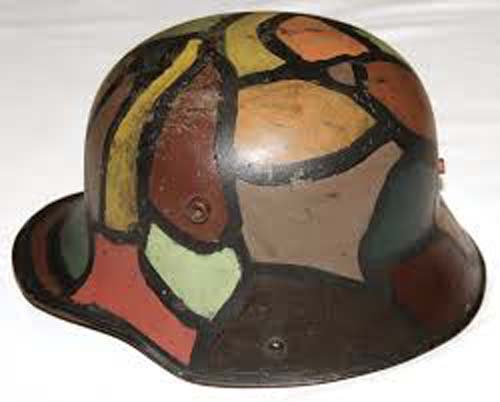
In the skies, the Royal Flying Corps, the RFC, were always dominant but the Germans were very adept at protecting themselves with camouflage, and very good at hiding themselves, and their weaponry. Most striking, perhaps, was their use of “dazzle camouflage”, as on this possibly early Bauhaus chamber pot from 1918…..


20 Comments

Filed under Aviation, France, History, military

Widdle (7) or, more accurately, the Rise of the Urban Fox

After the First World War, London began to expand as a city, particularly to the north and west. What had been farmland was now purchased and then built on. Many, but not all, of the woods were chopped down, the trees and branches were burnt, and new houses were then built on the site. The people who lived in those new houses for the most part worked in the centre of London and new words had to be invented to describe what they had to do in order to get to work. They took the train. Suburban, local trains, whose only purpose was to carry people who were now being called “commuters”, on their way to work. What they did was called “commuting”, and it obviously paid them to do it. Their salaries must have been high enough to justify adding a couple of hours to every one of their working days.

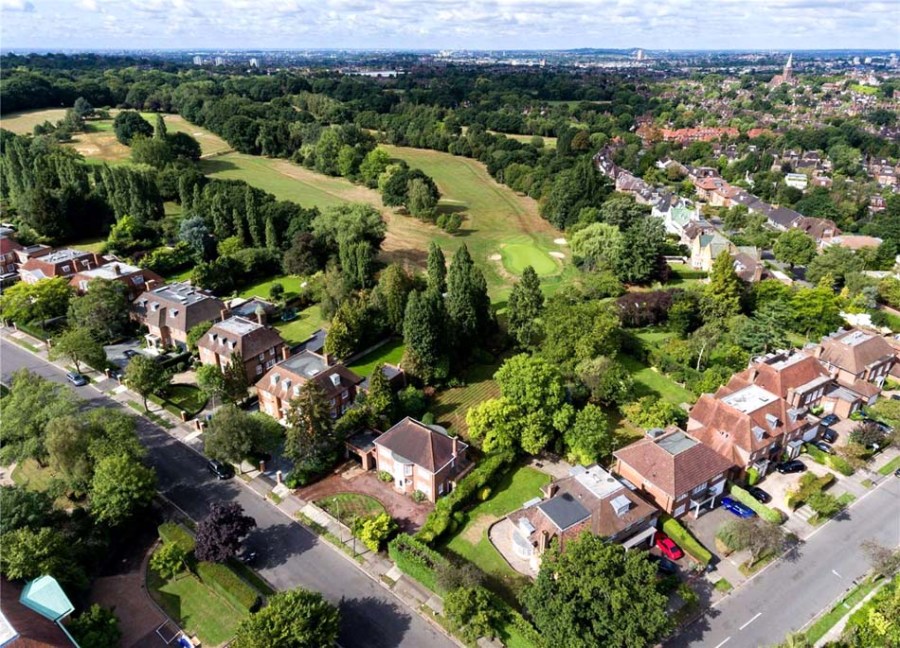
The very best paid commuters lived in what were called the “leafy suburbs”. They could even afford to buy a detached house near the golf course, with four or five bedrooms and a large private garden all the way round it:

In some cases, the leaves of the new leafy suburbs were attached to trees which pre-dated the building of the new houses. Builders with a bit of vision had soon realised that they could save themselves a lot of cash, and finish up with a much better product if they kept as many of the mature trees as possible. All they had to do was to build the houses between them and to do the same with the streets, if they could. Look at the age of these trees:

That slight change in approach by the builders had quite an effect on the suburbs created at the ends of the hundreds of the suburban railway lines which linked the centre of London with the houses where their office workers lived. And, to their credit, instead of just moving on elsewhere, the creatures which had lived in the woods before the developers arrived, made enormous efforts to stay in their homes and not be forced out.

In some cases badger setts survived the building process and remained unnoticed behind the park-keeper’s new storage sheds.

Hedgehogs hunted slugs and snails in rockeries and vegetable gardens, just as they had in spinneys, copses and woods.

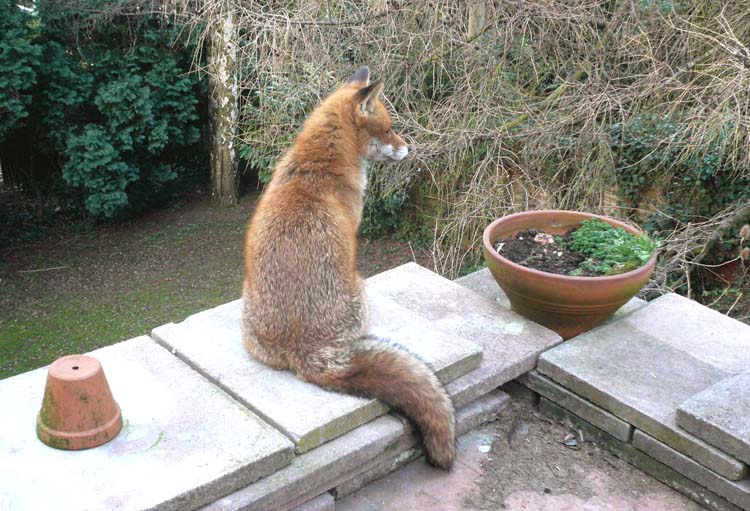
Mice, shrews and rats went unnoticed, as they always have. But above all, one animal benefited enormously. That was “vulpes vulpes”, better known as the fox. They carried on their lives pretty much as they always had done, taking little or no notice of human beings and their machines. If anything, life was considerably easier, and food more plentiful now that they lived in a city suburb, which was always a few degrees warmer than the bleak countryside. And very soon London had in excess of 10,000 urban foxes. And many other cities experienced the same process. Bristol. Birmingham. Sheffield. And Nottingham, the home of the most famous fox of them all…….

Here’s another of them, hurrying to the fish and chip shop to see if anybody couldn’t eat all of what are, hopefully, generous portions:

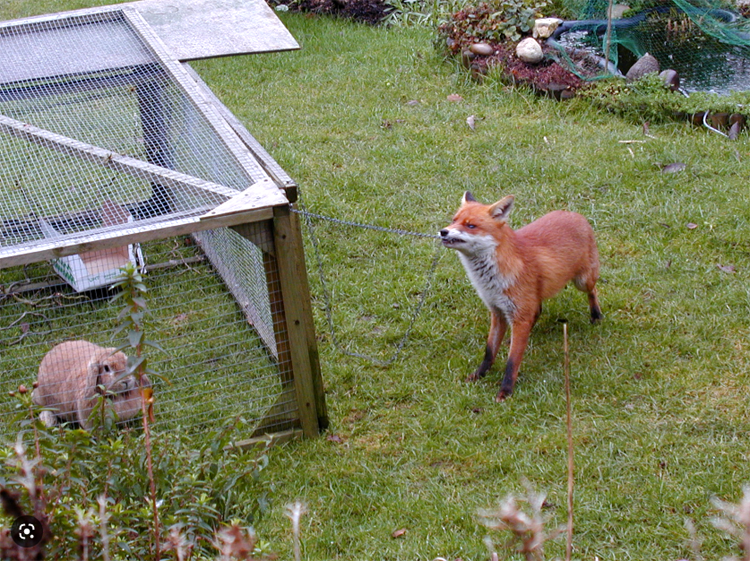
Foxes, like all undomesticated canids, are extremely intelligent. Once they have made a friend such as a big, fat rabbit, they always like to see if they can get even closer to him, perhaps by pulling a likely chain:

And here’s one of the very few photographs of Banksy Fox”…….

Next time, we take a look at the quality of the sausages available in the Iceland supermarket chain, exploring the views of one of their keenest consumers…………

17 Comments

Filed under History, My Garden, My House, Nottingham, Personal, Science, Widdle, Wildlife and Nature

Brincliffe Grammar School for Girls (3)

There was a strong connection between Brincliffe School and the High School but not, as you might expect, between the boys and the girls. Instead, the connection was a sporting one, and consisted of a number of football matches, all of them played between 1877-1880, when the physical building on Balmoral Road accommodated “Porter & Jones, boys’ school (Tudor House)”.

The High School had played their first match against another school seven years previously. News of the game appeared in the new school magazine, “The Forester”, which introduced a section entitled “Our Chronicle”, which was designed to allow reports about “the sports… of the School.”

Thus, on November 19th 1870, having travelled to Mansfield, the Nottingham High School First XI played a Mansfield Grammar School XV at football, beating them 3-0. Around 110 years later I took the First XI to Mansfield, not in a steam train, but by minibus, and we played them on a darkish Wednesday afternoon. We lost, although by then they had changed their name to Brunt’s School, now changed again to Brunt’s Academy. The Orange Arrow shows the High School, Mansfield is in the middle of the top edge of the map, and then see if you can find Eastwood, the birthplace of DH Lawrence, ex-pupil at the High School (1898-1901).
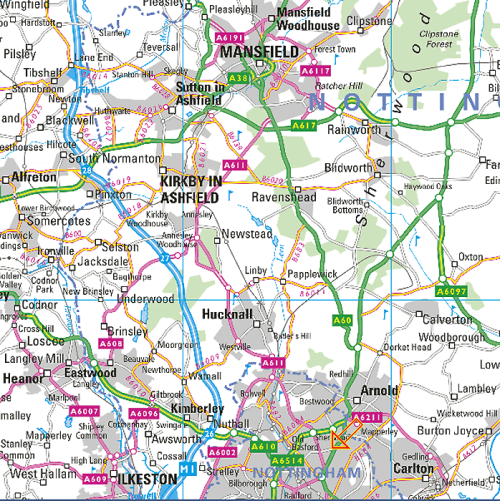
History always likes to puzzle us with the fogs of confusion that it loves to create, though. Just as we were digesting the fact that the High School played its first ever football match on November 19th 1870, when the First XI beat a Mansfield Grammar School XV by 3-0, I found that there is a some evidence that organised football was played by the High School even before this.

In just one edition of “The Forester”, there is an allusion to a football game between the High School and a Tudor House School XV on February 27th 1878. Charles Edwin Attenborough, the son of a hosier from Bilbie Street, was unlucky enough to break his leg and dislocate his ankle. It was reported at the time that, with the exception of one broken collar bone in, probably, the 1872-1873 season, this was the the first injury of any consequence “since the new school opened in 1868”.

This intriguing phrase might conceivably be taken to imply that football matches had taken place in that short interim period of just over two years between April 1868 and December 1870, when “The Forester’s” first reports appeared. This is so long after the event, though, that we may never know the exact truth.

Seven years after their first ever game against any other other school, the First XI played Mr Porter and Mr Jones’ “Tudor House” on October 31st 1877, probably on a pitch on the nearby Forest Recreation Ground.  The First XI won 15-0 and “The Forester” recorded that Tudor House did not once get the ball into the High School half, at any point in the game…..

“Goals were obtained as fast as the ball was kicked off.”

Fifteen had been scored “when time was called”.

Four months later, on February 27th 1878, again probably on a pitch on the nearby Forest Recreation Ground, the First XI beat a Tudor House XV by 3-2 (as already mentioned above). During this game, thirteen year old Charles Edwin Attenborough was unlucky enough to break his leg and dislocate his ankle. Despite our modern perceptions of the roughness of Victorian football, “The Forester” reported that, with the exception of one broken collar bone four seasons previously, this was the first injury of any consequence “since the new school opened” in April 1868.

And here it is, a photograph thought to have been taken on April 16th 1868, the school’s first day. The first lesson to be learnt was that more toilets would be needed if queuing was to be avoided:

A week or so after the glorious triumph over 15 boys in the Tudor House XV, on March 6th 1878, on the Forest, the First XI again played a Tudor House XV. and beat this slightly more numerous team by 2-0. These two games were the last two fixtures of the season 1877-1878.

During the following season, Tudor House scored their first ever victory over the High School. On a day misprinted in “The Forester” as October 60th 1878, on the Forest, the reporter said that “This was a very even game, but the fact that Bramwell and four other first team members were absent probably tipped the balance in favour of Tudor House.” They won by 1-0. We don’t know what colours the High School played in. In both these photographs, the colours are black and white. They come from 1897 and 1910, approximately:

This slideshow requires JavaScript.

A year later, on March 12th 1879, at an unknown venue, but probably the Forest , the First XI played out a skilfully planned 0-0 draw with Tudor House. This fixture took place in an extremely high wind, which encouraged the Tudor House players merely to kick the ball out of play as far as possible at every opportunity. “The Forester” lamented….

“….Unfortunately there is no rule which provides for occurrences of this kind, but we should have thought there would have been a better spirit prevailing to prevent such unsatisfactory proceedings.”

When I was in charge of the First XI, around 2000, I employed this tactic and it was extremely effective. Even better is to kick the ball into the road, the busier the road the better. Boys are not allowed to pursue a ball in such circumstances and it has to be the teacher/referee who has to go and fetch it. Invariably, he always takes ages.

Seven months later, on October 15th 1879, and back on the Forest, the two teams met again, and this time the wind had dropped and the game finished 6-1 to the High School. Only five of the regular First Team were in what “The Forester” called the “motley crew” who won this game. Now, Mötley Crüe are an American heavy metal band formed in Los Angeles in 1981. Please don’t confuse them with the Victorian footballers. It’s easily done:

Being sensible, and playing Tudor House with a weakened team which lacked many of the regular First XI players didn’t last long, though. The very last fixture ever against Tudor House came on February 11th 1880. Again at an unknown venue, the High School triumphed. The score was recorded as

Nottingham High School “at least 12” Tudor House 0

“The Forester” wrote that

“the difficulty in this game was “not to get goals”, so weak were the opposition. Goal followed goal in quick succession, so that it was rather hard to keep a correct account. It was certainly not less than 12 goals, and may have been more.”

I once coached the Second Team in such a match. It finished 13-0 (referee). 14-0 (me) or 15-0 (several of the players). We lost, of course.

We once lost to another school team who had a nine-year old girl in goal. Their member of staff asked me if it was OK for her to play and I agreed, not knowing that she was Spider Woman in her spare time. We lost 3-2.

STOP PRESS

Elsewhere I have spoken about how, in the attic, I stumbled upon the box containing all of my slides from the 1970s and early 1980s.

The photograph below I took around 1976. It was taken from the corridor which ran down towards the then E13, and you can see the roof of the Old Gymnasium and the Assembly Hall, sometimes called the Player Hall. Directly behind that are the two buildings of Brincliffe. To help you identify them, they both have gables picked out in bright white……..
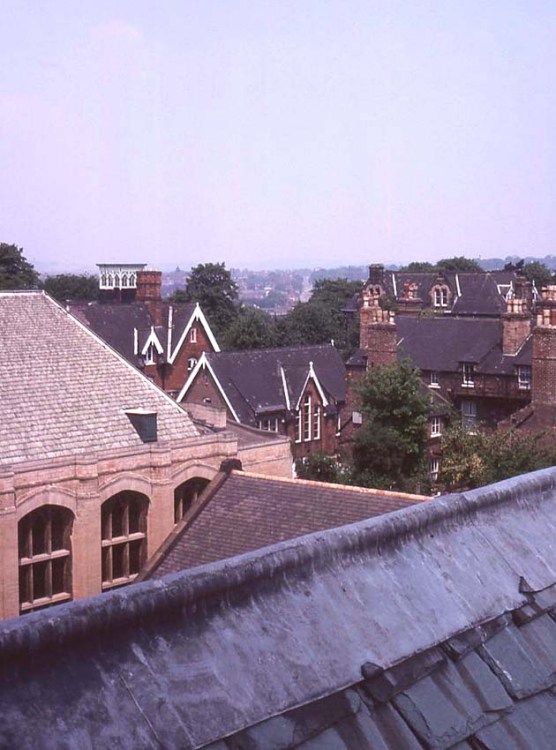
15 Comments

Filed under Football, History, Humour, Nottingham, Politics, The High School

The First Day of the Battle of the Somme, July 1st 1916 (Part 1)

I haven’t written very often about World War 1, but this particular subject, the Battle of the Somme, really attracted me……..

I have chosen the time to publish this blog post with great care.

On July 1st 1916 tens of thousands of British soldiers stood in the trench opposite the German lines.

When the officers blew their whistles, they “went over the top”, climbing up short ladders into no-man’s land, and walking sedately off, into battle.

Some 19,240 men of the British forces would be killed.

Some 38,230 of them would be wounded.

It was the worst day in the history of the British Army.

So……..what brought about this catastrophe?  Well ……..

By the end of December 1915, the Germans and the Western Allies had fought each other to a stalemate, a complete standstill. The latter therefore, resolved to organise massive co-ordinated attacks in 1916 in an effort to change the face of the war. The Russians and Italians, for example, would attack their respective German opponents and the British would carry out their “Big Push” into Belgium.

Things had to be completely changed in February 1916, though, when the Germans attacked the French at Verdun. The French were soon losing men in large numbers and they asked the British to attack not Belgium, but instead, to attack the Germans at the point where their two respective armies, French and British, were next to each other. This was the valley of the River Somme.

During the months of fighting on the Somme, the Allies would lose 623,907 men, including 146,431 killed or missing.

The Germans would lose 465,181 men including 164,055 killed or missing.

Allied casualties were huge……

And so were the German casualties……….

For the Allies, it was the British who fought the first day of the Battle of the Somme on July 1st 1916. These were the highest losses in any one day in the history of the British Army. The Germans, therefore, safe behind their defences, killed 19,240 men of the British forces and wounded 38,230 of their men. In just one day.

For the last century, analysts have argued why such a disaster occurred. I recently watched a three part series about the first seven months of the Somme Campaign. The programmes were based on the researches of an English historian. Peter Barton, who has spent many years as a “battlefield guide” in the Somme area……..
He carried out many of his initial researches largely because of the huge numbers of casualties involved.  He felt the first place to look would be the German language archives and he was amazed to discover that he was the first person ever to do so, and that not a single English historian had consulted them in a whole century.

Peter Barton’s overall conclusion was that the British had suffered so many casualties because of “recklessness, foolhardiness and treachery”.  All three will be explained in due course.

The cunning British plan for the forthcoming Battle of the Somme was simple……

Firstly, bombard the Germans with your artillery until they don’t know their own names.

That same artillery will destroy the barbed wire defences the Germans have in front of their lines.

Assemble huge numbers of Allied troops in their forward trenches, ready to go.

The officers blow their whistles.

The soldiers emerge into no-man’s-land and make their way towards the German trenches.

Walk, don’t run !!!!!

Take possession of the enemy trenches.

In due course, more Allied troops will arrive and any remaining Germans will surrender.

Then, all of the Allied armies will make their way deep into German held territory……… infantry, artillery, cavalry, everybody.

Repeat until you reach Berlin.

The whole thing could well be a perfect example of the strongly held British belief that “the artillery conquers, the infantry occupies”.

Peter Barton, though, found a completely different story in the German archives……

On June 30th 1916, the Germans were outnumbered by at least four to one and were completely out-gunned. Despite that, the following day, the British suffered 57,470 casualties with 19,240 killed.

Such a catastrophe is rather difficult to explain, but Peter Barton found the German Archives had plenty of suggestions.

Firstly, the Germans had been shelled for an entire week. The guns could be heard in London if the wind was right. The result, though, was quite simply unsatisfactory.

The enemy’s defences and guns had not been destroyed because a huge proportion of the shells had failed to go off. The barbed wire in front of the German trenches remained therefore largely intact.

The British troops, meanwhile, had been told to walk over to the German lines and quietly take possession of them. It would be easy, they were told, because by now the Germans would all have been killed by the bombardment.

When the attacking troops arrived at the German trenches, though, they were slaughtered……

The Germans were inordinately well informed about the British attack. For months they had been using a machine called “Moritz” which intercepted British radio broadcasts and created a huge mass of intelligence. By July 1st, the Germans knew absolutely everything there was to know, except the exact time of the attack. This they found out at 7.10 am, just twenty minutes before the whistles were blown, and the men went “over the top”.

The German Archives also proved that the British prisoners of war they had captured before the beginning of the battle had revealed every single detail of the British plans. By the time the battle began, hundreds of them had divulged everything there was to know about the British attack, including the British Order of Battle and the identity and location of every unit in the British forces. Much of it came from one particularly talkative British deserter.

19,240 men killed and 38,230 wounded 

Next time, more details about all the advantages handed on a plate to the Germans, before those fatal whistles blew, at 7.30 am on July 1st 1916.


18 Comments

Filed under France, History, military

Brincliffe Grammar School for Girls (2) Before and After

Having started my researches abou the Brincliffe Grammar School for Girls on Balmoral Road, I could not resist trying to find out more, and more, and more……..

Using my very sad collection of Kelly’s Directories of Nottingham, I was able to trace just a little bit of history, not so much for the Brincliffe School, but for the site where it would eventually be situated.

And so, in 1876, (the year of Custer’s Last Stand), on the corner of Balmoral Road and Forest Road, on the western side, was “Porter & Jones, boys’ school (Tudor House)”. In other words, the same building which would, one day in 1907, house Brincliffe Grammar School for Girls, had been, thirty years earlier, a private school run for profit, inside what had originally been a private house. The two partners in the business were Messrs Porter & Jones, and they had given the school the name of “Tudor House”.

Three years later, in 1879, the entry reveals that Tudor House had become a boarding and day school and that, of the original partnership of Porter & Jones, Mr Gregory Porter seemed to be the Head Honcho.

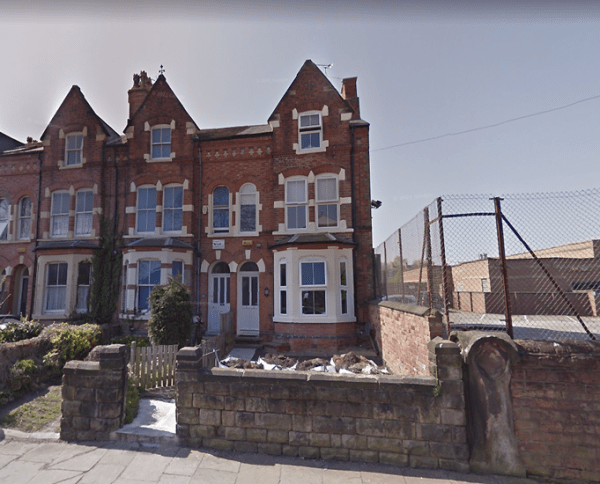
In 1881, the house, now apparently the property of Mr Gregory Porter alone, was now No 25 Balmoral Road. No 23 is still standing, the house immediately to the left of the main entrance to the High School staff car park. In 1885, the situation was exactly the same.  Tudor House, and Gregory Porter, were still in business. Here’s Nos 19, 21 and 23 today, complete with original Victorian sandstone wall:

Alas, by 1891, Tudor House was no more, and the school became “a ladies’ school” for ladies. under its Headmistress, Miss Blanche Hall.

By 1894-1895, the Misses B. & K. Hall were running a boarding and day school at No 25. The house was now called “Brincliffe”. Why they had chosen this name, I do not know. Presumably, it refers to the “brink” or edge of a “cliff”, a reference perhaps to the small area of steeply sloping ground to the northwest of the Church Cemetery, overlooking the much flatter and much lower, Forest Recreation Ground.

Here is that “brink of a cliff”:

The slope is actually quite steep and, while not a cliff, it would have seemed a lot more precipitous 140 years ago because there were no trees then. The trees are quite young for trees, only around 80-100 years old. Here is a view inside the trees on a very familiar path down from the High School (and Brincliffe) :

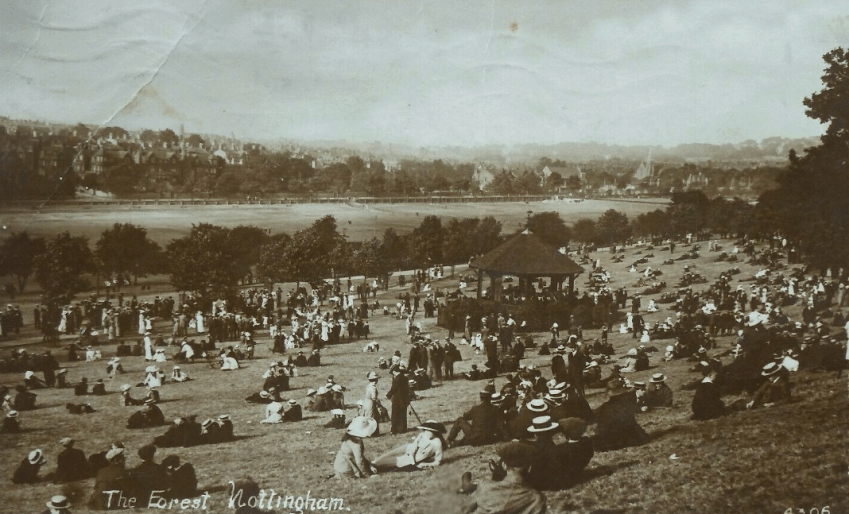
The slope is certainly steep enough to sunbathe on. Here is a lovely Sunday afternoon with people in their Sunday best, relaxing around the long gone bandstand. See if you can solve “Where’s Walter?” and can you spot Robin Hood?

And here is the much lower flat area, which has always hosted any number of football/soccer pitches. In 1865, they had seen the birth of Nottingham Forest, nicknamed at the time, the “Garibaldi Reds”:

So, by 1894-1895, the Misses B. & K. Hall were running a boarding and day school at No 25. It was called “Brincliffe”. And now you know why!

By 1898-1899, “Brincliffe” had been acquired by the Misses Koppel & Hall. It was still No 25. In 1904, Miss Amy Koppel was running the boarding & day school on her own, the premises still with the same name and number.

In 1907, the City Council made it a Girls’ Grammar School, but from 1913 onwards it is listed as just “Notts County Secondary School, Miss Sybil Randall, head-mistress”

I have not been able to find any pictures of the girls in their green blazers and Green Berets, “à la John Wayne”. That crumpled, baggy 1950s blazer is still the only thing I’ve found:

One final detail.

The very first mention of a school on the Brincliffe site was “Porter & Jones, boys’ school (Tudor House)”. We know this already, but one thing I did find was that in 1862, a Miss Sarah Porter was running a “school” on distant Woodborough Road. In 1864 she was named as Miss Sophia Elizabeth Porter, presumably the same person (or perhaps sisters), still in an un-numbered location on Woodborough Road.  Unfortunately I have no directories available for the period 1864-1876.

13 Comments

Filed under History, Nottingham, Politics, The High School

A discovery in the loft

A few months ago, after probably years of intermittent searching, deep, deep in the loft, I found the battered green cardboard box which I had always used to store my slides. It was hiding in plain sight, mixed in with around fifteen cardboard boxes of varying sizes and colours.

“What are slides ?”, I hear everybody under forty five thinking to themselves.

Well, fifty or sixty years ago, cameras were not at all like they are nowadays, and they required that the photographer did his or her fair share to make them actually take photographs. I was very keen on photography and I soon joined the ranks of those who took slides. Here are some random slides, in this case Kodak, which could be quite expensive. I preferred to use the much cheaper East German slides manufactured by Orwo. The frame of the slide is either cardboard or plastic, and and the slides themselves are merely a roll of photographic film which has been developed and then cut into 36 pictures:

Once I had two or three boxes of slides, I could then bore both friends and family rigid with interminable slide shows about “What we did on our holidays”. If you didn’t want to project your slides onto a screen, then you could buy a tiny “slide viewer” which allowed you to view your slides on what was more or less a four inch TV screen.

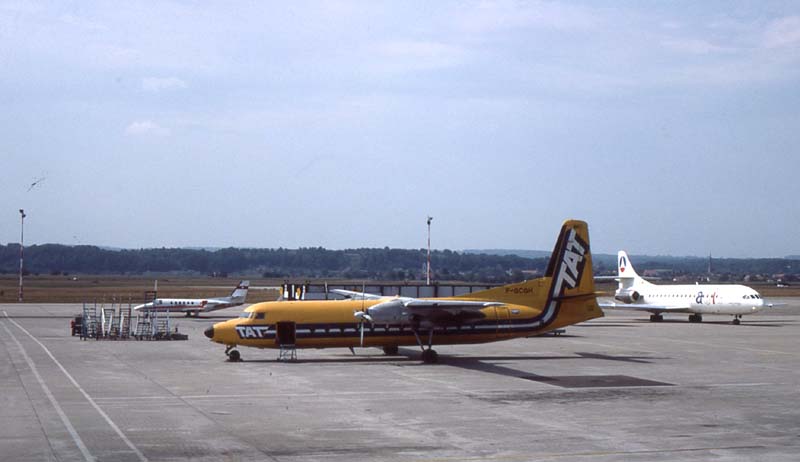
The first slide in this selection is a plane spotter’s dream, as I took a golden opportunity to photograph a foreign airport. I actually find passenger aircraft rather tedious, but I reckon that in this one slide there’s a Caravelle on the right, and perhaps a Fokker Friendship in the centre:

All of the cameras which I could afford were the kind where it was impossible to look through the lens to see what your eventual picture might be. Instead, there was just a view finder. Here’s a picture of a camera pretty much like mine, in the early 1970s. It’s a Voigtländer, a German camera, although I had originally bought mine more because it had a Leica lens:

To take photographs, you also had to use a light meter. Here’s one quite like mine, although I’m afraid I have only the vaguest idea of how I used to operate it. First of all, I think I used to set the overall controls on the meter for whether the camera was using a fast or a slow film. This means whether the film worked best in bright sunlight or in darker conditions, such as inside a church, for example. Then I used to insert the light reading I had taken into the various dials on the meter and then choose how I wanted to proceed. That would depend on the distance away from the camera of the subject and whether it was bright or dull weather, and whether the subject of the photograph was moving quickly or slowly.

The best results came when bright light made it possible to set the camera at 1/500th at “f22” with the lens of the camera focussed on infinity, marked as “”.

Here’s a link on how to use a light meter,

And here’s a light meter:

There were one or two further difficulties with slides, though.  They always seemed to pick up lots of dust and grime, all of which would be magnified when it was projected onto the screen.

Last June I was overjoyed to find that long lost medium sized green cardboard box. I recognised it immediately. It was the very box where I used to store all those yellow and blue plastic boxes full of slides. And there they were. Hundreds, if not thousands, of slides, none of which I had seen for the best part of forty or fifty years.

And then I remembered about our latest scanner. It had a setting for turning slides into digital images. I didn’t know anything whatsoever about how that worked but I gave it a go, and, sure enough, it reproduced all of the dust and grime absolutely perfectly, with the occasional added bonus of changing the overall colours of a slide into something quite bizarre such as purple or dark green. There was a setting on the scanner which suggested that I might wish to “Rectify the bizarre colours of your age old slides” and I chose this, but fairly frequently it just brought in a different weird colour. Here’s an example, taken in Switzerland :

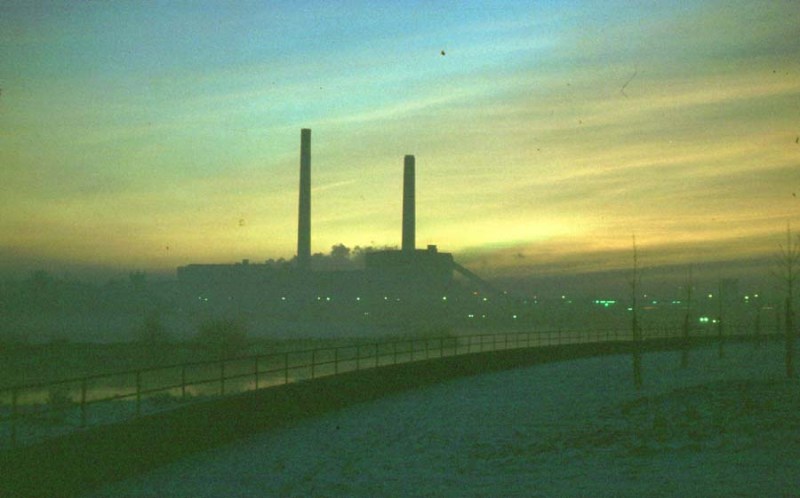
And here’s another. This is the River Trent at Nottingham, with the old Wilford Power Station still standing proudly in the gloaming.  Nowadays, it is  long demolished, replaced by the                                                                                                                Retail Park:

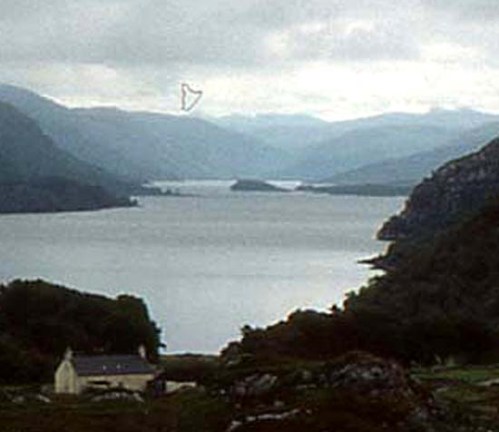
Rather naively, I had expected that all of the particles of grime, dust, grease and common household insects would be taken care of by the magic of the scanner’s technology, but, alas, I was wrong.  So, enjoy the “Flying Harp of Old Oireland” :

Were you able to spot it? Here’s an enlargement…..

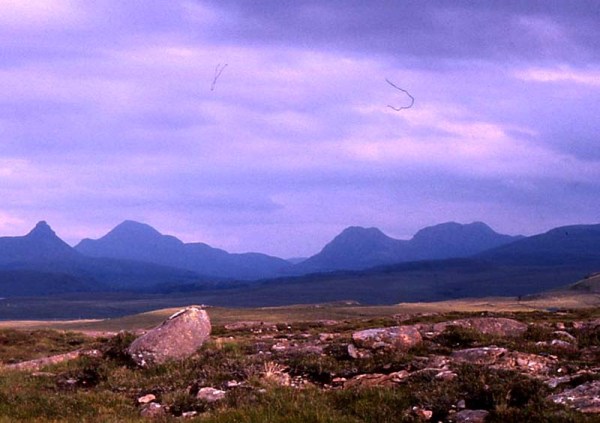
The “Artist formerly known as “Prince” possessed his very own breeding pair of Scottish Flying Snakes. Here they are, pictured at the height of their mating dance among the Purple Mountains and the Purple Haze in the very north of Scotland :

Here are just a few of the Exploding Gas Bombs used by the Scottish Liberation Army:

My next slide I call “UFOs over the mountains”. It’s the largest gathering of extra-terrestrial craft ever photographed. Or, it’s a tornado hitting the Glencoe Municipal Landfill site:

And thank goodness, after a good deal of practice, I have become quite adept at cleaning up the extraneous details. to produce a reasonably decent final version :

And finally, here is the slide I was offered well over $50, 000, 000 for………

“The Loch Ness Pterodactyl”

Did you manage to find it? Here’s an enlargement…..

It took me ages and ages and ages to rectify the dirt and grease on so many of my slides. A lot of the colour problems I was unable to solve. And I still have around twenty boxes of slides still to do.

What I intend to do now is to use some of my old slides in my blog posts. I’ve taken them in a number of different places including the Netherlands, Scotland, Switzerland and West Germany as well as Nottingham and the village where I grew up, namely Woodville in South Derbyshire. You have been warned!!


21 Comments

Filed under Aviation, History, Personal, taking slides

Brincliffe Grammar School for Girls (1)

When I am writing blog posts, just like David Bowie and Jimi Hendrix, I don’t normally do requests. On the other hand, I did feel a little bit guilty that, months ago, somebody contacted me and said, very politely, “Maybe one day you could tell us a bit more about Brincliffe School, please?”. Regrettably, I did not record their name. On the other hand, the Hairy Godmother has granted their wish………

Brincliffe School was situated in Balmoral Road in Nottingham, immediately to the east of the High School. This Grammar School for Girls occupied the area between the western corner of the junction with Forest Road East, as far south as No 23, the first house of a row of three storey Edwardian properties. The Orange Arrow tells the tale, indicating precisely the southern boundary of the now demolished school:

Here’s the Victorian equivalent of the same area. The Brincliffe building is south west of the “B-A-L” of “Balmoral Road”.:

Brincliffe didn’t really look much like a school. It was more like a school housed in a private dwelling house:

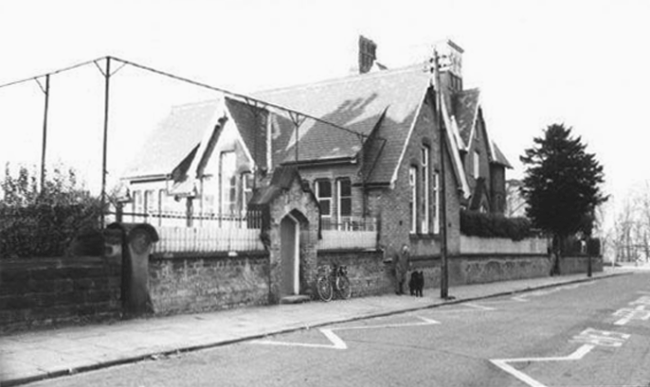
At one time, when it was a private house, Dame Laura Knight, the artist, had lived there. Not many pictures of the building are left nowadays. It was demolished in the late 1970s. Here is the view from the south. The key to linking up the two photographs is the bottom left of the photograph above, and the centre right of the photograph below. The three windows and the gate with a portico are crucial links. Don’t miss one man and his dog who have stopped for eternity next to the telegraph post.

Brincliffe was an all girls’ grammar school, which operated from 1907-1974. Entry was by passing a competitive examination. Unlike Nottingham Girls’ High School, no fees were payable. Such selective, and free, schools were a fantastic source of social mobility and an excellent examination for the poor.  Everybody in the school had a talent and the schoolwork they did was of a very high standard. At Brincliffe, girls had a genuine opportunity to do what they wanted to do with their lives, with little interferece, except from their own families.

The school produced a Gold Medallist in the 1974 Commonwealth Games, an Oxford don, a member of the D’Oyley Carte Opera Company, any number of students at Oxford and Cambridge Universities, and innumerable doctors, dentists, solicitors and politicians. And all of them came from an ordinary background. If you doubt that, then go and look at their Facebook page.

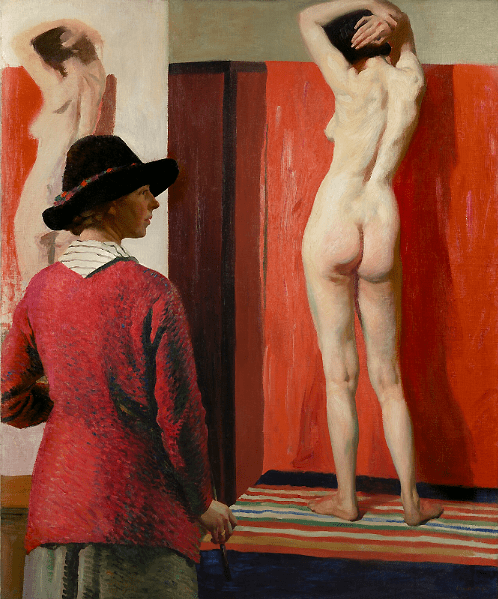
The most famous high achiever from Brincliffe was surely Dame Laura Knight, the painter.   One of her most famous paintings was “Self portrait with a nude”. It caused a right fuss:

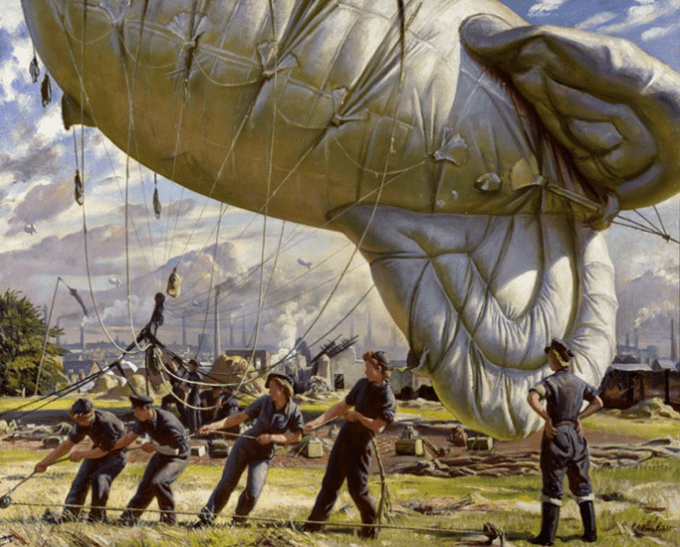
She also did a lot of paintings of World War Two. They included “A Balloon Site, Coventry” in 1943:

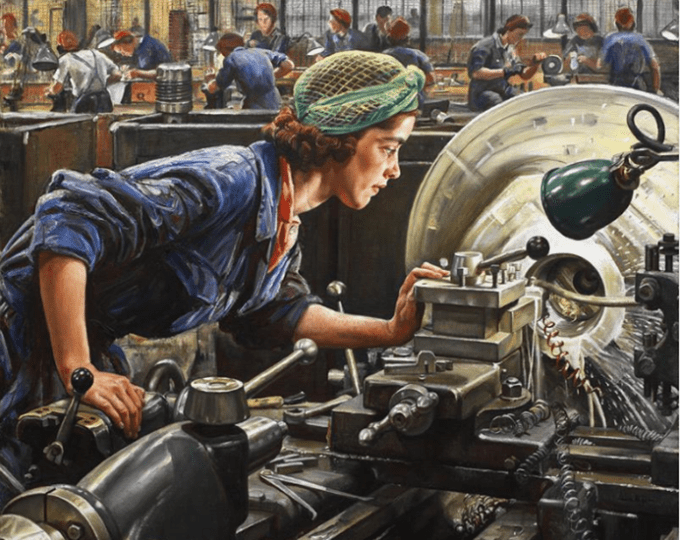
The superbly composed “Ruby Loftus Screwing a Breech-ring” in the same year of 1943:

And a portrayal of the crew of a Short Stirling bomber in 1943. It is entitled “Take Off “, and I found in one account that the poor young wireless operator had been killed almost before the paint on the painting had dried :

Dame Laura was one of a very few female artists during her era. Another famous Old Brincliffian was Enid Bakewell who played for the English women’s cricket team in twelve Tests between 1968 and 1979. Her batting and bowling averages show that she could well be  regarded as the best all-rounder that the English women’s game has ever produced.

The Brincliffe School ran from 1907 onwards, for almost seventy years. There was only a single thirty girl form in each year, so everybody knew each other. The pupils used to wear dark green blazers and berets. Here is a typical green blazer of the period:

Brincliffe had only five Headmistresses during its history, the Misses Randall, Yates, Yonge, Lloyd and Carter. Teaching at Brincliffe came to an end in 1974 and I can remember still seeing the typical Victoria building during my first few years at the High School, from 1975 onwards. I have vague memories that, as the school was so close to the High School, we were allowed to use the empty classrooms for some of our smaller classes, such as Sixth Form groups. Brincliffe didn’t die in 1974, but it was severely wounded by a Labour Council’s decisions.  It was merged with another school for girls on Gregory Boulevard. This was the Manning School, formally opened by Alderman Manning in April 1931. (Aren’t local politicians just shameless?)

When Brincliffe and Manning merged, they also became a comprehensive school catering for girls aged between 11 and 16 years. In 1983 the school moved to new buildings in Aspley, a suburb further to the west, whilst the old school buildings on Gregory Boulevard became the Forest Comprehensive School. In September 2011, the Manning School became the Nottingham Girls’ Academy, the first all girls’ academy in Nottingham. It catered for girls aged between 11 and 18 years old.

34 Comments

Filed under History, Nottingham, The High School

Enigma 4

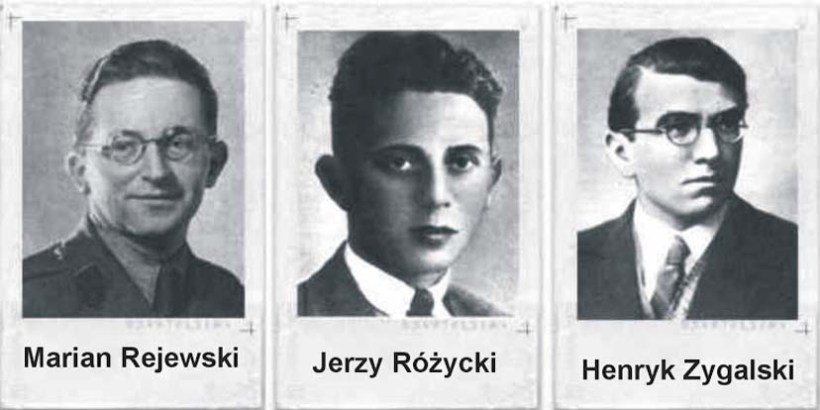
Last time, I was telling the story of how the three Polish whizz kid mathematicians, Marian Rejewski, Jery Rozycki and Henryk Zygalski, had told the British and the French, everything they had discovered about Enigma. Here they are:

That generous act enabled the British to begin decrypting German messages almost straight away, and, very soon, to start affecting the outcome of the war. In March-April 1941, Enigma revealed, for example, that Crete was going to be invaded from the air, using gliders and paratroopers. Everybody was ready for them and the German invasion force suffered heavy casualties, with as many as 4,000 men killed.

I also talked last time about how, in May 1941, the Royal Navy was told the whereabouts of all the supply ships that were servicing the Bismarck. They also ascertained on one particular occasion, that the Bismarck was headed to a harbour in France, rather than in Germany.

The stories all came from the book by John Jackson which relates the story of Enigma, the German encrypting machine used throughout the entire Second World War, the Germans always confident that their codes could never be cracked….

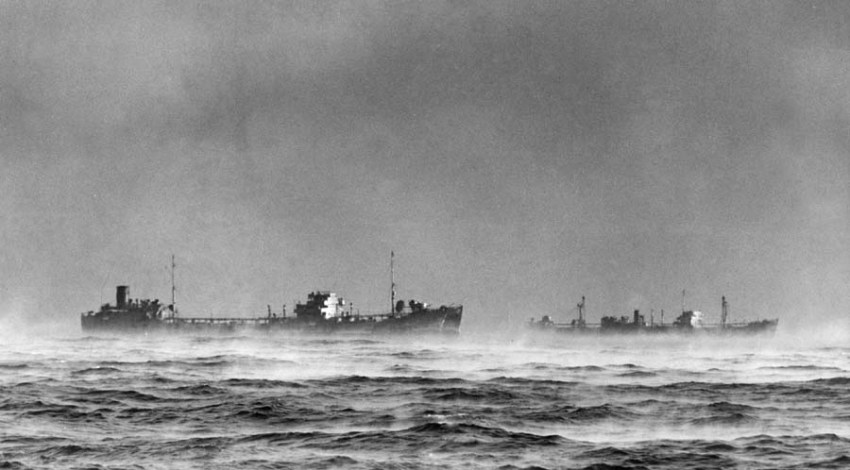
In July 1942, if the Royal Navy had been clever enough to believe the Enigma decrypt given to them, they would not have told the Arctic convoy PQ17 to scatter, an act which condemned 24 ships to a watery grave and 153 sailors to an early death. Arctic convoys were dreadful:

Temperatures were always unbelievably low, and the ships were  attacked more or less constantly:                                                                                                                                                                                                                                                                                                                               

There was very little air cover, and the one constant threat was the mighty battleship, the Tirpitz:

Even Enigma cannot overcome the arrogance of unintelligent senior officers. And what was the reason for the mix-up?

Well, the great men at the top end of the Royal Navy believed that the Tirpitz had left port to attack the convoy. But, unbelievable as it may seem, they were actually mistaken and the biggest naval disaster of the Second World War ensued.

In April 1944, General Guderian went on a tour of the various armoured units that the Germans had stationed in Normandy. This enabled the Allies to know exactly which Germans were where, and gave them…….

“a splendid insight into the distribution of the armour a month before the landing.”

Here is General Guderian. He was the author of the definitive book on tank warfare called “Panzer”. If only one of the senior English officers had read it before the Panzers rolled into France in 1940:

Further Enigma decrypts in 1944 revealed exactly the strength of the Germans in northern France, with six top quality divisions in France and Belgium, along with fourteen divisions of lesser quality. Worryingly, perhaps, the Cotentin Peninsula, to the west of the D-Day beaches, was being heavily reinforced, although it was music to Churchill’s ears to hear the large number of complaints from a large number of various German units that petrol and oil were again in very short supply. The Prime Minister was also extremely pleased to hear that, day by day, Hitler and his generals were beginning to believe more and more strongly that the Allies would land not in Normandy, but in the Pas de Calais.

Enigma decrypts also revealed that in, May 1944, the Luftwaffe had a thousand aircraft including 650 fighters, although Allied numbers were much, much, higher. Interestingly, given that the weather satellite had not yet been invented, the Allies were delighted that on D-Day, thanks to Enigma, they would be able to use what were probably far more accurate forecasts than anything they had themselves, namely the Germans’ own weather forecasts.

In June 1944, Enigma also managed to decipher encrypted messages between Peenemünde and Blizna, a testing ground for the V1 and V2. Before long, everybody at Bletchley Park was familiar with the name of Werner von Braun, soon to give up being a career war criminal and to move to a cushy well paid job in the United States.

Here’s a V2 rocket:

They were tested initially at Peenemünde and then at Blizna. Not a lot went on without the Enigma decrypts letting the RAF know something about it. Peenemünde was heavily damaged after a huge number of RAF bombers bombed every square foot of the site. They included 103 Squadron, starring my Dad. The RAF were particularly keen to blast and obliterate Peenemünde, because they’d all been told……

“Destroy the secret weapon site tonight, or you’ll all have to go back tomorrow evening.” 

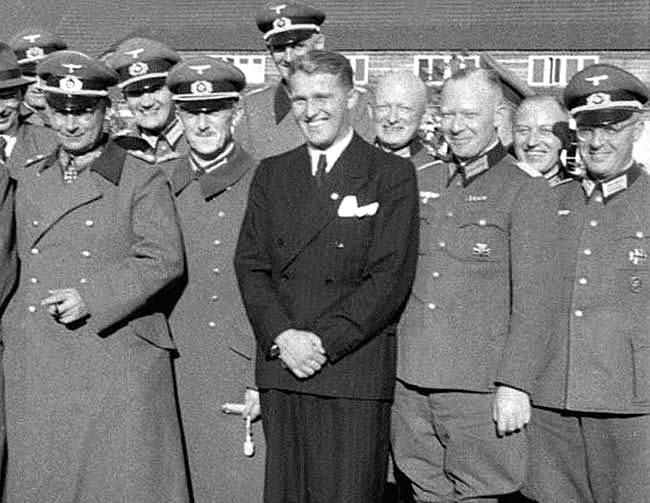
The main scientist in charge at Peenemünde was, of course Werner von Braun, not an SS war criminal who used slave labourers to build whatever he required but a helpful scientist who took Mankind to the Moon. Here he is, sharing one or two Slave Labourer jokes with his pals:

At the time, the people deciphering the Enigma messages were absolutely amazed at what the Germans were doing. They had never anticipated what were, after all, artillery shells, being propelled around a hundred miles to blow up either London or Antwerp. By late 1944, the so-called “Rocket Bradshaw” decrypts were providing everybody with the Germans’ timetable of all the V2 launches from the Hague area of the Netherlands, all of them targeted on London. The exact target was always Tower Bridge although they never got within a mile of it.

One final thought, which does not actually come from John Jackson’s book but from a TV programme I saw about the Final Solution. I hadn’t realised that there were still Enigma encrypts which had defied all attempts to decipher them. One of them was deciphered as recently as 2020. It was a careful record of how many Jews had been rounded up from the ghettoes in a score or more towns and cities in central and eastern Poland and had now been transported to Auschwitz-Birkenau and murdered. They were apparently using their strongest encryptions for that one.

18 Comments

Filed under Aviation, Bomber Command, History, military, Russia

My Dad’s cars (3)

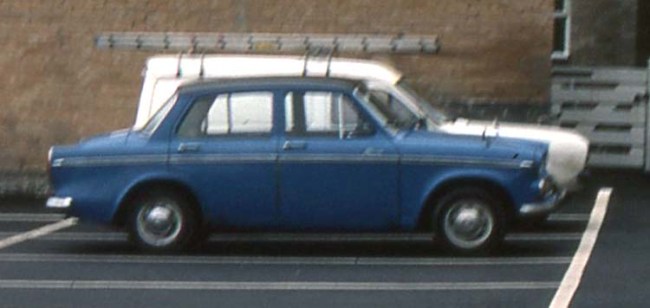
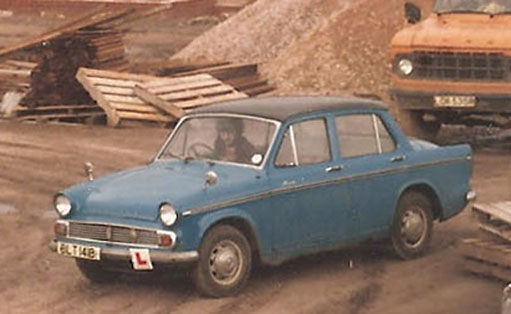
I have already told you about the love of my Dad’s motoring life, his Hillman Minx De Luxe, Registration Number BLT 141B. He gave it to me after he retired, and I had it for about two or  three years. Here is a picture of it in the car park of the old Savoy Hotel in 1980, on our wedding day. That’s why the picture’s so shaky:

Here I am driving this 1964 car, as it gradually began to get rustier and rustier :photo 4

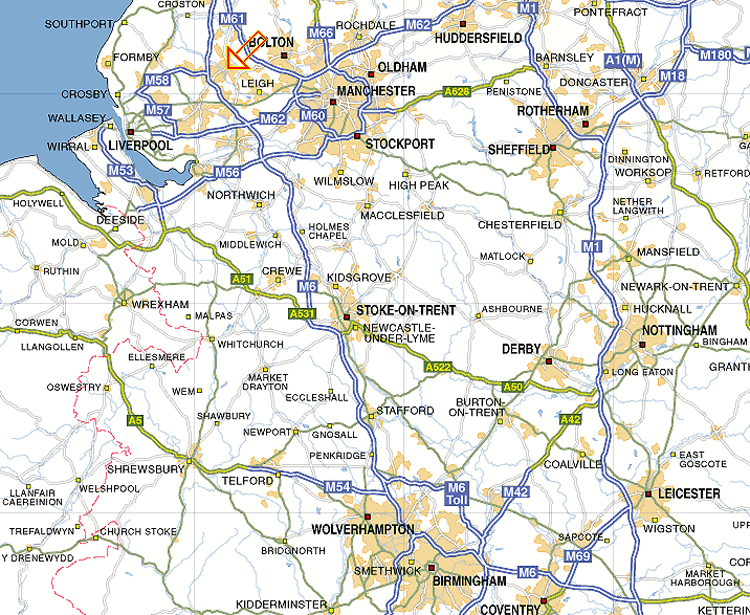
It was in this Hillman Minx that, back in 1968, Fred was returning from Wigan down the M6, when, because the motorway was still in the throes of construction, he failed to see the tiny hand-painted direction signs, and finished up in a building site in Birmingham, having missed his turn off in Stoke-on-Trent. That sounds incredible, but he’d never been on  a motorway before. Wigan is a town in Lancashire and is indicated by the Orange Arrow. My Mum’s parents lived there. The other towns and cities are in capital letters. Fred was aiming at Burton-on-Trent near Derby, which is south east of Stoke:

He was driving the same car in Leicester (south east of Derby) when he got lost and was forced to ask a policeman the way. Realising that he was dealing with somebody from out-of-town, this eminently sensible officer told Fred to avoid a rather horrific one-way system by driving fifty yards the wrong way down a one way street, while he promised to turn a blind eye to the whole thing.

It was again in this very same Hillman Minx that, three years later, Fred again missed his way in that very same city of Leicester, and went the wrong way up another one way street. Instead of being able to solve the problem by the previous method, however, Fred was forced on this second occasion to extricate himself from the situation by executing a three point turn in the face of a rapidly advancing four lanes of densely packed vehicles.

I have vague memories too, of getting lost as we went on holiday for the first time to the Yorkshire coast at either Bridlington or Scarborough. We stopped at, I think, Pontefract, somewhere near a power station, to ask the way.

The man that Fred approached spoke with an accent which was completely incomprehensible, and after a few frustrated minutes, Fred just drove off at top speed, angrily spinning the wheels on his rather sedate family saloon. At the time, he insisted that, against all the apparent mathematical odds, he had managed to find the local village idiot at his very first attempt.

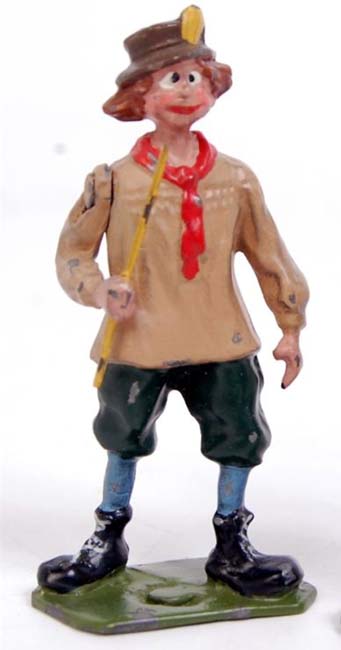
Incidentally, above, you can see the Britain’s Lead Soldier version of the village idiot which usually reaches £200 at auction.

Nowadays, I think, in calm retrospect, that the man’s Yorkshire accent may well have been beyond us. It is difficult, though, even to best guess the location of these events. Perhaps it was near the huge power station at Ferrybridge where the A64 to the east coast Yorkshire holiday resorts left the main A1 trunk road, as it would have been at that time. The power station was demolished a long time ago:

Whenever Fred left his car anywhere unfamiliar, such as when he was away on holiday, or for any length of time in his own local area, he would always immobilise it by removing part of the carburettor . On occasion, Fred would even immobilize the car when he parked it on his own drive. It was years after his death that I realized that in this apparently bizarre zeal for crime prevention, Fred was only carrying out the orders that he would have been given in the early part of World War Two, in 1939-1940, when it was a serious criminal offence to leave a vehicle without totally immobilising it. There was a very real fear of imminent invasion, and the arrival of Nazi paratroopers, many of them disguised as nuns. And even in 1975, the Soviet Spetsnaz forces would have drunk a bottle of vodka each in celebration to have found such a fast and classy vehicle as a 1964 Hillman Minx. Here’s their badge in case your car is ever stolen. Spetsnaz are everywhere:

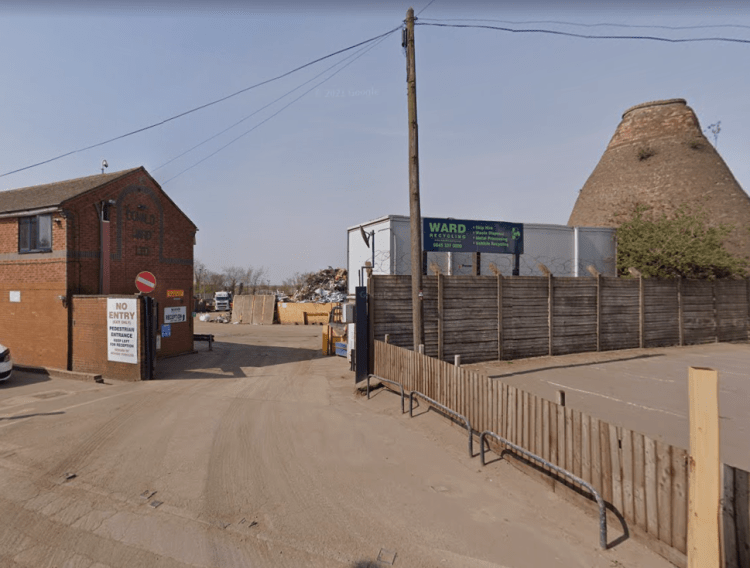
This Hillman Minx was THE car of Fred’s life. He had it for more than sixteen years, before, around 1980, he passed it on to me as a newly qualified driver. I in my turn used the car until it failed its MOT test by a very wide margin, some £300 when my annual salary was £500. I then duly drove it back from Nottingham to Woodville, where my family lived. Fred was then able to drive “that Hillman” as he always called it, on its last ever journey, the short distance from 9 Hartshorne Road to Donald Ward’s scrapyard in Moira Road. Here it is, complete with Victorian bottle kiln:

16 Comments

Filed under History, Humour, my Dad, My House, Nottingham, Personal, Russia