Category Archives: military

The next few months of the Battle of the Somme with more revelations about British stupidity (Part 5)

Surprisingly, throughout the whole First World War, the British were unbelievably lax on what could be termed “personal security”. In the German Archives, therefore, battlefield expert, Peter Barton, seen below,………

………found that literally hundreds of lower ranked British officers had been captured by the Germans with top secret plans in their possession, including many labelled “not to be taken into the front line”.

Not surprisingly, the Germans found these maps extremely useful and once they had seen them, they would quickly change their defensive plans and tactics to fit in with them. For example, on one occasion, they resited all of their heavy machine guns out of range of the Allied creeping barrage. Here they are, the schweinhunds……

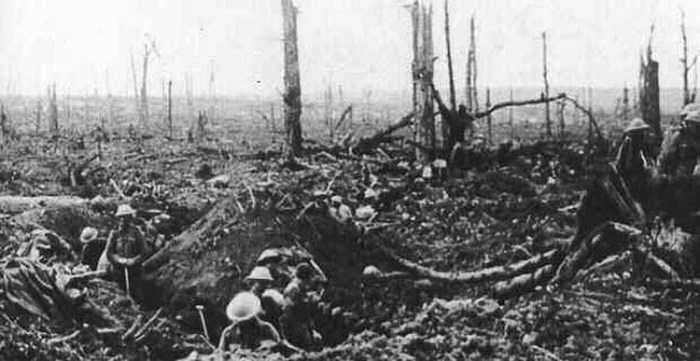
During the very harsh winter of 1916-1917, the morale of the British troops plunged, in large part because of the lack of success on the Somme and the huge casualties suffered there.

According to the German Archives, hundreds of British POWs shared that very same opinion. The POWs were only too ready to tell the Germans that anxiety, depression and pessimism were rife among the men in the British trenches. A war which was going to be a “walkover” had now become a very long steeplechase with an almost infinite number of obstacles.

Indeed, war weariness was such that both officers and soldiers were frequently delighted to become POWs in German captivity. There was also widespread disgust at how the British press told blatant lies about the progress of the war, especially the Daily Mail. Here are headlines about how a desperate German population was now eating the corpses of their dead soldiers…..
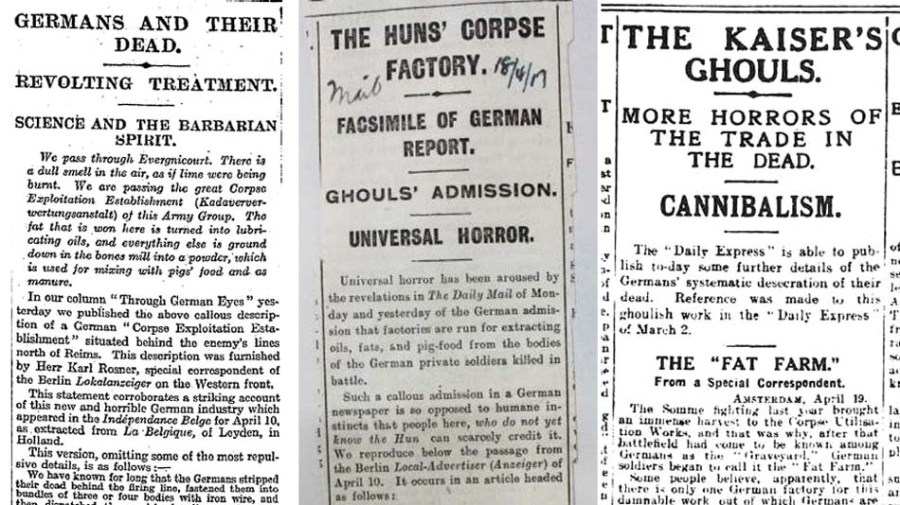
By 1916-197, divisions were also beginning to appear between the British and the Dominions of the Empire, with the Australians, Canadians and New Zealanders only too willing to slate the British leadership on the Somme.

The numbers of men who wanted to go on fighting were increasingly small and the Australians in particular, who were no fools and were 100% aware that they were “always used in tough battles” were beginning to see their role as the “White Slaves of the Somme”. The same would happen to them in World War Two, and the Canadians would also suffer in a similar way in both wars. In World War 2, the Poles and the French speaking Canadians could also added to the list.

Mental illness, shell shock and desertion were increasing by leaps and bounds. Haig showed them no mercy and nine times out of ten opted to have them shot. It was carried out in the most ill considered of ways, with the members of the firing squad always selected from the condemned man’s unit. On many occasions, therefore, they were being asked to shoot somebody who they may have known personally, quite possibly as a friend. Here’s a British Army firing squad, hard at work…….
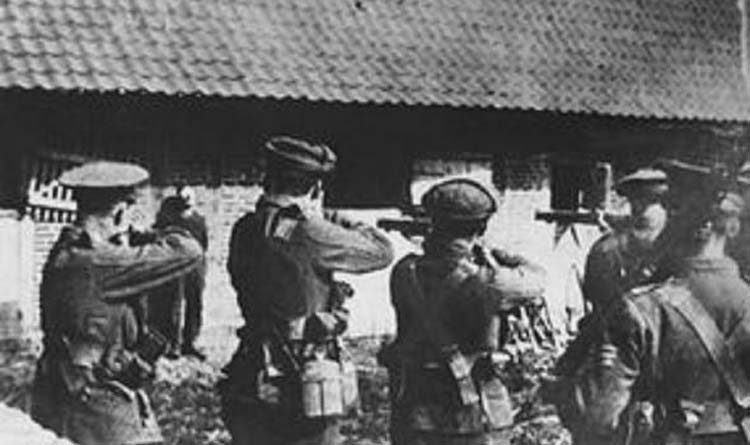
Both sides tried wrongdoers at courts martial. The British did not give the accused access to a lawyer, but instead they had an officer to give them advice and to fight their corner.

The Germans made it much more like a civil trial. There was a jury whose job was to decide the guilt of the prisoner, and he had access to a fully qualified lawyer.

The Germans used physical punishments and these were carried out in the local area.

When dealing with captured German soldiers, the British constantly harassed them and tended to be very fierce and very nasty to them. The result was that they hardly ever discovered any useful intelligence information.

The Germans, though, were always very pleasant with the British POWs, who soon became much more relaxed. The two sides would begin to chat to each other, and share a cup of tea, sometimes with biscuits.  Those simple aids would usually persuade the British to give up their secrets, often in very great detail. Here are prisoners in a German Prisoner-of-War camp. Some of these men might have been here for four years, since being captured, for example, at the Battle of Mons….

20 Comments

Filed under Canada, History, military

The next few months of the Battle of the Somme, July, August, September, October 1916 (Part 3)

My previous blog posts about the Battle of the Somme were based on the “Both sides of the wire”” series of TV programmes, which were themselves based on the extensive researches of the English historian, Peter Barton, who has spent many years as a “battlefield guide” in the Somme area. He was the first person ever to consult the German language archives and was amazed to discover that he was the only English historian who had looked at them in a whole century. Here he is…..

My previous blog posts concentrated on the famous “First Day of the Somme”, July 1st 1916, the British Army’s most disastrous ever day, which  was portrayed in the first programme of the three. The remaining two programmes followed the campaign until the Battle of Boom Ravine between February 17th–18th 1917. This was when the Allies attacked the Germans troops on the Ancre Heights near Courcelette and to the north of the Ancre valley. That was the end, more or less, of the Somme Campaign. Overall, the British had casualties of 420,000 men, the French 200,000 and the Germans 512,000. If my Maths serves me well, that is 1,132,000 poor souls killed or wounded, many of them horrifically disfigured for life.

Rather than take you through these two remaining TV programmes in immense detail, I would prefer to tell you about the most striking details Peter Barton found. Although they are often unrelated to each other, these details are all really interesting and might well persuade you to set the recorder for all three hours of programming on the next occasion these ground-breaking documentaries are shown. So don’t expect a bedtime story, rather a list of unusual, quirky truths that Peter Barton found in his researches in the German Archives. I decided to label them “Fun facts” in case anybody wanted to have a test afterwards.

Funfact One

In the fighting from July 14th onwards, the excellent fighting qualities of the Germans were often completely underestimated, particularly their defensive organisation. Advances which were anticipated to take a few hours, instead took the British several weeks. The Germans had by now developed new tactics, there was extremely fierce resistance and the British attack just petered out. It took an unexpected two weeks to capture Longueval, and the Germans in nearby Delville Wood were to remain there until August 27th. What a pretty little wood it was! …….

Funfact Two

Overall, the Germans had always preferred to be defensive and the British were forced to be offensive. According to the German Archives, though, the British POWs had told their German captors that the British feared open warfare and very much preferred a war based on a defensive system with trenches, barbed wire and minefields.

Not all the British generals shared these views, however, and differences of opinion were frequently marked. Rawlinson was the second in command and he was an infantry man. He believed in what was popularly called “Bite and hold”, or the acquisition of enemy territory in cautious, tiny steps. Haig, however, the British No 1, was a cavalry man, who believed in great thrusts of advance. Haig had the derring-do of a cavalry man and was considered to be a “thruster”, a man who would always unleash the cavalry when the opportunity arose. Here’s Haig, wearing his “Anti-Gas trousers”….

Funfact Three

During the July 14th attack during the Somme campaign, there was a cavalry charge which involved some Indian troops of the 20th Deccan Horse. Peter Barton discovered that German POWs in British hands had reported, when they spoke to their own officers much later, that many of the British cavalrymen were feeding and watering their horses at the very same time when senior British officers had told the press that their derring-do charge was taking place.

In other words, the charge could not possibly have taken place as the newspapers described it. This was further emphasised by the fact that it could not have happened as early in the day as the newspapers reported, because the ground at that time would have been too hard and slippery for the horses’ hooves. Only later would conditions have been suitable. The inference is, of course, that direct lies were being told about events to make the British attack and their meagre achievements look more impressive.

Funfact Four

The Germans were aware of every single detail about the British because of their enormous number of telephone intercepts. They must been aware too, therefore, that the German army was only one fifth the size of the Allied forces.

Funfact Five

Again, the fact was emphasised that the British may actually have been very pleased to turn to defensive, trench warfare. Open warfare requires great flexibility, lots of different techniques and lots of different skills, but the German Archives revealed that the British troops seemed to have received no battlefield training whatsoever. Their basic tactic remained a massive heavy bombardment by thousands of mortars and field guns, and then a charge across no-man’s-land in large numbers. They had presumably learnt nothing from July 1st 1916, except that it was okay to run rather than having always to walk.

Even so, the Germans had enormous respect for the British, who attacked and then attacked again, even when it was obviously pointless. This, of course, produced enormous casualties for very little gain but that did not seem to matter a huge amount. With the Allied forces five times as numerous as their opponents, the war became very much a “war of attrition”. The effectiveness of attrition as a tactic was made to look all the better by using optimistic, or possibly, even false, German casualty figures.

Funfact Six

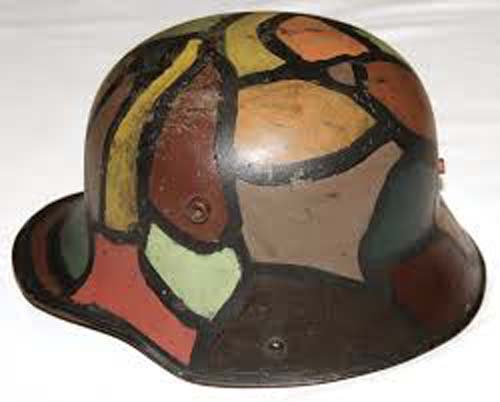
In the skies, the Royal Flying Corps, the RFC, were always dominant but the Germans were very adept at protecting themselves with camouflage, and very good at hiding themselves, and their weaponry. Most striking, perhaps, was their use of “dazzle camouflage”, as on this possibly early Bauhaus chamber pot from 1918…..


20 Comments

Filed under Aviation, France, History, military

The First Day of the Battle of the Somme, July 1st 1916 (Part 1)

I haven’t written very often about World War 1, but this particular subject, the Battle of the Somme, really attracted me……..

I have chosen the time to publish this blog post with great care.

On July 1st 1916 tens of thousands of British soldiers stood in the trench opposite the German lines.

When the officers blew their whistles, they “went over the top”, climbing up short ladders into no-man’s land, and walking sedately off, into battle.

Some 19,240 men of the British forces would be killed.

Some 38,230 of them would be wounded.

It was the worst day in the history of the British Army.

So……..what brought about this catastrophe?  Well ……..

By the end of December 1915, the Germans and the Western Allies had fought each other to a stalemate, a complete standstill. The latter therefore, resolved to organise massive co-ordinated attacks in 1916 in an effort to change the face of the war. The Russians and Italians, for example, would attack their respective German opponents and the British would carry out their “Big Push” into Belgium.

Things had to be completely changed in February 1916, though, when the Germans attacked the French at Verdun. The French were soon losing men in large numbers and they asked the British to attack not Belgium, but instead, to attack the Germans at the point where their two respective armies, French and British, were next to each other. This was the valley of the River Somme.

During the months of fighting on the Somme, the Allies would lose 623,907 men, including 146,431 killed or missing.

The Germans would lose 465,181 men including 164,055 killed or missing.

Allied casualties were huge……

And so were the German casualties……….

For the Allies, it was the British who fought the first day of the Battle of the Somme on July 1st 1916. These were the highest losses in any one day in the history of the British Army. The Germans, therefore, safe behind their defences, killed 19,240 men of the British forces and wounded 38,230 of their men. In just one day.

For the last century, analysts have argued why such a disaster occurred. I recently watched a three part series about the first seven months of the Somme Campaign. The programmes were based on the researches of an English historian. Peter Barton, who has spent many years as a “battlefield guide” in the Somme area……..

He carried out many of his initial researches largely because of the huge numbers of casualties involved.  He felt the first place to look would be the German language archives and he was amazed to discover that he was the first person ever to do so, and that not a single English historian had consulted them in a whole century.

Peter Barton’s overall conclusion was that the British had suffered so many casualties because of “recklessness, foolhardiness and treachery”.  All three will be explained in due course.

The cunning British plan for the forthcoming Battle of the Somme was simple……

Firstly, bombard the Germans with your artillery until they don’t know their own names.

That same artillery will destroy the barbed wire defences the Germans have in front of their lines.

Assemble huge numbers of Allied troops in their forward trenches, ready to go.

The officers blow their whistles.

The soldiers emerge into no-man’s-land and make their way towards the German trenches.

Walk, don’t run !!!!!

Take possession of the enemy trenches.

In due course, more Allied troops will arrive and any remaining Germans will surrender.

Then, all of the Allied armies will make their way deep into German held territory……… infantry, artillery, cavalry, everybody.

Repeat until you reach Berlin.

The whole thing could well be a perfect example of the strongly held British belief that “the artillery conquers, the infantry occupies”.

Peter Barton, though, found a completely different story in the German archives……

On June 30th 1916, the Germans were outnumbered by at least four to one and were completely out-gunned. Despite that, the following day, the British suffered 57,470 casualties with 19,240 killed.

Such a catastrophe is rather difficult to explain, but Peter Barton found the German Archives had plenty of suggestions.

Firstly, the Germans had been shelled for an entire week. The guns could be heard in London if the wind was right. The result, though, was quite simply unsatisfactory.

The enemy’s defences and guns had not been destroyed because a huge proportion of the shells had failed to go off. The barbed wire in front of the German trenches remained therefore largely intact.

The British troops, meanwhile, had been told to walk over to the German lines and quietly take possession of them. It would be easy, they were told, because by now the Germans would all have been killed by the bombardment.

When the attacking troops arrived at the German trenches, though, they were slaughtered……

The Germans were inordinately well informed about the British attack. For months they had been using a machine called “Moritz” which intercepted British radio broadcasts and created a huge mass of intelligence. By July 1st, the Germans knew absolutely everything there was to know, except the exact time of the attack. This they found out at 7.10 am, just twenty minutes before the whistles were blown, and the men went “over the top”.

The German Archives also proved that the British prisoners of war they had captured before the beginning of the battle had revealed every single detail of the British plans. By the time the battle began, hundreds of them had divulged everything there was to know about the British attack, including the British Order of Battle and the identity and location of every unit in the British forces. Much of it came from one particularly talkative British deserter.

19,240 men killed and 38,230 wounded 

Next time, more details about all the advantages handed on a plate to the Germans, before those fatal whistles blew, at 7.30 am on July 1st 1916.


18 Comments

Filed under France, History, military

Enigma 4

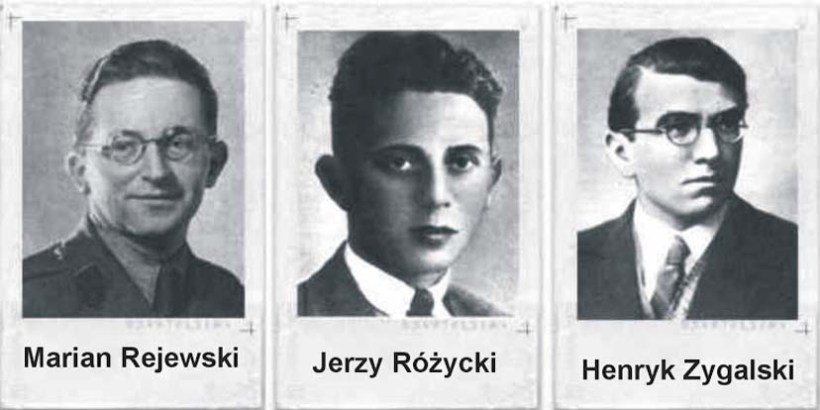
Last time, I was telling the story of how the three Polish whizz kid mathematicians, Marian Rejewski, Jery Rozycki and Henryk Zygalski, had told the British and the French, everything they had discovered about Enigma. Here they are:

That generous act enabled the British to begin decrypting German messages almost straight away, and, very soon, to start affecting the outcome of the war. In March-April 1941, Enigma revealed, for example, that Crete was going to be invaded from the air, using gliders and paratroopers. Everybody was ready for them and the German invasion force suffered heavy casualties, with as many as 4,000 men killed.

I also talked last time about how, in May 1941, the Royal Navy was told the whereabouts of all the supply ships that were servicing the Bismarck. They also ascertained on one particular occasion, that the Bismarck was headed to a harbour in France, rather than in Germany.

The stories all came from the book by John Jackson which relates the story of Enigma, the German encrypting machine used throughout the entire Second World War, the Germans always confident that their codes could never be cracked….

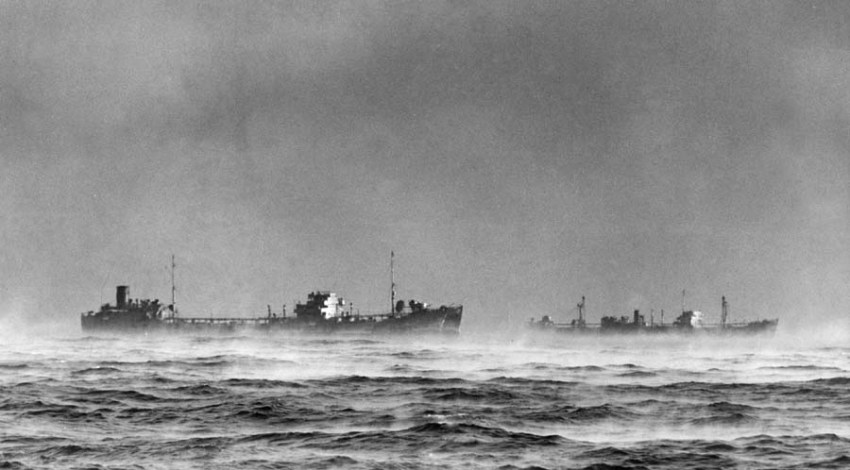
In July 1942, if the Royal Navy had been clever enough to believe the Enigma decrypt given to them, they would not have told the Arctic convoy PQ17 to scatter, an act which condemned 24 ships to a watery grave and 153 sailors to an early death. Arctic convoys were dreadful:

Temperatures were always unbelievably low, and the ships were  attacked more or less constantly:                                                                                                                                                                                                                                                                                                                               

There was very little air cover, and the one constant threat was the mighty battleship, the Tirpitz:

Even Enigma cannot overcome the arrogance of unintelligent senior officers. And what was the reason for the mix-up?

Well, the great men at the top end of the Royal Navy believed that the Tirpitz had left port to attack the convoy. But, unbelievable as it may seem, they were actually mistaken and the biggest naval disaster of the Second World War ensued.

In April 1944, General Guderian went on a tour of the various armoured units that the Germans had stationed in Normandy. This enabled the Allies to know exactly which Germans were where, and gave them…….

“a splendid insight into the distribution of the armour a month before the landing.”

Here is General Guderian. He was the author of the definitive book on tank warfare called “Panzer”. If only one of the senior English officers had read it before the Panzers rolled into France in 1940:

Further Enigma decrypts in 1944 revealed exactly the strength of the Germans in northern France, with six top quality divisions in France and Belgium, along with fourteen divisions of lesser quality. Worryingly, perhaps, the Cotentin Peninsula, to the west of the D-Day beaches, was being heavily reinforced, although it was music to Churchill’s ears to hear the large number of complaints from a large number of various German units that petrol and oil were again in very short supply. The Prime Minister was also extremely pleased to hear that, day by day, Hitler and his generals were beginning to believe more and more strongly that the Allies would land not in Normandy, but in the Pas de Calais.

Enigma decrypts also revealed that in, May 1944, the Luftwaffe had a thousand aircraft including 650 fighters, although Allied numbers were much, much, higher. Interestingly, given that the weather satellite had not yet been invented, the Allies were delighted that on D-Day, thanks to Enigma, they would be able to use what were probably far more accurate forecasts than anything they had themselves, namely the Germans’ own weather forecasts.

In June 1944, Enigma also managed to decipher encrypted messages between Peenemünde and Blizna, a testing ground for the V1 and V2. Before long, everybody at Bletchley Park was familiar with the name of Werner von Braun, soon to give up being a career war criminal and to move to a cushy well paid job in the United States.

Here’s a V2 rocket:

They were tested initially at Peenemünde and then at Blizna. Not a lot went on without the Enigma decrypts letting the RAF know something about it. Peenemünde was heavily damaged after a huge number of RAF bombers bombed every square foot of the site. They included 103 Squadron, starring my Dad. The RAF were particularly keen to blast and obliterate Peenemünde, because they’d all been told……

“Destroy the secret weapon site tonight, or you’ll all have to go back tomorrow evening.” 

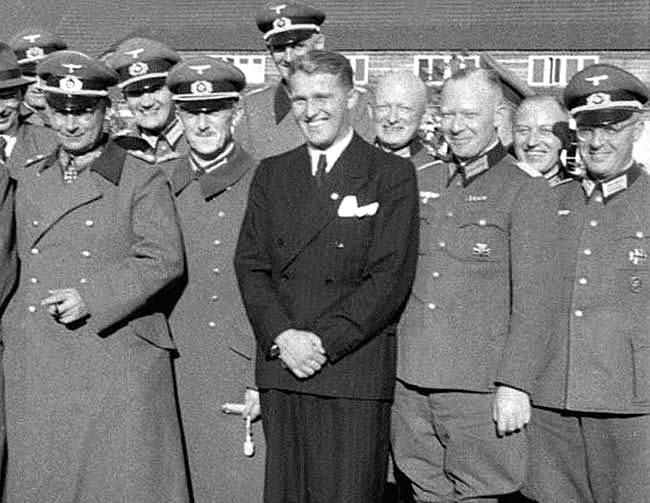
The main scientist in charge at Peenemünde was, of course Werner von Braun, not an SS war criminal who used slave labourers to build whatever he required but a helpful scientist who took Mankind to the Moon. Here he is, sharing one or two Slave Labourer jokes with his pals:

At the time, the people deciphering the Enigma messages were absolutely amazed at what the Germans were doing. They had never anticipated what were, after all, artillery shells, being propelled around a hundred miles to blow up either London or Antwerp. By late 1944, the so-called “Rocket Bradshaw” decrypts were providing everybody with the Germans’ timetable of all the V2 launches from the Hague area of the Netherlands, all of them targeted on London. The exact target was always Tower Bridge although they never got within a mile of it.

One final thought, which does not actually come from John Jackson’s book but from a TV programme I saw about the Final Solution. I hadn’t realised that there were still Enigma encrypts which had defied all attempts to decipher them. One of them was deciphered as recently as 2020. It was a careful record of how many Jews had been rounded up from the ghettoes in a score or more towns and cities in central and eastern Poland and had now been transported to Auschwitz-Birkenau and murdered. They were apparently using their strongest encryptions for that one.

18 Comments

Filed under Aviation, Bomber Command, History, military, Russia

Hendon objects 3

In my last blog post about the non-flying exhibits in the museum at Hendon in north London, we were looking at some of the objects and various pieces of metal which had been rescued from aircraft as they awaited their turn in the scrapyard. These treasures were all housed in the RAF Museum which my family and I visited as long ago as 2010.

In my first two blog posts, I made an effort to include mostly things that were associated with the ground, such as a battleship, medals and the metal cross from a dog’s collar. This time, though, the objects are supposed to be connected more closely with the air.

We have therefore, some examples of the nose art on RAF Lancasters and other Bomber Command bombers.

This one comes from an aircraft in one of the Polish squadrons of the RAF:

This aircraft has all of its missions marked carefully, although I do not know whether the white or yellow colouration has any significance:

This is the artwork on a Boeing B-17 Flying Fortress. In general, American artwork tended to be less inhibited than in the RAF:

Here’s what looks like a wasp type creature on a B-24 Liberator of the Indian Air Force:

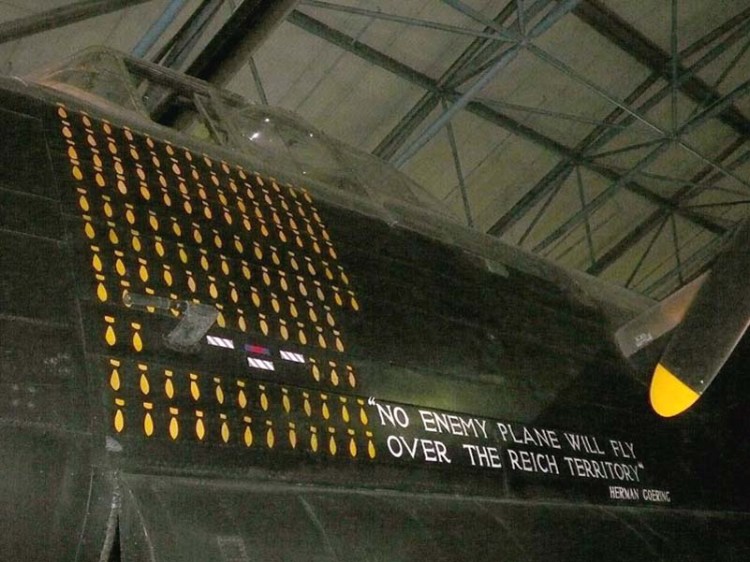
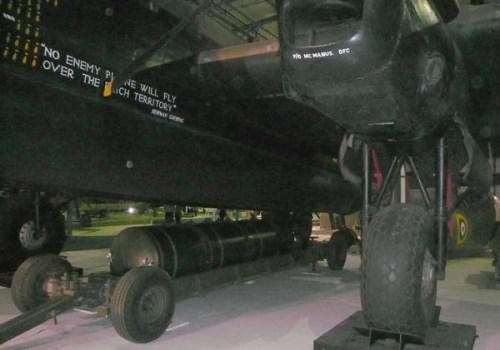
These bombing raid symbols are just about the neatest that you could ever get. Note the quotation from Herman Goering underneath them:

“No enemy plane will fly over the Reich Territory.”     Herman Goering

The bombing raid symbols also contain three medal ribbons for the Distinguished Flying Crosses or Distinguished Flying Medals won by members of the crew. The one with blue and red in the medal I do not know. The name of the medal recipient was painted underneath the engine nacelles. Here is Pilot Officer Tottenham:

And Pilot Officer McManus:

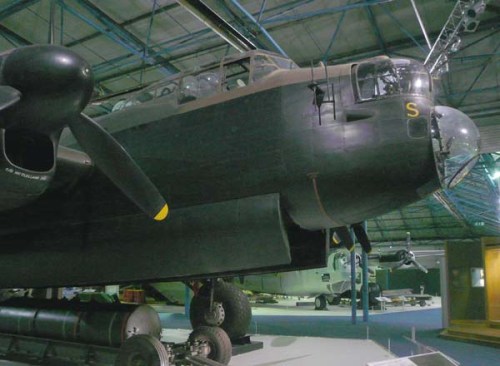
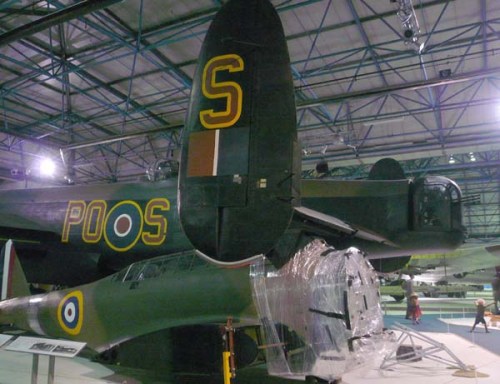
This aircraft was “S-Sugar” within the squadron. As well as on the side of the fuselage, the single letter appears on the nose:

And also on the tailfins:

I don’t know what the little aircraft is. Possibly, it is a training aircraft. If you know its identity, please indicate in the Comments Section.

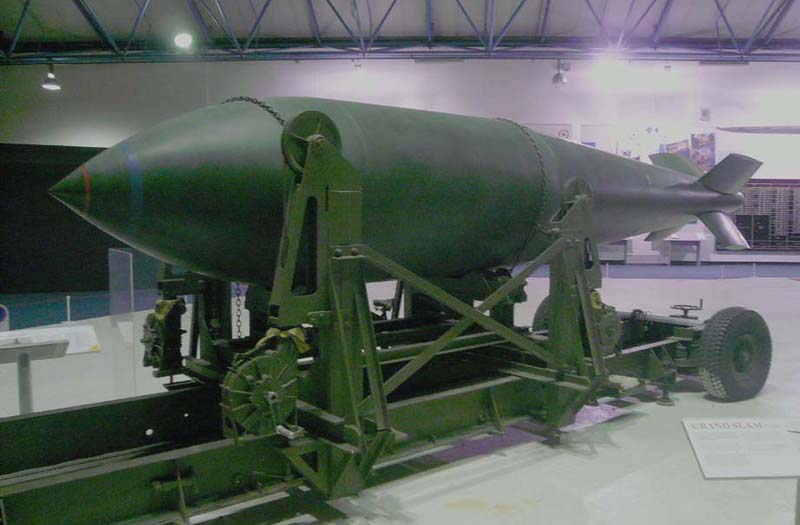
The museum has a couple of bombs on show.

This appears to me to be a standard 4,000lb “cookie” which carried the maximum bombload inside a very thin skin so as to create the biggest blast possible. That would blow the roofs off and allow the incendiaries to get inside the buildings and start their work:

This is a “Grand Slam” ten ton bomb, designed to penetrate the ground at more than the speed of sound and then to explode, creating a vast empty space deep in the ground. The technical term for this is a camouflet, an artificial cavern created by an explosion. Whatever is above it, buildings, railways, bridges, whatever, can then collapse into the void.

It was an incredible sight, my Dad always said, to see a Lancaster getting off the runway carrying this enormous weight. The aircraft would invariably struggle and he always described its wings as “being like a huge crescent”, although somehow, the gallant aircraft always managed to get into the sky:

It was when he was with 617 Squadron in late 1944 and 1945 that Fred had seen Lancasters staggering into the air armed with these gigantic bombs. I did ask him in the latter stages of his life if he remembered any of the places he had bombed, but, alas, he was too old by then. He added that from his point of view, so many of the targets were names he had never heard before. And I suppose with “Mimoyecques” he does have a point!  The only target he did in fact remember were the U-boat pens in Brest. The crews were all told to make sure that they dropped their bombs well in the middle of each protective concrete roof. Otherwise, they would stand little chance of doing very much damage.

These extraordinary ten ton weapons were used operationally by 617 Squadron from March 14th 1945 onwards.

And finally, here’s one of those hypnotic spinner patterns beloved of the Luftwaffe. They always seem to appear in the newsreels from the early part of the war:

PS :  Forgive the weird colours in the previous photographs, but this entire floor was lit with special lighting to preserve the original Bomber Command matt black.

Here is some modern nose art from the 1970s. This was on the nose of a Handley Page Victor V-Bomber which had been preserved without the rest of the aircraft:

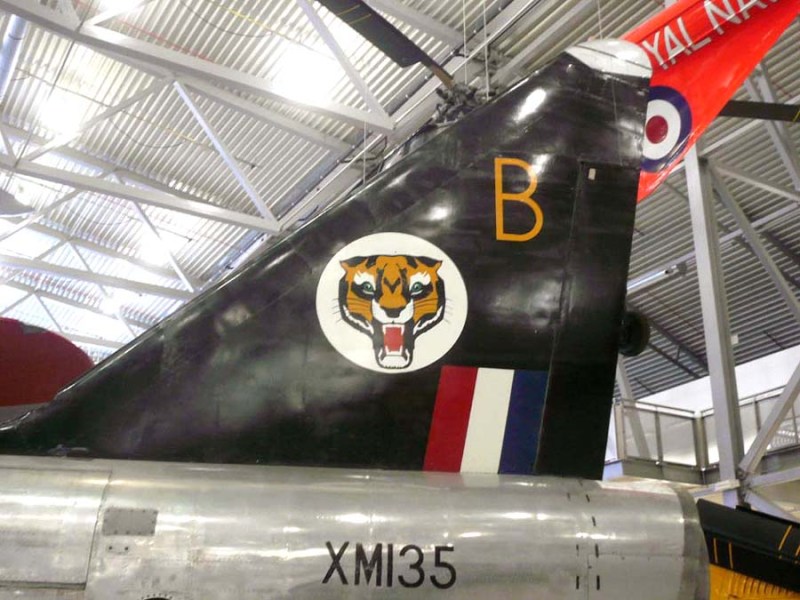
And finally, here is an English Electric Lightning fighter of the early sixties, proudly displaying its tiger badges. Firstly, on the nose itself, there are the two stylised versions either side of the RAF roundel:

And here is the  animal proper on the aircraft’s tail:

This Mach-2 fighter was operated by 74 Squadron and this is the Tiger scheme from the days when they were the RAF display team in 1962.

20 Comments

Filed under Aviation, Bomber Command, History, military, my Dad, Personal

Enigma 3

Last time, I had told the story of how the three Polish whizz kid mathematicians, Marian Rejewski, Jery Rozycki and Henryk Zygalski, had told the British and the French, everything they had discovered about Enigma.  The stories all came from the book by John Jackson which relates the story of Enigma, the German encrypting machine used throughout the entire Second World War…..

From these Polish beginnings, many, many aspects of the war were affected….. for the better. There was, however, a Golden Rule always in operation.

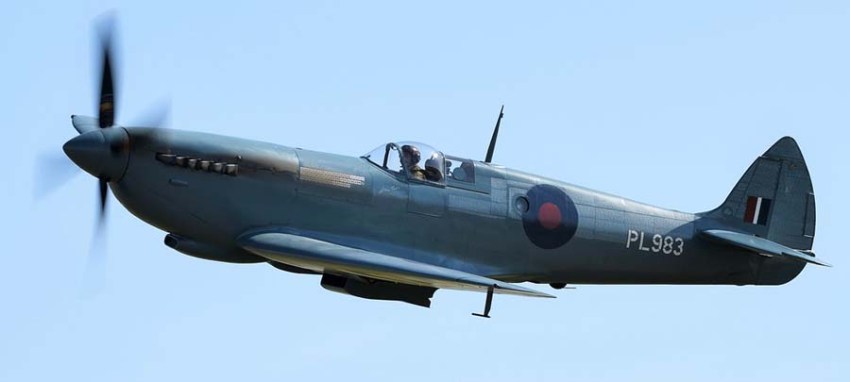
If the only information about a future event came from Enigma, then other sources had to be created as well. The rule resulted, for example, in a lot of photo-reconnaissance aircraft being sent to take photographs of a place already mentioned by the Enigma decrypt and which was going to be bombed  The pilot was always told to fly the aircraft around a lot of other nearby places as well, and to make it look as if the trip was completely routine. Here is a photo-reconnaissance Spitfire. They were usually entirely blue, although  I’m sure that they were also painted pink, a colour which was frequently nicknamed in North Africa especially, “Mountbatten pink”:

Mosquitoes were also used, especially for the longer trips:

If Enigma was the only source of a piece of information, of course, then any action taken by the British would prove to the Germans that the code had been cracked. For this reason, if there was only one source of information, and that was Enigma decrypts, then no action was taken.

The system worked so well that right until the very end of the war, the Germans continued to believe that Enigma was uncrackable and that only they had the secret of deciphering it.

In May 1941, Enigma was able to tell the Royal Navy the whereabouts of all the supply ships that were servicing the Bismarck. They also ascertained that the Bismarck was headed to France, not Germany, after a particular phase of the battle.  Here’s the German “Pocket Battleship of the Month”:

The Bismarck was one of my very few Airfix ships kits. That and HMS Tiger, a Royal Navy destroyer.  The way this piece of informnation from Enigma worked was that the ships carrying fuel and ammunition were all sunk, and so too was any other ship carrying supplies that added to the Bismarck’s capabilities as a ship destroyer.  Supply ships carrying records, newspapers, and a change of library books were all left alone, as were the ships carrying food and drink.

On November 1940, a major air-raid might have been opposed more thoroughly if the people at the top had used their brains and guessed which city in England was being referred to in a mildly encoded sequence of the names of cities about to be bombed back into the Stone Age………..

For example…..

“LOge” was “LOndon”

Do you see how it works? Nothing particularly Enigma-inspired at this point. The first two letters give it away.  So, what was “BRuder” ?

No, it wasn’t Brisbane, or Brighton & Hove or Bradford. It was…..

“BRistol”

So, now, what was “BIld”

No, it wasn’t Bicester, or Bishop Auckland or Bilston. It was…….

“BIrmingham”

So, a more difficult one, now. A city with its own name in German. And it’s actually easier than you might think. If the Air Vice Marshall had  taken his road atlas out of his bag, he would have realised that, of the 1, 165 cities, towns and villages of Great Britain, not a single one begins “Ko-“.

And no,  “Konchester” is not the German for “Manchester”, and “Korwich” is not the German for “Norwich”.

The correct answer is…..

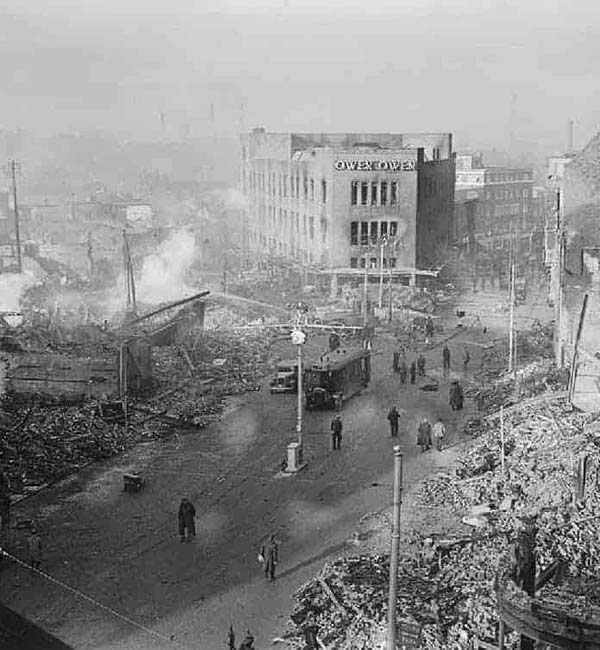
“KOventry”

The  only city of the four with its own name in German. The city was flattened……

…..especially the cathedral……

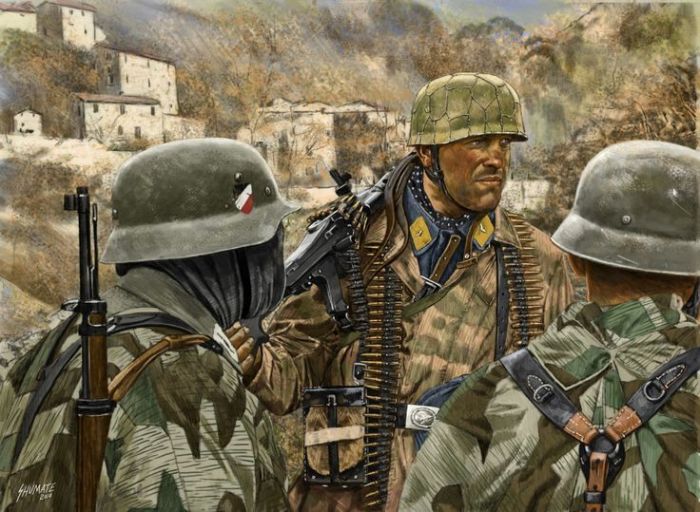
In March-April 1941, Enigma revealed that Crete was to be invaded from the air, in the glider towing and troop carrying aircraft that the Germans had been assembling in Bulgaria and Greece for some time now. It was easy enough to pass off the information the British possessed as the product of the hundreds of spies in every city in this part of the world. The German paratroopers were called “Fallschirmjäger” and they wore helmets and smocks which were different from the uniform of the Wehrmacht……..

Preparations were made to give the German paratroopers a warm welcome, and as a result of the fierce resistance from both Allied forces and civilian Cretan locals, the invasion force suffered heavy casualties. Hitler then forbade further operations of this type for the rest of the war. Here they are in action……..

Overall, nearly 4,000 German paratroopers were killed.

In June 1941, the Germans invaded the Soviet Union. Stalin had been told time and time again by the British, the Americans and the Japanese that this was going to happen but he thought it was all some vast capitalist plot to upset his non-aggression pact with that nice man Hitler.

For Churchill, it had all become much likelier as a forecast when a series of Enigma decrypts revealed that three Panzer divisions had been moved to the Polish frontier, next to the Russian held zone of Poland. Overall, Churchill thought that Stalin and his Sycophants were…..

“the most completely outwitted bunglers of the Second World War.”

In August 1941, the RAF and the Royal Navy were told all about the German supply ships which were  transporting whatever Rommel required for the war in North Africa across the Mediterranean. Such precision made it easy to target and sink the oil tankers, the petrol carriers and the ammunition/weapons ships, even if that meant letting through the odd ship carrying savoury sausages or bottles of schnapps or a further change of library books for everybody. Ultimately. by supplying this kind of information, Enigma would make victory in the Battle of El Alamein a great deal more likely.

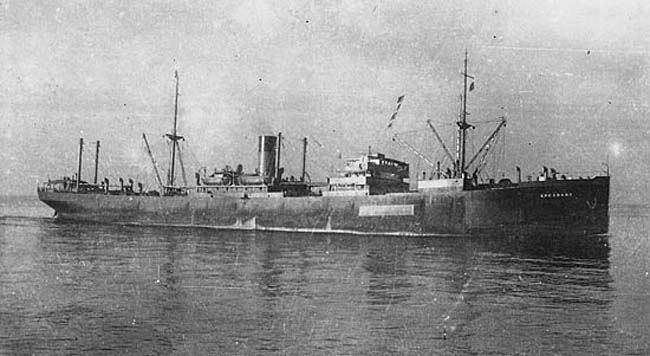
Here’s the ship with the library books:


17 Comments

Filed under Aviation, History, military, Russia

Enigma 2

Last time we finished with a really strange episode from the book which was the story of Enigma, the German encrypting machine…..

A rather large and peculiar parcel had been sent in obvious error to Warsaw’s main Post Office.  Nobody knew what it was. Nobody had a clue. When the Great Gift was opened, though, it was found to be a military grade Enigma machine, brand new, state of the art, and, as yet, unused.

So what did Anton Palluth, the Head of the Cipher Bureau, do with it? Well, we found out last time that the Poles had worked out for themselves that World War One codebreakers would not be clever enough to crack the new type of codes  being introduced at the time, that is to say, the early 1930s. They found three whizz kid mathematicians, all with first class degrees, at the top universities in Poland and gave them the job. Their names were Marian Rejewski, Jery Rozycki and Henryk Zygalski. As leader, Anton Palluth picked the man that he thought was the cleverest and the one likeliest to defeat Enigma. It was Marian Rejewski.

Marian was also given a file which contained everything that the Poles had already discovered about Enigma machines, both commercial, and military. Anton asked him to work on their brand new Christmas present n his spare time. After a reasonable interval, Marian finally cracked it. He knew how Enigma worked.  He knew how to programme it and he knew how to read the messages. This feat was called in the book by author John Jackson….

“a breakthrough in cryptography on a global scale”.

Marian deciphered his first Wehrmacht communication in January 1933. I could not resist saying that the first message he found was….

“Come home Machine No 476. All is forgiven.”

Here’s another shot of Marian Rejewski. He must have saved millions of lives with what he had discovered, and we all owe him a debt of gratitude that we cannot begin to repay.

At a meeting with the British and the French in January 1939, it was obvious that the two western countries knew very little indeed about Enigma. They had more or less no ideas whatsoever about how it worked.

On that occasion, the Poles kept their mouths firmly shut, but, in July 1939 at a second meeting in Warsaw, as German forces prepared to invade their country, the Poles realised that they had to come clean and to tell the British and the French everything that they had found out. There was nothing for them to lose. In actual fact, the Poles knew an enormous amount about Enigma. By September 1st 1939, the day the Germans violated the frontier, the Poles had intercepted and decrypted so many Wehrmacht messages that they know the exact identities of some 98% of the German units involved…..

The British and the French, who included a Professor of Mathematics from Cambridge, were dumbfounded to find out that the Poles had cracked Enigma.

They were dumbfounded and then, quite simply embarrassed at their own stupidity, when they asked the Poles for one particular thing that had totally beaten their cryptographers for months, namely……

“How are the wirings inside the Entry Disc set up? We have made no progress whatsoever on this one!”

And the Poles replied:

  “Well, the wiring sequence is “A-B-C-D-E-F-G-H-I-J-K-L-

and so on ”.

These Polish secrets saved the British at least twelve months’ work on Enigma. This was because the first Enigma machine was not captured in Norway until May 1940. Until then, any progress whatsoever would have been impossible for the British and the French.

Later in the war, the three Poles, Marian Rejewski, Jery Rozycki and Henryk Zygalski, came to England to help with code breaking. They were never allowed to work at Bletchley Park. I cannot imagine why.

In October 1944, Marian Rejewski asked for the return of the Enigma machine they had given to the British in 1939. The British refused.

Marian also asked the British to share what they had discovered about German codes since 1939.  They refused that too.

Marian also asked that the British should share any intercepted material with the Poles so that they could decipher it and, presumably, help the war effort. This too was refused.

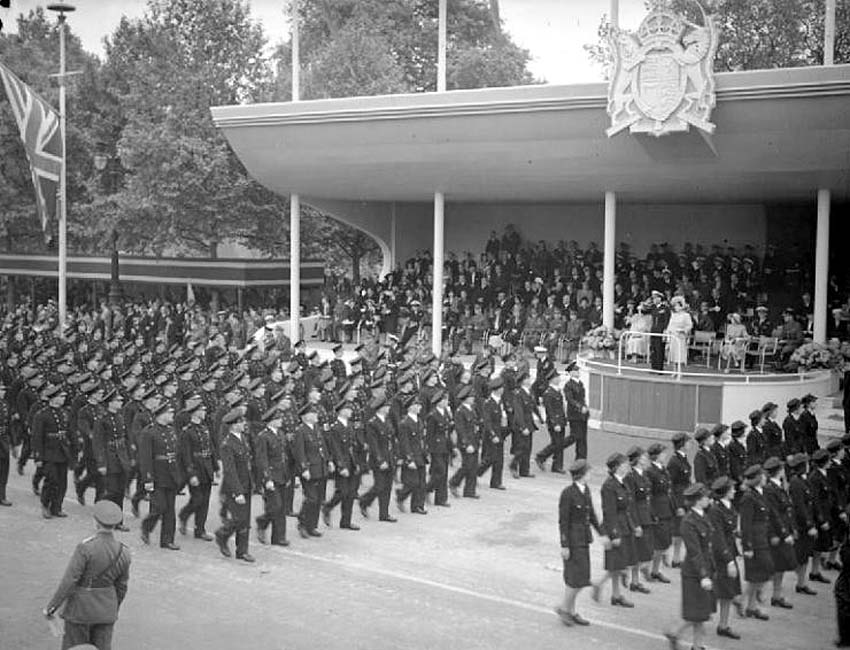
Conceivably, these slaps in the face were connected with the celebrations in London at the end of the war in 1946. The British Labour government failed to invite the Polish forces in exile who had fought under British High Command to participate in the Victory Parade which celebrated the end of the war in Europe. A number of MPs including Winston Churchill protested against the decision, which was described as an affront to the Polish war effort as well as an immoral concession to communist power, namely Stalin and the USSR.

The things we did to make jovial Joe Stalin feel better!! Here’s a bit of the celebrations:


There were no Soviet forces invited to participate either.


25 Comments

Filed under France, History, military, Russia

What would you do ? (18) The Solution

“What would you do ?” used to figure on the cover of a boys’ comic called “Boys’ World”. This was a publication, obviously, aimed at boys, and first appeared on January 26th 1963. There were 89 issues before the comic was merged with Eagle in 1964. The last issue of “Boys’ World” came out on October 3rd 1964.

I used to buy “Boys’ World”, and this was mainly for the front cover which always featured a kind of puzzle. It was called “What would you do ?” and was based on somebody being in what Ned Flanders would call “A dilly of a pickle”. Here’s the situation:

And the problem was:

The correct solution was always given inside the comic, in this case on page 2.  Here it is :

And just in case you wondered, here is the whole of pages 2 and 3 :

And what about the clue? Well, if you look very carefully at the front cover, there are large quantities of lemons hanging on the trees, both behind the Orange Box, and to the right of the sentry tower.

In actual fact, this is a rather strange clue to have. Hardly any German POW camps  were in locations where lemon trees grew. For example, the POW camps of Italy were staffed by Italian troops  until September 1943 when they surrendered. Many Allied prisoners took the opportunity to leave their camp and walk south to the Allied lines. The vast majority, though, obeyed their orders from London which said, basically,  “Sit tight and we will come and get you.” Within a couple of weeks, the Germans arrived and moved every single Allied prisoner to Germany, many of them as slave labour. Some of them finished up in a POW camp from where they had a grandstand view of the daily workings of the Auschwitz-Birkenau death camp. You can read all about this in “Spectator in Hell” by Colin Rushton. Many of these spectators were Nottingham men, captured when the Sherwood Foresters surrendered at Tobruk. In my researches, I discovered that one of them may have been John Arthur Finking, the son of a factory manager from 5 Selby Road in West Bridgford, and an Old Boy of Nottingham High School. John would be murdered by his captors as they marched all of their prisoners westwards to escape the Red Army in the snowy depths of the savage 1944-1945 winter.

Finally, there were no POW camps in the Balkans as far as I am aware or in Greece. This was because any escaper might well have been helped by the local people.

The main  criteria for the location of POW camps was (1) in Germany, surrounded by hostile civilians (2) if possible, on sandy or very light soil, so tunneling was difficult. This latter point was the reason that so many camps were located in what is now Poland, where the pine forests were gigantic, difficult to navigate in and devoid of any sympathetic locals, as those areas were then part of Germany. The soil was also extremely sandy. Finally, all of the POWcamps were as far to the east as possible, so that anybody who did escape had a very long walk to the west, and therefore a much greater chance of being spotted.


14 Comments

Filed under History, military

What would you do ? (18) The Puzzle

I used to buy “Boys’ World”, and this was mainly for the front cover which always featured a kind of puzzle. It was called “What would you do ?” and was based on somebody being in what Ned Flanders would call “A dilly of a pickle”. Here’s the situation:


The Orange Box sets the scene, and the task is for you to solve the situation.

And let me add, the Orange Arrow is over-the-moon to see his eldest son, “Yob” or “Young Orange Box”, becoming involved in the world of blogging. Anyway, perhaps you might like to write your idea in the “Comments” section.

What can he do?? Good luck with this one ! It’s certainly a dilly of a pickle, although you are helped by a clue in the picture.

16 Comments

Filed under History, military

Hendon objects 1

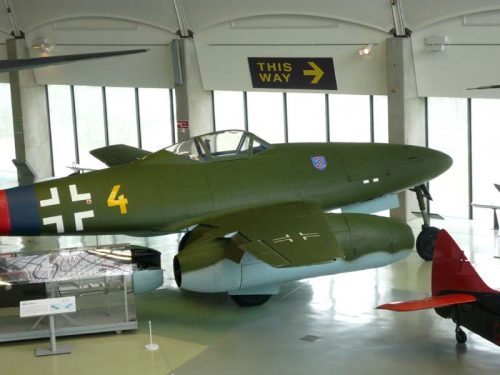
As you may have seen from previous blog posts, in 2010, I went with my family to the RAF Museum at Hendon. I did a whole series of articles, all of them based around one particularly iconic aircraft. In this case it is the Messerschmitt Me 262 jet fighter which you can read about here:

https://johnknifton.com/2018/07/27/the-messerschmitt-me-262-at-hendon/

If you want to read about any of the other aircraft, it would be easiest to search the whole blog for them. They were the Avro Lancaster, the Bristol Beaufighter, the Bristol Beaufort, the Curtiss P-40 Warhawk, the Gloster Meteor, the de Havilland Mosquito, the P-51 Mustang, the Short Sunderland, the Supermarine Southampton and the Supermarine Walrus.

It wasn’t all aircraft at Hendon, though. There were lots of identified non-flying objects and various pieces of metal rescued from aircraft as they awaited their turn in the scrapyard.

The famous German battleship, the Tirpitz, provided a battle flag:

There is also a decorated metal door from the ship’s interior. The ship itself was sunk on November 12th 1944 with the loss of up to 1204 sailors’ lives:

Here are the medals of Herman Goering the man in charge of Hitler’s Luftwaffe. As with many objects of this type, they are kept under glass and difficult, if not impossible, to photograph without reflections being included:

Here is the wall of an RAF hut, taken down carefully to preserve the artwork left on it by an anonymous artist. It shows a Short Stirling, the RAF’s first four engine bomber:

The particular aircraft in the picture is a Short Stirling Mark III of 199 Squadron based at North Creake in Norfolk. Its squadron letters were EXN and its serial number was LJ531 and its name was “N-Nan”. At 2219 hours on June 16th 1944, the crew took off to accompany 162 Halifaxes, 147 Lancasters and 12 Mosquitoes on a bombing mission which targeted the synthetic oil plant at  Sterkrade between Duisburg and Essen. They carried no bombs, but instead were to use their Mandrel, a noise jammer, to overwhelm the signals from the German Freya and Würzburg radar sets. Between them, nine such aircraft were capable of creating a 200 mile gap in the Germans’ radar coverage.

In the official records, the aircraft was “lost without trace” but modern sources on the internet suggest that it was shot down by Unteroffizier Josef Ottrin (Bordfunker/radar operator) to Feldwebel Trenke, of the 6./KG 51, some fifty miles north of Ostend. This incident took place at 02.00 hours at an altitude of 14,800 feet. They had taken off from Soesterberg in the Netherlands in a Messerschmitt Me 410 A-1/U2 to carry out an armed reconnaissance of London, probably to find targets for the new wonder weapons, the V-1 and the V-2.

All the crew of “N-Nan”were killed. They were:

Thomas Wilson Dale RNZAF (pilot, aged 25), the son of James Murray Dale and Maude Mary Dale of Wellington, New Zealand.

John Martin Watts (flight engineer, aged 19), the son of John and Ethel Rosetta Watts, of Caxton, Cambridgeshire.

Ronald Joffre Whittleston RNZAF, (navigator, aged 28), the son of Arthur William and Grace Whittleston and the husband of Frances Hellena Bertha Whittleston, of Frankton Junction, Auckland, New Zealand.

Kenneth Matthew Francis Swadling, (bomb aimer, aged 21), the son of Frank and Louise Marie Swadling, of Wembley Hill, Middlesex.

Francis Charles Brittain, (gunner, aged 21), the son of Charles Frederick and Hazel Margaret Brittain, of Kilburn, Middlesex.

Frank Lofthouse, (Mandrel specialist operator, aged 23), the son of Albert and Miriam Lofthouse, of Lupset, Yorkshire

John Critchley Higginbottom, (gunner, aged 21), the son of John Elliott Higginbottom and Lilian Jessie Higginbottom, of Streatham Hill, London.

William  McCreadie  Latimer, (gunner, aged 19) the son of George C. Latimer and Mary Latimer, of Garlieston, Wigtownshire in Scotland

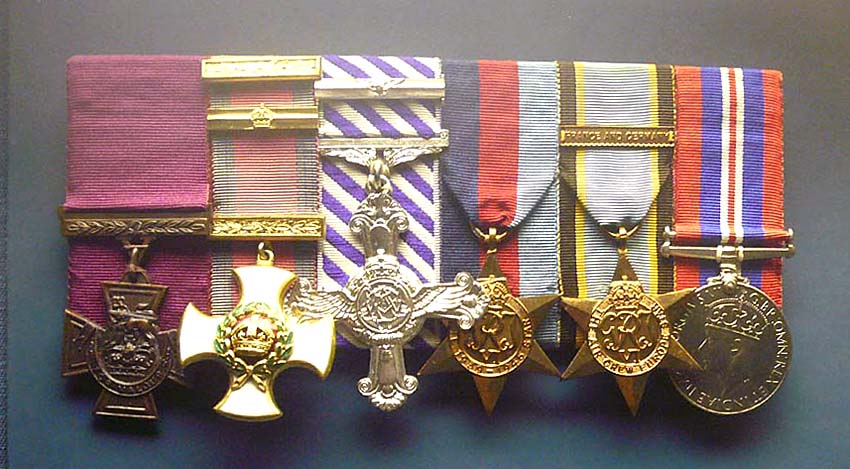
Also on display at RAF Hendon are the medals won by Guy Gibson, the Squadron Leader of 617 Squadron at the time of the famous Dambusters raid. On the left is the highest British award for gallantry, the Victoria Cross. The usual price at auction for this famous medal is usually around £500,000-£700,000. Guy Gibson’s personal medal, though, would be worth many millions.

And here’s the insignia on the collar of his dog, a big Black Labrador, which was run over and killed by a mystery car at the exact same moment as Gibson was leading the squadron in the attack om the Möhne dam.

The lettering reads:

“SQ.D.N LDR

C.P.GIBSON.D.F.C.

R.A.F.   

89 SQDN

His dog was buried at RAF Scampton and here is his grave today:

19 Comments

Filed under Aviation, Bomber Command, History, military, Personal