Tag Archives: bowler

Part 3 : John Watson and Mycroft Holmes

Last time, we saw how Arthur Conan Doyle decided to immortalise his favourite bowler and wicketkeeper combination by combining the two names “Shacklock” and “Sherwin”, to give the name “Shackwin” to the hero of his new detective novel, “A Study in Scarlet”.

“Shackwin??” said all of his friends “Are you mad?? Think again. You can do better than that!!”

Arthur went away to think again, and he turned the name on its head. Now it became “Sherlock”.  And Sherlock Holmes, a star, was born.

The next question is, of course, whether anybody else in the Sherlock Holmes books had their origins in cricket?

Well, there was an Alexander (Alec) Watson, who was a slow bowler for Lancashire. He took 1,384 wickets in a career that took in 303 matches. I believe that Arthur Conan Doyle, as a keen member of the Marylebone Cricket Club, watched Watson play in May 1886, and take 10 wickets for 54 runs, an extraordinary feat. And Alec was duly rewarded with a kind of immortality.

Here is the exact analysis of his bowling:

And in May 1877, perhaps Arthur Conan Doyle had again been there to watch Watson take 14 wickets for 49 runs against the Marylebone Cricket Club.  After all, Lancashire were one of the very best teams in England .Here are the MCC innings:

And here are the detailed statistics of each bowler:

No wonder that Arthur felt he had to include “Watson” as one of his two main characters. Fourteen wickets for 49 runs is really as good as it gets! Here is our hero, second from the left……..

And a close up………………

Now, a frequent pub quiz question.

“What was the name of Sherlock Holmes brother?”

Well, he was called Mycroft Holmes.

I believe that Arthur Conan Doyle got the name “Mycroft” from William Mycroft, a bowler who played for Derbyshire in 138 matches and who took 863 wickets. I am 99% certain that Arthur had perhaps watched William Mycroft play for the Marylebone Cricket Club in May 1877 when Alec Watson took fourteen wickets for England. For the other side, though, Mycroft took a fabulous six England wickets for 12 runs in the second innings. Here we are. First of all, the full scorecard. Just look at the second innings:

And the bowling figures:

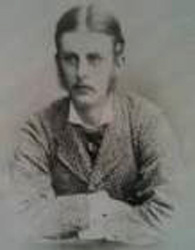
It looks as if Arthur took two names from this one single game, Mycroft and Watson. Here’s Mycroft:
Here’s another superb performance by William Mycroft, playing for the MCC against Hertfordshire in July 1879. Again, the probability is that Arthur Conan Doyle actually watched this game, insofar as he was a member of the MCC. Mycroft went out to bowl against Hertfordshire with the odds stacked strongly against the MCC. Hertfordshire, with ten batsmen needed a paltry sixty runs:

Wickets fell regularly during the innings. A wicket was lost when the score was 2, then 10, then 10 again, 11, 11 again, 15, 17, 23 and 23 again.  Mycroft’s bowling figures were:

An amazing nine wickets for eight runs!!  And here’s another picture of Mycroft to finish with:

Sadly, despite a fair amount of research, I have been unable to come up with the origin of the surname. “Holmes”.
 

8 Comments

Filed under cricket, History, Humour, Nottingham

Sherlock Holmes : Part 1

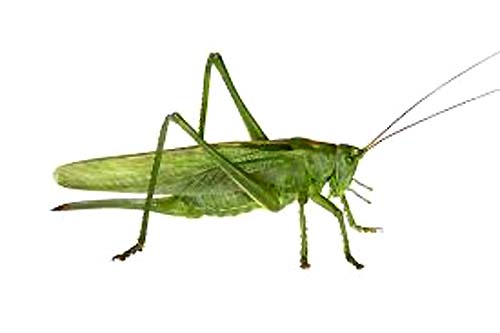
Bear with me, but before we get to the meat of this post, I need to explain a little bit about cricket for those of my readers who think that cricket is some kind of insect, albeit a big, scary one, that you definitely wouldn’t want to find on your knee. This one can be up to four inches long…..

Cricket can be a very complicated sport but most people can recognise the two wickets, one at either end of the pitch.
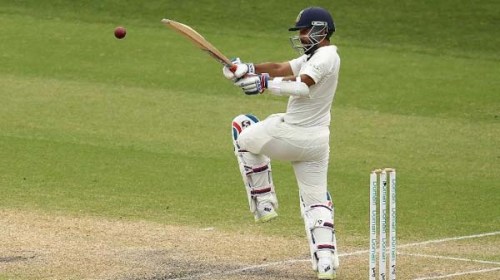
Then there are two “batsmen”, one of whom, Batsman A, tries to hit the ball as far as possible when it is bowled at his wicket.

The other batsman, B, stands at the other end of the pitch and awaits developments.  By coincidence, he is near where the “bowler” bowls from.

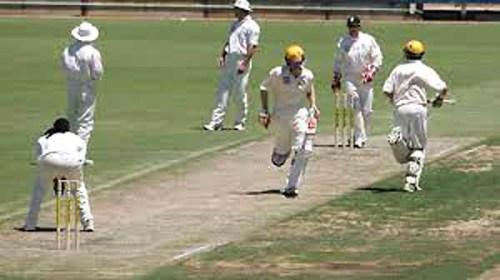
If Batsman A hits the ball a long way, then both batsmen, both A and B, may then decide to run as fast as they can to the wicket at the other end. Every time they do this, they exchange their original positions and their team scores one “run”.  The batsmen here are wearing yellow helmets……

The two batsmen’s immediate opponents are the bowler who bowls the ball, subject to a rather long list of rules, and the wicketkeeper.  Any ball hit by Batsman A is eventually returned to the bowler so he can have another go.  By that point, more or less, the batsmen will have stopped running.  Here’s the bowler bowling, and Batsman B waiting for Batsman A at the other end to hit the ball to the moon so that they can run 10,000 times.

Now comes the complicated bit.

Batsman A is trying to defend his wicket against the bowler, who bowls the ball from a position level with the opposite wicket. Batsman B is standing nearby (picture above).

Batsman A, at the other end, will try to hit the ball as far as possible.

The bowler, though, is trying to dismiss Batsman A so that he will have to return to the dressing room and cannot bat any more. The most obvious way for the bowler to do this is to hit the wicket and to knock at least some of it over. And then the batsman is “out” ! :

And now, the wicketkeeper. He is on the same side as the bowler, and his primary job is to stop any balls bowled by the bowler and then missed by Batsman A. If he doesn’t stop the ball, the batsmen can run, just as if Batsman A had hit it:

The wicketkeeper also has another job to do. If Batsman A hits the ball, but only nicks it, then wicketkeeper can catch it as it whizzes past at high speed, and Batsman A will be “out”, dismissed from the game, provided that the ball doesn’t touch the ground.

Indeed, this same rule applies to all the members of the bowling side. If Batsman A is a fool, he will hit the ball in the air and then when any opponent catches it before it touches the ground, it’s “Goodnight, Vienna” for him. This way of being, literally, “caught out” is the commonest way to be dismissed for a batsman:

Extremely common too is the situation mentioned above where Batsman A just nicks the ball as it passes him, and the wicketkeeper then catches it. The reason is that the ball may well be travelling extremely fast when Batsman A nicks it…perhaps 80 or 90 mph in top class cricket. If a team has a very good fast bowler, then the bowling team’s main tactic will be to get the batsman to nick the ball and then have the wicketkeeper catch it.

In the 1970s, the Australians’ main bowler was Dennis Lillee, and he bowled extremely fast, and with any luck, his colleague, Rodney Marsh, the Australian wicketkeeper, would catch the ball when it was nicked by the terrified Batsman A.

Here’s Dennis Lillee, my favourite ever bowler:

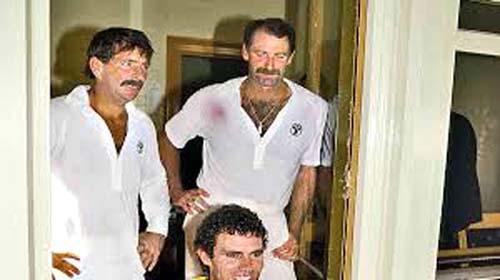
And here’s Rodney Marsh, who died recently, in March 2022. Dennis Lillee is also in the picture:

In the scorebook, that particular dismissal of the batsman would be recorded as:

Batsman A        caught Marsh        bowled Lillee        0

In the more usual abbreviated form…..

Batsman A         c    Marsh                b  Lillee                  0

Those five words soon became the most frequent means of dismissal in the history of international cricket, with more than 200 occurrences. Here’s just one of them:

Lillee is on the right, Marsh is flying, and the English batsman is Tony Greig.

And here’s another. Lillee is on the left, flying, Marsh is on the extreme right and the English batsman is doomed.

Be patient. This blog post is definitely leading somewhere. On a journey. A journey that takes in a world famous cricket ground. An author with a household name. And a demolished pub about a mile away from where I am sitting right now. Just bear with me.

In the meantime, here’s that pub, just before the demolition men got to it:

And here it is now;

It was a great pity to lose a real Victorian pub, even if social housing replaces it.

19 Comments

Filed under cricket, Criminology, History, Humour, Literature, Nottingham, Writing