
When I am writing blog posts, just like David Bowie and Jimi Hendrix, I don’t normally do requests. On the other hand, I did feel a little bit guilty that, months ago, somebody contacted me and said, very politely, “Maybe one day you could tell us a bit more about Brincliffe School, please?”. Regrettably, I did not record their name. On the other hand, the Hairy Godmother has granted their wish………
Brincliffe School was situated in Balmoral Road in Nottingham, immediately to the east of the High School. This Grammar School for Girls occupied the area between the western corner of the junction with Forest Road East, as far south as No 23, the first house of a row of three storey Edwardian properties. The Orange Arrow tells the tale, indicating precisely the southern boundary of the now demolished school:

Here’s the Victorian equivalent of the same area. The Brincliffe building is south west of the “B-A-L” of “Balmoral Road”.:

Brincliffe didn’t really look much like a school. It was more like a school housed in a private dwelling house:
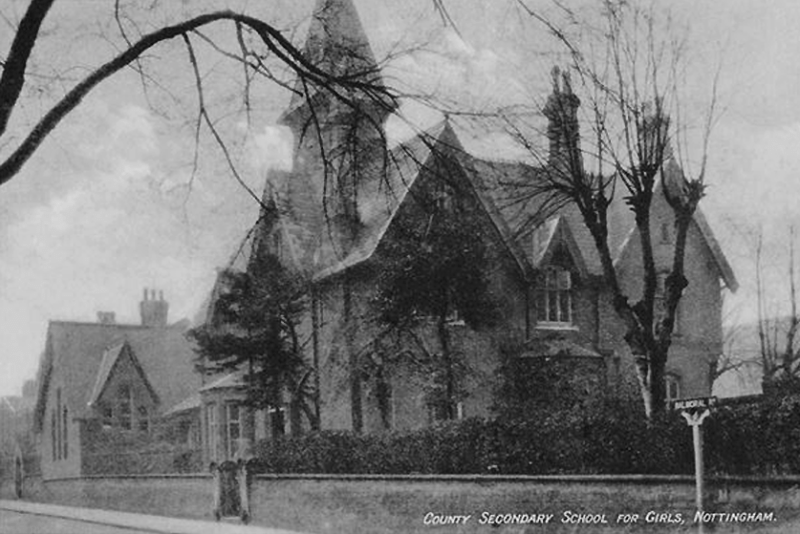
At one time, when it was a private house, Dame Laura Knight, the artist, had lived there. Not many pictures of the building are left nowadays. It was demolished in the late 1970s. Here is the view from the south. The key to linking up the two photographs is the bottom left of the photograph above, and the centre right of the photograph below. The three windows and the gate with a portico are crucial links. Don’t miss one man and his dog who have stopped for eternity next to the telegraph post.
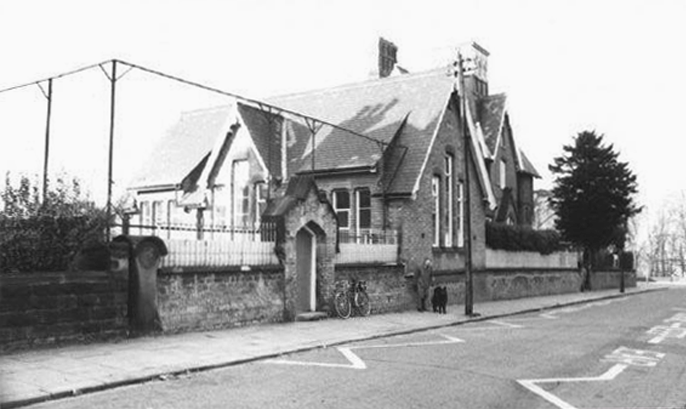
Brincliffe was an all girls’ grammar school, which operated from 1907-1974. Entry was by passing a competitive examination. Unlike Nottingham Girls’ High School, no fees were payable. Such selective, and free, schools were a fantastic source of social mobility and an excellent examination for the poor. Everybody in the school had a talent and the schoolwork they did was of a very high standard. At Brincliffe, girls had a genuine opportunity to do what they wanted to do with their lives, with little interferece, except from their own families.
The school produced a Gold Medallist in the 1974 Commonwealth Games, an Oxford don, a member of the D’Oyley Carte Opera Company, any number of students at Oxford and Cambridge Universities, and innumerable doctors, dentists, solicitors and politicians. And all of them came from an ordinary background. If you doubt that, then go and look at their Facebook page.
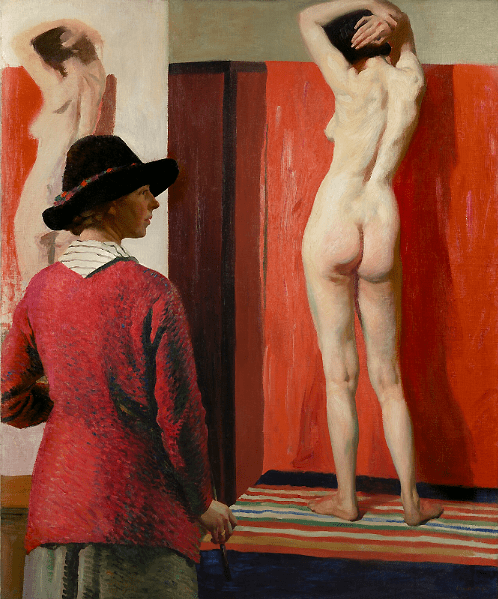
The most famous high achiever from Brincliffe was surely Dame Laura Knight, the painter. One of her most famous paintings was “Self portrait with a nude”. It caused a right fuss:
She also did a lot of paintings of World War Two. They included “A Balloon Site, Coventry” in 1943:

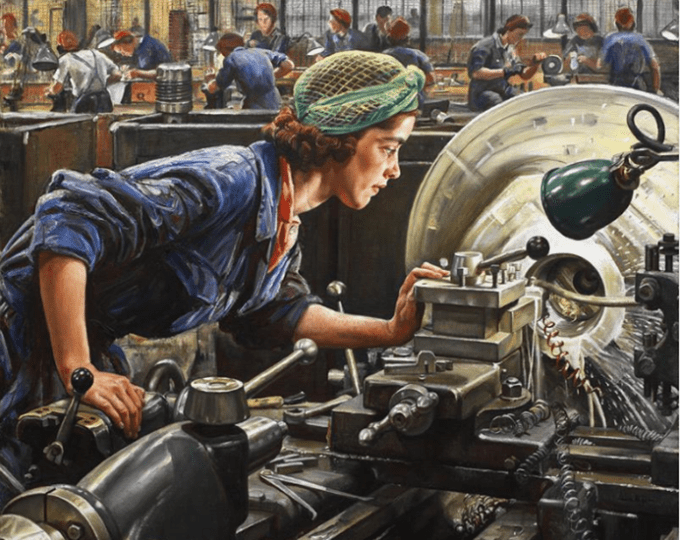
The superbly composed “Ruby Loftus Screwing a Breech-ring” in the same year of 1943:
And a portrayal of the crew of a Short Stirling bomber in 1943. It is entitled “Take Off “, and I found in one account that the poor young wireless operator had been killed almost before the paint on the painting had dried :

Dame Laura was one of a very few female artists during her era. Another famous Old Brincliffian was Enid Bakewell who played for the English women’s cricket team in twelve Tests between 1968 and 1979. Her batting and bowling averages show that she could well be regarded as the best all-rounder that the English women’s game has ever produced.
The Brincliffe School ran from 1907 onwards, for almost seventy years. There was only a single thirty girl form in each year, so everybody knew each other. The pupils used to wear dark green blazers and berets. Here is a typical green blazer of the period:

Brincliffe had only five Headmistresses during its history, the Misses Randall, Yates, Yonge, Lloyd and Carter. Teaching at Brincliffe came to an end in 1974 and I can remember still seeing the typical Victoria building during my first few years at the High School, from 1975 onwards. I have vague memories that, as the school was so close to the High School, we were allowed to use the empty classrooms for some of our smaller classes, such as Sixth Form groups. Brincliffe didn’t die in 1974, but it was severely wounded by a Labour Council’s decisions. It was merged with another school for girls on Gregory Boulevard. This was the Manning School, formally opened by Alderman Manning in April 1931. (Aren’t local politicians just shameless?)
When Brincliffe and Manning merged, they also became a comprehensive school catering for girls aged between 11 and 16 years. In 1983 the school moved to new buildings in Aspley, a suburb further to the west, whilst the old school buildings on Gregory Boulevard became the Forest Comprehensive School. In September 2011, the Manning School became the Nottingham Girls’ Academy, the first all girls’ academy in Nottingham. It catered for girls aged between 11 and 18 years old.



 John Knifton