Tag Archives: Forest Road East

Brincliffe Grammar School for Girls (4) A cry from history

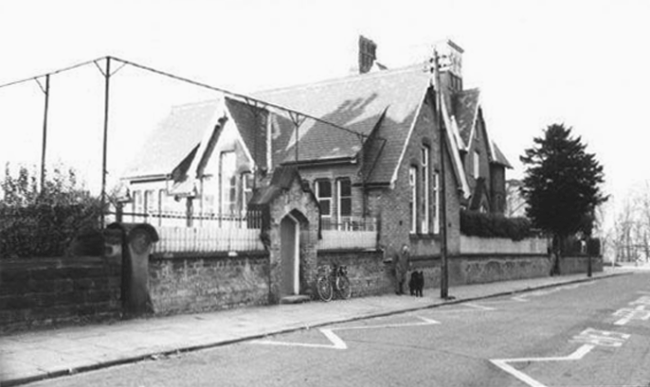
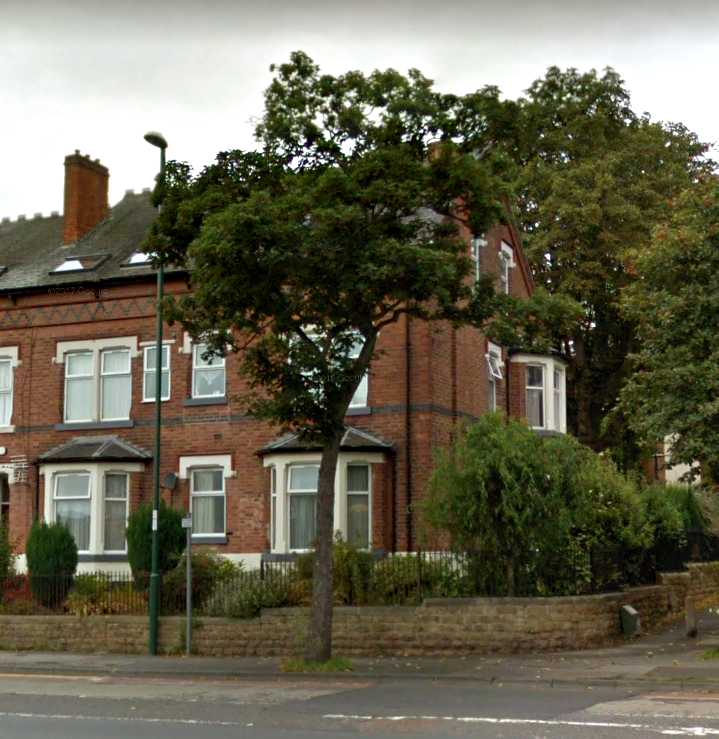
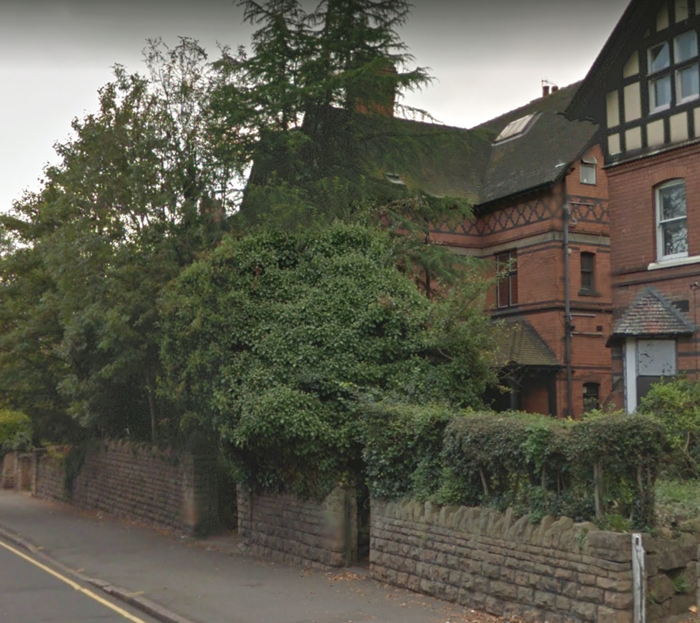
What traces remain of Brincliffe Grammar School for Girls? Well, in Balmoral Road, the front wall still remains, running from No 23 Balmoral Road, all the way to the corner with Forest Road East and then past that for a few yards. It’s easy to see and it is virtually untouched. It’s a sandstone wall which continues round the corner and runs as far as what would have been the old boundary of the High School in, say, 1895. The wall continues for all this distance and the fact that it matches both of the two remaining Victorian photographs of the school is proof enough for me.

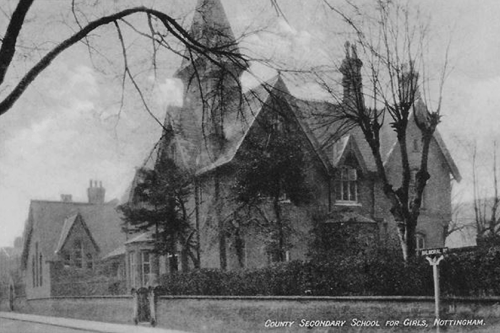
Here are the two pictures of Brincliffe still in existence. This is the older of the two:

And here is the one where the bike has been invented:

And here is a sample of the wall. The brighter, red one is modern, the tan coloured lower wall dates from 1870 at least. At the same time, you can see how, in modern times, it was thought wiser to make the original wall much higher.
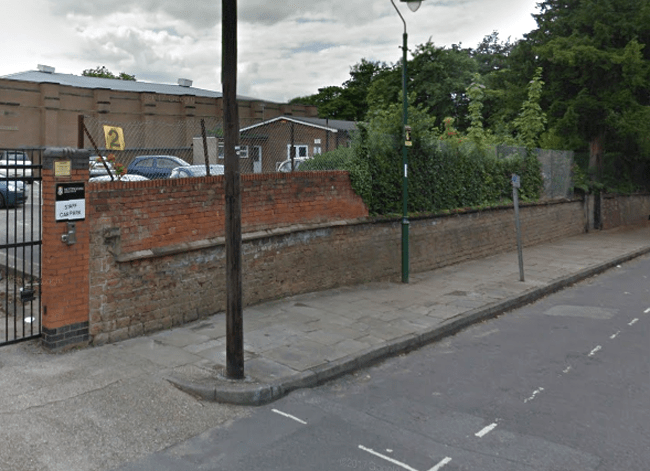
The sandstone Brincliffe wall stretches all the way round onto Forest Road East and meets the old boundary line of the old High School (right). Here we are:
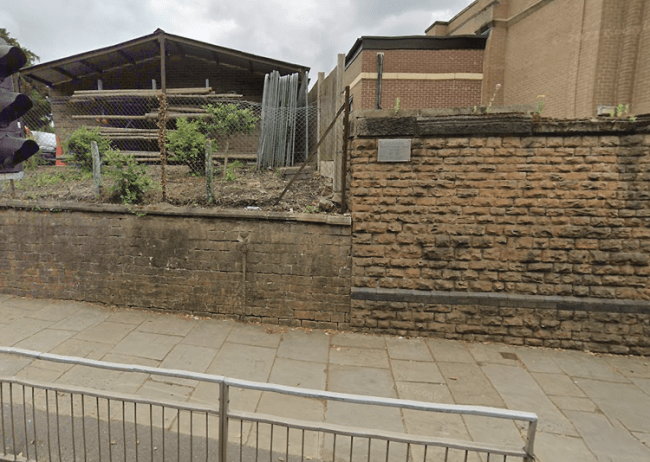
But what is this Victorian remnant? Some kind of fire hydrant?
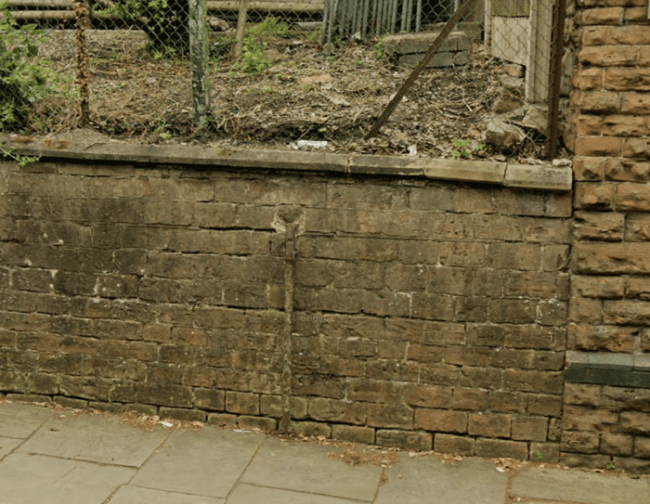
At the side of No 23 Balmoral Road there is a pillar which clearly dates from the turn of the 20th century or earlier, and is visible in the second of the old photographs above. Here it is:
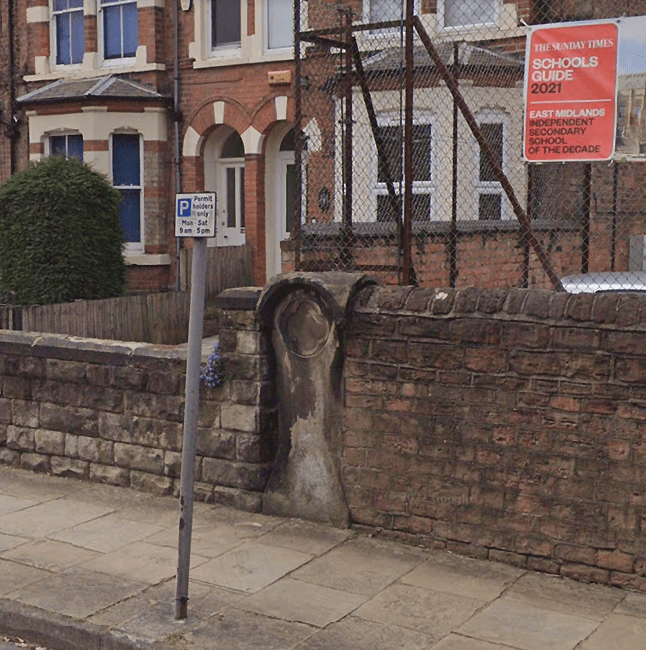
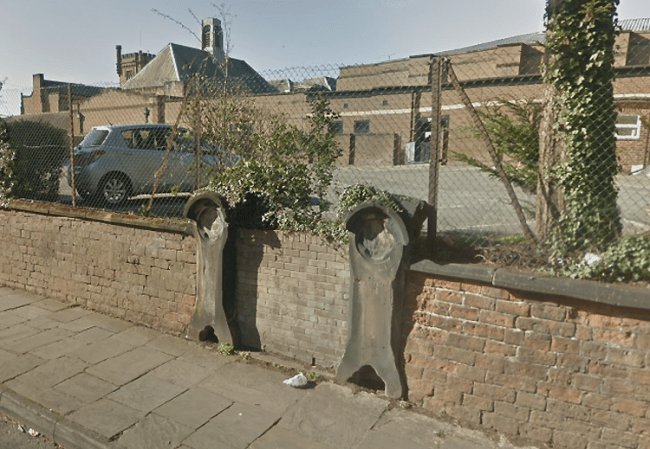
Further down, what has clearly been a gate to the school is still visible. In the controversial “pushbike-and-dog” photograph, it is down near the fir tree, but difficult to see. In the “Welcome, Munsters” postcard, it is the first gate you see in the wall and the ornate tops are clearly visible.  Here it is:
As  you know, I sometimes buy articles connected with the High School from ebay. A while back I produced seven blog posts called “Nottingham High School on ebay”. This link should take you to No 1 if you are interested. Sometime after #7 was published world wide, I bought this:
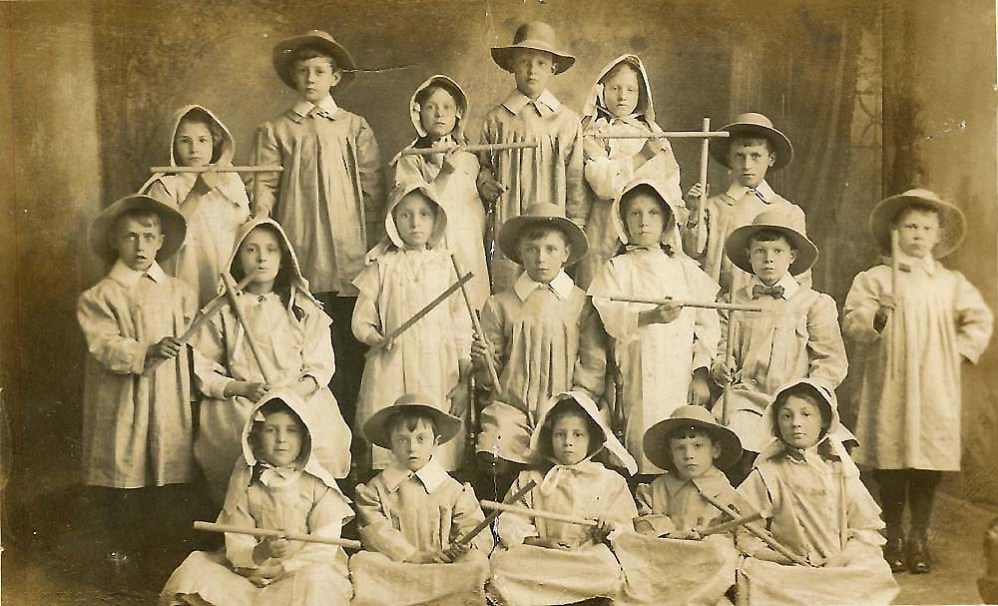
It shows a group of unknown children from what was called “Brincliffe School” although the presence of little boys must mean that events took place before 1907 when the Girls’ Grammar  School started up. I have no idea whatsoever what is going on with all their sticks and costumes. But the picture and the words that go with it really amount to a cry which comes from well over a century ago. And that wordless cry says

Here I am. I used to be alive like you.”

And those sentiments are present in the picture but they are also written on the back of the postcard:

It reads, as far as I can see:

“Yours Truly

Bernard Raven

as

A Farmers Boy

First boy on top row to the left”

Just have a look at him. The back row, the boy on the left. He can’t even be trusted to carry a stick, and appears to have lost his. But he is the one we can look at and we know his name. Bernard Raven. He grew up, perhaps he fell in love, perhaps he married, perhaps he had children of his own. I suspect we will never know. But with a little bit of luck, he will be read about, if only for a few seconds, in Australia, India, the USA, all over the world. I hope he was happy with his life.
24 Comments

Filed under History, Nottingham, Politics, The High School

Brincliffe Grammar School for Girls (2) Before and After

Having started my researches abou the Brincliffe Grammar School for Girls on Balmoral Road, I could not resist trying to find out more, and more, and more……..

Using my very sad collection of Kelly’s Directories of Nottingham, I was able to trace just a little bit of history, not so much for the Brincliffe School, but for the site where it would eventually be situated.

And so, in 1876, (the year of Custer’s Last Stand), on the corner of Balmoral Road and Forest Road, on the western side, was “Porter & Jones, boys’ school (Tudor House)”. In other words, the same building which would, one day in 1907, house Brincliffe Grammar School for Girls, had been, thirty years earlier, a private school run for profit, inside what had originally been a private house. The two partners in the business were Messrs Porter & Jones, and they had given the school the name of “Tudor House”.

Three years later, in 1879, the entry reveals that Tudor House had become a boarding and day school and that, of the original partnership of Porter & Jones, Mr Gregory Porter seemed to be the Head Honcho.

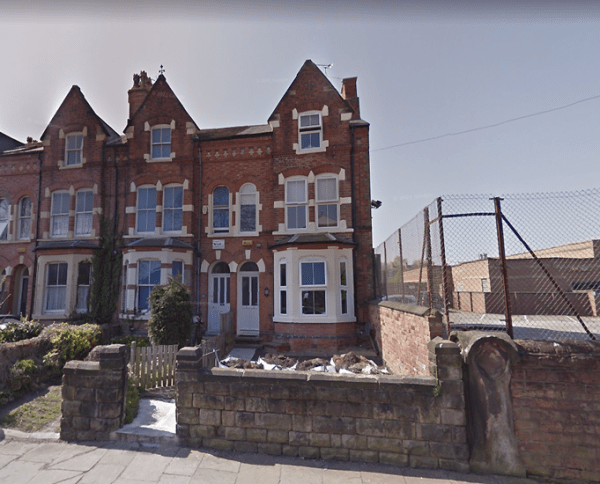
In 1881, the house, now apparently the property of Mr Gregory Porter alone, was now No 25 Balmoral Road. No 23 is still standing, the house immediately to the left of the main entrance to the High School staff car park. In 1885, the situation was exactly the same.  Tudor House, and Gregory Porter, were still in business. Here’s Nos 19, 21 and 23 today, complete with original Victorian sandstone wall:

Alas, by 1891, Tudor House was no more, and the school became “a ladies’ school” for ladies. under its Headmistress, Miss Blanche Hall.

By 1894-1895, the Misses B. & K. Hall were running a boarding and day school at No 25. The house was now called “Brincliffe”. Why they had chosen this name, I do not know. Presumably, it refers to the “brink” or edge of a “cliff”, a reference perhaps to the small area of steeply sloping ground to the northwest of the Church Cemetery, overlooking the much flatter and much lower, Forest Recreation Ground.

Here is that “brink of a cliff”:

The slope is actually quite steep and, while not a cliff, it would have seemed a lot more precipitous 140 years ago because there were no trees then. The trees are quite young for trees, only around 80-100 years old. Here is a view inside the trees on a very familiar path down from the High School (and Brincliffe) :

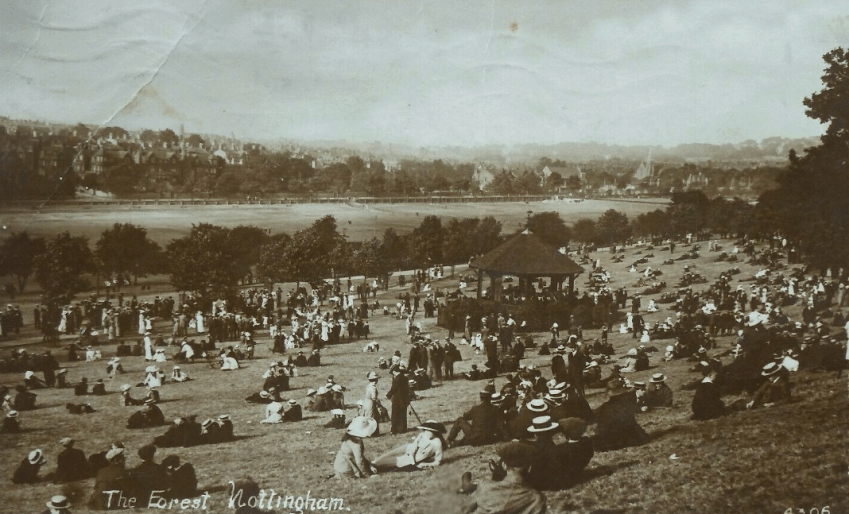
The slope is certainly steep enough to sunbathe on. Here is a lovely Sunday afternoon with people in their Sunday best, relaxing around the long gone bandstand. See if you can solve “Where’s Walter?” and can you spot Robin Hood?

And here is the much lower flat area, which has always hosted any number of football/soccer pitches. In 1865, they had seen the birth of Nottingham Forest, nicknamed at the time, the “Garibaldi Reds”:

So, by 1894-1895, the Misses B. & K. Hall were running a boarding and day school at No 25. It was called “Brincliffe”. And now you know why!

By 1898-1899, “Brincliffe” had been acquired by the Misses Koppel & Hall. It was still No 25. In 1904, Miss Amy Koppel was running the boarding & day school on her own, the premises still with the same name and number.

In 1907, the City Council made it a Girls’ Grammar School, but from 1913 onwards it is listed as just “Notts County Secondary School, Miss Sybil Randall, head-mistress”

I have not been able to find any pictures of the girls in their green blazers and Green Berets, “à la John Wayne”. That crumpled, baggy 1950s blazer is still the only thing I’ve found:

One final detail.

The very first mention of a school on the Brincliffe site was “Porter & Jones, boys’ school (Tudor House)”. We know this already, but one thing I did find was that in 1862, a Miss Sarah Porter was running a “school” on distant Woodborough Road. In 1864 she was named as Miss Sophia Elizabeth Porter, presumably the same person (or perhaps sisters), still in an un-numbered location on Woodborough Road.  Unfortunately I have no directories available for the period 1864-1876.

13 Comments

Filed under History, Nottingham, Politics, The High School

Nottingham High School on ebay (2)

As well as not buying a rather expensive medallion on ebay, I have actually bought a postcard or two over the years. The first one was sent on October 27th 1926. It is stamped with an 8.00 pm postmark, so I presume that it was written earlier that day and then posted perhaps before dinner, or, more likely perhaps, on the sender’s way home from work. It was a Wednesday, which in those days would have been half day closing, so he probably left work at 1.00 pm and put it into the post box on his way home:

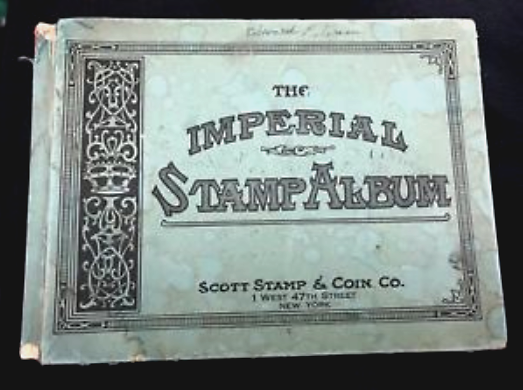
Notice how the Post Office slogan is “British Goods are best”. Only a few months after the General Strike, the economy was in real need of a boost if further discontent and upheaval was to be avoided. Notice too, the beautiful, classic stamp. King George V was a fanatical stamp collector, and loved nothing better of an evening than sticking his stamps in his thousand albums. When you’re an emperor, this is the album for you:

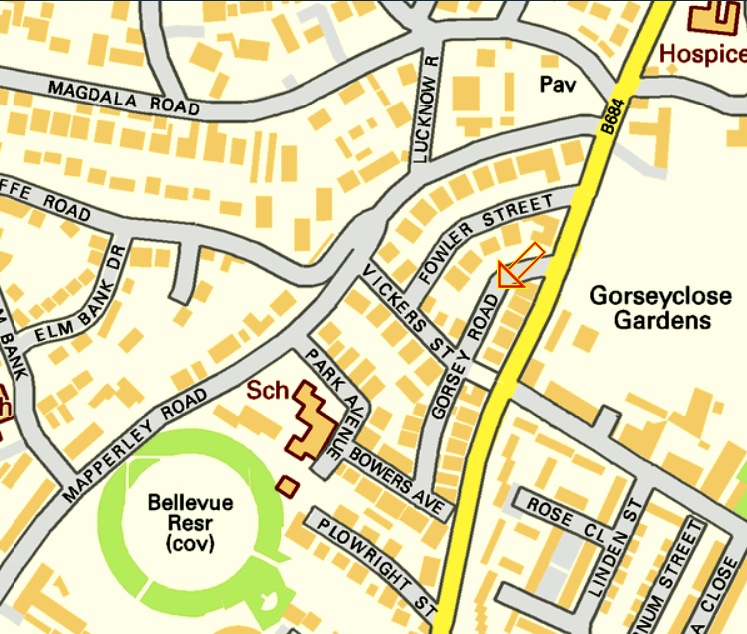
The postcard is addressed to NG Peet of 2 Gorsey Close in Mapperley Park. I couldn’t trace a Gorsey Close but I did find a Gorsey Road. Here is a close up view of the area. Gorsey Road is between the B684 Woodborough Road and Mapperley Road, in Mapperley Park, one of Nottingham’s leafier suburbs. Look as always for the orange arrow.  No 2 is on the corner with the B684, Woodborough Road. :

If you look at this larger map, you can see that Gorsey Road is not too far away from the High School which is in the bottom left corner in the area between Arboretum Street, Forest Road East and Waverley Street. The School is on the corner either side of the pale green patch. Gorsey Road, I should have said, is again indicated by the orange arrow.

This is No 2 Gorsey Road now, a little overgrown perhaps, and in a street which looks to have gone a little downhill, but obviously, it was a very beautiful house in its time:

The Peet family had only recently moved to Gorsey Close when that postcard arrived in the late evening of October 27th 1926. In the Kelly’s Directory published in 1925, their future abode was owned by Edward Westwick Kirk of Kirk & Macdonald. The Head of the Family, WG Peet, was living at that time at 249 Woodborough Road, presumably with everyone else in the family. Here it is:

Three years or so later, when all of the information had been collected for the 1928 edition of the Kelly’s Directory, the house in Gorsey Road was now recorded as being occupied by Mrs Ann Elizabeth Peet. She was presumably NG Peet’s mother, rather than his wife. At this time her son was still in his early twenties and it is by no means surprising that he was still living in the parental home. There is certainly no NG Peet listed as living elsewhere in Nottingham, nor indeed in the rest of the county.

In 1929, the High School prepared its own list of the Old Boys’ addresses. In that, NG Peet is listed as still living at 2 Gorsey Close although it could just be that they carried an old address forward.

NG Peet, incidentally, I should have introduced him earlier. He is Noel Gordon Peet, who was born on December 26th 1901, hence the name. His father was William George Peet who was a “General Agent”. Six years later, in 1925, the relevant Kelly’s Directory listed William George Peet as working for “WG Peet, Son & Company”. By 1928, he is listed as a “yarn merchant” operating from Kaye’s Walk. His telephone number was listed as “TN 42769” and his telegraphic address as “Knitiarns”.

Noel entered the High School on April 26th 1917, at the age of 15. He was Boy No 3662 and he stayed there until July 1919. At this time, 1917 at least, the family was living at 413 Mansfield Road. Here’s 413 Mansfield Road, in spirit a very similar house to 2 Gorsey Road. I’m a huge lover of trees, but these need a tree surgeon and his assistant for a day and the whole place would look so much better:

Noel packed a lot into his two and a bit years at the High School. He won the Fifth Form B Prize in 1918 and the Fifth Form Writing Prize in the same year. In 1919, he won the Sixth Form B Prize. In the Officer Training Corps, he became a Corporal in 1918 and a Sergeant in 1919. In cricket, he won the School Prize for Batting in the same year.  He had 13 innings and scored a total of 144 runs at an average of 11.07. His top score was 36. Not a classic season for the School apparently !

Also listed in the High School’s list of Old Boys in 1929 was William Ronald Peet, Noel’s younger brother. He too is recorded as living at No 2 Gorsey Close. He was born on October 9th 1910 and entered the High School as Boy No 4036 on May 1st 1919. He left in December 1926 at the end of the First Term. By the time William entered the School, the family had moved from Mansfield Road and were living at Sutherland Lodge in Lucknow Drive in Mapperley Park. The boys’ father is listed as a “manager”. Lucknow Drive, or rather the word “Lucknow”, is visible in the top right corner of the second map above.

Did anything significant happen on the day the postcard was posted, namely October  27th 1926, anywhere in the world ? Well, nothing really earth shattering, but there was one episode which I found quite amusing. Here’s a clue, with a picture of a Shipstone’s Brewery beer crate and some of their products:

Shipstone’s Brewery lasted from 1852-1991. I always felt that it was, at best, an acquired taste. Anyway, here’s the funny story to finish with. It comes from ‘Hansard’ which records everything said by everybody in debates in the Houses of Parliament. The story came out because Labour Party MP, Alfred Salter, was censured in the House of Commons for refusing to retract remarks of his that had appeared in the Daily Express:

 “I am not prepared to withdraw, modify or apologise for anything I have said on this matter, and I propose to repeat the words I made use of and about which complaint has been made.

I said, and I repeat it here to-day, that I have seen members of all parties in this House, my own party I regret to say included, drunk in this House not on one occasion but on many.”

A motion was passed calling the statement “a gross libel on the Members of this House and a grave breach of its privileges.”


20 Comments

Filed under History, Nottingham, Personal, The High School