Tag Archives: Giant Nottingham Geese

Goose Fair (3)

Last time we finished with Mr Pat Collins’ “Giant Nottingham Geese, All Alive and Kicking” but some surprisingly exotic, and indeed, unusual, animals made their appearance at Goose Fair.

Smallest of them all were the performing fleas:

Look at what they could do:
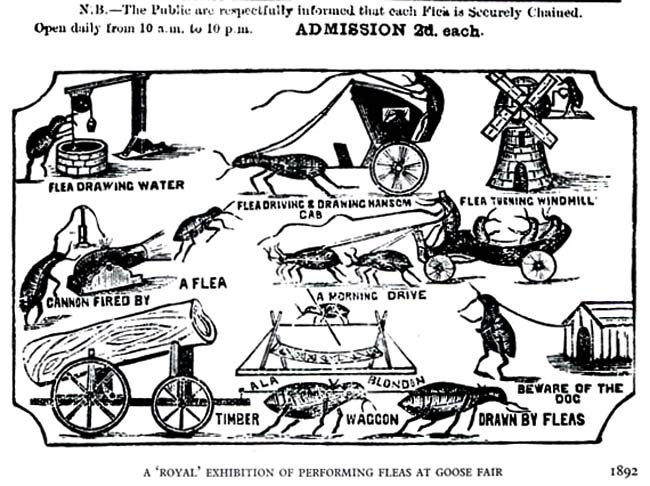
And don’t worry:

“Each flea is Securely Chained”

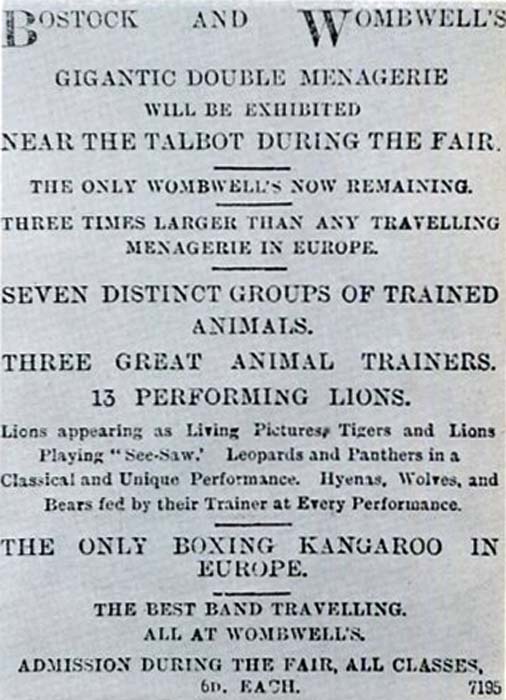
In 1899, for their last visit to Goose Fair, Bostock & Wombwell produced a special poster, which listed all of their animals.
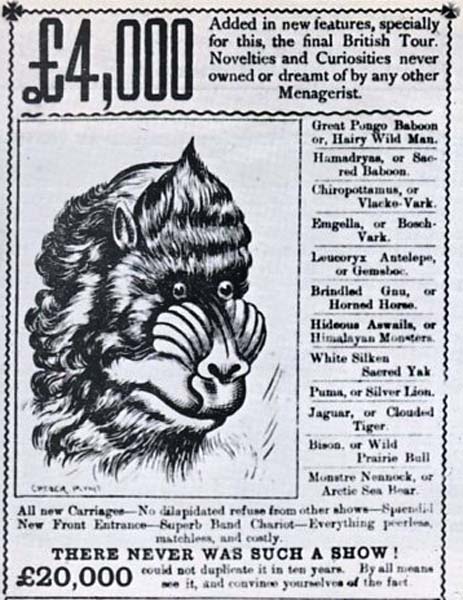
Their rivals, of course, boasted about their own animals which included “Novelties never owned or dreamt of by any other Menagerist.” There was the “Great Pongo Baboon”, the “Hamadryas, or Sacred Baboon”, the “Leucoryx Antelope or Gemsboc”, a “Brindled Gnu, or Horned Horse”, a “White Silken Sacred Yak”, a “Puma”, “Jaguar”, a “Bison, or Wild Prairie Bull” and the “Monstre Nennock”.

Here we are:
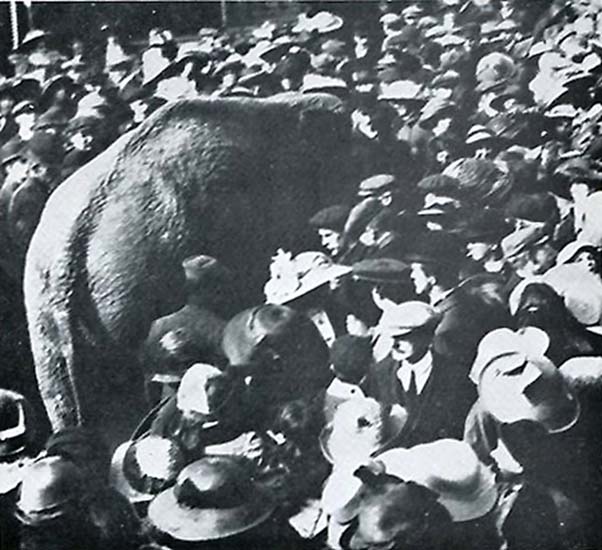
There was also a huge elephant christened “The Mighty Mastodon”. We still have photographs of him apparently pushing and shoving his way through the Goose Fair crowds, apparently unsupervised, making his way back home to his trailer. Don’t worry about safety, though. Only two years before the council were discussing whether it was dangerous to have brown bears in Upper Parliament Street. Talk about re-wilding!
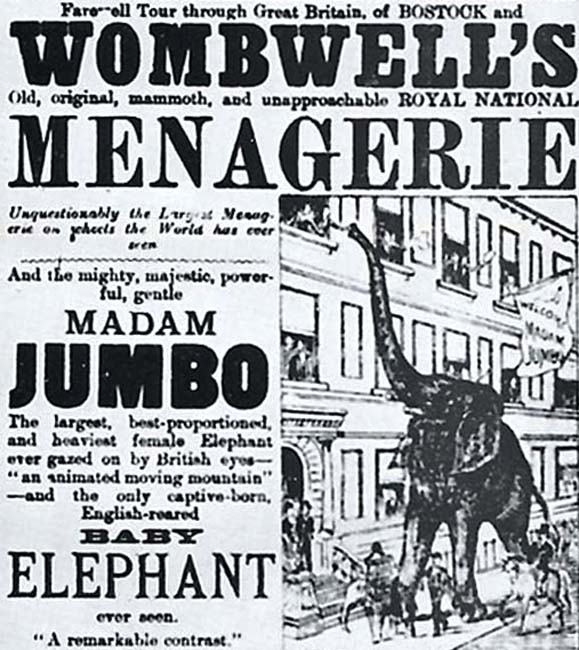
Even more frightening, apparently, was “Madam Jumbo”, an elephant of, well, elephantine proportions. It could actually lift people down from the second floor of the Post Office in Queen Street. Just look at the size of it. Look at the baby elephant in comparison, or the horse:
Amazingly, in King Street, “The Royal Monster Whale” was on exhibition for Goose Fair week, and for the week after that. It cost only threepence, with children half price. A “Royal Monster Whale” must have caused a great many difficulties for everybody, not just when it was delivered on a handcart, but in providing thousands of gallons of seawater in a city more than fifty miles from the sea. However, that may have been the least of their problems. As Monty Python so rightly said:

“Where are we going to get forty-four tons of plankton from every morning?”

An insoluble problem, unless, of course, “The Royal Monster Whale” was stuffed.

At least one lion at Goose Fair was personally supplied by the great Cecil Rhodes, the diamond billionaire who established the Rhodes Scholarships at Oxford University, the oldest graduate scholarships in the world. Every year, 102 full postgraduate scholarships are granted to students across the world. Here’s his lion, serving a life sentence by the look of it:

Sedgwick’s Menagerie had some baby lions, “Performing Elephants”, “Alphonso’s Group of Educated Lions”, “Lorenzo’s Performing and Talking Bears”, “Lorenzo’s Performing Wolves” and then you could see “Lorenzo performing with Nero and Brutus, the largest full-grown untameable African Forest Bred Lions”. Another threepence well spent, children half price.

One of Sedgewick’s chief attractions was “Blonko Bill”:

The first Goose Fair of the new twentieth century starred “the Mafeking Monkey”. During the Siege he had rung a bell every time the Boer artillery shelled the town:
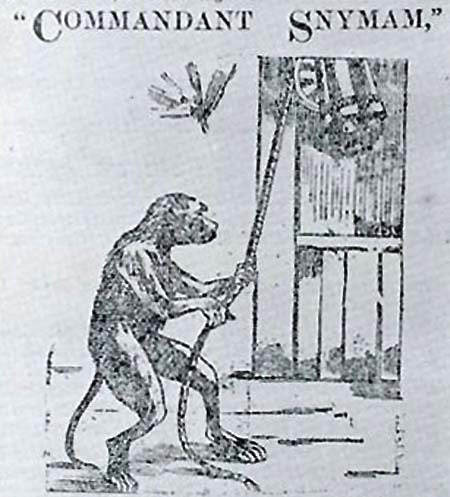
I still don’t see what’s so smart about him, though. Every time the town is shelled, he rings a bell to tell people that they’re being shelled. How is that helpful?

Alongside “the Mafeking Monkey” were “Professor Burnett’s Fencing Booth and Military Tournament”, “Walls Electric Boer Warograph” and “Twigdon’s Electric Palace.” There was also a hairless or “rubber-skinned” mare from the Transvaal, a horse with a mane and tail 21 feet long, a giant horse over 20 hands high and a miniature horse and mule both only 24 inches high.  In addition, there was the “smartest boxing kangaroo” in the world and, sadly, allocated to the animal section,”the giant negro Aaron Moore who is 8 feet in height.” In actual fact, Aaron is known to have been more like 7 feet 3 inches. He was from North Carolina, and, from the photographs I have seen, seems to have worn nearly all the time, a 9 inch high pillar box hat:

13 Comments

Filed under Africa, History, Humour, military, Nottingham

Goose Fair (2)

Goose Fair always brought with it a host of what could be called “camp followers” who, to be honest, would probably have made their way to pretty well every large fair in the country.

Wandering the streets, therefore, were a good number of distinctively dressed gypsy women, who sold “tickling sticks”, bags of confetti, balls on elastic, ropes of beads and “monkeys on sticks”. All vital commodities in Victorian England!

The gypsy women were extremely popular as fortune tellers, and were always recognisable as such because they traditionally carried a linnet in a cage at the end of a long, thin staff.

And in this photograph of a gipsy woman, notice the boy’s funky pillbox hat. Eagerly, he ia waiting for the birth of  Bob Dylan:

A linnet was chosen, incidentally, because:

“When finches come into our awareness, it is a sure sign of joy-filled, happy times ahead.”

I knew that.

Here are some “sundry sellers, who no doubt had access to their own private supplies of tickling sticks, bags of confetti, balls on elastic, ropes of beads and monkeys on sticks:

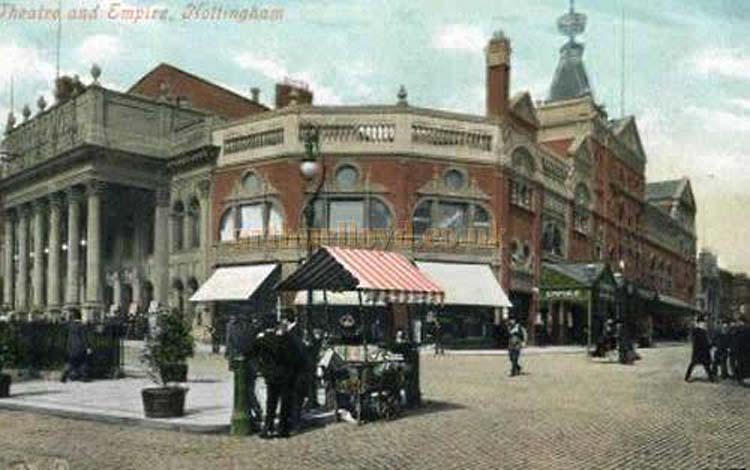
And at the other end of the spectrum, a little further away, on Upper Parliament Street, around the columns in front of the Theatre Royal, stood the “nymphs of fashion”.

Here are the columns of the Theatre Royal which is to the left of the now long demolished Empire Theatre :

The “nymphs of fashion” were what we would nowadays call prostitutes. They charged men for their sexual favours. Here’s one of the hottest, preparing to drive the young men wild, or perhaps straight to their doctor:

And here she is without her make-up. Surely, I’m not the only one who thinks that’s a man:

Setting aside for a moment the delights of these disease ridden lovelies, I investigated the attractions which appeared most frequently at Goose Fair around 1900. I discovered that, on Long Row, there was “Wadbrook’s Ghost Exhibition” with the celebrated “Pepper’s Illusion”. In front of the Exchange Building, Pat Collins had his roundabouts including his “Mountain Ponies”, his “Venetian Gala Gondolas” and his “Pneumatic Steam Bicycles”. There was “music produced by electricity on the latest musical instrument, the “Gaviolophone”, equivalent to a String Band of 60 performers, playing Opera, Classical and Popular Music.”

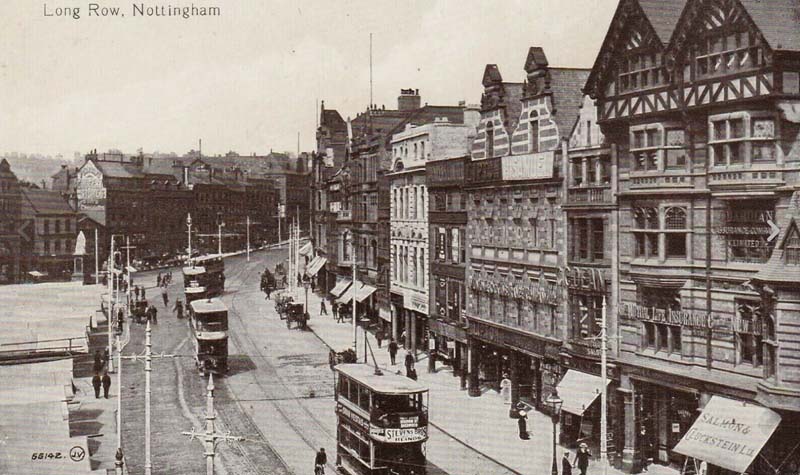
Incidentally, here’s Long Row to the north of the Old Market Square. The western end:

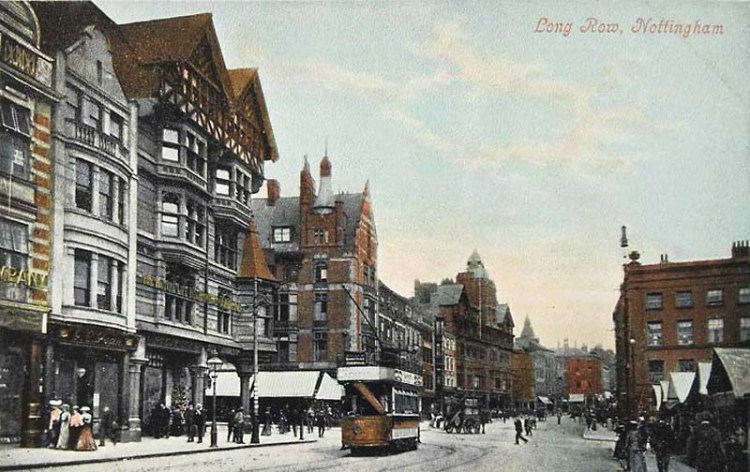
The central area:

And finally, the eastern end, with the incomparable Black Boy Hotel, which, during the Second World War, supplied all of the beds required for the sexual adventures of every single member of Bomber Command in all the RAF bases for fifty miles around:

There may well have been “Wadbrook’s Ghost Exhibition” with “Pepper’s Illusion”. There may well have been roundabouts such as the “Mountain Ponies”, the “Venetian Gala Gondolas” and the “Pneumatic Steam Bicycles”. Despite all of them, though, despite even the “Gaviolophone”, many people, and all the children, still liked to see a few exotic animals, no matter how moth eaten they might have appeared.

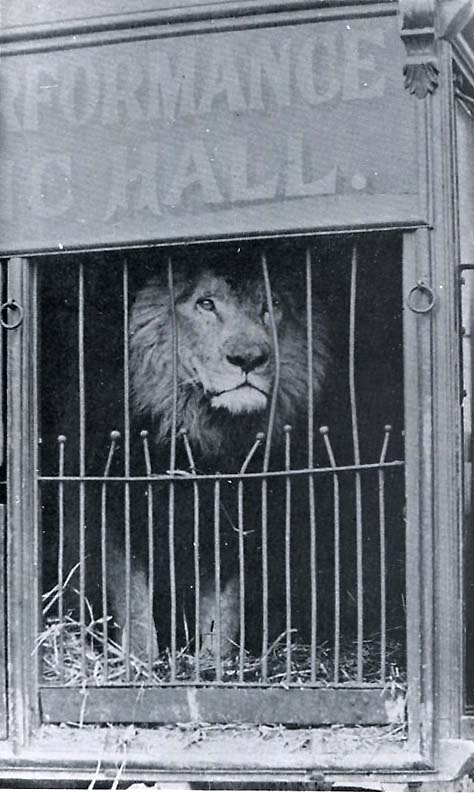
By 1898, Day’s “No 1 Royal Menagerie” had returned to the Market Square after a short absence. Day’s was “a Special Engagement of the Greatest Lion Tamers on Earth” with “Captain Laurance & Delvonico, The Lion Kings” (96 years before Disney!). There were “20 noble lions of all ages and sizes” who provided the members of “Delvonico’s Wrestling Lions”, “Delvonico’s Boxing Lions”, “The Clown Lions” and “A Lion in a Trance”. All of them were acts which had been “The Rage and Talk of Europe”, as was “The Daring Performance of Captain Laurance” along with “the only Real Original and Absolutely Untameable Lion Wallace”. Wallace had also appeared in 1896 and 1897. He doesn’t look very fierce in this photograph, though:

Among the animals were “Many Specimens of Birds, Beasts and Reptiles” some of which must have been stuffed, as there was actually a humming bird mentioned, a species which, even nowadays, cannot easily be kept in captivity. At the same time though, there was an elephant called “Elephant Jumbo” who was surely a live animal, as an elephant would be a bit of a nightmare for the taxidermist.

Overall, the proprietors of Day’s “No 1 Royal Menagerie” were happy to call themselves, “The People’s Show at the People’s Price”.

Slightly less exotic as animals were Mr Pat Collins’ “Giant Nottingham Geese, All Alive and Kicking”:

“For rollicking fun, there’s nothing to beat them

If you are “out for the night” don’t miss them;

And while you are there, try the razzle-dazzle cars

Drawn by ostriches, and spinning round at lightning speed.”

And the judges’ verdicts……….. “No rhyme and very little reason.”

19 Comments

Filed under Bomber Command, Criminology, History, Humour, Nottingham