Tag Archives: Goose Fair

Goose Fair (4)

Before the sudden advent of the huge electric amusement machines around 1900, exotic animals were a firm favourite of the Goose Fair hordes………

The big problem, of course, was the fact that, in the desire to exhibit the most unusual animals, the owners of the animals would often end up by going to an animal market and buying a creature that they themselves could not identify. So sit back and enjoy my own attempts to work out what the unknown animal really was………

Let’s start with……..

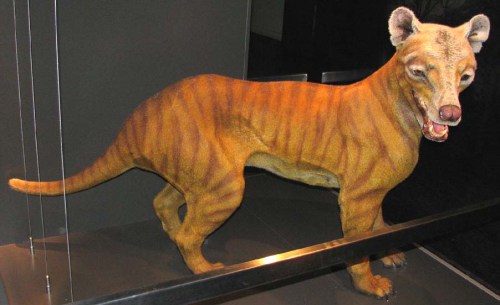
Tiger Wolves direct from the Black Rocks of Abyssinia”. These were shown in Day’s “No 1 Royal Menagerie” in 1898 as a “Group of Wild and ferocious Tiger Wolves direct from the Black Rocks of Abyssinia”. Alongside them was a group of Baby Lions”.

There are wolves in Ethiopia, but they are red, so much so that they are also called “the Simien fox or Simien jackal or horse jackal”. Intriguingly, at this time, the name “Tiger-Wolf” was the accepted shortened form of “Tasmanian Tiger-Wolf”. This phrase was used to refer to the Thylacine, an unbelievably rare Australian animal to turn up in a fair in Nottingham. I really do wonder what these animals were!
A slightly less colourful one:

I think you’re getting the idea…..

Day’s “No 1 Royal Menagerie” also had “Blonko Bill, King of the Lion Tamers” working for them.” I have been unable to trace the meaning of “blonko”, although if ever a word sounded like Australian slang, this is it! The internet was no help. One site said it meant “kind, entertaining, handsome”, another said it meant “fat, fat, fat”.

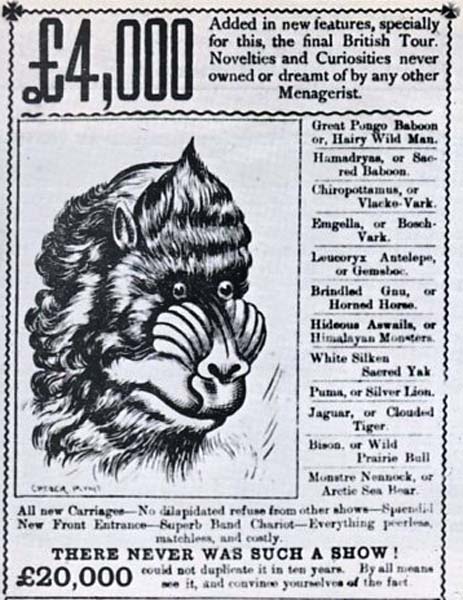
In 1899, Bostock & Wombwell produced a special poster listing all of their animals, including the “Great Pongo Baboon, or Hairy Wild Man”. Intriguingly, “Pongo” is the scientific name for the orangutan, thought to be a close relative of Bigfoot, hence the “Hairy Wild Man” epithet:

This slideshow requires JavaScript.


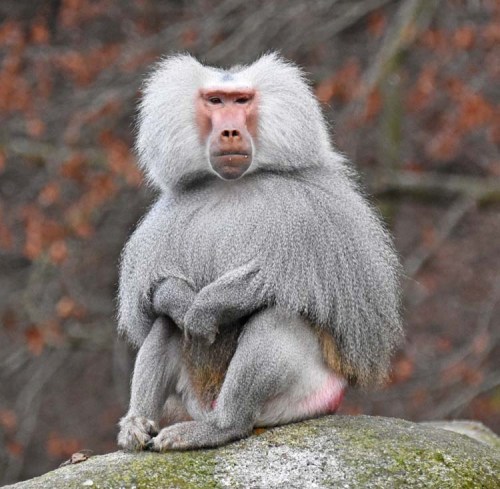
Another strange sounding animal on the Bostock & Wombwell poster was the “Hamadryas, or Sacred Baboon” although, ironically, it is very simple. The poster is referring to the Hamadryas Baboon from the Horn of Africa and the southwestern region of the Arabian Peninsula. You can just see the side of his bright scarlet posterior……
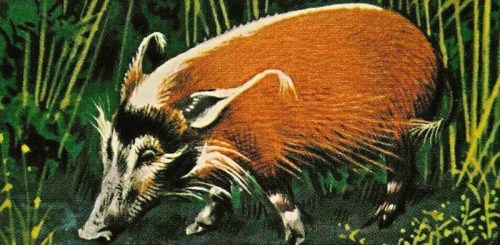
The same owners had a “Chiropottamus, or Vlacko-Vark” which is merely a sort of wild pig. It may be the Red River Hog, “a wild member of the pig family living in the Guinean and Congolian forests. Here’s the old Brooke Bond tea card from the “Wild Animals of Africa” collection….
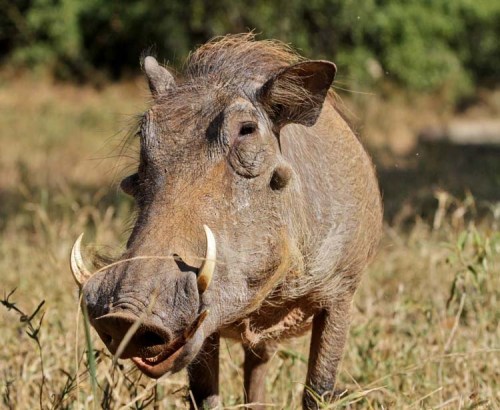
Alternatively, it may be the warthog which is the “vlakvark” in Afrikaans…..
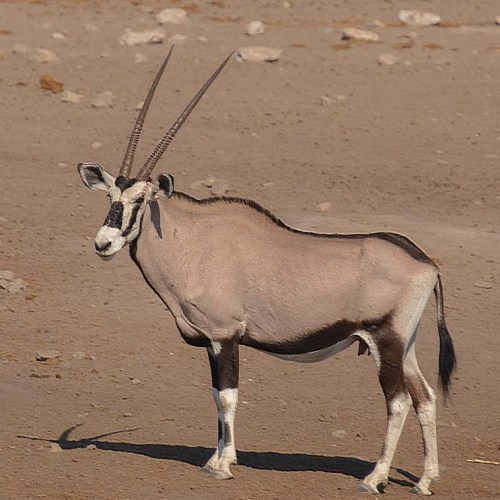
A “Leucoryx Antelope” sounds a very strange beast but it is also called the “Gemsboc” on the poster. And the “Gemsboc is the gemsbok, gemsbuck or South African oryx, native to the arid regions of Southern Africa, such as the Kalahari Desert. It is a very beautiful animal….
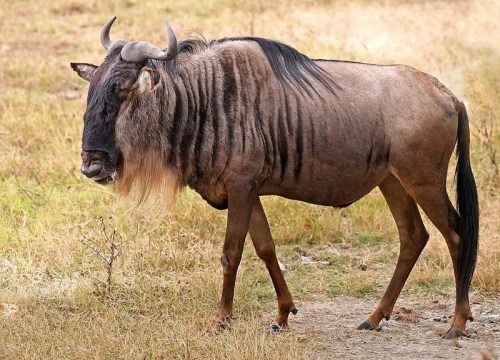
The “Brindled Gnu, or Horned Horse” is a lot easier, because we have all seen this strange word. Not totally unexpectedly, the Brindled Gnu is the blue wildebeest, also called the common wildebeest, the white-bearded wildebeest or the white-bearded gnu. It is one of the two species of wildebeest…..
The Bostock & Wombwell poster advertises a “White Silken Sacred Yak” which would have been a pure white yak. Nowadays, some 5% of the herds are white. They are regarded as an extremely auspicious animal since white represents light, a personification of the illumination of wisdom and the universal Buddha……

Some animals are very easy to sort out.

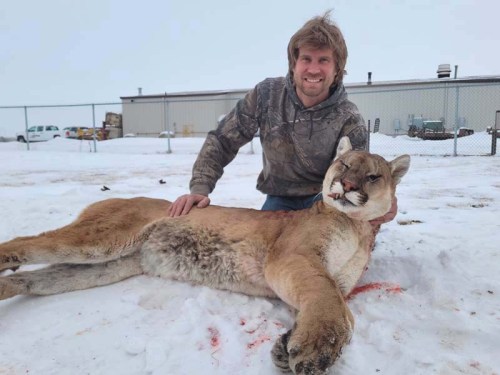
A “Puma or Silver Lion” was presumably a North American mountain lion, cougar or puma. Here’s a lovely picture of one of the first ever mountain lions to be found in North Dakota…..
A “Jaguar or Clouded Tiger” is nowadays called a “jaguar” or a “clouded leopard”……

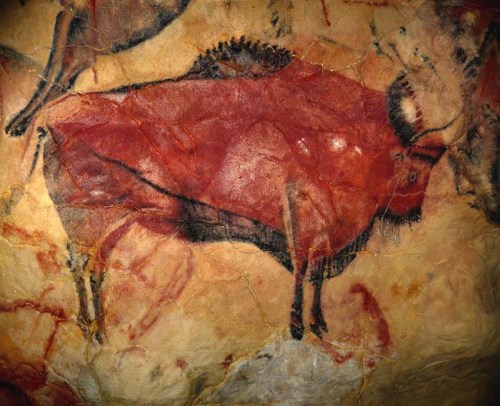
A “Bison, or Wild Prairie Bull” is most probably the North American bison…..
A “Monstre Nennock” sounds incomprehensible, but the alternate names give it away, with “Arctic Sea Bear” making it the polar bear. It would be nice to know what a nennock is, though. Incidentally, I’ve just turned my slides into digital photographs, photoshopped them to make them a little lighter and got rid of the hairs and general dirt. So, here is a nennock or two at Basel Zoo in Switzerland in 1979….

Two final animals though, are most intriguing. Just what were the “Hideous Aswaila”, or “Himalayan Monsters”? Were they a family group of yetis? I bet they were, but the people of the time did not know what yeti was…….

And last of all. What on earth were “Lorenzo’s Performing and Talking Bears”? Were they a family group of Bigfoots? Using their famous “Samurai Chatter” to pass comment about Nottingham and its inhabitants? Here’s a youtube video, and if you move swiftly to 4 minutes exactly, you’ll hear what “Samurai Chatter” is. At 4.40, you can hear the Bigfoot walking around the cabin. It’s really scary!

17 Comments

Filed under Africa, Cryptozoology, History, Humour, Nottingham, Science, Wildlife and Nature

Goose Fair (3)

Last time we finished with Mr Pat Collins’ “Giant Nottingham Geese, All Alive and Kicking” but some surprisingly exotic, and indeed, unusual, animals made their appearance at Goose Fair.

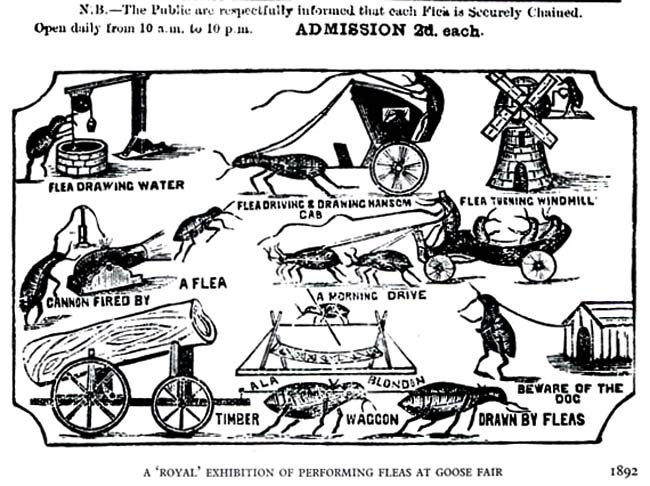
Smallest of them all were the performing fleas:

Look at what they could do:

And don’t worry:

“Each flea is Securely Chained”

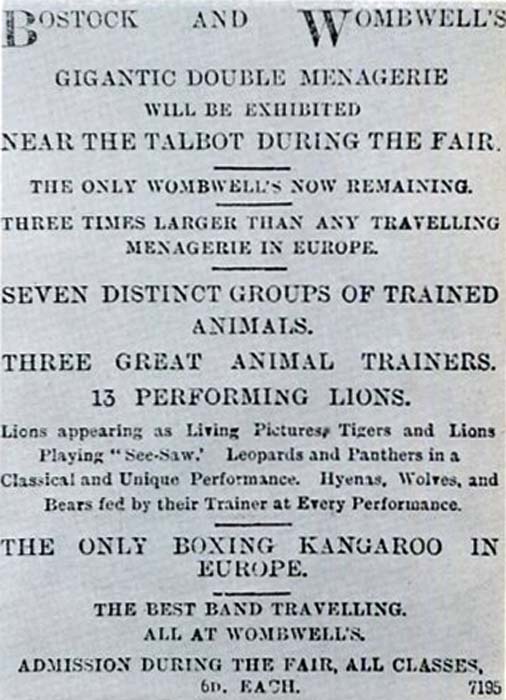
In 1899, for their last visit to Goose Fair, Bostock & Wombwell produced a special poster, which listed all of their animals.

Their rivals, of course, boasted about their own animals which included “Novelties never owned or dreamt of by any other Menagerist.” There was the “Great Pongo Baboon”, the “Hamadryas, or Sacred Baboon”, the “Leucoryx Antelope or Gemsboc”, a “Brindled Gnu, or Horned Horse”, a “White Silken Sacred Yak”, a “Puma”, “Jaguar”, a “Bison, or Wild Prairie Bull” and the “Monstre Nennock”.

Here we are:

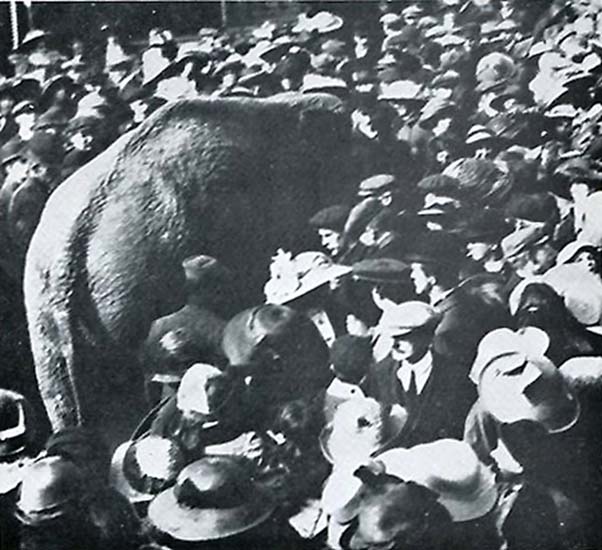
There was also a huge elephant christened “The Mighty Mastodon”. We still have photographs of him apparently pushing and shoving his way through the Goose Fair crowds, apparently unsupervised, making his way back home to his trailer. Don’t worry about safety, though. Only two years before the council were discussing whether it was dangerous to have brown bears in Upper Parliament Street. Talk about re-wilding!

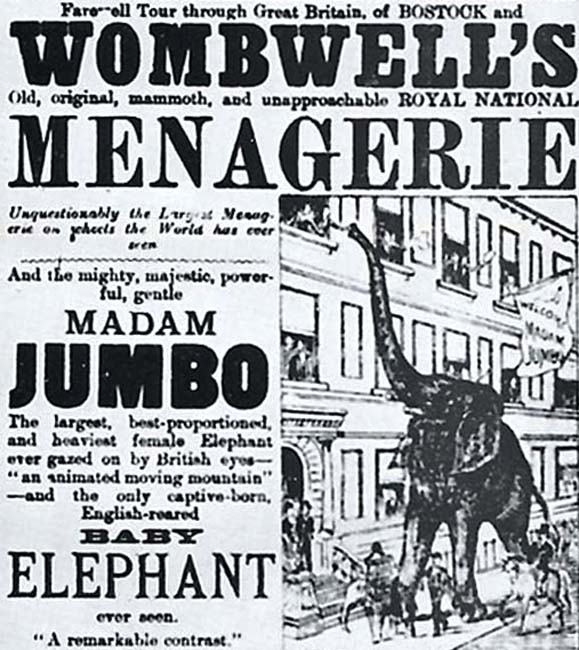
Even more frightening, apparently, was “Madam Jumbo”, an elephant of, well, elephantine proportions. It could actually lift people down from the second floor of the Post Office in Queen Street. Just look at the size of it. Look at the baby elephant in comparison, or the horse:

Amazingly, in King Street, “The Royal Monster Whale” was on exhibition for Goose Fair week, and for the week after that. It cost only threepence, with children half price. A “Royal Monster Whale” must have caused a great many difficulties for everybody, not just when it was delivered on a handcart, but in providing thousands of gallons of seawater in a city more than fifty miles from the sea. However, that may have been the least of their problems. As Monty Python so rightly said:

“Where are we going to get forty-four tons of plankton from every morning?”

An insoluble problem, unless, of course, “The Royal Monster Whale” was stuffed.

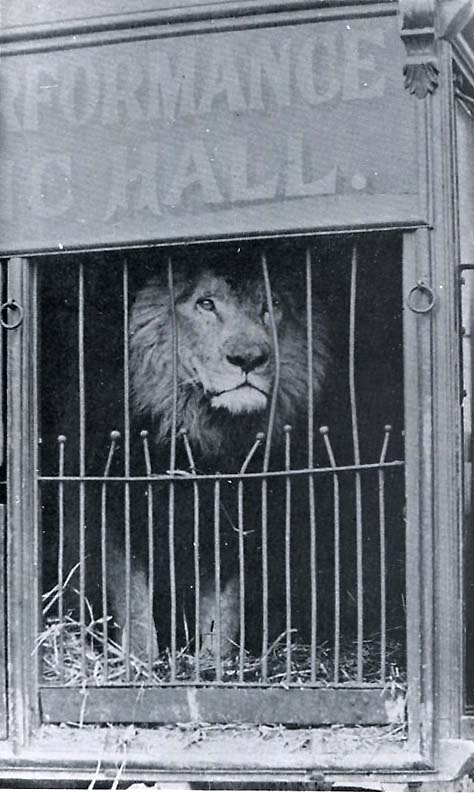
At least one lion at Goose Fair was personally supplied by the great Cecil Rhodes, the diamond billionaire who established the Rhodes Scholarships at Oxford University, the oldest graduate scholarships in the world. Every year, 102 full postgraduate scholarships are granted to students across the world. Here’s his lion, serving a life sentence by the look of it:

Sedgwick’s Menagerie had some baby lions, “Performing Elephants”, “Alphonso’s Group of Educated Lions”, “Lorenzo’s Performing and Talking Bears”, “Lorenzo’s Performing Wolves” and then you could see “Lorenzo performing with Nero and Brutus, the largest full-grown untameable African Forest Bred Lions”. Another threepence well spent, children half price.

One of Sedgewick’s chief attractions was “Blonko Bill”:

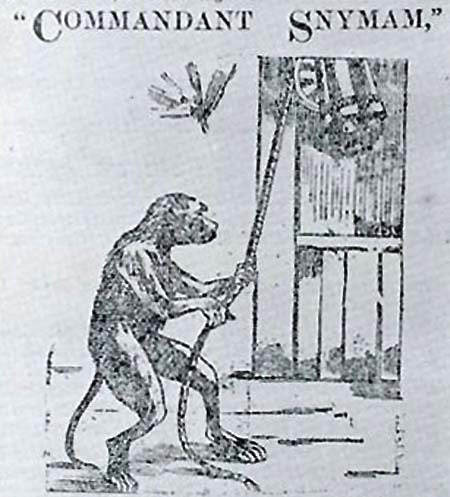
The first Goose Fair of the new twentieth century starred “the Mafeking Monkey”. During the Siege he had rung a bell every time the Boer artillery shelled the town:

I still don’t see what’s so smart about him, though. Every time the town is shelled, he rings a bell to tell people that they’re being shelled. How is that helpful?

Alongside “the Mafeking Monkey” were “Professor Burnett’s Fencing Booth and Military Tournament”, “Walls Electric Boer Warograph” and “Twigdon’s Electric Palace.” There was also a hairless or “rubber-skinned” mare from the Transvaal, a horse with a mane and tail 21 feet long, a giant horse over 20 hands high and a miniature horse and mule both only 24 inches high.  In addition, there was the “smartest boxing kangaroo” in the world and, sadly, allocated to the animal section,”the giant negro Aaron Moore who is 8 feet in height.” In actual fact, Aaron is known to have been more like 7 feet 3 inches. He was from North Carolina, and, from the photographs I have seen, seems to have worn nearly all the time, a 9 inch high pillar box hat:

13 Comments

Filed under Africa, History, Humour, military, Nottingham

Goose Fair (2)

Goose Fair always brought with it a host of what could be called “camp followers” who, to be honest, would probably have made their way to pretty well every large fair in the country.

Wandering the streets, therefore, were a good number of distinctively dressed gypsy women, who sold “tickling sticks”, bags of confetti, balls on elastic, ropes of beads and “monkeys on sticks”. All vital commodities in Victorian England!

The gypsy women were extremely popular as fortune tellers, and were always recognisable as such because they traditionally carried a linnet in a cage at the end of a long, thin staff.

And in this photograph of a gipsy woman, notice the boy’s funky pillbox hat. Eagerly, he ia waiting for the birth of  Bob Dylan:

A linnet was chosen, incidentally, because:

“When finches come into our awareness, it is a sure sign of joy-filled, happy times ahead.”

I knew that.

Here are some “sundry sellers, who no doubt had access to their own private supplies of tickling sticks, bags of confetti, balls on elastic, ropes of beads and monkeys on sticks:

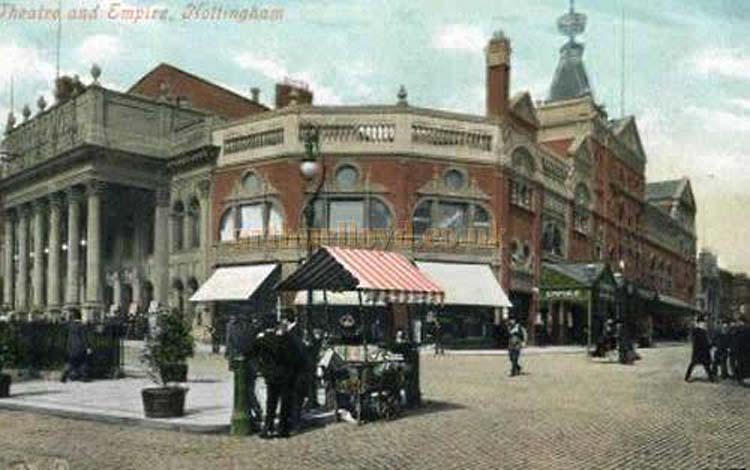
And at the other end of the spectrum, a little further away, on Upper Parliament Street, around the columns in front of the Theatre Royal, stood the “nymphs of fashion”.

Here are the columns of the Theatre Royal which is to the left of the now long demolished Empire Theatre :

The “nymphs of fashion” were what we would nowadays call prostitutes. They charged men for their sexual favours. Here’s one of the hottest, preparing to drive the young men wild, or perhaps straight to their doctor:

And here she is without her make-up. Surely, I’m not the only one who thinks that’s a man:

Setting aside for a moment the delights of these disease ridden lovelies, I investigated the attractions which appeared most frequently at Goose Fair around 1900. I discovered that, on Long Row, there was “Wadbrook’s Ghost Exhibition” with the celebrated “Pepper’s Illusion”. In front of the Exchange Building, Pat Collins had his roundabouts including his “Mountain Ponies”, his “Venetian Gala Gondolas” and his “Pneumatic Steam Bicycles”. There was “music produced by electricity on the latest musical instrument, the “Gaviolophone”, equivalent to a String Band of 60 performers, playing Opera, Classical and Popular Music.”

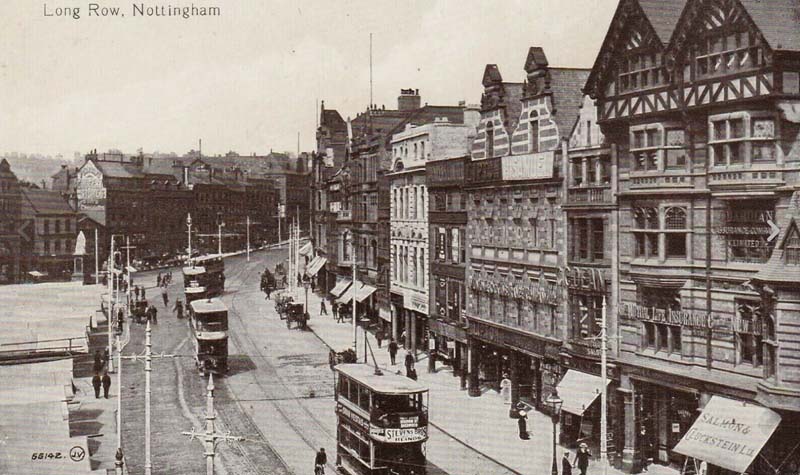
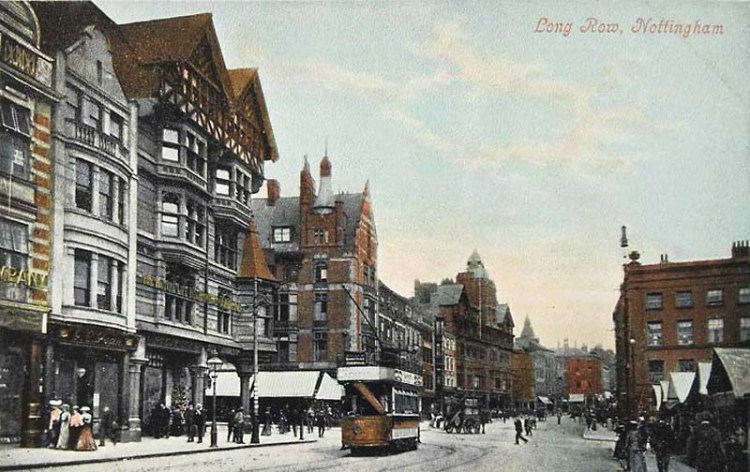
Incidentally, here’s Long Row to the north of the Old Market Square. The western end:

The central area:

And finally, the eastern end, with the incomparable Black Boy Hotel, which, during the Second World War, supplied all of the beds required for the sexual adventures of every single member of Bomber Command in all the RAF bases for fifty miles around:

There may well have been “Wadbrook’s Ghost Exhibition” with “Pepper’s Illusion”. There may well have been roundabouts such as the “Mountain Ponies”, the “Venetian Gala Gondolas” and the “Pneumatic Steam Bicycles”. Despite all of them, though, despite even the “Gaviolophone”, many people, and all the children, still liked to see a few exotic animals, no matter how moth eaten they might have appeared.

By 1898, Day’s “No 1 Royal Menagerie” had returned to the Market Square after a short absence. Day’s was “a Special Engagement of the Greatest Lion Tamers on Earth” with “Captain Laurance & Delvonico, The Lion Kings” (96 years before Disney!). There were “20 noble lions of all ages and sizes” who provided the members of “Delvonico’s Wrestling Lions”, “Delvonico’s Boxing Lions”, “The Clown Lions” and “A Lion in a Trance”. All of them were acts which had been “The Rage and Talk of Europe”, as was “The Daring Performance of Captain Laurance” along with “the only Real Original and Absolutely Untameable Lion Wallace”. Wallace had also appeared in 1896 and 1897. He doesn’t look very fierce in this photograph, though:

Among the animals were “Many Specimens of Birds, Beasts and Reptiles” some of which must have been stuffed, as there was actually a humming bird mentioned, a species which, even nowadays, cannot easily be kept in captivity. At the same time though, there was an elephant called “Elephant Jumbo” who was surely a live animal, as an elephant would be a bit of a nightmare for the taxidermist.

Overall, the proprietors of Day’s “No 1 Royal Menagerie” were happy to call themselves, “The People’s Show at the People’s Price”.

Slightly less exotic as animals were Mr Pat Collins’ “Giant Nottingham Geese, All Alive and Kicking”:

“For rollicking fun, there’s nothing to beat them

If you are “out for the night” don’t miss them;

And while you are there, try the razzle-dazzle cars

Drawn by ostriches, and spinning round at lightning speed.”

And the judges’ verdicts……….. “No rhyme and very little reason.”

19 Comments

Filed under Bomber Command, Criminology, History, Humour, Nottingham

Goose Fair (1)

Every year, a huge fair is held in Nottingham. It lasts from the first Wednesday in October to the following Saturday. It dates back to a royal charter in 1284 although it is known that the Saxons had held “St. Matthew’s Fair” long before that. Modern belief is that the Saxon fair was based on a fair held by the fun-loving Vikings. A Viking army had captured Nottingham from the Saxons in 868 AD. Its leaders had two of the coolest names ever.

“Ivar the Boneless”

“Halfdan Ragnarsson”

Presumably his Dad was “Wholedan”, or even “Fulldan”.

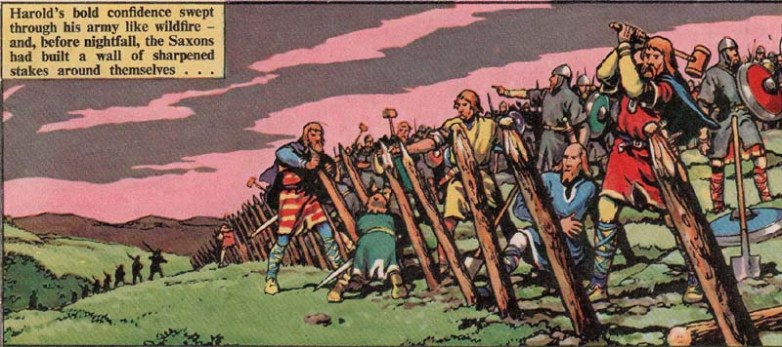
This combination of Saxons and Vikings would make the Goose Fair well over a thousand years old. Here are some Vikings:

And here are some Saxons:

The name “Goose Fair” comes from the thousands of geese that were driven to Nottingham on foot from Lincolnshire, Cambridgeshire and East Anglia. Their feet coated with tar and sand to protect them on the long journey of a hundred miles or more, the geese would provide the traditional Michaelmas dish of roast goose on September 29th. Goose Fair was traditionally held in the Old Market Square in the city centre, although it was moved to the Forest Recreation Ground in 1928. The fair has only been cancelled on very few occasions. In 1646 because of bubonic plague, during both World Wars, and finally in 2020 and 2021.

The Old Market Square was a very different place before 1928.

In the 1700s, the fair was no longer about geese, but was more to promote the sale of Red Nottingham, the local cheese which was traditionally made in the shape of a large wheel. The whole thing became a little too Red Nottingham in 1766, when the natives of the town got a little over exuberant and started “The Great Cheese Riot”.  I shall be doing a blogpost about that glorious day when I have spoken to the Archivist of the Museum of the Fifteenth Dragoons to see if the names of the Nottingham peasants they slaughtered have been recorded anywhere.

By 1900, the fair was all about entertainment of every kind, with Aunt Sally’s (sic), shooting galleries, swing boats, roundabouts and merry-go-rounds (is there a difference?). There were theatres showing short films called “animated photographs”. These included boxing matches from the USA, bullfighting from Boulogne in northern France and the famous “Dreyfuss Affair” which was probably the series of eleven short silent films made by the famous French director, Georges Méliès. The very biggest attraction, though, and the most exciting thing on offer, was the increasingly large number of huge spectacular machines powered by electricity. As Pat Collins, the owner of many of the attractions, said:

“the build-up of the mechanical side was very rapid as the manufacturers turned out better machines in each succeeding year”.

One perennial attraction was the Children’s Corner which was situated away from the main fair, at the junction of King Street and Queen Street:

The enntire Market Square was lined with stalls, which also continued up Market Street. These stalls sold “gingerbread, without which Goose Fair would hardly be Goose Fair”, “coconuts, almost equally indispensable” and a profusion of “comestibles and indigestibles”, the latter including mainly children’s toys, books and fruit. On Market Street, the stalls sold a profusion of wash leathers and sponges, and, for the children, there were “penny prize packets” which contained a mixture of tiny sweets and chocolates. There was also a Cheese Fair and a Poultry Fair, and out at Eastcroft, a large cattle market was held. Punch and Judy shows were very popular and they frequently graced St Peter’s Square, or the area in front of the Talbot public house, a little further on than the junction with Market Street.

Next time, the “Nymphs of fashion”, an ironic title, perhaps, given how willing they were to divest themselves of their clothing.

16 Comments

Filed under History, Humour, Nottingham