
My previous blog posts about the Battle of the Somme were based on the “Both sides of the wire”” series of TV programmes, which were themselves based on the extensive researches of the English historian, Peter Barton, who has spent many years as a “battlefield guide” in the Somme area. He was the first person ever to consult the German language archives and was amazed to discover that he was the only English historian who had looked at them in a whole century. Here he is…..

My previous blog posts concentrated on the famous “First Day of the Somme”, July 1st 1916, the British Army’s most disastrous ever day, which was portrayed in the first programme of the three. The remaining two programmes followed the campaign until the Battle of Boom Ravine between February 17th–18th 1917. This was when the Allies attacked the Germans troops on the Ancre Heights near Courcelette and to the north of the Ancre valley. That was the end, more or less, of the Somme Campaign. Overall, the British had casualties of 420,000 men, the French 200,000 and the Germans 512,000. If my Maths serves me well, that is 1,132,000 poor souls killed or wounded, many of them horrifically disfigured for life.
Rather than take you through these two remaining TV programmes in immense detail, I would prefer to tell you about the most striking details Peter Barton found. Although they are often unrelated to each other, these details are all really interesting and might well persuade you to set the recorder for all three hours of programming on the next occasion these ground-breaking documentaries are shown. So don’t expect a bedtime story, rather a list of unusual, quirky truths that Peter Barton found in his researches in the German Archives. I decided to label them “Fun facts” in case anybody wanted to have a test afterwards.
Funfact One
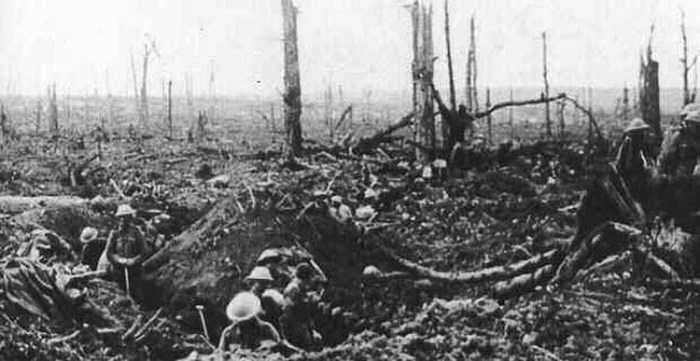
In the fighting from July 14th onwards, the excellent fighting qualities of the Germans were often completely underestimated, particularly their defensive organisation. Advances which were anticipated to take a few hours, instead took the British several weeks. The Germans had by now developed new tactics, there was extremely fierce resistance and the British attack just petered out. It took an unexpected two weeks to capture Longueval, and the Germans in nearby Delville Wood were to remain there until August 27th. What a pretty little wood it was! …….
Funfact Two
Overall, the Germans had always preferred to be defensive and the British were forced to be offensive. According to the German Archives, though, the British POWs had told their German captors that the British feared open warfare and very much preferred a war based on a defensive system with trenches, barbed wire and minefields.
Not all the British generals shared these views, however, and differences of opinion were frequently marked. Rawlinson was the second in command and he was an infantry man. He believed in what was popularly called “Bite and hold”, or the acquisition of enemy territory in cautious, tiny steps. Haig, however, the British No 1, was a cavalry man, who believed in great thrusts of advance. Haig had the derring-do of a cavalry man and was considered to be a “thruster”, a man who would always unleash the cavalry when the opportunity arose. Here’s Haig, wearing his “Anti-Gas trousers”….

Funfact Three
During the July 14th attack during the Somme campaign, there was a cavalry charge which involved some Indian troops of the 20th Deccan Horse. Peter Barton discovered that German POWs in British hands had reported, when they spoke to their own officers much later, that many of the British cavalrymen were feeding and watering their horses at the very same time when senior British officers had told the press that their derring-do charge was taking place.
In other words, the charge could not possibly have taken place as the newspapers described it. This was further emphasised by the fact that it could not have happened as early in the day as the newspapers reported, because the ground at that time would have been too hard and slippery for the horses’ hooves. Only later would conditions have been suitable. The inference is, of course, that direct lies were being told about events to make the British attack and their meagre achievements look more impressive.
Funfact Four
The Germans were aware of every single detail about the British because of their enormous number of telephone intercepts. They must been aware too, therefore, that the German army was only one fifth the size of the Allied forces.
Funfact Five
Again, the fact was emphasised that the British may actually have been very pleased to turn to defensive, trench warfare. Open warfare requires great flexibility, lots of different techniques and lots of different skills, but the German Archives revealed that the British troops seemed to have received no battlefield training whatsoever. Their basic tactic remained a massive heavy bombardment by thousands of mortars and field guns, and then a charge across no-man’s-land in large numbers. They had presumably learnt nothing from July 1st 1916, except that it was okay to run rather than having always to walk.
Even so, the Germans had enormous respect for the British, who attacked and then attacked again, even when it was obviously pointless. This, of course, produced enormous casualties for very little gain but that did not seem to matter a huge amount. With the Allied forces five times as numerous as their opponents, the war became very much a “war of attrition”. The effectiveness of attrition as a tactic was made to look all the better by using optimistic, or possibly, even false, German casualty figures.
Funfact Six
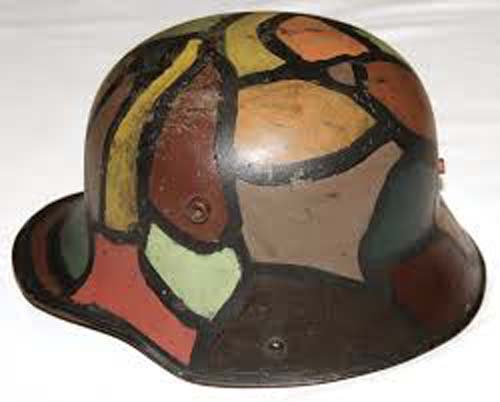
In the skies, the Royal Flying Corps, the RFC, were always dominant but the Germans were very adept at protecting themselves with camouflage, and very good at hiding themselves, and their weaponry. Most striking, perhaps, was their use of “dazzle camouflage”, as on this possibly early Bauhaus chamber pot from 1918…..


 John Knifton