
Last time, I tried to explain why and how there came to be a healthy population of urban foxes living in the leafy suburbs of London. Within a decade, there were large populations of urban foxes in other cities with extensive leafy suburbs, such as such as Bristol, Manchester, Birmingham and Nottingham. One of these sophisticated city foxes even came to be a personal friend of Banksie:
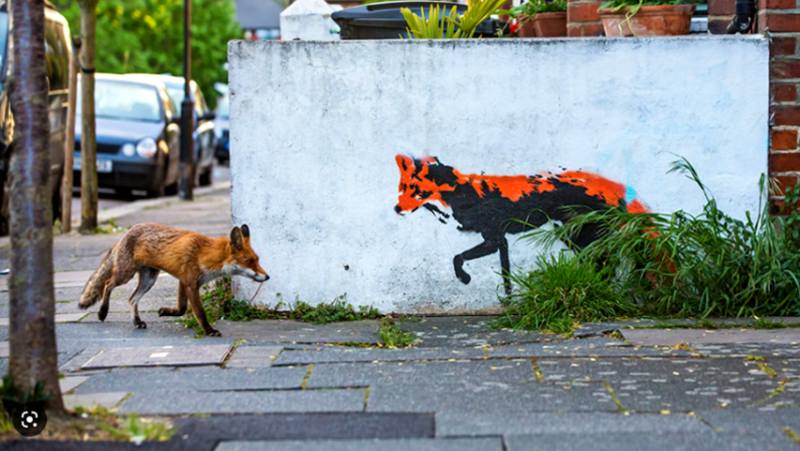
There was nothing to stop the urban foxes. On average, councils found that for every letter of complaint, there were 25 which said “Hands off our foxes”. And killing them off was very expensive. anyway. And unpopular. The Daily Express reported that…….
“Hackney Council ordered the removal of traps in a popular park within hours of animal lovers reacting angrily to the idea of the inner city foxes being destroyed.”
Nottingham, of course, has its urban foxes. On one occasion. long before I got to know Widdle, I found traces of them near a path between the Ring Road and the tennis courts. Here’s the path, which seems to be Nottingham’s first Linear Litter Bin. The tennis courts are to the left behind the chainlink fencing, and the ringroad is behind the heavy black metal fence on the right:

Something seems to have crawled underneath the chain link fencing which protects the tennis courts:

At one point I found this carefully excavated hole, which I believe to be a fox’s den.

In a city, there are literally hundreds, if not thousands, of possible places for a fox family to live, such as disused sheds and out buildings and underneath garden decking. There’s plenty of food, especially if there is a fast food restaurant nearby. Indeed, news was released recently that foxes in cities have begun to have broader, stronger muzzles than their country cousins, because a certain amount of strength is needed to open the discarded food containers. Once the containers are open, though, the food that they contain will contain many more calories than the usual diet of a fox out there in the countryside, eating mice, hedgehogs, beetles and other insects.
It was Kevin Parsons, a senior lecturer at the University of Glasgow, who recently announced that investigators had found that “urban foxes had wider, shorter muzzles than those in rural areas. Diet plays a large part in some of the changes. Urban foxes need a stronger bite for the food they eat in cities.
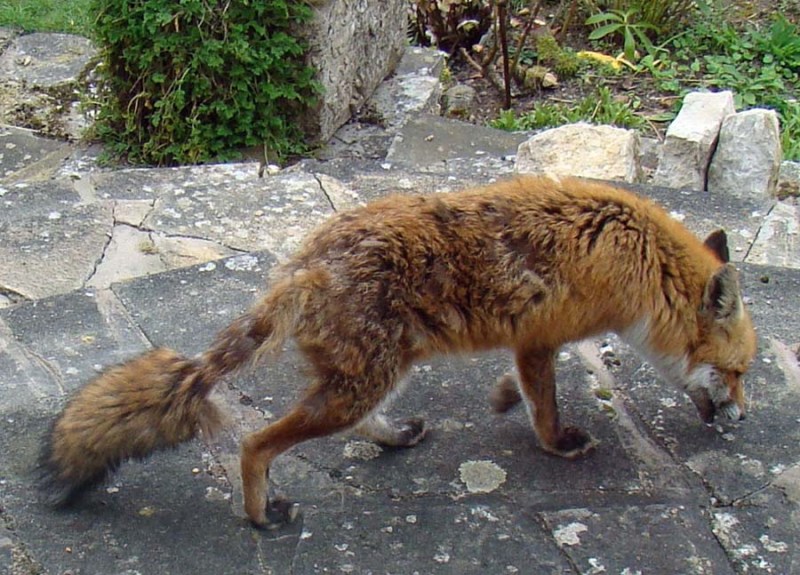
Foxes have all they might need in the city. Even their life expectancy is better than country foxes. The only fly in the ointment is mange which is a disease which can sweep through a city’s fox population and kill nearly every single one. Here’s a fox with the early stages of mange. Look at his tail ! :
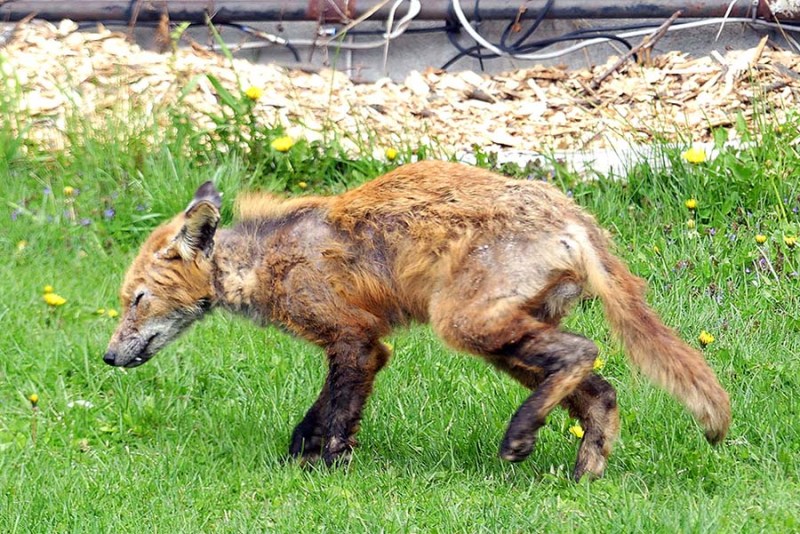
Here’s a fox who is past the point of no return. He looks, and is, a terminally sick animal:
Don’t be fooled though! Sometimes a perfectly healthy fox can look as if he is at Death’s Door, when he is moulting, which is, of course, a perfectly normal stage of his life:
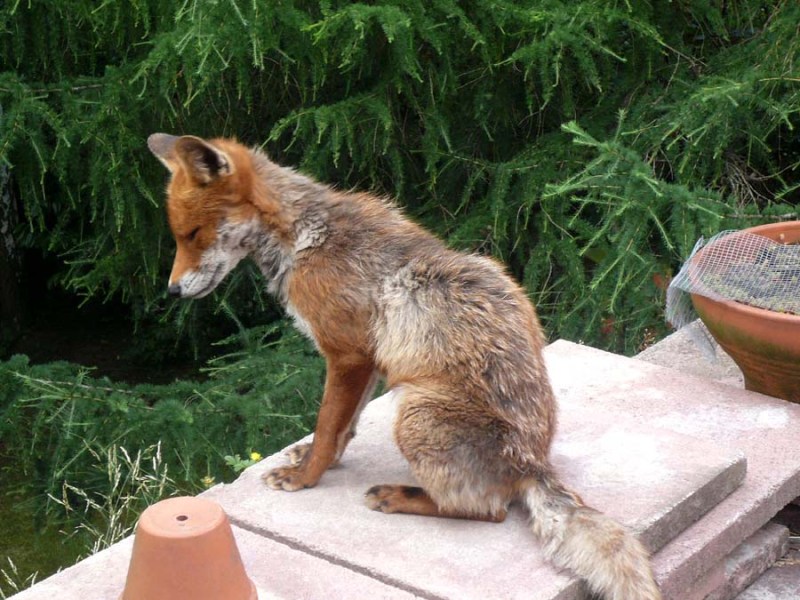
Surely you will recognise this rather tatty chap. He is called “Widdle” and was a personal friend of mine. He could look extremely ill when he was moulting, but there was a difference. If a fox is basically healthy, his moult starts at the tail and then spreads up towards the head, which is usually the last to go. Other body extemities, such as the legs, may also stay rich red rather than turn to that tatty fawn-pale orannge-black. And in the three photographs, one of a healthy Widdle and the other two of a fox with mange, that is exactly what is happening.



 John Knifton