Tag Archives: Orange Arrow

Brincliffe Grammar School for Girls (3)

There was a strong connection between Brincliffe School and the High School but not, as you might expect, between the boys and the girls. Instead, the connection was a sporting one, and consisted of a number of football matches, all of them played between 1877-1880, when the physical building on Balmoral Road accommodated “Porter & Jones, boys’ school (Tudor House)”.

The High School had played their first match against another school seven years previously. News of the game appeared in the new school magazine, “The Forester”, which introduced a section entitled “Our Chronicle”, which was designed to allow reports about “the sports… of the School.”

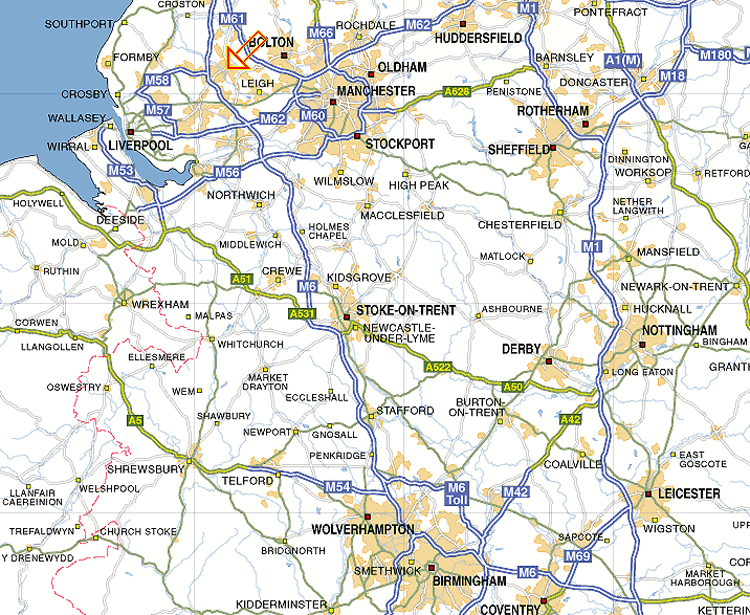
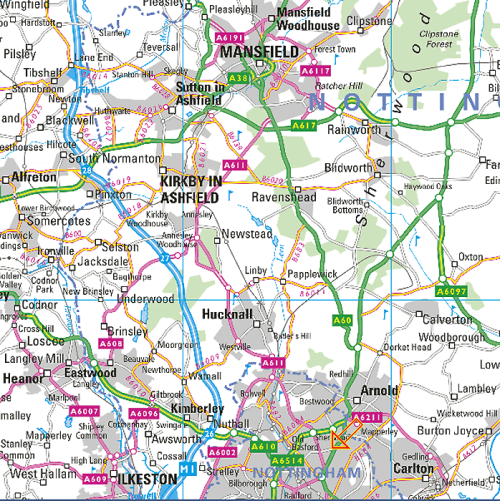
Thus, on November 19th 1870, having travelled to Mansfield, the Nottingham High School First XI played a Mansfield Grammar School XV at football, beating them 3-0. Around 110 years later I took the First XI to Mansfield, not in a steam train, but by minibus, and we played them on a darkish Wednesday afternoon. We lost, although by then they had changed their name to Brunt’s School, now changed again to Brunt’s Academy. The Orange Arrow shows the High School, Mansfield is in the middle of the top edge of the map, and then see if you can find Eastwood, the birthplace of DH Lawrence, ex-pupil at the High School (1898-1901).
History always likes to puzzle us with the fogs of confusion that it loves to create, though. Just as we were digesting the fact that the High School played its first ever football match on November 19th 1870, when the First XI beat a Mansfield Grammar School XV by 3-0, I found that there is a some evidence that organised football was played by the High School even before this.

In just one edition of “The Forester”, there is an allusion to a football game between the High School and a Tudor House School XV on February 27th 1878. Charles Edwin Attenborough, the son of a hosier from Bilbie Street, was unlucky enough to break his leg and dislocate his ankle. It was reported at the time that, with the exception of one broken collar bone in, probably, the 1872-1873 season, this was the the first injury of any consequence “since the new school opened in 1868”.

This intriguing phrase might conceivably be taken to imply that football matches had taken place in that short interim period of just over two years between April 1868 and December 1870, when “The Forester’s” first reports appeared. This is so long after the event, though, that we may never know the exact truth.

Seven years after their first ever game against any other other school, the First XI played Mr Porter and Mr Jones’ “Tudor House” on October 31st 1877, probably on a pitch on the nearby Forest Recreation Ground.  The First XI won 15-0 and “The Forester” recorded that Tudor House did not once get the ball into the High School half, at any point in the game…..

“Goals were obtained as fast as the ball was kicked off.”

Fifteen had been scored “when time was called”.

Four months later, on February 27th 1878, again probably on a pitch on the nearby Forest Recreation Ground, the First XI beat a Tudor House XV by 3-2 (as already mentioned above). During this game, thirteen year old Charles Edwin Attenborough was unlucky enough to break his leg and dislocate his ankle. Despite our modern perceptions of the roughness of Victorian football, “The Forester” reported that, with the exception of one broken collar bone four seasons previously, this was the first injury of any consequence “since the new school opened” in April 1868.

And here it is, a photograph thought to have been taken on April 16th 1868, the school’s first day. The first lesson to be learnt was that more toilets would be needed if queuing was to be avoided:

A week or so after the glorious triumph over 15 boys in the Tudor House XV, on March 6th 1878, on the Forest, the First XI again played a Tudor House XV. and beat this slightly more numerous team by 2-0. These two games were the last two fixtures of the season 1877-1878.

During the following season, Tudor House scored their first ever victory over the High School. On a day misprinted in “The Forester” as October 60th 1878, on the Forest, the reporter said that “This was a very even game, but the fact that Bramwell and four other first team members were absent probably tipped the balance in favour of Tudor House.” They won by 1-0. We don’t know what colours the High School played in. In both these photographs, the colours are black and white. They come from 1897 and 1910, approximately:

This slideshow requires JavaScript.

A year later, on March 12th 1879, at an unknown venue, but probably the Forest , the First XI played out a skilfully planned 0-0 draw with Tudor House. This fixture took place in an extremely high wind, which encouraged the Tudor House players merely to kick the ball out of play as far as possible at every opportunity. “The Forester” lamented….

“….Unfortunately there is no rule which provides for occurrences of this kind, but we should have thought there would have been a better spirit prevailing to prevent such unsatisfactory proceedings.”

When I was in charge of the First XI, around 2000, I employed this tactic and it was extremely effective. Even better is to kick the ball into the road, the busier the road the better. Boys are not allowed to pursue a ball in such circumstances and it has to be the teacher/referee who has to go and fetch it. Invariably, he always takes ages.

Seven months later, on October 15th 1879, and back on the Forest, the two teams met again, and this time the wind had dropped and the game finished 6-1 to the High School. Only five of the regular First Team were in what “The Forester” called the “motley crew” who won this game. Now, Mötley Crüe are an American heavy metal band formed in Los Angeles in 1981. Please don’t confuse them with the Victorian footballers. It’s easily done:

Being sensible, and playing Tudor House with a weakened team which lacked many of the regular First XI players didn’t last long, though. The very last fixture ever against Tudor House came on February 11th 1880. Again at an unknown venue, the High School triumphed. The score was recorded as

Nottingham High School “at least 12” Tudor House 0

“The Forester” wrote that

“the difficulty in this game was “not to get goals”, so weak were the opposition. Goal followed goal in quick succession, so that it was rather hard to keep a correct account. It was certainly not less than 12 goals, and may have been more.”

I once coached the Second Team in such a match. It finished 13-0 (referee). 14-0 (me) or 15-0 (several of the players). We lost, of course.

We once lost to another school team who had a nine-year old girl in goal. Their member of staff asked me if it was OK for her to play and I agreed, not knowing that she was Spider Woman in her spare time. We lost 3-2.

STOP PRESS

Elsewhere I have spoken about how, in the attic, I stumbled upon the box containing all of my slides from the 1970s and early 1980s.

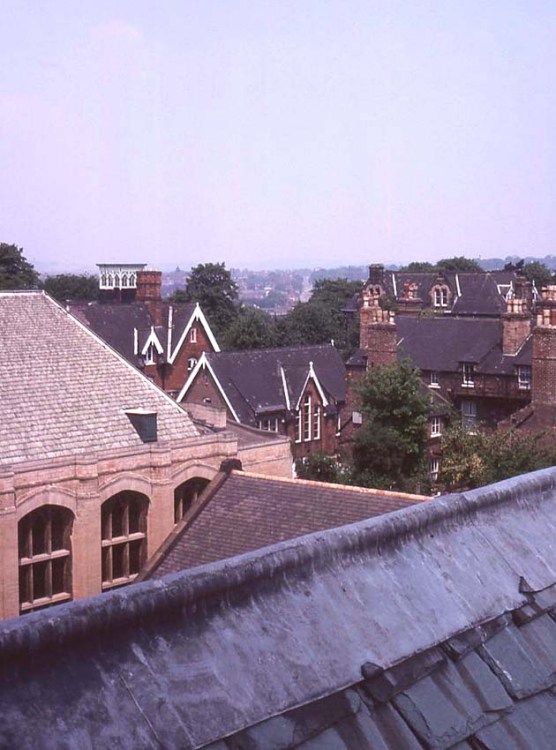
The photograph below I took around 1976. It was taken from the corridor which ran down towards the then E13, and you can see the roof of the Old Gymnasium and the Assembly Hall, sometimes called the Player Hall. Directly behind that are the two buildings of Brincliffe. To help you identify them, they both have gables picked out in bright white……..
15 Comments

Filed under Football, History, Humour, Nottingham, Politics, The High School

My Dad’s cars (3)

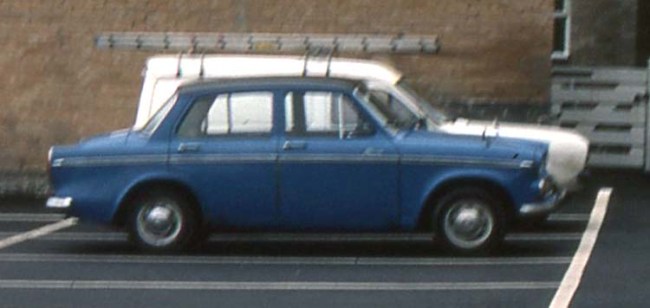
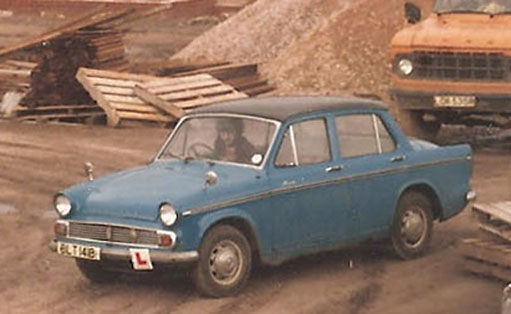
I have already told you about the love of my Dad’s motoring life, his Hillman Minx De Luxe, Registration Number BLT 141B. He gave it to me after he retired, and I had it for about two or  three years. Here is a picture of it in the car park of the old Savoy Hotel in 1980, on our wedding day. That’s why the picture’s so shaky:

Here I am driving this 1964 car, as it gradually began to get rustier and rustier :photo 4

It was in this Hillman Minx that, back in 1968, Fred was returning from Wigan down the M6, when, because the motorway was still in the throes of construction, he failed to see the tiny hand-painted direction signs, and finished up in a building site in Birmingham, having missed his turn off in Stoke-on-Trent. That sounds incredible, but he’d never been on  a motorway before. Wigan is a town in Lancashire and is indicated by the Orange Arrow. My Mum’s parents lived there. The other towns and cities are in capital letters. Fred was aiming at Burton-on-Trent near Derby, which is south east of Stoke:

He was driving the same car in Leicester (south east of Derby) when he got lost and was forced to ask a policeman the way. Realising that he was dealing with somebody from out-of-town, this eminently sensible officer told Fred to avoid a rather horrific one-way system by driving fifty yards the wrong way down a one way street, while he promised to turn a blind eye to the whole thing.

It was again in this very same Hillman Minx that, three years later, Fred again missed his way in that very same city of Leicester, and went the wrong way up another one way street. Instead of being able to solve the problem by the previous method, however, Fred was forced on this second occasion to extricate himself from the situation by executing a three point turn in the face of a rapidly advancing four lanes of densely packed vehicles.

I have vague memories too, of getting lost as we went on holiday for the first time to the Yorkshire coast at either Bridlington or Scarborough. We stopped at, I think, Pontefract, somewhere near a power station, to ask the way.

The man that Fred approached spoke with an accent which was completely incomprehensible, and after a few frustrated minutes, Fred just drove off at top speed, angrily spinning the wheels on his rather sedate family saloon. At the time, he insisted that, against all the apparent mathematical odds, he had managed to find the local village idiot at his very first attempt.

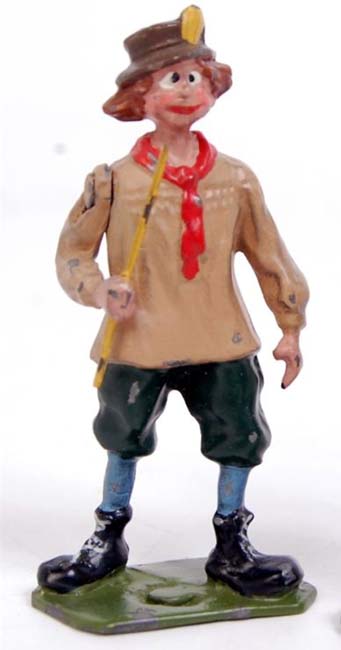
Incidentally, above, you can see the Britain’s Lead Soldier version of the village idiot which usually reaches £200 at auction.

Nowadays, I think, in calm retrospect, that the man’s Yorkshire accent may well have been beyond us. It is difficult, though, even to best guess the location of these events. Perhaps it was near the huge power station at Ferrybridge where the A64 to the east coast Yorkshire holiday resorts left the main A1 trunk road, as it would have been at that time. The power station was demolished a long time ago:

Whenever Fred left his car anywhere unfamiliar, such as when he was away on holiday, or for any length of time in his own local area, he would always immobilise it by removing part of the carburettor . On occasion, Fred would even immobilize the car when he parked it on his own drive. It was years after his death that I realized that in this apparently bizarre zeal for crime prevention, Fred was only carrying out the orders that he would have been given in the early part of World War Two, in 1939-1940, when it was a serious criminal offence to leave a vehicle without totally immobilising it. There was a very real fear of imminent invasion, and the arrival of Nazi paratroopers, many of them disguised as nuns. And even in 1975, the Soviet Spetsnaz forces would have drunk a bottle of vodka each in celebration to have found such a fast and classy vehicle as a 1964 Hillman Minx. Here’s their badge in case your car is ever stolen. Spetsnaz are everywhere:

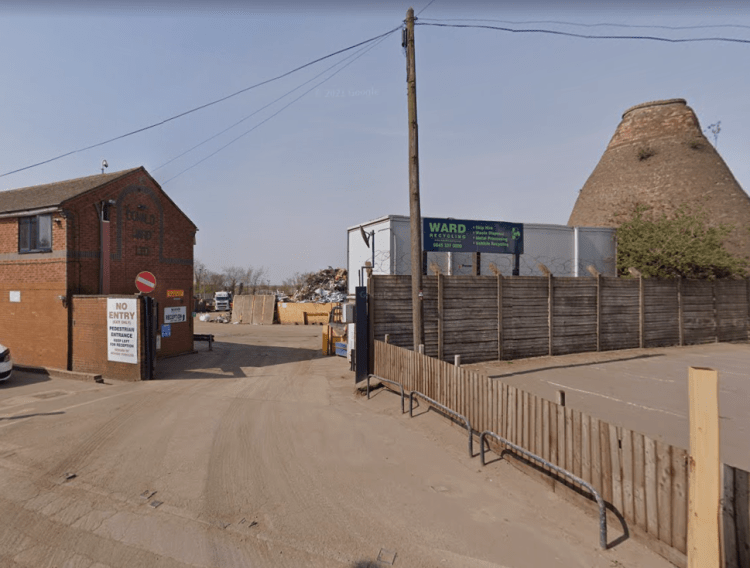
This Hillman Minx was THE car of Fred’s life. He had it for more than sixteen years, before, around 1980, he passed it on to me as a newly qualified driver. I in my turn used the car until it failed its MOT test by a very wide margin, some £300 when my annual salary was £500. I then duly drove it back from Nottingham to Woodville, where my family lived. Fred was then able to drive “that Hillman” as he always called it, on its last ever journey, the short distance from 9 Hartshorne Road to Donald Ward’s scrapyard in Moira Road. Here it is, complete with Victorian bottle kiln:

16 Comments

Filed under History, Humour, my Dad, My House, Nottingham, Personal, Russia

Stories about my Dad (3)

In 1946, my Dad, Fred,  gave up his exciting job as a Brylcreem Boy of Bomber Command and signed up to be for what was called at the time “emergency training” as a teacher. It has always intrigued me as to how many veterans of Bomber Command became teachers. And I have my own ideas about that! Fred finished up getting a job quite near to his home, at a school in Hastings Road in Church Gresley. The school was built in 1898 for 420 children. Fred taught there until the mid-1950s.

Here’s a modern map of the area. The Orange Arrow points to where Hastings Road School used to stand before it had to be demolished in the late 1950s, lest the subsidence problems made it collapse completely with the teachers and children inside :

When my Dad, Fred, worked there, the vast majority of the children were the sons and daughters of miners, both of coal and of clay. They were all what you would call “rough diamonds”.

Most of them, therefore, were far from sophisticated, either in their knowledge or their behaviour or, indeed, their hygiene. Fred used to tell the story of having a boy in his class called “Stinky Roberts” . At the beginning of the school year, Fred was given the helpful advice by his colleagues never to let this particular boy sit next to a hot radiator under any circumstances. If he sits next to a radiator, then make him move!

Whether it was because Fred did not believe the other teachers, or whether it was because, in the absence of any particularly obvious hygiene problem, he quite simply forgot their advice, remains unclear.  But on one unfortunate day, when “Stinky” did get to sit by that scorching radiator, the wisdom of his colleagues became manifest, as the unbelievable stench of long unwashed filth and ancient, uncontrolled urine wafted inescapably around the room. In this way, Fred learnt one of the most important basics of teaching, namely that no boy is ever given a nickname without very good reason.

At one point, Fred had a bet with another teacher that he could leave his class working quietly while he went down to Lloyds Bank in Swadlincote to draw out some money. The pupils were told to behave themselves properly while he was away, and to continue with their work. This they duly did, and Fred won the bet.

In another variation of what was obviously the same story, Fred did not go down to the bank in Swadlincote, but instead, went to post a letter at the Church Gresley Post Office, a destination considerably nearer to Hastings Road School, and, from the point of view of unsupervised children, a much shorter, and therefore, perhaps, a more plausible time to be away.

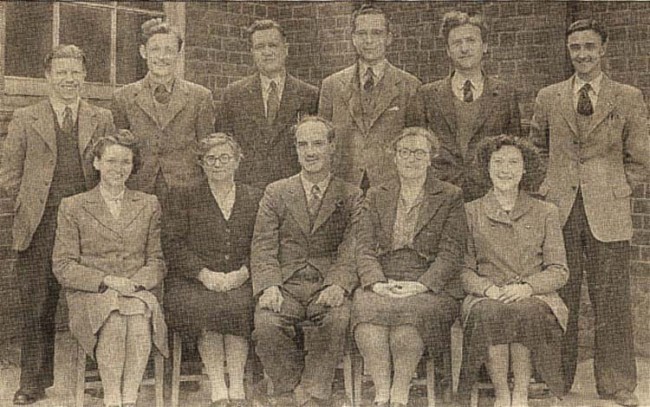
One of Fred’s more pleasant jobs was the fact that he ran the school football team. He was partnered in this by his young friend, Vernon Langford. We do actually have a misty photograph of the staff at Hastings Road. Here it is :

The teachers are (back row), Mr Morris, Mr Roberts, Mr Baker, Mr Picker, Mr Goodall and Mr Knifton. The front row comprises Miss Rowe, Miss Smith, Mr Handford, Mrs Errington and Mrs P Middleton.

Fred’s teaching career at Hastings Road reached its pinnacle when he was conducting a lesson in Physics. At this time all secondary school teachers, even those who were trained to teach Geography, were expected to be able to turn their hand to more or less anything.

Fred’s brief was to demonstrate the effects of air pressure, so he took a pint glass, filled it with water, and then put a sheet of card over the top. He then explained that in a moment, when he turned the glass upside down, the contents would not spill out, because the air pressure on the card, which was equal to hundreds of pounds, was pressing down and keeping it in place. This news was received by the children, of course, with immense scepticism.

When Fred turned the glass over, however, perhaps as much to his surprise as anybody else’s, the rather unlikely result was that the card did actually stay in place, and the water did not spill out. The children’s reaction was astonishing. They were all totally amazed. One boy stood up, and shouted at the top of his voice, “A miracle ! A miracle ! Mester Knifton’s worked a miracle ! ” And then he ran out of the room and around the school, still shouting

“A miracle ! A miracle ! Mester Knifton’s worked a miracle ! ”

I believe that this incident was the closest that Fred ever came to being regarded as divine. Here’s a video of a mere mortal man trying out this trick:

23 Comments

Filed under Aviation, Bomber Command, History, Humour, my Dad, Personal, Science