Tag Archives: Prisoner of War

What would you do ? (18) The Solution

“What would you do ?” used to figure on the cover of a boys’ comic called “Boys’ World”. This was a publication, obviously, aimed at boys, and first appeared on January 26th 1963. There were 89 issues before the comic was merged with Eagle in 1964. The last issue of “Boys’ World” came out on October 3rd 1964.

I used to buy “Boys’ World”, and this was mainly for the front cover which always featured a kind of puzzle. It was called “What would you do ?” and was based on somebody being in what Ned Flanders would call “A dilly of a pickle”. Here’s the situation:

And the problem was:

The correct solution was always given inside the comic, in this case on page 2.  Here it is :

And just in case you wondered, here is the whole of pages 2 and 3 :

And what about the clue? Well, if you look very carefully at the front cover, there are large quantities of lemons hanging on the trees, both behind the Orange Box, and to the right of the sentry tower.

In actual fact, this is a rather strange clue to have. Hardly any German POW camps  were in locations where lemon trees grew. For example, the POW camps of Italy were staffed by Italian troops  until September 1943 when they surrendered. Many Allied prisoners took the opportunity to leave their camp and walk south to the Allied lines. The vast majority, though, obeyed their orders from London which said, basically,  “Sit tight and we will come and get you.” Within a couple of weeks, the Germans arrived and moved every single Allied prisoner to Germany, many of them as slave labour. Some of them finished up in a POW camp from where they had a grandstand view of the daily workings of the Auschwitz-Birkenau death camp. You can read all about this in “Spectator in Hell” by Colin Rushton. Many of these spectators were Nottingham men, captured when the Sherwood Foresters surrendered at Tobruk. In my researches, I discovered that one of them may have been John Arthur Finking, the son of a factory manager from 5 Selby Road in West Bridgford, and an Old Boy of Nottingham High School. John would be murdered by his captors as they marched all of their prisoners westwards to escape the Red Army in the snowy depths of the savage 1944-1945 winter.

Finally, there were no POW camps in the Balkans as far as I am aware or in Greece. This was because any escaper might well have been helped by the local people.

The main  criteria for the location of POW camps was (1) in Germany, surrounded by hostile civilians (2) if possible, on sandy or very light soil, so tunneling was difficult. This latter point was the reason that so many camps were located in what is now Poland, where the pine forests were gigantic, difficult to navigate in and devoid of any sympathetic locals, as those areas were then part of Germany. The soil was also extremely sandy. Finally, all of the POWcamps were as far to the east as possible, so that anybody who did escape had a very long walk to the west, and therefore a much greater chance of being spotted.
 

14 Comments

Filed under History, military

A nice German in Woodville

I have been friends with Chris since we went to Woodville Junior School when we were seven years old, almost sixty years of friendship:

He recently told me the following story. It fits in so well with my previous two posts on this subject of Germans and/or Nazis in Woodville that I would like to include it here. I have kept to Chris’ original words:

“A few years ago my mother told me the story of an event during the Second World War.

One day she came home from work to find a German Prisoner of War in the living-room drinking tea.

My grandfather introduced him as “Gerard”. I imagine his name was actually Gerhardt. My grandfather had met Gerhardt walking up the railway line from Ensor’s brickyard where apparently he was working. (I was not aware that POWs could be required to work for what was to them the enemy but your blog entry confirms that they did.)

“Gerhardt was on his way to Woodville Tollgate to wait for the transport back to the camp, which I think was near Etwall, and given that he had almost two hours to wait, my grandfather invited him in for tea. My mother was horrified since she thought that it was probably illegal to have an enemy POW in the house  – fraternising with the enemy and all that.”

“It transpired that Gerhardt’s ‘plane had been shot down; he and most of the crew bailed out before it crashed. From what I gather, Gerhardt was a reluctant combatant and was quite relieved to be hors de combat. He obviously spoke English, since none of my family spoke German, so he must have been relatively well-educated.”

In any event, Gerhardt finished his tea and went on his way. They never saw him again.

I wish my mother had told me this story years ago because I would have tried to find Gerhardt and see what happened to him subsequently.”

It is by no means beyond the realms of possibility that Chris might have found Gerhardt. If he was born between 1910-1920, he may have lasted beyond the Year 2000. My own Dad was in the RAF in 1941, around twenty years old, and he lasted until 2003 when he died aged 80.

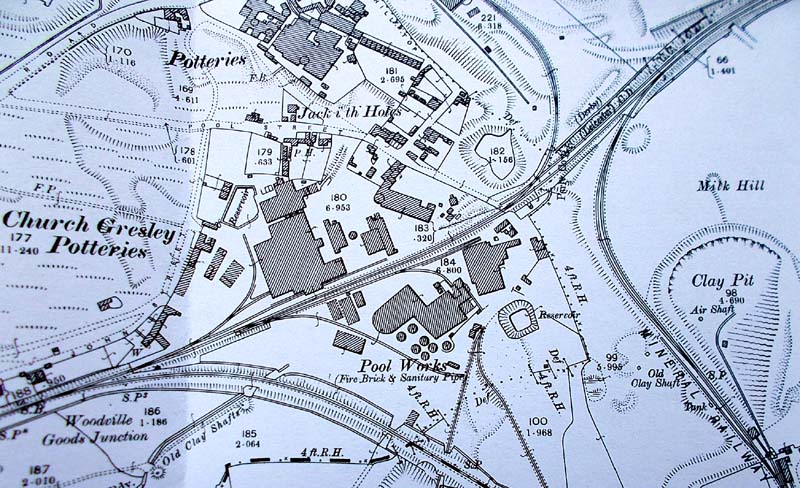
Ensor’s brickworks is long gone, but here is the Victorian nineteenth century map of the area :

The railway whose course Gerhardt was following runs from bottom left to top right and Ensor’s Pool Works is just to the south of the middle of the railway. Gerhardt would have been walking to the north east along the railway.

My friends and I all played in that extremely dangerous industrial area from, say 1962-1968, although by then the Pool Works had been demolished. We did play on the majestic slopes of “Milk Hill” though, which was an enormous pile of clay, made from, I presume, several million tons of the sticky stuff. You can see “Milk Hill” in the middle of the right hand side of the map. And we went down into the clay pit as well, which was even more dangerous, because of the lakes of wet clay with a deceptive thin dry crust on top. And if there was one “air shaft”, there would have been more. Still, just like many boys, and indeed fully grown men, (if there is such a thing) “Danger is my middle name”.

At the middle of the top of the map is “Jack i’ th’ Holes” which is a very strange name and, to me, has supernatural connotations, Jack very often referring to Satan himself.

On the map the seven  little  circles in the Pool Works are circular kilns. Here is a picture taken in the Pool Works showing some of them. When he left school, my Dad, Fred, aged then only thirteen or fourteen, worked as a junior in the offices at Ensor’s Pool Works. He is standing to the right of the man with the shovel. Notice how two men have climbed one of the kilns to be in the photograph :

In later years, Fred was not the only person to be disgusted that Freckleton, the son of the business’ owner, was to remain at home throughout the Second World War, hiding his cowardice behind the spurious claim that his job was a reserved occupation. It wasn’t.

Some time before the outbreak of the war, Fred was to witness an incident when a workman, for some unknown reason, had hit Freckleton hard in the face, and knocked him backwards into a puddle. Freckleton was drenched with muddy water and his magnificent suit was ruined.

Needless to say, the workman was dismissed on the spot, and, given the connections which existed between factory owners at this time and were renewed every time there was a Freemasons’ meeting, he was unable to find work anywhere in South Derbyshire ever again.

Incidentally, I did a little research about the location of the Prisoner of War camp, and found that there were a number in the area, along the side of the River Trent, where digging tunnels was more likely to result in death by drowning than freedom. Sites included the Weston Camp in Weston-on-Trent (top right), but the likeliest site for Gerhardt, in my opinion, was the section of Weston Camp in King’s Newton. Here’s the Orange Arrow, Herr Orange Pfeil, released early for good behaviour. Woodville is bottom left:

It’s funny looking at that map, which is perhaps ten miles square. I spent all of my life until I was eighteen in Woodville, yet I’ve never ever been to Twyford or Ingleby or King’s Newton or Newbold or Coleorton or Heath End. I was once on a bus going through Peggs Green, and it was so countrified that when an old lady that the driver expected to be at the bus stop wasn’t there to catch the bus, he went and knocked on her door to tell her to hurry up, or he’d have to leave her.

33 Comments

Filed under Bomber Command, History, Personal, Politics