
Last time, I had told the story of how the three Polish whizz kid mathematicians, Marian Rejewski, Jery Rozycki and Henryk Zygalski, had told the British and the French, everything they had discovered about Enigma. The stories all came from the book by John Jackson which relates the story of Enigma, the German encrypting machine used throughout the entire Second World War…..

From these Polish beginnings, many, many aspects of the war were affected….. for the better. There was, however, a Golden Rule always in operation.
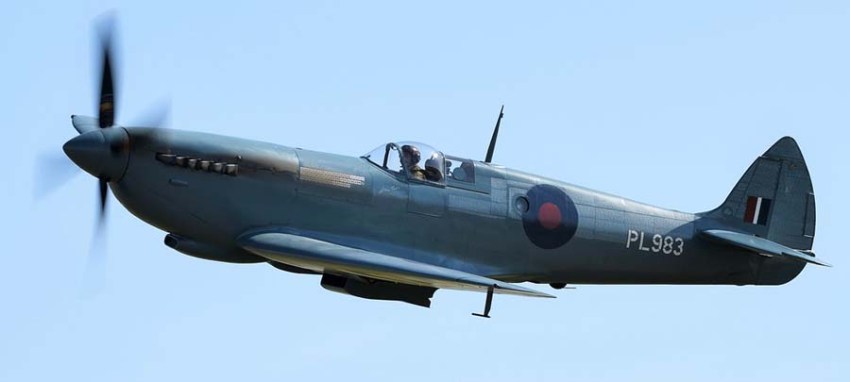
If the only information about a future event came from Enigma, then other sources had to be created as well. The rule resulted, for example, in a lot of photo-reconnaissance aircraft being sent to take photographs of a place already mentioned by the Enigma decrypt and which was going to be bombed The pilot was always told to fly the aircraft around a lot of other nearby places as well, and to make it look as if the trip was completely routine. Here is a photo-reconnaissance Spitfire. They were usually entirely blue, although I’m sure that they were also painted pink, a colour which was frequently nicknamed in North Africa especially, “Mountbatten pink”:
Mosquitoes were also used, especially for the longer trips:

If Enigma was the only source of a piece of information, of course, then any action taken by the British would prove to the Germans that the code had been cracked. For this reason, if there was only one source of information, and that was Enigma decrypts, then no action was taken.
The system worked so well that right until the very end of the war, the Germans continued to believe that Enigma was uncrackable and that only they had the secret of deciphering it.
In May 1941, Enigma was able to tell the Royal Navy the whereabouts of all the supply ships that were servicing the Bismarck. They also ascertained that the Bismarck was headed to France, not Germany, after a particular phase of the battle. Here’s the German “Pocket Battleship of the Month”:

The Bismarck was one of my very few Airfix ships kits. That and HMS Tiger, a Royal Navy destroyer. The way this piece of informnation from Enigma worked was that the ships carrying fuel and ammunition were all sunk, and so too was any other ship carrying supplies that added to the Bismarck’s capabilities as a ship destroyer. Supply ships carrying records, newspapers, and a change of library books were all left alone, as were the ships carrying food and drink.
On November 1940, a major air-raid might have been opposed more thoroughly if the people at the top had used their brains and guessed which city in England was being referred to in a mildly encoded sequence of the names of cities about to be bombed back into the Stone Age………..
For example…..
“LOge” was “LOndon”
Do you see how it works? Nothing particularly Enigma-inspired at this point. The first two letters give it away. So, what was “BRuder” ?
No, it wasn’t Brisbane, or Brighton & Hove or Bradford. It was…..
“BRistol”
So, now, what was “BIld”
No, it wasn’t Bicester, or Bishop Auckland or Bilston. It was…….
“BIrmingham”
So, a more difficult one, now. A city with its own name in German. And it’s actually easier than you might think. If the Air Vice Marshall had taken his road atlas out of his bag, he would have realised that, of the 1, 165 cities, towns and villages of Great Britain, not a single one begins “Ko-“.
And no, “Konchester” is not the German for “Manchester”, and “Korwich” is not the German for “Norwich”.
The correct answer is…..
“KOventry”
The only city of the four with its own name in German. The city was flattened……
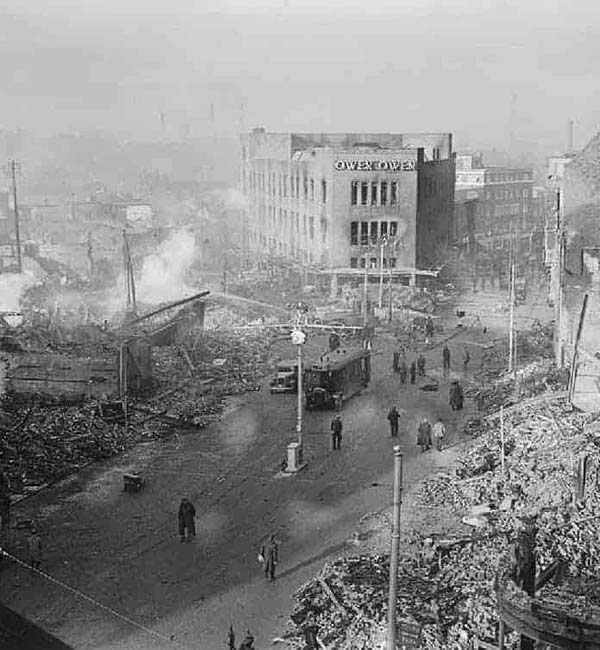
…..especially the cathedral……

In March-April 1941, Enigma revealed that Crete was to be invaded from the air, in the glider towing and troop carrying aircraft that the Germans had been assembling in Bulgaria and Greece for some time now. It was easy enough to pass off the information the British possessed as the product of the hundreds of spies in every city in this part of the world. The German paratroopers were called “Fallschirmjäger” and they wore helmets and smocks which were different from the uniform of the Wehrmacht……..
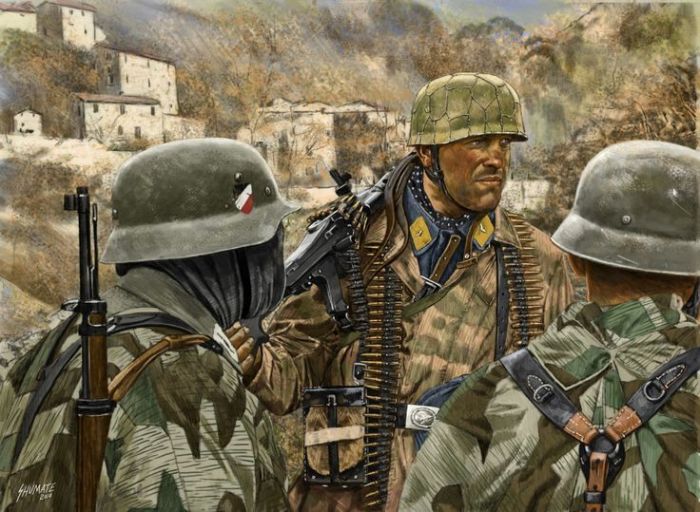
Preparations were made to give the German paratroopers a warm welcome, and as a result of the fierce resistance from both Allied forces and civilian Cretan locals, the invasion force suffered heavy casualties. Hitler then forbade further operations of this type for the rest of the war. Here they are in action……..

Overall, nearly 4,000 German paratroopers were killed.
In June 1941, the Germans invaded the Soviet Union. Stalin had been told time and time again by the British, the Americans and the Japanese that this was going to happen but he thought it was all some vast capitalist plot to upset his non-aggression pact with that nice man Hitler.
For Churchill, it had all become much likelier as a forecast when a series of Enigma decrypts revealed that three Panzer divisions had been moved to the Polish frontier, next to the Russian held zone of Poland. Overall, Churchill thought that Stalin and his Sycophants were…..
“the most completely outwitted bunglers of the Second World War.”
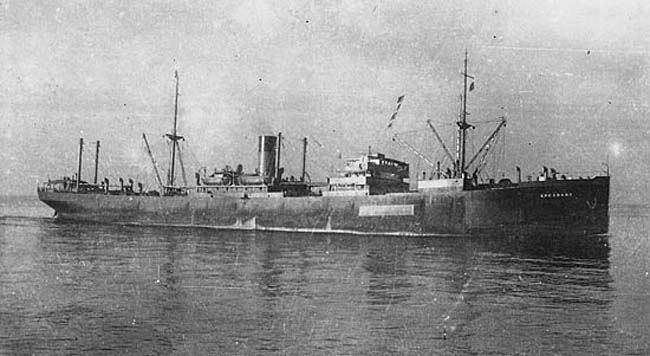
In August 1941, the RAF and the Royal Navy were told all about the German supply ships which were transporting whatever Rommel required for the war in North Africa across the Mediterranean. Such precision made it easy to target and sink the oil tankers, the petrol carriers and the ammunition/weapons ships, even if that meant letting through the odd ship carrying savoury sausages or bottles of schnapps or a further change of library books for everybody. Ultimately. by supplying this kind of information, Enigma would make victory in the Battle of El Alamein a great deal more likely.
Here’s the ship with the library books:






 John Knifton