
The colour and texture of a fox’s coat may vary due to the change in seasons. It will be richer and denser in the colder months and lighter in the warmer months. To get rid of the dense winter coat, foxes moult once a year around April. The moult begins from the feet, up the legs, and then along the back, finishing with the neck and head.
Widdle was a fox who came to us, apparently around two years old, one day in 2007. He was looking for affection and for help. He came to us from a desire to understand nice human beings, and most of all, for unlimited access to good quality sausages:

Over the three to four years that we knew Widdle, his appearance changed a great deal. He was certainly not always what our American friends call a “red fox”, because in the spring and summer months, he was the hapless victim of his single annual moult.

According to Wikipedia, quoted above, a fox’s moult “begins from the feet, up the legs, and then along the back”. Sometimes in June, in the middle of the moult, Widdle looked rather like he’d been down to the pub the night before, and had a few too many:

In May, he had tried stretching exercises, but that didn’t last long:
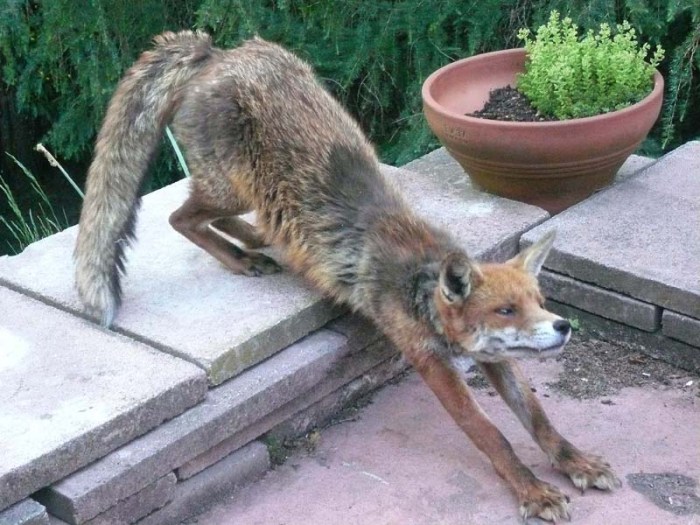
No, the only remedy is a couple of sausages. Or so we thought. It was actually more complicated than that.
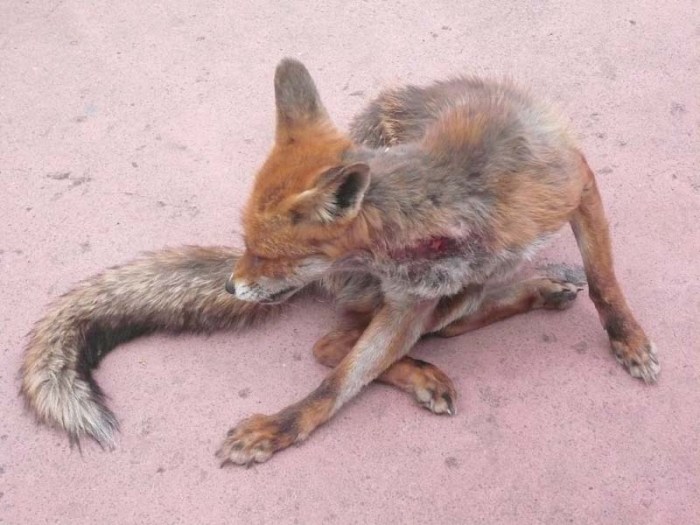
Widdle’s main problem with his coat was fleas, particularly during the moult. Here he is, scratching away. As far as we were aware, it was impossible for humans to be infected by fox fleas, and in up to four years with him, we never thought we had. I did once inquire about trying to give him something against fleas, but we were told it was pointless. Something for a dog and its fleas probably wouldn’t work. It might give him an allergic reaction and kill him. And, as soon as he went back to Mrs Widdle, he would be re-infected:

Male foxes fight quite a lot and here he is with part of his coat ripped off, I remember saying to him “That look’s a very painful wound.”, and he said “Well, you should have seen the other fella’.”
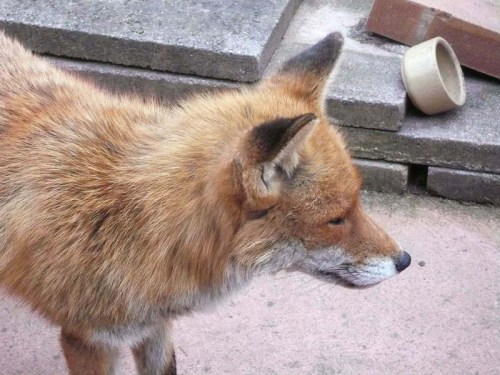
By winter, though, Widdle has acquired that magnificent coat that we all know and love. In this photograph, he shows that certainly as far as he is concerned, the neck is the last section to change.
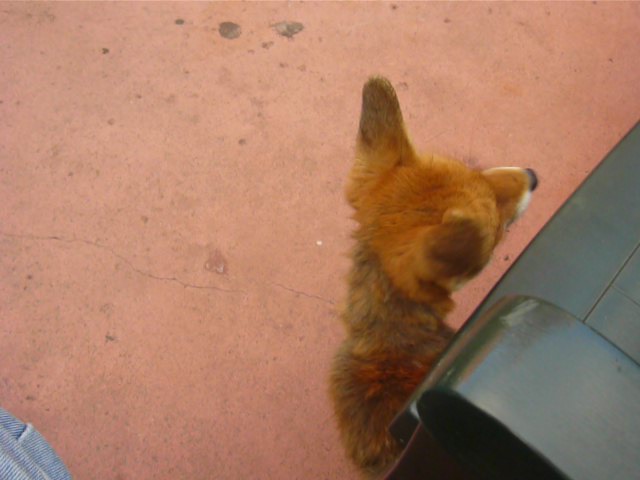
Anyway, by early September, the transformation is complete. All that is missing is the white tip to his tail, which, as far as I recall, Widdle never had. Well, not in full anyway:

And certainly, by November, it is as if he had been spray painted “fox-red”. He has lost all the black bits on his legs and the black and white stripes on the upper sides of his paws. He is Red Red Red:
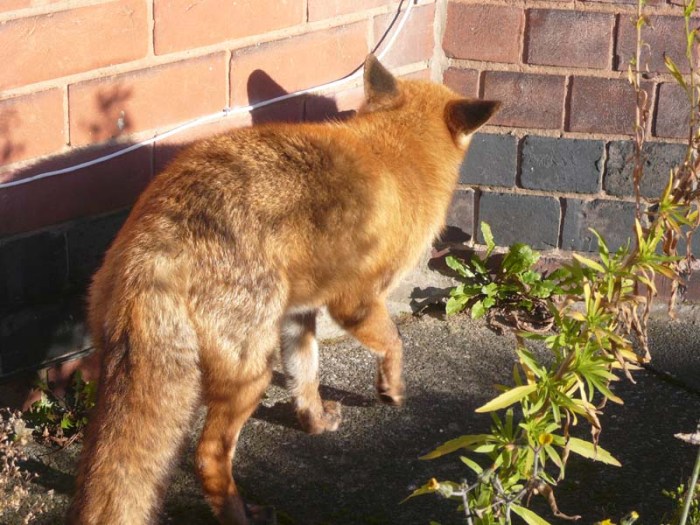
The last picture comes from April 2010 when the very first signs of the Great Itching Time are beginning to appear. Even so, the coat still looks exceptionally thick and is standing on end to trap the warm air:



 John Knifton