Tag Archives: yeti

Goose Fair (4)

Before the sudden advent of the huge electric amusement machines around 1900, exotic animals were a firm favourite of the Goose Fair hordes………

The big problem, of course, was the fact that, in the desire to exhibit the most unusual animals, the owners of the animals would often end up by going to an animal market and buying a creature that they themselves could not identify. So sit back and enjoy my own attempts to work out what the unknown animal really was………

Let’s start with……..

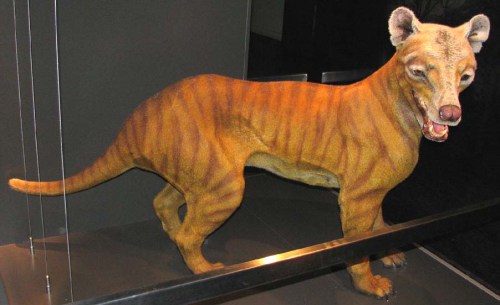
Tiger Wolves direct from the Black Rocks of Abyssinia”. These were shown in Day’s “No 1 Royal Menagerie” in 1898 as a “Group of Wild and ferocious Tiger Wolves direct from the Black Rocks of Abyssinia”. Alongside them was a group of Baby Lions”.

There are wolves in Ethiopia, but they are red, so much so that they are also called “the Simien fox or Simien jackal or horse jackal”. Intriguingly, at this time, the name “Tiger-Wolf” was the accepted shortened form of “Tasmanian Tiger-Wolf”. This phrase was used to refer to the Thylacine, an unbelievably rare Australian animal to turn up in a fair in Nottingham. I really do wonder what these animals were!
A slightly less colourful one:

I think you’re getting the idea…..

Day’s “No 1 Royal Menagerie” also had “Blonko Bill, King of the Lion Tamers” working for them.” I have been unable to trace the meaning of “blonko”, although if ever a word sounded like Australian slang, this is it! The internet was no help. One site said it meant “kind, entertaining, handsome”, another said it meant “fat, fat, fat”.

In 1899, Bostock & Wombwell produced a special poster listing all of their animals, including the “Great Pongo Baboon, or Hairy Wild Man”. Intriguingly, “Pongo” is the scientific name for the orangutan, thought to be a close relative of Bigfoot, hence the “Hairy Wild Man” epithet:

This slideshow requires JavaScript.


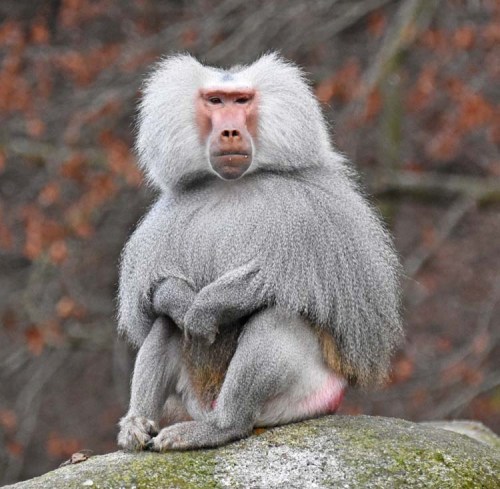
Another strange sounding animal on the Bostock & Wombwell poster was the “Hamadryas, or Sacred Baboon” although, ironically, it is very simple. The poster is referring to the Hamadryas Baboon from the Horn of Africa and the southwestern region of the Arabian Peninsula. You can just see the side of his bright scarlet posterior……
The same owners had a “Chiropottamus, or Vlacko-Vark” which is merely a sort of wild pig. It may be the Red River Hog, “a wild member of the pig family living in the Guinean and Congolian forests. Here’s the old Brooke Bond tea card from the “Wild Animals of Africa” collection….
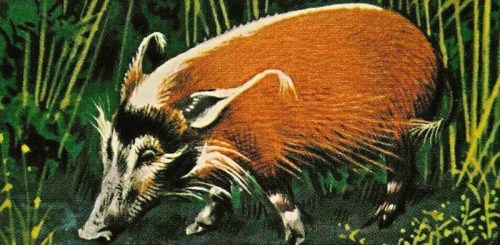
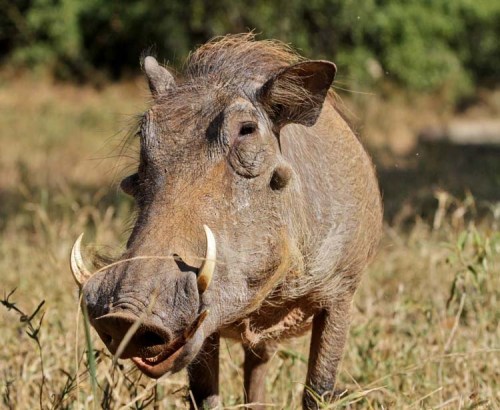
Alternatively, it may be the warthog which is the “vlakvark” in Afrikaans…..
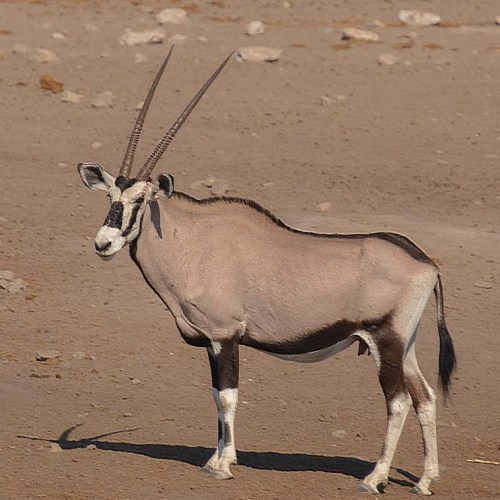
A “Leucoryx Antelope” sounds a very strange beast but it is also called the “Gemsboc” on the poster. And the “Gemsboc is the gemsbok, gemsbuck or South African oryx, native to the arid regions of Southern Africa, such as the Kalahari Desert. It is a very beautiful animal….
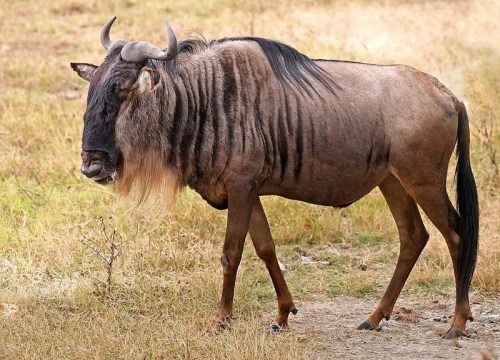
The “Brindled Gnu, or Horned Horse” is a lot easier, because we have all seen this strange word. Not totally unexpectedly, the Brindled Gnu is the blue wildebeest, also called the common wildebeest, the white-bearded wildebeest or the white-bearded gnu. It is one of the two species of wildebeest…..
The Bostock & Wombwell poster advertises a “White Silken Sacred Yak” which would have been a pure white yak. Nowadays, some 5% of the herds are white. They are regarded as an extremely auspicious animal since white represents light, a personification of the illumination of wisdom and the universal Buddha……

Some animals are very easy to sort out.

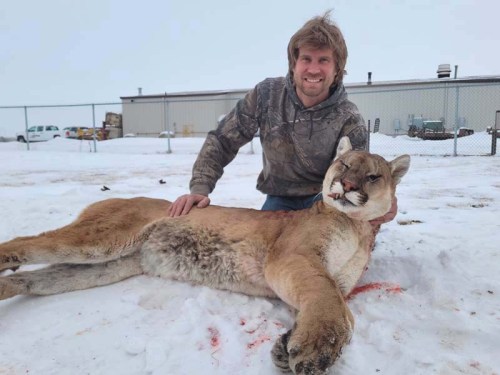
A “Puma or Silver Lion” was presumably a North American mountain lion, cougar or puma. Here’s a lovely picture of one of the first ever mountain lions to be found in North Dakota…..
A “Jaguar or Clouded Tiger” is nowadays called a “jaguar” or a “clouded leopard”……

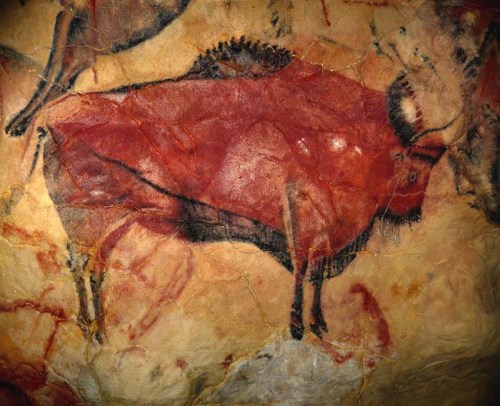
A “Bison, or Wild Prairie Bull” is most probably the North American bison…..
A “Monstre Nennock” sounds incomprehensible, but the alternate names give it away, with “Arctic Sea Bear” making it the polar bear. It would be nice to know what a nennock is, though. Incidentally, I’ve just turned my slides into digital photographs, photoshopped them to make them a little lighter and got rid of the hairs and general dirt. So, here is a nennock or two at Basel Zoo in Switzerland in 1979….

Two final animals though, are most intriguing. Just what were the “Hideous Aswaila”, or “Himalayan Monsters”? Were they a family group of yetis? I bet they were, but the people of the time did not know what yeti was…….

And last of all. What on earth were “Lorenzo’s Performing and Talking Bears”? Were they a family group of Bigfoots? Using their famous “Samurai Chatter” to pass comment about Nottingham and its inhabitants? Here’s a youtube video, and if you move swiftly to 4 minutes exactly, you’ll hear what “Samurai Chatter” is. At 4.40, you can hear the Bigfoot walking around the cabin. It’s really scary!
17 Comments

Filed under Africa, Cryptozoology, History, Humour, Nottingham, Science, Wildlife and Nature

The School Leprechaun

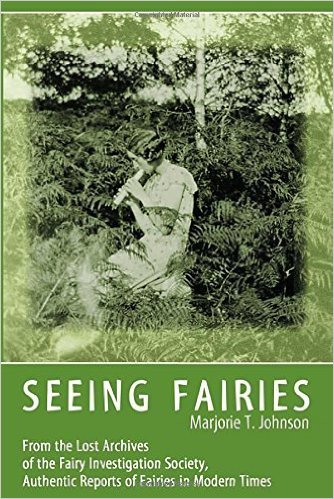
After reading all about gnomes, elves, pixies, fairies and such like, it should come as no surprise to hear that Wollaton is not the only place around Nottingham to have played host to fairies in recent times. Marjorie Johnson, the lady who saw fairies in her garden in Carlton was to become very famous in fairy circles. She wrote this best selling book:

fairy book

Here is a link to an account of fairies she saw in Nottingham, in Carlton to be more precise.

Belief in fairies persists still, even in our own time. When we went once to an isolated farm at Constantine in Cornwall, the farmer clearly believed that the huge ruined megalith in his bottom field was the home to fairy folk. He had seen their fairy lights on more than one occasion.

It is in Iceland that gnomes and fairies are taken most seriously. Over a half of Icelanders believe that these tiny entities are, at the very least, “possible”. They are thought to be from another dimension, usually making their homes inside huge boulders and outcrops of rock.

Known as huldufólk these beings are not regarded as trivial. Roads can be redirected on their behalf.

This report by Journeyman starts off in almost comic fashion, but does make some quite serious points:

This film by Torsten Scholl, aka “hatcast” has even more serious points to make:

This account by Richard Williams aka “rockuvages” is of the moment when the huldufólk seem to pop out of their own dimension:

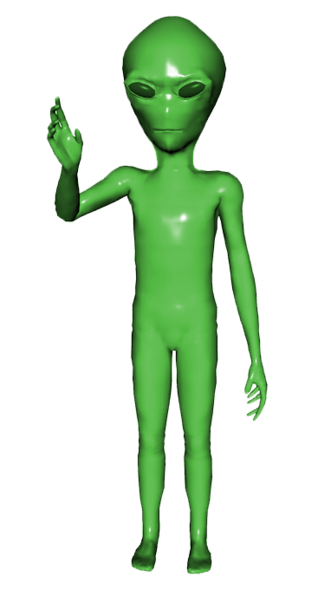
Nowadays, we tend to see fairies and their like as something lovely and wonderful. This attitude has only come about since Peter Pan and Tinkerbell. Before that, fairies were considered by those who had regular contact with them to be malevolent beings who, if they were in any way annoyed, would readily kidnap adults, willingly do harm to them and, most of all, steal their babies, replacing them with changelings. This is why nowadays a lot of modern folklorists tend to equate ancient beliefs in fairies, with our current fondness for space aliens and little green men, who have continued in modern times to carry out all of these evil deeds:

green alien

Tales of fairies invariably involve abduction and poor innocent people forced to remain in Fairy Land, sometimes for ever. What difference is there between malevolent fairies holding people hostage in their realm and our modern tales of extra-terrestrial kidnap?

Other parallels are there. Some types of fairies, such as leprechauns and goblins, have green as their favourite colour, just as some aliens are literally “little green men”. Only medical experiments seem to be absent from the connections between the two groups, perhaps because in sixteenth and seventeenth century Ireland or Cornwall, there was no health care available and advanced medicine was not a subject on anybody’s mind. Only ointments and magic potions were on offer back then, and these simple remedies do figure from time to time in the more ancient tales of fairies.

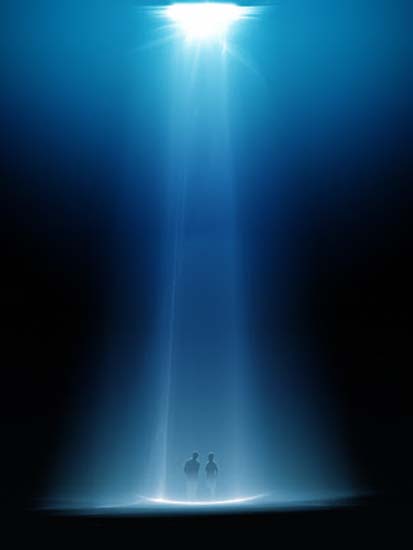
Here is something more modern, a tractor beam, although some would argue that those fairy lights, leading innocent people out onto the marsh to drown or be abducted, did pretty much the same job:

uftgyu
This modern cartoon by “grackle” sums up best our ancient knowledge of fairies, who were by no means the magnanimous and well intentioned Peter Pan heroes of Walt Disney’s world.

Certainly, the Cornish and the Irish, for example, seem to view “piskies” or “the little people” as, at best, potentially tricky and at worst possibly, evil, and similar figures are met with in every human culture across the globe.

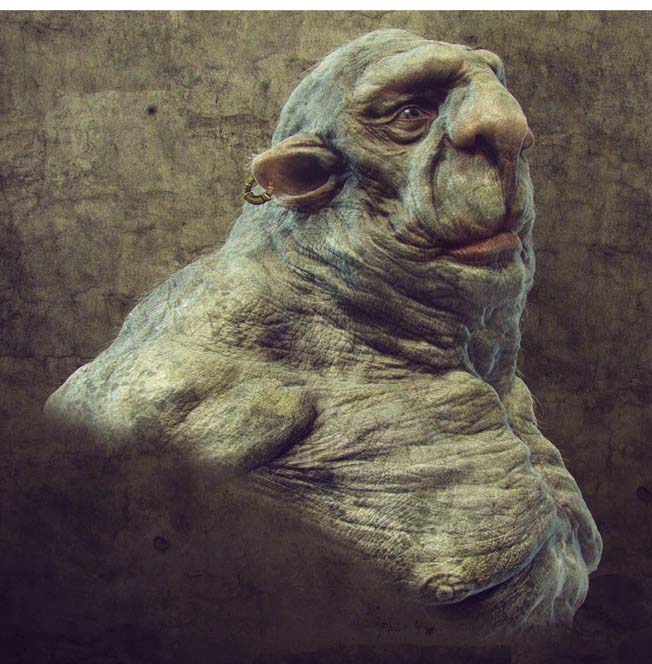
In North America, there are Ishigaq (Inuits), Jogahoh (Iroquois), Nimerigar (Shoshone) and the Yunwi Tsundi (Cherokee). In Hawaii, there are the Menehune, and for the Maoris, the Patupaiarehe. In Europe, there is a host of names such as the Brownies, the Kobolds in Germany, GoblinsGremlins, Pixies, Leprechauns and the Swedish “Di sma undar jordi”, who are clearly almost identical with the huldufólk of Iceland:

307228-mythical-creatures-troll

Let’s finish with a quite extraordinary piece of film.

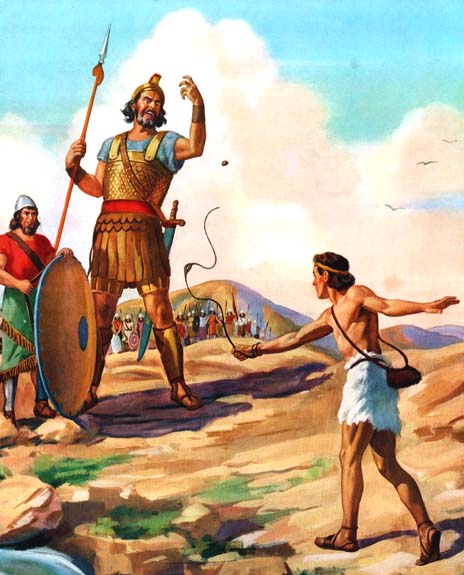
All over the world, of course, as well as “the little people”  there are the enormously large people. In Nepal, the “yeti”, in North America, “Bigfoot”, in Western Europe “the Wildman” or “Wodewose”. In Iraq, he was represented by “Enkidu” the companion of Gilgamesh. In Israel, he was “Goliath” whom David slew:

golithyuj

In Australia, the enormously large person is called the “Yowie” and he is very fierce indeed.

The huge Yowie, though, has a tiny equivalent. To the white man he is “Brown Jack” but to the blackfella he is the “Junjudee”. He is tiny and here is a purported film of one:

Any film by TheRusty222 is well worth watching. He tries to film Yowies but most of all, he ventures deep into the realm of the thickest parts of the Australian bush, an environment of staggering beauty if you ever watch one of his films.
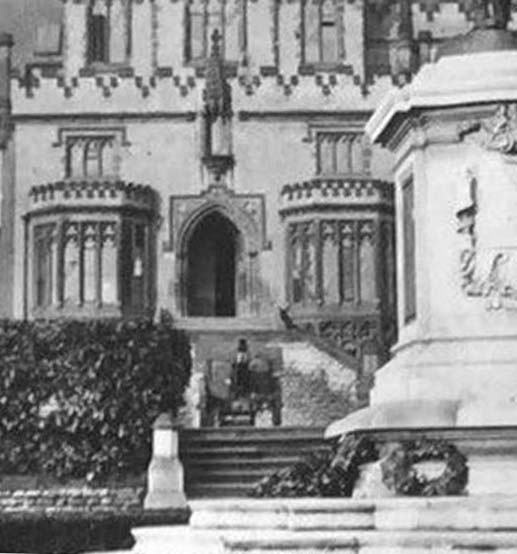
Talking of “Little People”, a few weeks ago, I bought a postcard of the High School taken in 1927. I was intrigued to see what is obviously the “School Leprechaun” busy guarding the front of the school:

lep[rechaun 1

You can see his right hand, his jacket of Irish Green, his little fawn breeches and his lovely top hat. Here he is, slightly enlarged:

lep[rechaun 2

Do you see his mutton chop whiskers? And what about little Pumpkin Head, next to him, with his tiny hat and his little legs and boots?

Both photographs, courtesy of the Pareidolia Brothers.


17 Comments

Filed under Cryptozoology, History, Literature, Nottingham, Personal, The High School