
Goose Fair always brought with it a host of what could be called “camp followers” who, to be honest, would probably have made their way to pretty well every large fair in the country.
Wandering the streets, therefore, were a good number of distinctively dressed gypsy women, who sold “tickling sticks”, bags of confetti, balls on elastic, ropes of beads and “monkeys on sticks”. All vital commodities in Victorian England!

The gypsy women were extremely popular as fortune tellers, and were always recognisable as such because they traditionally carried a linnet in a cage at the end of a long, thin staff.

And in this photograph of a gipsy woman, notice the boy’s funky pillbox hat. Eagerly, he ia waiting for the birth of Bob Dylan:

A linnet was chosen, incidentally, because:
“When finches come into our awareness, it is a sure sign of joy-filled, happy times ahead.”
I knew that.
Here are some “sundry sellers, who no doubt had access to their own private supplies of tickling sticks, bags of confetti, balls on elastic, ropes of beads and monkeys on sticks:

And at the other end of the spectrum, a little further away, on Upper Parliament Street, around the columns in front of the Theatre Royal, stood the “nymphs of fashion”.
Here are the columns of the Theatre Royal which is to the left of the now long demolished Empire Theatre :
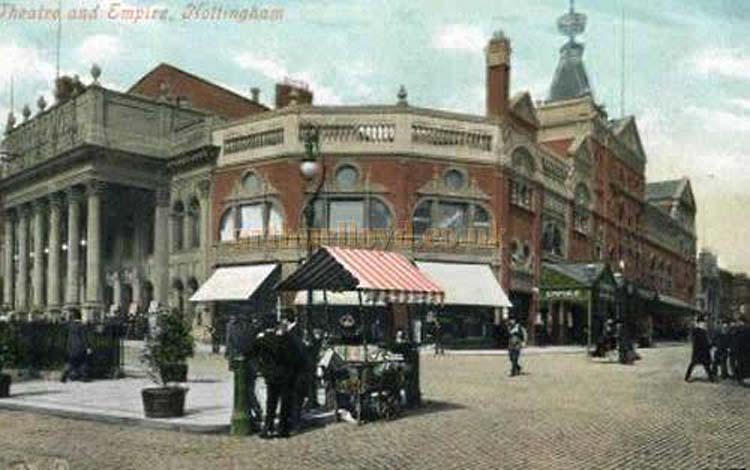
The “nymphs of fashion” were what we would nowadays call prostitutes. They charged men for their sexual favours. Here’s one of the hottest, preparing to drive the young men wild, or perhaps straight to their doctor:

And here she is without her make-up. Surely, I’m not the only one who thinks that’s a man:

Setting aside for a moment the delights of these disease ridden lovelies, I investigated the attractions which appeared most frequently at Goose Fair around 1900. I discovered that, on Long Row, there was “Wadbrook’s Ghost Exhibition” with the celebrated “Pepper’s Illusion”. In front of the Exchange Building, Pat Collins had his roundabouts including his “Mountain Ponies”, his “Venetian Gala Gondolas” and his “Pneumatic Steam Bicycles”. There was “music produced by electricity on the latest musical instrument, the “Gaviolophone”, equivalent to a String Band of 60 performers, playing Opera, Classical and Popular Music.”
Incidentally, here’s Long Row to the north of the Old Market Square. The western end:
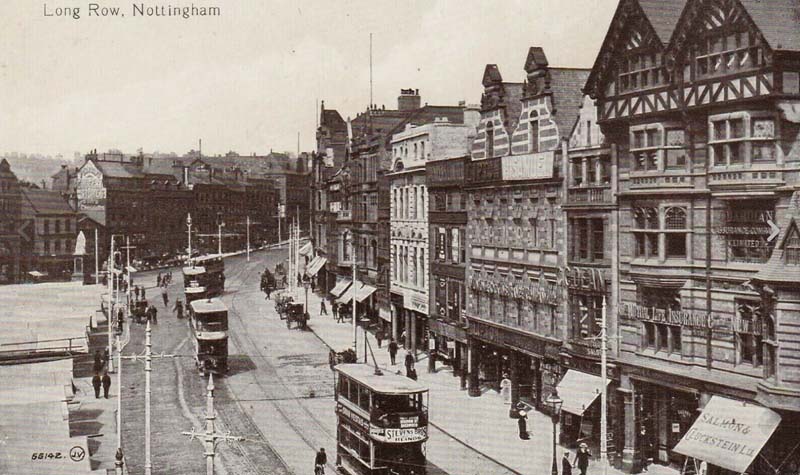
The central area:
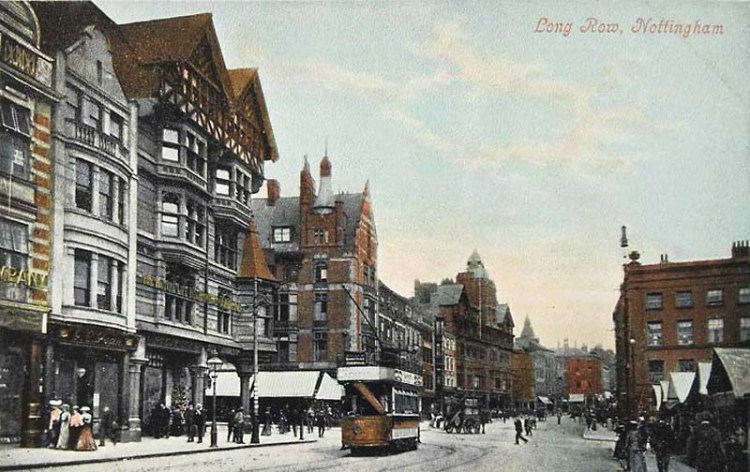
And finally, the eastern end, with the incomparable Black Boy Hotel, which, during the Second World War, supplied all of the beds required for the sexual adventures of every single member of Bomber Command in all the RAF bases for fifty miles around:

There may well have been “Wadbrook’s Ghost Exhibition” with “Pepper’s Illusion”. There may well have been roundabouts such as the “Mountain Ponies”, the “Venetian Gala Gondolas” and the “Pneumatic Steam Bicycles”. Despite all of them, though, despite even the “Gaviolophone”, many people, and all the children, still liked to see a few exotic animals, no matter how moth eaten they might have appeared.
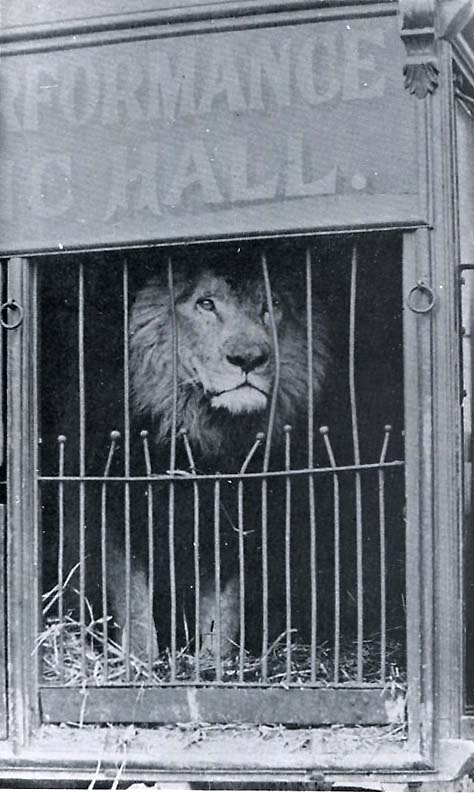
By 1898, Day’s “No 1 Royal Menagerie” had returned to the Market Square after a short absence. Day’s was “a Special Engagement of the Greatest Lion Tamers on Earth” with “Captain Laurance & Delvonico, The Lion Kings” (96 years before Disney!). There were “20 noble lions of all ages and sizes” who provided the members of “Delvonico’s Wrestling Lions”, “Delvonico’s Boxing Lions”, “The Clown Lions” and “A Lion in a Trance”. All of them were acts which had been “The Rage and Talk of Europe”, as was “The Daring Performance of Captain Laurance” along with “the only Real Original and Absolutely Untameable Lion Wallace”. Wallace had also appeared in 1896 and 1897. He doesn’t look very fierce in this photograph, though:
Among the animals were “Many Specimens of Birds, Beasts and Reptiles” some of which must have been stuffed, as there was actually a humming bird mentioned, a species which, even nowadays, cannot easily be kept in captivity. At the same time though, there was an elephant called “Elephant Jumbo” who was surely a live animal, as an elephant would be a bit of a nightmare for the taxidermist.
Overall, the proprietors of Day’s “No 1 Royal Menagerie” were happy to call themselves, “The People’s Show at the People’s Price”.
Slightly less exotic as animals were Mr Pat Collins’ “Giant Nottingham Geese, All Alive and Kicking”:
“For rollicking fun, there’s nothing to beat them
If you are “out for the night” don’t miss them;
And while you are there, try the razzle-dazzle cars
Drawn by ostriches, and spinning round at lightning speed.”
And the judges’ verdicts……….. “No rhyme and very little reason.”


 John Knifton
A welcome look back, John. You may be interested in this post, being one of several encounters with gypsy women on Westminster Bridge: https://derrickjknight.com/2013/02/28/artificial-carnations/
You’re far too worldly wise to be caught by as obvious a scam as that one, Derrick!!
Thanks a lot. I saw them get very abusive at times.
The police forces in Notts and Leicestershire are scared stiff of the gypsy community. A fellow teacher took a police officer and they watched his stolen car being dismantled near Farndon. Nothing could be done. The cost of calling out vanloads of police etc was far too much for a used car, apparently.
A very interesting post about an era long gone. Thanks, John.
I’m glad you enjoyed it, Allen. There are two or three more to come, including some interesting details on the posters advertising the attractions in the menageries.
I remember in the 50s regular buses were occasionally used for NHS transport. On the upper deck there was access to the destination identifier which in those days consisted of a large fabric roll with destinations printed on it, one of which was Goose Fair. A regular amusement was to wind the roll round from “Not on Service” to “Goose Fair”.
Thank you for your contribution to the blog post. I’m glad that you enjoyed it.
In my own all boys’ school, we used to do pretty much the same thing, Michael, when we were put on the old “Midland Red” buses. Perhaps it was the first thing that boys would think of doing as soon as they had commandeered the upstairs front seats
An incredible collection!
It certainly was! And as we shall see in the future, Goose Fair would prove itself capable of showing off some unbelievably exotic animals. So much so, that nowadays, I’m not too sure what some of them were!
Sounds like the Goose Fair had an attraction for everyone’s taste. “Nymphs of fashion”: How creative a description!
Arguably, Goose Fair possessed almost as many ways of making money as existed in English society at the time, from selling monkeys on sticks to what we now call, rather coyly, “sex workers”.
Very interesting indeed John. It sounded like the Goose Fair was far more dangerous than we might think, with ladies festooned in disease and wild animals of every kind ready to amaze and scare you. Some of those toys would no doubt fail todays high standards set by Mr ‘elf ‘n’ safety too. Perhaps on hindsight it’s a place best avoided!
Well, the last Saturday night of Goose Fair was widely acknowledged as a splendid opportunity for a top class punch up.
As regards prostitutes, if a woman was widowed in Victorian times, and had no family, there were few other ways of making money if a factory job was unobtainable.
A sad indictment of Victorian Britain I suppose.
Thank you for sharing a part of history!.. I expect the fair changed some as society changed, gives one a idea of the thinking of a percentage of society at that time… 🙂
Hope all is well, you have the mostest wonderful weekend and until we meet again…
May your troubles be less
Your blessings be more
And nothing but happiness
Come through your door
(Irish Saying)
Thank you so much for your good wishes.
Goose Fair does seem to have reflected the people who attended it to a large extent. It tried, for example, to make money from their interests in animals, sport and ghosts, and it was probably only a small number of individuals whose chief attraction was the “nymphs of fashion”, most of whom would have looked like the second photograph of a young woman, rather than the first !
This is really fascinating. Here temples have their annual fairs. Certain rituals are performed inside and outside it is a different world. On the last evening there are fireworks.
Thank you, Lakshmi. I think the main difference between England and India must be the religious element, which does not really seem to be present in the Nottingham celebrations.