Author Archives: jfwknifton

Why I am what I am (1)

One day I started thinking about all the little facets of myself as a person and where they all came from. I didn’t take me long to work out that the vast majority came from my Dad. I suppose that was because when I was a little boy I spent a lot of time with him. I was nevertheless really quite surprised how many apparently insignificant activities took on a major importance in my later life.

My Dad, Fred, made it quite obvious to me that he liked football/soccer. He took me to games with Derby County although it was their sixth game before they won. Norwich City (1-4), Newcastle United (1-2), Stoke City (1-1), Grimsby Town (2-4), Blackburn Rovers (1-1) and , finally, in a friendly, Spartak Prague (7-1). Here’s the programme to the first match I ever watched. I was seven years old.

I have always read avidly, and, every Saturday morning, Fred used to take me to the old library in Alexandra Road  in Swadlincote, a small town in South Derbyshire. It was on the right hand side as you went down a very steep hill, just before the local cinema.
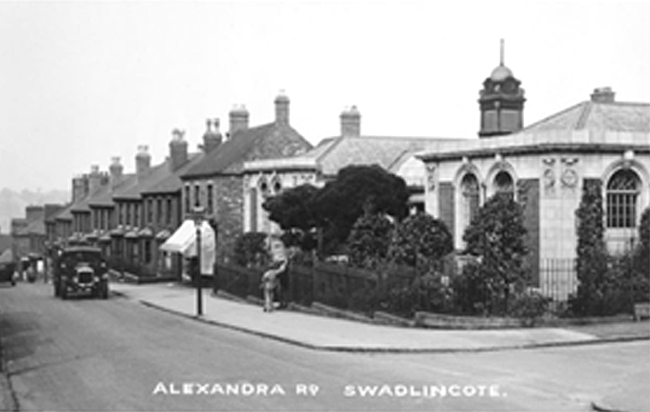
I have read books avidly ever since, and often wish I could see again the big green book of Norse Myths and Legends that was in that Old Library all those years ago. The library itself was plagued by subsidence caused by coal mining and it was demolished in 1960.Here are some houses in the same street. Just look at the cracks in those bay windows…..

And here’s a short video of the problem. I included this clip in a previous blog post…..

As a boy, I collected stamps because Fred had collected stamps as a boy and he gave me his stamp collection. I always remember that it was in a “Commando” stamp album, resplendent with a commando firing a sten gun from the hip on the front cover. As an adult, I do wonder what connection, if any, that had to do with stamp collecting but in 1961 nobody seemed to notice….

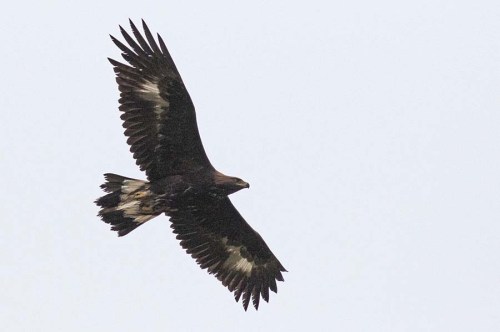
I like birdwatching because Fred talked about eagles in Scotland when he was in the RAF. On one occasion, as he travelled by train across the Highlands south towards Edinburgh, he was in a compartment alone with an old Scotsman. It was a fine, bright sunny day, when suddenly the Highlander tapped him on the knee, and pointed out of the window towards the distant mountain tops. There, high in the clear blue sky, was the unmistakeable shape of a soaring Golden Eagle….
I can actually remember going on a walk with Fred one morning when I was seven or eight. and at one point I was a little tired, so I went to sit on a clump of grass with my back against an old fence post. As I sat there, Fred caught my attention, and he pointed up to a bird that was singing its heart out as it hovered high in the sky. I asked him what it was, and he replied “a skylark”. In the sixty or more years since then, I have never lost that desire to identify birds:

One day when I was in my Dad’s class at Woodville Junior School he gave us all a printed sheet with his own hand drawn pictures of four common birds. We all coloured them in so that one day we would recognise them when we saw them. The birds were blackbird, thrush, starling and robin (the European version, Erithacus rubecula)  Here they are……

This slideshow requires JavaScript.

And here they are in a modern version of what we received in class, almost a whole lifetime ago. There were no multicoloured worksheets on computer screens in 1961…..

This slideshow requires JavaScript.


15 Comments

Filed under Aviation, Bomber Command, History, my Dad, Personal, Wildlife and Nature, Writing

Phonetic Alphabets (1)

Signalling by one group of soldiers to another, or by one ship to another, has gone on for centuries. Signalling flags were used on ships in the time of Admiral Nelson:

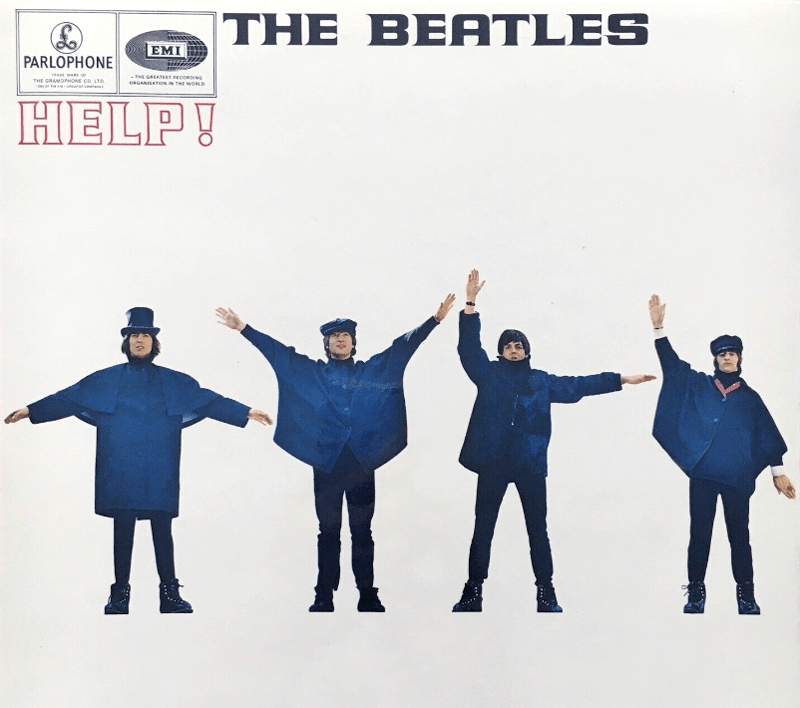
And there was always semaphore. As used by the Beatles:

The advent of radio, however, made things a lot more difficult, because when men spoke to each other, interference was a frequent problem. Sometimes words, especially place names, had to be spelt out, and merely giving out a list of letters, such as L-O-N-D-O-N did not always work, especially if the interference was intermittent.

In 1904, British Army signallers started to use a partial spelling alphabet, where only the more problematic letters had their own code word. This produced:

ACK, BEER/BAR, C, D, E, F, G, H, I, J, K, L ,  EMMA, N,O, PIP, Q, R, ESSES, TOC, U, VIC, W, X, Y, Z

Only seven letters needed! By 1918, the problems of using the 1904 alphabet had added  a few words:

CORK,   DON.   EDDY.    INK.    JUG.   QUAD.   TALK

Here’s a war artist’s rendition of a signaller:

Things got better once for the British army when they adapted horse drawn radios:

Overall, it is crucial to have only ONE spelling alphabet, otherwise the situation becomes downright confusing. There used to be different alphabets for:

the 1914 British Post Office with Apple, Brother, Charlie, Dover, Eastern,

the 1917 Royal Navy with Apples, Butter, Charlie, Duff, Edward

the 1918 Western Union with Adams, Boston, Chicago, Denver, Edward

Much more sensibly, during World War II, the US Army and Navy used the same alphabet. It is familiar from so many war films and so many comics:

Able, Baker, Charlie, Dog, Easy, Fox, George, How, Item, Jig, King, Love, Mike,

Nan, Oboe, Peter, Queen, Roger, Sugar, Tare, Uncle, Victor, William, X-ray, Yoke

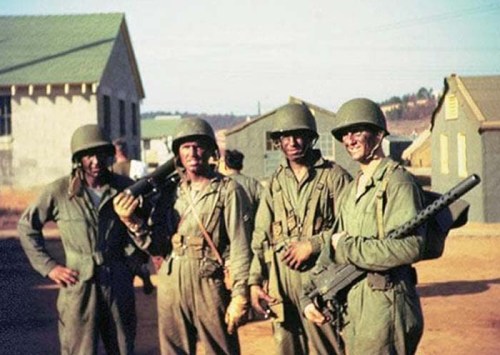
These men were some of the members of the real “Easy Company” :

What is important here is to have no words whatsoever that sound like any of the others. In this alphabet maybe jig and king, or able and baker, or dog and fox might cause problems.

Here’s the RAF spelling alphabet until 1942:

Apple, Beer, Charlie, Don, Edward, Freddie, George, Harry, Ink, Johnnie, King, London, Monkey,

Nuts,  Orange, Pip, Queen, Robert, Sugar, Toc, Uncle Vic,  William, Yorker, Zebra

And here’s the RAF alphabet after 1942

Able, Baker, Charlie, Dog, Easy, Fox, George, How, Item, Jig, King, Love, Mike, Nan, Oboe,

Peter, Queen, Roger, Sugar, Tare, Uncle, Victor, William, X-ray, Yoke, Zebra.

Smart people will have noticed how close it is to the US Army and Navy alphabet. How sensible!

In actual fact, the RAF was already using quite a few other alphabets anyway, such as this one noted in 1942-1943 :

Apple, Beer, Charlie, Dog, Edward, Freddy, George, Harry, In, Jug/Johnny, King, Love, Mother,

Nuts, Orange, Peter, Queen, Roger/Robert, Sugar, Tommy, Uncle, Vic, William, X-ray, Yoke/Yorker, Zebra

And there was a further alphabet for the squadron letters on the side of the aircraft in the Dambusting 617 Squadron:

A-Apple, B-Baker, C-Charlie, E-Easy, F-Freddie, G-George, H-Harry, J-Johnny, K-King,

L-Leather, M-Mother, N-Nuts, O-Orange, P-Popsie, S-Sugar, T-Tommy, W-Willie, Y-York, Z-Zebra.

I presume that the missing letters were non-existent aircraft. Here is 617 Squadron and these are B-Baker, G-George and M-Mother:

This slideshow requires JavaScript.

I wrote a number of blog posts about my wife’s friend, Len, who flew in 617 Squadron, in G-George. His full name was Len Dorricott, and this link will take you to the first of the three posts. If you copy and paste the surname “Dorricott” into “Search”, then finding Blog Posts No 2 and No 3 about Len becomes a doddle.

18 Comments

Filed under Aviation, Bomber Command, History, Humour, military

Headless Valley (3)

The Nahanni Valley is in the middle of nowhere in Canada’s Northwest Territories, some 300 miles or so west of Yellowknife. It is a very hostile region accessible only on foot, by boat or by floatplane. For many years tales were told about fur trappers and gold prospectors going into the area, and either disappearing without trace or being found beheaded  and dead. The number of decapitated bodies found within Nahanni Valley earned it the nickname “Valley of Headless Men”.

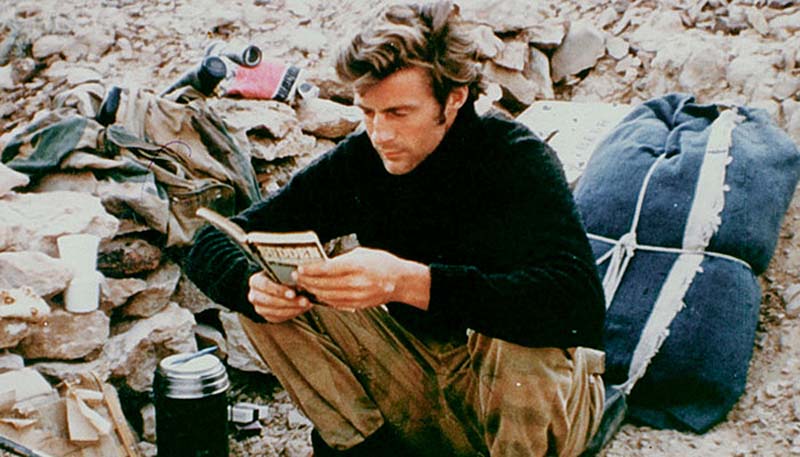
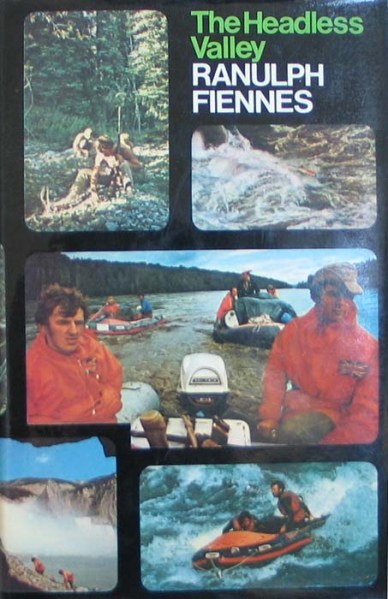
In 1971, the intrepid explorer, traveller and writer, Ranulph Fiennes, aka “Ranulph Twisleton-Wykeham-Fiennes” took a small expedition of soldiers from the Scots Greys to explore the region. Ranulph’s book is called “The Headless Valley” and contains a very perceptive account of the murders that gave it its name. Clearly, from his writings, the author seems to have discovered that many of the victims had quite simply not lost their heads. Here he is, in his comfy trousers:

Ranulph Fiennes, throughout his book, seems to tease the reader a little. He repeatedly mentions details which to a person interested in Bigfoot seem to be very strong indications that there is a Bigfoot very close to them, but then Ranulph chooses to feign innocence, just reporting any strange events as something which can easily be dismissed with a simple, normal, everyday explanation. For example, we have a moment when they are moving through very thick cover and suddenly….

“A crackling of breaking alder sounded ahead and the ground trembled as some great beast moved away.”

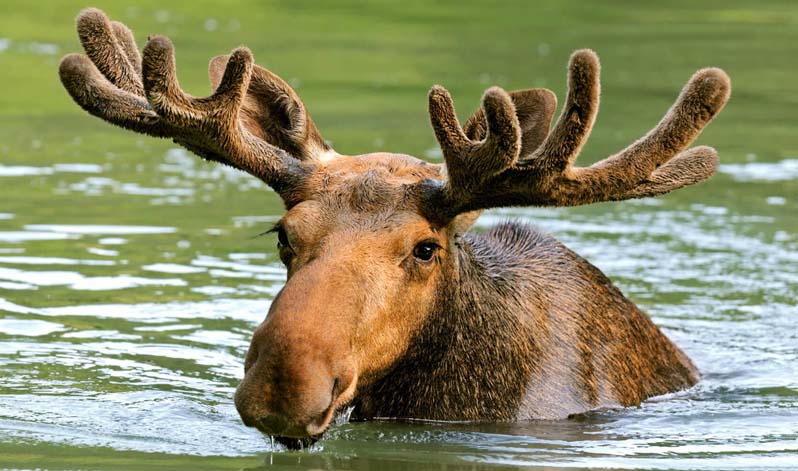
Perhaps it was a moose or a bear but I really do wonder if the ground trembles as they walk along. It frequently does for Bigfoot. who can weigh up to a thousand pounds for a mature male. Here’s a moose:

And then:

“(we went) to find rabbits beyond Prairie Creek. We followed the stream inland for an hour and smelled the stench of sulphur pools, though we saw none. Moving through a tall forest in dark undergrowth we heard a roar from higher up the valley: perhaps it was a bear or cougar we didn’t know, and, finding no rabbits…”

Bigfoot roars extremely loudly and very often, and he certainly stinks. Usually it is described as the smell of excrement, sewage, dead, rotting flesh, a wet skunk but also as the smell of sulphur.

And then, as they camped overnight….

Some of the animals that moved about around us that night were large enough to shake the ground- perhaps bears but more probably deer since we had seen a great many deer spoor along the narrow “game” runs.”

This is the same argument as I mentioned the first time, when they are moving through very thick cover.  And my point of view is still the same. Deer do not make the ground shake. And then….

“We heard the thud of hooves or paws as heavy creatures moved ahead through the trees.”

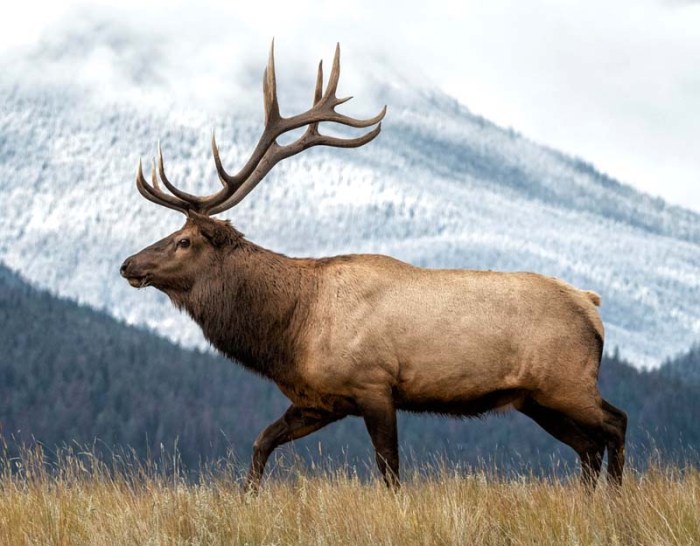
A classic mark of Bigfoot. Yes, they could be bears, or moose, or elk, but don’t forget that Bigfoot is always very keen to get away from human observers. Here’s that elk. He isn’t big enough to make the ground shake:

Bigfoot frequently wanders around a campsite at night looking for food, but he is also capable of stealing other things that he likes, such as in this short anecdote….

“An aged prospector, returning from a fruitless three year search in the Yukon found his mug had been stolen and a chunk of rock left in its place. The rock contained gold quartz and the prospector made a fortune.”

And:

Jack told us of a large black bear which he had watched ambling through some bush”.

People who say they have seen a black bigfoot are frequently told that they have seen a black bear, so, presumably, the two must be similar. I have seen neither, unfortunately!

Overall, “The Headless Valley” is a really good read, if you like tales of the wilderness. Ranulph Fiennes captures well the thrills of  shooting the rapids, or, equally, the awful couple of hours when he is a long way from camp and is totally lost. If you like that kind of book, then a second hand copy is very easy to acquire via the usual websites, and well worth taking the trouble.

22 Comments

Filed under Bigfoot, Canada, Criminology, Cryptozoology, History, Science, Wildlife and Nature

Why no statue ? (10)

Last time, I revealed that, up to and including the Second Boer War…….

“in every war fought by British forces they lost more men to typhoid than to the enemy”.

That was easily true of the Crimean War where 4,602 were killed in battle and 17,580 by typhoid. It was certainly true too of the Second Boer War and it would have been true of World War One, but for Almroth Wright.

Once he had seen the efficacy of his vaccine, Almroth gradually convinced the people in charge of the British armed forces of two measures which they absolutely had to take. Firstly, all military personnel would have to be injected, whatever they personally thought about it. Secondly, from 1910 onwards, around 10,000,000 vaccine doses had to be made immediately available for the troops.

As a consequence, when World War One began, the British Army was the only one with 100% vaccination of its troops against typhoid. In the Boer War in South Africa, there were 105 cases of typhoid per 1,000 troops and the death rate was 14.6 per 1,000 troops. In World War One though, there were 2.35 cases of typhoid per 1,000 troops and the death rate was 0.139 per 1,000 troops.

The result was that the British Empire suffered an appalling total of 1,118,264 casualties but the vast majority of them were on the battlefield. If the war had taken place without Almroth’s vaccine then the number of men and women to die would have been 2,236,529, and that would have been the figure if typhoid deaths were only one man more than those killed in action (which was extremely unlikely).

Let’s imagine that World War One had been played by Boer War rules. In South Africa, 5,774 men died in combat, or of the wounds they received in combat and 14, 210 died of disease. That is a ratio of just about 2½ to one, disease and combat. I’m not sure that I can believe my own Maths, but that would give you a grand total of 3,354,792 dead by the end of World War One, if typhoid had killed soldiers at its usual rate.

Is that not enough to warrant a statue? A total of 2,236,528 lives saved if the calculations are done by Boer War rules.

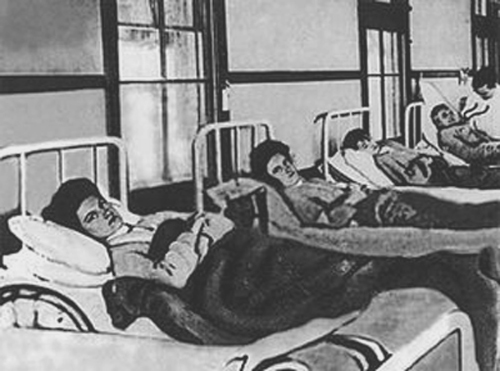
Even after Almroth Wright’s work, typhoid did still break out here and there in Great Britain. Without really searching very hard, I found that there were outbreaks in Maidstone in Kent (1897), Southampton and Winchester (1902) and Lincoln, England (1905). There was one very famous outbreak in New York (1906), but the disease kept up its unhealthy average in Dublin (1908), Retford in Nottinghamshire (1912), Tideswell in Derbyshire (1915), Croydon (1937), Chatham (1938), Dundee (1938) and Aberdeen (1964). Presumably, the arrival of lorry loads of Almroth’s vaccine prevented these outbreaks from becoming really serious (with the exception of Typhoid Mary, of course, in New York in 1906). Here she is, nearest bed:

During his lifetime, Almroth received at least 28 medals, prizes and honorary degrees. There is no statue of him, though. He was nominated 14 times for the Nobel prize from 1906 till 1925 but he didn’t receive one. All he has is a ward named after him at St Mary’s Hospital in Paddington in London…….


25 Comments

Filed under Africa, History, military, Science

Headless Valley (2)

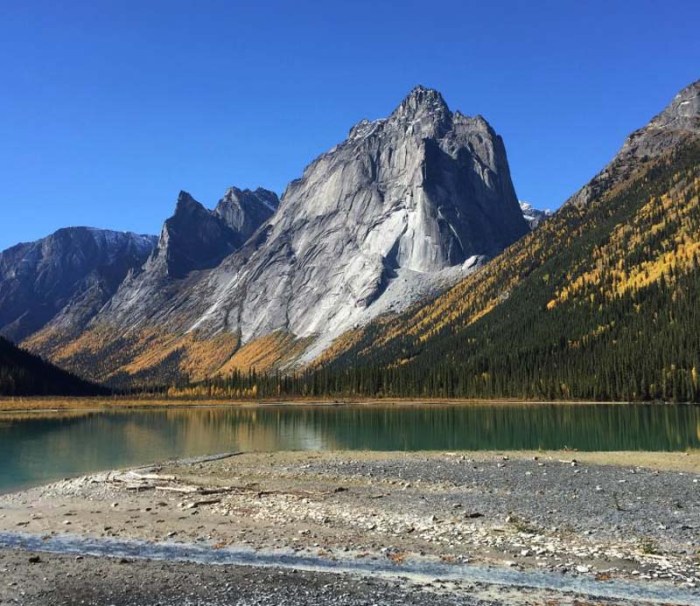
The Nahanni Valley is in the middle of nowhere in Canada’s Northwest Territories, some 300 miles or so west of Yellowknife. It is a very hostile region accessible only on foot, by boat or by floatplane. It’s very beautiful, though:

For many years there have been large numbers of tales told about fur trappers and gold prospectors going into the area, and then either disappearing without trace or being found dead minus their heads. All these decapitated bodies found within the Nahanni Valley have earned it the nickname “Valley of Headless Men”. You can read what I have already written about this region here.

In 1971, the intrepid explorer, traveller and writer, Ranulph Fiennes, aka “Ranulph Twisleton-Wykeham-Fiennes” took a small expedition of soldiers from the Scots Greys to explore the region. Ranulph’s book is called “The Headless Valley” and contains a very perceptive account of the murders that gave it its name. Clearly, from his writings, the author seems to have discovered that a great many of the victims had quite simply not lost their heads. Here he is:

In 1926, Annie Laferte was lost in the bush. There was a sighting of her some time afterwards, by an Indian named Big Charley. She was climbing a nearby hill, almost naked, but was never seen again. Supposedly, she had lost her mind, rather than her entire head.

In 1927, the bones of “Yukon Fisher,” a man wanted by the RCMP, were found on Bennett Creek. They included the bones of his head. The anticipation of gold had claimed his life. Far too impatient, he had pushed on ahead of the main party and was never seen again.

In 1932, a prospector named Phil Powers was found dead by a Mountie patrol.  Constable Martin found his bones in a burnt down cottage  upstream of the mouth of the Flat River.  Powers lay on the remains of a bunk and had been laid out in the outline of a human being, as though he had been sleeping. The skull was there at the opposite ending to the footbones and a rifle was laid over the knees. So, not a lot of decapitation there, then!

In 1936, William Epier and Joseph Mulholland were trapping and prospecting when they disappeared up the Nahanni. A bush pilot called Dalziel (pronounced “Dee-Ell”) located their cabin on Glacier Lake. It was burnt down to the ground. He reported it to Constable Graham at Fort Liard. Here’s Glacier Lake:

In 1940, a prospector named Holmberg was found dead of no established cause.

In 1945, a miner from Ontario, whose name has not survived for definite, but who may well have been Ernest Savard, was found dead in his sleeping bag. His head had been ripped off and was never found. At last! The hint of a reason for the area to be called “The Valley of the Headless Men”.

Ranulph Fiennes was told by Brian Doke of Nahanni Butte, how…….

“His father-in-law, Mr Turner, had travelled up the Nahanni in 1953, to take some food to a man who lived upstream. He was a prospector or trapper or both and Mr Turner found him dead with his cabin burnt down around him. His head was firmly intact.”

In 1961, Alec Mieskonen, a gold prospector, was blown up by dynamite, despite his well-known fear of explosives. This was thought to be a case of suicide, despite Mieskonen’s deep seated fear that one day he would die through trying to use explosives. What a strange story!!

In the same year, 1961, two partners, Orville Webb and Tom Pappas, set off overland for Nahanni Butte since they were short of food, but they were never seen again.

In the 1961 quarterly magazine of the Royal Canadian Mounted Police, Constable Shaw said….

Of the deaths….there is one aspect common to all….fire of undetermined origin has often been a factor in each in some way or another.”

No mention there of heads being ripped off, then! And so many of the deaths reported to the RCMP did involve fire, a factor which may well exclude Bigfoot, who has never been known to use fire. And if it isn’t Bigfoot decapitating his victims, I simply don’t know whether there might be another predator which enjoys the challenge of pulling the heads off its victims so that it can eat them. On the other hand, so many TV nature programmes here in England will tell you that apex predators always go first for two extremely nutritious parts of the body.  Indeed, they are quite capable of leaving the rest if they are not particularly hungry. Those two best bits are the brain and the liver.

In 1962 Blake MacKenzie survived an aircraft crash but then disappeared completely.  He was a strong healthy man with an ample supply of food and was seen close to the river. He kept a diary and survived at least 42 days after the crash and was well and healthy. And then suddenly, MacKenzie’s  daily diary entries stopped, abruptly and inexplicably.

A second aircraft crashed in the Nahanni Valley in 1962. A prospector named Hudson was found dead by the plane. The other two occupants and the pilot were never found.

For many of these men, especially those who just disappeared, the best candidate as the killer will be the supposedly much more violent and much larger northern variety of Bigfoot. Hundreds of years ago, the First Nations people regularly fought wars with Bigfoot because of their violence and their cannibalism.

A gentleman called David Paulides (pronounced “Poor–Lid–Uss”, with the emphasis on the first syllable), has written a number of books about the many unexplained disappearances in the National Parks of the USA.  He has written quite a few of these “Missing 411” books and estimates that well over 1,600 people may disappear there every year. Paulides used to be a police officer. This link takes you to his website :

This is one of his many excellent books about disappearances in the North American national parks:


18 Comments

Filed under Bigfoot, Canada, Criminology, Cryptozoology, History, Science, Wildlife and Nature

Why no statue? (9)

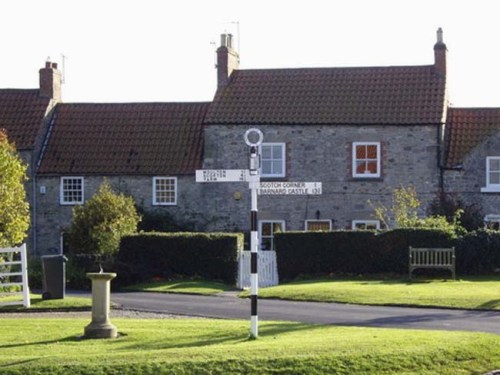
Almroth Edward Wright was born on August 10th 1861 in Middleton Tyas, which is a small village near Richmond in the extremely picturesque countryside of North Yorkshire in England.

And here’s the village church, which dates back to the twelfth century:

Almroth’s family was of mixed Anglo-Irish and Swedish origin. His father was a rector in the Church of England but his mother was Ebba Johanna Dorothea Almroth, the daughter of Nils Wilhelm Almroth, who was a professor of chemistry in the Carolinska Medico-Surgical Institute and the Royal Artillery School in Stockholm. In later years he became the director of the Swedish Royal Mint.

Almroth does not seem to be particularly famous nowadays, but he changed the world. Even on the Wikipedia page for his village, though, he is not paid any real attention. The village’s “notable people” therefore, are listed as, in first place, the fraudster Sir Edmund Backhouse and his brother, the naval officer, Roger Backhouse. Then comes in third place, Lady Alicia Blackwood, and then Arthur Francis Pease. Then comes Almroth Wright and his brother, and finally Keith Hawkins, the poker player.

Almroth was a lot cleverer than any of those, though.

Almroth was, in actual fact, the man responsible for developing a system of inoculation against typhoid fever, a disease which, at the time, was killing literally millions of people across the world. In the late 1890s, he also pointed out to whoever cared to listen, that one day bacteria would develop a resistance to antibiotics and then we would really be in trouble. His other main idea was that preventive medicine was what doctors should really be aiming at developing. And lastly, in any spare time he had, he also managed to develop vaccines against enteric tuberculosis and pneumonia, the latter a disease which killed more people in England than any other at that time. Not for nothing was it called

“The Captain of the Men of Death”

In the 1890 census in the United States, 76,490 had died of it, a death rate per 100,000 of the population of 186.94.

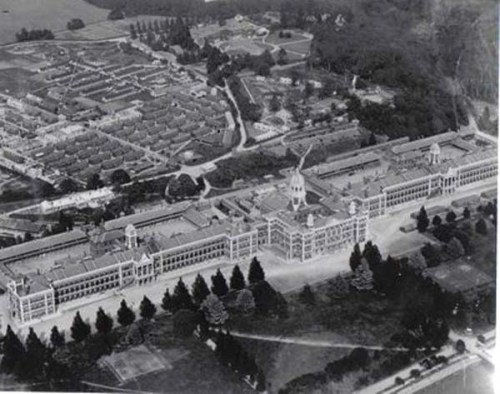
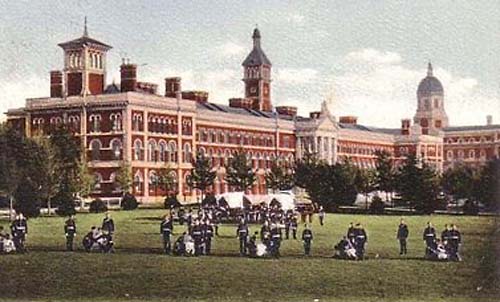
Almroth graduated in 1882 from Trinity College, Dublin with first class honours in modern literature and modern languages. In 1883 he graduated in medicine, before studying and lecturing at Cambridge, London, Leipzig, Magdeburg, Marburg, and Straßburg as it then was. Back in England in 1891, he worked in the laboratories of the Royal Colleges of Physicians and Surgeons and was then appointed Professor of Pathology at the Army Medical School in Netley, on the south coast of Hampshire in England.

Here is the hospital in black and white:And here it is in colour:

At Netley, he developed a method of immunising people against that mighty killer, typhoid fever. And then, in 1898, he went to India as a member of the Plague Commission and tested his vaccine on the 3,000 Indian soldiers who had all volunteered to try it out for him.

And it worked!

Not a single one of the vaccinated soldiers succumbed to the dreaded disease. And then, the vaccine was equally successful in the Boer War of 1899-1902, although a major mistake was made by continuing to make vaccination optional rather than compulsory.

There were 328,244 men in the British Army in the Boer War but sadly, only 14,626 men volunteered to be injected. None of that select group, though, were among the 57,684 cases of typhoid in South Africa or the 9,022 who died from the disease. Exactly as had been the case in India, the ones who had the vaccine all survived because of it.

Until Almroth came upon the scene, though, typhoid fever had always held the entire world in its grasp. It was a simple disease with lots of places to catch it. As Wikipedia says:

“Typhoid is spread by eating or drinking food or water contaminated with the fæces of an infected person”.

That scenario was easily arranged before a vaccine was developed.

In 430 BC in Greece, typhoid killed Pericles and a third of all Athenians. It killed off at least half of the inhabitants of the English settlement in Jamestown, Virginia. Between 1607 and 1624 more than 6,000 of them perished and they may well have passed it to the rest, thereby eliminating the entire colony……

Typhoid went on to kill 80,000 soldiers in the American Civil War. And I have seen more than one source which said that in every war fought by British forces until the Boer War, more men were lost to typhoid than to the enemy.

Next time, we’ll look at the impact that Almroth’s vaccine had on the number of casualties in the British Empire forces in World War One. It’s giving nothing away to say that he prevented deaths from disease in unprecedented numbers.

17 Comments

Filed under Africa, History, Nottingham, Science, The High School, Wildlife and Nature

Headless Valley 1

The Nahanni Valley is in the middle of more or less nowhere in Canada’s Northwest Territories, some 300 miles or so west of Yellowknife. It is, however, unbelievably beautiful:

It is a very hostile region, much of it accessible only on foot, by boat or by floatplane. For well over a hundred years, there have been countless tales told about fur trappers and gold prospectors who went into the area, and then either disappeared without trace or were found minus their heads. And obviously dead.

One website, taken more or less at random from the many, states that

“Over the years, many unfortunate travellers and explorers have gone missing, or turned up dead and beheaded. The number of decapitated bodies found within Nahanni Valley have earned it the nickname “Valley of Headless Men”. 

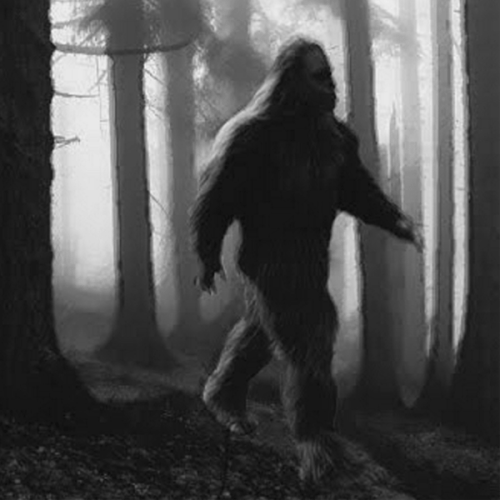
The number of headless bodies found in the Nahanni Valley varies enormously from one website to another or from one book to another. It is usually quoted as between somewhere 30-50 deaths. Explanations vary. The chief suspects include the extremely naughty Naha tribe who are apparently extremely aggressive and extremely elusive and guard their land very jealously. Or perhaps it’s a different group of people, namely a race of hairy, cave-dwelling cannibals who are extremely aggressive and extremely hungry too. And don’t forget that legendary scary hominid who goes by the name of “Nuk-luk”, a Neanderthal-like creature, five feet tall with a long beard. He doesn’t wear any clothes. Here he is, in a very blurred photograph, thank goodness:

In first place in the long list of suspects, though, is the supposedly much more violent northern variety of Bigfoot, examples of which supposedly measuring up to twelve feet tall or even more are regularly claimed in this area. This is a perfect application of Bergmann’s Rule :

“According to Bergmann’s rule, the body size of vertebrates is closely related to the average ambient air temperature in the region in which the vertebrate lives, so organisms in warmer regions are typically smaller than members of the same species in colder regions.”

Given this colourful and perhaps rather horrific, background to the area, in 1971, the intrepid English explorer, traveller and writer, Ranulph Fiennes, aka “Ranulph Twisleton-Wykeham-Fiennes” to give him his full name, took a small expedition of soldiers from the Royal Scots Greys to explore the Nahanni Valley. Ranulph’s book is called “The Headless Valley” and contains a very detailed account of the murders that have given the area its name (and his book its title). Clearly, from his writings, the author seems to have discovered that many of the victims had, quite simply, not lost their heads.

But first, from the internet, the famous tale of the McLeod brothers, who were mixed race, with one First Nation parent and one white:


“In 1908, after a lengthy search which had lasted two years, their brother Charley finally found the skeletons of Frank and Willie McLeod. Both men had been shot as they lay warm in their blankets, one either side the fire. They still had their heads. There was no sign of Weir, their partner, he was never seen again.”

I did find, though, in a rather more sensationalist book, an account which recorded the tale of the McLeod brothers as being found “reportedly decapitated”.  To be fair, though, there were some men on the list who did lack their heads:

” In 1916, a mounted policeman called Corporal Churchill found the headless skeleton of a prospector called Jorgensen up the Nahanni.”

Jorgenson evidently died a rather painful death, although one which had been particularly thoroughly carried out:

“a tough experienced woodsman, his remains were found by a log cabin near the Flat River’s confluence with the Nahanni. A loaded rifle close to the body, the cabin had been burnt down…. However heavy a sleeper Jorgensen would surely have woken up if the cabin had been on fire …..if he was still alive.”

And next, one with no head mentioned:

“In 1922, a prospector named John O’ Brien went up the Nahanni and never came back…”

The Nahanni Valley stories are good examples of how a rather shaky, iffy, perhaps somewhat gossipy piece of evidence can take on a life of its own. Granted, there may have been a small number of trappers and prospectors found minus their heads, but such a fate was certainly not what happened to every single person killed or disappeared in the Nahanni Valley, and there were certainly not thirty to fifty of them. More blood-soaked examples next time, when we will further examine that familiar old dilemna:

“Head or no Head?”


18 Comments

Filed under Bigfoot, Canada, Criminology, Cryptozoology, History, Science, Wildlife and Nature

Strathallan…………the lost air museum (2)

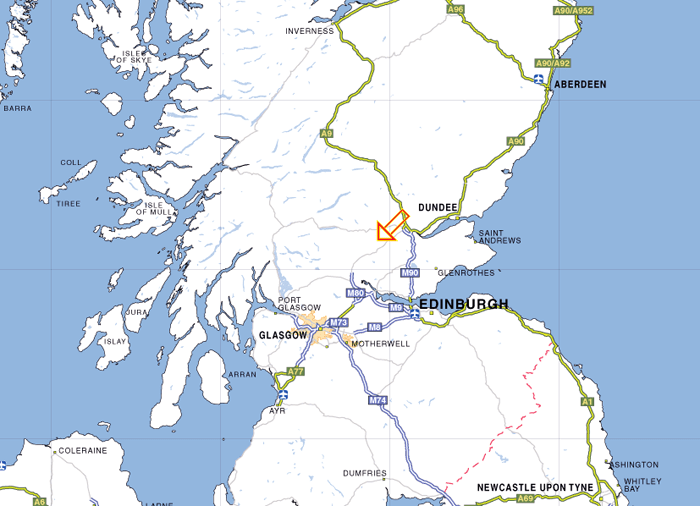
Last time we looked at just a few of the aircraft which my friend, Bill, and myself saw on our visit to Strathallan Air Museum, near Auchterader, in the mid-1970s. Strathallan, if you remember, was the aircraft museum which eventually went bankrupt and all of the aircraft were disposed of in one way or another. A look at the map shows why, in pre-motorway days, very few visitors came to see the aircraft:

One of the most easily identifiable aircraft at Strathallan  was their de Havilland Comet, the world’s first jet airliner, which made its maiden flight on July 27th 1949.

Here’s my photograph, taken with a plastic camera whose controls for light were “bright” and “dull” :

And here’s a de Havilland Comet, by a much better photographer, which I found on the internet. On second thoughts, though, perhaps that may be a model. If so, it’s a really good one :

Of course, it’s a model ! But what are the other articles on this 1950s table? Is that the pilot’s map?

The Strathallan Comet (XK655) was eventually broken up for scrap metal, and in 1995 its nose was sold to Gatwick Airport for display purposes on the Spectators Terrace. Not a fate I myself would care to share. Here it is:

On an internet forum I found “G-ORDY” who said that XK655 was built for BOAC as the first Comet Mark 2, G-AMXA. It was eventually converted into “a Comet 2R, an aircraft of electronic intelligence gathering (ELINT) configuration, by Marshalls of Cambridge, and flew with 51 Squadron from Wyton. The forward fuselage of XK655 is now in the Al Mahatta Museum, located at the old Sharjah airport, UAE, and is restored in BOAC colours.”

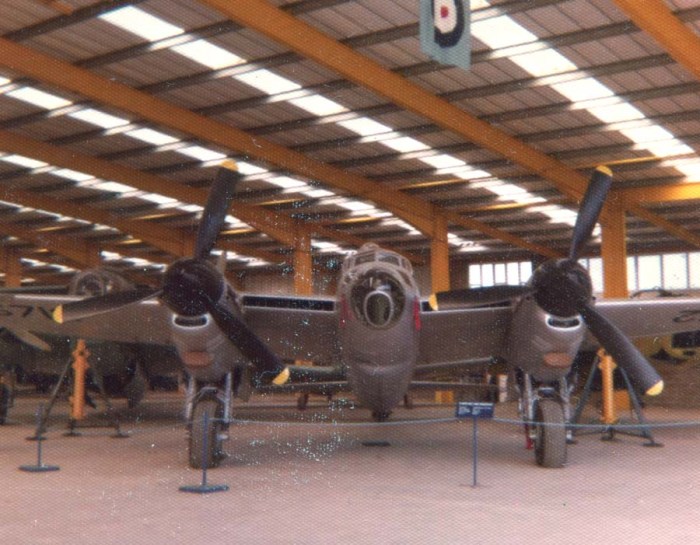
There was another de Havilland aircraft at Strathallan. This was a De Havilland DH-98 Mosquito TT35, “TT” standing for “target tug”. Here’s my photograph:

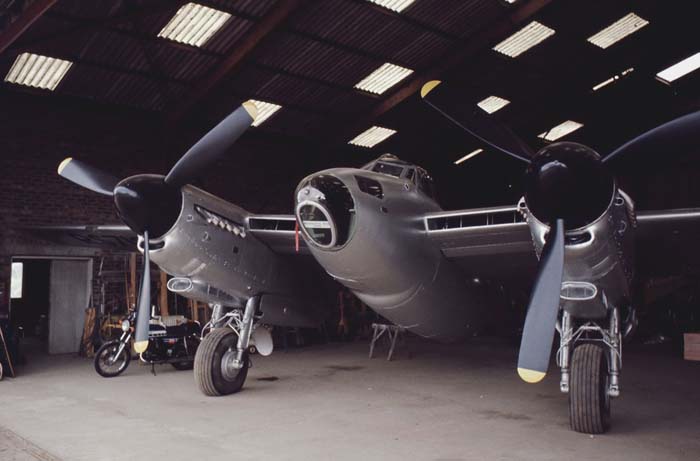
And here it is in a much better photograph which I found on the internet:

In the RAF, the Strathallan aircraft had a serial number of RS712 and had featured as one of the bombers in the film “633 Squadron” and the later film “Mosquito Squadron”. The aircraft is currently displayed at the EAA Museum in Oshkosh, in Wisconsin, as RS712 and EG-F, the aircraft flown by Group Captain P.C.Pickard during the attack on Amiens prison in 1944:

I have actually already written very briefly about the book featured above, in a post called “Books for Christmas 1”.  I said:

“A famous incident of the air war is investigated in this book by Jean-Pierre Ducellier. Its title is “The Amiens Raid: Secrets Revealed: The Truth Behind the Legend of Operation Jericho” and Ducellier has spent the majority of his adult life attempting to put the evidence together into a coherent whole. And his solution is not a lot like the official version.”

Here’s Strathallan’s Grumman Avenger, a TBM-3W2 of the Royal Netherlands Navy, the Koninklijke Marine. Here’s my photograph:

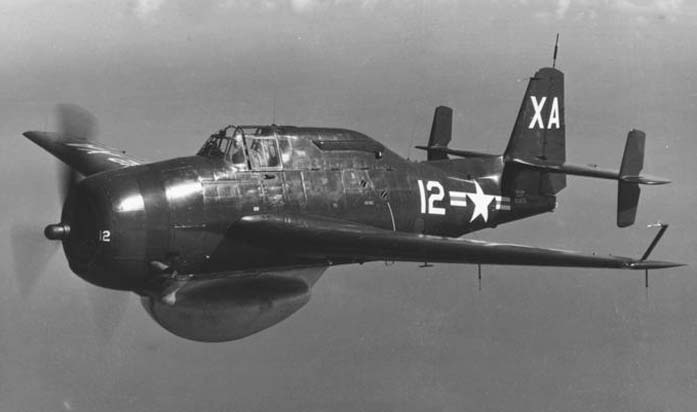
And here’s a much better photograph, of an Avenger in a much better state of repair:

When the museum closed, the Dutch aircraft went back to the USA and is now registered as N452HA at Hickory Air Museum, a private museum in North Carolina whose proud boast is that they never charge a penny for entrance.
The only other aircraft I can remember seeing at Strathallan was the RS3, built in 1945 at the Reid and Sigrist factory at Desford, some seven miles from Leicester:

It was designed as a small, twin engined trainer, although the RAF showed little interest. In 1948 it was adapted for prone-pilot experiments, with a lengthened, glazed nose, and a set of controls for another pilot who lay on his stomach. Here’s a better photograph from the internet:

The RS3 flew in this form in June 1951, and eventually went to the Institute of Aviation Medicine at the Royal Aircraft Establishment at Farnborough.

When I went to Strathallan, there may have been some other aircraft there which today, just over fifty years later, I have simply forgotten. It all depends on which year I went to the museum and in which year certain aircraft were sold off. The aircraft which I can no longer recall were an Avro Anson, an Avro Lancaster, a Supermarine Spitfire and a Westland Lysander. To be honest, had they been there during my visit, I do think I would probably have taken some  photographs.

This picture from the Internet was the closest I got to the ex-Strathallan Lancaster, KB976 and GB-BCOH. It is currently held at Polk City, Florida:

17 Comments

Filed under Aviation, Bomber Command, History, military, Personal, Science

What would you do ? (16) The Solution

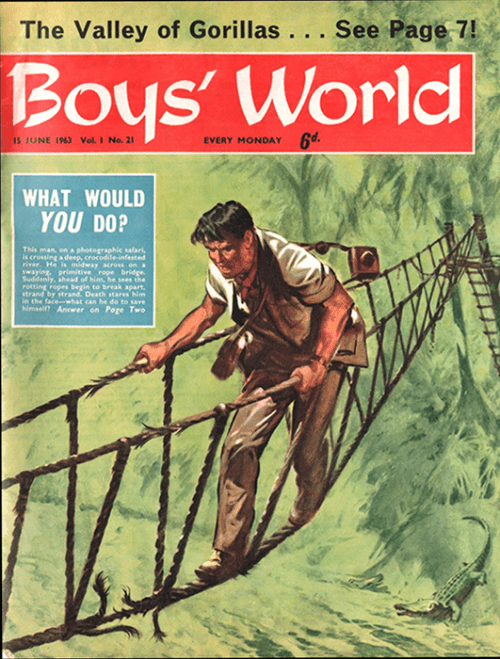
“What would you do ?” used to figure on the cover of a boys’ comic called “Boys’ World”. This was a publication, obviously, aimed at boys and first appeared on January 26th 1963. There were 89 issues before the comic was merged with Eagle in 1964. The last issue of “Boys’ World” came out on October 3rd 1964.

I used to buy “Boys’ World”, and this was mainly for the front cover which always featured a kind of puzzle. It was called “What would you do ?” and was based on somebody being in what Ned Flanders would call “A dilly of a pickle”. Here’s the situation:

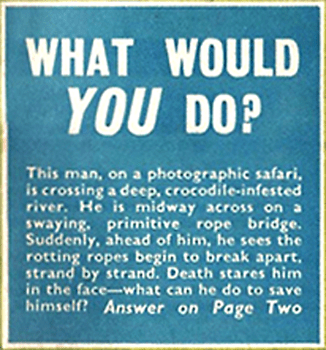
And here’s the blue box:

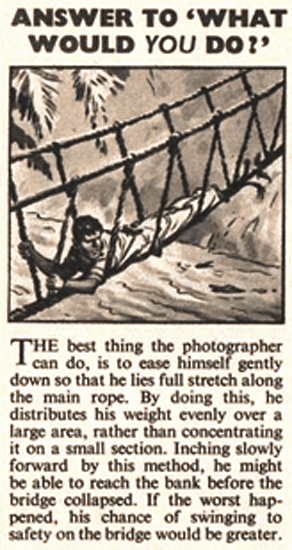
And the correct solution given on page 2 of the comic is:

If you can’t quite read it, it boils down to not walking across the bridge, but easing oneself gently down and lying full length on the central rope. This will distribute his weight much more evenly than through two boots. Then, he inches himself back the way he came, because he knows that the rope there is probably of a better standard. This way, he may reach the bank before the bridge gives up the ghost. If he doesn’t he will stand more chance of swinging or climbing to safety than if he had continued across the rotting rope.
Why didn’t I think of that?

21 Comments

Filed under Africa, Wildlife and Nature

What would you do ? (16) The Puzzle

“What would you do ?” used to figure on the cover of a boys’ comic called “Boys’ World”. This was a publication aimed, obviously, at boys, and first appeared on January 26th 1963. There were 89 issues before the comic was merged with Eagle in 1964. The last issue of “Boys’ World” came out on October 3rd 1964.

I used to buy “Boys’ World”, and this was mainly for the front cover which always featured a kind of puzzle. It was called “What would you do ?” and was based on somebody being in what Ned Flanders would call “A dilly of a pickle”. Here’s the situation:

The blue box sets the scene, and the task is for you to solve the situation. Perhaps you might like to write your idea in the “Comments” section.

Here’s the blue box enlarged:

So……it’s a photographic safari and a deep, crocodile infested river must be crossed. Midway across, he realises that he is on an inadequate and primitive rope bridge. Indeed, suddenly, the rotting ropes begin to break apart, one strand after another. Death seems just seconds away. Is there anything he can do to save himself?

26 Comments

Filed under Africa, Wildlife and Nature