Category Archives: Aviation

Strathallan…………the lost air museum (2)

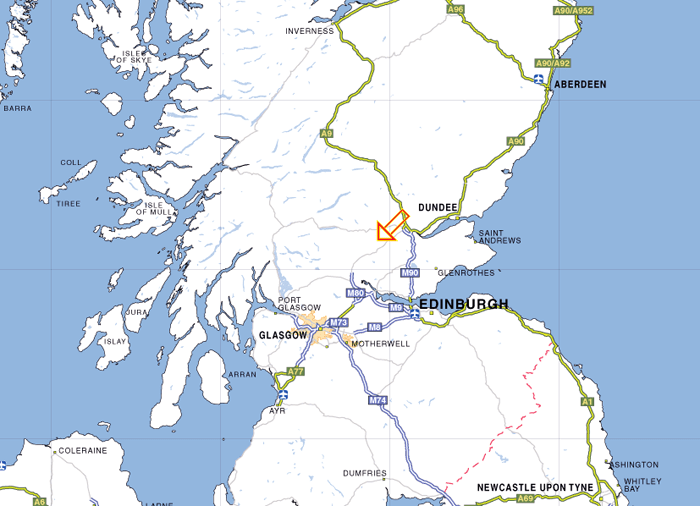
Last time we looked at just a few of the aircraft which my friend, Bill, and myself saw on our visit to Strathallan Air Museum, near Auchterader, in the mid-1970s. Strathallan, if you remember, was the aircraft museum which eventually went bankrupt and all of the aircraft were disposed of in one way or another. A look at the map shows why, in pre-motorway days, very few visitors came to see the aircraft:
One of the most easily identifiable aircraft at Strathallan  was their de Havilland Comet, the world’s first jet airliner, which made its maiden flight on July 27th 1949.

Here’s my photograph, taken with a plastic camera whose controls for light were “bright” and “dull” :

And here’s a de Havilland Comet, by a much better photographer, which I found on the internet. On second thoughts, though, perhaps that may be a model. If so, it’s a really good one :

Of course, it’s a model ! But what are the other articles on this 1950s table? Is that the pilot’s map?

The Strathallan Comet (XK655) was eventually broken up for scrap metal, and in 1995 its nose was sold to Gatwick Airport for display purposes on the Spectators Terrace. Not a fate I myself would care to share. Here it is:

On an internet forum I found “G-ORDY” who said that XK655 was built for BOAC as the first Comet Mark 2, G-AMXA. It was eventually converted into “a Comet 2R, an aircraft of electronic intelligence gathering (ELINT) configuration, by Marshalls of Cambridge, and flew with 51 Squadron from Wyton. The forward fuselage of XK655 is now in the Al Mahatta Museum, located at the old Sharjah airport, UAE, and is restored in BOAC colours.”

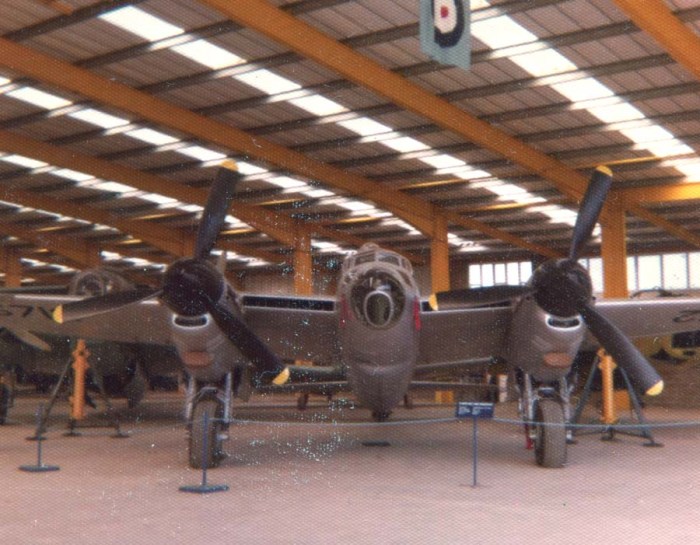
There was another de Havilland aircraft at Strathallan. This was a De Havilland DH-98 Mosquito TT35, “TT” standing for “target tug”. Here’s my photograph:
And here it is in a much better photograph which I found on the internet:
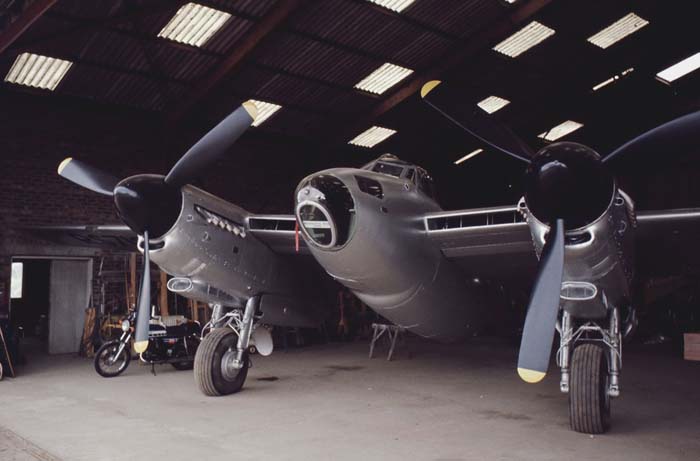
In the RAF, the Strathallan aircraft had a serial number of RS712 and had featured as one of the bombers in the film “633 Squadron” and the later film “Mosquito Squadron”. The aircraft is currently displayed at the EAA Museum in Oshkosh, in Wisconsin, as RS712 and EG-F, the aircraft flown by Group Captain P.C.Pickard during the attack on Amiens prison in 1944:

I have actually already written very briefly about the book featured above, in a post called “Books for Christmas 1”.  I said:

“A famous incident of the air war is investigated in this book by Jean-Pierre Ducellier. Its title is “The Amiens Raid: Secrets Revealed: The Truth Behind the Legend of Operation Jericho” and Ducellier has spent the majority of his adult life attempting to put the evidence together into a coherent whole. And his solution is not a lot like the official version.”

Here’s Strathallan’s Grumman Avenger, a TBM-3W2 of the Royal Netherlands Navy, the Koninklijke Marine. Here’s my photograph:

And here’s a much better photograph, of an Avenger in a much better state of repair:
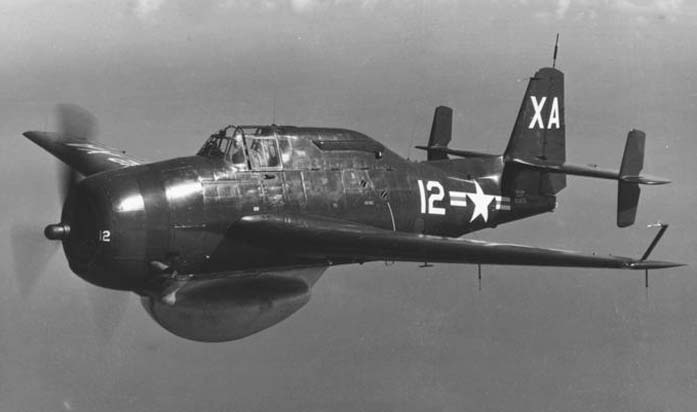
When the museum closed, the Dutch aircraft went back to the USA and is now registered as N452HA at Hickory Air Museum, a private museum in North Carolina whose proud boast is that they never charge a penny for entrance.
The only other aircraft I can remember seeing at Strathallan was the RS3, built in 1945 at the Reid and Sigrist factory at Desford, some seven miles from Leicester:

It was designed as a small, twin engined trainer, although the RAF showed little interest. In 1948 it was adapted for prone-pilot experiments, with a lengthened, glazed nose, and a set of controls for another pilot who lay on his stomach. Here’s a better photograph from the internet:

The RS3 flew in this form in June 1951, and eventually went to the Institute of Aviation Medicine at the Royal Aircraft Establishment at Farnborough.

When I went to Strathallan, there may have been some other aircraft there which today, just over fifty years later, I have simply forgotten. It all depends on which year I went to the museum and in which year certain aircraft were sold off. The aircraft which I can no longer recall were an Avro Anson, an Avro Lancaster, a Supermarine Spitfire and a Westland Lysander. To be honest, had they been there during my visit, I do think I would probably have taken some  photographs.

This picture from the Internet was the closest I got to the ex-Strathallan Lancaster, KB976 and GB-BCOH. It is currently held at Polk City, Florida:

17 Comments

Filed under Aviation, Bomber Command, History, military, Personal, Science

Strathallan…………the lost air museum (1)

In the mid-1970s, Bill Brown, a friend of mine, and I used to spend time camping around Scotland, the Land of Mountains, Mist and Midges. For the most part, we explored the wild west coast, but one year, probably 1975, on our return home, we stopped at a place called Strathallan, on the eastern side of Scotland, to visit the air museum there. No digital cameras then. At RAF Cosford in 2011 I took 854 photographs. At Strathallan, in around 1975, with 16 shots on each rather expensive roll of film, I took 11 photographs. Strathallan is quite a remote place. Look for the orange arrow, resplendent in his kilt:    

 I didn’t realise at the time that Strathallan was well on the way to having to close, because of financial pressures. As somebody said, it was too remote from any large city and hardly anybody could be bothered to visit it. And back then, the motorway north of Edinburgh, the M90, simply did not exist.

That said, I was happy enough with the museum and I took photographs of the majority of the aircraft. Whether there were any more aircraft that I did not think were worth the cost of a photograph, I do not know. I can’t remember any more. That fact, to me, is plain scary. What percentage of our lives have we totally forgotten? 50%? 70%? 90%?

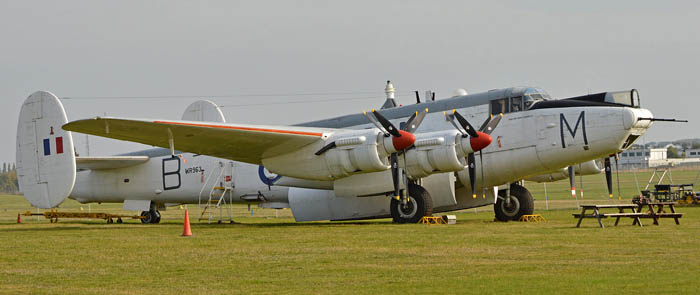
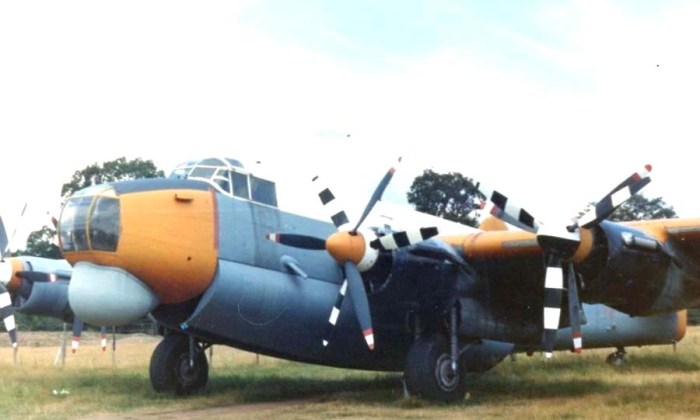
My favourite exhibit was their very colourful Avro Shackleton T4. The Shackleton was the last of the Manchester-Lancaster-Lincoln-Shackleton line and was used for maritime reconnaissance. I have clear memories of them flying over our house in South Derbyshire in the early 1960s. Presumably, they were following a Severn-Trent shortcut.

Here’s my only photograph:

The stripes on some of the eight propellers are to stop you walking into them. Here’s a photograph taken by a proper photographer. I found it on the internet:

As far as the Avro Shackleton is concerned, the British and the South African Air Force were the only countries to use it.

Here it is in even stripier hue. This particular aircraft was operated by the South African Air Force.

My Dad once saw a man walk accidentally into the propeller of a Lancaster. It affected him for the rest of his life, I always thought. He only ever spoke of it to me once.

Strathallan’s Shackleton was broken up eventually, although its nose is now in the Midland Air Museum in Coventry. Not how I envisage my own eventual fate.

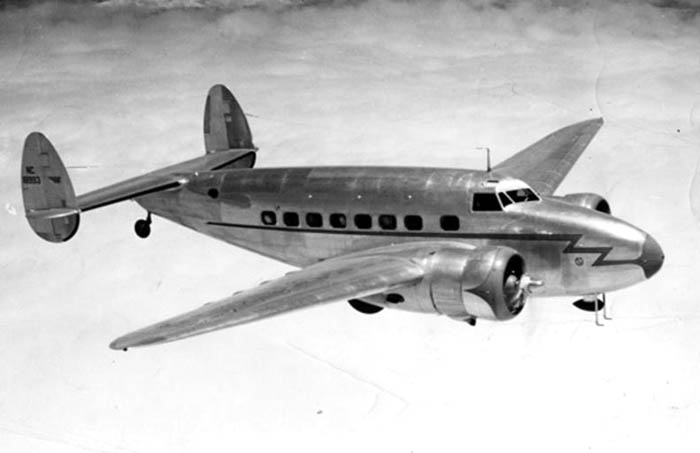
The museum had a Lockheed Hudson, an America  light bomber and coastal reconnaissance aircraft, primarily operated by the RAF. It was a military conversion of the Lockheed Super Electra airliner, and the first ever large contract for Lockheed. Here’s the Model 14 Super Electra:
 

And here’s the Lockheed Hudson at Strathallan:
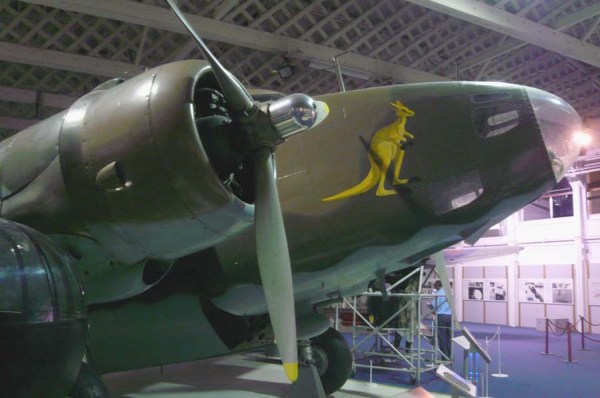
I would meet this aircraft again at Hendon and take three photographs of it, rather than just the one:

The kangaroo is the obvious link between the two encounters:

Next time, we’ll continue this mini-tour around the lost aircraft of Strathallan.

25 Comments

Filed under Aviation, Bomber Command, History, military, Personal

The Sandiacre Screw Company (11)

Let’s recap this sad, sad, tale. And I’ve also found out one or two important new facts, and I’ve found a good number of new details. So don’t just dismiss it. Take a walk 80 years back into the past…..

Ivan Keith Doncaster was born on October 17th 1923. His mother was Evelyn Mary Fell before she got married. His father was Raymond Doncaster, an engineer. Ray’s father was Sir Robert Doncaster, the founder and owner of the Sandiacre Screw Company, a huge firm, the enormous size of whose premises on Sandiacre’s Bradley Street reflected perfectly the size of the business:

Sir Robert arrived in Sandiacre, a small town of some 9,000 inhabitants, around the beginning of the twentieth century. In 1899 he was living at “The Grange” on Derby Road and by 1912, he was living at “The Chestnuts” on the same road. (Or, he had just changed the name of his house.)

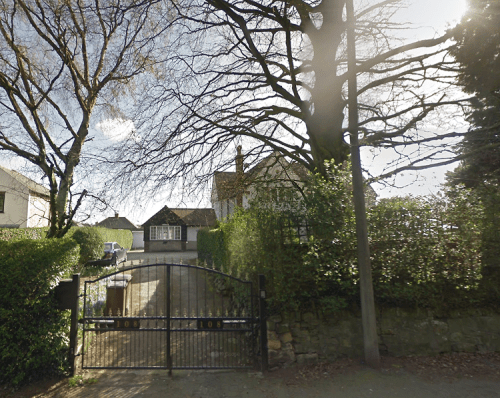
Ray and Evelyn Doncaster, Keith’s parents, lived at “Shenstone” in Longmoor Lane which is just one section of an extremely long road which runs north to south,  across the middle of the town. It begins as Ilkeston Road, then Lenton Street, then Longmoor Lane as it passes under Brian Clough Way and then finally Petersham Road.  In the 1930s, houses in Longmoor Lane were so infrequent that house numbers were not necessary. The address given to the High School for young Keith, in 1933, therefore, did not include a house number. Just “Shenstone” would suffice. The house was actually the modern No 108, to the south of Brian Clough Way, almost on the brow of the hill as you travel southwards. And this detached house, set back from the road, is absolutely enormous. It was originally built for the founder of the family firm, Sir Robert Doncaster, and was set in its own grounds, with mature trees and lots of space in every direction. It is currently pebble dashed completely white and must contain many very large and lovely rooms. One quite fascinating detail that I found out was that the house’s garage has its own minor place in history. Protected by hundreds of sandbags, it operated as one of the ARP centres for nearby Sandiacre. The ARP (Air Raid Precautions) was set up in 1937 as an organisation to protect the civil population from the worst effects of the inevitable terror bombing by the Luftwaffe. This is the house:

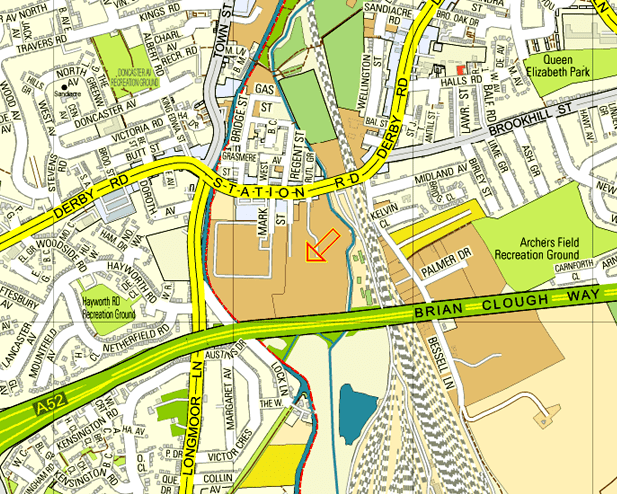
Ray Doncaster, Keith’s father, served in the army during the First World War. When he returned home in 1919, Ray became Assistant Works Manager of his father’s company. In due course, he was promoted to Works Manager, eventually replacing his father as Managing Director. He retired during the 1960s. It does not take a fortune teller to work out that, had he lived, Ray Doncaster’s only son, Ivan Keith Doncaster, would himself eventually have succeeded to that position. Instead, Keith did not come back from his war and the company eventually just disappeared. How many hundreds, if not thousands, of jobs were lost when young Sergeant Doncaster’s Lancaster was shot down? Today, the area which was occupied by the Sandiacre Screw Company is easily traceable. It is the brownish area on this modern map, with Longmoor Lane to the west and the railway tracks to the right. The Orange Arrow marks the spot:

Nowadays, this area is home to an almost uncountable number of modern industrial units, small workshops,  places where a large lorry can be loaded, places where a large lorry can be unloaded,  places to have a broken windscreen replaced, places to rent storage space, places where they carry out autorepairs, distribution centres and supermarkets. But it’s a dead place:

Just here and there, occasionally, a vehicle drives past, a car drives into one of the unit’s car parks. A van sets off to deliver car parts to Bingham. A fork lift truck driver shouts a greeting across to his friend in a lorry. It is a huge area but it certainly does not support anywhere near the huge number of people that used to work for the Doncaster family:

This slideshow requires JavaScript.

Here and there a few red brick buildings remain. And the occasional red brick wall:

They are all that is left of the Sandiacre Screw Company nowadays. Just one German bullet had such a huge effect. Initially on one 20 year old mid-upper gunner. And then the ripples spread wider, and affected a whole family. Then they touched on a whole factory and its workforce of so many hundreds of workers in a distant English town. And thirty years or so after that Lancaster plunged to earth, the workforce found they had no work, and ultimately, they had no factory.

20 Comments

Filed under Aviation, Bomber Command, History, military, Nottingham

The Sandiacre Screw Company (10)

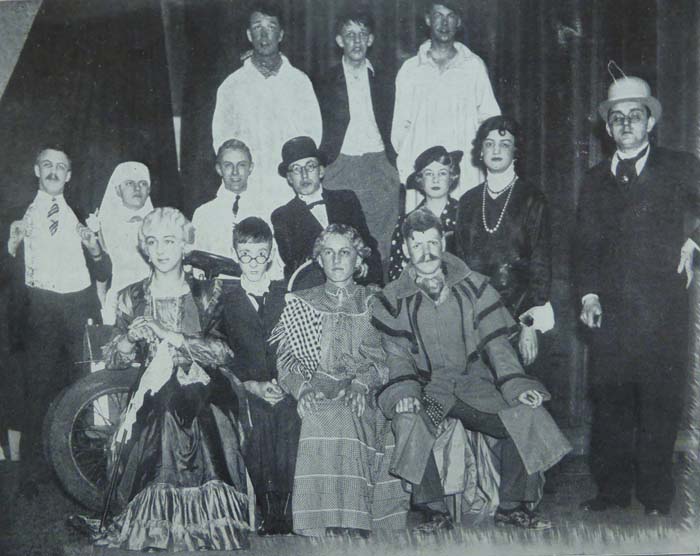
The brave young men from the High School who died defending their country have left relatively little behind them. Sometimes we have a  few blurry photographs of school plays (the “woman” next to the teacher, and the boy in the middle of the very back row);

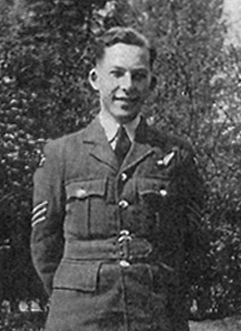
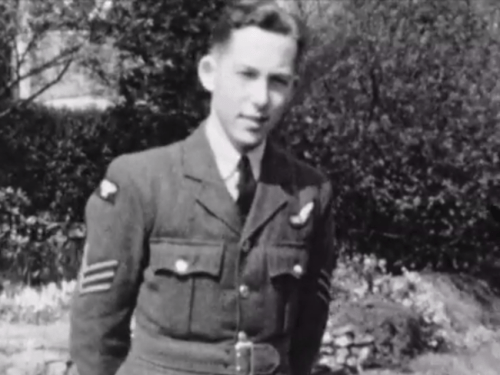
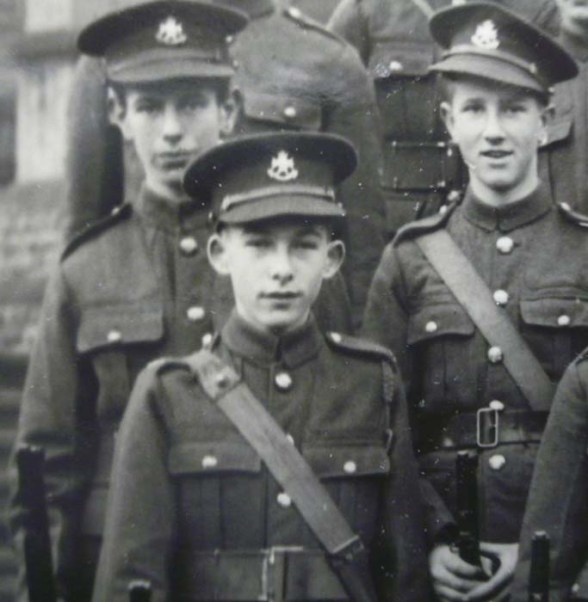
And sometimes we have a few blurry pictures of them in their uniforms:

We have some nice pieces of writing in the Nottinghamian magazine from Frank Corner and from John Walker. In the School Archives, John Grain’s school cricket blazer has hung on a hook there since 1936 and will hopefully continue to hang there until “towers cave in and walls collapse”. Whenever I saw it, I always thought that John could not possibly have imagined such a lonely fate for his blazer. No, he thought that one day in 1980. when he was 61 years old and a fat old man, he would come up to visit his old school and get them to dig out his old blazer and he’d then try it on. He’d say:

“Look! It almost fits me!”

And everybody would laugh and say:

“Why!  You can’t even get it over your shoulders! You must have grown a lot of muscles in the last forty five years! Perhaps the army made you fitter!”

And then he’d go back to his grandchildren and tell them where he’d been that day, and what it was like when he was at school.

We have a couple of Keith Doncaster’s poems.

In addition, we also have a lovely picture of the Officers Training Corps in 1937, with Keith on the left hand end of the very front row, looking extremely youthful and nowhere near his calendar age:

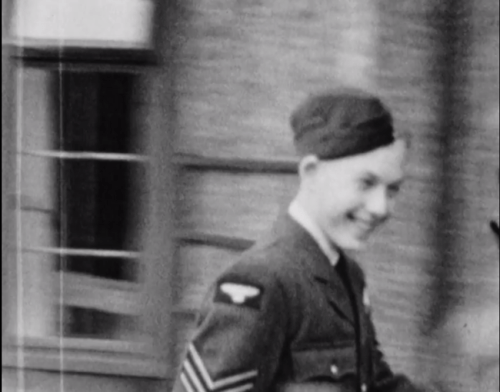
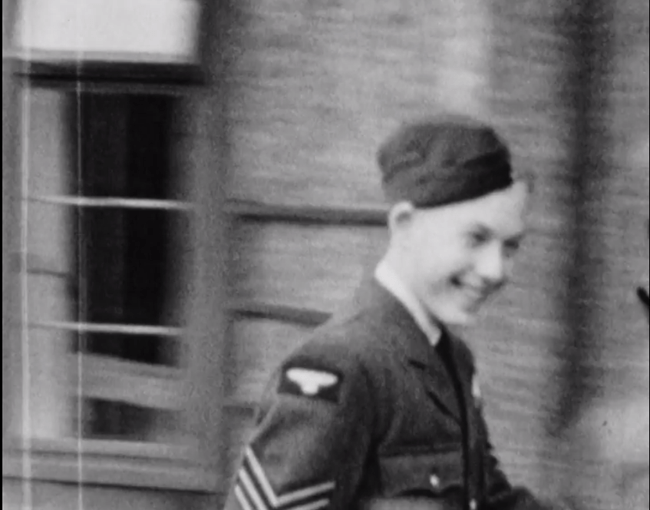
Keith Doncaster though, is the only casualty from the Second World War, of around 125 men, of whom we have a cinefilm. It was originally for sale on the internet but it can now be watched for free on BFI-Player, courtesy of the BFI, the British Film Institute. The four-minute film is silent and rather blurred, but everything is recognisable.

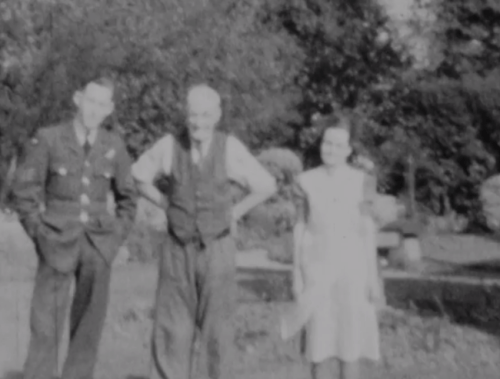
The title is “Shenstone and Longmoor Farm May-July 1943” but most of it clearly shows Keith in the garden of the family house in Sandiacre, relaxing on leave in the early summer of 1943.

Keith is in full, impeccable, RAF uniform, his hair shining with the traditional Brylcreem. He is a very slight young man, looking much younger than his actual age:

And then you can turn it into a close-up:

Then we see him walking towards the camera:

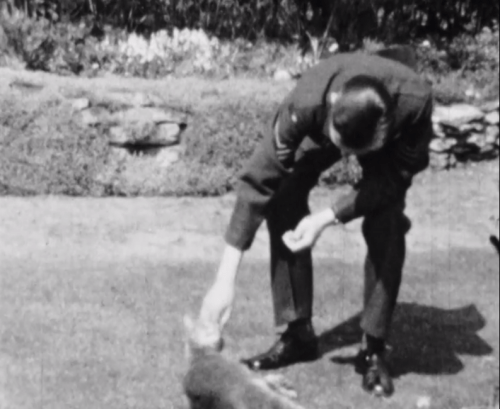
Then he’s on the lawn scratching the cat’s ears,:

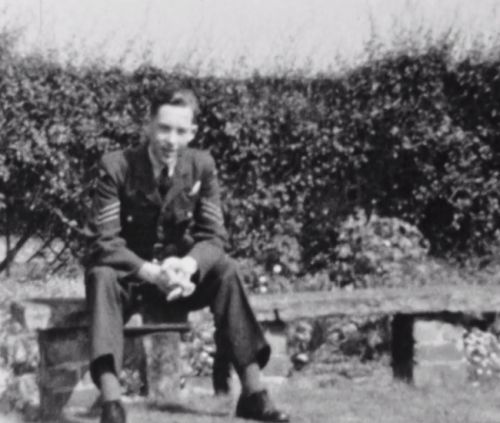
He’s walking around the lawn, and then sitting down on a garden bench:

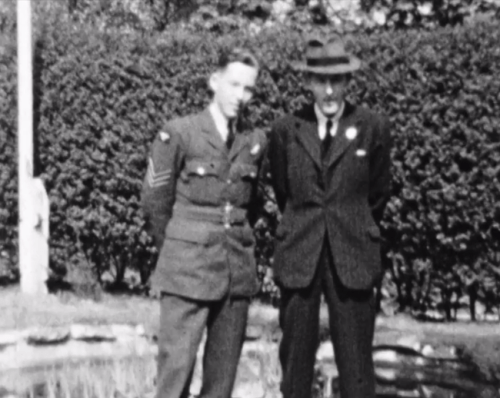
His sergeant’s stripes stand out in a pale grey world. What must be his father is there, wearing his office suit and smoking a cigarette:

A very old couple is there too. They could be Grandma and Grandad, but equally, they may well be the gardener and the cook:

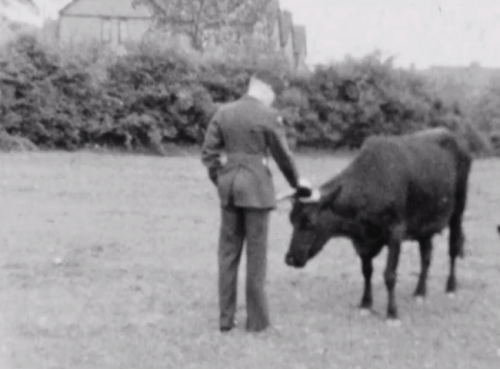
There are shots of what must be Longmoor Farm with cows. One of them is very tame and Keith can scratch the back of its head and neck just like a dog:

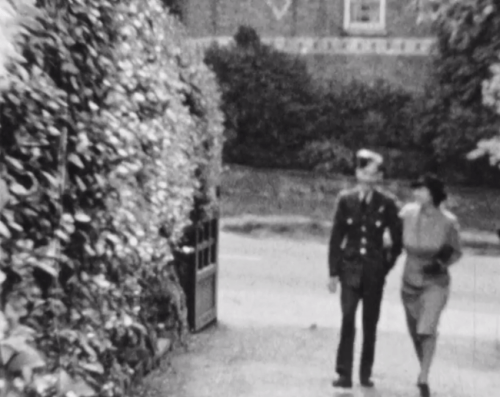
Back at Sandiacre, the humans are still a mystery. Keith is with an elegantly dressed woman that may be his mother:

Certainly Dad is there, this time without the hat:

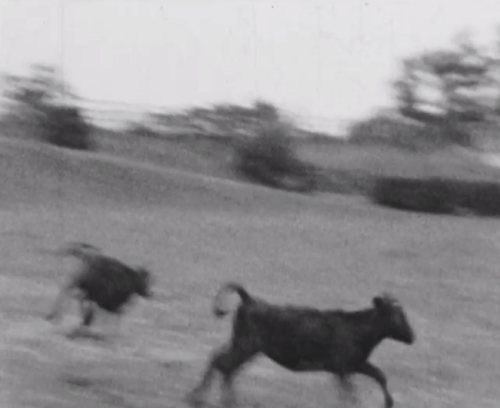
Back on the farm there is a herd of cows in a field, then two calves are let loose in a field to scamper and chase each other like two dogs:

But who are the two men? The cowmen? Alas, we will certainly never know:

And one of the stills I produced is quite lovely:

One more blog post, before Keith Doncaster fades back into history.

The home movie is available at

https://player.bfi.org.uk/free/film/watch-doncaster-shenstone-and-longmoor-farm-may-july-1943-1943-online

and of slightly lower standards of presentation, at

https://www.macearchive.org/films/doncaster-shenstone-and-longmoor-farm-may-july-1943

13 Comments

Filed under Aviation, Bomber Command, Film & TV, History, military, Nottingham, The High School

Stories about my Dad (3)

In 1946, my Dad, Fred,  gave up his exciting job as a Brylcreem Boy of Bomber Command and signed up to be for what was called at the time “emergency training” as a teacher. It has always intrigued me as to how many veterans of Bomber Command became teachers. And I have my own ideas about that! Fred finished up getting a job quite near to his home, at a school in Hastings Road in Church Gresley. The school was built in 1898 for 420 children. Fred taught there until the mid-1950s.

Here’s a modern map of the area. The Orange Arrow points to where Hastings Road School used to stand before it had to be demolished in the late 1950s, lest the subsidence problems made it collapse completely with the teachers and children inside :

When my Dad, Fred, worked there, the vast majority of the children were the sons and daughters of miners, both of coal and of clay. They were all what you would call “rough diamonds”.

Most of them, therefore, were far from sophisticated, either in their knowledge or their behaviour or, indeed, their hygiene. Fred used to tell the story of having a boy in his class called “Stinky Roberts” . At the beginning of the school year, Fred was given the helpful advice by his colleagues never to let this particular boy sit next to a hot radiator under any circumstances. If he sits next to a radiator, then make him move!

Whether it was because Fred did not believe the other teachers, or whether it was because, in the absence of any particularly obvious hygiene problem, he quite simply forgot their advice, remains unclear.  But on one unfortunate day, when “Stinky” did get to sit by that scorching radiator, the wisdom of his colleagues became manifest, as the unbelievable stench of long unwashed filth and ancient, uncontrolled urine wafted inescapably around the room. In this way, Fred learnt one of the most important basics of teaching, namely that no boy is ever given a nickname without very good reason.

At one point, Fred had a bet with another teacher that he could leave his class working quietly while he went down to Lloyds Bank in Swadlincote to draw out some money. The pupils were told to behave themselves properly while he was away, and to continue with their work. This they duly did, and Fred won the bet.

In another variation of what was obviously the same story, Fred did not go down to the bank in Swadlincote, but instead, went to post a letter at the Church Gresley Post Office, a destination considerably nearer to Hastings Road School, and, from the point of view of unsupervised children, a much shorter, and therefore, perhaps, a more plausible time to be away.

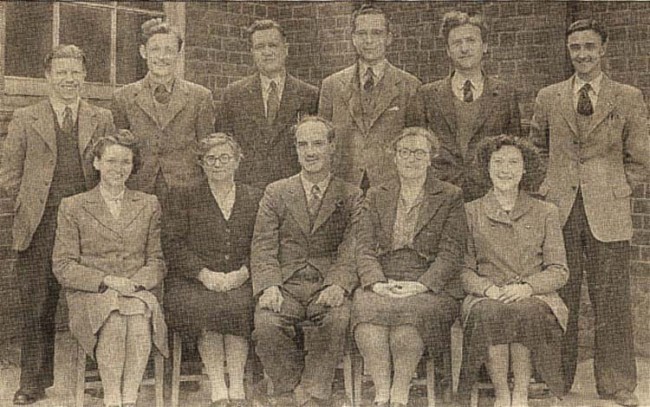
One of Fred’s more pleasant jobs was the fact that he ran the school football team. He was partnered in this by his young friend, Vernon Langford. We do actually have a misty photograph of the staff at Hastings Road. Here it is :

The teachers are (back row), Mr Morris, Mr Roberts, Mr Baker, Mr Picker, Mr Goodall and Mr Knifton. The front row comprises Miss Rowe, Miss Smith, Mr Handford, Mrs Errington and Mrs P Middleton.

Fred’s teaching career at Hastings Road reached its pinnacle when he was conducting a lesson in Physics. At this time all secondary school teachers, even those who were trained to teach Geography, were expected to be able to turn their hand to more or less anything.

Fred’s brief was to demonstrate the effects of air pressure, so he took a pint glass, filled it with water, and then put a sheet of card over the top. He then explained that in a moment, when he turned the glass upside down, the contents would not spill out, because the air pressure on the card, which was equal to hundreds of pounds, was pressing down and keeping it in place. This news was received by the children, of course, with immense scepticism.

When Fred turned the glass over, however, perhaps as much to his surprise as anybody else’s, the rather unlikely result was that the card did actually stay in place, and the water did not spill out. The children’s reaction was astonishing. They were all totally amazed. One boy stood up, and shouted at the top of his voice, “A miracle ! A miracle ! Mester Knifton’s worked a miracle ! ” And then he ran out of the room and around the school, still shouting

“A miracle ! A miracle ! Mester Knifton’s worked a miracle ! ”

I believe that this incident was the closest that Fred ever came to being regarded as divine. Here’s a video of a mere mortal man trying out this trick:

23 Comments

Filed under Aviation, Bomber Command, History, Humour, my Dad, Personal, Science

The Sandiacre Screw Company (9)

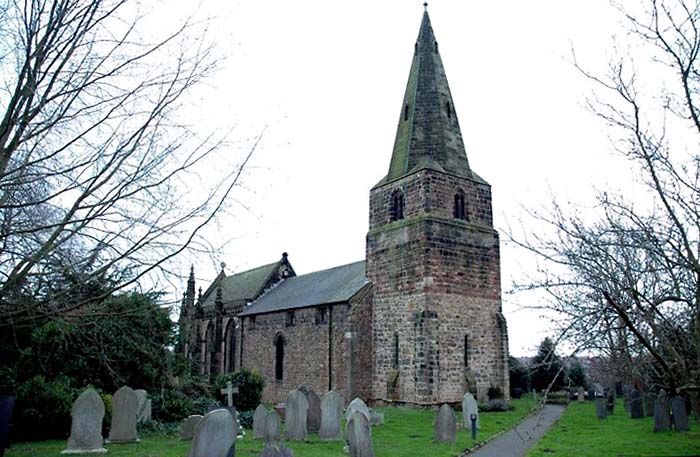
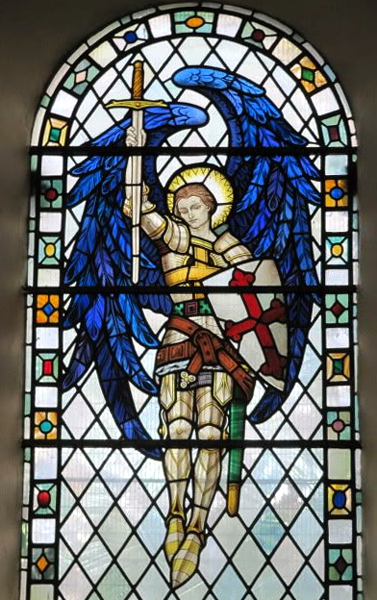
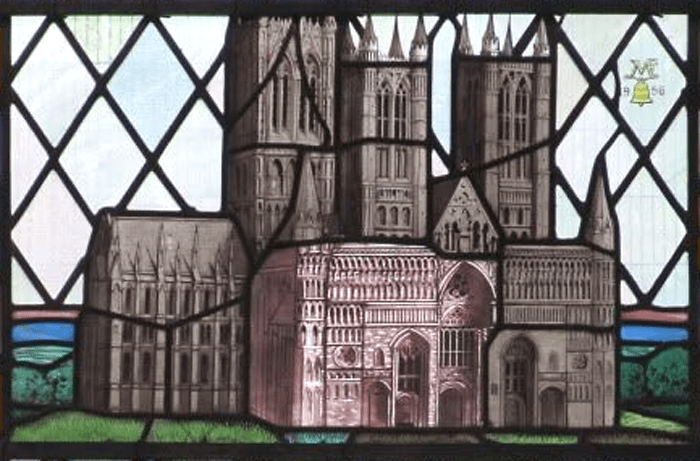
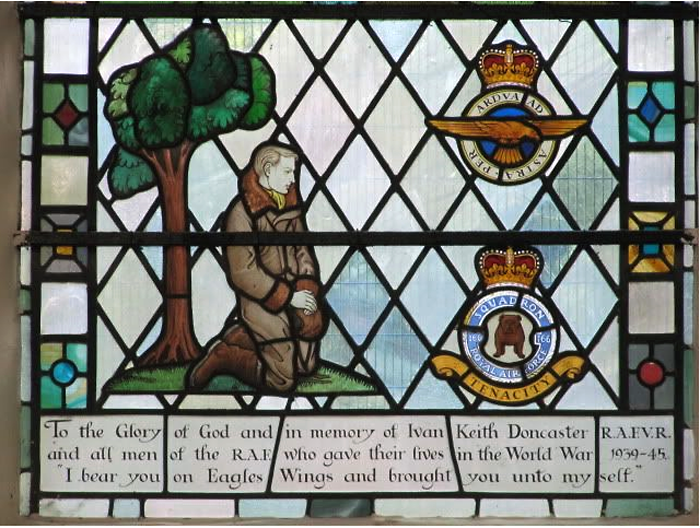
There is a rather beautiful stained glass window to the memory of young Ivan Keith Doncaster in St Giles’ Church in Sandiacre in Derbyshire.

It has a wonderful representation of St George with his sword and shield. Notice how he is flying, totally in keeping with an RAF casualty :

Lower down, Lincoln Cathedral is included:

There is also a superb illustration of an airman kneeling in prayer under the Tree of Life. To the right is the badge of the RAF with “Per ardua ad astra” and the badge of 166 Squadron, with its bulldog and its motto of “Tenacity” :

In the Long Eaton Advertiser, in Keith’s obituary, the local newspaper said that he was “thoughtful, quiet and unassuming, with a great love of the land and the country people”.

On his gravestone, Keith’s parents had the following inscription:

“To live in hearts we leave behind is not to die”.

The wireless operator, Edward Ellis Jones, had slightly more direct feelings expressed:

“He gave his life that others might live. God bless him”

These sentiments are echoed by the words on the gravestone of Roy Elkington Ault, the bomb aimer:

“He died so that England might live”.

Similar feelings to these were expressed by Keith in his “Last letter”, the letter which is left behind, sealed, and may only be opened by parents or wife in the event of the writer’s death:

“These ops are what we have been training for, for many months. Now is our chance to make this earth a place for decent people to live in. I hope that the seven of us can flatten a large number of German homes as well as factories during our tour of ops. If I do have to go then I only hope that I can have a good chance to do some damage over there first. If that happens I shall die in the way that any Englishman would want to—fighting for his country.”

There are two more blog posts in the future to round off this tragic tale. And by the way, the pictures of those beautiful stained glass windows were originally put on the internet by “Berenice UK” in 2015.

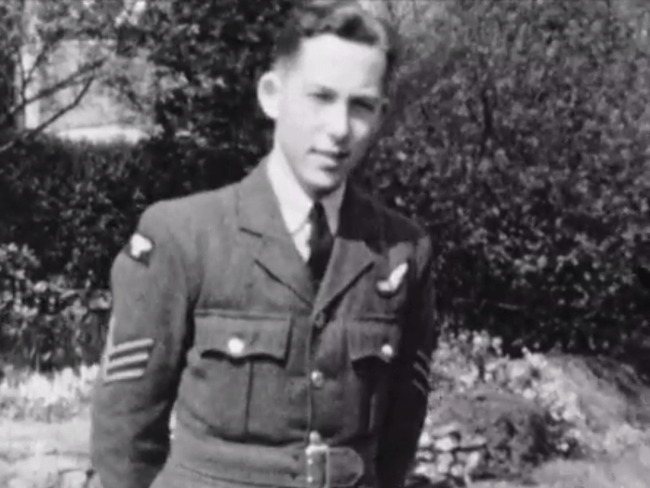
Here’s Keith at the High School again:

Here he is in the RAF……..

And here he is at home as Sergeant Doncaster, mid-upper gunner…..


20 Comments

Filed under Aviation, Bomber Command, History, military, Nottingham, The High School

The Sandiacre Screw Company (8)

Ivan Keith Doncaster was lost on a raid on Kassel by 166 Squadron on October 22nd 1943.  He was the mid-upper gunner in  “Z-Zebra”, an Avro Lancaster Mk III with the squadron letters AS-Z and the serial number EE196…..

The morning after “Z-Zebra” had crashed, and most of the crew had been killed, including Keith Doncaster,  the flight engineer, Arthur Pilbeam, had the appalling task of identifying the four corpses which had so far been found. He thought that they all had been killed by the exploding bombload or had been unable to pull their ripcords after they jumped because they were unconscious.

I have been unable to identify any likely German pilot who might have pulled the trigger. When so many black painted aircraft were shot down in the pitch black, there were so many claims that hardly any of them can be verified:

Let’s take an example from the night of October 22nd-23rd 1943. Oberleutnant Hermann Bertram claimed a four engined aircraft “35 km N Kassel” at an altitude of 4,200 metres. How do we know if it was a Halifax or a Lancaster? Was he definitely “35 km N Kassel”? Did he see it crash? And so on.

Oberleutnant Bertram is not a liar. He is a young man who cannot possibly be 100% certain of what happened. And the same would apply to a very long list of night fighter pilots who might possibly have shot down “Z-Zebra”. These men claimed to have destroyed a Lancaster or a Halifax or a “4-mot flugzeug” and they mentioned Kassel in their claim. No doubt the list is incomplete:

Horst-Rüdiger Blume, Fritz Brandt, Franz Brinkhaus, Victor Emanuel, Leopold Fellerer, Erwin Glass, Ernst Haase, Alfred Heldt, Johannes Hiedlmayer, Werner Hoffmann, Horst John, Otto Kutzner, Hans Leickhardt, Richard Lofgen, Erich Metz, Manfred Meurer, Klaus Möller, Hans von Niebelschütz, Günther Nord, Heinz Oberheide, Ruprecht Panzer, Erhard Peters, Günther Radusch, Lothar Sachs, Josef Sallmütter, Heinrich zu Sayn-Wittgenstein, Heinz-Wolfgang Schnaufer, Eduard Schröder, Helmuth Schulte, Paul Streuff, Gustav Tham, Kurt Welter, Gerhard Witt, Achim Wœste, Josef Wolfsberger and Fritz Yung.

And here are four of them:

This slideshow requires JavaScript.

Eventually, all six of the crew of “Z-Zebra” were found. They were buried in Schwalenberg Cemetery on October 25th 1943. On September 18th 1947, they were all re-interred at Hanover War Cemetery. They occupy five graves that must be next to each other.

Keith Doncaster occupies Grave No 16.E.1, Edward Ellis Jones occupies Grave No 16.E.2, Roy Elkington Ault occupies Grave No 16.E.3, Victor George Deacon occupies Grave No 16.E.4 and Charles Neville Hammond occupies Grave No 16.E.5. The sole American, John Murray Walton, was reburied in the Ardennes American Cemetery at Neuville-en-Condroz in Belgium on an unrecorded date.

The Lancaster’s pilot, Charles Neville Hammond, received a posthumous Distinguished Flying Cross for his bravery and self-sacrifice as he struggled to fly the stricken Lancaster straight and level so that its crew could all escape the burning aircraft.

16 Comments

Filed under Aviation, Bomber Command, History, military, Nottingham, The High School

The Sandiacre Screw Company (7)

Six young men were killed in Keith Doncaster’s bomber, which was lost on a raid by 166 Squadron on Kassel on October 22nd 1943. Keith was the mid-upper gunner in  “Z-Zebra”, an Avro Lancaster Mk III with the squadron letters AS-Z and the serial number EE196. The fact that he was engaged in a raid on Kassel does actually establish a rather tenuous link with my own father, Fred Knifton, who, at the time, was with 103 Squadron at Elsham Wolds. My Dad had been involved on the raid on Peenemünde in an effort to prevent the Germans developing the V1 and the V2. All of the participants, in all of their different briefing rooms, were told…..

“If you don’t destroy thr target tonight, you’ll have to go back the following night. And the the night after that and the next night, until the target is destroyed.”

Keith Doncaster’s raid on Kassel was a kind of a follow up to my Dad’s efforts. This time the bombers were after the Fieseler aircraft works which were heavily engaged with developing and manufacturing the guidance gear used to keep both the V1 and the V2 on the right track. And the raid was successful. Kassel was, to all intents and purposes, “flattened”.

The pilot of “Z-Zebra”was Charles Neville Hammond, the son of Thomas Neville Hammond and Doris Hammond from Llanrug in Caernarvonshire, and the husband of Mary Hammond of Odiham in Hampshire.  This is Llanrug, a quiet little town:

This slideshow requires JavaScript.

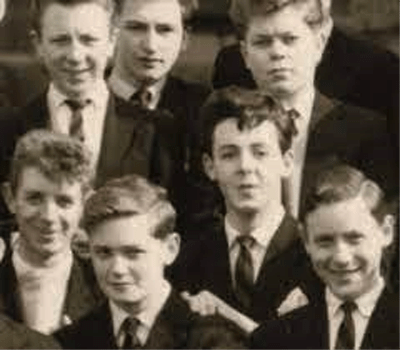
Charles was 23 years old. He had begun his RAF career as a Leading Aircraftman before receiving an emergency commission. He had previously attended the Liverpool Institute High School for Boys, a grammar school which numbered Paul McCartney and George Harrison among its old boys. What a school photograph this is:

The navigator was Master Sergeant John Murray Walton who was 21 years old. John was serving with the 12th Replacement Control Depot of the USAAF.  He was the son of an American couple, Melville R Walton and Mabel Walton although he was born in Ontario in Canada. He was a Canadian citizen by reason of his birth and an American citizen by reason of his parents’ nationality. John had joined the Royal Canadian Air Force but then, like thousands of others, he flew with the RAF. He was the navigator and one of the very few men in World War 2 with a Distinguished Flying Medal, an Air Medal and a Purple Heart:

This slideshow requires JavaScript.

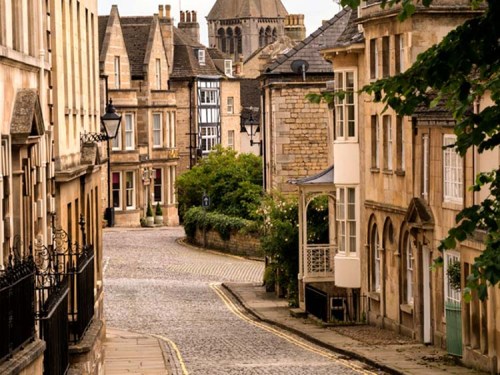
The bomb aimer was Roy Elkington Ault, the son of Reuben John Ault and Olive Eugenie Ault from Sidcup in Kent, although Roy was born in Stamford in Lincolnshire. He was 22 years old. He too, began as a Leading Aircraftman before receiving an emergency commission. Here’s Stamford, another quiet little town, with all the buildings of that warm yellow-orange colour:

The wireless operator was Edward Ellis Jones, the son of Evan Jones and Mary Ellen Jones. He was born at Ammanford, a tiny community in Carmarthenshire in South Wales. He was the husband of Margaret Jones who lived in Wembley in Middlesex. Edward was 32 years old. He had originally been a sergeant before receiving an emergency commission:

This slideshow requires JavaScript.

Keith Doncaster, the mid-upper gunner, was 20 years and 5 days old.

The rear gunner was Victor George Deacon, the son of George Victor Deacon and Edith Elizabeth Deacon. Victor came from Brixton in Surrey. Here’s Brixton and a distinctive building Victor might have been familiar with:

Victor was 35 years old and his wife was Lilian Elizabeth Ruskin who lived in Long Eaton in Derbyshire. They had a son called James Deacon. Long Eaton is only three miles from Keith’s house in Sandiacre and Keith had been a member of the Long Eaton Air Training Corps. Did these two young men ever travel home together on leave? Did they visit each other’s families? Did Keith ever look wistfully at little James and wish that he had a son of his own? Long Eaton Air Training Corps are still in business today:

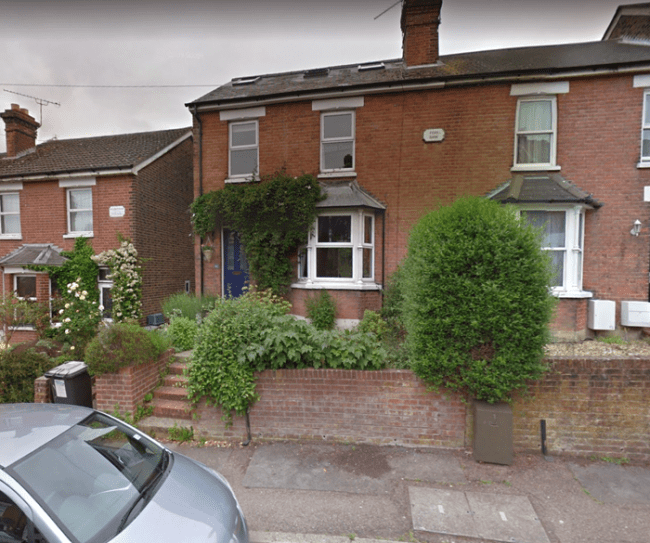
The flight engineer was the only survivor. He was Arthur Iden Pilbeam from Kent. His father, also called Arthur Iden Pilbeam, was a baker and lived at 66 St Mary’s Road in Tunbridge Wells, which I found on that all-seeing google application:

His mother was Mary Pilbeam and his wife was Irene Lilian Pilbeam née Abbott. After being captured, Arthur became Prisoner of War No 261472 at Sagan, then Belaria and finally at Mühlberg (Elbe). After the war he became a fruiterers’ manager and a member of the Worshipful Company of Fruiterers. Arthur lived to a ripe old age, passing away in Chichester in Sussex at the age of 92. Good for him!

Keith’s aircraft had been shot down by a night-fighter, around sixty miles short of Kassel. It crashed at Brakelsiek, roughly 110 miles from Düsseldorf and to the NNW of Kassel. The only survivor, Arthur Pilbeam, has actually supplied an account of what happened. A night-fighter attacked without warning and one wing of the Lancaster burst into flames. The pilot struggled with his damaged controls to give everybody time to escape, but the stricken Lancaster went into a spin after one of the bombs exploded, hit by a cannon shell from the night-fighter. Seconds later, the whole aircraft blew up. Here’s a nice old building in Brakielsk:


21 Comments

Filed under Aviation, Bomber Command, History, military, Nottingham, The High School

The Sandiacre Screw Company (6)

Keith Doncaster took off on his last mission with 166 Squadron at 18:12 hours on October 22nd 1943 from RAF Kirmington, 11 miles south west of Grimsby in Lincolnshire. Here’s what RAF Kirmington looks like today:

Keith was in “Z-Zebra”, an Avro Lancaster Mk III with the serial number EE196 and the squadron letters AS-Z . During the course of the war, because of the astonishing levels of bomber losses, nine different aircraft in 166 Squadron were to carry those letters of AS-Z, “Z-Zebra”. That means, over time, 63 different young men as crew, of whom a minimum of 54 would have experienced disaster of some kind, up to, and including, their own deaths.

There were also nine different aircraft for AS-E, “E-Edward”, (63 more young men’s lives risked) and for AS-F, “F-Freddy”, (63 more) and for AS-N, “N-Nuts”, (63 more) and for AS-S, “S-Sugar”, (63 more). Those five different letters, then, E, F, N, S and Z, accounted for 45 Lancaster bombers and 315 young men all put into extreme danger.

In an Avro Lancaster, if the aircraft was shot down, only one man of the seven crew, on average, escaped with his life. That makes 54 young men killed in the nine different aircraft which carried the letter “Z”. And overall, those five different letters, E, F, N, S and Z, accounted for 270 young men, all of them in all probability, killed.

The members of the crew all had a financial value and cost. The Head of Bomber Command was Arthur Harris, aka Bomber Harris, aka Butcher Harris (to his men). Harris always used to reckon that to train just one member of a Lancaster crew cost as much as sending six men to Oxford or Cambridge for three years. Whether that is true or not, we do know that the actual figure was £10,000, although the website did say that that total is expressed in 1943 prices. Allowing for inflation, in today’s money, the cost becomes £500,000 per man.  And the crews of those five different letters, E, F, N, S and Z, therefore, were trained at a cost of around £135,000,000.


That all created some startling casualty figures for Bomber Command. A total of 51% of all bomber crew were killed on operations, 12% were killed or wounded in non-operational accidents and 13% became prisoners of war.  Just 24% survived.

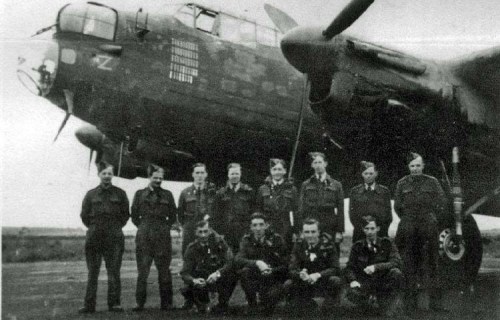
Those five letters, E, F, N, S and Z, also stood for enormous sums of money. In the early 1940s, Lancasters cost, in today’s money, around £2,000,000 each. Those 45 aircraft would therefore have cost £90,000,000. Here’s “Z-Zebra” and its crew, possibly with the members of the ground crew ho kept if flying…….
Never forget, though, that there is a difference between “cost” and “value”. Let’s look at two sentences……
“What is the cost of just one of those aircrew to the RAF?”
“What is the value of just one of those aircrew to his family?”
Here’s the crew of Z-Zebra, and, presumably, five of the ground crew who kept them flying……..

Tonight, the target was Kassel, a city to the northeast of Frankfurt. No satellites in those days meant that accurate weather forecasts were very rare and the bombers frequently encountered unforeseen meteorological difficulties.

And so it was on this occasion, when 569 bombers, including 322 Lancasters and 247 Halifaxes, set off for Kassel. Twenty of them encountered heavy rain, ice formed on the aircraft and they were forced to turn back. Other various problems forced 39 more bombers to turn back. Eventually, 444 aircraft arrived at the target, 78% of the original force.

Kassel was a prime target because of the Fieseler aircraft factory, the Henschel & Sohn factories producing Tiger tanks, an engine factory, a motor vehicle factory, and the headquarters of the organisation responsible for all railway and road construction in central Germany as well as two military headquarters and the regional supreme court. Kassel housed the headquarters of Military District 9 and the local satellite camp of Dachau provided slave labourers for the Henschel factories.

The 444 survivors from that original force dropped 2,000 tons of bombs and an amazing 460,000 incendiaries. Native speakers were used, broadcasting from special Lancasters, to give the German night fighter pilots incorrect orders over the radio or to countermand their previously given orders. A diversionary raid on Frankfurt, by 28 Lancasters and eight Mosquitoes caused further confusion.

The main target was marked exceptionally well and the bombs fell extremely accurately, creating a minor firestorm, made all the more severe when the main telephone exchange and the city’s water supply were put out of action.

4,349 blocks of flats containing 26,782 individual family flats were demolished. The bombers damaged 6,743 more blocks, containing 26,463 individual units. 120,000 people became homeless. There were 1,600 major fires and a thousand smaller ones. Overall, 160 industrial premises were flattened, along with 140 government buildings. At this time Henschel were manufacturing V-1 missiles, so this severe damage impacted hugely on the date of the first launchings against England. Two German spectators watch the spectacle :

Kassel was devastated and burned for seven more days. Casualties were dug out of the hot rubble for weeks. 5,600 people were killed and 3,300 just disappeared, cremated in the firestorm and its week long aftermath. After the previous raid of October 3rd-4th 1943, up to 90% of the city centre was now destroyed. There were only two more significant raids on Kassel during the rest of the war. One on the Henschel motor transport plant, and the RAF’s final farewell on March 8th-9th 1945. The RAF really had done an enormous amount of damage:

All of this success had its price though. That night, 241 men were killed as 25 Halifaxes and 18 Lancasters were destroyed. On the way to Kassel anti-aircraft fire accounted for three bombers, and night-fighters claimed a couple more. The anti-aircraft fire at Kassel, aided by 70 searchlights, brought down five more bombers. Searchlights could be a formidable opponent, especially if they had a cathedral to defend:

This slideshow requires JavaScript.

The night-fighters then struck as they returned home. No 10 Squadron lost 21 men, with further losses from No 12 Squadron (eight men), 35 Squadron (two men), 49 Squadron (nine men), 50 Squadron (one man), 51 Squadron (seven men), 57 Squadron (ten men), 61 Squadron (six men), 76 Squadron (eight men), 77 Squadron (ten men), 78 Squadron (six men), 100 Squadron (five men), 102 Squadron (eight men), 103 Squadron (19 men), 158 Squadron (14 men), 166 Squadron (12 men), 207 Squadron (nine men), 408 Squadron (seven men), 419 Squadron (five men), 427 Squadron (26 men), 428 Squadron (one man), 429 Squadron (11 men), 431 Squadron (seven men), 434 Squadron (22 men) and 467 Squadron (seven men).

In addition to these 241 men killed, 71 became prisoners of war. This constituted a completely unsustainable loss rate of 7.6 %. In other words, at that rate, nobody would live to carry out more than fourteen missions.

Not many of the young men in this photograph will be over thirty:

19 Comments

Filed under Aviation, Bomber Command, History, military, Nottingham, The High School

The Sandiacre Screw Company (5)

Young Keith Doncaster, whom we have met already four times, was a mid-upper gunner, who sat in a perspex dome half way along the bomber’s fuselage. He protected the aircraft from attacks originating from above the horizon, mostly diving attacks from the rear. His turret was rather like an upturned goldfish bowl and could become extremely hot on occasion. That occasion was quite rare, and cold, particularly at altitude and at night, was a far more frequent problem:

An ex-Lancaster gunner, Russell Margerison, listed the clothes he wore for each mission:

“Women’s silk stockings, woollen knee-caps, woollen long johns with sleeves and a high neck, a shirt, trousers, ordinary socks and over those, long woollen ones. Then a thick pullover, a battle-dress top, a heated suit, an outer suit of kapok, electrically heated slippers, fur-lined boots, silk gloves, heated long gloves, and leather gauntlets. And anti-freeze ointment on any exposed flesh.”

If the perspex was shot away, temperatures might drop to 60° below.

Margerison said that the gunners hardly ever fired their guns. If anybody spotted an enemy aircraft, they would shout: “Corkscrew port !!” or “Corkscrew starboard !!” and the supremely agile thirty ton bomber would embark on its famous twisting and turning manoeuvre which no German fighter could possibly keep up with, especially in darkness:

Keith would have been familiar with this life. Ruled by superstition, clothes were always put on in a set sequence and mascots such as lucky dolls or toys were always taken along. And there were “chop girls”, young ladies whose boyfriends kept getting killed and whom nobody would date any more, no matter how pretty they were. And then there was the constant hunt for fuel for the metal stove in the middle of an icy Nissen hut:

The crew were the most important people in Keith’s life. Outside these seven men, you were a fool to make other close friendships when life expectancy was six weeks with just four weeks for a rear gunner. Only your family counted for more than your crew:

Before D-Day, 65% of crew members were killed before they completed their “tour” of thirty missions. Each mission carried a 4% chance of being shot down. Overall, the casualty rate was around 45%, and eventually 55,573 men would be killed. The death rate in the US Eighth Air Force was considerably lower. This was because they wore their parachutes during missions. Those silken life savers were not stored away from the owner. And the Eighth Air Force flew in daylight when it was easier, theoretically, to get out of the plane:


17 Comments

Filed under Aviation, Bomber Command, History, military, Nottingham, The High School