Category Archives: Bomber Command

To bale out or not to bale out? (7)

In a previous post in this series, “To bale out or not to bale out? (3)”,  I told the story of Harold Pronger who baled out of a Lancaster bomber when the aircraft looked likely to crash because of mechanical problems. But like the rest of the crew, Harold survived. And so did the pilot, Flying Officer B.C. Fitch, who stayed with the aircraft. It was as if Lancaster LM360, like a living being, seemed to have made a sudden recovery from all the problems that had previously beset it:
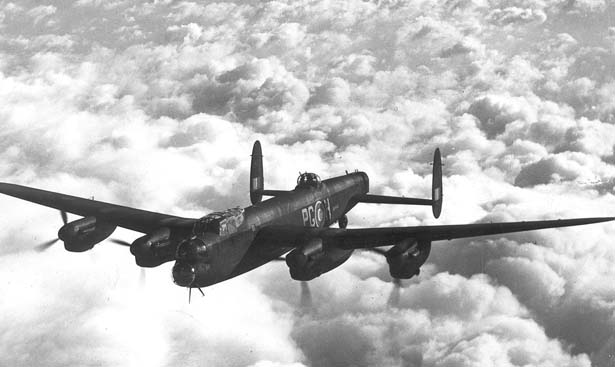
And so, Fitch was able to land without incident at RAF Winthorpe, despite repeated episodes of losing height, an inability to climb, the mid-upper turret out of commission and an engine on fire. Here is RAF Winthorpe today:

What the members of the crew did not necessarily know was that this Lancaster, LM360,  somehow was aware that it had a glorious destiny in its future, and it was making damned sure that it survived to achieve it.
That day, or rather night, of destiny began for Lancaster LM360 on November 3rd 1943, when O for Oscar took off from its base at RAF Syerston, piloted by Flight Lieutenant William Reid. He and his crew were tasked with bombing industrial facilities in and around Düsseldorf.

On the way, just after they crossed over the Dutch coast, at 21,000 feet, they were attacked by a Messerschmitt Bf 110G-4 night fighter:
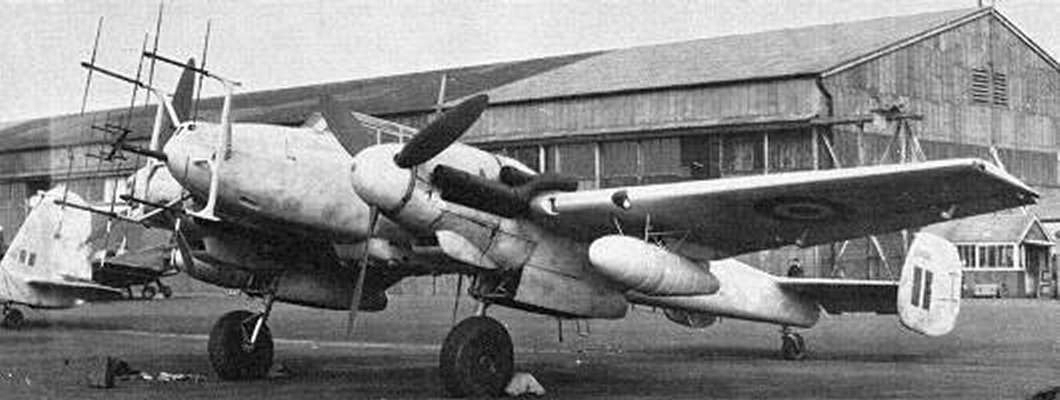
The Luftwaffe fighter caused enormous damage to the front gun turret and the aircraft’s steering system, but most importantly, the pilot’s windscreen was smashed and it was no longer able to protect the crew from the cold of a November night at 20,000 or so feet above the ground.

What a pity that the aircraft’s heating system had not been working before the attack, so that the rear gunner, his hands frozen and stiff, had been unable to open fire on the German aircraft or even to warn the pilot over the intercom about the night fighter’s arrival. The stricken Lancaster lost more than 15,000 feet of altitude but Bill recovered, fortunately, just before they hit the ground.
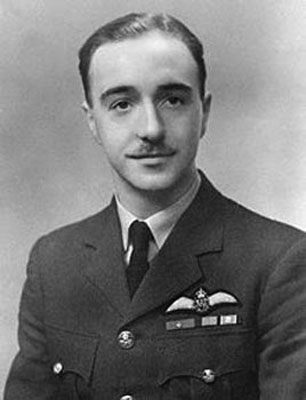
Bill was badly wounded but said absolutely nothing about his own injuries. The intercom system was not working and the compasses were unusable. The decision, though, was made to carry on to the target:

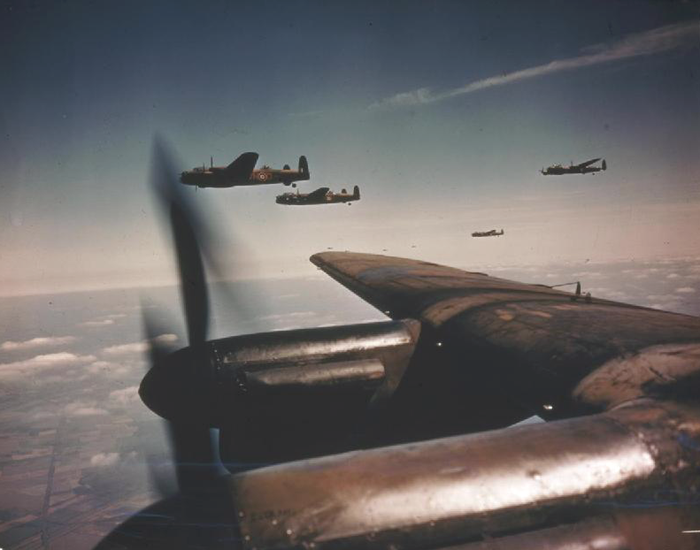
The Lancaster was then attacked for a second time by a Focke-Wulf Fw 190 single seat fighter which raked them with cannon fire from nose to tail. The navigator was killed outright and the wireless operator received severe wounds. Bill was hit for a second time and so was the flight engineer. The starboard section of the tailplane had been shot off, the bomber’s communication system didn’t work and there was no oxygen supply.  The flight engineer, wounded in the arm, found a bottle or two of oxygen and held them up for Bill to breathe from. Bill, who, as always, had previously memorised the course to fly for the mission, still kept to the plan. He reasoned that turning round now would entail crossing through a bomber stream of 600 aircraft, which would have been rather dangerous, and that their aircraft would then have become a vulnerable unprotected lone sitting duck. Here is a tiny part of a bomber stream:
So on they went for the next 50 minutes and 200 miles and they bombed their target at Düsseldorf successfully. It was a ball bearing factory which Bill actually recognised.

And then, they turned for home. By now Bill was weak from loss of blood, lack of oxygen and the cold icy blast coming through the broken windscreen. That cold icy blast was actually freezing the blood from his head wound as it seeped into his eyes.  There was a very real risk that Bill would not be capable of lasting all the way back to Syerston. The flight engineer and bomb aimer took over control of the plane, when Bill lapsed into semi-consciousness. But on and on they flew, despite the heart stopping moment when all four engines stopped but then just as quickly restarted. Heavy anti aircraft fire over the Dutch coast missed them. Minute by minute, mile after mile into the darkness. The first moment of happiness, the English coast. And then as they flew over Norfolk, the crew noticed the lights of the airfield at Shipdham, 5 miles south-south-west of Dereham:

Despite vision limited by blood in his eyes, Bill revived somewhat and he carried out a fine landing, although the landing lights were hidden by fog rising in the early morning. The Lancaster’s undercarriage gave way on one side and they skidded down the runway. The wireless operator was taken immediately to the medical centre, but, unfortunately, he died there of his injuries. The story of Bill Reid’s bravery is repeated many times on the Internet, but this was the website I used as the skeleton.

I must have looked at more than 20 websites. Only one named the rest of his crew. They were:

Flight Sergeant J.A. Jeffreys (Navigator)

Flight Sergeant L. Rolton (Bomb Aimer)

Flight Sergeant J.W. Norris (Flight Engineer)

Flight Sergeant J.J. Mann (Wireless Operator)

Flight Sergeant D. Baldwin, D.F.M. (Mid-Upper gun turret)

Flight Sergeant A.F. ´Joe´ Emerson (Rear gun turret)

Flight Sergeant John Alan Jeffreys, the Navigator, was killed outright during the attack by the Fw 190 night fighter. He was a member of the Royal Australian Air Force and he was 30 years old.  He came from Perth in Western Australia, and he was the son of John Alfred Jeffreys and Amelia Jeffreys. He was the  husband of Florence Isobel Jeffreys. John was buried in Cambridge Cemetery.

Flight Sergeant John James Mann was the Wireless Operator who sadly died in the medical centre at Shipdham. He was only 22 and he was the son of James Mann and Dora Mann, of Liverpool. He was buried in Bootle Cemetery.

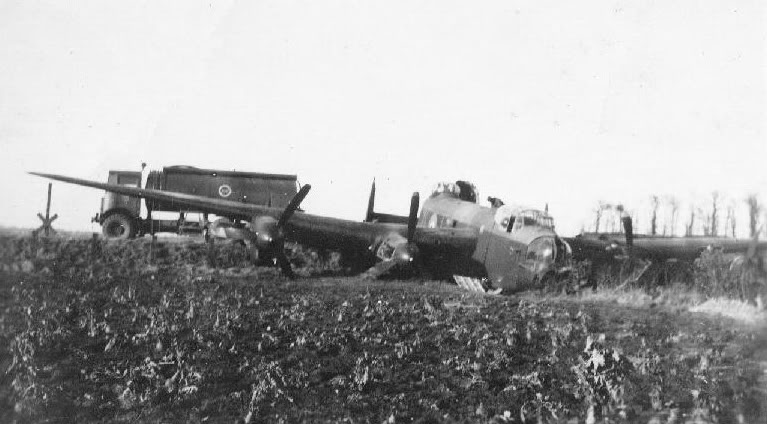
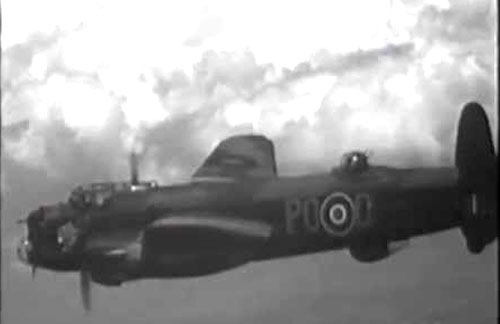
Here’s the Lancaster that brought them back, looking a little the worse for wear :


19 Comments

Filed under Aviation, Bomber Command, History

The End of the War in Europe and Church Gresley (3)

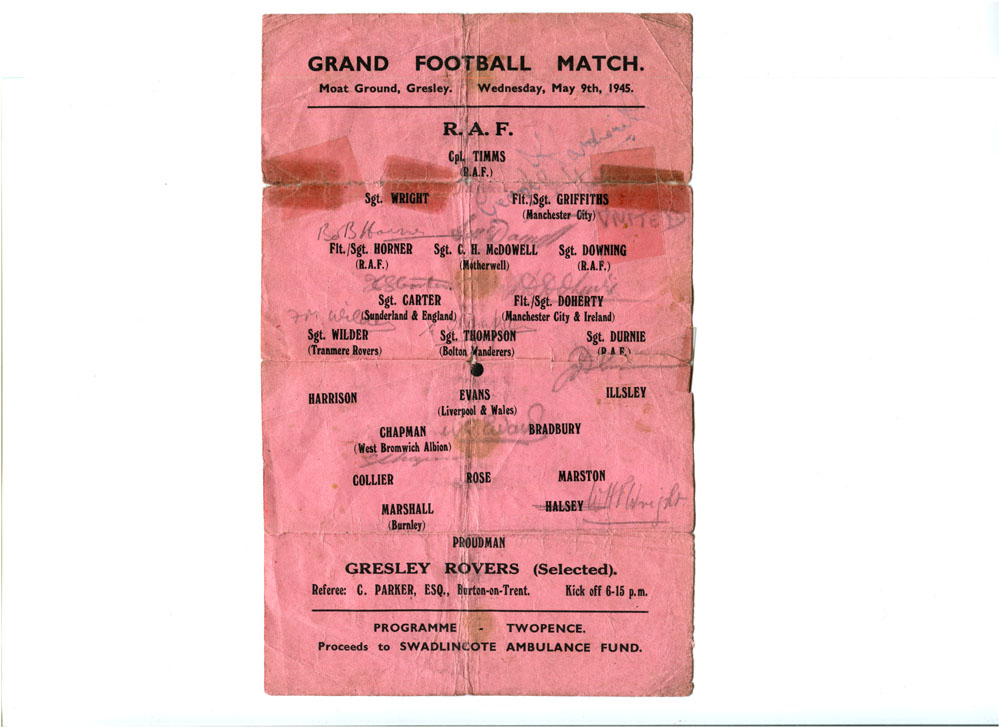
In my most recent post on this topic, I looked at the RAF team in a celebration match played in Church Gresley, the neighbouring village to the one where I grew up. The game took place on May 9th 1945 to commemorate the end of the war in Europe. We have already looked at the RAF team:

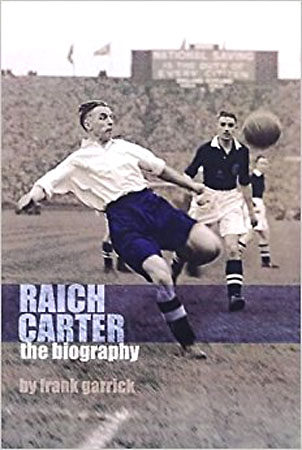
It was captained by Raich Carter, the only man to have won the FA Cup both before and after the war. The people are King George VI, the Queen and a young Raich Carter. Adolf Hitler is fooling nobody with that dyed blond hair:

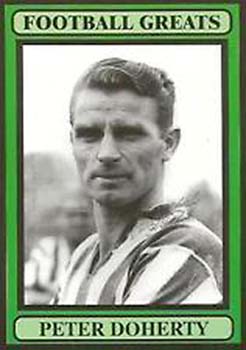
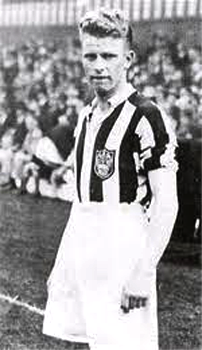
The other star player was Peter Doherty of Northern Ireland:

Here is what I found out about the players of Gresley Rovers (Selected) who opposed them. A very large proportion of the information came from the superb Player Database, which is now a feature of the Gresley FC website, having appeared for many years on the Gresley Rovers website.

Most of the Gresley players were local men and worked “down pit” as miners. Being a miner was a reserved occupation so they were not involved in combat situations. It is true to say, though, that many miners did a job which was statistically much more dangerous than that of many soldiers or sailors. This is a picture of what was then a heavily industrialised area, with clay and coal mining as well as the fabrication of huge pipes for drains and sewers:


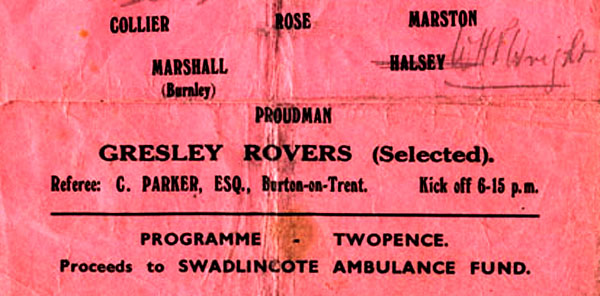
The first section shows the defence of the Gresley Rovers (Selected) team, the price of this single sheet programme and the recipients of any charity money which was raised :

I traced a great deal about the goalkeeper. John Proudman, but none of it was because John had a long and happy life.

Tragically, he was killed on September 23rd 1950 while playing in a Leicestershire Senior League game for Moira United against Quorn Methodists at Quorn, a little village in Leicestershire. During the first five minutes of the game he fell very heavily as he tried to make a save. He finished up at Harlow Wood Hospital in Mansfield, where, sadly, he died from a fractured spine on September 24th. He was only 27 years old. His first ever appearance for Rovers had been on September 9th 1943 against the RAF ‘T’ (won 5-1) and the final one of his 71 games for Rovers came on May 4th 1946 against Melton Town (lost 1-2). After that he played for Newhall United and then Moira United. John was a miner and he worked at Cadley Hill Colliery near Swadlincote.  The Gresley FC Online database has a brief account of John’s performance in this game against all the stars:

“My father worked at Cadley Hill pit with John Proudman and told me about an exhibition game that John played in for Gresley Rovers, when amongst the opposition was the legendary Raich Carter. During the game Carter hit one of his trademark powerful drives which John Proudman managed to get in the way of, the ball cannoning off his chest before he could grasp it. At work the following day he stripped off his shirt to show Raich Carter’s ‘autograph’, a round red imprint of the heavy case ball, complete with panels, in the centre of his chest.”

This is John’s photograph. To put his tragic death in context, in the whole world, only 6 men died playing football between 1919-1939, as far as we know, and only one between 1939-1959:

The right full back, Bill Halsey, who was originally going to play but did not actually appear, played 30 games for Rovers in 6 years. He made his debut against Woodville Athletic on April 8th 1944 (won 7-1) and appeared for the last time against Retford Town on May 4th 1950 (won 3-1). Here’s Bill:

I have been unable to trace anything about the WHF Wright who is written in near his name, except that it is not Billy Wright the England football captain. He was William Ambrose Wright. Here he is again:

Arthur Marston, the right half, played 130 times for Rovers making his début on April 27th 1938 against Whitwick Holy Cross (won 4-0) and taking a final bow on March 19th 1947 against Kettering Town Reserves (result unrecorded). Despite being primarily a defender, he scored 15 goals.

The centre half, Eric Rose, made 140 appearances but scored only twice. His first appearance had been against Ensor Sports on November 25th 1944 (won 10-0, King scored 7 goals, Rose, 1 goal) and his final game, like Halsey, came on May 14th 1950 at home to Retford Town. Here’s Eric:

Left half Collier made his first team debut way back on November 6th 1926 against Bromsgrove Rovers (lost 1-3). He hung up his boots twenty years later on February 22nd 1946 against Holwell Works (won 8-0). The database says that he played most frequently for the Reserves, but I would presume that the  71 appearances and 13 goals quoted in the Player Database are for the First Team. This total was fewer than 4 games per season. What a modest unassuming servant for the club! Is that why they let him play in this glamour game? Let’s hope so.

The left full back, Marshall, was a guest player to give Rovers a chance against all of the visiting superstars. He is actually Jack Marshall (1917-1998) who played for Burnley from 1936-1948. In later years, he was the manager at Rochdale, Blackburn Rovers, Sheffield Wednesday and Bury. On Boxing Day 1963, he reached, literally, the pinnacle of his career, when Blackburn Rovers occupied the top spot in Division One for just one day….

They think it’s all over….well, not yet it isn’t!


14 Comments

Filed under Aviation, Bomber Command, Derby County, Football, History, Personal

To bale out or not to bale out? (6)

Last time, I talked about a Lancaster from 61 Squadron, Serial Number EE176, Squadron Letters QR-M. They took off from RAF Coningsby to attack Nuremburg.

Absolutely the place to attack, the black, beating heart of Nazism:

On the way back, the Lancaster was struck by lightning and the pilot was blinded. He ordered the crew to bale out but only Len Darben and Harold Pronger, as we have seen, obeyed his order. They both perished and their sacrifice is commemorated on the Runnymede Memorial:

The Grim Reaper was not happy with that kind of situation though. He is always very, very, greedy during times of war, so on June 25th 1944, he organised his best friend, Disaster, to help him seize the men who had not been killed by the lightning strike of March 29th 1944. Here they are:

Forrest. Kemish. Macfie. Newman. Wood.

Their days were numbered:

And so he put his plan into operation…….

On June 24th 1944, at 22:37, an Avro Lancaster III, serial number LM518 and squadron letters QR-C, took off from RAF Skellingthorpe to bomb V-1 flying bomb launching sites at Prouville, some 15 miles north of Abbeville in Normandy. They were attacked and shot down by a night fighter, and they crashed at Bienfay in the Somme Department. It would be nice to know who fired the bullet but there are just too many Lancasters and “4-mot. Flzg” on the list of Luftwaffe fighter victims to differentiate one from another, especially as most of them were shot down in Normandy:

The pilot, John Augustus Forrest, only 21 years old, was killed. He was the son of Matthew Augustus Campbell Forrest and Clarice Irene Preston Forrest. The family lived at Busselton in Western Australia. It has a beautiful beach and a wonderful pier to walk along:

Busselton is a city in the south west region of the state, some 140 miles south of Perth, with an estimated population of 36,285 in 2015. (Wow! Some wild guess!)

The navigator, James Rankin Stratton Wood, aged 34, was killed. He was the son of James and Jessie Wood and the nephew of Barbara G. Wood. They all came from Stonehaven in Kincardineshire in Scotland.

Edward James Kemish DFM was the wireless operator/air gunner. He was the son of Benjamin and Ellen Rose Kemish, of Enfield in Middlesex and was only 23 years of age when he was killed. On his grave his parents had inscribed:

“To the world he was just an airman, to us he was all the world. Dad and family”

Now working as a flight engineer rather than a bomb aimer, Donald Cecil Newman, aged only 22, was killed. He was the son of Cecil Newman and Kitty Newman from Bristol.

The man most probably working as a rear gunner was John Macfie. He was only 21 and he was killed. He was the son of Andrew B. Macfie and Frances Macfie, of Glasgow.

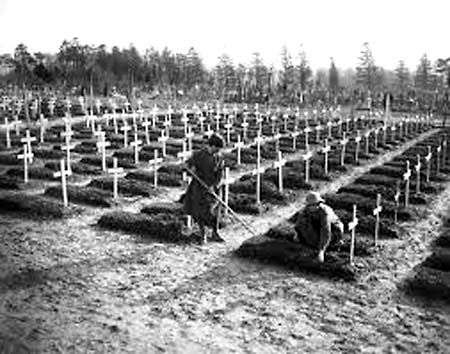
All four were buried in the Abbeville Communal Cemetery Extension along with 2098 other casualties from the two World Wars. Here is quite a famous picture from its early years back in 1919:

That very same night, a second Lancaster from 61 Squadron was lost. It was also a Mark III, serial number ND987 and squadron letters QR-B. Six of the crew were killed and we have already met one of them before in this blood soaked story. He was Sergeant Norman Harold Shergold, the Flight Engineer, who was buried in the London Cemetery and Extension at Longueval, eight miles east-north-east of Albert, a town made famous in another blood soaked story:

Let us not forget, though, in the same aircraft, the sacrifice of Pilot Officer J Kramer of the RCAF, Flight Sergeant RW Burkwood, Flight Sergeant CW Greenaway, Sergeant P Donohue and Sergeant RF Coleman. Sergeant AN Avery survived and he became an evader.


21 Comments

Filed under Aviation, Bomber Command, History

The End of the War in Europe and Church Gresley (2)

Last time I talked about an old single sheet football programme. It was for a match played literally one day after the war ended in Europe, on May 9th 1945. The programme was for “Gresley Rovers (Selected) v RAF”.  The top two stars in the RAF team were Raich Carter and Peter Doherty, both highly rated international players of the era, the equivalents, perhaps, of a younger Steven Gerrard and an older Kevin de Bruyne:


Here are Sergeant Carter and Flight Sergeant Doherty on the programme which is quite tatty, but does contain a large number of autographs in pencil. This is what pushed the price up at auction. Here is the RAF attack, if I can use that phrase:

I have been unable to trace either Sergeant Wilder of Tranmere Rovers or Sergeant Thompson of Bolton Wanderers.

Sergeant Durnie of the RAF cannot be the same Jim Durnie who was loaned to Annbank United Junior Football Club by Glasgow Rangers, because his son, Jim Durnie jnr, has kindly informed me that his father’s year of birth was 1935. I won’t be taking down this magnificent old picture of Ibrox Park, though. Record attendance there was 118,567 for a League game against Celtic on January 2nd 1939:

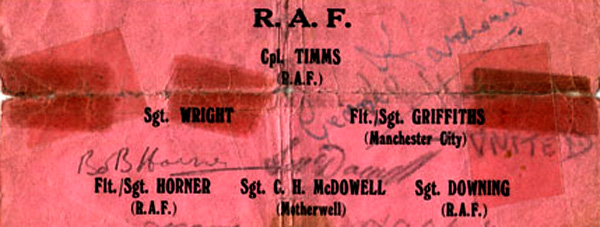
On this second picture, of the RAF defence, there are autographs for Messrs Griffiths, Horner and McDowell, but not for the rest:

Flight Sergeant Griffiths’ club has been altered to Manchester United and there is another autograph in a blueish colour reading diagonally towards the top right corner. I think it begins with George and the surname may be Hardemer or Vardemer or something very vaguely like it. It may even be George Hardwick. Of him, more later.

All in all, I have had very little luck with my detective work for this section. I have been unable to find anything for either Downing, Horner or McDowell.

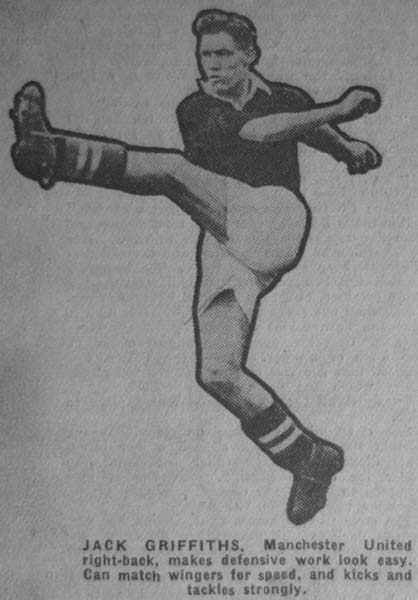
Flight Sergeant Griffiths is the Jack Griffiths who played for Wolverhampton Wanderers, Bolton Wanderers, and Manchester United during the 1930s. His football career came to an end because of the Second World War, but he played 58 times for United during the war and also guested for Derby County, Notts County, Port Vale, Stoke City and West Bromwich Albion. After the RAF he became player-coach of Hyde United. Here he is, frozen in time on an old cigarette card:

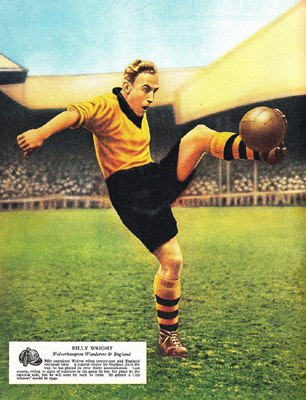
Sergeant Wright is unlikely to be Billy Wright, the England captain, because he was in the Army at the time, but it cannot be completely excluded if the team were short of RAF players. Here he is, practicing for his meeting with Puskás in seven years’ time:

Timms, the goalkeeper, I could not trace beyond the guess that he may be the W Timms who played only five times for Gresley Rovers, making his début against Bolsover Colliery in the Derbyshire Divisional Cup Final on April 8th 1939 (lost 0-5). His fifth and final game came, amazingly, just 14 days later against Quorn Methodists on the 22nd (won 5-0). “The Lord giveth and the Lord taketh away”, as you might say!

12 Comments

Filed under Aviation, Bomber Command, Derby County, Football, History, Personal

To bale out or not to bale out? (5)

The last post finished on a bit of a cliffhanger.
A 61 Squadron Lancaster, serial number EE176, squadron letters QR-M, had taken off from RAF Coningsby to attack Nuremburg.

During the raid, more or less everything had gone wrong for the bomber force during the costliest raid of the war. Almost 100 bombers were destroyed and around 550 RAF aircrew were killed.

When EE176 was just short of the coast of Suffolk, England on the way back, the aircraft was struck by lightning:

The pilot was blinded and the whole crew were stunned. As the aircraft plunged earthwards, thinking that they were over land, the pilot ordered his crew to bale out. Just a thousand feet from catastrophe, though, just a thousand feet from what would prove for two crew members to be a cold and watery grave, he suddenly regained some of his eyesight.  It was enough for him to stabilise the aircraft and to fly it straight and level. He turned to ask the crew if they were all OK……

Unfortunately, Harold Pronger and Leonard George Darben, the wireless operator / air gunner, thinking that it was the right thing to do, had both baled out, taking their Mae West flotation gear with them:

The rest of the crew, luckily for them, had all been too affected by the lightning strike to follow the pilot’s order. They were all, literally, stunned.

The bomber was now really quite close to the English coast, and Air Sea Rescue were immediately notified by radio about what had happened, and that there were two men in the sea who needed rescuing as soon as possible:

Despite extensive searching at first light the following day, the rescue boats failed to find the two missing men.

The water in the North Sea is too cold in late March to survive for very long and it was presumed that both men had perished. Research in 2008 showed that a body floating in the sea off Western Europe becomes a partial skeleton after a month and a complete skeleton after three months. Once the latter stage is reached, presumably the bones all disappear.

We already know the bare details of Harold Pronger’s life back in Australia, but not Len Darben. Poor Len was only 20 years old. He was the son of Joseph William Darben and Emily Darben of Walthamstow in Essex.

No cold and watery grave for the rest of the crew, though, the five men still in the aircraft. The pilot, Flying Officer John Augustus Forrest, also of the RAAF, managed to reach the English coast without difficulty and they all landed safely at RAF Little Snoring in north Norfolk at 0600 hours.

The crew of this Lancaster, EE176, was Flying Officer JA Forrest (pilot), Sergeant AH Davies, (flight engineer), Flight Sergeant JRS Wood, (navigator), Sergeant DC Newman, (bomb aimer), Sergeant LG Darben, (wireless operator/air gunner), Flight Sergeant HW Pronger, (air gunner) and Sergeant J Macfie, (air gunner).

I did not realise until long afterwards, though, that Lancaster, EE176, was a star among Lancasters, a Bette Davis or an Errol Flynn among bombers.

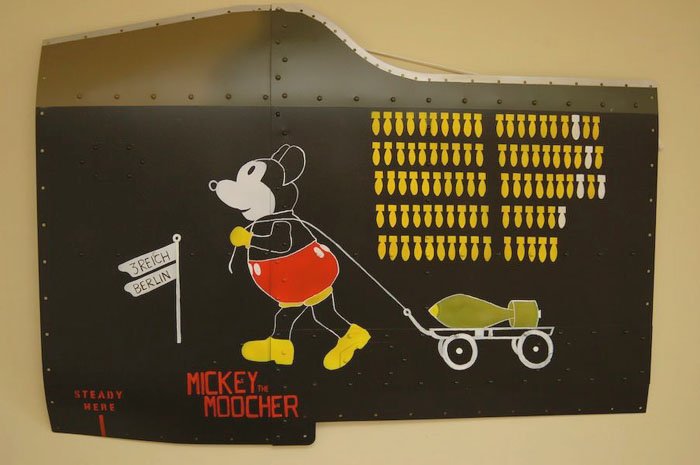
EE176 of 61 Squadron was in actual fact, “Mickey the Moocher”, a so-called “Ton-up Lanc” which carried out 119 missions. This section of the fuselage has been preserved:

These larger bits were probably not preserved:

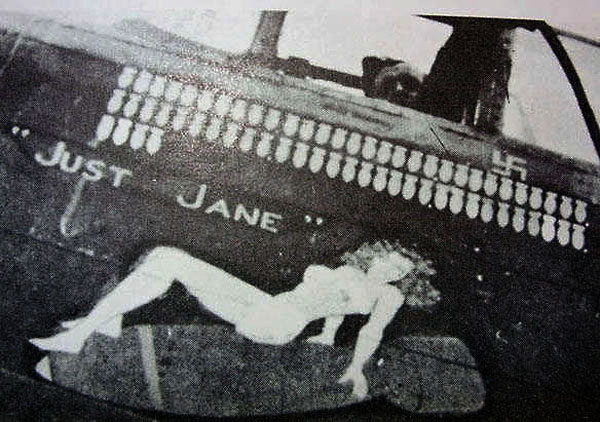
In actual fact, 61 Squadron had another, second, “Ton-up Lanc”, JB138, the famous “Just Jane”, which carried out somewhere in the region of 120 missions. Here’s the original:

The Lancaster in the wonderful museum at East Kirkby is currently painted as this particular aircraft:

And subsequent research revealed others.

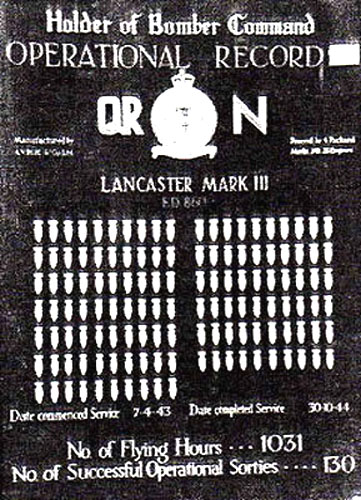
ED860 carried out 130 operations until it all came to an end on October 28th 1944 after a bombing raid on Bergen in Norway. Apparently, on its return, the Lancaster swung out of control on the runway and crashed. Nobody was injured. Shared with 156 Squadron, N-Nuts or N-Nan had flown almost 1032 hours before it was struck off charge on November 4th 1944 and subsequently scrapped:

LL843 or ‘Pod’ (=P=OD) was a 61 Squadron Lancaster which was also shared with 467 Squadron. It was scrapped by Messrs Cooley & Co on May 7th 1947 after carrying out 118 raids:

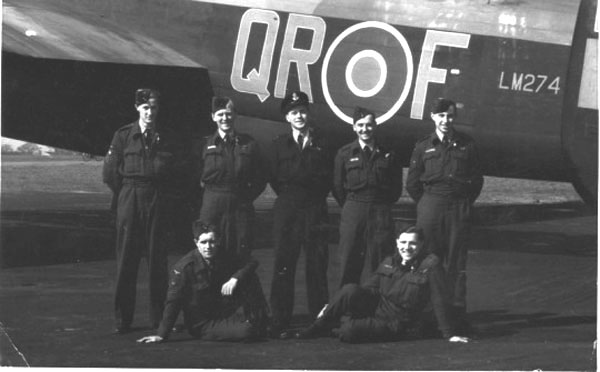
LM274 carried out 138 missions as QR-F for Freddie. This aircraft survived everything the Luftwaffe and the Third Reich could throw at it, but not the end of the war. It was scrapped and turned into ploughshares on April 18th 1946:

Around 35 Lancasters achieved 100 ‘ops’ or more. You can read about all of them in “Ton-up Lancs” a splendid book:

30 Comments

Filed under Aviation, Bomber Command, History

The End of the War in Europe and Church Gresley (1)

Near to the clay mining village of Woodville where I spent my childhood there is a very similar coal mining village called Church Gresley. From 1882-2009, Church Gresley was the home of a football team called Gresley Rovers.

Here is a small scale map of where I am talking about. The orange arrow points to Church Gresley:

Rovers managed more than 125 years of inoffensive existence until, in our new and wonderful world of money, money, money, they found they hadn’t got any money, money, money, and immediately went bankrupt.  Rovers went into receivership and disappeared for ever. Shortly afterwards they re-emerged as Gresley FC. I’m afraid I stopped bothering with them at that point. I used to go to see “Rovers” as a lad, not “Gresley FC”.

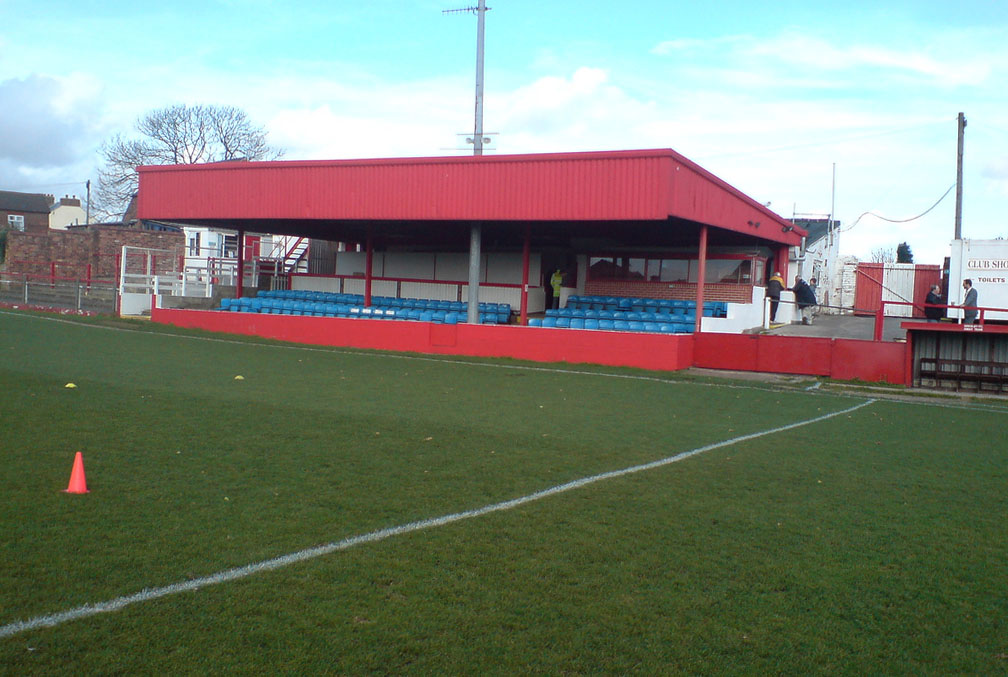
Rovers had a ground called the Moat Ground which dates back over a century:

Here is a larger scale map of the village with the orange arrow pointing to the stadium, if that is the right word:


The club played quite a big part in the life of my family. Before the First World War, my Grandad, Will, played a few games for the reserves and before the Second World War, my Dad, Fred, managed a few games for the same team. When I was still a toddler in a pushchair, my Dad used to take me up to the Moat Ground to watch Rovers play. This would have been in the 1950s. My Dad used to teach in the school in Hastings Road, only half a mile from the ground. You can find Hastings Road on the map in the top right corner. He taught many of the players and supporters over the years. The team manager and coach was the school caretaker (or janitor).

Unfortunately, or fortunately, the school isn’t there any more. Because of mining subsidence, it has had to be pulled down.

The last football match I ever attended with my Dad was the Final of the F.A.Vase. It was between Gresley Rovers and Guiseley, a team from near Leeds in Yorkshire:

The game took place at Wembley Stadium, and I left it to Fred to buy the tickets and arrange the transport down to London.  We left in one of the many, many coaches full of happy Rovers supporters which streamed out of the village on that hot, sunny Saturday 26 years ago.
Another big day in the club’s history came on May 9th 1945, when Rovers played a match to celebrate the end of the Second World War. I don’t know if they realised it at the time, but the supporters had the privilege of seeing some of the greatest players of the era. It was billed as “Gresley Rovers (Selected) v RAF”.  Last year I bought the single sheet programme for the game on ebay.

I paid far too much by the standards of people who don’t need their heads examining. In the auction I was extremely cunning. I bid “a very large sum of money I have never told my wife about” plus a penny. I won the auction by a penny.
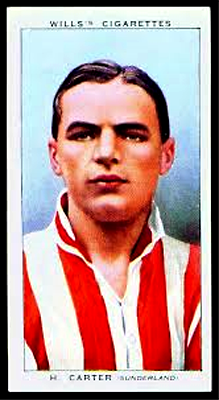
Rovers’ opposition that joyful day were the RAF. Captain of the RAF team I believe was Raich Carter, the only man to win the FA Cup both before and after the Second World War:

He played top class football for 21 years, appearing in midfield for Sunderland (245 appearances, 118 goals), Derby County (63 appearances, 34 goals), Hull City (136 appearances, 57 goals) and Cork Athletic (9 appearances, 3 goals). He played for England in 13 matches and scored 7 times. He then became a manager with Hull City, Cork Athletic, Leeds United, Mansfield Town and Middlesbrough. He also played first class cricket for Derbyshire and Minor Counties cricket for Durham.

Carter mentions the Gresley game in his autobiography:

“One vivid memory from this period was of a team put together by Carter and Doherty which played charity matches against local sides. One such match was played at a packed Church Gresley on a May evening in 1945. The result was not important.”

What was important was the fact that the war was over, Hitler was defeated, and within weeks, all of Britain would move forward into a Golden Age.
The other great star in the RAF team was Peter Doherty who partnered Raich Carter in midfield at Derby County.

On April 27th 1946, the two of them would help Derby to beat Charlton Athletic in the FA Cup Final at Wembley.
Peter Doherty, from Northern Ireland, played for several clubs, including two Irish teams, Coleraine and Glentoran, and then Blackpool (82 appearances, 28 goals), Manchester City (119 appearances, 74 goals), Derby County (15 appearances, 7 goals),  Huddersfield Town (83 appearances, 33 goals) and Doncaster Rovers (103 appearances, 55 goals), giving a total of 200 goals in 402 appearances. He played 16 times for Northern Ireland and scored 3 goals. When he moved into management, he managed Doncaster Rovers, Northern Ireland and Bristol City. All this and he still smoked a pipe.
As Len Shackleton said:

“the genius among geniuses… the most baffling body swerve in football… all the tricks with the ball… a shot like the kick of a mule… enough football skill to stroll through a game smoking his pipe…”

We’ll look at the programme next time…

21 Comments

Filed under Aviation, Bomber Command, Derby County, Football, History, Personal

To bale out or not to bale out? (4)

Last time, I talked about a Lancaster, Lancaster LM360, which apparently had a great number of mechanical problems, such that the pilot ordered the entire crew to bale out in an effort to save their lives. This they did, and they all had a jolly time making their way back to their base from Norfolk where the winds of Fate had carried them. Meanwhile, the pilot found that the plane was seemingly recovering from its funny turn and was able to carry on, such that Flying Officer Fitch was able to make a safe landing at RAF Winthorpe. Here it is today, with its fossilised runways:

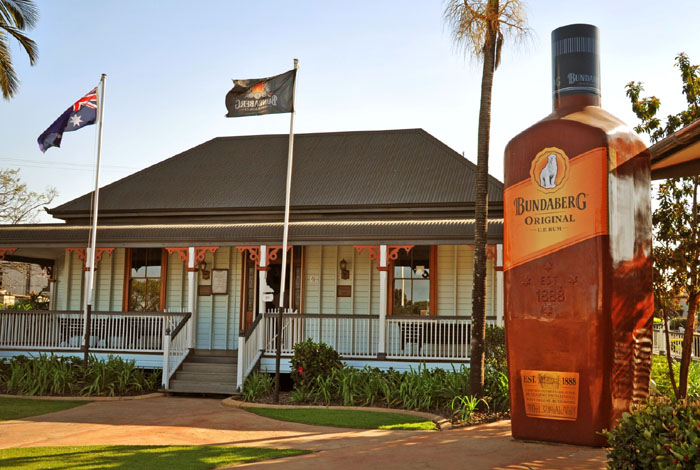
One of the happy survivors this time was Harold William Pronger. He was a 33 year old married Australian from Bundaberg in Queensland and by March 29th 1944 he was still a member of 61 Squadron. In 2015, Bundaberg had a population of 70,588. It is on the River Burnett in southern Queensland and looks a lovely place to spend a summer, despite the recent floods which reached nearly 30 feet above normal. The town is nowadays famous for its rum, usually sold in special Australian sizes :

During the night of March 30th-31st 1944, Harold was again on board a 61 Squadron Lancaster, serial number EE176, squadron letters QR-M. They took off from RAF Coningsby to attack Nuremburg. This was an extremely long trip from Lincolnshire, some 700 miles at least.

The raid proved to be the biggest disaster in the history of Bomber Command. 795 bombers were sent to Nuremberg but there were very high winds to blow them off course, a clear sky without cloud cover, bright moonlight and perfect meteorological conditions for the formation of contrails:

In addition, the target was clouded over when they got there. All of these potentially disastrous problems had been revealed by a Mosquito meteorological reconnaissance flight just before the raid set off, but the top brass decided that it was best to keep calm, to ignore the evidence the Mosquito had brought back and carry on.

All of these meteorological circumstances helped the German night fighters enormously. They moved into the attack as soon as the bomber stream crossed the Belgian coast. Hardly any damage was done by the RAF to the target and a sizeable number of aircraft were more than 60 miles off course when they bombed Schweinfurt by mistake, immediately after it was target marked in error by two Mosquito pathfinders.

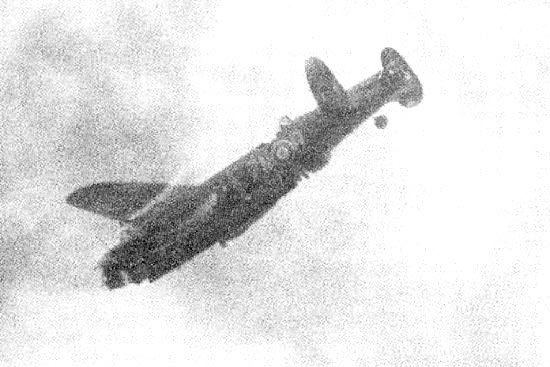
At one point, the bombers were losing one aircraft per minute for just under an hour. Almost 100 bombers were destroyed and around 550 RAF aircrew were killed. You would think it could not get any worse, but for Harold William Pronger, it did. On his way back, after experiencing severe sleet and hail near Hannover, suddenly, at around 0530 hours, just before they would have crossed the English coast, Lancaster EE176 met up with a huge and violent electrical storm:

The storm was too big to fly either over or around, so instead, they were obliged to plough straight through the snow, the sleet, the hail, and the torrential rain. Suddenly, with no warning whatsoever, the Lancaster was struck by lightning.

All of the crew were severely stunned. The pilot and some other members of the crew were temporarily blinded. For a short period, with effectively no pilot at the controls, the aircraft careered all over the sky. The pilot, still blind, ordered everybody to bale out, thinking that they had already crossed the English coast. The aircraft continued to plunge all over the sky, but its main direction was earthwards.

When the Lancaster reached just 1,000 feet above the cold raging waters of the North Sea, the pilot suddenly regained his eyesight. Not perfection, not 20/20 vision, but enough to take over control of the aircraft.
He then started to check that everybody was OK.  They weren’t.

The rest of the story, next time.

19 Comments

Filed under Aviation, Bomber Command, History

To bale out or not to bale out? (3)

My last two posts have involved an RAF Bomber Command raid on Mannheim during the night of September 5th-6th, 1943. And as the titles have suggested, there was more than a little emphasis on the idea of baling out. Is it better to stick it out inside a damaged aircraft? But then, you might have huge problems in trying to land safely. Is it worth it to risk finishing up in the River Trent?

Or is it better to jump out into the unknown? Perhaps into the freezing North Sea, or into one of the hundreds of minefields strewn down the eastern coast of England. Both decisions involve unknown consequences, and in the case of Bomber Command in 1943, they often involved, literally, a step in the dark:

During that same raid on Mannheim that accounted for Lancaster serial number DV 232 and squadron letters QR-K, in a second Lancaster, the pilot, Flying Officer B.C. Fitch, found that his own aircraft, Lancaster LM360, was steadily losing height. He was totally unable to gain any altitude to improve the situation. In addition, the mid-upper turret was not working. The crew made the decision to turn back for home. Not a popular thing to have to do, as it meant the operation did not count towards the magical 30 raids which would take them off combat flying.  This particular night they were carrying, among other things, a 4,000lb Cookie, which the pilot dropped into the North Sea at position 54 21 North, 01 40 East:

And then they carried on, lighter but still slowly losing height as they made their way westwards. Within a short time, according to Murphy’s Law, one of the engines caught fire. The pilot, Flying Officer Fitch, extinguished the blaze and feathered the propeller. On they went, but it wasn’t looking good. Fitch decided to give the order to bale out as they were now over land. All of the crew duly did this, and they all survived without a problem except for the odd bruises and twists associated with a parachute escape. Flying Officer Fitch flew on alone. On and on, with the plane apparently feeling better and better about the whole idea:

So Fitch decided to attempt a landing at RAF Winthorpe. Wonder of Wonders!  Not a problem and he ate all the bacon and eggs prepared for the rest of the crew as they sat on very slow moving buses travelling at a snail’s place towards King’s Lynn.

The crew was:

Flying Officer B.C. Fitch, (pilot)

Sergeant T.W. Taylor, (flight engineer)

Flying Officer S.A. Jennings, (navigator)

Pilot Officer A.Lyons, (bomb aimer)

Sergeant G. Kershaw, (wireless operator / air gunner)

Flight Sergeant H.W. Pronger, (mid-upper gunner)

Sergeant L.W. Cromarty, (rear gunner)

Sergeant Livesy, (2nd wireless operator / air gunner)

Harold William Pronger, the mid-upper gunner, was a 33 year old Australian whose parents lived in Bundaberg in Queensland:

His parents were called William Charles Pronger and Helena Pronger. Sadly, despite his life being saved by his parachute, Harold was disappointed not to become a member of the Caterpillar Club, an organisation which is open to people who have successfully used a parachute to escape from a disabled aircraft.  They receive a membership certificate and a very attractive lapel pin:

Sadly, Harold had used the wrong brand of parachute! He had, apparently, a GQ Obs. type parachute, made by the GQ Parachute Company Limited of Woking. Harold did receive though, for his bravery, a GQ Club Badge, No.181.

All of the crew of Lancaster LM360 survived the war as far as I can ascertain…except one. There are, though, a lot of men called Livesey, rather than Livesy, just in case an error has been made. And at least half a dozen of these Liveseys were killed while serving in the RAF.

We’ll look at the one man who did not survive the war next time.


18 Comments

Filed under Aviation, Bomber Command, History

To bale out or not to bale out? (2)

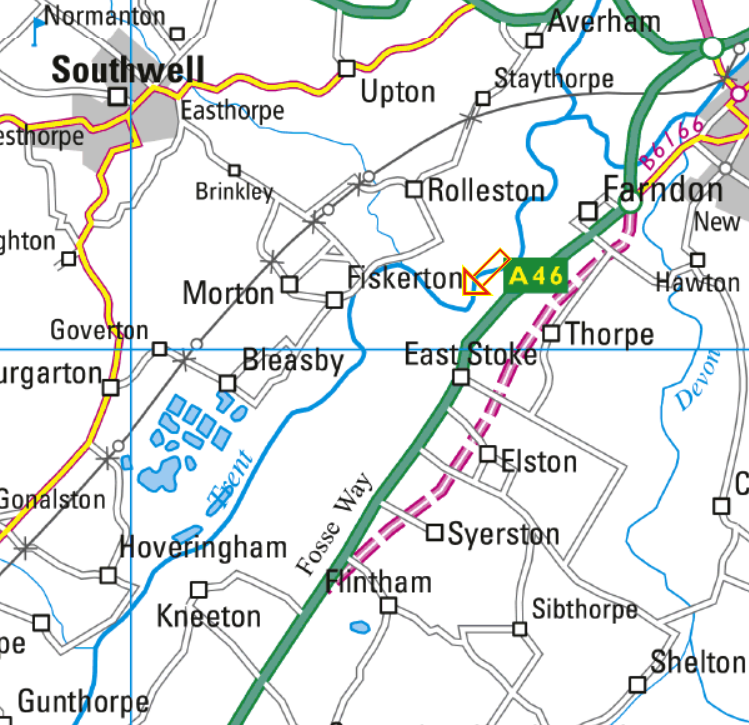
The last RAF post was about an Avro Lancaster III of 61 Squadron, serial number DV 232, squadron letters QR-K which went for a swim in the River Trent near East Stoke on September 6th 1943:

They had taken off, one of many, at 2015 on September 5th 1943 from RAF Syerston to go and bomb Mannheim. This was a huge operation and involved 605 aircraft including 299 Lancasters, 195 Halifaxes and 111 Stirlings. Of the 605 aircraft, 34 were lost, some 5.6% of the attacking force. The trip to Mannheim was a very, very, costly one for the young men of Bomber Command:

9 Squadron  (14 killed)
10 Squadron (7 killed )
12 Squadron (2 killed)
44 Squadron (7 killed)
49 Squadron (5 killed)
51 Squadron (5 killed )
73 Squadron (4 killed )
76 Squadron (6 killed)
77 Squadron (12 killed )
78 Squadron (19 killed )
83 Squadron (7 killed)
90 Squadron (7 killed)
101 Squadron (1 killed )
106 Squadron (13 killed)
149 Squadron (12 killed )
156 Squadron (2 killed)
196 Squadron (6 killed)
405 Squadron (3 killed )
419 Squadron (13 killed )
427 Squadron (7 killed )
619 Squadron (6 killed )
620 Squadron (4 killed )

The people in Mannheim weren’t exactly dancing in the shattered streets either. The Pathfinders did their job perfectly, marking a target completely free of clouds as if it were a training exercise. The bombs fell exactly where they were scheduled to fall. We have very few facts and figures about the exact damage done. This was because the raid was so severe that the report gathering and recording process broke down completely. Indeed the German records use only one word about this night. That word is “catastrophe”.

Around six months later, during the night of March 24th-25th 1944, pretty much the same men who had been the crew of QR-K in the River Trent, but were now part of 97 Squadron, were compelled to ditch into the Channel after their 16th trip to Berlin. Fortunately for them, they were picked up by a German E-boat and became prisoners. Only poor Sergeant Robson, the flight engineer, still only 20 years old, perished. He was drowned in the very severe impact and his body was never found. The crew that day was Todd, Robson, Fuller, Duvall, Housley, McCloskey, Cartwright:


One man lost a leg and several of them were quite badly injured. But as far as my researches tell me, they all survived the war.
I don’t know though, about some of the others….people who made just occasional appearances in the crew’s line up, such as Patrick , or Debnam, for example. I have no initials and too many dead Debnams to make even a wild guess about him.

I might have found a match, though, with Frederick Cyril Shergold of 207 Squadron. On September 22nd 1943, at the age of only 21, Frederick was killed during a raid on Hannover. Like the Shergold on September 6th 1943, he too, was a navigator, so I strongly suspect he may have been the same man who went into the River Trent on that “All’s Well that Ends Well” night . Alas! More than one man called Shergold was killed in the RAF during this greedy war to be totally, absolutely certain.

22 Comments

Filed under Aviation, Bomber Command, History

To bale out or not to bale out? (1)

This post is about an Avro Lancaster III of 61 Squadron, serial number DV 232, squadron letters QR-K. They took off, one of many, at 20:15 on September 5th 1943, from RAF Syerston near Nottingham to go and bomb Mannheim. This was a huge operation and involved 605 aircraft including 299 Lancasters, 195 Halifaxes and 111 Stirlings.

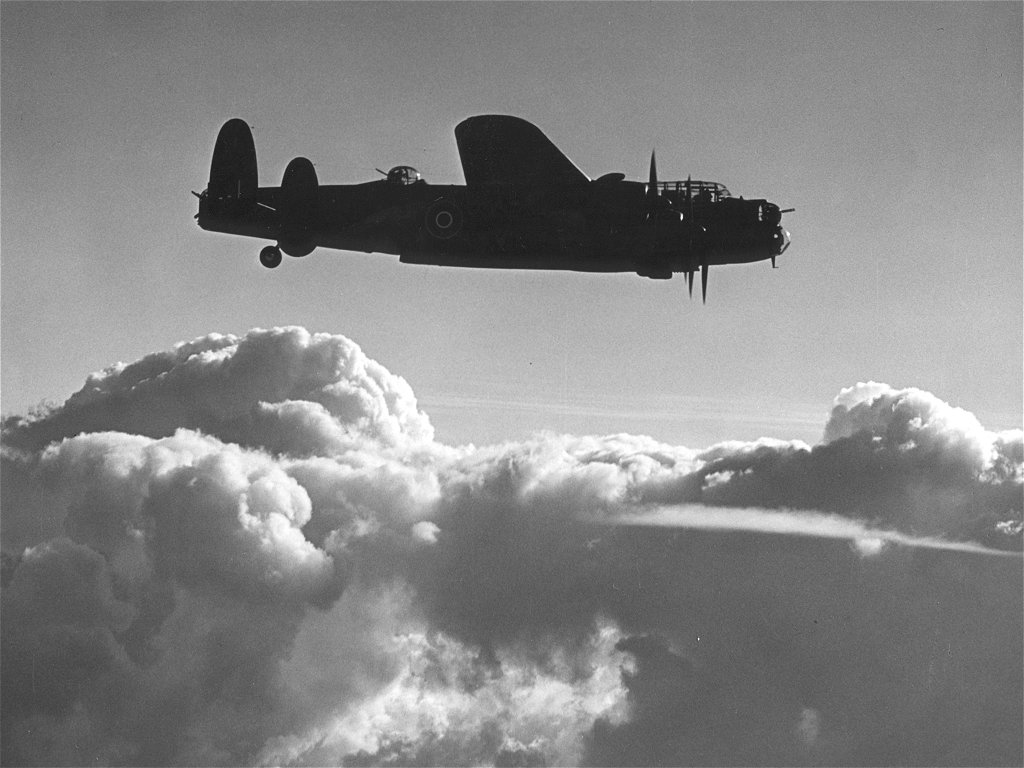
This is a Lancaster:

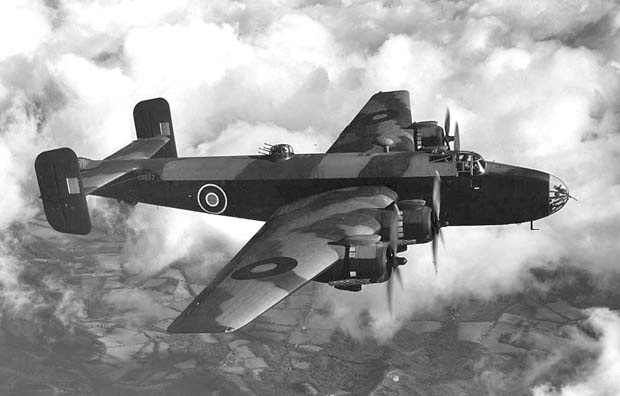
This is a Halifax:

And this is a Stirling:

Of the 605 aircraft, 34 were lost, some 5.6% of the attacking force, an unsustainable casualty rate.

On their way to the target, Lancaster DV 232 and QR-K had severe engine problems, with the port outer engine failing and the pilot unable to maintain height. And then the port outer engine caught fire. Pilot Officer Peter Todd, the pilot, extinguished it and feathered the propeller. The decision was taken to carry on and not to bale out. The aircraft’s 4,000lb cookie and the rest of the bombload were all duly dropped on Mannheim from around 15,000ft:

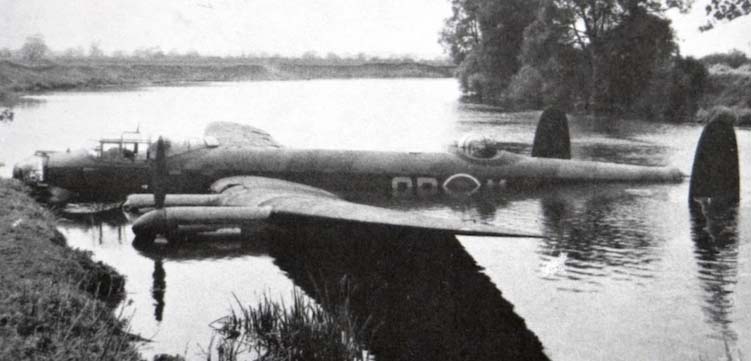
The crew then turned for home, full of a strange mixture of trepidation and perhaps misplaced hope. All credit to the plane, though, as the aircraft flew on sedately with Todd at the controls. Eventually he crossed the North Sea, crossed the English coast and discovered that the crew still did not want to bale out, even though they were over English fields. They wanted to stick with the plane which had faithfully brought them so far. They finally reached RAF Syerston where Todd attempted a landing. It did not go too well as the three remaining engines all stalled and the bomber began to sheer over towards the left. Todd missed the airfield buildings but soon found himself skipping too low and too fast over a landscape of fields unfamiliar to him. To the south was the River Trent and eventually the aircraft somehow skidded to stop in the welcoming waters of the river:

The crew were all completely uninjured, floating gently on the river’s calm cold waters:

And just in case you were wondering, the Lancaster was removed by floating it downstream and then rescuing it from the foaming torrent on the southern bank where there was a large flat area just before the village of East Stoke.

This story also turns out to be a very good example of how paperwork often went wrong in WW2. “We had more important things to do than get the bloody paperwork right!” as one high ranking RAF officer once said.

I mentioned just recently that research nowadays, especially with the Internet, can reveal many, many details about the events of the Second World War. But sometimes, quite basic details are lost. One website therefore, the best one, I would say, gives the crew as

Pilot Officer PH Todd (pilot), Sergeant S Robson, (flight engineer), Flying Officer J Hodgkinson, (navigator), Sergeant VR Duvall, (bomb aimer), Sergeant W Housley, (wireless operator / air gunner), Flight Sergeant Patrick , Sergeant John Cartwright, (air gunner).


An RAF Forum says, though, that the original Todd crew, posted in to 61 Squadron from 1661 Conversion Unit on August 25th 1943, was:

Todd, Robson, Shergold, (navigator), Duvall, Housley, Debnam, (air gunner). Cartwright.

Sergeant Patrick came from 1654 Conversion Unit on August 25th 1943 and he replaced Debnam for their first operation on the 3/4th September 1943. This was a disastrous raid on Berlin with 316 Lancasters and 4 Mosquitoes. 22 Lancasters were lost, an unsustainable rate, just below 7.0%. At least 70 aircrew were killed:


In Berlin, destruction was caused to major water and electricity works and to one of the city’s largest breweries. A total of 422 people were killed, namely 225 civilians, 24 servicemen, 18 men and 2 women of the air-raid services, along with 123 foreign workers made up of 92 women and 31 men. Another 170 civilians were missing. Two delayed action bombs eventually went off and they killed a soldier and seven “criminals”….convicts who could earn remission of their sentence by volunteering for this work. Later in the war, of course, when they ran out of convicts, the Germans made extensive use of Jews for the manual transportation of apparently live bombs which had failed to explode.

The same crew which flew to Berlin was used to fly to Mannheim. They were the ones who returned ultimately to slither rather ignominiously into the River Trent. My belief is that they were:

Todd, Robson, Shergold, Duvall, Housley, Patrick, Cartwright

All of the crew were able, incidentally, to walk to the bank of the River Trent along the fuselage and then out through the front gun turret:


26 Comments

Filed under Aviation, Bomber Command, History, Nottingham