Category Archives: History

The Murder of Leslie Howard (3)

Last time we were looking at how the airliner in which Leslie Howard, the film star, was returning to England, was shot down in the Bay of Biscay by the German Luftwaffe, resulting in the deaths of every single person on board, including the children. Here is some of Leslie Howard’s best work, taken from the now controversial “Gone with the Wind” :


Since that first day of June 1943, there have been literally scores of theories put forward as to why Leslie Howard and the rest of the civilian passengers and crew of the DC-3 “Ibis” were all murdered in this callous fashion. Shot down into the waters of the cold Atlantic Ocean, while travelling to England in an aircraft which was unarmed and the property of a neutral country, namely the Netherlands. And this attack was clearly directed at somebody, because the attackers were eight Junkers Heavy Fighters, armed to the teeth and clearly, sent specifically to destroy this inoffensive DC-3 Dakota.
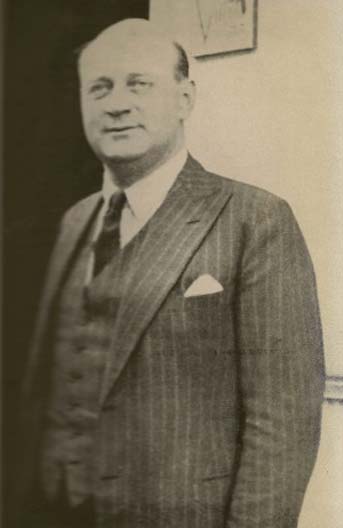
Leslie Howard’s business manager, Alfred Chenhalls was a fat, bald man who loved to smoke cigars and who occasionally drank alcohol in sensible quantities. It was extremely easy to mistake him for Winston Churchill. What do you think ? Did a German spy see Chenhalls get on the plane and immediatelyt telephone the German Embassy in Lisbon?

Which one is this?  Churchill or Chenhalls?
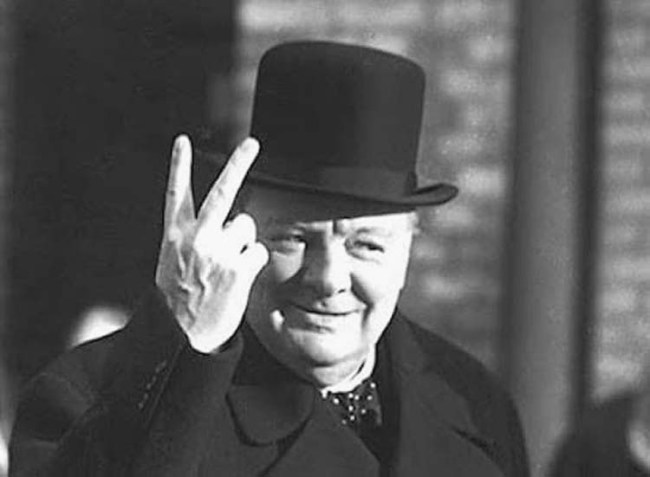
And is this the Prime Minister or a party going bon viveur, who liked nothing better than drinking the very best whisky in large quantities?

“Two bottles for each of us, barman !!! “
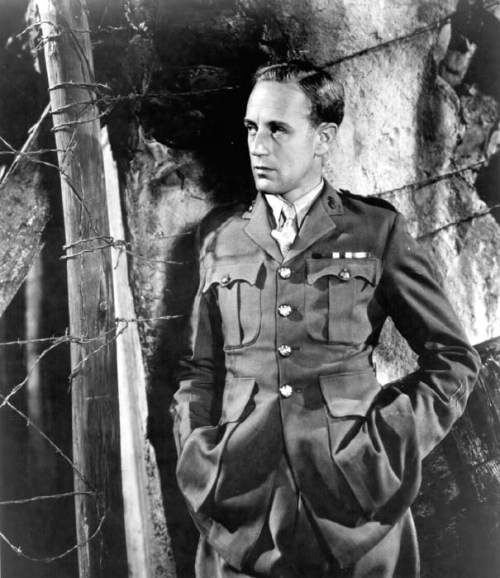
As we have seen elsewhere, Leslie Howard was not an English landowning gentleman, but a Hungarian Jew. He supposedly resembled Churchill’s bodyguard, Detective Inspector Walter Thompson. Similarly, Detective Inspector Thompson had the air of an archetypal English gentleman, self assured, self confident, upper class and, most of all, slim. Here’s Leslie Howard:
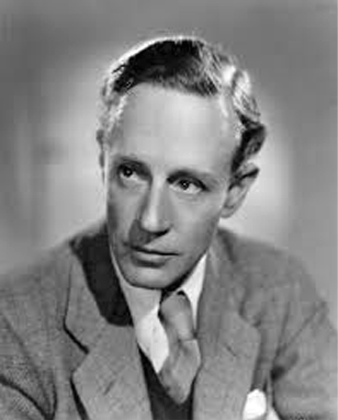
And here’s Walter Thompson, on the right:

There are other theories, of course.

How valid is the theory, though, that Leslie Howard was supposedly the virtual double of Sir Anthony Eden, England’s Foreign Secretary at the time? Here’s Eden at the age of around twenty, as a student at Oxford University……….
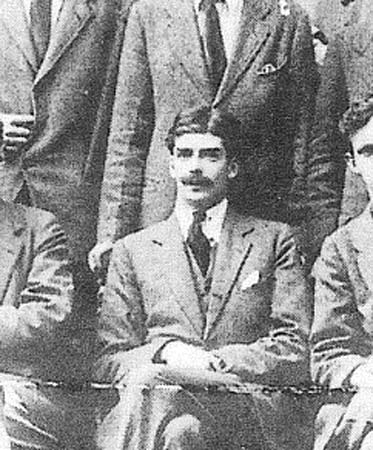
There is though, a bit of a giveaway which is tremendously helpful in any “Pick-out-Anthony-Eden” competition. The real Anthony Eden, for his entire adult life, had that stonking great moustache which he fixed into his nostrils at seven o’clock every morning and then didn’t take off until midnight.

And what about the idea, quite widespread at the time apparently, that the Germans thought that Leslie Howard and Reginald Mitchell, designer of the legendary Spitfire, were one and the same man? Leslie Howard we have already seen, and here’s the designer of what began its life as the Supermarine Shrew :

In my mind, the best fit is “Churchill and Thompson v Howard and Chenhalls”.  And we must not forget that the only images of Churchill or Leslie Howard seen by most of the attendees of the Dakota’s take-off from London would have been either crudely printed photographs from newspapers or perhaps slightly better quality pictures from magazines. Moving pictures would have been from Howard’s films, or for Churchill , the two minute Pathé News films shown in cinemas during the interval. In other words, confusion was a great deal easier in 1943 than it was in 2023.

It was by no means a completely ridiculous idea, therefore, to suggest that “Churchill–Chenhalls” was on that plane from Lisbon. And for the Germans, it was well worth organising an attempt to shoot down the plane, even if the Prime Minister was supposedly at an important conference in Algiers.

How easy it would have been to alert Berlin, who could then have contacted the fighter base, probably at Mérignac near Bordeaux in southern France, and then telling those eight Junkers Ju88C-6 heavy fighters to take off and intercept the DC-3. Such attacks were in actual fact very rare in the Bay of Biscay, so this particular Luftwaffe operation must surely have been for a specific reason, and for a specific and important target.

And now a whole second level of conspiracy theories swings into action. Perhaps British Intelligence invented the entire story of Churchill’s being on board “Ibis” that day, so that he could fly back home to England in his own private aeroplane, an Avro York. Here’s an excellent short film giving you all the relevant facts about the Avro York, which was basically a different fuselage, set on a pair of Lancaster wings:


There were plenty of people who believed this story that British Intelligence had told the Germans that Churchill was returning to England in the DC-3 that particular day, and that he would be refuelling near Lisbon. In this way, his Avro York would be able to return to London in peace, even if the Dakota finished up in pieces.

And so it goes on, round and round in ever decreasing circles with very little beyond well informed guesswork and random supposition. These are certainly very far from being guaranteed truths.

In 1943, the earliest rumours to surface were that “bon viveur” Alfred Chenhalls had actually been mistaken for Churchill by German agents as he walked out to the plane in Lisbon. Furthermore, this explanation is known to have been the one favoured by Churchill himself. At the same time, though, Churchill was certainly puzzled as to how German intelligence could possibly believe that he, with all the resources of the British Empire’s armed forces and those of the United States at his fingertips, should be reduced to travelling in an unarmed, relatively slow and vulnerable commercial airliner.

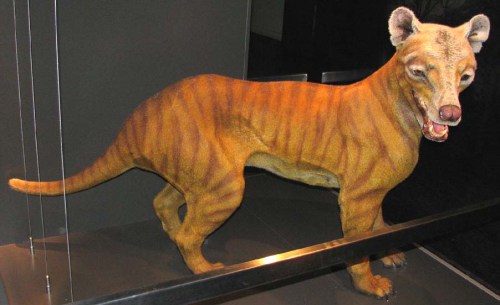
24 Comments

Filed under Aviation, Film & TV, History, military

Goose Fair (4)

Before the sudden advent of the huge electric amusement machines around 1900, exotic animals were a firm favourite of the Goose Fair hordes………

The big problem, of course, was the fact that, in the desire to exhibit the most unusual animals, the owners of the animals would often end up by going to an animal market and buying a creature that they themselves could not identify. So sit back and enjoy my own attempts to work out what the unknown animal really was………

Let’s start with……..

Tiger Wolves direct from the Black Rocks of Abyssinia”. These were shown in Day’s “No 1 Royal Menagerie” in 1898 as a “Group of Wild and ferocious Tiger Wolves direct from the Black Rocks of Abyssinia”. Alongside them was a group of Baby Lions”.

There are wolves in Ethiopia, but they are red, so much so that they are also called “the Simien fox or Simien jackal or horse jackal”. Intriguingly, at this time, the name “Tiger-Wolf” was the accepted shortened form of “Tasmanian Tiger-Wolf”. This phrase was used to refer to the Thylacine, an unbelievably rare Australian animal to turn up in a fair in Nottingham. I really do wonder what these animals were!

A slightly less colourful one:

I think you’re getting the idea…..

Day’s “No 1 Royal Menagerie” also had “Blonko Bill, King of the Lion Tamers” working for them.” I have been unable to trace the meaning of “blonko”, although if ever a word sounded like Australian slang, this is it! The internet was no help. One site said it meant “kind, entertaining, handsome”, another said it meant “fat, fat, fat”.

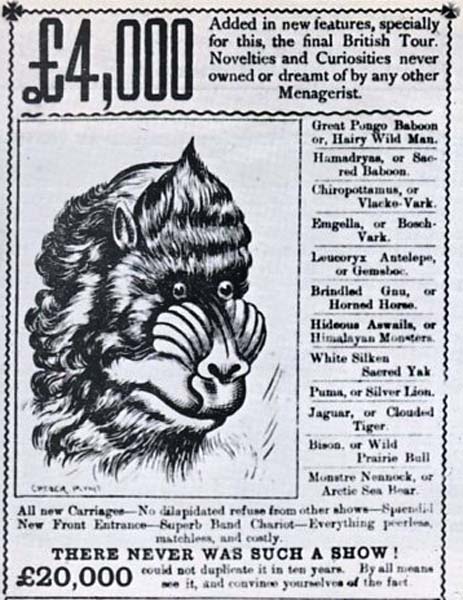
In 1899, Bostock & Wombwell produced a special poster listing all of their animals, including the “Great Pongo Baboon, or Hairy Wild Man”. Intriguingly, “Pongo” is the scientific name for the orangutan, thought to be a close relative of Bigfoot, hence the “Hairy Wild Man” epithet:

This slideshow requires JavaScript.


Another strange sounding animal on the Bostock & Wombwell poster was the “Hamadryas, or Sacred Baboon” although, ironically, it is very simple. The poster is referring to the Hamadryas Baboon from the Horn of Africa and the southwestern region of the Arabian Peninsula. You can just see the side of his bright scarlet posterior……

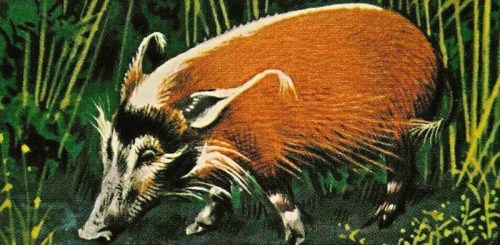
The same owners had a “Chiropottamus, or Vlacko-Vark” which is merely a sort of wild pig. It may be the Red River Hog, “a wild member of the pig family living in the Guinean and Congolian forests. Here’s the old Brooke Bond tea card from the “Wild Animals of Africa” collection….

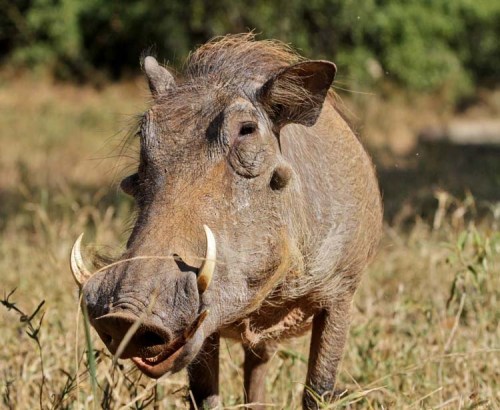
Alternatively, it may be the warthog which is the “vlakvark” in Afrikaans…..

A “Leucoryx Antelope” sounds a very strange beast but it is also called the “Gemsboc” on the poster. And the “Gemsboc is the gemsbok, gemsbuck or South African oryx, native to the arid regions of Southern Africa, such as the Kalahari Desert. It is a very beautiful animal….

The “Brindled Gnu, or Horned Horse” is a lot easier, because we have all seen this strange word. Not totally unexpectedly, the Brindled Gnu is the blue wildebeest, also called the common wildebeest, the white-bearded wildebeest or the white-bearded gnu. It is one of the two species of wildebeest…..

The Bostock & Wombwell poster advertises a “White Silken Sacred Yak” which would have been a pure white yak. Nowadays, some 5% of the herds are white. They are regarded as an extremely auspicious animal since white represents light, a personification of the illumination of wisdom and the universal Buddha……

Some animals are very easy to sort out.

A “Puma or Silver Lion” was presumably a North American mountain lion, cougar or puma. Here’s a lovely picture of one of the first ever mountain lions to be found in North Dakota…..

A “Jaguar or Clouded Tiger” is nowadays called a “jaguar” or a “clouded leopard”……

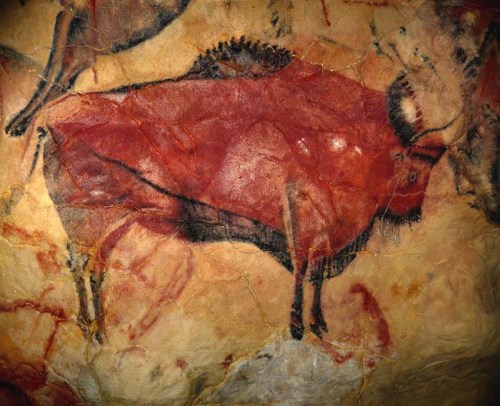
A “Bison, or Wild Prairie Bull” is most probably the North American bison…..

A “Monstre Nennock” sounds incomprehensible, but the alternate names give it away, with “Arctic Sea Bear” making it the polar bear. It would be nice to know what a nennock is, though. Incidentally, I’ve just turned my slides into digital photographs, photoshopped them to make them a little lighter and got rid of the hairs and general dirt. So, here is a nennock or two at Basel Zoo in Switzerland in 1979….

Two final animals though, are most intriguing. Just what were the “Hideous Aswaila”, or “Himalayan Monsters”? Were they a family group of yetis? I bet they were, but the people of the time did not know what yeti was…….

And last of all. What on earth were “Lorenzo’s Performing and Talking Bears”? Were they a family group of Bigfoots? Using their famous “Samurai Chatter” to pass comment about Nottingham and its inhabitants? Here’s a youtube video, and if you move swiftly to 4 minutes exactly, you’ll hear what “Samurai Chatter” is. At 4.40, you can hear the Bigfoot walking around the cabin. It’s really scary!

17 Comments

Filed under Africa, Cryptozoology, History, Humour, Nottingham, Science, Wildlife and Nature

Goose Fair (3)

Last time we finished with Mr Pat Collins’ “Giant Nottingham Geese, All Alive and Kicking” but some surprisingly exotic, and indeed, unusual, animals made their appearance at Goose Fair.

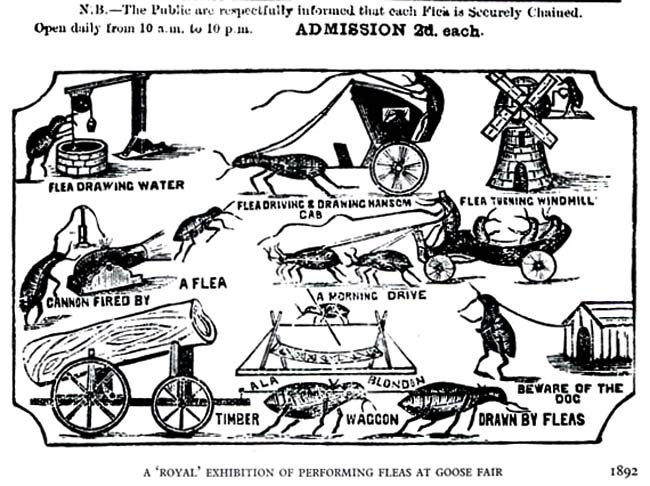
Smallest of them all were the performing fleas:

Look at what they could do:

And don’t worry:

“Each flea is Securely Chained”

In 1899, for their last visit to Goose Fair, Bostock & Wombwell produced a special poster, which listed all of their animals.

Their rivals, of course, boasted about their own animals which included “Novelties never owned or dreamt of by any other Menagerist.” There was the “Great Pongo Baboon”, the “Hamadryas, or Sacred Baboon”, the “Leucoryx Antelope or Gemsboc”, a “Brindled Gnu, or Horned Horse”, a “White Silken Sacred Yak”, a “Puma”, “Jaguar”, a “Bison, or Wild Prairie Bull” and the “Monstre Nennock”.

Here we are:

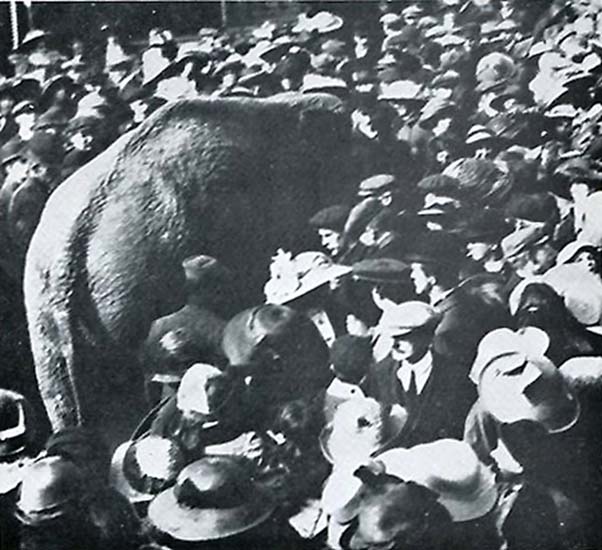
There was also a huge elephant christened “The Mighty Mastodon”. We still have photographs of him apparently pushing and shoving his way through the Goose Fair crowds, apparently unsupervised, making his way back home to his trailer. Don’t worry about safety, though. Only two years before the council were discussing whether it was dangerous to have brown bears in Upper Parliament Street. Talk about re-wilding!

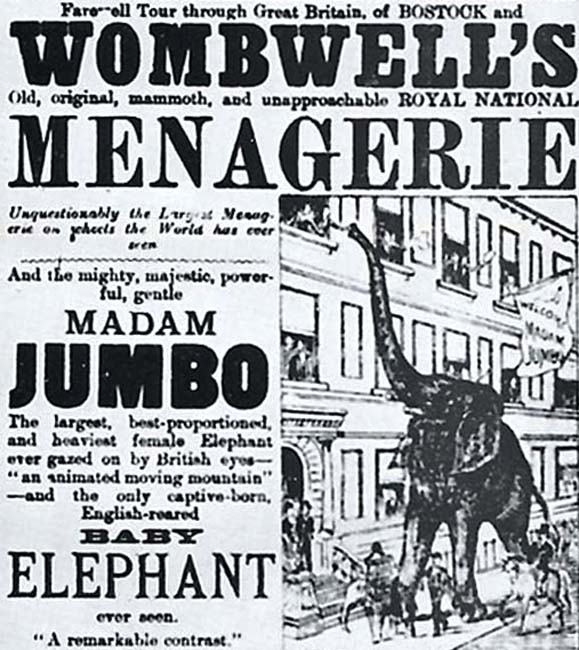
Even more frightening, apparently, was “Madam Jumbo”, an elephant of, well, elephantine proportions. It could actually lift people down from the second floor of the Post Office in Queen Street. Just look at the size of it. Look at the baby elephant in comparison, or the horse:

Amazingly, in King Street, “The Royal Monster Whale” was on exhibition for Goose Fair week, and for the week after that. It cost only threepence, with children half price. A “Royal Monster Whale” must have caused a great many difficulties for everybody, not just when it was delivered on a handcart, but in providing thousands of gallons of seawater in a city more than fifty miles from the sea. However, that may have been the least of their problems. As Monty Python so rightly said:

“Where are we going to get forty-four tons of plankton from every morning?”

An insoluble problem, unless, of course, “The Royal Monster Whale” was stuffed.

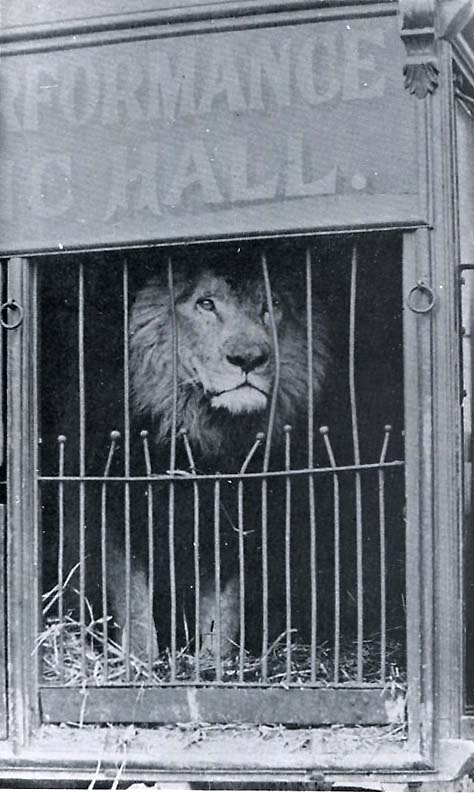
At least one lion at Goose Fair was personally supplied by the great Cecil Rhodes, the diamond billionaire who established the Rhodes Scholarships at Oxford University, the oldest graduate scholarships in the world. Every year, 102 full postgraduate scholarships are granted to students across the world. Here’s his lion, serving a life sentence by the look of it:

Sedgwick’s Menagerie had some baby lions, “Performing Elephants”, “Alphonso’s Group of Educated Lions”, “Lorenzo’s Performing and Talking Bears”, “Lorenzo’s Performing Wolves” and then you could see “Lorenzo performing with Nero and Brutus, the largest full-grown untameable African Forest Bred Lions”. Another threepence well spent, children half price.

One of Sedgewick’s chief attractions was “Blonko Bill”:

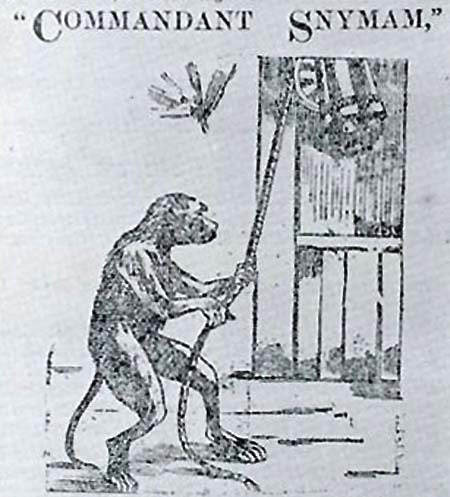
The first Goose Fair of the new twentieth century starred “the Mafeking Monkey”. During the Siege he had rung a bell every time the Boer artillery shelled the town:

I still don’t see what’s so smart about him, though. Every time the town is shelled, he rings a bell to tell people that they’re being shelled. How is that helpful?

Alongside “the Mafeking Monkey” were “Professor Burnett’s Fencing Booth and Military Tournament”, “Walls Electric Boer Warograph” and “Twigdon’s Electric Palace.” There was also a hairless or “rubber-skinned” mare from the Transvaal, a horse with a mane and tail 21 feet long, a giant horse over 20 hands high and a miniature horse and mule both only 24 inches high.  In addition, there was the “smartest boxing kangaroo” in the world and, sadly, allocated to the animal section,”the giant negro Aaron Moore who is 8 feet in height.” In actual fact, Aaron is known to have been more like 7 feet 3 inches. He was from North Carolina, and, from the photographs I have seen, seems to have worn nearly all the time, a 9 inch high pillar box hat:

13 Comments

Filed under Africa, History, Humour, military, Nottingham

Goose Fair (2)

Goose Fair always brought with it a host of what could be called “camp followers” who, to be honest, would probably have made their way to pretty well every large fair in the country.

Wandering the streets, therefore, were a good number of distinctively dressed gypsy women, who sold “tickling sticks”, bags of confetti, balls on elastic, ropes of beads and “monkeys on sticks”. All vital commodities in Victorian England!

The gypsy women were extremely popular as fortune tellers, and were always recognisable as such because they traditionally carried a linnet in a cage at the end of a long, thin staff.

And in this photograph of a gipsy woman, notice the boy’s funky pillbox hat. Eagerly, he ia waiting for the birth of  Bob Dylan:

A linnet was chosen, incidentally, because:

“When finches come into our awareness, it is a sure sign of joy-filled, happy times ahead.”

I knew that.

Here are some “sundry sellers, who no doubt had access to their own private supplies of tickling sticks, bags of confetti, balls on elastic, ropes of beads and monkeys on sticks:

And at the other end of the spectrum, a little further away, on Upper Parliament Street, around the columns in front of the Theatre Royal, stood the “nymphs of fashion”.

Here are the columns of the Theatre Royal which is to the left of the now long demolished Empire Theatre :

The “nymphs of fashion” were what we would nowadays call prostitutes. They charged men for their sexual favours. Here’s one of the hottest, preparing to drive the young men wild, or perhaps straight to their doctor:

And here she is without her make-up. Surely, I’m not the only one who thinks that’s a man:

Setting aside for a moment the delights of these disease ridden lovelies, I investigated the attractions which appeared most frequently at Goose Fair around 1900. I discovered that, on Long Row, there was “Wadbrook’s Ghost Exhibition” with the celebrated “Pepper’s Illusion”. In front of the Exchange Building, Pat Collins had his roundabouts including his “Mountain Ponies”, his “Venetian Gala Gondolas” and his “Pneumatic Steam Bicycles”. There was “music produced by electricity on the latest musical instrument, the “Gaviolophone”, equivalent to a String Band of 60 performers, playing Opera, Classical and Popular Music.”

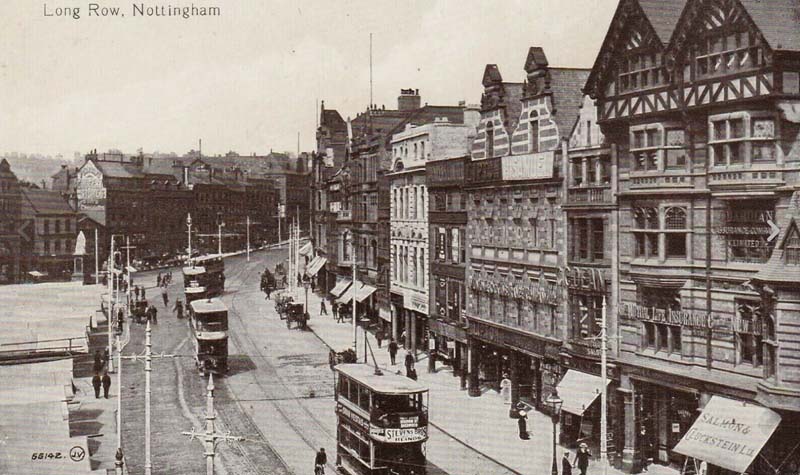
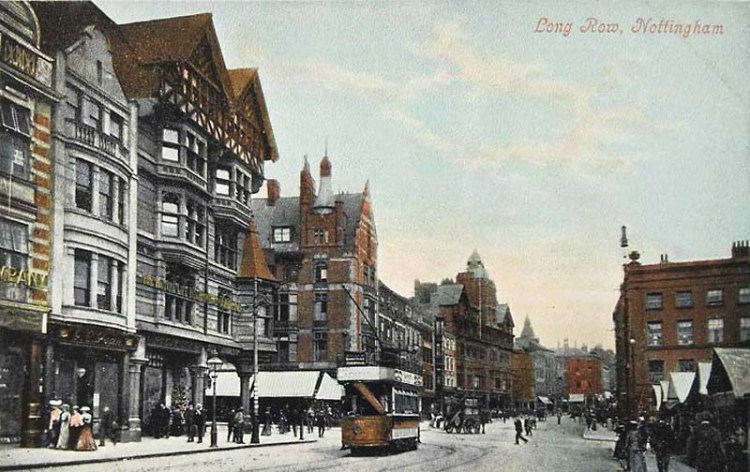
Incidentally, here’s Long Row to the north of the Old Market Square. The western end:

The central area:

And finally, the eastern end, with the incomparable Black Boy Hotel, which, during the Second World War, supplied all of the beds required for the sexual adventures of every single member of Bomber Command in all the RAF bases for fifty miles around:

There may well have been “Wadbrook’s Ghost Exhibition” with “Pepper’s Illusion”. There may well have been roundabouts such as the “Mountain Ponies”, the “Venetian Gala Gondolas” and the “Pneumatic Steam Bicycles”. Despite all of them, though, despite even the “Gaviolophone”, many people, and all the children, still liked to see a few exotic animals, no matter how moth eaten they might have appeared.

By 1898, Day’s “No 1 Royal Menagerie” had returned to the Market Square after a short absence. Day’s was “a Special Engagement of the Greatest Lion Tamers on Earth” with “Captain Laurance & Delvonico, The Lion Kings” (96 years before Disney!). There were “20 noble lions of all ages and sizes” who provided the members of “Delvonico’s Wrestling Lions”, “Delvonico’s Boxing Lions”, “The Clown Lions” and “A Lion in a Trance”. All of them were acts which had been “The Rage and Talk of Europe”, as was “The Daring Performance of Captain Laurance” along with “the only Real Original and Absolutely Untameable Lion Wallace”. Wallace had also appeared in 1896 and 1897. He doesn’t look very fierce in this photograph, though:

Among the animals were “Many Specimens of Birds, Beasts and Reptiles” some of which must have been stuffed, as there was actually a humming bird mentioned, a species which, even nowadays, cannot easily be kept in captivity. At the same time though, there was an elephant called “Elephant Jumbo” who was surely a live animal, as an elephant would be a bit of a nightmare for the taxidermist.

Overall, the proprietors of Day’s “No 1 Royal Menagerie” were happy to call themselves, “The People’s Show at the People’s Price”.

Slightly less exotic as animals were Mr Pat Collins’ “Giant Nottingham Geese, All Alive and Kicking”:

“For rollicking fun, there’s nothing to beat them

If you are “out for the night” don’t miss them;

And while you are there, try the razzle-dazzle cars

Drawn by ostriches, and spinning round at lightning speed.”

And the judges’ verdicts……….. “No rhyme and very little reason.”

19 Comments

Filed under Bomber Command, Criminology, History, Humour, Nottingham

Goose Fair (1)

Every year, a huge fair is held in Nottingham. It lasts from the first Wednesday in October to the following Saturday. It dates back to a royal charter in 1284 although it is known that the Saxons had held “St. Matthew’s Fair” long before that. Modern belief is that the Saxon fair was based on a fair held by the fun-loving Vikings. A Viking army had captured Nottingham from the Saxons in 868 AD. Its leaders had two of the coolest names ever.

“Ivar the Boneless”

“Halfdan Ragnarsson”

Presumably his Dad was “Wholedan”, or even “Fulldan”.

This combination of Saxons and Vikings would make the Goose Fair well over a thousand years old. Here are some Vikings:

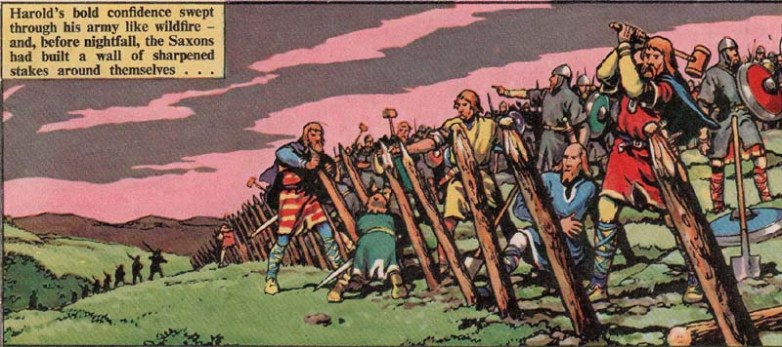
And here are some Saxons:

The name “Goose Fair” comes from the thousands of geese that were driven to Nottingham on foot from Lincolnshire, Cambridgeshire and East Anglia. Their feet coated with tar and sand to protect them on the long journey of a hundred miles or more, the geese would provide the traditional Michaelmas dish of roast goose on September 29th. Goose Fair was traditionally held in the Old Market Square in the city centre, although it was moved to the Forest Recreation Ground in 1928. The fair has only been cancelled on very few occasions. In 1646 because of bubonic plague, during both World Wars, and finally in 2020 and 2021.

The Old Market Square was a very different place before 1928.

In the 1700s, the fair was no longer about geese, but was more to promote the sale of Red Nottingham, the local cheese which was traditionally made in the shape of a large wheel. The whole thing became a little too Red Nottingham in 1766, when the natives of the town got a little over exuberant and started “The Great Cheese Riot”.  I shall be doing a blogpost about that glorious day when I have spoken to the Archivist of the Museum of the Fifteenth Dragoons to see if the names of the Nottingham peasants they slaughtered have been recorded anywhere.

By 1900, the fair was all about entertainment of every kind, with Aunt Sally’s (sic), shooting galleries, swing boats, roundabouts and merry-go-rounds (is there a difference?). There were theatres showing short films called “animated photographs”. These included boxing matches from the USA, bullfighting from Boulogne in northern France and the famous “Dreyfuss Affair” which was probably the series of eleven short silent films made by the famous French director, Georges Méliès. The very biggest attraction, though, and the most exciting thing on offer, was the increasingly large number of huge spectacular machines powered by electricity. As Pat Collins, the owner of many of the attractions, said:

“the build-up of the mechanical side was very rapid as the manufacturers turned out better machines in each succeeding year”.

One perennial attraction was the Children’s Corner which was situated away from the main fair, at the junction of King Street and Queen Street:

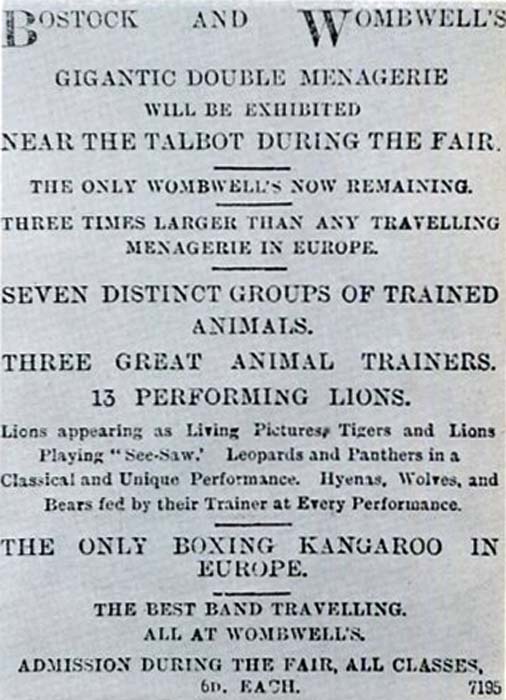
The enntire Market Square was lined with stalls, which also continued up Market Street. These stalls sold “gingerbread, without which Goose Fair would hardly be Goose Fair”, “coconuts, almost equally indispensable” and a profusion of “comestibles and indigestibles”, the latter including mainly children’s toys, books and fruit. On Market Street, the stalls sold a profusion of wash leathers and sponges, and, for the children, there were “penny prize packets” which contained a mixture of tiny sweets and chocolates. There was also a Cheese Fair and a Poultry Fair, and out at Eastcroft, a large cattle market was held. Punch and Judy shows were very popular and they frequently graced St Peter’s Square, or the area in front of the Talbot public house, a little further on than the junction with Market Street.

Next time, the “Nymphs of fashion”, an ironic title, perhaps, given how willing they were to divest themselves of their clothing.

16 Comments

Filed under History, Humour, Nottingham

Newark Air Museum (2)

Last time we looked at some of the Cold War aircraft in the Newark Air Museum, but there are a good many civil aircraft as well, most of them from this same period.

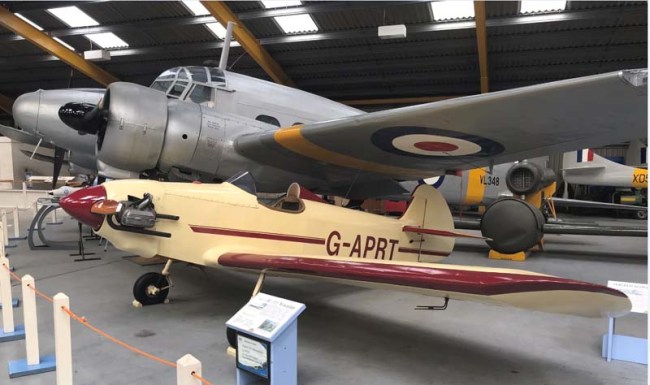
Let’s start with the exception, though, which would be the Avro Anson, even though this normally peace loving multi-engined aircrew trainer was originally designed as a maritime reconnaissance aircraft. In World War Two, the Anson finished up instead as the mainstay of the British Commonwealth Air Training Plan in North America, training pilots, navigators, air gunners and radio operators. Newark’s Anson C.19, though, was used as a light transport and communications aircraft. Top speed : 182 mph. The Anson is the bigger silver aircraft. The custard coloured one is a Taylor JT.1 Monoplane.

The Handley Page Hastings began life as the C1 troop-carrier and freight transport aircraft. The aircraft married a completely new fuselage to the wings which had been designed for the abandoned HP.66 bomber development of the existing Handley Page Halifax. This particular individual, TG517, was used in the Berlin Airlift, and then in meteorological flights and finally in the Cod Wars against the evil Icelanders from 1958-1976 . It had begun its career as a completely ordinary C1 but in 1958 was converted for RAF Bomber Command, acquiring a ventral radome to train V-bomber crews on the Navigation Bombing System (NBS). Top speed : 348 mph

The DH.104 Dove was a short-haul airliner manufactured by de Havilland. The aircraft was the monoplane successor to the pre-war Dragon Rapide biplane and was intended as a short-haul feeder for large airlines and airports. The Dove carried eight passengers and two crew, and overall, it was very popular, sales being in excess of five hundred.  Top speed : 210 mph

Now we reach a few nasty foreigners, beginning with the Russkies whose simple plan was to enslave us all. To do that, they might well have used the Mikoyan-Gurevich Mig-27, codenamed “Flogger”. This was a swing wing ground attack fighter based on the basic airframe of the MiG-23, but with a revised nose, hence its Russian nickname of “Platypus”. The “Flogger” was also used by Sri Lanka and later it was licence-produced in India by Hindustan Aeronautics as the Bahadur (“Valiant”).      Top speed : 1,171 mph.

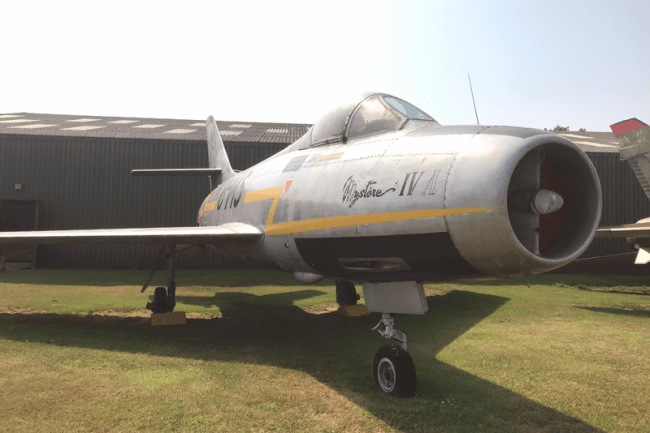
This next aircraft is French. It is a Dassault MD.454 Mystère IV and was used primarily in the 1950s and 60s as a fighter-bomber. It was the first French aircraft to break the sound barrier, and the first transonic aircraft to enter service with the French Air Force. It saw action with both the French and Israeli air forces in the Suez Crisis of 1956 and then again with the Israeli Air Force during the 1967 Six Day War, fighting Mig-17s and Mig-19s.

The Newark Air Museum also has a good many objects connected with the Dambusters’ Raid of May 17th 1943. They have a propeller from the crashed “S-Sugar” of 617 Squadron:

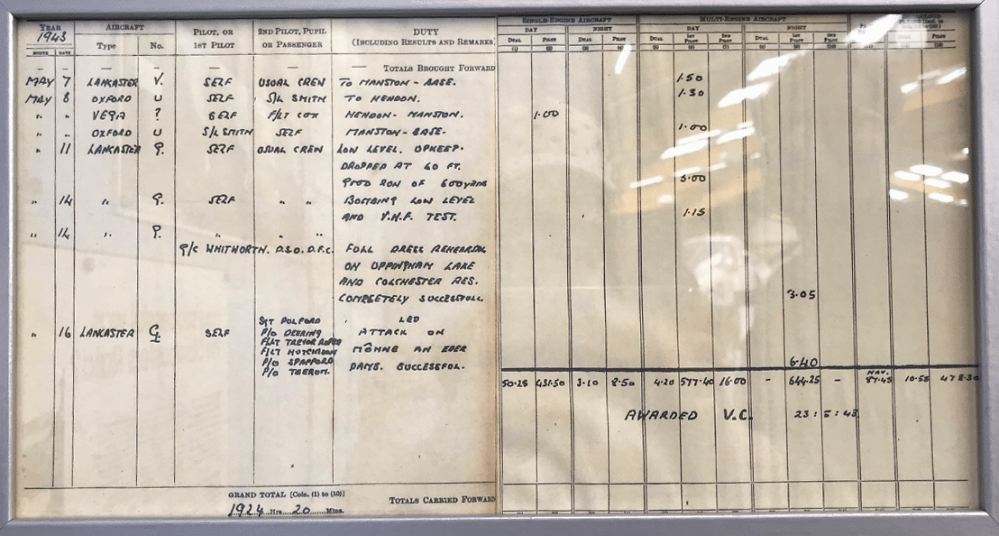
There is the relevant page from the logbook of Guy Gibson:

There is a piece of fuselage from a Lancaster:

And a man inside it demonstrates how many garments he has to wear:

There is a mid-upper turret from a Lancaster:

And finally, you can see the weight and distinctive shape of one of Barnes Wallis’ “Bouncing Bombs”, codenamed “Upkeep”. This particular bomb was built for testing purposes and was recovered from the waters off Reculver in Kent by Andrew Hemsley and the personnel of 101 Field Regiment TA, and 22 and 223 Squadrons.

All photographs courtesy of Lauren Knifton Fainberg


13 Comments

Filed under Aviation, Bomber Command, History, military, Personal

The Murder of Leslie Howard (2)

Last time, we read the most widely accepted version of the shooting down and killing of Hollywood star, Leslie Howard, by eight Luftwaffe Junkers Ju-88 heavy fighters:

Those two outstanding German authors, Sönke Neitzel and Harald Welzer, though, tell a much blacker story of the destruction of BOAC’s Dakota DC-3 “Ibis” in their recent book “Soldaten”.

………….During the war, the conversations of German POWs were recorded without their knowledge by their British captors. One of two prisoners in a particular prison camp near London had actually been in one of the Ju88s which had shot down Howard’s Flight 777:

His name was Dock and he said:

“Whatever crossed our path was shot down. Once we shot down – there were all sorts of bigwigs in it: seventeen people, a crew of four and fourteen passengers; they came from London. There was a famous English film-star in it too; Leslie Howard. The English radio announced it in the evening.

Those civil aircraft pilots know something about flying! We stood the aircraft on its head, with the fourteen passengers. They must all have hung on the ceiling! (Laughs) It flew at about 3200 meters. Such a silly dog, instead of flying straight ahead when he saw us, he started to take evasive action. Then we got him. Then we let him have it all right! He wanted to get away from us by putting on speed. Then he started to bank. Then first one of us was after him, and then another. All we had to do was to press the button, quietly and calmly. (…..laughs…)……It crashed…. They were all dead. Those fools don’t try to make a forced landing, even if they can see that it’s all up with them.”

The Allies proclaimed the act a war crime, and so too did a large number of neutral countries. After all, the Germans had shot down an aircraft which belonged to a neutral country (the Netherlands).

Not all of the names of the Ju 88 pilots who carried out this war crime have survived the Nazis’ frenzied burning of their own archives and records, but among the guilty men were:

Oberleutnant Albrecht Bellstedt, Staffelführer Oberleutnant Herbert Heintze, Oberfeldwebel Hans Rakow, Leutnant Max Wittmer-Eigenbrot

Bellstedt and Wittmer-Eigenbrot were both killed in the war, the others I have not been able to trace. No more BOAC daytime flights from Lisbon took place until the end of the war.

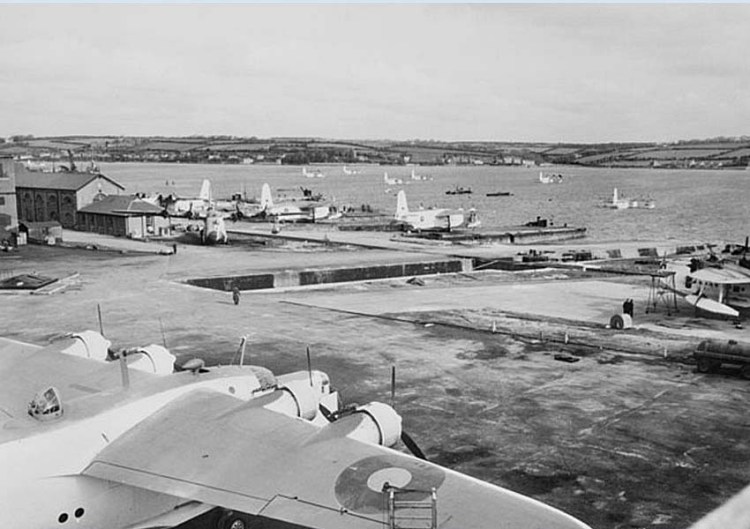
The flights which did take place were all at night, over a totally different route, completely beyond the range of a Ju-88. The British authorities responded to the DC-3’s failure to arrive by despatching a Short Sunderland GR3 flying boat to look for it. The aircraft, EJ134, was piloted by the brave Australians of 461 Squadron. The crew was James (Jim) Collier Amiss, Wilbur James Dowling, Alfred Eric Fuller, Ray Marston Goode, Albert Lane, Edward Charles Ernest Miles, Harold Arthur Miller, Kenneth McDonald Simpson, Philip Kelvin Turner, Colin Braidwood Walker and Louis Stanley Watson. Here’s a picture of RAAF 461 Squadron, looking for all the world like a flock of gigantic white geese:

The Australians found nothing whatsoever on the surface of the sea, but they did find the very same group of eight Ju88C-6s that the DC-3 had already met, at more or less the very same place where it had met them. Sunderland EJ134 and its crew then won their place in aviation legend. In a prolonged battle, the flying boat lost one engine and its tail turret. Messrs Dowling, Goode, Miller, Simpson and Walker were all injured and poor Ted Miles (27), one of the two side gunners, was killed. They did manage, though, to shoot down three of the eight German fighters. Of the other five, only two made it all the way back to Bordeaux. The other three were never heard of again. Six out of eight shot down. That should teach them not to attack unarmed airliners flying from neutral countries.

Overall, the Germans were very wary, if not simply afraid, of the Sunderland flying boat. It was an extremely heavily armed aircraft and a formidable opponent.

No wonder they called it

“Das Fliegende Schtachelschwein”, the Flying Porcupine”

This phrase  has proved particularly useful in all of my many trips to Germany, especially those to Berlin Zoo. And one day, when I ask for a cocktail called “A Flying Porcupine”, the barman will know how to make it!

14 Comments

Filed under Aviation, Film & TV, History, military, Politics, war crimes

Newark Air Museum (1)

The original Newark, or Newark-on-Trent, is a market town in Nottinghamshire in England. It stands on three important routes, namely the River Trent, the ancient Great North Road or A1, which ran from London to Edinburgh and it is also on the main East Coast railway line:

Newark has an historic castle which was “slighted” or put beyond military use in 1648.

Outside the town, Newark also has an air museum.

Nowadays going out to visit anywhere is not really feasible for me, so my daughter went as my ambassador, accompanied by her boyfriend, urged to take photographs of whatever she thought was a warplane. And she is no aviation expert, but she certainly knows a hawk from a handsaw and a Halifax from a Hastings. She wouldn’t know a Hampden from a Hereford, though, or a Harrow from a Sparrow or a Bombay. Who would?

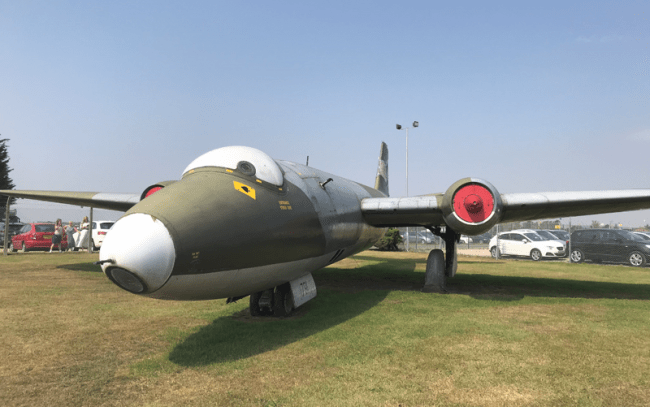
The majority of Newark’s aircraft are from the 1950s and the Cold War. Here’s an English Electric Canberra PR7, the photo-reconnaissance version. This one, WH 791, served at RAF Tengah in the western part of Singapore. Top speed : 580 mph

This is a Gloster Meteor two seat conversion trainer, the T7. This particular aircraft, VZ634, was in service from 1949-1958 with 247 Squadron, 609 Squadron, 141 Squadron and 41 Squadron. As a fighter, the Meteor was used by 16 foreign countries and Biafra. Top speed : 585 mph

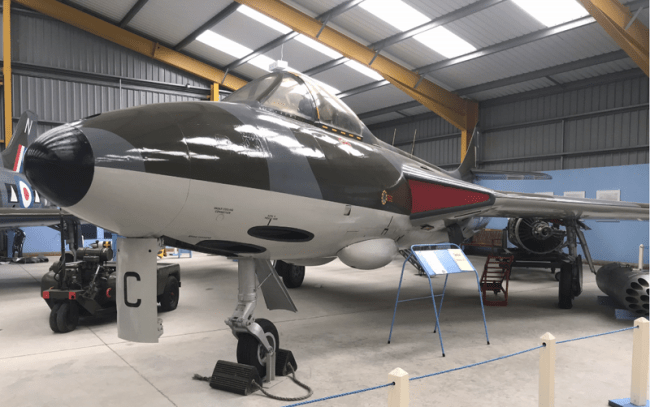
Here’s another fighter, the Hawker Hunter. At Newark, it’s an F.1 interceptor fighter, waiting eagerly for those Bears, Bulls and Badgers to show their evil Commie faces over the North Sea. Hunters were used by 21 other countries and had a Top Speed of : 623 mph. Nowadays everybody seems to have forgotten “The Black Arrows” aerobatic team and their manœuvre with 22 aircraft, certainly a world record at the time. There’s a link here.

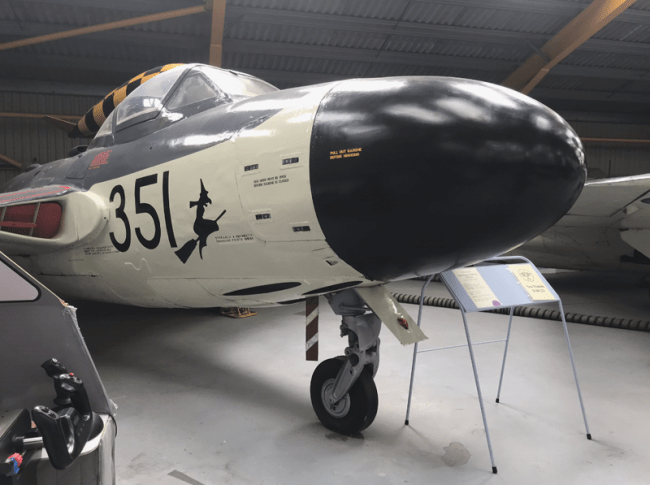
The de Havilland Sea Venom was a two seater shipboard strike fighter, one of the comparatively few aircraft to have been twin boom. At Newark there’s an “FAW.22” or “Fighter All Weather”, WW217, one of only 39 built. There’s a family tree here, starting with the de Havilland Vampire, then the Venom, the Sea Venom and finally the Sea Vixen which operated from carriers as late as 1972.

This is the Avro Shackleton, the last in the line which ran from the Avro Manchester to the Avro Lancaster to the Avro Lincoln and finally to the Avro Shackleton. It was a long-range maritime patrol aircraft, and was used by the British and the South Africans. Top speed : 302 mph

Here’s a closer view of some of those propeller blades:

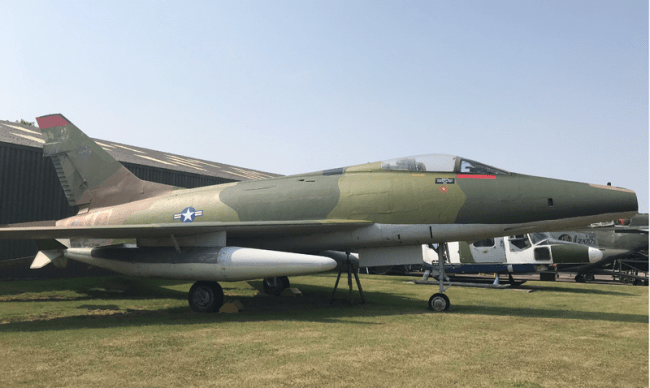
The only American warplane here is the North American F-100D Super Sabre, a single-seat fighter-bomber. This individual was used by France’s Armée de l’Air, and served in France, Germany and the old French colony, Djibouti in the Horn of Africa, today’s Somalia. In total, it had a career of 4,459 hours in the air. Top speed : 924 mph, Mach 1·4.

I think it was an F-100 that dropped the napalm in “Apocalypse Now”:

Next time, a look at some of Newark Air Museum’s civilian aircraft, some more of its foreign aircraft and its various bits of aircraft.

20 Comments

Filed under Africa, Aviation, Bomber Command, Film & TV, France, History, military, Personal

The Murder of Leslie Howard (1)

A couple of years ago, I wrote a series of blogposts about the Short Sunderland flying boat. In at least one of them, I talked about how a civilian airliner, with the film star Leslie Howard on board, was shot down over the Bay of Biscay on June 1st 1943. Howard, and the crew and all of the other passengers were killed.  I mentioned those events because, the following day, a Short Sunderland was sent out to look for the missing airliner. They didn’t find it, but they did find the eight German fighters which had shot down the BOAC Douglas Dakota DC-3. There then ensued one of the legendary battles of the Second World War as the Sunderland fought off a pack of Junkers Ju88s. That particular series of blog posts, though, concentrated on the Short Sunderland flying boat and the Junkers Ju88 long distance heavy fighter.
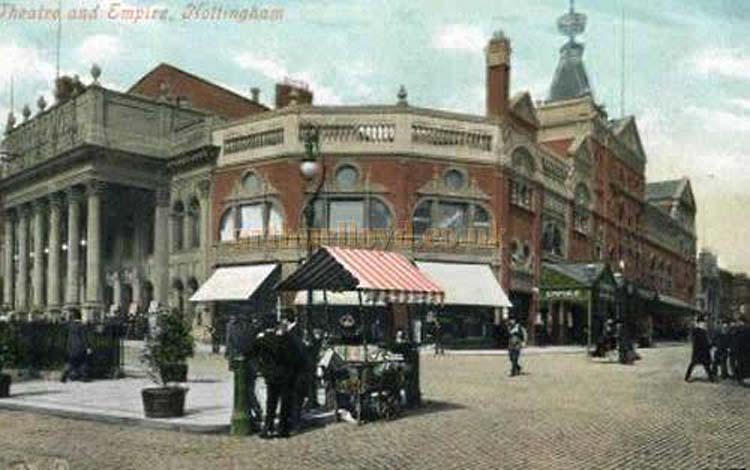
This series of blogposts which begins today, however, concentrates not on the aircraft involved, but instead the still unanswered question of……….

“Why did the Germans have to destroy that airliner ?”

And first of all, let’s take a look at the man who is usually put forward as the prime suspect for the reason that the Dakota had to be destroyed……..

Leslie Howard was a film star who starred in “Pimpernel Smith”, “The First of the Few”, “Of Human Bondage” and most famous of all, “Gone with the Wind”, a huge smash hit in 1939. Here he is in “Journey’s End”:

Howard’s father was Ferdinand Steiner, a Hungarian Jew, and his mother was Lilian Blumberg, from an English Jewish family of German origin. Howard had originally styled himself Leslie Stainer in an effort to anglicise his real name of Leslie Howard Steiner, but eventually he decided on the name by which he is known nowadays.

On June 1st 1943, Leslie Howard was in Lisbon, the capital of Portugal, with his business manager, Alfred Chenhalls. They intended to take the civilian passenger aircraft of KLM Royal Dutch Airlines which, even in wartime, made a regular morning run between Portela Airport to the north of neutral Lisbon and Whitchurch Airport near Bristol in England. Neither Howard nor Chenhalls had tickets, so two passengers were turned off the aeroplane to make room for them. The lucky two were a little boy called Derek Partridge and his nanny called Dora Rove. Or, in another story, one of the two passengers was a Catholic priest, Father Holmes. Or perhps the lucky two were George and William Cecil, recalled from their boarding school in Switzerland.

There is a story that the take-off was delayed while Howard went to collect a small parcel full of silk and nylon stockings, a present, perhaps, for his wife and daughter. While filming, Howard was pretty much a serial adulterer, who said….

“I never chased women but I couldn’t always be bothered to run away”

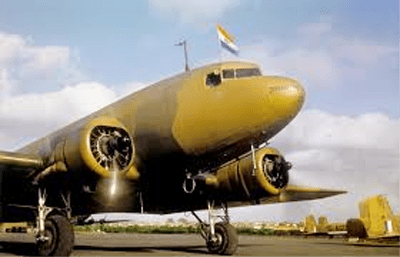
The aircraft was a Douglas DC-3-194 called “Ibis” with the civilian letters G-AGBB. Here it is, complete with its Dutch flag:The aircraft had hardly ever been impeded by the Luftwaffe on its 1,000 mile, seven hour, flight:

In actual fact, though, the Germans had already attacked the aircraft on two occasions in the previous six months. On November 15th 1942, it had been challenged by a single Messerschmitt Bf110 Zerstörer heavy fighter and on April 19th 1943, it had been ambushed by a patrol of six Bf110s. Here’s the nightfighting version of the Bf-110. The Zerstörer heavy fighters would have lacked the radar antennae….

On both occasions, the camouflaged airliner escaped a watery grave. The first attack involved a party of very high ranking American Eighth Air Force officers which included Ira Eaker. They were saved when the Bf110’s engine caught fire as it attacked. Everybody in the airliner, both passengers and crew, was terrified. In the second attack, the pilot, Captain Koene Dirk Parmentier, dropped down to the waves and then climbed steeply into the thick low clouds.

On the other hand, though, the trip had been made more than 500 times between 1939-1943 without the slightest problem.

On this occasion, though, just after midday, they were shadowed  initially by two Junkers Ju 88s over the countryside of northern Portugal and then of north-western Spain. They broadcast a message “we are being followed by enemy aircraft” and then “we are being shadowed”.

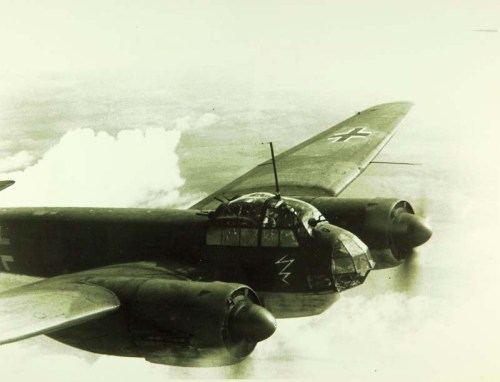
At around 12.45 pm eight different Junkers Ju88C-6 fighters of Gruppe V / Kampfgeschwader 40 spotted the “grey silhouette” of the DC-3. The Ju88s were flying with six aircraft abreast, fifty yards or so apart, with another two flying above them and acting as “spotters”. They had apparently been told to look for a twin engined grey aircraft. Their commander, Oberleutnant Heintze, had been told to carry out rigorous patrols during June and to shoot down the aircraft they found. This is a Junlers Ju-88 heavy fighter:

The Ju88s attacked the airliner at between 6,000-10,000 feet over the Bay of Biscay some two hundred miles north of the Spanish coast. One of the pilots, Oberleutnant Albrecht Bellstedt, radioed to his companions: “Indians at 11 o’clock, AA”. This meant enemy aircraft ahead, slightly to the left, attack, attack. One fighter came in from above and one from below. With their heavy calibre cannons, they set the Dakota’s port engine on fire and this then spread to the wing. A radio message was picked up from the wireless operator, van Brugge: “I am being followed by a strange aircraft….Putting on best speed….we are being attacked by enemy aircraft….cannon shells and tracers are going through the fuselage…. Am wave hopping and doing my best.” Oberleutnant Heintze, however, drew level with the stricken aircraft and quickly realised that it was a civilian airliner. He immediately stopped the attacks. Three, presumably, crew members, jumped out of the DC-3, deploying their parachutes but they did not open as they were already on fire and all three fell to their deaths. The aircraft plummeted into the sea where the wreckage floated on the surface for a very short period and then sank. By one o’clock, all four crew members and all thirteen passengers, including Leslie Howard, had been killed.

The four members of the crew were the pilot, Quirinus Tepas MBE, the second pilot, Captain Dirk de Koning, Cornelis van Brugge, the radio operator, and Engbertus Rosevink, the flight engineer.

Whoever was their intended target, the Germans were certainly serious about killing him or her. They had sent eight twin engined heavy fighters from Gruppe V / Kampfgeschwader 40 in a deliberate attempt to intercept that lone Dutch aircraft. If they had come across it purely by chance then surely there would have been just a single fighter involved, at best two, surely not a group of eight. And after they had shot down the DC-3, the German fighters circled the floating wreckage and took photographs of the burning plane before it finally sank. You don’t do that with just any old aerial kill. It has to be done for a very special reason. But that reason has never been found.

Here’s Alfred Chenhalls, Old Nopttinghamian, and Leslie Howard’s business manager. And with a cigar in one hand, and a whisky in the other, he’s a Winston Churchill look-alike. Apparently…………..

Don’t forget, though. In this day snd age, it was by no means simple to identify a famous person. They might have seen them in the cinema, but apart from this, there were only newspapers, magazines and, most of all, the radio. The latter, of course, was useful only for voice identification!

28 Comments

Filed under Aviation, Film & TV, History, military, Politics, war crimes

The next few months of the Battle of the Somme with more revelations about British stupidity (Part 5)

Surprisingly, throughout the whole First World War, the British were unbelievably lax on what could be termed “personal security”. In the German Archives, therefore, battlefield expert, Peter Barton, seen below,………

………found that literally hundreds of lower ranked British officers had been captured by the Germans with top secret plans in their possession, including many labelled “not to be taken into the front line”.

Not surprisingly, the Germans found these maps extremely useful and once they had seen them, they would quickly change their defensive plans and tactics to fit in with them. For example, on one occasion, they resited all of their heavy machine guns out of range of the Allied creeping barrage. Here they are, the schweinhunds……

During the very harsh winter of 1916-1917, the morale of the British troops plunged, in large part because of the lack of success on the Somme and the huge casualties suffered there.

According to the German Archives, hundreds of British POWs shared that very same opinion. The POWs were only too ready to tell the Germans that anxiety, depression and pessimism were rife among the men in the British trenches. A war which was going to be a “walkover” had now become a very long steeplechase with an almost infinite number of obstacles.

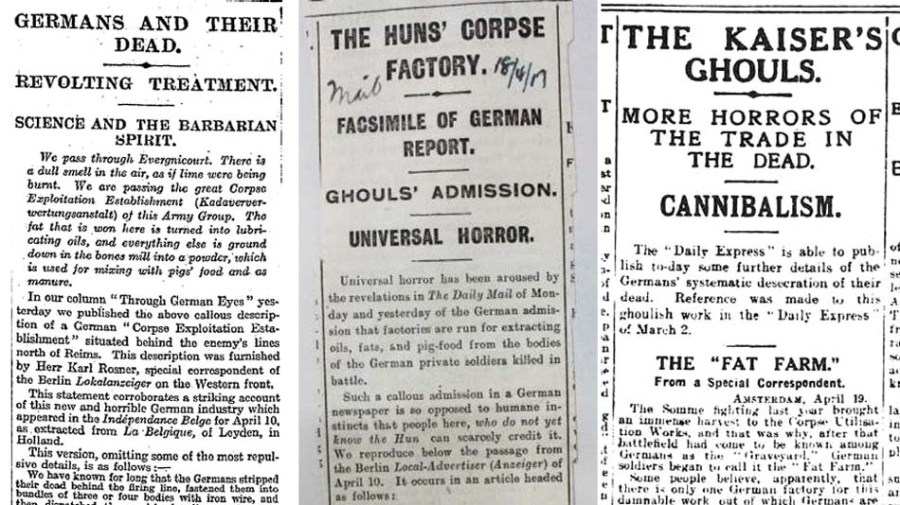
Indeed, war weariness was such that both officers and soldiers were frequently delighted to become POWs in German captivity. There was also widespread disgust at how the British press told blatant lies about the progress of the war, especially the Daily Mail. Here are headlines about how a desperate German population was now eating the corpses of their dead soldiers…..

By 1916-197, divisions were also beginning to appear between the British and the Dominions of the Empire, with the Australians, Canadians and New Zealanders only too willing to slate the British leadership on the Somme.

The numbers of men who wanted to go on fighting were increasingly small and the Australians in particular, who were no fools and were 100% aware that they were “always used in tough battles” were beginning to see their role as the “White Slaves of the Somme”. The same would happen to them in World War Two, and the Canadians would also suffer in a similar way in both wars. In World War 2, the Poles and the French speaking Canadians could also added to the list.

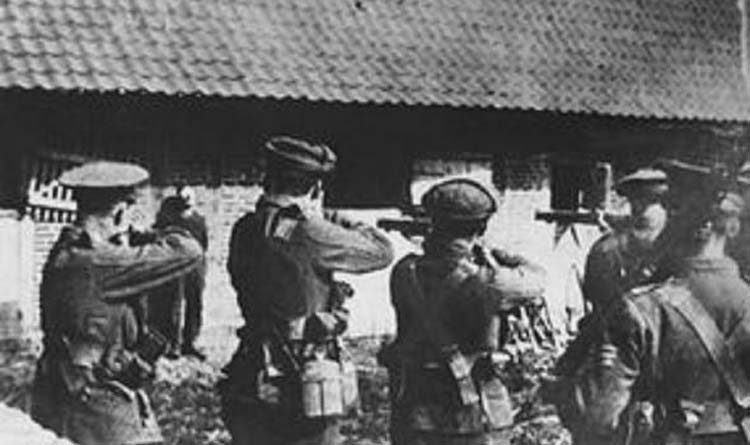
Mental illness, shell shock and desertion were increasing by leaps and bounds. Haig showed them no mercy and nine times out of ten opted to have them shot. It was carried out in the most ill considered of ways, with the members of the firing squad always selected from the condemned man’s unit. On many occasions, therefore, they were being asked to shoot somebody who they may have known personally, quite possibly as a friend. Here’s a British Army firing squad, hard at work…….

Both sides tried wrongdoers at courts martial. The British did not give the accused access to a lawyer, but instead they had an officer to give them advice and to fight their corner.
The Germans made it much more like a civil trial. There was a jury whose job was to decide the guilt of the prisoner, and he had access to a fully qualified lawyer.

The Germans used physical punishments and these were carried out in the local area.

When dealing with captured German soldiers, the British constantly harassed them and tended to be very fierce and very nasty to them. The result was that they hardly ever discovered any useful intelligence information.

The Germans, though, were always very pleasant with the British POWs, who soon became much more relaxed. The two sides would begin to chat to each other, and share a cup of tea, sometimes with biscuits.  Those simple aids would usually persuade the British to give up their secrets, often in very great detail. Here are prisoners in a German Prisoner-of-War camp. Some of these men might have been here for four years, since being captured, for example, at the Battle of Mons….

20 Comments

Filed under Canada, History, military