Category Archives: Humour

Brincliffe Grammar School for Girls (3)

There was a strong connection between Brincliffe School and the High School but not, as you might expect, between the boys and the girls. Instead, the connection was a sporting one, and consisted of a number of football matches, all of them played between 1877-1880, when the physical building on Balmoral Road accommodated “Porter & Jones, boys’ school (Tudor House)”.

The High School had played their first match against another school seven years previously. News of the game appeared in the new school magazine, “The Forester”, which introduced a section entitled “Our Chronicle”, which was designed to allow reports about “the sports… of the School.”

Thus, on November 19th 1870, having travelled to Mansfield, the Nottingham High School First XI played a Mansfield Grammar School XV at football, beating them 3-0. Around 110 years later I took the First XI to Mansfield, not in a steam train, but by minibus, and we played them on a darkish Wednesday afternoon. We lost, although by then they had changed their name to Brunt’s School, now changed again to Brunt’s Academy. The Orange Arrow shows the High School, Mansfield is in the middle of the top edge of the map, and then see if you can find Eastwood, the birthplace of DH Lawrence, ex-pupil at the High School (1898-1901).
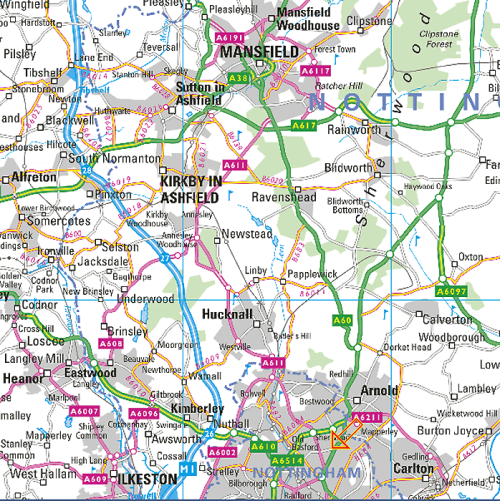
History always likes to puzzle us with the fogs of confusion that it loves to create, though. Just as we were digesting the fact that the High School played its first ever football match on November 19th 1870, when the First XI beat a Mansfield Grammar School XV by 3-0, I found that there is a some evidence that organised football was played by the High School even before this.

In just one edition of “The Forester”, there is an allusion to a football game between the High School and a Tudor House School XV on February 27th 1878. Charles Edwin Attenborough, the son of a hosier from Bilbie Street, was unlucky enough to break his leg and dislocate his ankle. It was reported at the time that, with the exception of one broken collar bone in, probably, the 1872-1873 season, this was the the first injury of any consequence “since the new school opened in 1868”.

This intriguing phrase might conceivably be taken to imply that football matches had taken place in that short interim period of just over two years between April 1868 and December 1870, when “The Forester’s” first reports appeared. This is so long after the event, though, that we may never know the exact truth.

Seven years after their first ever game against any other other school, the First XI played Mr Porter and Mr Jones’ “Tudor House” on October 31st 1877, probably on a pitch on the nearby Forest Recreation Ground.  The First XI won 15-0 and “The Forester” recorded that Tudor House did not once get the ball into the High School half, at any point in the game…..

“Goals were obtained as fast as the ball was kicked off.”

Fifteen had been scored “when time was called”.

Four months later, on February 27th 1878, again probably on a pitch on the nearby Forest Recreation Ground, the First XI beat a Tudor House XV by 3-2 (as already mentioned above). During this game, thirteen year old Charles Edwin Attenborough was unlucky enough to break his leg and dislocate his ankle. Despite our modern perceptions of the roughness of Victorian football, “The Forester” reported that, with the exception of one broken collar bone four seasons previously, this was the first injury of any consequence “since the new school opened” in April 1868.

And here it is, a photograph thought to have been taken on April 16th 1868, the school’s first day. The first lesson to be learnt was that more toilets would be needed if queuing was to be avoided:

A week or so after the glorious triumph over 15 boys in the Tudor House XV, on March 6th 1878, on the Forest, the First XI again played a Tudor House XV. and beat this slightly more numerous team by 2-0. These two games were the last two fixtures of the season 1877-1878.

During the following season, Tudor House scored their first ever victory over the High School. On a day misprinted in “The Forester” as October 60th 1878, on the Forest, the reporter said that “This was a very even game, but the fact that Bramwell and four other first team members were absent probably tipped the balance in favour of Tudor House.” They won by 1-0. We don’t know what colours the High School played in. In both these photographs, the colours are black and white. They come from 1897 and 1910, approximately:

This slideshow requires JavaScript.

A year later, on March 12th 1879, at an unknown venue, but probably the Forest , the First XI played out a skilfully planned 0-0 draw with Tudor House. This fixture took place in an extremely high wind, which encouraged the Tudor House players merely to kick the ball out of play as far as possible at every opportunity. “The Forester” lamented….

“….Unfortunately there is no rule which provides for occurrences of this kind, but we should have thought there would have been a better spirit prevailing to prevent such unsatisfactory proceedings.”

When I was in charge of the First XI, around 2000, I employed this tactic and it was extremely effective. Even better is to kick the ball into the road, the busier the road the better. Boys are not allowed to pursue a ball in such circumstances and it has to be the teacher/referee who has to go and fetch it. Invariably, he always takes ages.

Seven months later, on October 15th 1879, and back on the Forest, the two teams met again, and this time the wind had dropped and the game finished 6-1 to the High School. Only five of the regular First Team were in what “The Forester” called the “motley crew” who won this game. Now, Mötley Crüe are an American heavy metal band formed in Los Angeles in 1981. Please don’t confuse them with the Victorian footballers. It’s easily done:

Being sensible, and playing Tudor House with a weakened team which lacked many of the regular First XI players didn’t last long, though. The very last fixture ever against Tudor House came on February 11th 1880. Again at an unknown venue, the High School triumphed. The score was recorded as

Nottingham High School “at least 12” Tudor House 0

“The Forester” wrote that

“the difficulty in this game was “not to get goals”, so weak were the opposition. Goal followed goal in quick succession, so that it was rather hard to keep a correct account. It was certainly not less than 12 goals, and may have been more.”

I once coached the Second Team in such a match. It finished 13-0 (referee). 14-0 (me) or 15-0 (several of the players). We lost, of course.

We once lost to another school team who had a nine-year old girl in goal. Their member of staff asked me if it was OK for her to play and I agreed, not knowing that she was Spider Woman in her spare time. We lost 3-2.

STOP PRESS

Elsewhere I have spoken about how, in the attic, I stumbled upon the box containing all of my slides from the 1970s and early 1980s.

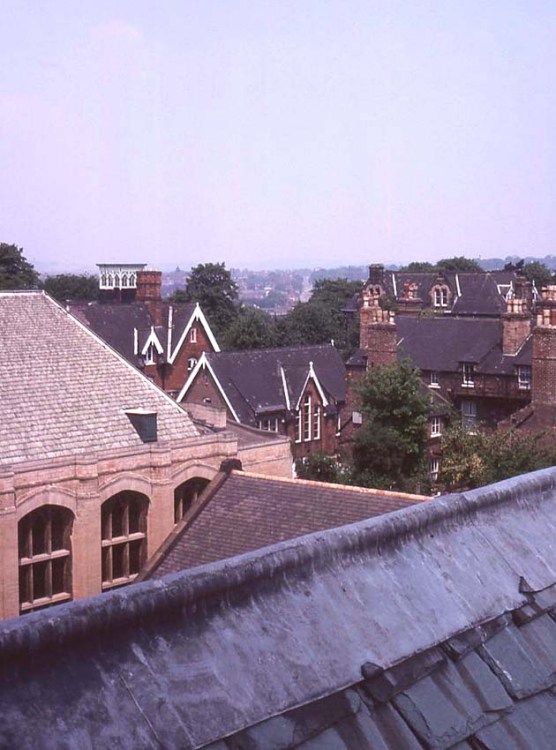
The photograph below I took around 1976. It was taken from the corridor which ran down towards the then E13, and you can see the roof of the Old Gymnasium and the Assembly Hall, sometimes called the Player Hall. Directly behind that are the two buildings of Brincliffe. To help you identify them, they both have gables picked out in bright white……..
15 Comments

Filed under Football, History, Humour, Nottingham, Politics, The High School

My best friend, Widdle (6)

The  colour and texture of a fox’s coat may vary due to the change in seasons.  It will be richer and denser in the colder months and lighter in the warmer months. To get rid of the dense winter coat, foxes moult once a year around April. The moult begins from the feet, up the legs, and then along the back, finishing with the neck and head.

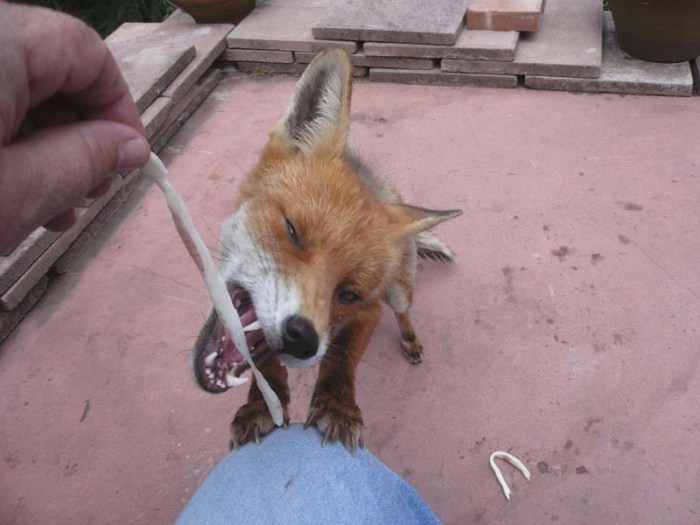
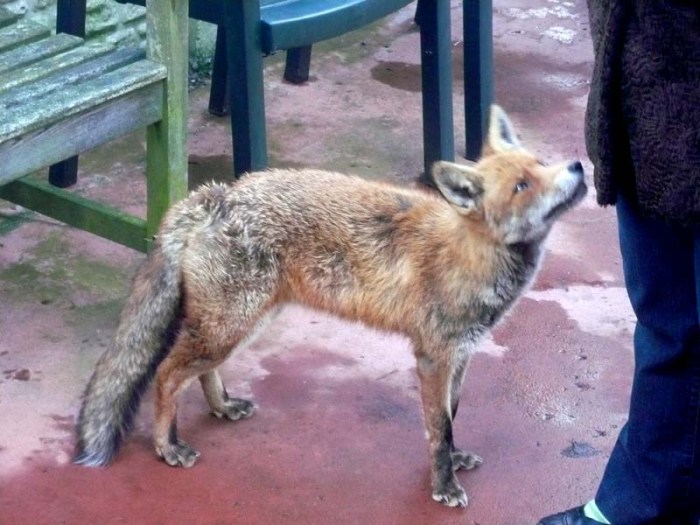
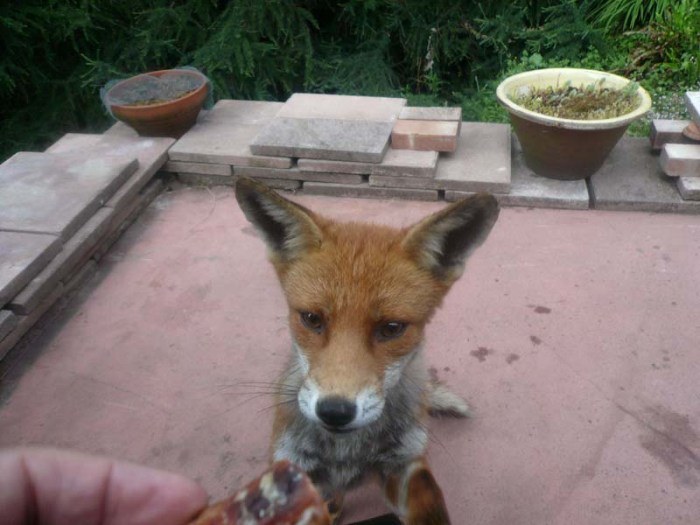
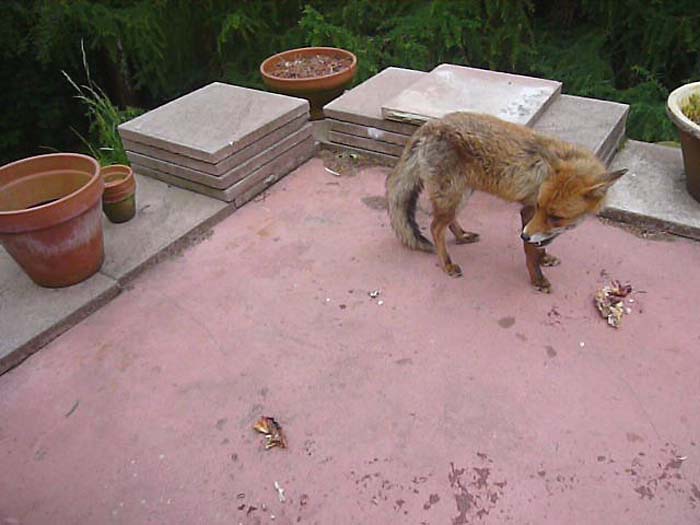
Widdle was a fox who came to us, apparently around two years old, one day in 2007. He was looking for affection and for help. He came to us from a desire to understand nice human beings, and most of all, for unlimited access to good quality sausages:

Over the three to four years that we knew Widdle, his appearance changed a great deal. He was certainly not always what our American friends call a “red fox”, because in the spring and summer months, he was the hapless victim of his single annual moult.

According to Wikipedia, quoted above, a fox’s moult “begins from the feet, up the legs, and then along the back”. Sometimes in June, in the middle of the moult, Widdle looked rather like he’d been down to the pub the night before, and had a few too many:

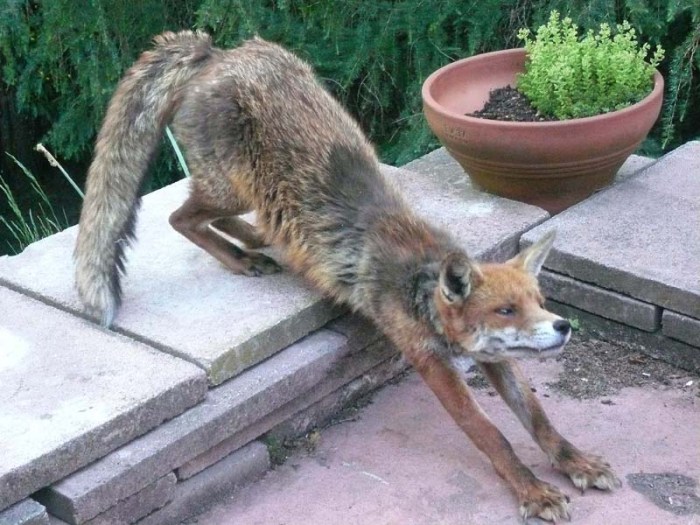
In May, he had tried stretching exercises, but that didn’t last long:

No, the only remedy is a couple of sausages. Or so we thought. It was actually more complicated than that.

Widdle’s main problem with his coat was fleas, particularly during the moult. Here he is, scratching away. As far as we were aware, it was impossible for humans to be infected by fox fleas, and in up to four years with him, we never thought we had. I did once inquire about trying to give him something against fleas, but we were told it was pointless. Something for a dog and its fleas probably wouldn’t work. It might give him an allergic reaction and kill him. And, as soon as he went back to Mrs Widdle, he would be re-infected:

Male foxes fight quite a lot and here he is with part of his coat ripped off, I remember saying to him “That look’s a very painful wound.”, and he said “Well, you should have seen the other fella’.”

By winter, though, Widdle has acquired that magnificent coat that we all know and love. In this photograph, he shows that certainly as far as he is concerned, the neck is the last section to change.

Anyway, by early September, the transformation is complete. All that is missing is the white tip to his tail, which, as far as I recall,  Widdle never had. Well, not in full anyway:

And certainly, by November, it is as if he had been spray painted “fox-red”. He has lost all the black bits on his legs and the black and white stripes on the upper sides of his paws. He is Red Red Red:

The last picture comes from April 2010 when the very first signs of the Great Itching Time are beginning to appear. Even so, the coat still looks exceptionally thick and is standing on end to trap the warm air:


25 Comments

Filed under Humour, Nottingham, Personal, Widdle, Wildlife and Nature

My Dad’s cars (3)

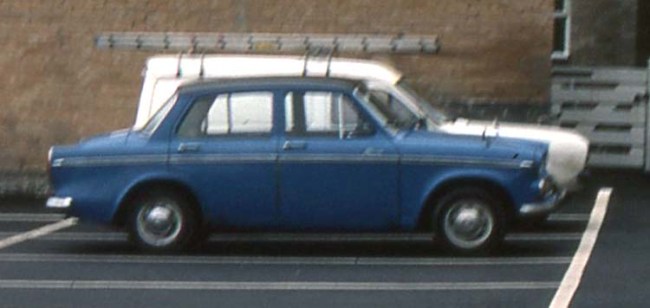
I have already told you about the love of my Dad’s motoring life, his Hillman Minx De Luxe, Registration Number BLT 141B. He gave it to me after he retired, and I had it for about two or  three years. Here is a picture of it in the car park of the old Savoy Hotel in 1980, on our wedding day. That’s why the picture’s so shaky:

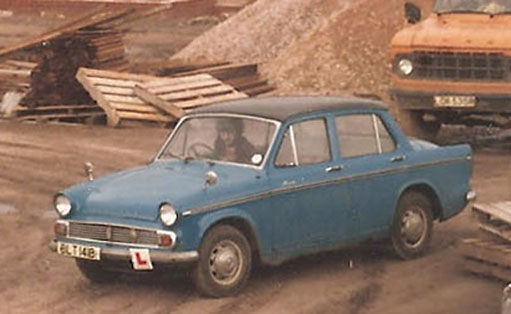
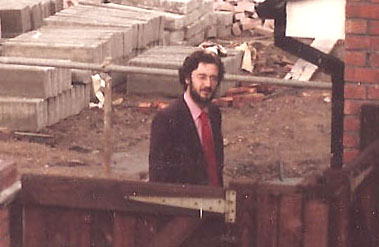
Here I am driving this 1964 car, as it gradually began to get rustier and rustier :photo 4

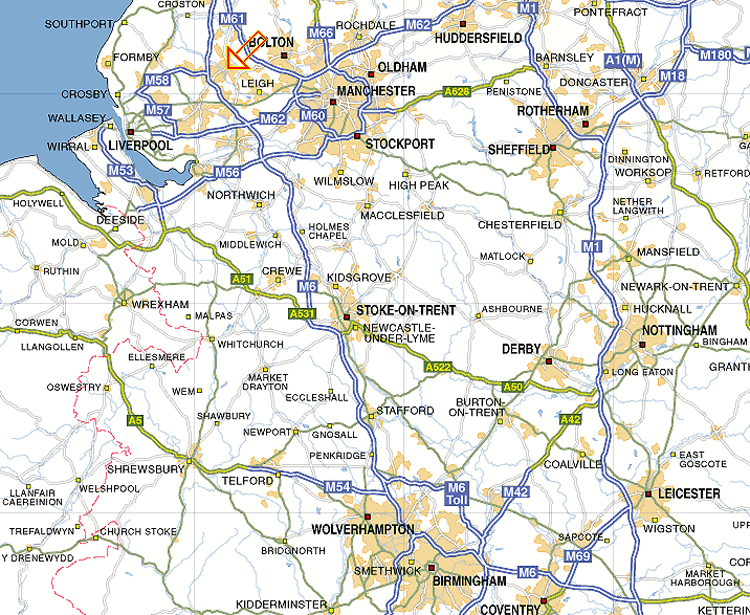
It was in this Hillman Minx that, back in 1968, Fred was returning from Wigan down the M6, when, because the motorway was still in the throes of construction, he failed to see the tiny hand-painted direction signs, and finished up in a building site in Birmingham, having missed his turn off in Stoke-on-Trent. That sounds incredible, but he’d never been on  a motorway before. Wigan is a town in Lancashire and is indicated by the Orange Arrow. My Mum’s parents lived there. The other towns and cities are in capital letters. Fred was aiming at Burton-on-Trent near Derby, which is south east of Stoke:

He was driving the same car in Leicester (south east of Derby) when he got lost and was forced to ask a policeman the way. Realising that he was dealing with somebody from out-of-town, this eminently sensible officer told Fred to avoid a rather horrific one-way system by driving fifty yards the wrong way down a one way street, while he promised to turn a blind eye to the whole thing.

It was again in this very same Hillman Minx that, three years later, Fred again missed his way in that very same city of Leicester, and went the wrong way up another one way street. Instead of being able to solve the problem by the previous method, however, Fred was forced on this second occasion to extricate himself from the situation by executing a three point turn in the face of a rapidly advancing four lanes of densely packed vehicles.

I have vague memories too, of getting lost as we went on holiday for the first time to the Yorkshire coast at either Bridlington or Scarborough. We stopped at, I think, Pontefract, somewhere near a power station, to ask the way.

The man that Fred approached spoke with an accent which was completely incomprehensible, and after a few frustrated minutes, Fred just drove off at top speed, angrily spinning the wheels on his rather sedate family saloon. At the time, he insisted that, against all the apparent mathematical odds, he had managed to find the local village idiot at his very first attempt.

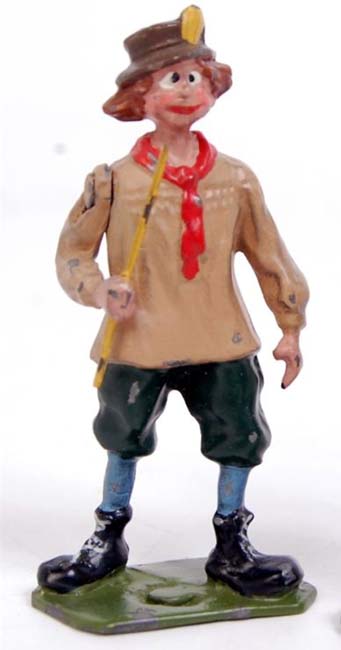
Incidentally, above, you can see the Britain’s Lead Soldier version of the village idiot which usually reaches £200 at auction.

Nowadays, I think, in calm retrospect, that the man’s Yorkshire accent may well have been beyond us. It is difficult, though, even to best guess the location of these events. Perhaps it was near the huge power station at Ferrybridge where the A64 to the east coast Yorkshire holiday resorts left the main A1 trunk road, as it would have been at that time. The power station was demolished a long time ago:

Whenever Fred left his car anywhere unfamiliar, such as when he was away on holiday, or for any length of time in his own local area, he would always immobilise it by removing part of the carburettor . On occasion, Fred would even immobilize the car when he parked it on his own drive. It was years after his death that I realized that in this apparently bizarre zeal for crime prevention, Fred was only carrying out the orders that he would have been given in the early part of World War Two, in 1939-1940, when it was a serious criminal offence to leave a vehicle without totally immobilising it. There was a very real fear of imminent invasion, and the arrival of Nazi paratroopers, many of them disguised as nuns. And even in 1975, the Soviet Spetsnaz forces would have drunk a bottle of vodka each in celebration to have found such a fast and classy vehicle as a 1964 Hillman Minx. Here’s their badge in case your car is ever stolen. Spetsnaz are everywhere:

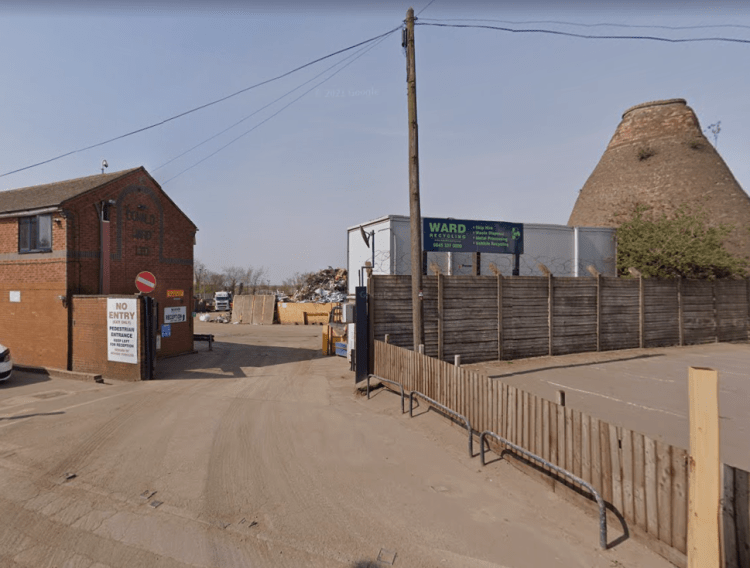
This Hillman Minx was THE car of Fred’s life. He had it for more than sixteen years, before, around 1980, he passed it on to me as a newly qualified driver. I in my turn used the car until it failed its MOT test by a very wide margin, some £300 when my annual salary was £500. I then duly drove it back from Nottingham to Woodville, where my family lived. Fred was then able to drive “that Hillman” as he always called it, on its last ever journey, the short distance from 9 Hartshorne Road to Donald Ward’s scrapyard in Moira Road. Here it is, complete with Victorian bottle kiln:

16 Comments

Filed under History, Humour, my Dad, My House, Nottingham, Personal, Russia

My Dad’s cars (2)

My Dad’s first car was an Austin A40 Devon, in Connaught green, with the registration leters of LXJ 701…..
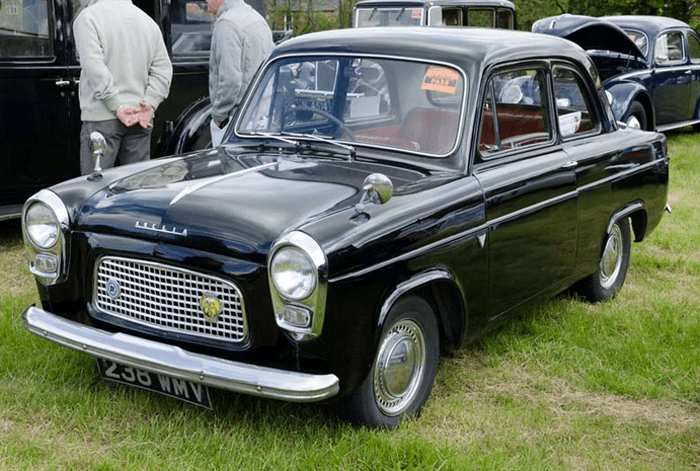
After the Austin A40 Devon, Fred had a 1959 Ford Anglia, registration number SNR 863, which he bought from a garage in nearby Ashby-de-la-Zouch. It was exactly like this:

When I was around eleven or twelve we used to go and visit a nearby toy shop, “Shellbrook Motors” which used to sell Dinky and Corgi die-cast models of cars and larger vehicles, Airfix and Frog aircraft kits, and Hornby model electric railways. By 2017, they had changed a little and were selling artists’ materials, although they did refuse to pay the signwriter’s bill on this occasion:
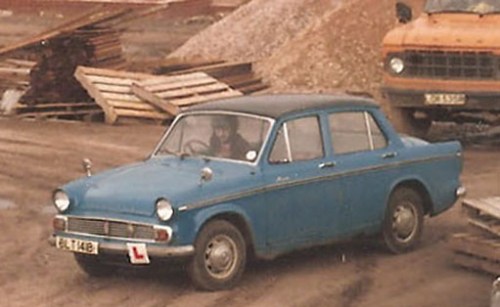
There were no Ford Anglia type problems of low level criminality and cheap plastic with Fred’s next car, an English Hillman Minx De Luxe, BLT 141B. This beautiful blue car with the metallic chrome side stripe was “the one” as far as Fred’s motoring career was concerned.
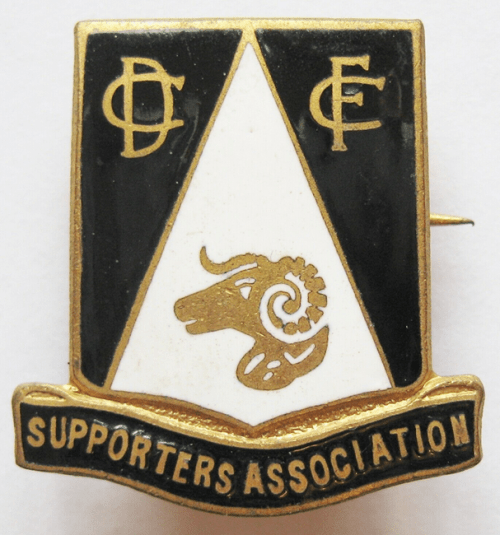
He had taken me to Derby one day, and we visited Peveril Garage, on Friar Gate, near the headquarters of the Derby County Supporters’ Club:

Fred told me not to mention anything whatsoever about the day to my mother, under any circumstances. Without consulting her at all, therefore, he bought the car, priced at £510, which was, in those days, a princely sum. Indeed, the price was such a total royal that, when my mother did eventually find out how much the car had cost, she would have had Fred beheaded if she could have organised it. The car was a rich pale blue, half way between sky blue and navy blue. Here is one today:

In later years, when he had problems with rust on one of the wings, Fred was to opt for a total respray, which allowed him to retain the same colour blue for the body, but to incorporate a black roof which added that extra, unique, little detail. Here it is, with James Bond driving it, back in the days when I was 28. I had always wanted a personalised number plate, and this was the time when I changed my name to “BLT 141B”:

This was also the day that I caught both Francisco Scaramanga and Auric Goldfinger hiding together on a building site:

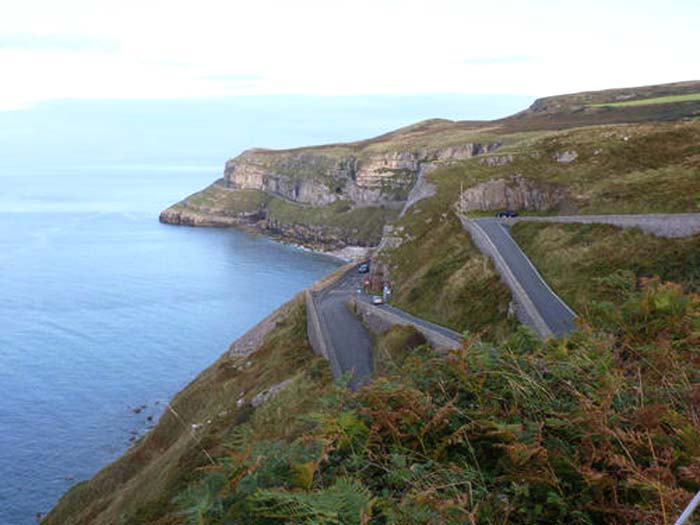
It was in this car that Fred had what were probably the most outstanding motoring experiences of his life. I can still recall, for example, just how scared he was, and indeed, we all were, when he drove a circuit of the Alpine like road which ran around the Great Orme near Llandudno in North Wales.

Indeed, some thirty years later, I returned to look at this road for myself, to see whether it was quite the challenge that it had seemed in the late 1960s. And, of course, the circuit had been considerably watered down since then. All the sheer drops down to the sea had now been fenced off, and, most significant of all, perhaps, a narrow road which I remember as having been two way, had been limited nowadays to just one way traffic. Gentrified, I think the word is:

10 Comments

Filed under Criminology, History, Humour, my Dad, Nottingham, Personal

My Dad’s cars (1)

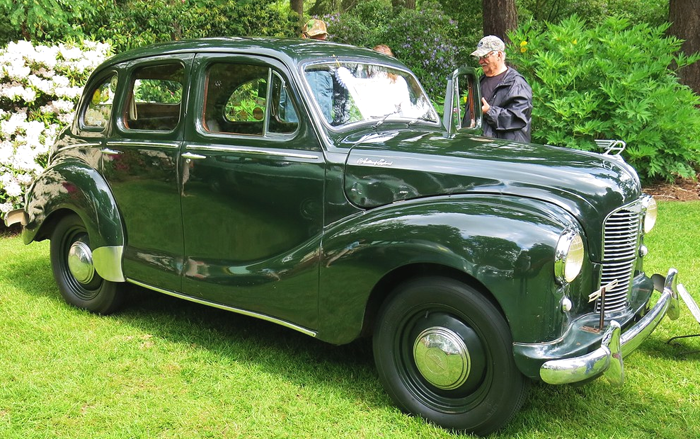
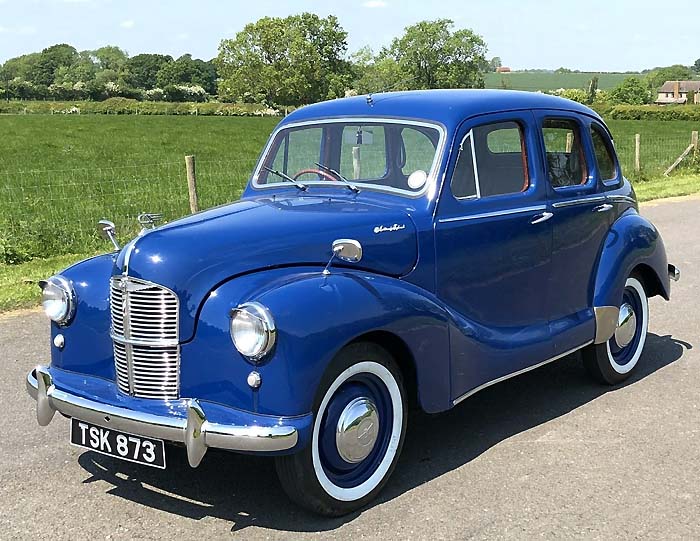
My Dad, Fred’s, first car was a Connaught green Austin A40 Devon, registration number “LXJ 701” (“seven-nought-one”). This car had been acquired in the early 1950s with the help of his in-laws, as a bargain for the newlyweds. It had previously belonged to the owner of a cement factory near Manchester, and for this reason, it proved almost impossible ever to get a good shine on the vehicle, as the painted surface had absorbed such a huge quantity of cement dust through being parked all day long in the office car park at the works. Here is a car of the correct colour, although it has been modified for use as a taxi:

I really wish my Dad had bought an A40 of this revolting bright blue. And I’m an absolute sucker for white wall tyres:

Fred never seemed to use the car an enormous amount, but, like so many people during this era, we often went out for a drive as a family on a nice Sunday afternoon. I remember that on occasion we used to go out on trips towards Repton, but I cannot really recollect anywhere else that we went, although Fred assured me in later years that we had visited destinations as far afield as the church at Breedon-on-the-Hill, Calke, Staunton Harold and Swarkestone Bridge:

This slideshow requires JavaScript.

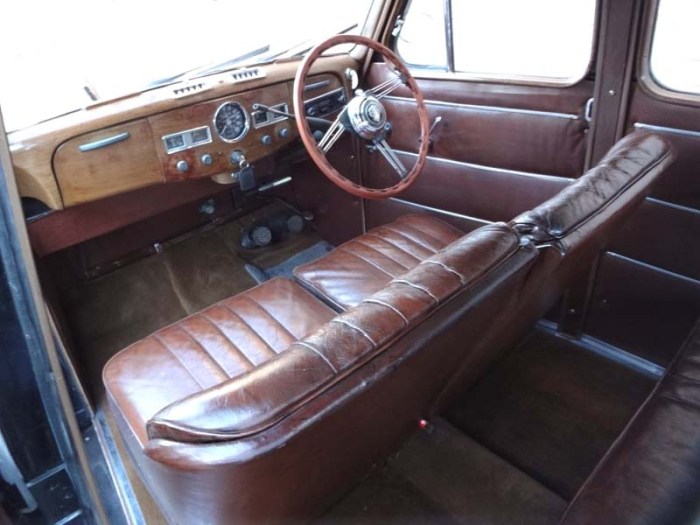
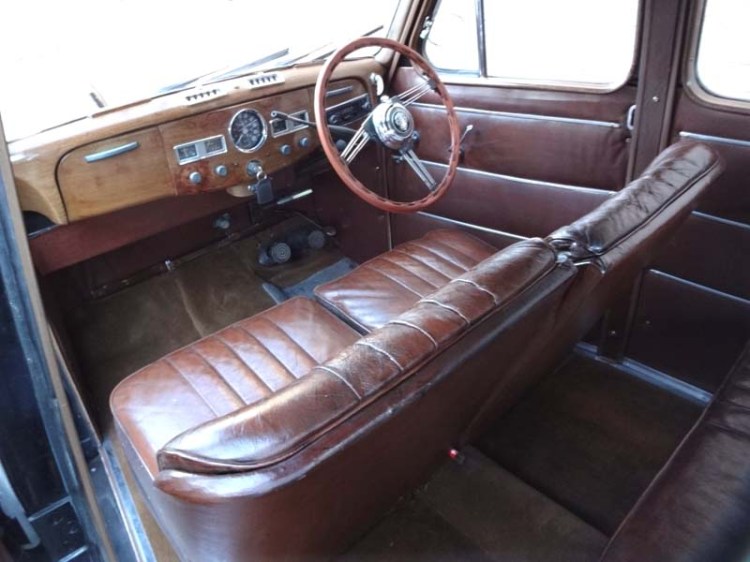
The one thing I do recall about these trips, though, was parking the car one day in a sunlit grassy field, and leaving all the doors wide open to let in the fresh air. The car had rich brown all leather upholstery, sewn lengthways in distinctive style:

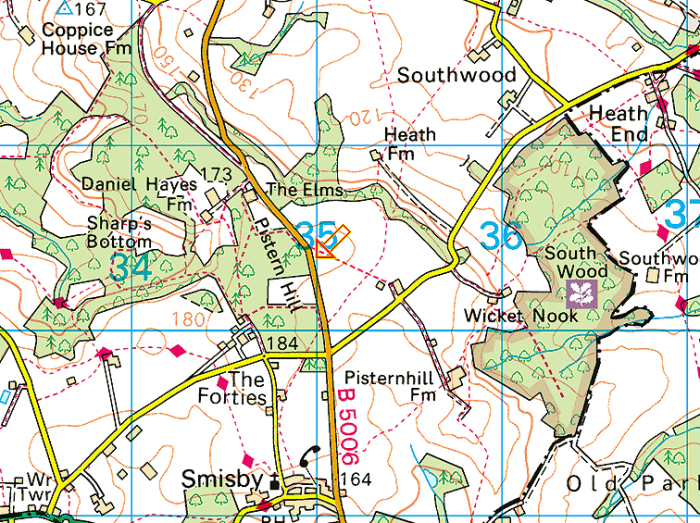
I must have been a very small boy indeed, when Fred had a crash in this car. We were out somewhere in the lanes around the village of Smisby, perhaps somewhere towards Pistern Hills, and I remember that at a T-junction, we failed to turn, but just drove straight on, ploughing into the bank below the hedge at the far side of the road. The Orange Arrow points at Pistern Hills where this accident may have taken place:

In the days before seat belts, I was projected forward, and the ignition key somehow smashed into my forehead between my eyes. I certainly was not taken to hospital with what in the 1950s was just a minor injury, but instead, I was transported to the nearest country cottage at the side of the road. All that I can recall now is sitting at a wooden table in an almost bare kitchen. A woman came in. She was wearing a white blouse and a voluminous long skirt. She was plump and reached up to the wooden shelf which ran all the way around the room, some six feet off the ground, because she had to stretch to reach the tin she was after. She passed it to me. It was a tin of biscuits and she let me eat a few. I do not remember any more. I still have the scar on my forehead.

18 Comments

Filed under History, Humour, my Dad, Personal

My best friend, Widdle (5)

Last time,we were looking at what Widdle the Friendly Fox would eat and what he would turn his nose up at. Over time, we gradually built up a list of his likes and dislikes.

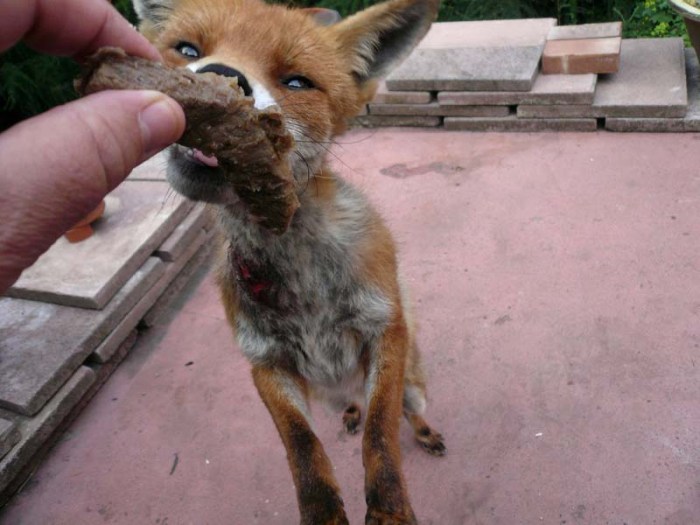
Physically, he was very thin and very wiry, but he was extremely strong for his size. If he pulled one end of a stick and you pulled the other, you could feel his muscles and his strength. Most of this came, in our opinion, because he wouldn’t eat bread or cakes. He wouldn’t eat curry or anything flavoured. He wouldn’t eat pizza. Even our local magpies wouldn’t eat pizza, incidentally. Widdle wouldn’t eat hamburgers, although we didn’t quite understand this. Perhaps he had his culinary standards. After all, the bar was set pretty high by our sausages (42% meat).

This photograph appears to show the biggest object Widdle ever managed to carry away. I have no idea what it was, but may have been a big bone or maybe some cut of meat that had gone past its sell-by date:

Raw bacon rind appears to be a delicacy in the fox world. Firstly, sniff what it is…

Don’t let it escape under any circumstances:


“A second piece? Don’t mind if I do!”

In the next picture, note the first piece of rind safely stashed on the floor. He didn’t find getting both in his mouth at the same time too easy!


“Cheese is different. You have so many dreadful flavours in cheese. So make sure you sniff it first….”


“Take hold of it carefully. It may crumble and you might lose some.”

“Sniff the next piece carefully. Just because the first piece was cheddar, that doesn’t mean they all will be.”

“Yes, it’s OK. I’ll take it, please. It’s good for the teeth, cheese!”

Not that Widdle would turn down proper meat.

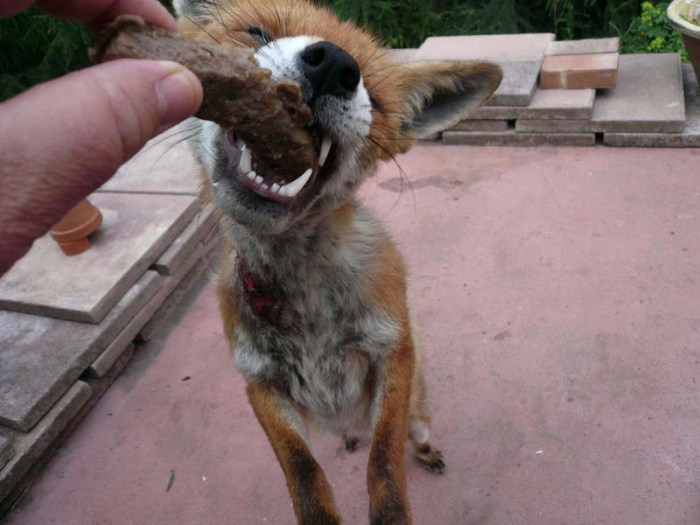
“Would I like a bit of steak? You bet I would!”

“Mmm. Lovely!”

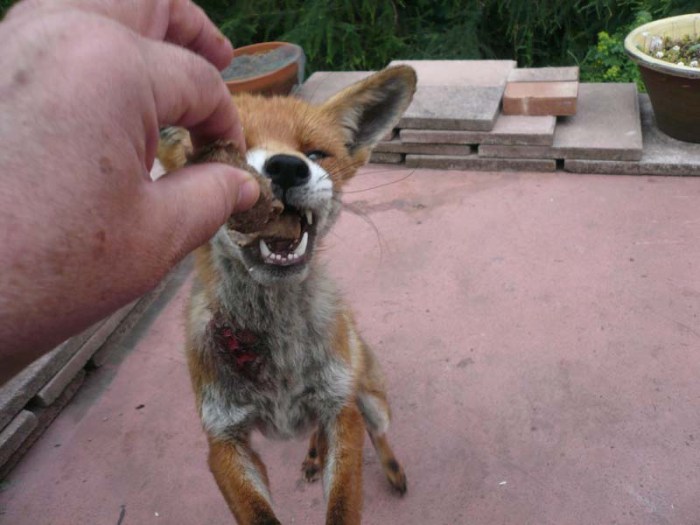
Watch what you’re doing. Fingers at your own risk!!”

Widdle usually took all the food that was offered to him. He filled his mouth up with sausages, bits of meat and so on, and took them back to Mrs Widdle in the den. She would eat some and share the rest with her cubs. The largest litter I ever saw in our garden was four, with No 4, the smallest one, perhaps only two thirds the size of the others. Mum and Dad taught them their table manners. Any transgression got a sharp nip on the backside to emphasise the point.

Notice how, in the last three photographs, Widdle has a great gaping wound on his chest. As I mentioned, male foxes frequently fight each other, and they bite their opponent’s muzzle and fore-limbs. I don’t know how Widdle acquired this particular wound, but it didn’t take long to heal up.

On four occasions, Widdle had bad injuries to one of his front legs and he could barely walk. In a wilder world, he would not have managed to hunt and he would have died, but his friends stepped in with Sausage-Aid and he got over it. That gave him five lives instead of the usual one, a minimum of four or five years of life compared to the usual two or three, and as many as fifteen cubs produced, instead of the usual figure of between none and four.

21 Comments

Filed under Humour, Nottingham, Personal, Widdle, Wildlife and Nature

My best friend, Widdle (4)

Between approximately 2007-2010, our family had a completely wild fox as a friend. When Widdle came to you like this, you knew that he had only one thought on his mind. Sausages!!

These are the brand he preferred. We used to buy them at a frozen food supermarket called Iceland. We wanted a cheap, but nourishing, sausage for our furry friend, so we looked round most of the butcher-type shops in our suburb of Nottingham and finally made the decision to buy at Iceland where the budget sausages were 42% meat, easily the highest percentage in the world for the budget sausage. Dog food was even more unbelievable. All of the cheaper ones I looked at were full of “ash”. I’d really like to know why!

And what type of ash was it, that was included in so many dogfoods? Surely not the ashes of former dog owners? :

Sometimes Widdle was extremely polite, putting a fore-paw on each knee, showing you his pale brown eyes, and staring with a mixture of wistfulness and plain hunger:

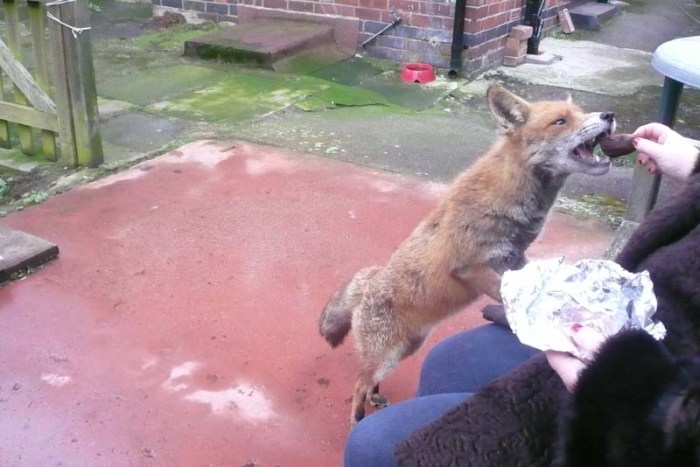
On other occasions, he was a lot more forthright, explaining with his pointy teeth, that he was pressed for time, so could you crack on with it, please? After all, we both know how it’s going to end:

I wasn’t the only person who could feed him, but that perfect lunge was always his favourite method. Keep still and you were perfectly safe:

On occasion he was over excited and perhaps got some sausage stuck on his teeth. He would always want to clean it off straightaway:

He made several trips back to “The Den” to feed the family. On his last trip, the sausage or sausages were always for him, and he would get over excited and lick his lips in anticipation:

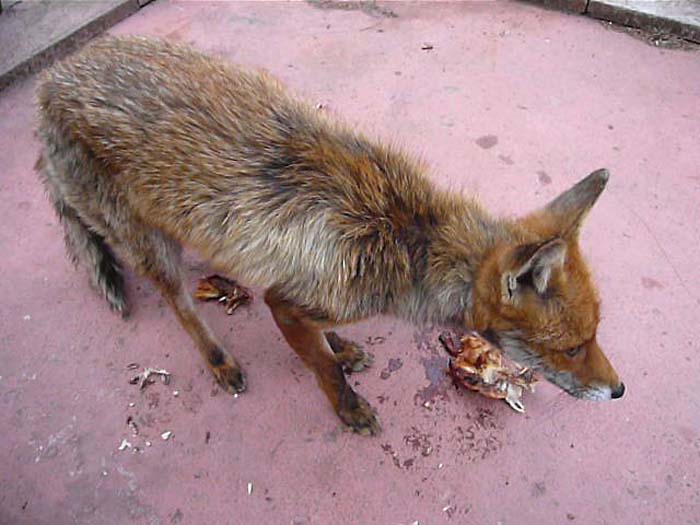
He was happy enough to eat leftovers. Here he has the carcass of a chicken, I think it is. Just look how, in this view, the early stages of his moult are easily visible:

This next picture comes seconds after the previous one. It catches Widdle in a strange pose. He has just heard a noise behind him and looks over to where the noise has come from. The angle makes it look as if he is being aggressive and snarling. But he isn’t. In actual fact, I never heard him make any noise of any kind. That pointy, sharp tooth is there though:

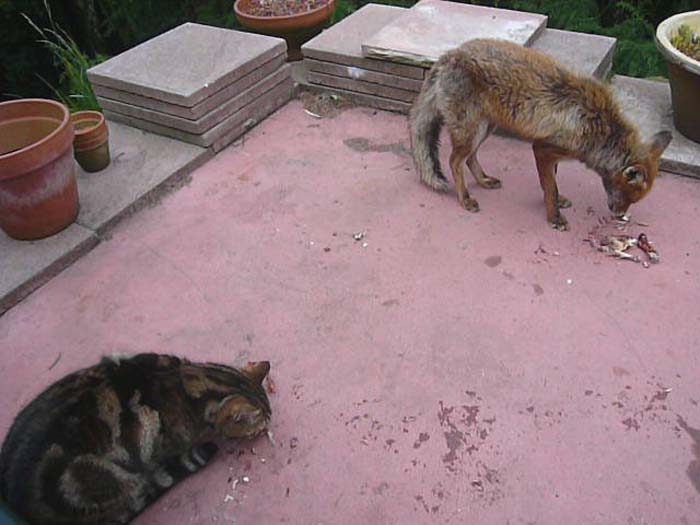
The noise came from next door’s cat, an old bruiser called Yin-Yang.  He was taken, as far as I know, as a young kitten, from a feral cat’s nest and brought up in a normal home. People always seem to think that foxes eat cats but Widdle and Yin-Yang didn’t ever take any notice of each other. Foxes are always extremely wary of a cat’s claws and the possibility of losing an eye in any fight with one.

Anyway, here they are, both sharing the same bits of the same chicken. Yin-Yang lived to be around seventeen or eighteen years old. He died in my daughter’s arms after some macho hero deliberately drove his car over him in front of our house. Yin-Yang was deaf, so he didn’t hear the car horn.


22 Comments

Filed under Humour, Nottingham, Personal, Widdle, Wildlife and Nature

Phonetic Alphabets (2)

Last time we looked at a number of phonetic alphabets. There was the British Army in 1904, the  British Post Office in 1914 , the  Royal Navy in 1917 and the  Western Union in 1918. Then came the good sense of the US Army and the US Navy in 1941 to have the same alphabet (for both) in contrast with the four different alphabets used by the RAF in different periods of World War II.

But what about the foreigners?

Here’s the Luftwaffe alphabet  in 1940. The very same one was used by the Wehrmacht, the German army:

Anton, Ärger, Bertha, Cäsar, Charlotte, Dora, Emil, Friedrich, Gustav, Heinrich, Ida, Julius, Konrad,

Ludwig, Martha, Nordpol, Otto, Ödipus, Paula, Quelle, Richard, Siegfried, Schule, Theodor, Ulrich, Viktor,

Wilhelm, Xanthippe, Ypsilon, Zeppilon

It is obviously different from the Allies’ alphabet, being based on names, but that must surely have made it quite easy to learn. Incidentally, “Ärger” and “Ödipus” were used for any words which contained either ” ä ” or ” ö “. Notice too how they have a code word for Ä and Ö. There is also a quick way of doing ‘c’ and ‘ch’ with Cäsar and China along with ‘s’ and ‘sch’ with Siegfried and Schule.

The most frequent marks of the Messerschmitt Bf109 such as the 109D, the 109E, the 109F and the 109G were frequently known by their phonetic letters, the Dora, the Emil, the Friedrich and the Gustav.

Here’s a young man and an old man who are the one and the same man. He was a Luftwaffe radio operator in WW2. The shape of his ears is a giveaway. Age yourself by seventy years but you’ll never change your ears.

And here is the cloth badge to be sewed on the uniform of a crewmember that the Luftwaffe called a “bordfunker”:

The German Navy, the Kriegsmarine, had a very slightly different alphabet, but , again, it was based on names:

Anton, Ärger, Bruno, Cäsar, China, Dora, Emil, Friedrich, Gustav, Heinrich, Ida, Julius, Konrad,

Ludwig, Martha, Nordpol, Otto, Ödipus, Paula, Quelle, Richard, Siegfried, Schule, Theodor, Ulrich, Viktor,

Wilhelm, Xanthippe, Ypsilon,  Zeppilon

The Wehrmacht used pretty much the  same alphabet with:

Anton, Ärger, Berta, Cäsar, Charlotte, Dora, Emil, Friedrich, Gustav, Heinrich, Ida, Julius, Konrad,

Ludwig, Martha, Nordpol, Otto, Ödipus, Paula, Quelle, Richard, Siegfried, Schule, Theodor, Ulrich, Übel, Viktor,

Wilhelm, Xanthippe, Ypsilon, Zeppelin 

 I couldn’t find a guaranteed French phonetic alphabet for World War II, but I did find this one, which is obviously based on first names:

Anatole, Berthe, Célestin, Désiré, Eugène, François, Gaston, Henri, Irma, Joseph, Kléber,

Louis, Marcel, Nicolas, Oscar, Pierre, Quintal, Raoul, Suzanne, Thérèse, Ursule, Victor, William, Xavier,

Yvonne, Zoé

That was a real list of sex bombs for French soldiers of every sexual persuasion to drool over. I don’t know what a “Quintal” is, but this happy curly haired chap is Ryan Quintal:

Actually I did look up “quintal” and one website said “a hundredweight  or a weight equal to 100 kilograms”. Another website said “backyard”. I often confuse the two.

The Italians, like many other nations, base their alphabet on towns and cities:

Ancona, Bologna, Como, Domodossola, Empoli, Firenze, Genova, Hotel, Imola, Jolly, Kursaal,

Livorno, Milano, Napoli, Otranto, Padova, Quarto,Roma, Savona, Torino,

Udine, Venezia, Washington, Xeres, Yacht, Zara.

Surely we all know the telegram sent by the humourist Robert Benchley to the New Yorker magazine:

“Have arrived Venice. Streets full of water. Please advise.”

I did find a Soviet spelling alphabet. The Russian alphabet, though, uses 33 letters, so it was quite complicated.  I decided to transcribe only the words for our Western letters. That came to:

Anna, Boris, Konstantin, Dmitri, Yelena, Fyodor, Grigory,

Khariton, Ivan, Zhenya, Leonid, Mikhail,

Nikolai, Olga, Pavel, Roman, Semyon,

Tatyana, Ulyana, Vasiliy, Zinaida.

Some letters such as ‘k’, ‘q’,  ‘w’, ‘x’ and ‘y’ do not really exist in Russian. Here’s a link to some of the letters of their alphabet.

Here are some Soviet signallers, giving a report to Headquarters in an unknown German town that has just been captured:

Two final points. If you can understand this, you’re a better man than me. This is perhaps 20% of a very large presentation of the Japanese phonetic alphabet. My best guess is that a word stands for a syllable, so that “suzume” stands for the syllable “su” and so on:

And finally, here’s the weirdest phonetic alphabet I found, taken from Tasmania in 1908:

Authority, Bills, Capture, Destroy, Englishmen, Fractious,

Galloping, High, Invariably, Juggling, Knights, Loose,

Managing, Never, Owners, Play, Queen, Remarks,

Support, The, Unless, Vindictive, When, Xpeditiously,

Your,  Zigzag


18 Comments

Filed under Aviation, History, Humour, military, Russia, the Japanese

Phonetic Alphabets (1)

Signalling by one group of soldiers to another, or by one ship to another, has gone on for centuries. Signalling flags were used on ships in the time of Admiral Nelson:

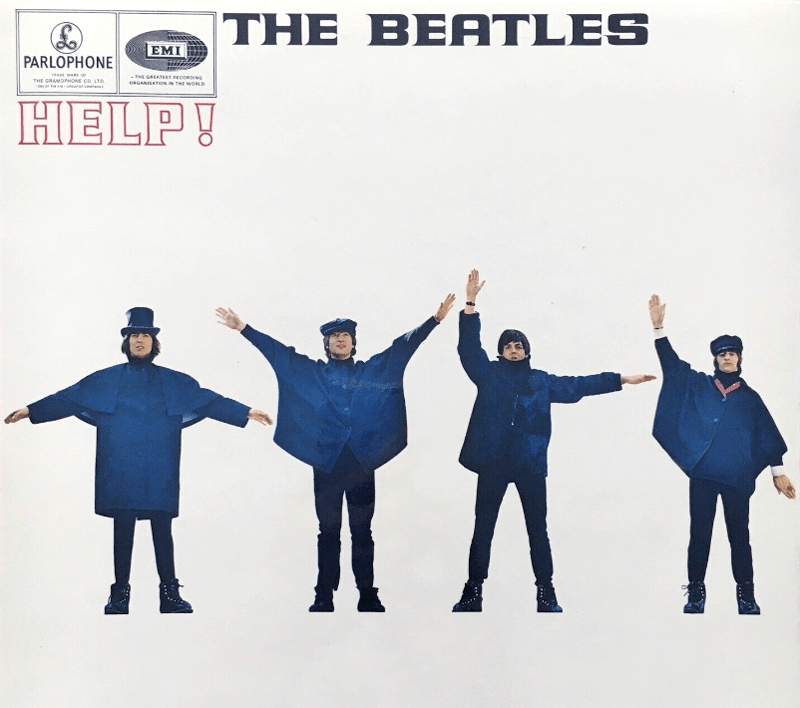
And there was always semaphore. As used by the Beatles:

The advent of radio, however, made things a lot more difficult, because when men spoke to each other, interference was a frequent problem. Sometimes words, especially place names, had to be spelt out, and merely giving out a list of letters, such as L-O-N-D-O-N did not always work, especially if the interference was intermittent.

In 1904, British Army signallers started to use a partial spelling alphabet, where only the more problematic letters had their own code word. This produced:

ACK, BEER/BAR, C, D, E, F, G, H, I, J, K, L ,  EMMA, N,O, PIP, Q, R, ESSES, TOC, U, VIC, W, X, Y, Z

Only seven letters needed! By 1918, the problems of using the 1904 alphabet had added  a few words:

CORK,   DON.   EDDY.    INK.    JUG.   QUAD.   TALK

Here’s a war artist’s rendition of a signaller:

Things got better once for the British army when they adapted horse drawn radios:

Overall, it is crucial to have only ONE spelling alphabet, otherwise the situation becomes downright confusing. There used to be different alphabets for:

the 1914 British Post Office with Apple, Brother, Charlie, Dover, Eastern,

the 1917 Royal Navy with Apples, Butter, Charlie, Duff, Edward

the 1918 Western Union with Adams, Boston, Chicago, Denver, Edward

Much more sensibly, during World War II, the US Army and Navy used the same alphabet. It is familiar from so many war films and so many comics:

Able, Baker, Charlie, Dog, Easy, Fox, George, How, Item, Jig, King, Love, Mike,

Nan, Oboe, Peter, Queen, Roger, Sugar, Tare, Uncle, Victor, William, X-ray, Yoke

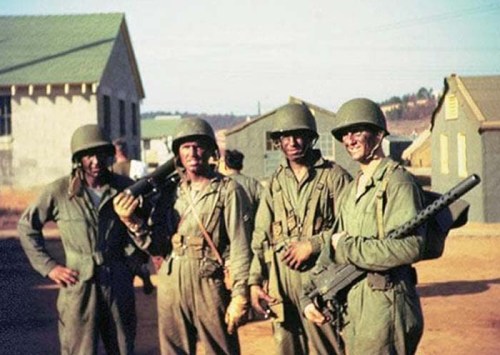
These men were some of the members of the real “Easy Company” :

What is important here is to have no words whatsoever that sound like any of the others. In this alphabet maybe jig and king, or able and baker, or dog and fox might cause problems.

Here’s the RAF spelling alphabet until 1942:

Apple, Beer, Charlie, Don, Edward, Freddie, George, Harry, Ink, Johnnie, King, London, Monkey,

Nuts,  Orange, Pip, Queen, Robert, Sugar, Toc, Uncle Vic,  William, Yorker, Zebra

And here’s the RAF alphabet after 1942

Able, Baker, Charlie, Dog, Easy, Fox, George, How, Item, Jig, King, Love, Mike, Nan, Oboe,

Peter, Queen, Roger, Sugar, Tare, Uncle, Victor, William, X-ray, Yoke, Zebra.

Smart people will have noticed how close it is to the US Army and Navy alphabet. How sensible!

In actual fact, the RAF was already using quite a few other alphabets anyway, such as this one noted in 1942-1943 :

Apple, Beer, Charlie, Dog, Edward, Freddy, George, Harry, In, Jug/Johnny, King, Love, Mother,

Nuts, Orange, Peter, Queen, Roger/Robert, Sugar, Tommy, Uncle, Vic, William, X-ray, Yoke/Yorker, Zebra

And there was a further alphabet for the squadron letters on the side of the aircraft in the Dambusting 617 Squadron:

A-Apple, B-Baker, C-Charlie, E-Easy, F-Freddie, G-George, H-Harry, J-Johnny, K-King,

L-Leather, M-Mother, N-Nuts, O-Orange, P-Popsie, S-Sugar, T-Tommy, W-Willie, Y-York, Z-Zebra.

I presume that the missing letters were non-existent aircraft. Here is 617 Squadron and these are B-Baker, G-George and M-Mother:

This slideshow requires JavaScript.

I wrote a number of blog posts about my wife’s friend, Len, who flew in 617 Squadron, in G-George. His full name was Len Dorricott, and this link will take you to the first of the three posts. If you copy and paste the surname “Dorricott” into “Search”, then finding Blog Posts No 2 and No 3 about Len becomes a doddle.

18 Comments

Filed under Aviation, Bomber Command, History, Humour, military

Madame Lionnet, the High School’s French mistress

Madame Marie Lionnet was one of the very few women to work at Nottingham High School during the Victorian era. She may even have been the second-ever woman to be employed by the school. Regrettably, I have found out relatively little about her, with only a series of mere snapshots of her fascinating and colourful life available at various intervals.

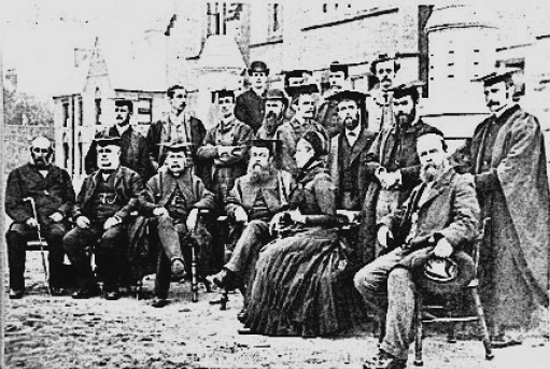
Marie Lionnet was born in middle to late 1835 or early 1836, although I have failed abjectly to discover either her maiden name or her place of birth, beyond “France” and probably “Paris”. We have no pictures of Madame Lionnet either. When she worked at the High School she seems to have slipped between the staff photographs of 1883 and those of 1895. The only woman we have on a staff photograph of that era is Mrs Bowman Hart, the music teacher. Here is the staff of 1883-1884:

As far as we know, they are :

back row:

Mr H Lupton ?, the Reverend EAT Clarke ?, Mr C “Carey” Trafford, unknown

middle row:

Mr JA Crawley, Mr WE “Jumbo” Ryles, Mr W Jackson, Mr S “Sammy” Corner, Mr S “Cheesy” Chester, Mr J Russell, Mr B “Benny” Townson.

front row:

Monsieur JLE Durand, Mr C “Donkey” Bray, the Reverend JG “Jiggerty” Easton, Dr. R Dixon (Headmaster) Mrs Bowman Hart (of whom, more later), Mr H “Donkeys” Seymour

Here is the High School at that time:

Notice that the school’s enormous coal fire chimneys have not yet been added. That was something that happened around 1890. There were originally two crosses on the roof, but clearly, one has been taken down, or more likely, blown down in some long-forgotten storm. In front of the school, the bushes are beginning to grow out of control but eventually they would all join up to form one enormous shrubbery, home to foxes and sixth formers with cigarettes.

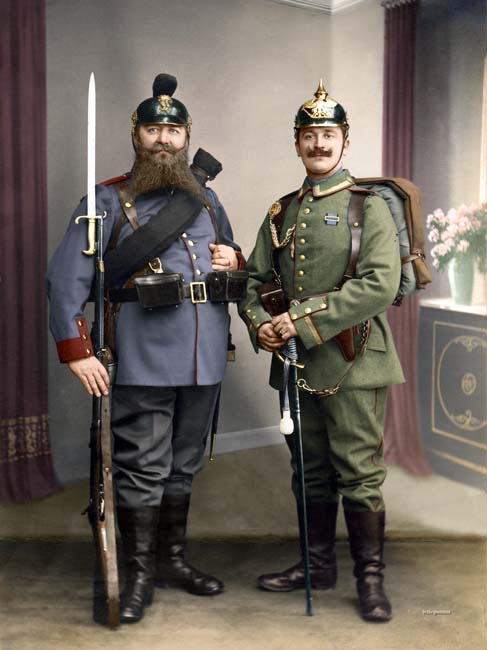
Madame Lionnet is known to have married an engineer called Lionnet and they spent a good few years travelling with his work around the United States, Canada and various European countries. They went back to Paris, France, however, in early 1870 and were present in the capital during the Franco-Prussian war of 1870-1871. Here is a single soldier from each side:

On the left is a member of the famous “Grenadiers de Bretagne” who would express their reluctance to retreat by tying their beards or moustaches to the beard or moustaches of the man next to them, often forming defensive lines up to two or three miles long.  On the right is a member of the famous Prussian “Bismarcken Shocken Troopen” who would always fight so bravely in Germany’s many wars that in late 1939 the Führer designated them the first ever “Sacred Regiment of Adolf Hitler Impersonators”.

We presume that in 1870 Madame Lionnet must have been visiting her family, who hailed from the capital, because we know that she was present at home in Paris when her father was killed in combat. He had been fighting in one of the battles around the city’s fortifications during the siege. Shortly afterwards Madame Lionnet’s husband was killed and, with hardly any family left,  when the siege was lifted, she came to England to work as a teacher of French, possibly a little like this one:

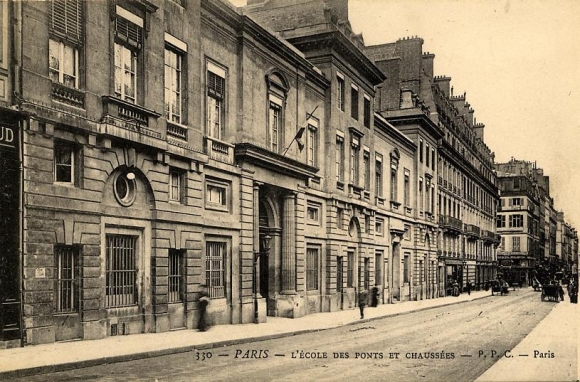
On the French version of Google, I did find a rough fit for somebody who may well have been Madame Lionnet’s husband. This was Étienne Napoléon Lionnet, who was born on April 13th 1815. He began his studies at the “Ecole des Ponts et Chaussées (School of Bridges and Roadways) in 1837 at the age of 22. Here is a postcard from that era. Even then, the notorious Parisian traffic was absolutely ferocious:

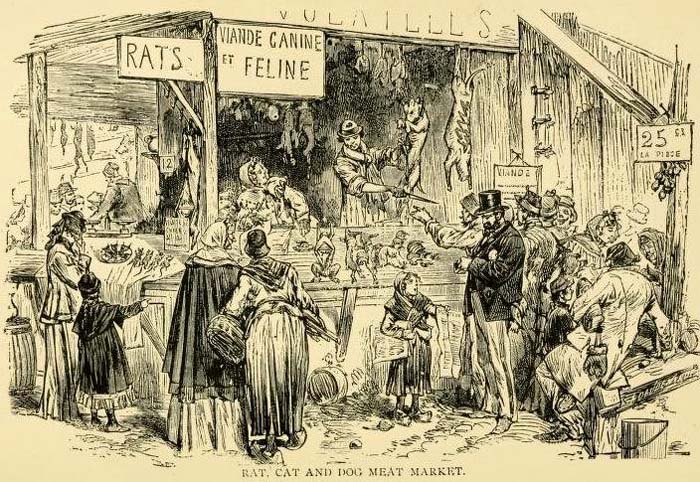
Monsieur Lionnet died on December 15th 1870 which would have been in the very middle of the Siege of Paris which lasted from September 19th 1870 to January 28th 1871.  I also found mention of the Lionnet brothers who ran an ambulance service during the Siege of Paris in 1870-1871. People were really hungry during the siege, and some rather queer markets soon sprang up, Rat is very obvious, but “viande canine et féline” means “dog and cat meat”. Tastes a little like chicken, apparently:

The whereabouts of Madame Lionnet in the 1870s are unknown, other than just generally, “in England”.

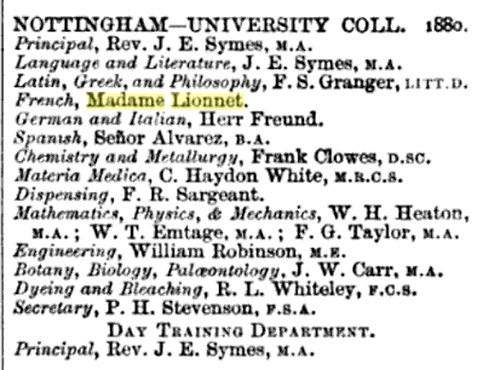
The first exact piece of news came from Nottingham. Madame Lionnet became the University College’s first ever lecturer in French, having started her employment there in the college’s opening year of 1881:

Before that, she had worked at the High School for Girls as “A French Mistress”:

Madame Lionnet started her career at the High School in, probably, the academic year of 1885-1886. She died on March 9th 1895, so she worked there for nine years.

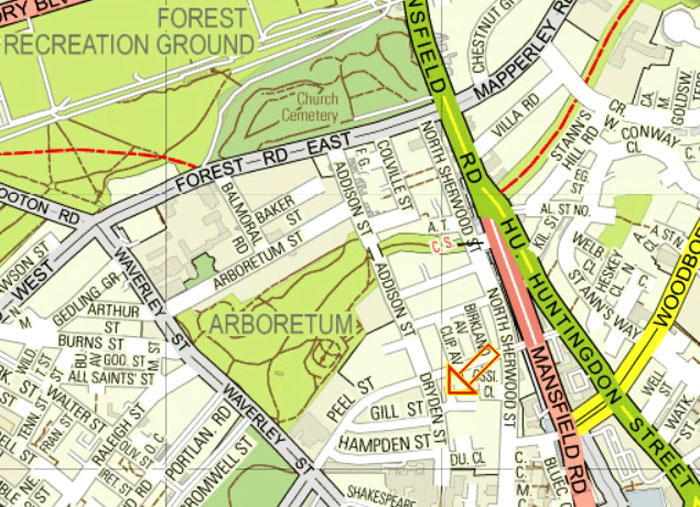
She had her own house, which seems to have had the name “Esplanade”. It was at 5 Dryden Street. Dryden Street, indicated by “La flèche orange”, runs north from Shakespeare Street and ultimately, via Addison Street, finishes at Forest Road East. If you turn left out of Addison Street, and walk along Forest Road East, you will soon come to the High School, which is the white rectangle near the corner with Waverley Street:

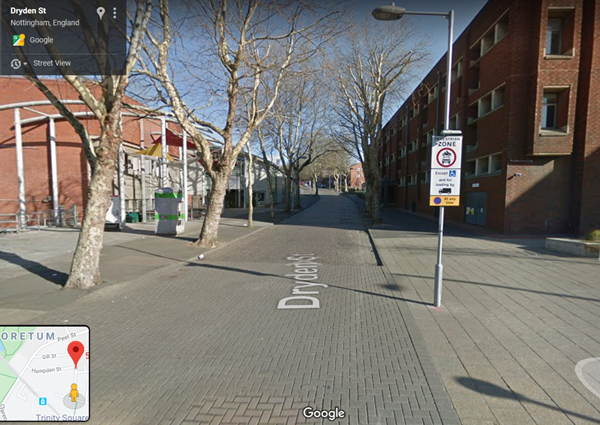
Madame Lionnet seems to have bought her house from John Hudson, a machinist, and after her death, it passed into the hands of Mrs Betsy Stevens. Nowadays, every single square inch of Dryden Street has been used to build new buildings for Nottingham Trent University. This is where Dryden Street joins Shakespeare Street. No 5 would have been near to the junction. Perhaps Madame Lionnet would recognise those mature plane trees on the left:

In her obituary in the school magazine, “The Forester”, Madame Lionnet is described as

“a woman of wide culture and well read in the literatures of several languages, and was a most capable and energetic teacher who spared no pains with her pupils. It will ever be a sincere regret to her many friends that her last years were embittered with heavy losses; for she lost the savings of many years through the failure of the Liberator Society.”

The Liberator Society crashed in 1892 when £3,500,000 of investors’ money was lost after the closure of the London and General Bank which, along with the House and Land Investment Trust, was investing money in “gigantic building speculations”.

“Madame Lionnet was remarkable for open handed generosity, and those who knew her well could speak of many deeds of charitable kindness, and pay a tribute to the courageous industry and independence of character which enabled her to work so successfully in a foreign land.”

Madame Lionnet was killed by a bout of pneumonia which “supervened on influenza”. Pneumonia was the commonest killer in Victorian England, and just before the First World War, Sir William Osler would call pneumonia the “Captain of the Men of Death” as it was by then the most widespread and dangerous of all acute diseases. As we have seen, Madame Lionnet died on Saturday March 9th 1895 and she was buried in the Church Cemetery on Mansfield Road on the following Wednesday, the Reverend Peck, a teacher at the High School, conducting the service.

The Forester said that the interment took place:

“in the presence of many friends and pupils and of representatives from the School, the University College and the High School for Girls. Numerous beautiful wreaths, with which the coffin was entirely covered, testified to the respect in which the deceased lady was held.”

9 Comments

Filed under France, History, Humour, Nottingham, The High School