Category Archives: The High School

Staff v Prefects Football Match Christmas 1980 (2)

These are three more of the ten photographs I found recently of the teachers playing the School Prefects at football, or soccer as some might call it. The photographs show a game from the early 1980s, when my wife took a few pictures of the match.

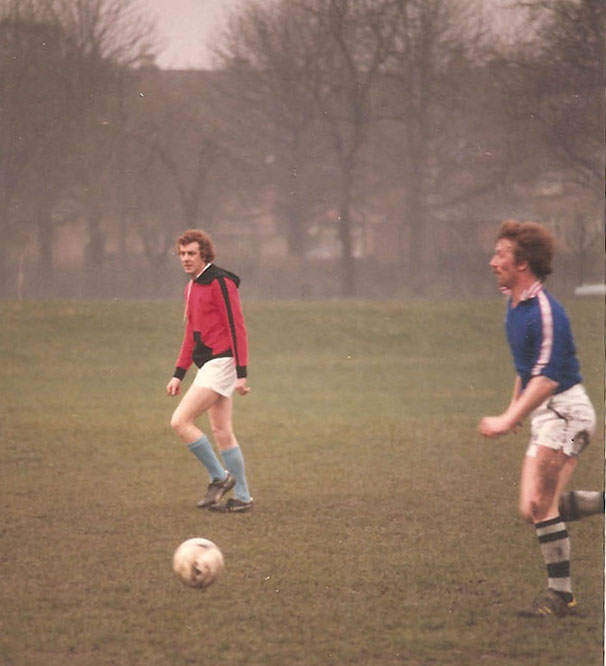
This photograph shows the Staff goalkeeper kicking the ball downfield. This is the legendary Chris Mann, a young chap from Liverpool with the accent to match. He eventually left the High School to go to teach at Staffordshire University, where he remains to this day, as far as I know. The last time I heard, he was doing very well as the Senior Lecturer in the School of Engineering (Maths & Statistics) in the Faculty of Computing, Engineering and Sciences:

PHOTO A

This photograph shows myself shielding the ball against a defender. In just a second, I will pass it on to the other player in blue, who is Paul Morris, the now retired Physics teacher:

PHOTO B

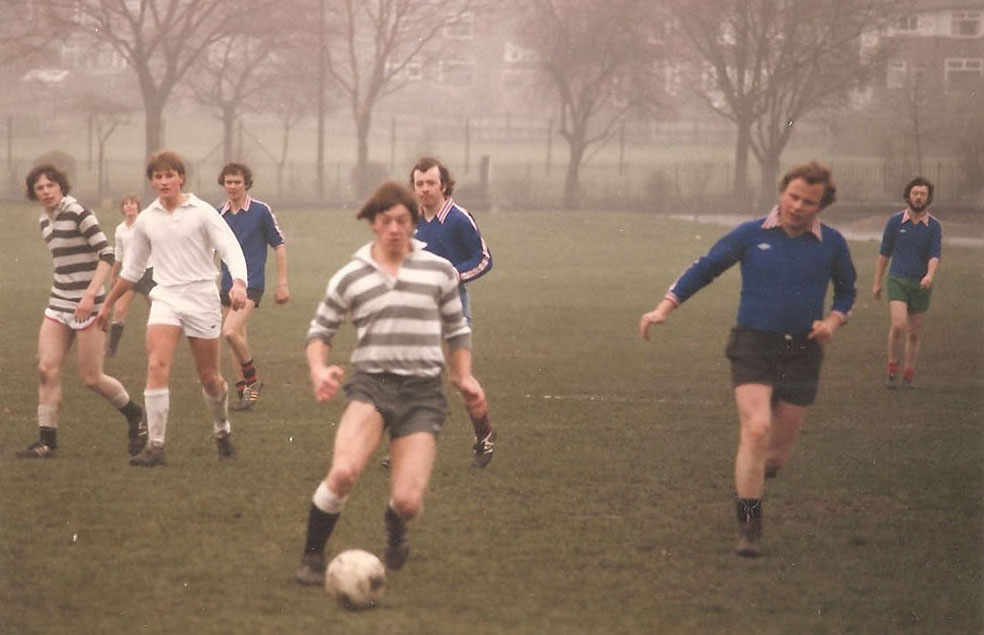
This final picture shows proceedings when players are perhaps beginning to get a little tired. There are four blue shirted members of staff on view. I am Number Four counting from the left and Paul Morris is Number One. Number Two is the then Head of Music, Stephen Fairlie, a young man far too gentle to be playing football. Not long after this game, in 1985, he was to found the Nottingham Youth Orchestra which still continues in existence to this very day:

PHOTO C

Player Number Three is Ron Gilbert, an ex-Chemistry teacher who retired recently, and whose first love was actually Rugby Union, but he was always a very good sport, and willing to turn out for the staff when the occasion arose.
Yet again, I am not able to recognise any of the Prefects who, by now, must be in their early fifties with not just children but, conceivably, grandchildren.

14 Comments

Filed under Football, History, Humour, Nottingham, Personal, The High School

Staff v Prefects Football Match Christmas 1980 (1)

At the end of either the Christmas Term or the Easter Term or sometimes both, there used to be a tradition of the Teachers playing the School Prefects at football, or soccer as some call it. The very first one took place as far back as the evening of Monday, March 9th 1959. The staff triumphed by a single goal.  Nowadays, Health and Safety Regulations have put paid to such risky and dangerous pursuits.

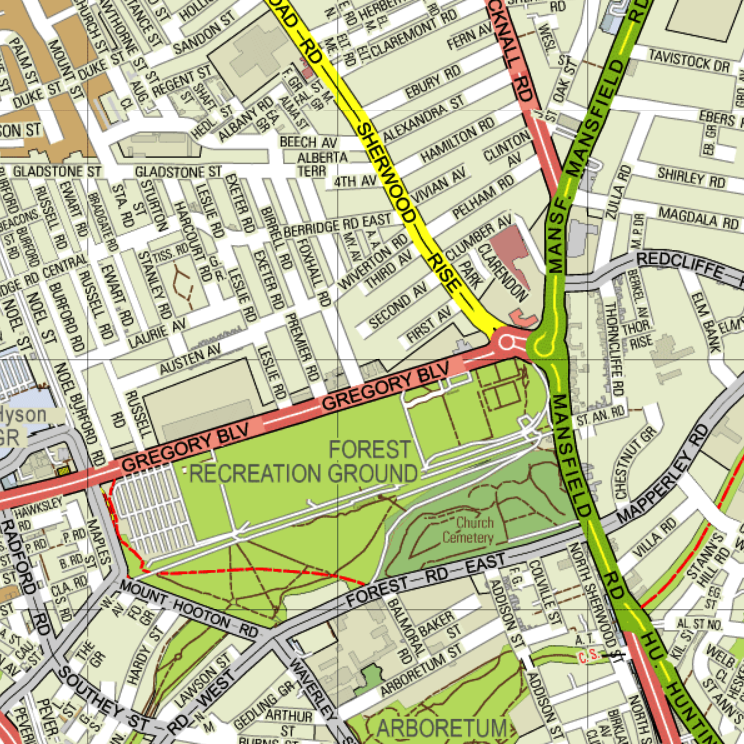
The game used to take place here, on the Forest Recreation Ground:

forest


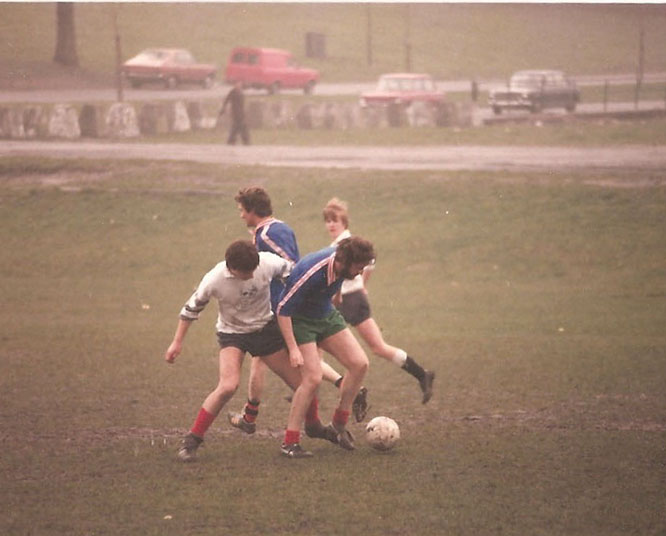
When I was a lot younger and a lot, lot, thinner, I used to play in such games, and these photographs show a match from the early 1980s. I was newly married and my beautiful young wife, as one of, admittedly, very few spectators, was given a camera and the freedom to take a few pictures. In total, there were only ten, because in those days, there were no digital cameras, and people were not in the habit of shooting hundreds, if not thousands, of photographs on the off chance that three or four might be good ones.
This first photograph shows my good self in the blue shirt and green shorts. The other player in blue is Paul Morris, a teacher of Physics, who, like myself, retired within the last two years. Everybody else is a Prefect, although I am sorry to say that I could not put a name to any of them.

PHOTO A

This photograph shows a young red haired gentleman playing for the staff team and running off with the ball into attack. He is Bob Howard who had been Best Man at our wedding. To his left, in red, is Richard Willan, one of Bob’s colleagues in the Geography Department. Richard retired in the same year as myself.

- PHOTO B

This final picture shows my unbelievably thin self, still in my green, blue and red outfit. I somehow seem to have acquired a mop of curly, dark brown hair, instead of the white ensemble I now have. On the right, in front of the goalpost is Best Man Bob Howard. The other player in blue is not a member of staff, but, presumably, a Prefect playing for the Staff Team to make up the numbers. Again, I could not name any of the opposition, but I do recognise a couple of the spectators. The red haired young man with the non-regulation brown scarf is Dave Beech who played for the school First Eleven at football on around half a dozen occasions when I was the team manager. To the left of him is Russell Poole, a superb young cricketer, whose Dad used to come down every games day to the Games Field to coach cricket to the more talented young players.

PHOTO C


6 Comments

Filed under Football, History, Humour, Nottingham, Personal, The High School

Casualty rates in the Great War

Years ago I wrote a worldwide best-selling book about the history of football in the High School from 1870-1914.(Just kidding). In the foreword, I revealed the identity of the Old Boy who had won an Olympic Gold Medal for the United Kingdom at Association Football. I made public which Old Boy had scored more goals in a single F.A.Cup tie than any other player in the history of the competition. I listed the eight Old Boys who had played international football for England. I recalled the Old Boy whose refereeing in an F.A.Cup tie led the F.A. to introduce the concept of the neutral referee, an idea which has spread worldwide since that biased performance. I described an occasion when the High School goalkeeper let in the winning goal as a protest against the refereeing of the game, and the day when the referee refused to give a penalty because “penalty kicks were unknown in amateur football”. The reader could find out which team lost 0-13 and did not get the ball into the opposition half at any point during the game. In another fixture, against Nottingham Asylum, “the presence of so many lunatics unnerved the school team, for it did not come up to its normal form.”  I remembered the day when “The School Six defeated the Masters by three goals to one. The masters, who, like Hamlet, were somewhat “fat and scant of breath”, then demanded to play two fat men extra, to compensate for their want of nimbleness. This unfortunate challenge was accepted, and the School won again by ten goals to one.”

Overall,  this book provided many examples of extraordinary, and, indeed, often amusing events on the football pitches of Victorian and Edwardian England.

villa-cup

When I first started my researches, looking through issue after issue of, firstly, “The Forester’, and then “The Nottinghamian”, it seemed that this would ever be the case. Here was a football spectators’ paradise, where goals rained into the net in every single game, as Leicester Wyggeston School  were beaten by 23-0 on two separate occasions. Deadly goal poachers scored hat tricks past defenders made slow-witted by heavy leather boots, and referees, and their decisions, grew ever more eccentric by the year.


My suspicions, though, were initially aroused by the story of William Norman Hoyte who was at the High School from 1904-1913, when he won an Open Scholarship to Jesus College, Cambridge to read Natural Sciences. William represented his college at rowing and appeared in the Second May Boat. His studies, and his rowing, though, were interrupted by his military service as a Lieutenant in the Sherwood Foresters in the Great War. He was a very brave young man and won the Military Cross twice. When he returned to Jesus College in 1919, though, he was unable to continue with his rowing. After the appalling carnage of the Great War, William Norman Hoyte M.C. and Bar was Jesus College’s only remaining rower from the pre-war years. All the rest had been killed.

zzzzzz   Massengrab_

Morbid curiosity then caused me to wonder what were the eventual fates of those familiar names whose footballing deeds were recorded in perpetuity in their School Magazine, especially those who would have been of an age to have been sucked into the flesh shredding maelstrom of the Great War. where, on average, every single metre of trench was to be hit by a total of one ton of explosives. What I found, quite frankly, astounded me, and I do not feel that any reader, safe from harm, here at the beginning of the twenty first century, can begin to comprehend either the numbers of men involved in this war, or the enormous casualties which the nation suffered.

somme

During the Great War, for example, British forces lost 887,711 men killed and 1,663,570 men wounded. Of these 118,941 were officers. The British Empire had casualties of 1,244,589, with French deaths counted at 1,737,800. Italy lost 1,737,800 me killed and the Russians 3,394,369. Germany had 2,800,720 killed, the Austro-Hungarian Empire 2,081,200 and the Ottoman Empire 3,271,844. The United Kingdom lost as many as 2.20% of its total population, the French 4.39% and the Germans 4.32%.

zzzzzz-Ypres-necropole-

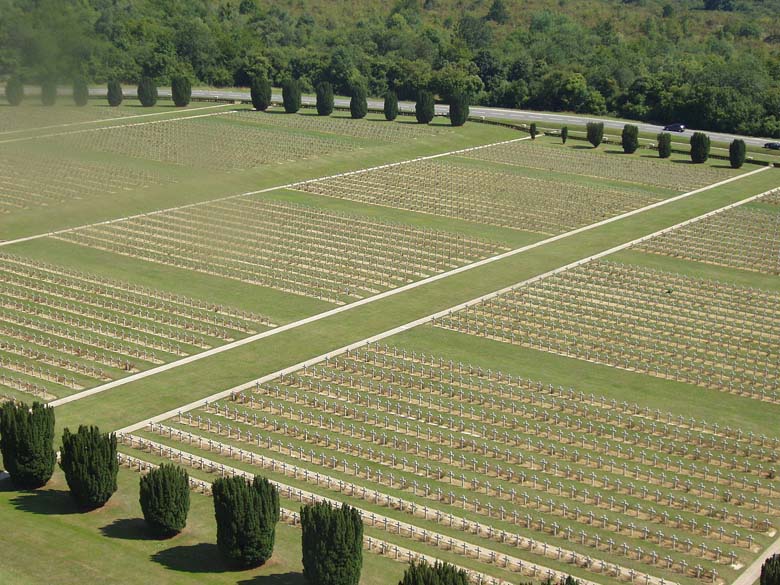
In individual battles, the loss of human life could be even more astounding. On the first day of the Battle of the Somme, on July 1st 1916, the 8th Division lost 218 of its 300 officers at Ovillers in just two hours. Of 8,500 other ranks, 5,274 men perished. On this single day, the total casualties of the British Army were 57,470 men. German casualties were just over 300. In the first three days of the Battle of the Somme, the average daily casualties per division were 101 officers and 3,320 men. During the second week, 10,000 men a day were lost, and for the remaining four or five months of the campaign, casualty rates were in the range of 2,500 men per day. Overall, this battle was to cost the lives of 420,000 British and Commonwealth troops, with a total of 220,000 French casualties. German losses remain unknown but were at least 450,000, and may have reached 600,000. In the photograph below, the tiny squares are all graves:

zzzzzz -Douaumont_ossuary3

Nor is this necessarily an isolated set of statistics. In the Second Battle of Ypres, in April 1915, the 149th Brigade lost over three quarters of their complement, a total of some 42 officers and 1,912 men. The 10th Brigade more or less ceased to exist, losing 73 officers and 2,346 men. In the Third Battle of Ypres, between August and November 1916, British infantry repeatedly advanced against German machine gunners, with casualties totalling 244,897. On the second day of the Battle of Loos, twelve battalions, numbering some 10,000 men, attacked the German machine guns. In just over three hours, 385 officers were lost, along with 7,681 men. On July 31st 1917, when the 1/1st Hertfordshires attacked the Langemarck Line, every single officer was a casualty and eleven of them were killed. The other ranks suffered 459 casualties and drafts of men had to be made to rebuild the battalion. Not until May 1918 was the 1/1st Hertfordshire Regiment fully reconstituted by absorbing thirty officers and 650 men from 6th Bedfordshire Regiment. In the Battle of Aubers Ridge, General Rawlinson, irritated with the lack of progress, complained to his Brigadier-Generals,

“Where are the Sherwood Foresters ?  Where are the Sherwood Foresters? ”

Brigadier-General Oxley replied, “They are lying out in no-man’s-land, sir, and most of them will never stand again.” Many of these particular casualties, especially the Lieutenants and Second Lieutenants, may well have been Old Nottinghamians, but nowadays, there is no way of being any more precise than that.

zzzz ertyuio

One thing of which we are certain is that Robert George Hopewell played in the High School First Team from 1897-1899. Robert was the son of Noah and Margaret Hopewell, of Old Basford and the devoted husband of Gladys Eleanor Hopewell.  They lived at West Brook in Mansfield, Robert was killed at Thiepval during the Battle of the Somme on September 3rd 1916, at the age of 33. A stretcher-bearer’s description of Thiepval in 1916 has survived to the present day…

“The trenches were knee-deep in glueing mud and it was the hardest work I have ever done…The banks on each side were full of buried and half-buried corpses and the stench was appalling. As one was carrying a wounded man down, one perhaps got stuck in the mud and staggered whilst one extricated oneself or was extricated. You put out a hand to steady yourself, the earth gave way and you found that you were clutching the blackened face of a half-buried German.”

Revelon, gefallener Deutscher

Nowadays, Thiepval is the scene of a huge memorial dedicated to those British soldiers who have no known grave. There are 73,000 names listed on it.

zzzzzz b Morgen53

Thomas Cripwell Wilson was an Old Nottinghamian who served as a Private in the 2nd Canadian Mounted Rifles Battalion. He was the son of Thomas and Mary Carr Wilson, of 5, Mount Hooton Terrace, Forest Road, just a five minute walk from the High School. Thomas was wounded in 1915, but returned to France in 1917.

wilson

He was killed in action in November of that same year. His war could be described in equally frank terms…

“All those picturesque phrases of war writers are dangerous because they show nothing of the individual horror, nothing of the fine personalities suddenly smashed into red beastliness, nothing of the sick fear that is tearing at the hearts of brave boys…a thing infinitely more terrible than physical agony.”

The earliest High School football players to be involved in the Great War were four boys who played in the 1891-1892 season, namely Blackwall, Hadfield, Senior and Wallis.

Ten years later, the 1901-1902 season was to provide a full team, eleven brave individuals called Constantine, Cooper, Cullen, Emmett, Hore, Johnson, Marrs, Millward, Settle, Watson and Woollatt.

By 1913-1914, even more footballers were destined to risk their lives on the Western Front. They were now a full tem with a generous selection of substitutes, including Barber, Boyd, Cleveland, Fleet, Harlow, Hind, Lyon, Munks, Nidd, Page, Parr, Prince, Sadler, Taylor, Telford, A.G.Wilson and W.M.Wilson.

Old Nottinghamians, both footballers and non-footballers, volunteered in huge numbers for the Great War. At least one thousand five hundred boys and staff went willingly from a comfortable, safe, and usually well-off  family background in Nottingham, to what was arguably the bloodiest war in human history.

This slideshow requires JavaScript.

11 Comments

Filed under Football, France, History, Nottingham, Politics, The High School

The Ghost of George’s Hill

I used to be a teacher. Not much connection there with scary monsters, but I did once hear an absolutely wonderful ghost story at a Parents’ Evening. The phantom involved is actually very famous in Nottinghamshire, but at the time, I had never heard this scary tale.

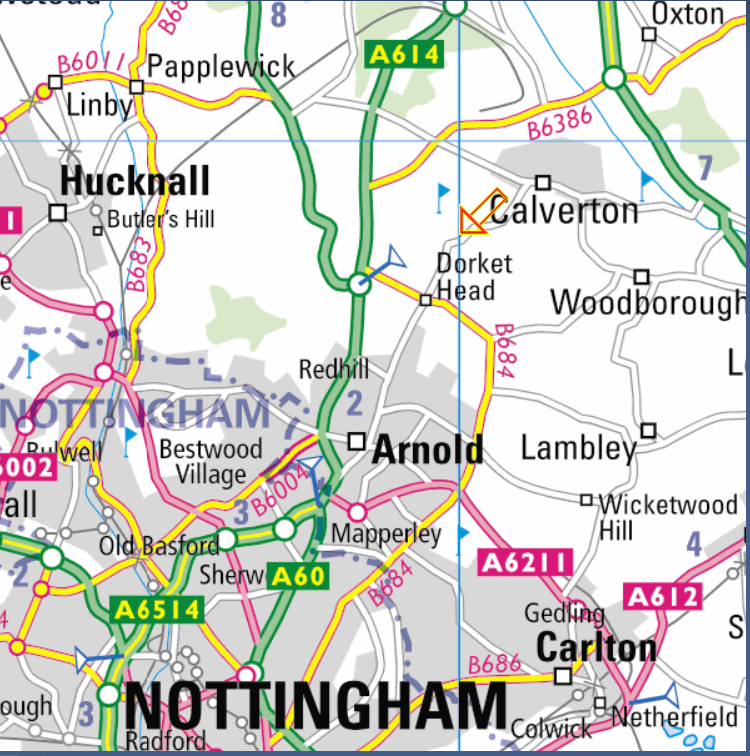
I was speaking to a boy’s mother. She said that the family lived in the village of Calverton.  She told me how her husband refused ever to drive again along a certain road to the north of Nottingham because it was strongly haunted, and he had been absolutely terrified when he met the ghost. Look for the orange arrow…

Untitled s

In the map above, the yellow road in the centre is the B684, the “Plains Road” which leaves Nottingham northwards and climbs slowly but surely along what must have been at one time an ancient Stone Age Ridge Route and perhaps even a hunting trail. With some amazing views, particular to the east, the road eventually sweeps around to the west  to join the main road from Nottingham, the  A614. This road goes northwards towards the A1 at Clumber Park, the “Great North Road”. Just before this major junction there is a minor cross roads called Dorket Head where a country lane winds northwards down an extremely steep hill. It forms a short cut down to what is nowadays the dormitory village of Calverton.

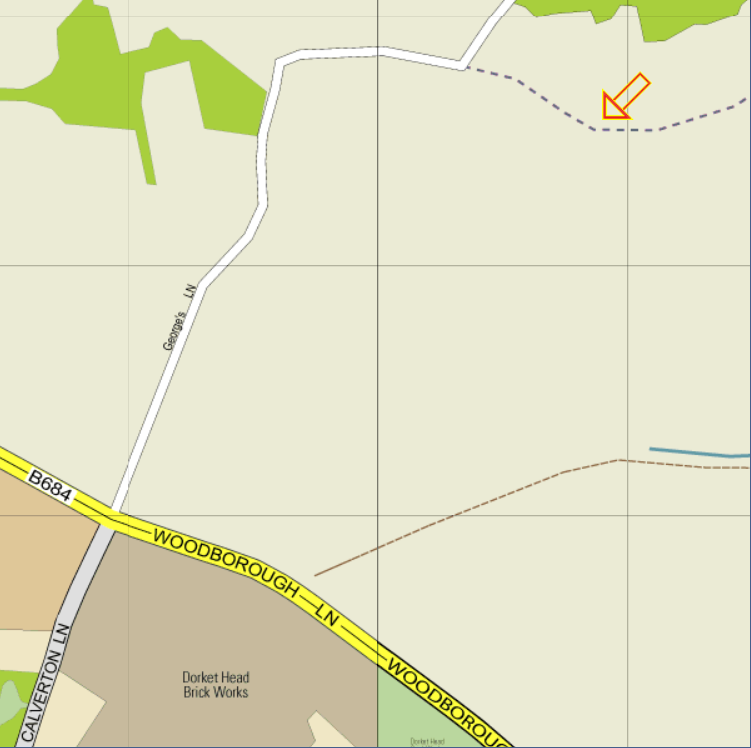
The map below is a larger scale version of the most important features in the tale. (the orange arrow points to the steeply winding country lane in question)

dork head 1

The mother explained how her husband had seen the ghost and he had been so absolutely terrified that, after this, he had never ever again driven back home along this road. He therefore ignored an obvious shortcut to Calverton from his office, one which would have saved quite a lot in petrol costs over the weeks and months. Instead the husband preferred to spend his hard earned cash on driving around the three sides of a rectangle, but a rectangle where there was no possible prospect of being terrified out of his wits on a second occasion. This circuitous route ran along the B684 to the main road, the A614, and then along the next turn right, the brown road past Ramsdale House and up to the Arts Centre, and then another right turn into Calverton. The three sides of his rectangle must have included making at least one right turn across the high-speed oncoming traffic on the A614.

Her husband had seen the ghost in the absolutely classic way which is featured on so many different websites about Nottinghamshire phantoms.

Basically it is a very simple scenario. As you drive down the narrow road following the twisting, turning descent with great care, concentrating hard on what is ahead of you, you suddenly notice that there is somebody sitting in the empty back seat of your car. You will see the stranger occasionally in the rear view mirror when the car swings from side to side as you follow the twisting loops of the road. Sightings of your unwanted passenger will be only fleeting, but they will seem more terrifying because of this. Drivers who stop the car to look behind them invariably find that the rear seat is empty.

Anyway, this particular father was so terrified that he never again even contemplated going down the hill. The ghost he saw, as far as I remember, was an old woman. The mother also told me how a very great number of people in Calverton, if they can possibly avoid it, would not consider for a moment driving down this hill for the very same reason as her husband.

Ten minutes’ research on the Internet revealed that the road is called George’s Lane and the hill is called George’s Hill. The haunting seems to be most frequent at Dorket Head or at the junction with Spindle Lane. On this map, Dorket Head is the crossroads which forms the junction of George’s Lane with the B684. The dotted line, indicated again by the orange arrow, is Spindle Lane.

dorket haed

Nicholas A.C. Blake of Nottingham made an appeal for information on his website. He too had seen an old lady in the car and he sought other witnesses at “nblake42@hotmail.com”

Sarah Meakin of Carlton, Nottingham, returned from Calverton after some babysitting to feel the car suddenly go cold on a warm summer’s evening, and she then looked in her rear view mirror to see “a black hooded figure, which can only describe as looking like a monk”.
The absolutely splendid “Paranormal Database” reveals that…

“A ghostly entity is reported to materialise on the back seat of passing cars in both of these locations – on the lane the figure takes the form of an old lady, and on the hill the figure wears a black hooded garment. Normally the witness only sees the entity in the rear view mirror; when they turn round, the figure has vanished.”

Well, you know where George’s Lane is, and you know what might happen and you know what you might see. So off you go, and make sure you keep your eyes on the road, as well as on your rear view mirror.

17 Comments

Filed under Nottingham, The High School

School Gardener wins F.A.Cup Medal !!!

During the early months of the Easter Term of 1925, the long serving and popular School Gardener, Mr Kidd, was taken seriously ill. He had worked at the High School for thirty-seven years, and “must have been seen by thousands of boys at his work in front of the school.”  Mr Kidd was not well enough to carry on with his job and, poor man, was eventually to succumb to his illness during the early part of the Summer Term.  He was duly succeeded as the School Gardener by Mr Wragg, whom the “Nottinghamian” called “a footballer and cricketer of great prowess”.

Mr Wragg was paid £3 per week, which was a decent wage in 1925. At the same time, my own Grandad was more than happy to earn £2.20 as his weekly wage in a clay works in South Derbyshire. I have done quite a lot of research about who exactly Mr Wragg was.  Of course, nearly a century after the event, it is impossible to establish the truth without the slightest shred of doubt whatsoever, but I am now 99.9% certain that the High School’s new Gardener was William Arthur “Willie” Wragg.

williamwragg

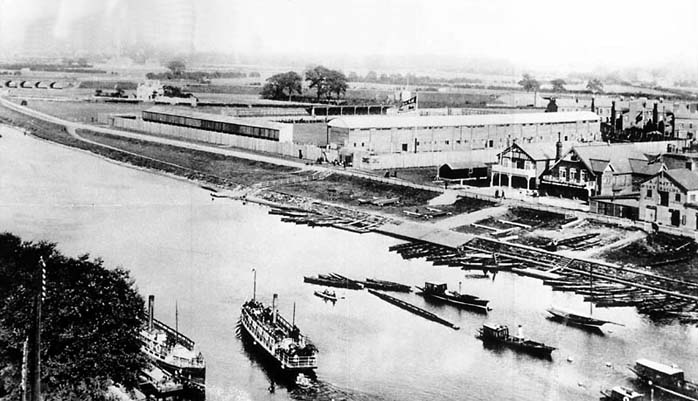
Willie Wragg was born in Radford, Nottingham in 1875, and initially played local football for Notts Olympic, Sutton-in-Ashfield, Newstead Byron and then Hucknall Portland. He was soon signed by Nottingham Forest and played for them as a professional footballer from 1896-1899. Appearing usually as a left-half, Willie made 48 League appearances in the First Division for Forest and scored one goal. Overall, he played 58 times for Forest in all competitions. This photograph shows the home of Nottingham Forest, the City Ground, during the 1898-1899 season:

City-Ground-1898

Willie made his début at home to Liverpool on November 28th 1896 in a comfortable 2-0 victory. He went on to play a further twelve times in the First Division that season, with a further four appearances in the F.A.Cup. He scored a single goal in a friendly match, a 2-1 victory over Dundee United at Crystal Palace. The following season of 1896-1897, Willie Wragg made 24 appearances in Division One and six in the F.A.Cup. He scored a single goal in the First Division in a 1-1 draw at home to Sunderland. The next season of 1897-1898 was his last at Forest. He played 13 times with most of his games coming as a left fullback. His final appearance came as a left half in a 0-0 draw at home to local rivals Notts County in front of a crowd of some 16,000 spectators. Here is Notts County’s magpie kit on that long ago Saturday, September 4th 1897. The crowd was a very respectable 15,000 spectators:

notts_county_1890-1900

As far as the boys are concerned the School Gardener can be a rather anonymous figure, working away quietly at the front of the school, a man whom the majority of pupils would not even notice. They were probably unaware of his lengthy pedigree as a professional footballer, but many hundreds of those unknowing little boys would have given a great deal to get their hands on what Willie Wragg had won during his three years at Forest, namely a Winner’s Medal from an F.A.Cup Final.

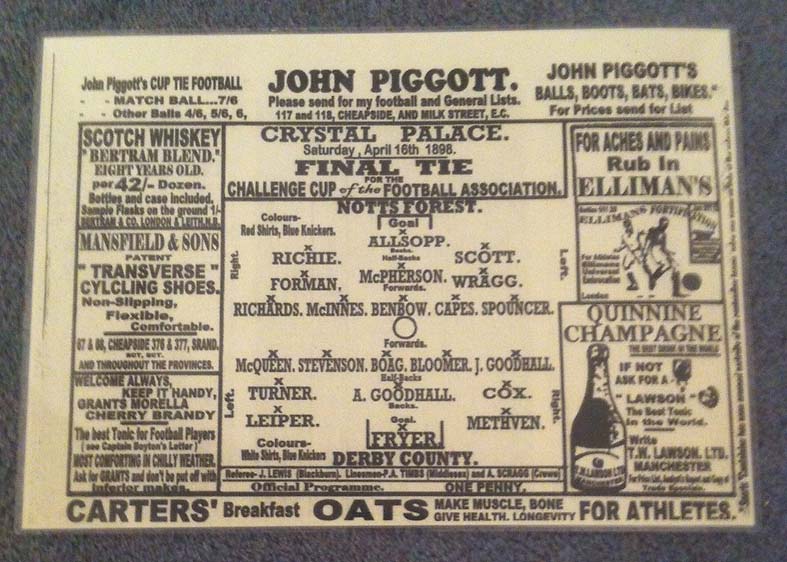
Willie had played at Crystal Palace on April 16th 1898 in front of a crowd of 62,017 spectators, when Nottingham Forest beat Derby County, Steve Bloomer and all, by three goals to one. Here is the front of the programme:

programme

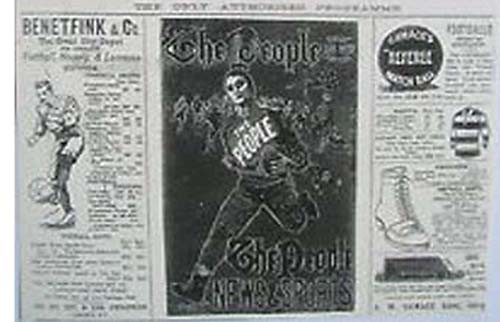
And here is the back:$(KGrHqFHJE4FGNV2GFfCBRonbILDSQ~~60_35

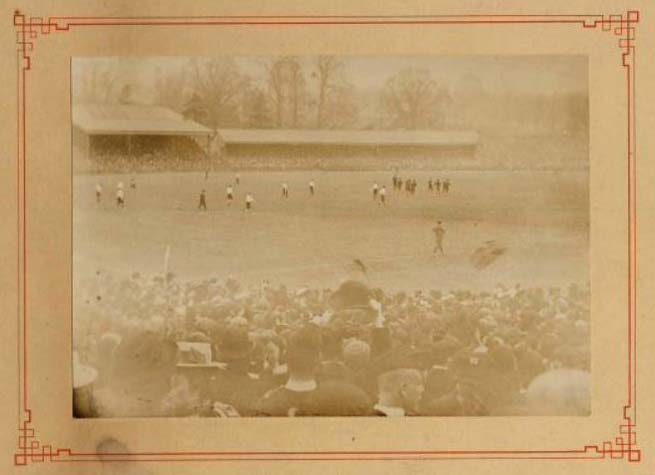
From his position as a left-half, Willie actually created Forest’s first goal, for it was from his free kick on the left near the touchline, that the ball eventually reached Arthur Capes who hit  the back of the net through a crowd of defenders.  Here is a picture of the game in progress…IMAGE_386

And here is a second photograph from a little further back…

Capture

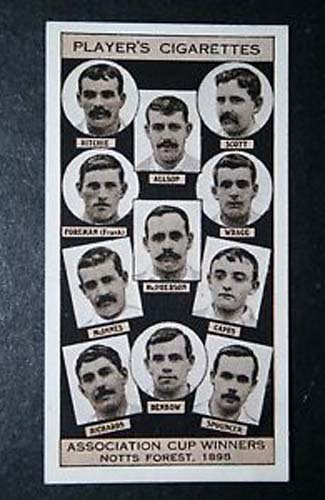
Later in the game, Wragg aggravated an injury suffered in the first-half, and, in the days before substitutes, was forced to move out on to the wing, not taking much further part in the game.That did not stop his appearance on the souvenir cigarette card…

$_35

Willie then left Forest, to go and play for Leicester Fosse in the Second Division. He spent two seasons at Leicester, making 50 appearances and scoring four goals. He was perhaps a little slower now and played at full back. Willie also became the club’s free kick specialist. He went on to appear just once for Small Heath (later to become Birmingham City), but he was unfortunately unable to displace George Adey from the team. His footballing career then rather petered out as he played for Watford in the Southern League and then Hinckley Town in the Midland League. His Football League career began again with Chesterfield Town (20 appearances, no goals) before a final return to non-League football with Accrington Stanley, Doncaster Rovers and finally Brighton & Hove Albion. Overall, Willie Wragg had made 119 appearances in the Football League.

Personally I believe that Willie Wragg may well have acquired his job as School Gardener at the High School through his past career at Nottingham Forest. At the time of the Cup win in 1898, the club’s then Chairman was Mr William Thomas Hancock, a prominent Old Boy of the High School, who had retired as Chairman of Nottingham Forest in 1920, only five years before Willie Wragg was appointed as the School Gardener. In 1925 Mr Hancock was still a Life Member of the football club.

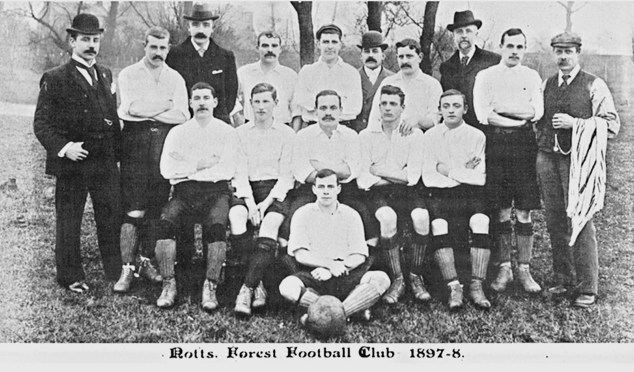
Most romantically of all though, perhaps ex-Chairman Hancock still remembered his day of glory when he posed on the Official Photograph of the F.A.Cup Winners of 1898 and knew exactly who had done more than his share to make possible that unique and unrepeatable thrill of being a winner. Mr Hancock is the gentleman third from the left on the back row.

forest team

Indeed, in 1898, when this photograph was taken of the players in the victorious team at Crystal Palace, how proud Mr Hancock must have been to stand with them:

back row: H.Hallam (Secretary), T.McInnes, Mr W. T. Hancock (Chairman), A.Ritchie, D.Allsop, unknown, A.Scott, unknown, A.Spouncer, G.Bee (Trainer)

front row:  C.H.Richards, Frank Forman, J.McPherson, W.A.Wragg, A.Capes

sitting:  L.Benbow

The photograph is, in itself, quite interesting, because it is one of two very similar photographs. In one of them, Forest posed with the cup, and in the other, they were photographed without it. The reason for this was that the crowd for the F.A.Cup Final was 62,000 spectators and almost all of them invariably invaded the playing area after the end of the game. This made it quite impossible to take a proper photograph of the winning team. And certainly the crowds do look huge and they seem to be pretty much left to their own devices…

This slideshow requires JavaScript.

The usual convention, therefore, was that both teams were photographed before the match, in conditions of complete calm, the photographers taking two pictures of each, one as victors with the trophy, the other as losers without it.  Afterwards, the two irrelevant photos were destroyed, although this has clearly not happened in this case.

It is also known that in this particular year, enormous problems were experienced with Forest’s red shirts and blue shorts, which did not show up particularly well in the comparatively dull weather conditions.

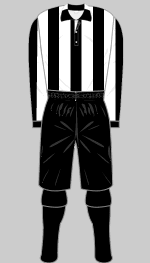
forest kit

The photographers therefore asked them to pose in Derby’s kit, wearing white shirts and black shorts. Perhaps this is why they look especially miserable, although, of course, Forest were certainly to have the last laugh.

Whatever the reason for Willie Wragg becoming the School Gardener, though, there was certainly an enormous connection between the football club and the High School. Almost forty Old Nottinghamians had already played for Forest, especially in the 1880s, and many of them had represented the club in important cup games, including semi-finals. By 1925, they were all just of the age to occupy important administrative posts in the club and certainly Tinsley Lindley had been a Committee member at Forest.

tinsley

Another familiar face at the City Ground was an Old Nottinghamian who had made his England début alongside Tinsley Lindley in a 6-1 victory over Ireland in Belfast. This was John Edward Leighton, called “Teddy” when he was at school, or, when he played for Forest, “Kipper”, because of his incredible ability to fall asleep in the dressing room before games. Indeed, old Mr Leighton was to fall asleep for the very last time at the City Ground, on the afternoon of Saturday, April 15th 1944, at the age of seventy-nine after a fatal seizure. His sudden demise occurred during a Wartime Cup tie between Nottingham Forest and Northampton Town, a fixture in which the Reds were eventually to triumph by 1-0. Here is “Kipper” though, on a better, and younger, day, sitting with all his pals, it is thought, in the Church Cemetery on Forest Road. They are all wearing the same bright scarlet shirts, and they are universally known as “The Garibaldi Reds” One day they will win the European Cup. Twice.

teddy

9 Comments

Filed under Derby County, Football, History, Nottingham, The High School

Ancient initials carved a century ago

In the High School, there is a much vandalised stone mantelpiece over an old fireplace on the ground floor. Boys have carved their names on it well over a hundred years ago and the letters are only just beginning to disappear into the thick levels of gloss paint now used to cover the original stone. The fireplace is located between the General Office and the entrance to the Assembly Hall, so literally thousands of boys will have queued past it as they go into Morning Assembly.

On Wednesday, January 18th 1899, Thomas Ignatius Joseph Gillott entered the school. He was to leave during the course of his fourth academic year, in July 1902. Sadly Thomas died on Sunday, July 6th 1913, after a failed operation at the London Hospital. On that same day in 1899, his brother Bernard Cuthbert Gillott, also entered the school. He was destined to remain a pupil only until the end of that academic year and he left in July 1899. With the advent of the Great War, Bernard was to join the army, where he served as a Captain in the 6th Northamptonshire Regiment. A brave man, he won both the British Military Cross and the French Croix de Guerre. Eventually he was  severely wounded, but thankfully he survived, and he was invalided home to England.

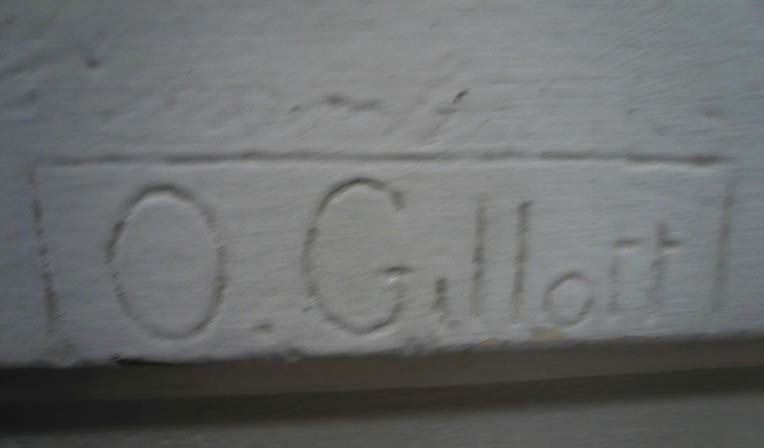
On Tuesday, September 12th 1899, the youngest of the three brothers, Oswald Cornek Gillot entered the school aged nine. Oswald was born in Ripley on July 22nd 1890 and his father was Thomas Gillot, M.I.C.E., a civil engineer whose address was given as either, Upland House, Eastwood, or Langley Mill near Ilkeston.  Possibly towards the end of the Summer Term, 1905, Oswald carved his name on that extremely popular stone mantelpiece on the ground floor fireplace between the General Office and the Assembly Hall. Oswald left the High School in March 1907.
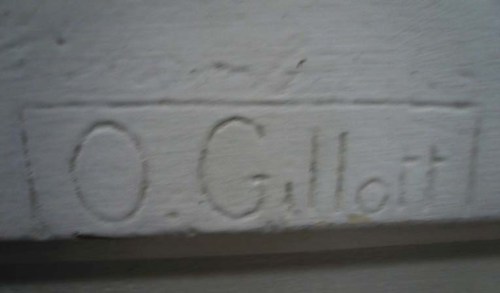
Gillott ccccccccc

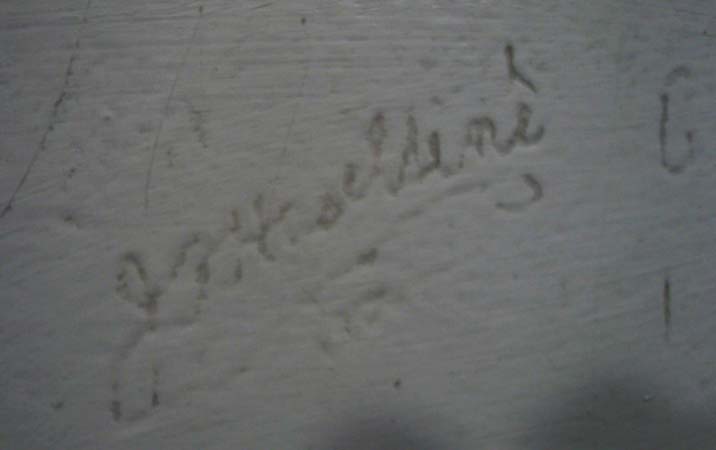
Taking decent photographs of these carved signatures has in actual fact, proved extremely difficult. They are located on the northern side of the school where the usually tropical English sun does not often penetrate,  and they are surrounded by vast thick walls of stone and brick, with a singular lack of windows. This means that the whole area is more or less permanently dark from a photographic point of view. Added to this is the fact that in the century or so since these interesting acts of senseless vandalism were carried out, a succession of school caretakers, under the almost inhuman management pressure to hurry up that all school caretakers permanently face, have repainted the mantelpiece with a succession of layers of whitish gloss paint, all of them applied without having the time to remove the previous one. The stone therefore, now wears a building’s equivalent of an inflatable Sumo suit.
Consequently, I have been forced to Photoshop the pictures I took so that the now faint carvings stand out a little more clearly from the dimly lit and pale coloured background. One unfortunate young man, R.Salew, has proved completely impossible to conjure out of the camouflaging layers that now hide his signature. But he is definitely there.
Towards the end of the Christmas Term, 1904, John Francis Haseldine carved his name, in rather florid handwriting, on that same stone mantelpiece.
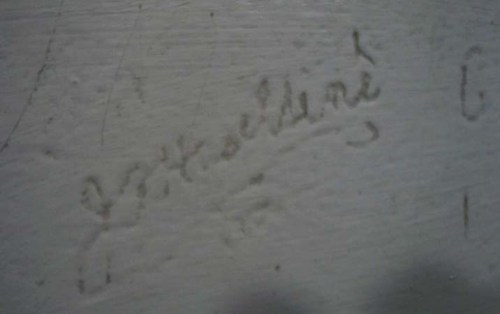
haseldine cccccc

John was born on December 28th 1886 and entered the High School on May 4th 1896, aged nine. His father was Frank Haseldine, a lace manufacturer of St.John’s Grove, Beeston. John was a very good footballer (soccer player), and made his début for the First XI on Wednesday, March 26th 1902, in an away game against Loughborough Grammar School. We know that the school’s best player, J.B.Sim, worked hard throughout the match, but, according to the School Magazine of the time,“The Forester”, he was “too carefully watched” by the Loughborough defence, and the game was lost by 0-2. That particular spring, John had been in the team which had won the Football Sixes, a six-a-side competition organised within the school by the boys themselves, with the teams all drawn out of a hat. It was taken, of course, extremely seriously. Coincidentally, the winning team’s captain was that very same J.B.Sim, who was a well-known High School footballer of that era, with more than fifty appearances for the First XI.
On Wednesday, February 14th 1903, John scored his only goal for the school, in a 4-1 away victory over Mansfield Grammar School, “a rather poor and one-sided game”. As an ever present in the team, John won his football colours at the end of this season and was also awarded a “Standard Medal” for Football . In season 1903-1904, he became Captain of Football.  John spent the Christmas Term of 1904 at the High School, but, like so many boys during this period, he left half way through the academic year in December 1904.
In the Great War John was a Major in the Royal Engineers, Special Reserve. He was Mentioned in Dispatches on June 3rd 1916 and received the Military Cross on January 1st 1917. By 1929, he was living at Northdene, New Barnet, in  the northern suburbs of Greater London.
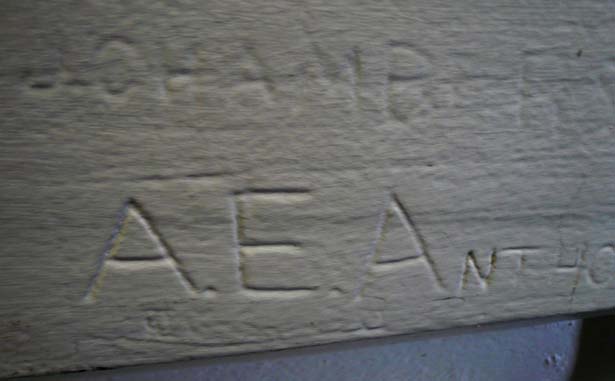
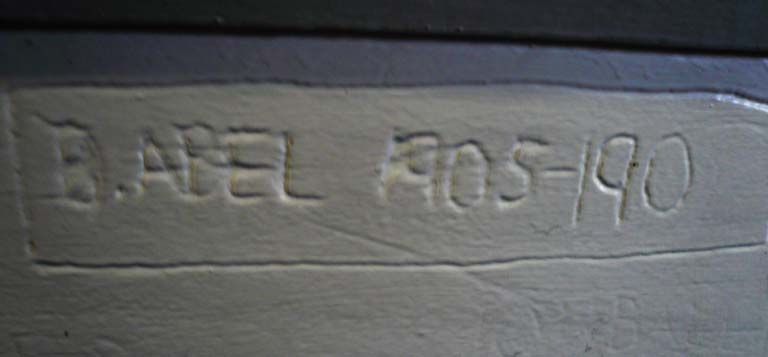
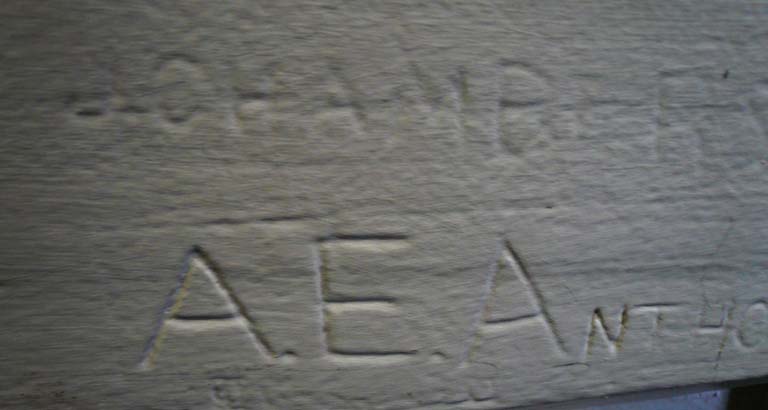
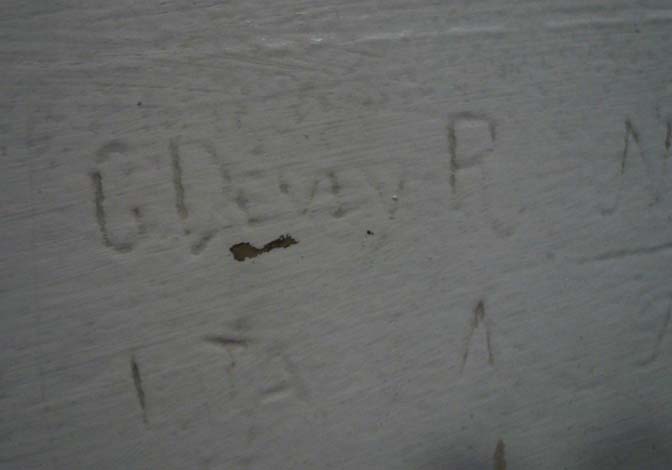
Among the other more legible carved names are “A.E.Anthony” and “G.Devey”. What is apparently “R.Salew” is also there, although there are many, many  layers of gloss paint to obscure the lettering of this particular name, and the photo has not come out because of this. Another seems to read “B.Abel 1905-190” as if the young man had been interrupted, perhaps by a Master (teacher), as he came towards the end of his carving, and then did not ever return to finish the job.

Alfred Edward Anthony was born on June 12 1906, and entered the school on September 18th 1918, aged twelve. His father was F.W.Anthony of 120, Radcliffe Road, West Bridgford. He was the Managing Director of Gotham Co Ltd (apparently sic). Alfred left the school in December 1922.
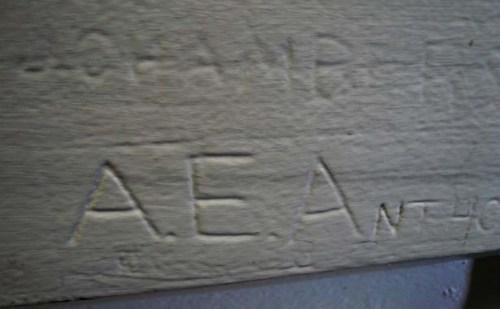
anthony 1 ccccccc

“G.Devey” was the elder brother of Reginald Devey, whose own name had already been carved on the fireplace upstairs, in the staffroom corridor, alongside that of D.H.Lawrence and L.S.Laver, the High School’s very own Latin Champion of the World.

r.a. devey cccccccv

This ground floor effort though, was Gerald Bertil Devey, who was born on June 10th 1903,. Gerald entered the school on May 27th 1918 at the rather late age of fourteen. His father was James Edward Devey, a civil servant, and the family lived at 22, Ebury Road, Sherwood Rise. Gerald left the High School in July 1919.
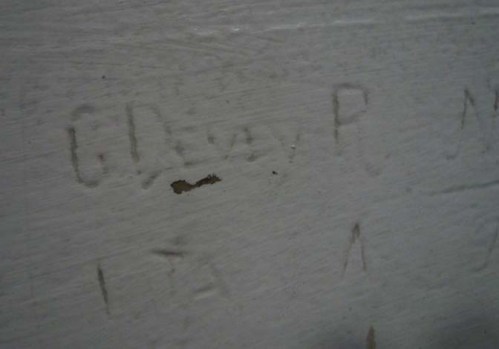
devey cccccc

John Rylett Salew entered the school on May 4th 1916, aged fourteen. He left in December 1918. John was born on February 28th 1902 and his father was Joseph William Salew, an “agent” of 19, William Rd, West Bridgford.

Bertram Albert Abel was born on July 31st 1889 and entered the school on September 13th 1905, aged sixteen. His father was William Jenkinson Abel, a clerk to the Nottingham Education Committee. The family lived at 99, Waterloo Crescent, and Bertram left the school in July 1907.

b abell ccccccc
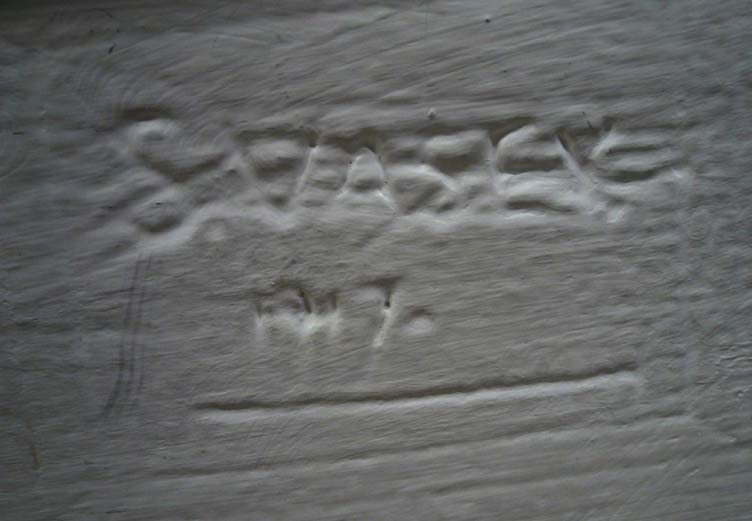
The fact that “S.Vasey” has carved his name in two different places on the stone, one of them complete with his own personal dates, namely “1917” and “1917-1922” shows not only that he had an extremely strong desire for immortality, but that, within the context of the High School, it has been fulfilled. He must have been a very swift, and fairly brazen, vandal.

zzzzz s vasey 1907

Stanley Vasey was born on June 5th 1905 and he entered the school at the age of thirteen, on September 18 1918. His father was Alfred Vasey, a shop inspector, and the family lived at 15, Glebe Road, West Bridgford. He left in December 1922.
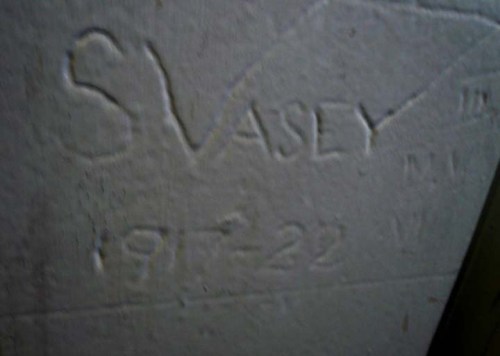
zzzzzzzzzz vasey 1922
It is actually possible to best guess friendship groups among these carved names. Messrs Anthony, Devey and Vasey, for example, all joined the school in 1918. They all left in the latter half of 1922. They must surely have known each other. John Rylett Salew and Stanley Vasey both lived within a penknife’s throw of each other in the very posh Nottingham suburb of West Bridgford. Did the four boys seal their friendship by committing their names to the hard surface of that much painted fireplace ? Did three of them keep watch while the fourth scratched his name into the welcoming stone ?

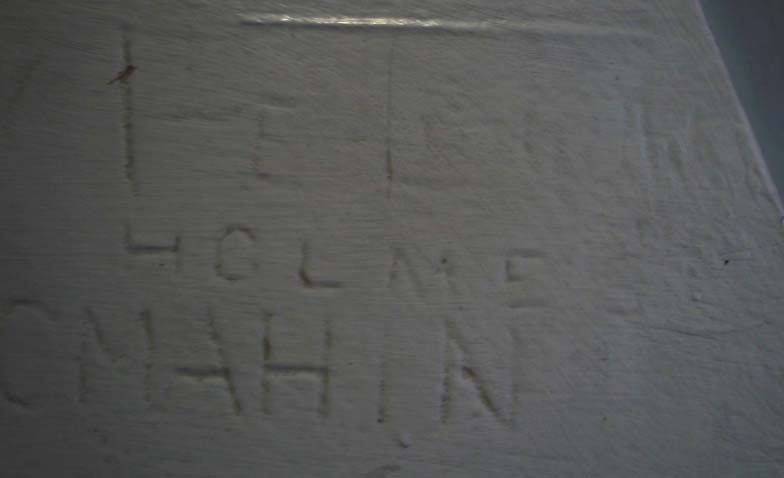
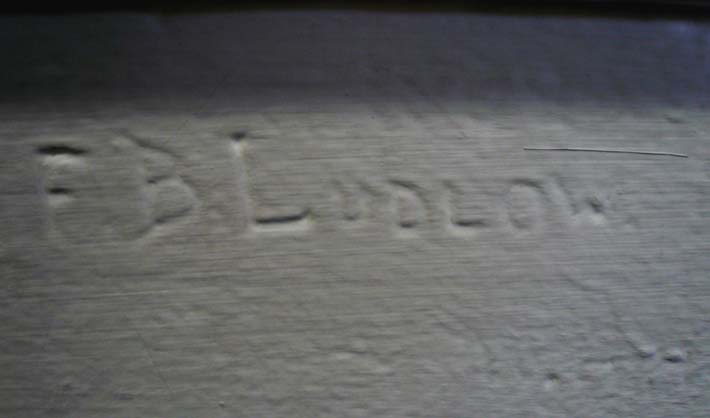
The other names on the fireplace, some of them extremely indistinct, include “F.B.Ludlow”, “N.G.Peet”, “Littler”, “Meigh” and “Holmes”. The latter was possibly the George Chudleigh Holmes who was a regular player in the First XI football team during the 1902-1903 season. Born on June 15th 1887, George entered the school on January 17th 1900, aged twelve. His father was George H.Holmes, a Lace Manufacturer of Gregory Street, Old Lenton. George left at Easter 1903, perhaps once the football season was over.

hiolmes 2 ccccccccc
Fred (sic) Ball Ludlow was born on April 28th 1891. He entered the school on May 1st 1900 aged  nine. His father was William Ludlow, a clerk in the Gas Depôt. The family lived at 10, Willoughby Avenue, Lenton in the western suburbs of the City. Fred left in June 1907.

ludlow cccccc

Noel George Peet was born on December 26th 1901 and entered the High School on April 26th 1917, aged fifteen. His father was William George Peet, a “general agent”, and the family lived at 413, Mansfield Road. Noel left the school in July 1919. Perhaps he was a relative of Mrs.Mary Peet who was the school’s nurse during the late 1970s and the 1980s.

Samuel Littler was born on May 16th 1891. He entered the school on September 16th 1903 aged twelve. The family lived at 8, Appleton Gate, Newark-on-Trent, and his father, a veterinary surgeon, was also called Samuel Littler. Samuel junior left in July 1908.

Vincent George Meigh entered the school as an Agnes Mellers scholar on September 12th 1899 aged ten, the cost of his place in the school automatically paid for. His father was George Meigh, a schoolmaster of 3, Willoughby Avenue, Lenton. Vincent left in December, 1903.
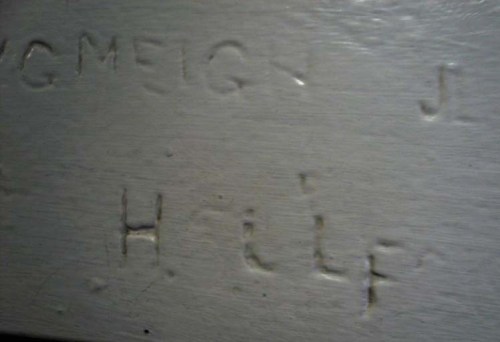
meigh ccccc
On the mantelpiece, one set of letters to set the heart a-flutter is “(illegible)BALL  1900-1907” , but this cannot be the famous air ace, as there are clearly a fair number of letters before the B-A-L-L. In any case, Albert Ball did not stay long in the High School, being expelled after an incident when he disrupted school assembly by emptying a large bag of bullseyes, gobstoppers and bouncing sweets onto the floor.

Best fit is probably Oliver Herbert Ball, who was born on August 13th 1891. He had entered the school on January 17th 1900, aged eight, as the third of three brothers. Oliver was to leave in July 1907. His mother was called Emma, and his father was Alfred Holmes Ball, the “Laundry Man” of “Sunnyside”, Daybrook, Notts.  Presumably, this was the company which was eventually to become the massive “Daybrook Laundry”.’ It was situated opposite the Home Brewery on the Mansfield Road, and was only recently demolished during the first decade of the twenty first century. The Arnold branch of the “Aldi” supermarket chain has now been built on this site during the latter part of 2014. It was open for business by the end of the year. Look for the orange arrow:
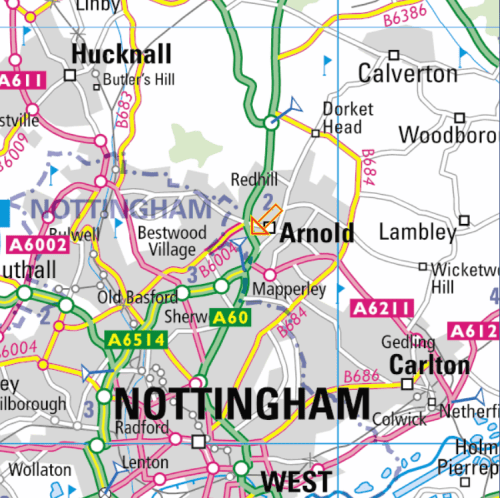
north nottingham

During the Great War, Oliver Ball was to serve as a Second Lieutenant in the 10th Battalion of the Yorkshire Regiment.  Aged only twenty five, he was killed on September 28th 1916 and is buried in the Guards’ Cemetery at Lesboeufs in France. Oliver’s  death was part of the Somme offensive.  He shares the cemetery with 1,492 identified casualties, and a grand total of 3.136 men.
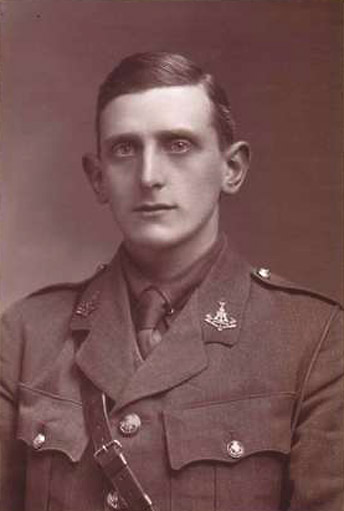
oh ball

Oliver Ball’s elder brother was Walter William Ball, the second son of the three, and himself an Old Nottinghamian. Walter had returned to the Western Front, and the Yorkshire Regiment, from his leave in Nottingham on Friday, November 19th 1915. The “Nottingham Guardian” reported his death on Monday, November 29th 1915. He had apparently been shot through the head by a sniper while organising a firing party with his captain. The tragic news was communicated to his parents by his younger brother, Second Lieutenant Oliver Ball, who held a commission in the same regiment. According to the “Nottingham Guardian”, Walter was “well-known in Nottingham and had a large circle of friends”. He had received his commission as a Second Lieutenant a mere twelve months previously. Walter is buried in Houplines Communal Cemetery Extension in France, Plot 1, Row A, Grave 21. He was 28 years of age.

ww ball

As far as I can trace, the third brother seems to have survived the war.

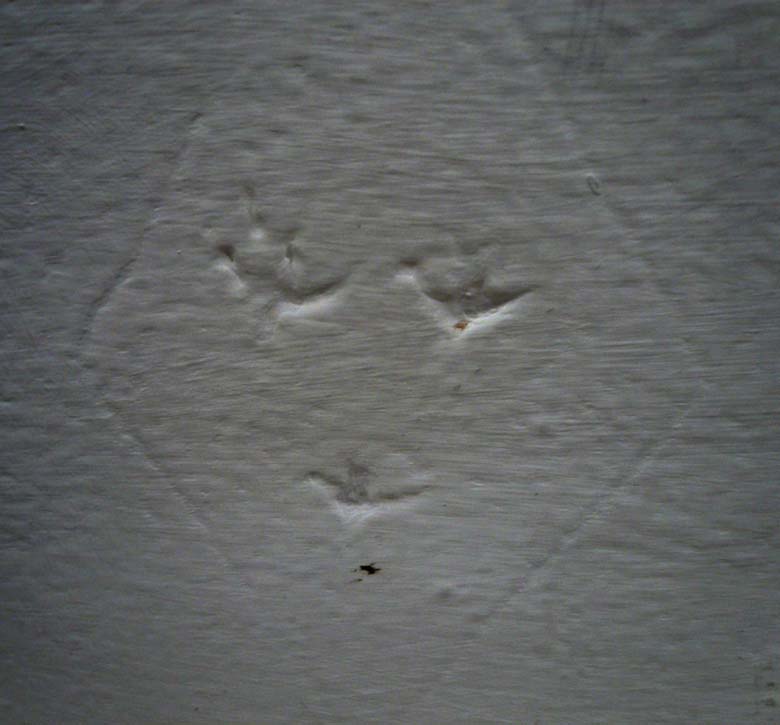
One of the more notable objects on the mantelpiece is perhaps the school badge which has been carved relatively large, and in primitive style, with the lozenge and the three merles or heraldic blackbirds still recognisable even now, the best part of a century after it was executed by some unknown, juvenile artist.
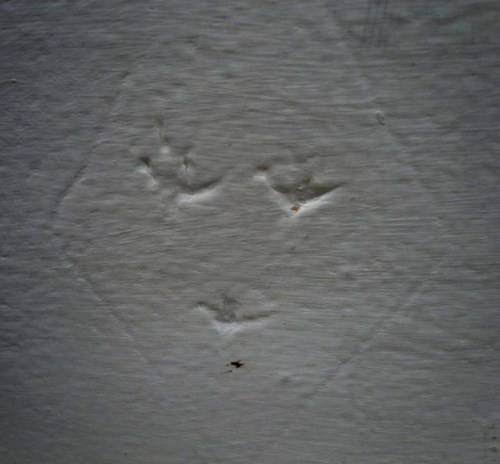
badge cccccccc c

Less time proof perhaps, are the boys who managed to carve only their initials, namely “JL”, “MV”, either “WA” or “WR”, and either “BFW” or “SFW”. It is just so difficult to be certain about whose initials they might be. In some cases, there are literally dozens of possible candidates in the school registers, and it becomes almost a pointless effort to try and guess who has carved them.

Some boys seem to have been able to make only part of their name legible. We appear to have, therefore, a group of letters which seems to spell “H-LLF”.

Similarly, I have tried so hard to turn “—-NGTON” into Victor George Darrington, one of the very few young men to have captained the school at both football and rugby. The time is right (he entered the school in 1909, aged twelve) but the fact is that the blurred and multi-layer gloss paint painted-over obscured letters just do not look like they were ever meant to spell Darrington.

Even more striking is the young member of what is probably the “Chambers” family who did not manage to carve his initials clearly. The name can be seen just above “A.E.Anthony”, although the letters seem to be an even whiter shade of pale.  Just a cursory perusal of the school registers reveals the existence, between 1897 and 1926, of “E.Chambers”, “W. Chambers”, “P. Chambers”, “N. Chambers”, “J.F. Chambers”, “J.S. Chambers”, “A. Chambers”, “C.G. Chambers”, “J. Chambers”, “B.J. Chambers”, “C.C. Chambers”,  “S.H. Chambers”, “D.B. Chambers”, and a second “W. Chambers”

chambers 1zzzzzzzzzzzz

No doubt a really thorough search would reveal even more members of the apparently vast Chambers clan.
It would be nice to think, though, that the perpetrator was the (uninitialled) Chambers of Form IVb, whose doings are reported in the Prefects’ Book for Thursday, February 1st 1912….

“…A meeting was held before afternoon school, Towles and Haubitz (prefects) being absent. Chambers (IVb) had been reported for carrying a loaded revolver in his pocket. He admitted the offence, and produced the weapon, which proved to be loaded in four chambers. He was requested not to bring it to school again, and the School Captain decided to interview the Headmaster.”

Most unfortunately, no record has survived of the outcome of this conversation. Here again, it is possible to guess at putative friendships between the names in the stone. Two of the boys, for example, Fred Ball Ludlow and Oliver Herbert Ball, both joined the school in 1900, and their entries are virtually next to each other in the School Register. Perhaps the use of the surname of one as the middle name of the other hints at a blood relationship, rather than just one of mere friendship.
Coincidentally, a third name on this single ancient page of the school register is that of Harold Binks, who entered the school in the very same year of 1900, although Harold was never to carve his own name on the fireplace. From his reminiscences, published in April 1935, we know that one of his best friends in the Senior School was called Ball. It seems likely too that another of the friends was Oswald Cornek Gillot, who was already in the school when Ludlow, Ball and Binks arrived. All these boys were of the same age, and they all left the school in the latter part of the academic year 1906-1907. As we have already noted, Gillot lived near distant Ilkeston, but Holmes lived in Gregory Street, Old Lenton, very close to Ludlow and Meigh who themselves both lived in the same street, namely Willoughby Avenue, Lenton. Again, we can imagine two keeping watch while the third one carried out the evil deed with his penknife.

On Thursday, June 7th 1917, just  ten years after carving his name on the stone fireplace, Oswald Cornek Gillott was killed at the age of twenty six, yet another hapless victim of the Great War. Even a school as small as the High School (400  pupils) was to provide some three hundred young men, all destined to die well before their time.

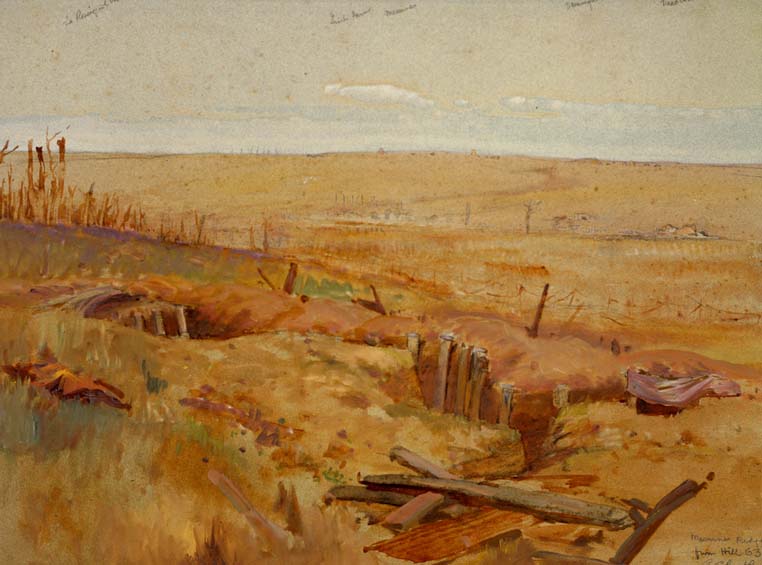
After he left the school, Oswald moved to Teesside, and became a twenty year old apprentice mechanical engineer living at 2, Woodland Terrace, Borough Road, Middlesbrough, Yorkshire. When the Great War came, Oswald joined the 68th Field Company of The Royal Engineers. They trained at Newark-on-Trent before sailing from Liverpool for Gallipoli at the end of June 1915. They remained at Lala Baba in Suvla Bay until December 19th and 20th 1915, when they withdrew and returned to Egypt by the end of January. Oswald was recorded as having been wounded during this period. In June 1916 the Division was ordered to France to reinforce the Third Army on the Somme. By July, they were in the Front Line and took part in the fighting at Thiepval. In early 1917 they were fighting on the Ancre, and then moved north to Flanders for the Battle of Messines
Messines_Ridge_from_Hill_63 cccccccSecond Lieutenant Oswald Gillott’s last day on Earth was June 7th 1917, coincidentally no doubt, the first day of the successful attack on the Messines Ridge.  The assault was preceded by the detonation of nineteen large mines, in what was described at the time as “the loudest explosion in human history”. Oswald, as a member of the Royal Engineers, may well have been involved in this activity when he was killed. On the Commonwealth War Graves Commission website there are a mere three pages of Gillotts, with only thirty two men of this name killed. Oswald Gillott lies in the Messine Ridge British Cemetery in Mesen, West-Vlaanderen in Belgium along with the 577 of his colleagues whose remains have been identified.

This slideshow requires JavaScript.

Second Lieutenant Gillott, aged twenty seven was one of a trifling 24,562 casualties, as the British under Field Marshal Herbert Charles Onslow Plumer, 1st Viscount Plumer, GCB GCMG GCVO GBE slowly began to learn how to fight battles at much lower costs than previously. (Battle of the Somme, 623,907 dead).

The other side of the coin, of course, is the fact that if the Field Marshall and his lordly colleagues are not much more careful with the lives of their social inferiors, they will risk actually running out of men. The  623,907 men killed in the Battle of the Somme is a catastrophe, but the apparently much lower figure of 24,562 killed during the assault on Messine Ridge could well be regarded as every single man in a town the size of, say, present-day Arnold or Newark-on-Trent.

One set of initials I have not dealt with. That is F.C.Mahin, one of the High School’s very few Americans, and I will talk about his incredible and hitherto completely unknown life in another blog post.


6 Comments

Filed under Criminology, History, Humour, Nottingham, The High School

In memory of those who perished in the Holocaust

This is an extract from the history of the High School which I have been writing recently:

Tuesday and Wednesday, March 29th and 30th 2005

Organised by the Reverend Stefan Krzeminski, over the course of two days, the whole of Year 9 had the privilege of visiting what is now the National Holocaust Centre near Ollerton in north Nottinghamshire.

In past years the boys had been able to listen to the testimony of Arek Hersh, but on this occasion the speaker was Josef Perl ….

“It was not long before the train stopped and the front wagons pulled up at a platform. The people inside, who had clearly come directly from their homes, were marched away and disappeared down some steps straight to the gas chambers. We were in Auschwitz.

The doors of our wagons were unlocked and we had to jump down. There was a smartly dressed commandant deciding who would live and who would die.

Waving his riding crop, he indicated “links oder recht” (left or right) with a casual flick of the wrist. Those he sent to the left (over 70 per cent) went immediately to the gas chambers, those to the right had been selected, either for work or for experimentation.

It was Dr Mengele.”

I myself well remember hearing this chilling story of an encounter with the Angel of Death. At lunch, I was able to ask the question about concentration camps which had burned in my mind for years, namely, “Why, if you were all going to die anyway, didn’t you fight back and kill the Germans?”

Mr Perl answered my question and then asked me that, as a teacher, I should tell as many people as possible exactly what had happened in the Holocaust, so that it could never happen again.

I have never forgotten Josef Perl, or his request. Once again, therefore, I am happy, if that is the word, to do exactly as he asked.

1 Comment

Filed under History, Nottingham, Personal, The High School

The End of the British Empire, December 26th 1913

The very first game of Rugby in the long history of the High School was played on Friday, December 26th 1913, the last Christmas and the last Boxing Day before the outbreak of the Great War. The game took place on the High School’s playing fields at Mapperley Park Sports Ground , used by the school since 1897, when they had left the Forest Recreation Ground which was considered to be too dangerous for boys to play sport there.

This map shows the walk from the High School (which is in the bottom left on the opposite side of the yellow road from the “C” of “Cemy”) down to Mapperley Park in the centre right, indicated by the orange arrow. The present day Games Field, at Valley Road, is the blue word “Day”  in the top left hand corner.

games medium

This map shows the site of the Sports Ground in greater detail. Look for the orange arrow again.

Untitled 2

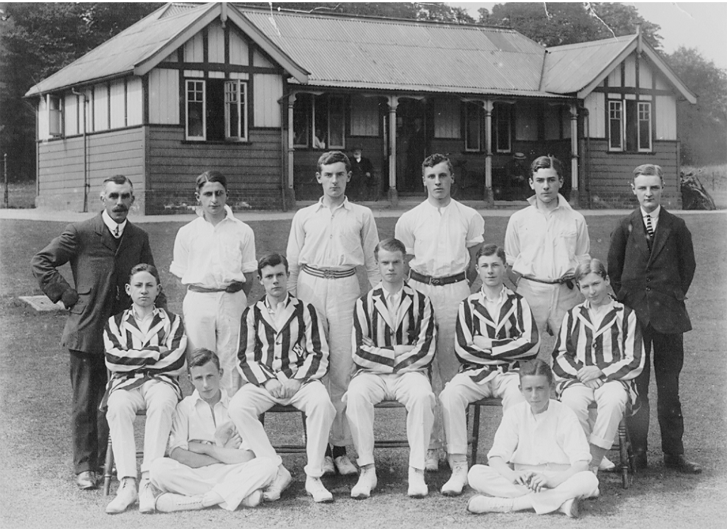
This is the Pavilion at the Mapperley Park Sports Ground which was demolished only within the last twenty or thirty years . The young men are a long forgotten First XI school cricket team from just a few short years before  the Great War.

pavilionThe gentleman on the left of the back row is Mr.Albert Grant Onion, the groundsman. He coached the High School cricketers with great enthusiasm, and saw many of them go on to do very well with local clubs. In 25 years, he did not miss umpiring a single 1st XI fixture, and was famed for his fairness and impartiality. He and his wife and daughters were responsible, too, for preparing all of the teas for the players. The young man at the other end of the back row is probably the team scorer, who kept an exact record of the game. Alternatively, he may be the reserve player, the so-called twelfth man.

On this occasion though, on Boxing Day, 1913,  it was not a cricket match but a rugby game. As a preliminary before the school’s changeover from Football, which was played from 1870-1914, to the new sport of  Rugby Union, therefore, the Old Nottinghamians played against Notts Rugby F.C.. The Old Boys lost a closely fought game by (three tries) 9 points to (three goals), 15 points. The tries were scored by H.A.Johnstone, C.G.Boyd and D.P.C.Grant. The referee was Mr.Lionel Kirk. Presumably, this fixture served for many people as a demonstration of the new sport.  In the days before television, the majority of Old Boys and Masters, and especially the parents and current pupils, would probably never have seen the game played before.

The Old Boys’ team was Stocks; H.A.Johnstone, H.S.Stocks (Captain), A.Willatt, R.L.W.Herrick, C.G.Boyd, W.Johnstone; D.P.C.Grant, F.Hardwick, J.K.Turpin, A.R.S.Grant, H.W.Ballamy, L.W.Peck, E.G.Hogan and W.S.Facon.

A pleasant interval in the Christmas festivities, one might think, a little respite from a surfeit of roast turkey, brussels sprouts, Christmas pudding, port, sherry, cigars and all the other indulgences of this wonderful time of year. Except that nobody who was there on that fatal Friday knew that a World War was to break out within less than eight months. That more than four years of fighting would leave almost a million British dead, and in that number would be more than three hundred Old Nottinghamians.

In actual fact, the eventual fate of the members of the Old Boys’ Rugby team pretty much defies belief. As well-intentioned, patriotic, decent, optimistic, courageous and athletic young men, they were to run forward into the maelstrom of the Great War as if it were a blood spattered combine harvester.

Henry Archer Johnstone became a Major in the 152nd Brigade of the Royal Field Artillery. He was the beloved son of John and Ada Johnstone, of Fairmead, Risley, Derbyshire.

johnstone

Henry was to die on Tuesday, May 21st 1918, at the age of only twenty eight. He is buried in Wancourt British Cemetery near Arras in northern France. His rugby playing days were finally over.

H.S.Stocks, who left the High School in July 1904, was eventually to become a Lieutenant in the 7th (Service) Battalion of the Royal Sussex Regiment. He was severely wounded on Friday, July 7th 1916, in the Battle of the Somme, and rendered unfit for further active service. I would certainly have been very surprised if he ever played any more Rugby matches with his young laughing friends.

imagesJ0RY1CA0

John Riversdale Warren Herrick was a Captain in the “2nd King Edward’s Own Gurkha Rifles (The Sirmoor Rifles). He was in the 3rd Battalion attached to the 11th Gurkha Rifles when he was fatally wounded on active service in Iraq. The son of Dr.R.W.Herrick and Mrs.Edith Herrick of 30, Regent Street, Nottingham, Captain Herrick was to die from his wounds on Sunday, October 24th 1920 at the age of only twenty seven. He is buried in the Basra War Cemetery, Iraq. His rugby playing days were finally over.

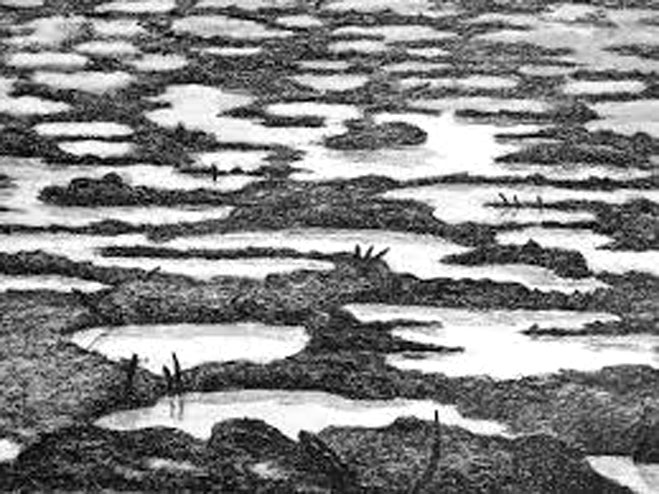
741px-second_battle_of_passchendaele_-_field_of_mud_

Charles Gordon Boyd was a Second Lieutenant in the 7th Battalion of the Sherwood Foresters, but was attached to the 9th Battalion of the Leicestershire Regiment. On Thursday, May 3rd 1917, he was killed whilst attacking Fontaine-Les-Croiselles with ‘D’ Company at the age of only twenty four. He was the son of George Herbert Boyd and Sarah Louisa Boyd, of, initially, 13, Tavistock Drive, Mapperley Park. Charles Boyd had been the Captain of the School in 1911-1912. In cricket, he was the First Team’s wicketkeeper and he was an enthusiastic footballer who played regularly for the First Eleven. His full record as a goalscorer was eleven goals in nine appearances. He surely got changed for this particular fixture in his own home nearby and perhaps walked along Tavistock Drive to the pitch in a laughing little group of his fellow players.  At the time of his death, his parents had moved to St Peter’s-in-Thanet, Kent. Tragically, Charles Boyd’s remains were not found until some six years after his death, in November 1923, when he was reburied in the Heninel-Croisilles Road Cemetery in the Pas-de-Calais in northern France. His rugby playing days were finally over.

James Knowles Turpin was the beloved only son of Harry and Minnie Turpin, of 68, Henry Road, West Bridgford. James was a Second Lieutenant in “A” Battery, 241st South Midland Brigade of the Royal Field Artillery.

turpin 2

On Tuesday, August 14th 1917, he was killed in action at Boundary Road behind the Brigade HQ at Hill Top Farm near St Jaan just west of the frontline.  he was just twenty five years of age. He was buried in Plot 6, Row D, Grave 7 in Vlamertinghe New Military Cemetery, West-Vlaanderen, Belgium. His rugby playing days were finally over.

somme_1

Allan Roy Stewart Grant, while he was at school as A.R.S.Grant, was nicknamed “Pongy” by his fellow students, because of his parents’ choice of initials for him. He served as a Captain in the 10th Battalion of the Seaforth Highlanders, Ross-shire, Buffs, and the Duke of Albany’s. He was awarded the Military Cross. “Pongy” survived the conflict and duly returned to Nottingham.

Not so his elder brother, Donald Patrick Clarke Grant, who was in the 7th Battalion of the Cameron Highlanders.  He is listed as either a Lance-Corporal (by the Commonwealth War Graves Commission), or a Lieutenant (in the school lists of the fallen). He was killed on Thursday, April 12th 1917 at the age of only twenty seven. He had previously been the Manager at the British Crown Insurance Office in Nottingham. His remains were never found but his death is commemorated on the Arras Memorial.

Both young men were the beloved sons of the Reverend John Charles Grant, a Minister of Religion, and his wife Ellen Jemima Grant who lived at “The Manse” at 16, Baker Street, Nottingham. The family was of Scottish origin. Donald had, in actual fact, been born at Loanhead in Midlothian.

Harold William Ballamy was a Lieutenant in “B” Battery of the 231st Brigade of the Royal Field Artillery.

ballamy 1234

He was the beloved son of Frederick William Ballamy, a commercial traveller, and his mother,  Mrs.M.A.Ballamy of 17a, Gedling Grove.

ballamy 2

He was killed on either Tuesday, August 14th or Wednesday, August 15th 1917, as part of the Third Battle of Ypres, usually known as the Battle of Passchendaele. He was twenty four years of age, and is buried in Fosse No 10 in the Communal Cemetery Extension at Sains-en-Gohelle,  in the Pas-de-Calais in northern France. His rugby playing days were finally over.

Leslie Wayland Peck was the son of Thomas Wayland Peck, a Clerk in Holy Orders, and a Diocesan Inspector of Schools, who had been, from 1885-1900, a master at the High School. From 1886-1893, despite being a teacher, Peck Senior had played regularly for the school’s First Team at both football and cricket. The family lived initially at 12, Arboretum Street, Nottingham, and then in Gedling Grove. He must certainly have known Harold Ballamy, a near neighbour. Perhaps the two boys used to make the short walk to school every morning, accompanied by Mr Peck. What could have been more embarrassing than walking to school with one of the teachers? Fortunately it was a very short walk. Today it would just necessitate crossing over the tram lines at  the High School tram stop.

Leslie Peck left the High School in June 1910, and joined the Bank, an establishment which was later to change its name to the National Westminster Bank. He had already served in the School Cadet Corps under Captain Trotman, and then joined the Sherwood Foresters Special Reserve. He was called up, and sent to France quite early in the Great War. He was “Mentioned in Dispatches”, but after being extremely badly shell-shocked, was invalided back home for a period of hospital treatment.

H08331 Leslie was then posted back to the Sherwood Foresters, but was never well enough to serve overseas again. I would certainly have been very surprised if he ever played any more Rugby matches with his young laughing friends.

passchendale

M.J.Hogan was the school goalkeeper from 1903-1905. In the Great War he became a Sergeant in the 1st Battalion of the Grenadier Guards. He was severely wounded on an unknown date. His goalkeeping days, and his rugby playing days too, were probably over for ever.

hogan 1904

I have been unable to trace anything concrete for W.S.Facon although according to the London Gazette, a Lieutenant W.S.Facon was promoted to Captain on December 21st 1921. The Internet also reveals that in the Air Force List for May 1939, a W.S.Facon worked at the Air Ministry in the Department of the Permanent Under-Secretary in the Directorate of Contracts.

I have been unable to trace either how many of these keen pioneer rugby players had been in the Officer Training Corps, but however many it was, it certainly had not trained them well enough for the Somme (1916) or Passchendaele (1917)

5 Comments

Filed under France, History, Nottingham, The High School

Gunpowder, treason and Nottingham

Not many people would connect the High School and Guy Fawkes’ Gunpowder Plot, but the link is there, if you trace it through carefully……

…..Brian Garnett, or Garnet, is thought to have been the Master of the Free School during some unknown period between the years 1564-1575.

free school

It is considered most probable that he took up the post between 1564-1567, and then retired in, probably, 1575. He may then have lived in Beeston, but he was certainly buried in Heanor in Derbyshire on December 21st 1576, as the “Late Skoolemaster of Nottingham”.

With his wife, Alice Jay, he had at least three sons, Richard, John and Henry, and three daughters, Margaret, Eleanor and Anne,  all of whom became nuns at Louvain.

Of the sons, Henry is the most notable, because eventually he was to become the Superior of the Jesuits in England, and, allegedly, an active member of the Gunpowder Plot which, in earlier centuries, often used to be called the Gunpowder Treason Plot or the Jesuit Treason. In general terms, the plot, of course, was a failed assassination attempt to blow up the Protestant King James I of England and his entire Parliament, by filling the cellars of the building with gunpowder. lighting the fuse, and retiring quickly and sensibly to a minimum distance of at least fifty yards.

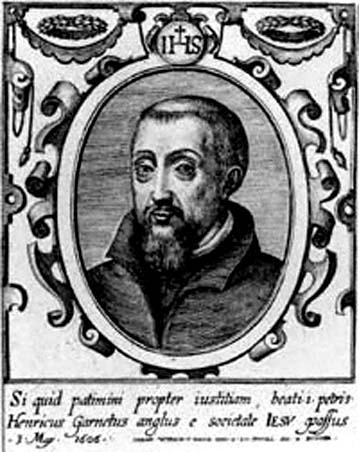
GunpowderPlot dddddddddGarnet was not quite tasked with carrying the barrels of gunpowder into the cellars, but rather, he was deemed to have been guilty of knowing all the details of the assassination attempt, but then doing nothing to save either the King’s life or those of his courtiers. Here he is….

google 2 zzzzzzzzz
In recent times, some doubt has been cast on the extent to which Garnet was actually aware of the dastardly plot, because all the details he knew were revealed to him through the plotters’ confessions. Of course, by the strict rules of his Catholic religion, Garnet was automatically prevented from informing the authorities by the absolute confidentiality of the confessional.

None of this alters the basic fact, though, that Henry Garnet was executed for treason, on May 3rd 1606. At his trial, the jury had needed only fifteen minutes to reach their verdict.

Where the tiniest of doubts still exists, however, is whether Henry was ever a pupil at the Free School, as no registers of this period are still in existence. It is certainly true, though, that he was educated in Nottingham, and the national rules in place at the time allowed only one school in each town or city. In any case, it is surely beyond credibility that he was not associated with the Free School during his father’s tenure of the position of Master, that is to say, the only teacher who was working there.
Indeed, at least one source says that young Henry came to the Free School during Henry Cockrame’s time as Master (most probably 1563-1564), possibly a year or so before Cockrame left in 1565 and was replaced by Henry’s father, Brian Garnett of Heanor, Derbyshire. Henry is supposed to have studied for two years under his father’s tutelage, before leaving for Winchester College where he was elected as a scholar on August 24th 1567 and duly entered the school in 1568.

WinCollege1_ccccccccccccccccc

Henry had been well taught in Nottingham, and proved to be an able student at Winchester. According to “The Oxford Dictionary of National Biography”…..

“His love of music and “rare and delightful” voice were complemented by an ability to perform songs without preparation, and he was reportedly also skilled with the lute.
Father Thomas Stanney wrote that Garnet was “the prime scholar of Winchester College, very skilful in music and in playing upon the instruments, very modest in his countenance and in all his actions, so much that the schoolmasters and wardens offered him very great friendship, to be placed by their means in New College, Oxford.”

Instead of the delights of New College, Oxford, however, when he left the school in 1571, Garnet moved to London to work for a publisher. Shortly afterwards, in 1575, he travelled to the continent and joined the Society of Jesus. Garnet then moved to Rome to study for the priesthood with the Jesuits. He was finally ordained as a priest around 1582. (Note the ear of corn which will be important)

henry again xxcccccdxdx

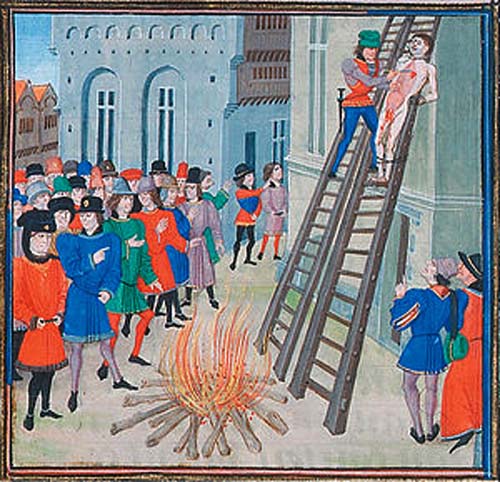
Whatever happened in his life during the next twenty three years in the service of the Lord, by virtue of the events of May 3rd 1606, Henry Garnet must surely remain the only Old Nottinghamian ever to have been convicted as a terrorist, and, indeed, one of the very few ever to have been hanged, drawn and quartered, and then to have had his severed head placed on a pole on London Bridge.

Froissar txxxxxxxxx

(That’s going to hurt)

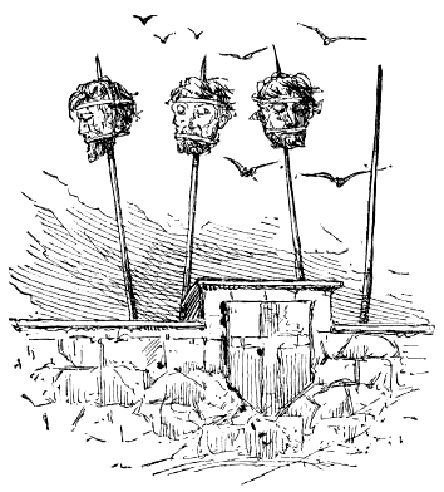
Heads_on_spikes xxxxxxxxx

(This engraving will be next month’s Caption Contest)

Thankfully, the more lurid details of his execution have survived in Antonia Fraser’s book, “The Gunpowder Plot”…..

“Garnet said his prayers, and was then thrown off the ladder and hanged.

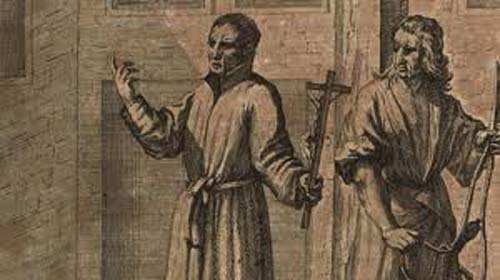
beforfe execuion xxxxxxxxxx

Before the executioner could cut him down alive, many in the crowd pulled on his legs, and as a result, Garnet did not suffer the remainder of his grim sentence. There was no applause when the executioner held Garnet’s heart aloft and said the traditional words, “Behold the heart of a traitor”.
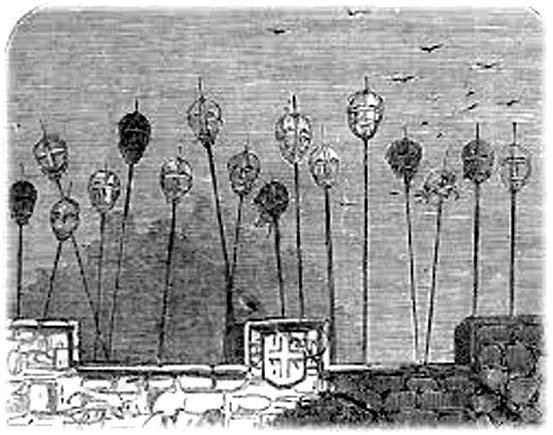
His head was set on a pole on London Bridge, but crowds of onlookers fascinated by its pallid appearance eventually forced the government to turn the head upwards, so its face was no longer visible.”

From this peculiar pallid appearance of course, came the widely held belief that Garnet’s head did not suffer any signs of decay or change.

nov 4th heads xxxxxxx(Can you spot Garnet’s head?)

Nowadays, of course, we are a lot more civilised and the heads of traitors are no longer placed on a pole on London Bridge. Instead, we have just two or three of the more unsuccessful Premier League managers.

modern cddddddddddd

(Why is nobody taking any notice?)

The final, and a slightly more serious thing to be said about Henry Garnet is that way back on May 3rd 1606, according to those who were there, a miraculous portrait of him apparently appeared on an ear of corn onto which drops of his blood had fallen at the moment of his execution. This particular ear of corn was later credited with achieving a number of miracles. At one point, it was taken secretly out of the country into the possession of the Society of Jesus, before, with its size surely playing a part, it was lost, rather appropriately, during the French Revolution.

-Portrait_of_Henry_Garnett zzzzzzzzz

The Roman Catholic Church, of course, has a large number of saints who have done far less than Henry Garnet to earn their sainthoods. Names which spring to my mind would include St.Buriana, St.Erc, St.Ia and any number of Cornish villages named after other dimly remembered saints.

Perhaps one fine day, Henry Garnet may yet become the only Old Nottinghamian ever to be canonised.

Leave a comment

Filed under History, Humour, Nottingham, Politics, The High School

And the Hallowe’en winner is………..

Around ten or fifteen years ago, I was a teacher of Religious Studies as well as my main subject of French. We were  studying the Afterlife, so, towards the end of, I think, the Christmas term, I asked the boys to write down for homework their own ghostly experience or a ghostly encounter that either their parents or anyone close to them had had. Here is a selection of the stories they came up with.
And, of course, yes, boys can tell lies just like everybody else, but by then I had taught this class for four months, seeing them for an hour and a half every week and I did not really think that anybody was lying. They may have been mistaken in their interpretation of events, but I’m sure they were sincere in what they thought was happening. This effort came from the parent, or even grandparent, of one of the pupils…

“My ghost story”

from Daniel J Furse who lived in the Old Manor House from 1956 to 1964.

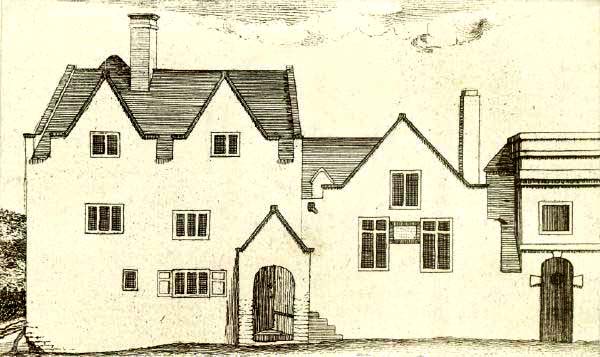
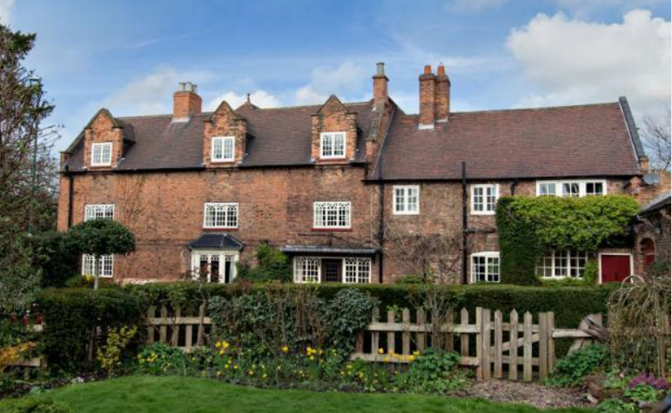
gregory_st_manor

“I bought the house from one of the printer Milward family and he told me that when he moved in there was a row of wire operated bells hanging in the passage by the kitchen, although they were all disconnected. Every now and then, at night, these bells would ring wildly. On investigation, no one was ever seen but the bells were all swinging on their springs!
Our own contribution was fairly mundane but baffling. In what was the dining room – next to the kitchen where there now appears to be a door, we had a very large Jacobean oak sideboard tight against the wall, and above it hung a picture. Sometimes, when coming down in the morning, we would find the picture neatly stowed under the sideboard, with the hook still in the wall, and the cord intact.”
I live in the Old Manor House in Lenton regularly referred to as haunted. We have some accounts of manifestations of the ghost in the past one of which I have quoted above. There is one room that is thought to be the “haunted” room. It was in this room that someone was so frightened by what they saw or heard that it caused the previous owners to have an exorcism in the house. We ourselves have had some strange experiences. We seem to have a “Visitor’s curse”. More often than can be explained, something has happened with our lighting, heating or kitchen appliances when a guest was either there or coming. Sometimes just one system fails, but the most dramatic was when a bar of spotlights fell down from the ceiling near some guests. Another time when we were expecting guests for Christmas, all lighting, heating and cooking appliances, including the Aga which runs on gas and the electric cooker which relies on electricity, refused to work.
Hopefully we can have a ghost- free Christmas this year!”

olg manor house cccccc

This was a very popular topic indeed with boys of fourteen and fifteen.
One young man told me the story of how he had seen a ghost when he met up with one of his friends who attended another school in, I think, Grantham. The boy went from Nottingham to spend the whole weekend as his friend lived quite a long way out in the Lincolnshire countryside. They stayed in the friend’s house which was very large with a very large garden. On the Friday evening, as soon as the visitor had unpacked, both boys went outside to see if they could see the phantom which the host had already explained could often be seen as it walked in the garden. The visitor from Nottingham was very excited that the garden was haunted and that he might actually see a real ghost.
The young man told me that as he stood there with his Lincolnshire friend in the early evening they saw not a sharply defined ghost, but a pale blue patch of mist or smoke, shaped like a human form. It moved across the end of the garden from right to left and by the time it reached the left-hand edge it was beginning to disappear.
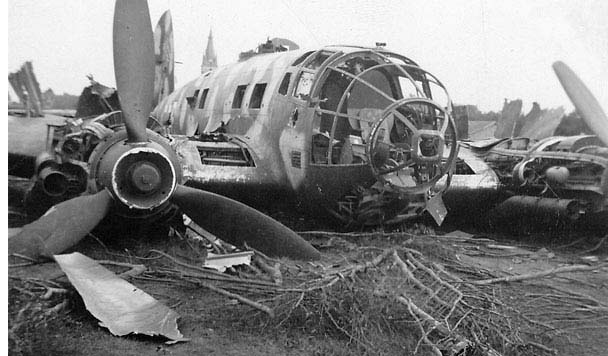
Supposedly, it was the ghost of a Second World War Luftwaffe flier whose aircraft, a Heinkel III bomber had been shot down, and he had been killed.

he111-5 zzzzz

Previously, I had been told about a slightly similar ghost by a now retired school technician called Frank. When he was young he used to live on the southern side of the Humber Estuary in Lincolnshire. Naturally, as a boy, he was keen to explore, and on one occasion he went with two of his friends out onto the salt marshes south of the estuary. He told me that there was a lookout tower right on the edge of the land, overlooking the waters of the estuary and of the North Sea. It had been put there for military purposes, probably either in the First or the Second World Wars. It was now in ruins but the shell of the brick built building was still there.

tower-inst xxxxxxxxxx

As the three boys made their way across the absolutely flat landscape, a saltmarsh covered in vegetation which was no more than four or five inches high, they suddenly saw a figure on the top of the tower.
Apparently an adult man, he stood there for a little while, and the boys watched him. I do not remember from the account whether he seemed aware that he was being watched, but I suspect that he did not. Anyway after five minutes or so, the figure leapt off the top of the tower which was at least twenty or thirty feet high, exactly as if he was doing a parachute jump or, as they always say, something silly. The three boys certainly thought so because they ran along the path which led to the building, to see if they could help what they presumed would be a fairly severely injured man. When they got there though, the place was completely deserted. Nobody was there.
What makes it so strange is that the landscape was such that he could not possibly have run away across either the saltmarsh or to the distant sandy beach without the boys seeing him. In any case it had not taken the boys long enough to get to the tower for him to have disappeared. He had not passed them on any of the paths which led across the marsh. They searched the tower but he was not there. They presumed therefore that he was a ghost of some kind. Later on, Frank explained that tales had been told of an occurrence just like this having been seen before in the very same location, but nobody had ever been able to explain what it was.

Two other stories were very scary indeed…..

“The crippled Ghost that learns to walk

Every so often when I lie awake in my bed at night and I leave the door open I see an old man in a brown wheel chair. He has grey hair and a mutilated face like it’s been taken off and jumbled about and then stuck back on.
It moves towards me without using its hands to move the wheels at all. Then when it reaches the door it stops and stands up. It starts to walk towards me. At that point I turn away and face the wall and try to force myself to believe it’s not real, it’s not real.

Then when it reaches my bed, it reaches out to touch me. The reason I know this is because I see its shadow on the wall. But as soon as it touches my head it disappears and so does the wheelchair which disappears as soon as he gets out of it. The only other thing that is strange about the man is that he is extraordinarily long thin fingers and shoulder length white hair.”

This extraordinary tale is recounted more or less exactly as the boy wrote it down. I have not altered anything at all except to make the tense used the present tense, rather than a mixture of several different ones.
What would be really interesting would be to try and trace in the history of the house if there was anybody who ever lived there who had the long fingers and long white hair, perhaps of a musician, or the mutilated face and the wheelchair of, perhaps, a Great War victim. It is however, even with the Internet, extremely difficult to trace who has lived in any house, and what his job was, or the hardest thing of all, what he did during his life and what happened to him.
And the winner is…….
…….This very last final story, which was clearly connected with my preparations for Christmas with the class. It is dated November 4th 2005, and is entitled…

“The white man with no face”

Interview with my Dad:
What size and age did the ghost appear to be?
He was a six-foot male…age impossible to say.
But roughly did he look middle-aged or quite young?
He was oldish but that’s the most accurate description I could give.
Did you contact any spiritualists or mediums about the ghost?
No I didn’t; it never crossed my mind. It didn’t really bother me personally, but I never thought to ask my wife whether she thought we should get somebody in to try and sort things out.
What was the scariest thing about the ghost?
It would be that every time you were fast asleep, this ‘thing’ could be looking over you; I wasn’t frightened about it at all, but it didn’t do anything… just stared endlessly at you.
If only I had ever seen the ghost and you hadn’t, would you believe me about it being ‘around’ or not? Would you look out for it?
I would believe you, but I wouldn’t go out of my way to find something that could only be found if ‘it’ wanted to be.
How did the ghost appear and what did it look like?
I was in deep sleep and there was a wind as if all the windows were open, and my shoulders felt cold like ice. Both your mum and I woke up basically at exactly the same time, and we saw ‘it’. All it did was just look down at us. I can’t remember the curtains blowing just a fairly strong wind, so the windows were definitely not open. My wife asked me: “Tell me what you just saw?” trying not to put any ideas into my head, and her expression when I replied, confirmed this was not a dream. We both looked away, and after a period of time I cannot remember, I eventually look back to see ‘it’ had vanished.
Did you ever feel like you are being watched?
Well obviously you knew there was something around but you just had to ignore it. My wife at the time was so terrified; she nearly moved out of the house and lived with her parents for a short time.
Did you ever stay on your own in the house?
Yes, of course, it didn’t bother me that much, it was your mum who was worried about it the most. However, this was one of the reasons why we eventually moved house. My mum has told me that for weeks she was terrified of the ghost reappearing, and too many times felt her shoulders turn ice cold even during the summer (just like when she first saw the ghost).
Apparently I saw the ghost on many occasions – more than my parents – and that I asked them “Who the white man in my room was” more than once. The ghost could communicate with “the living” as it asked me what my name was.
Chloe my sister regularly saw the ghost – which was obviously concerned my mom, and on one occasion she told my parents “a white man with no face keeps waking me up and then just staring at me”. At the time she wasn’t afraid of ‘it’ as she was too young to realise what was happening. Chloe can’t recall any of this but my parents remember it all too well.

3 Comments

Filed under Aviation, History, Nottingham, The High School