Tag Archives: Barnes Wallis

Newark Air Museum (2)

Last time we looked at some of the Cold War aircraft in the Newark Air Museum, but there are a good many civil aircraft as well, most of them from this same period.

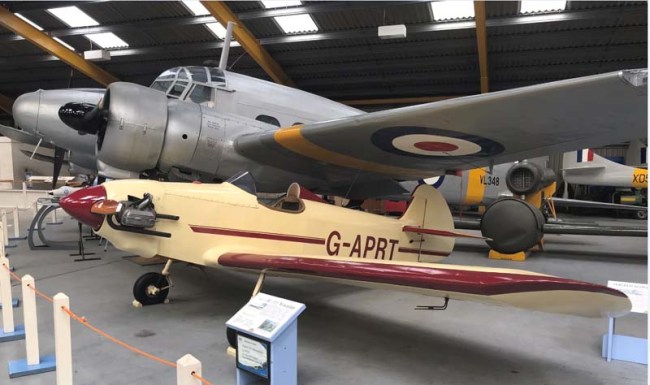
Let’s start with the exception, though, which would be the Avro Anson, even though this normally peace loving multi-engined aircrew trainer was originally designed as a maritime reconnaissance aircraft. In World War Two, the Anson finished up instead as the mainstay of the British Commonwealth Air Training Plan in North America, training pilots, navigators, air gunners and radio operators. Newark’s Anson C.19, though, was used as a light transport and communications aircraft. Top speed : 182 mph. The Anson is the bigger silver aircraft. The custard coloured one is a Taylor JT.1 Monoplane.
The Handley Page Hastings began life as the C1 troop-carrier and freight transport aircraft. The aircraft married a completely new fuselage to the wings which had been designed for the abandoned HP.66 bomber development of the existing Handley Page Halifax. This particular individual, TG517, was used in the Berlin Airlift, and then in meteorological flights and finally in the Cod Wars against the evil Icelanders from 1958-1976 . It had begun its career as a completely ordinary C1 but in 1958 was converted for RAF Bomber Command, acquiring a ventral radome to train V-bomber crews on the Navigation Bombing System (NBS). Top speed : 348 mph

The DH.104 Dove was a short-haul airliner manufactured by de Havilland. The aircraft was the monoplane successor to the pre-war Dragon Rapide biplane and was intended as a short-haul feeder for large airlines and airports. The Dove carried eight passengers and two crew, and overall, it was very popular, sales being in excess of five hundred.  Top speed : 210 mph

Now we reach a few nasty foreigners, beginning with the Russkies whose simple plan was to enslave us all. To do that, they might well have used the Mikoyan-Gurevich Mig-27, codenamed “Flogger”. This was a swing wing ground attack fighter based on the basic airframe of the MiG-23, but with a revised nose, hence its Russian nickname of “Platypus”. The “Flogger” was also used by Sri Lanka and later it was licence-produced in India by Hindustan Aeronautics as the Bahadur (“Valiant”).      Top speed : 1,171 mph.

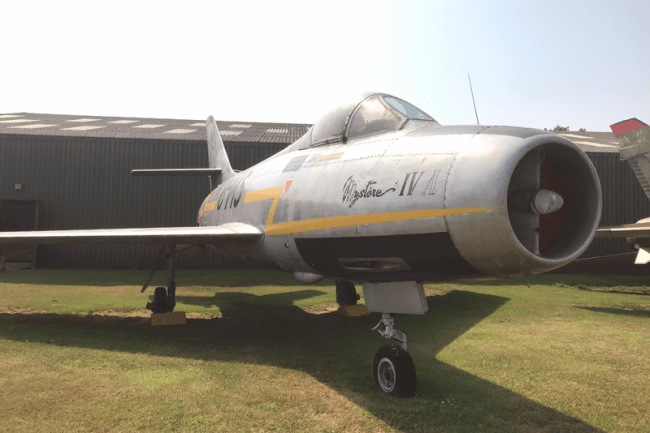
This next aircraft is French. It is a Dassault MD.454 Mystère IV and was used primarily in the 1950s and 60s as a fighter-bomber. It was the first French aircraft to break the sound barrier, and the first transonic aircraft to enter service with the French Air Force. It saw action with both the French and Israeli air forces in the Suez Crisis of 1956 and then again with the Israeli Air Force during the 1967 Six Day War, fighting Mig-17s and Mig-19s.
The Newark Air Museum also has a good many objects connected with the Dambusters’ Raid of May 17th 1943. They have a propeller from the crashed “S-Sugar” of 617 Squadron:

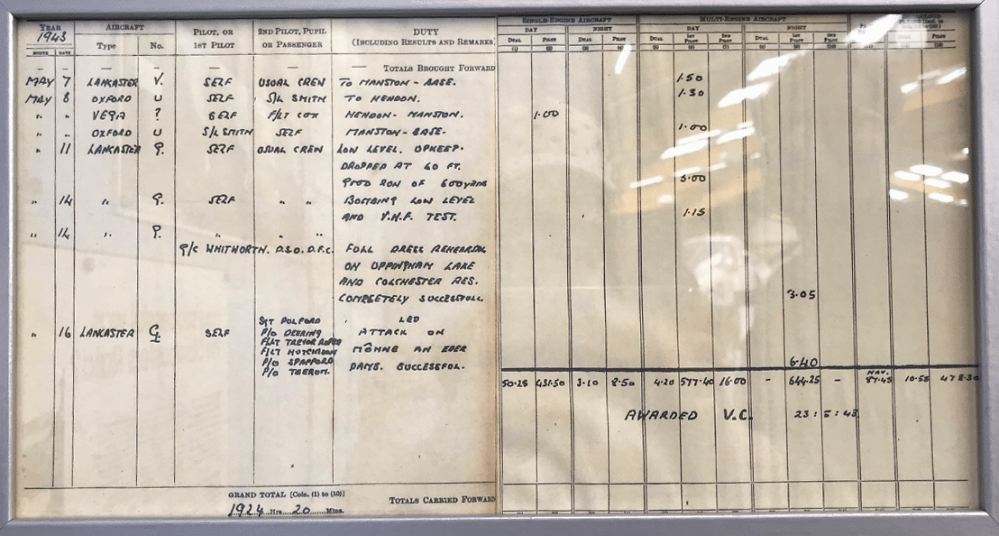
There is the relevant page from the logbook of Guy Gibson:
There is a piece of fuselage from a Lancaster:

And a man inside it demonstrates how many garments he has to wear:

There is a mid-upper turret from a Lancaster:

And finally, you can see the weight and distinctive shape of one of Barnes Wallis’ “Bouncing Bombs”, codenamed “Upkeep”. This particular bomb was built for testing purposes and was recovered from the waters off Reculver in Kent by Andrew Hemsley and the personnel of 101 Field Regiment TA, and 22 and 223 Squadrons.

All photographs courtesy of Lauren Knifton Fainberg


13 Comments

Filed under Aviation, Bomber Command, History, military, Personal

The Hendon Lancaster 137 not out

A few years ago, I drove down with the family to the RAF Museum at Hendon, just to the north of London. I made an immediate bee-line to the Bomber Command section to see their Avro Lancaster. Most of the aircraft here have their original coat of paint from World War II, so, to prevent it fading away completely under the onslaught of bright, harmful sunshine, the lighting is very subdued. That made it rather difficult for me to take photographs of a decent standard. Indeed, for the general view of the aircraft, I have had to use a photograph from the Internet. Here it is, with its capacity to carry up to 14,000 lbs of bombs into Nazi Germany:

HendonLancaster GOOGLE
Here is the front of this mighty bomber. Its huge black tyres are not far short of the height of a man. The yellow tips of the propellers are a safety feature and the yellow letter “S” is the aircraft’s squadron letter as “S-Sugar”:
P1320296XXX

This is the rear of the bomber. It has twin tails to give the mid-upper gunner a greater field of fire. You can see the door for the crew, which kept them well away from the four propellers, but it meant a very long and difficult crawl to the front of the aircraft. Its squadron letters are PO-S and its serial number is R5868:P1320297XXX

This particular plane is the oldest surviving Lancaster and the first RAF heavy bomber to complete 100 operations. It eventually went on to fly 137 sorties. R5868 was originally “Q-Queenie” with No. 83 Squadron at RAF Scampton and then became “S-Sugar” with No. 463 and No. 467 Squadrons of the Royal Australian Air Force at RAF Waddington. Its very last job came in May 1945, when it was used to transport liberated Allied prisoners of war back home to England.
The four Merlin engines have on them the names of the crew who received decorations. This is the starboard inner engine:
P1320283XXX

Here is another name, this time on the port inner engine. You can also see what looks to me to be an 8,000lb bomb underneath the enormous bomb-bay. Such a large bomb was made by merely bolting together two ordinary 4,000lb “Cookies” or Blockbuster bombs:
P1320285

I couldn’t resist showing you for a second time, in this second blogpost, the front of “S-Sugar”, which is adorned with the vain boast of Hermann Göring, “No enemy plane will fly over the Reich Territory”.

It is deliberately painted next to the symbols which represent the huge number of raids carried out over Germany by this one particular aircraft. All of the Avro Lancasters added together flew 156,000 missions over Europe as a whole and they dropped 608,612 tons of bombs on the Third Reich. So much for Hermann Müller and his pathetic promises, detailed in that previous post:

P1320286XXX

This is a “Grand Slam” bomb. It was designed by Barnes Wallis and weighed 22,000lb, ten tons, more or less, and the specially adapted Lancasters of 617 Squadron who carried it were at their physical limits:
P1320321

My Dad said their wings were shaped like giant crescents as they took off. When they were dropped, the bombs broke the sound barrier. At that time they must have been among the fastest objects made by Man. They penetrated deep underground and, when they exploded, they easily proved their nickname of the “Earthquake Bomb”. Unlike the majority of bombs dropped by the Allied Air Forces, they were always used on military sites such as U-Boat pens, gun-batteries or railway bridges.
Here is one being dropped by YZ-C of 617 Squadron:

This slideshow requires JavaScript.


I found two films about dropping a “Grand Slam” bomb. In both cases they are being used to destroy railway viaducts, in order to prevent the Nazis from moving troop reinforcements around their fast diminishing country. In this way, these spectacular bombs must have saved the lives of a lot of good men:

21 Comments

Filed under Aviation, Bomber Command, History, Personal