
In my early twenties. I used to go camping around Scotland with my friend, Bill. We used to travel around the perimeter of Scotland in a clockwise fashion, with a route which took in Glasgow, then up to the north-west corner of Scotland at Cape Wrath, then the north-east corner at John O’Groats and then home southwards along the east coast to Edinburgh and England. In those days we use to camp where we could find a reasonable place to do so…..”wild camping”, it used to be called. As long as we left no mess, the landowners didn’t seem to bother. I used to take slides with my trusty Voigtländer and was then able to bore people rigid with my “Pine Trees of the Northern Highlands”. I found all my slides recently, in a very large box in the attic, but unfortunately, there were a good few which I could not identify. When I got round to doing it, one or two of them also suffered during the conversion process into digital images, usually acquiring either an overall blue or purple cast, or, on other occasions, the image becoming much darker than it had originally been.
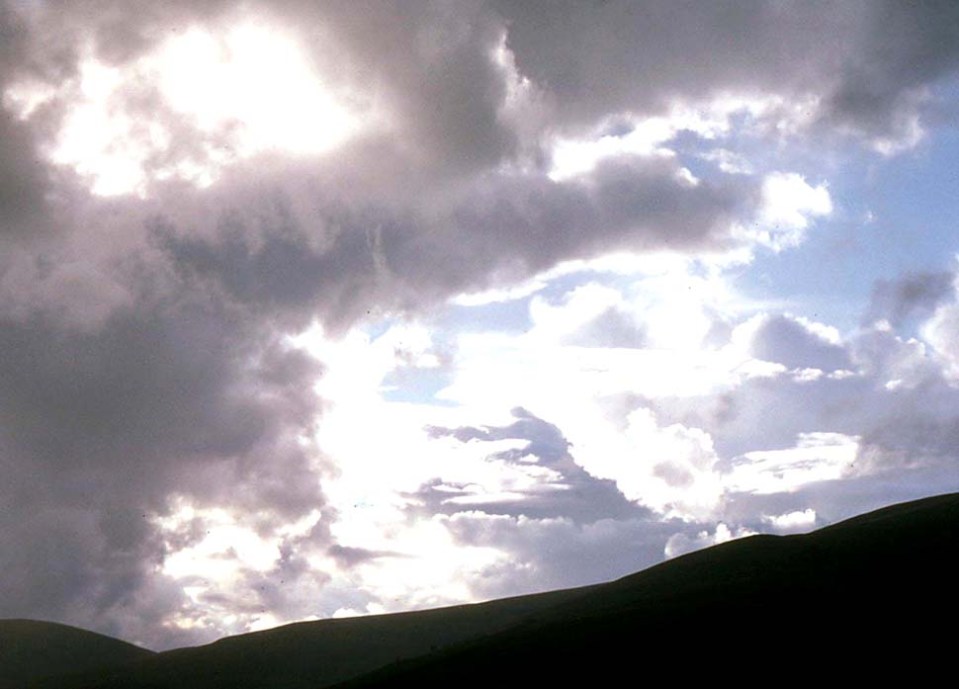
This 45 year old slide shows just a few seconds in the short life of a cloud formation somewhere in the Western Highlands. It seems so very bright compared to so many of my old slides….
This is quite a nice slode, too. I don’t remember where I took it from, possibly the north west coast of the Isle of Skye, but it looks westwards into a spectacular sunset where the Outer Hebrides can just be seen on the horizon. I remember thinking how remote this site must have seemed to some of the people who have visited Scotlsand over the centuries.
Did any of the survivors of the Roman Ninth Legion flee north and reach the Atlantic Ocean? Did they look out thinking that they had found the fabled “Ultima Thule” ?

But there are still plenty of dark places in Scotland. This is a very famous road at Applecross, a small village on the west coast, almost directly east of Skye. The road is famous not just for its steepness, which measures around 1 in 4 (25% ?), but for the fact that it continues for so long…….not fifty yards, but some two miles or so. In years gone by, it was used by a good many advertising companies to sell various motoring products.

I have driven up the road myself at least once and I have been a passenger perhaps half a dozen times, and I can testify, it is exremely steep and it goes on for quite a long way! On the other hand, there are no sudden huge drops to either left or right.
Well, there were some relatively bright shots there, weren’t there? This is Scotland, though, and it won’t last! Here’s a grassy area in the middle of nowhere, as the darkness comes in and the mist swirls round….

Here’s a much brighter day in the same overall area. In actual fact, this slide is pretty much a quick lesson about the ice ages. Vast sheets of ice, thousands of feet thick, smoothed most of the land into a huge stony snooker table. Where there are huge tall mountains, something of them will survive. So, in this region five peaks remain, but only as a shadow of their former selves. The ice sheets also carried huge rocks around on top of them, like hitch hikers in a 1960s film. They are usually called “erratics”, and 90% of the time, they are made of a type of rock not local to the area. Here, for example, the great big rock in the centre of the picture is probably sandstone, found in the north east, near John O’Groats.

This slide shows the end of Loch Ness. It is such a bright, sunshiny day that it is difficult to tell if the image is in in black and white or colour. It is, in fact, in colour……just.

As well as sandstone, there are some areas of the Highlands which contain limestone. Limestone, I think, is calcium carbonate and will readily dissolve if rainwater carrying even moderate amounts of acidity drains over it. The result may be the relatively spectacular “Limestone Pavement” made up of “clints” and “grykes”. These are flat areas separated by open cracks or fissures. The flat areas are “grykes” and the cracks or fissures are “clints”.
This one is on the mainland opposite the northern part of the Isle of Skye. A limestone pavement is one of the best ways to break your ankle known to man….

Mention of the Isle of Skye tempts me back to show you a second photograph of “Kilt Rock” and its 180 foot high waterfall, the “Mealt Falls”. It says everything about the control freakery of our modern world that on the internet nowadays you are actually recommended to book in advance to look at the rock and its waterfall. The tartan patterns in the cliff face (at the back) are seen much better here……
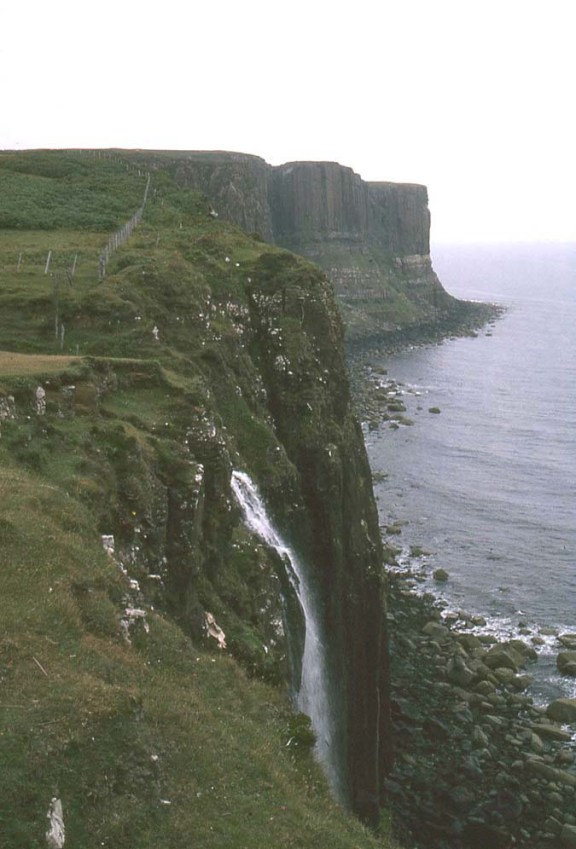
The Kilt Rock does have one very famous “kill” to its credit, so do not underestimate the danger of leaning over a 200 cliff, however picturesque it may seem. A newly married bride came out with her new husband in, I think, the late 1960s, to be photographed at the top of the waterfall. Alas, it was a windy day, and a sudden gust got under the yards of material in her ornate wedding dress and she fell over the cliff to her death.
My last two slides show Scotland in slightly poorer light conditions, as late afternoon turns to early evening. I have no idea whatsoever where either slide was taken, but the first one is very atmospheric…..
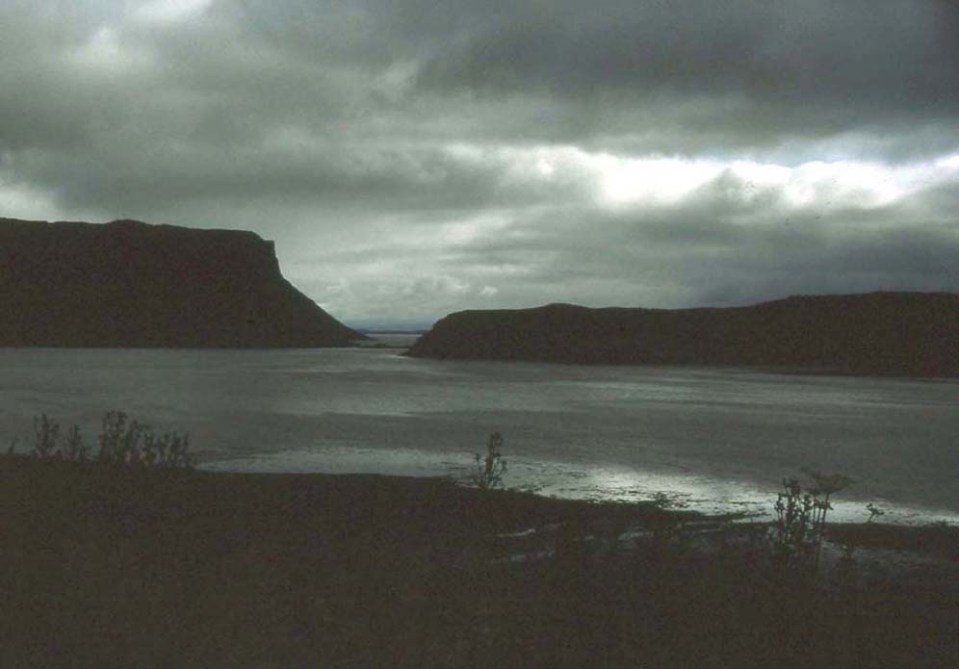
At the time, I am sure that I would have thought that my slide was a complete waste of a shilling, but nowadays, my standards are a lot more thoughtful. I love the way that the viewers’ eyes are led between two shorelines and then we notice that there is even more land half way to the horizon. Beyond the horizon, we can just catch sight of Newfoundland. In the corner, bottom right, there are a few sprigs of vegetation, but are we completely certain that that is what they are? Or do we have a pair of wading birds? Two thirds of the way back from Africa to western Greenland?
And then there is the biggest question of all. Is the slide colour or black and white? Well, look at the top right, where we have the very last, teeny tiny area of the early afternoon’s pale blue.
We finish with the last slide. Some long forgotten sand dune in western Scotland, covered in tough everlasting rye grass of some kind. And it’s the approach of dusk. And the Outer Hebrides cluster on the far horizon.
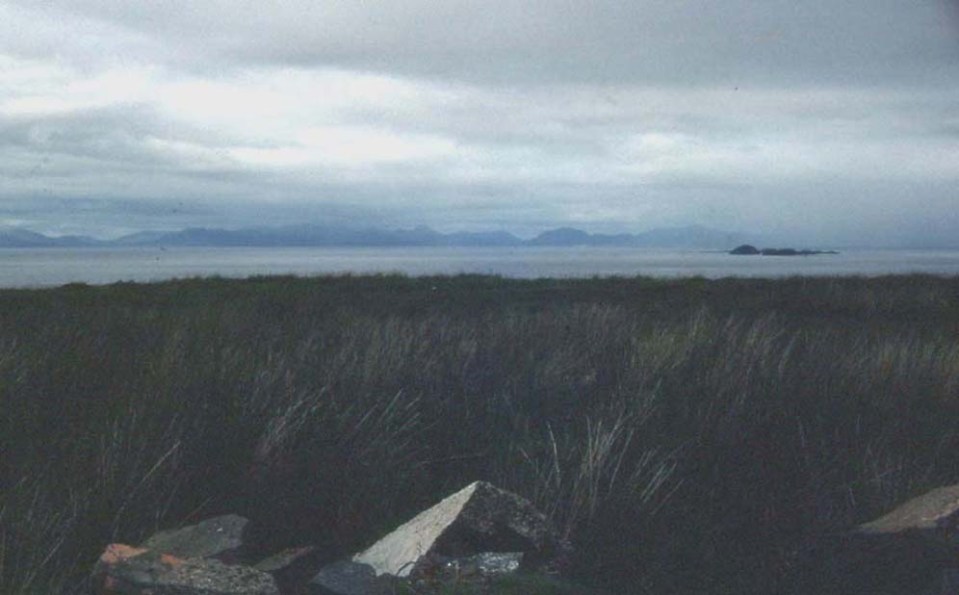
Underfoot, there are smashed up concrete blocks and lumps of carefully cut sandstone. Were they all part of some Second World War radar base? Or was there a village here until it was finally deserted after the ravages of the First World War?


 John Knifton