
Last time we looked at some of the Cold War aircraft in the Newark Air Museum, but there are a good many civil aircraft as well, most of them from this same period.
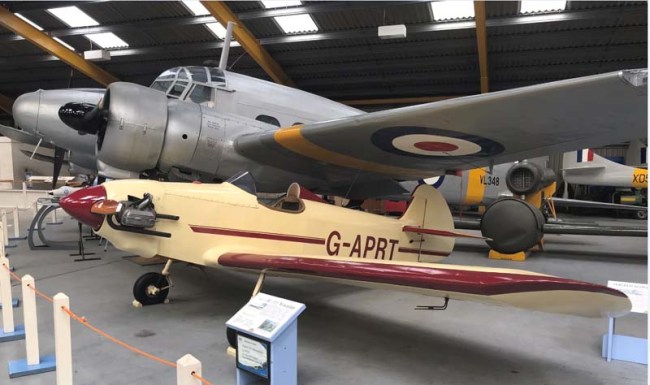
Let’s start with the exception, though, which would be the Avro Anson, even though this normally peace loving multi-engined aircrew trainer was originally designed as a maritime reconnaissance aircraft. In World War Two, the Anson finished up instead as the mainstay of the British Commonwealth Air Training Plan in North America, training pilots, navigators, air gunners and radio operators. Newark’s Anson C.19, though, was used as a light transport and communications aircraft. Top speed : 182 mph. The Anson is the bigger silver aircraft. The custard coloured one is a Taylor JT.1 Monoplane.
The Handley Page Hastings began life as the C1 troop-carrier and freight transport aircraft. The aircraft married a completely new fuselage to the wings which had been designed for the abandoned HP.66 bomber development of the existing Handley Page Halifax. This particular individual, TG517, was used in the Berlin Airlift, and then in meteorological flights and finally in the Cod Wars against the evil Icelanders from 1958-1976 . It had begun its career as a completely ordinary C1 but in 1958 was converted for RAF Bomber Command, acquiring a ventral radome to train V-bomber crews on the Navigation Bombing System (NBS). Top speed : 348 mph

The DH.104 Dove was a short-haul airliner manufactured by de Havilland. The aircraft was the monoplane successor to the pre-war Dragon Rapide biplane and was intended as a short-haul feeder for large airlines and airports. The Dove carried eight passengers and two crew, and overall, it was very popular, sales being in excess of five hundred. Top speed : 210 mph

Now we reach a few nasty foreigners, beginning with the Russkies whose simple plan was to enslave us all. To do that, they might well have used the Mikoyan-Gurevich Mig-27, codenamed “Flogger”. This was a swing wing ground attack fighter based on the basic airframe of the MiG-23, but with a revised nose, hence its Russian nickname of “Platypus”. The “Flogger” was also used by Sri Lanka and later it was licence-produced in India by Hindustan Aeronautics as the Bahadur (“Valiant”). Top speed : 1,171 mph.

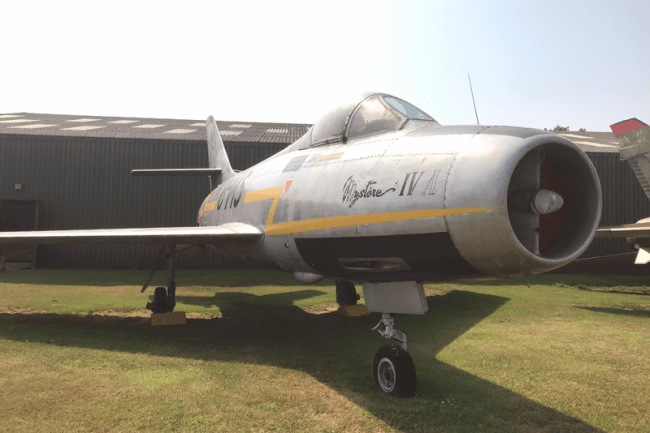
This next aircraft is French. It is a Dassault MD.454 Mystère IV and was used primarily in the 1950s and 60s as a fighter-bomber. It was the first French aircraft to break the sound barrier, and the first transonic aircraft to enter service with the French Air Force. It saw action with both the French and Israeli air forces in the Suez Crisis of 1956 and then again with the Israeli Air Force during the 1967 Six Day War, fighting Mig-17s and Mig-19s.
The Newark Air Museum also has a good many objects connected with the Dambusters’ Raid of May 17th 1943. They have a propeller from the crashed “S-Sugar” of 617 Squadron:

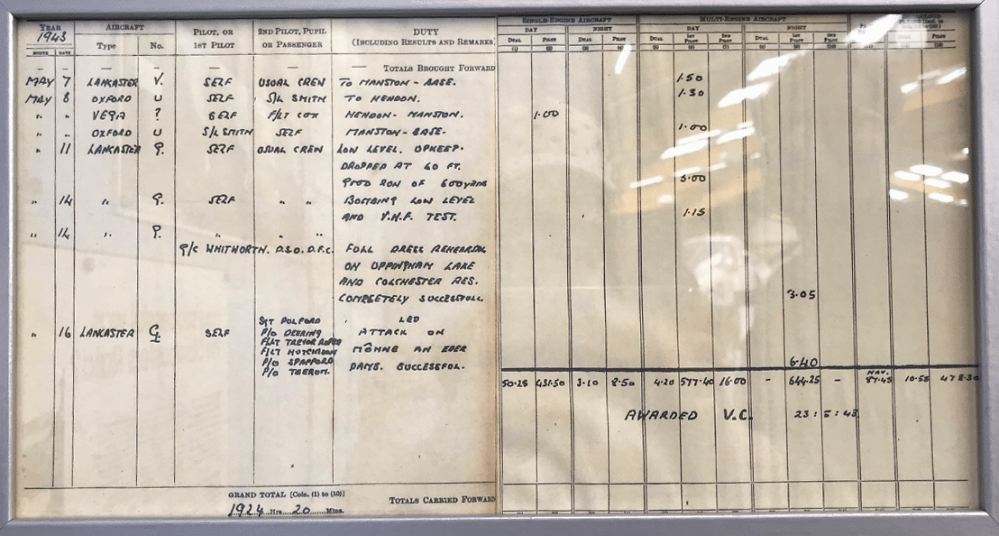
There is the relevant page from the logbook of Guy Gibson:
There is a piece of fuselage from a Lancaster:

And a man inside it demonstrates how many garments he has to wear:

There is a mid-upper turret from a Lancaster:

And finally, you can see the weight and distinctive shape of one of Barnes Wallis’ “Bouncing Bombs”, codenamed “Upkeep”. This particular bomb was built for testing purposes and was recovered from the waters off Reculver in Kent by Andrew Hemsley and the personnel of 101 Field Regiment TA, and 22 and 223 Squadrons.

All photographs courtesy of Lauren Knifton Fainberg







 John Knifton