Tag Archives: DH Lawrence

Brincliffe Grammar School for Girls (3)

There was a strong connection between Brincliffe School and the High School but not, as you might expect, between the boys and the girls. Instead, the connection was a sporting one, and consisted of a number of football matches, all of them played between 1877-1880, when the physical building on Balmoral Road accommodated “Porter & Jones, boys’ school (Tudor House)”.

The High School had played their first match against another school seven years previously. News of the game appeared in the new school magazine, “The Forester”, which introduced a section entitled “Our Chronicle”, which was designed to allow reports about “the sports… of the School.”

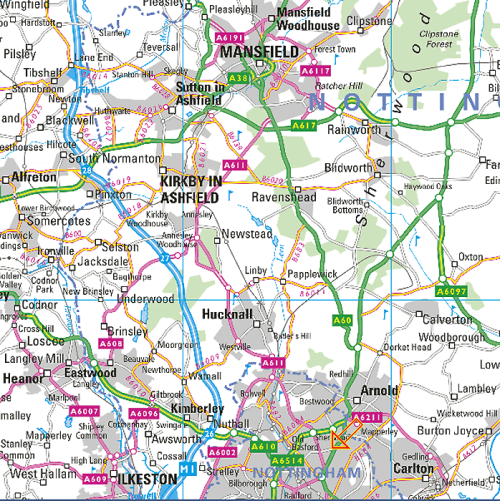
Thus, on November 19th 1870, having travelled to Mansfield, the Nottingham High School First XI played a Mansfield Grammar School XV at football, beating them 3-0. Around 110 years later I took the First XI to Mansfield, not in a steam train, but by minibus, and we played them on a darkish Wednesday afternoon. We lost, although by then they had changed their name to Brunt’s School, now changed again to Brunt’s Academy. The Orange Arrow shows the High School, Mansfield is in the middle of the top edge of the map, and then see if you can find Eastwood, the birthplace of DH Lawrence, ex-pupil at the High School (1898-1901).
History always likes to puzzle us with the fogs of confusion that it loves to create, though. Just as we were digesting the fact that the High School played its first ever football match on November 19th 1870, when the First XI beat a Mansfield Grammar School XV by 3-0, I found that there is a some evidence that organised football was played by the High School even before this.

In just one edition of “The Forester”, there is an allusion to a football game between the High School and a Tudor House School XV on February 27th 1878. Charles Edwin Attenborough, the son of a hosier from Bilbie Street, was unlucky enough to break his leg and dislocate his ankle. It was reported at the time that, with the exception of one broken collar bone in, probably, the 1872-1873 season, this was the the first injury of any consequence “since the new school opened in 1868”.

This intriguing phrase might conceivably be taken to imply that football matches had taken place in that short interim period of just over two years between April 1868 and December 1870, when “The Forester’s” first reports appeared. This is so long after the event, though, that we may never know the exact truth.

Seven years after their first ever game against any other other school, the First XI played Mr Porter and Mr Jones’ “Tudor House” on October 31st 1877, probably on a pitch on the nearby Forest Recreation Ground.  The First XI won 15-0 and “The Forester” recorded that Tudor House did not once get the ball into the High School half, at any point in the game…..

“Goals were obtained as fast as the ball was kicked off.”

Fifteen had been scored “when time was called”.

Four months later, on February 27th 1878, again probably on a pitch on the nearby Forest Recreation Ground, the First XI beat a Tudor House XV by 3-2 (as already mentioned above). During this game, thirteen year old Charles Edwin Attenborough was unlucky enough to break his leg and dislocate his ankle. Despite our modern perceptions of the roughness of Victorian football, “The Forester” reported that, with the exception of one broken collar bone four seasons previously, this was the first injury of any consequence “since the new school opened” in April 1868.

And here it is, a photograph thought to have been taken on April 16th 1868, the school’s first day. The first lesson to be learnt was that more toilets would be needed if queuing was to be avoided:

A week or so after the glorious triumph over 15 boys in the Tudor House XV, on March 6th 1878, on the Forest, the First XI again played a Tudor House XV. and beat this slightly more numerous team by 2-0. These two games were the last two fixtures of the season 1877-1878.

During the following season, Tudor House scored their first ever victory over the High School. On a day misprinted in “The Forester” as October 60th 1878, on the Forest, the reporter said that “This was a very even game, but the fact that Bramwell and four other first team members were absent probably tipped the balance in favour of Tudor House.” They won by 1-0. We don’t know what colours the High School played in. In both these photographs, the colours are black and white. They come from 1897 and 1910, approximately:

This slideshow requires JavaScript.

A year later, on March 12th 1879, at an unknown venue, but probably the Forest , the First XI played out a skilfully planned 0-0 draw with Tudor House. This fixture took place in an extremely high wind, which encouraged the Tudor House players merely to kick the ball out of play as far as possible at every opportunity. “The Forester” lamented….

“….Unfortunately there is no rule which provides for occurrences of this kind, but we should have thought there would have been a better spirit prevailing to prevent such unsatisfactory proceedings.”

When I was in charge of the First XI, around 2000, I employed this tactic and it was extremely effective. Even better is to kick the ball into the road, the busier the road the better. Boys are not allowed to pursue a ball in such circumstances and it has to be the teacher/referee who has to go and fetch it. Invariably, he always takes ages.

Seven months later, on October 15th 1879, and back on the Forest, the two teams met again, and this time the wind had dropped and the game finished 6-1 to the High School. Only five of the regular First Team were in what “The Forester” called the “motley crew” who won this game. Now, Mötley Crüe are an American heavy metal band formed in Los Angeles in 1981. Please don’t confuse them with the Victorian footballers. It’s easily done:

Being sensible, and playing Tudor House with a weakened team which lacked many of the regular First XI players didn’t last long, though. The very last fixture ever against Tudor House came on February 11th 1880. Again at an unknown venue, the High School triumphed. The score was recorded as

Nottingham High School “at least 12” Tudor House 0

“The Forester” wrote that

“the difficulty in this game was “not to get goals”, so weak were the opposition. Goal followed goal in quick succession, so that it was rather hard to keep a correct account. It was certainly not less than 12 goals, and may have been more.”

I once coached the Second Team in such a match. It finished 13-0 (referee). 14-0 (me) or 15-0 (several of the players). We lost, of course.

We once lost to another school team who had a nine-year old girl in goal. Their member of staff asked me if it was OK for her to play and I agreed, not knowing that she was Spider Woman in her spare time. We lost 3-2.

STOP PRESS

Elsewhere I have spoken about how, in the attic, I stumbled upon the box containing all of my slides from the 1970s and early 1980s.

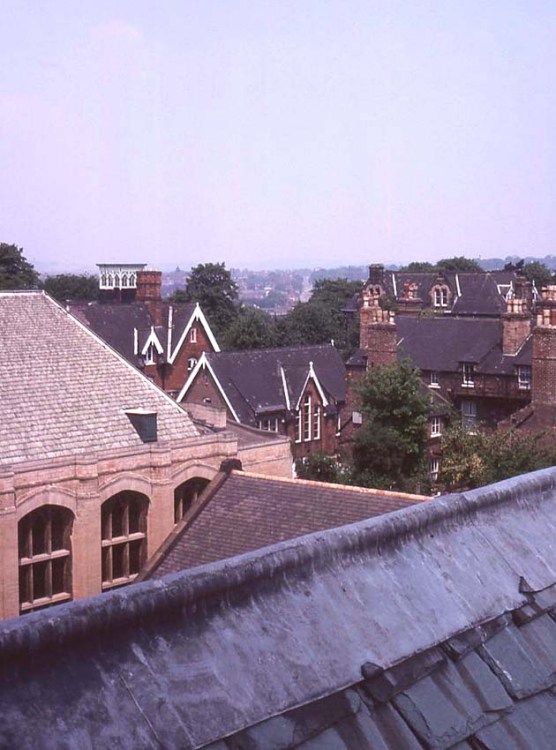
The photograph below I took around 1976. It was taken from the corridor which ran down towards the then E13, and you can see the roof of the Old Gymnasium and the Assembly Hall, sometimes called the Player Hall. Directly behind that are the two buildings of Brincliffe. To help you identify them, they both have gables picked out in bright white……..
15 Comments

Filed under Football, History, Humour, Nottingham, Politics, The High School

Stories about my Dad (2)

In 1946, my Dad, Fred,  left the Brylcreem Boys of the RAF and Bomber Command, and signed up to be trained as a teacher. He finished up getting a job quite near to his home in Hartshorne Road, Woodville. It was at the school in Hastings Road in Church Gresley. He taught there until the mid-1950s. In the 1990s, when I used to go and watch the local football/soccer team, Gresley Rovers, I met one or two of his erstwhile pupils who all remembered him, as a very strict teacher who brooked no nonsense. That might well have been because the teenage sons of coalminers at Hastings Road would have been a tough proposition to keep under control in classes of more than forty, especially for a first time teacher. I can quite well imagine that Fred would have had to employ what DH Lawrence, faced also with teaching the teenage sons of coalminers, called “three years’ savage teaching of collier lads”.

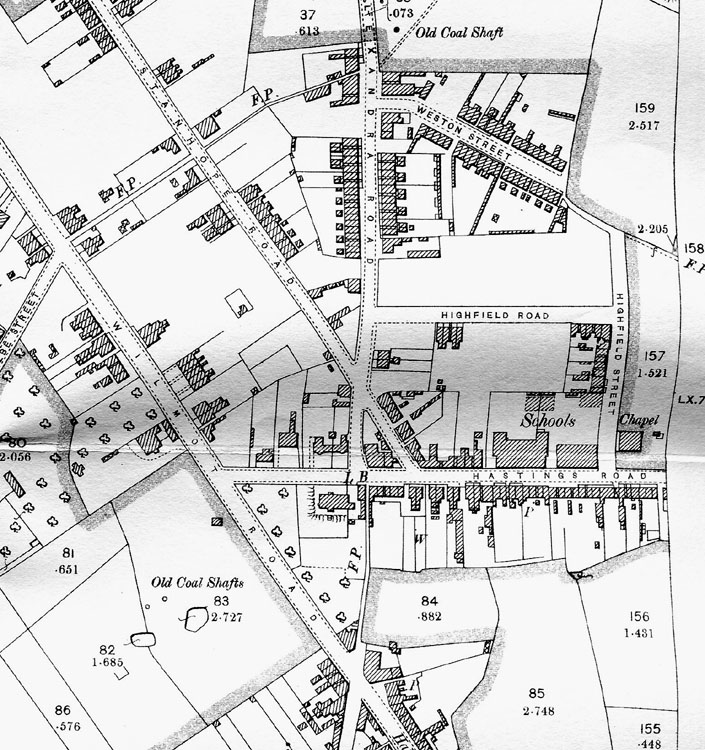
Here’s Hastings Road School. I have used one of the reprinted Victorian maps of England sold by Alan Godfrey . Hastings Road is in the middle of the eastern edge:

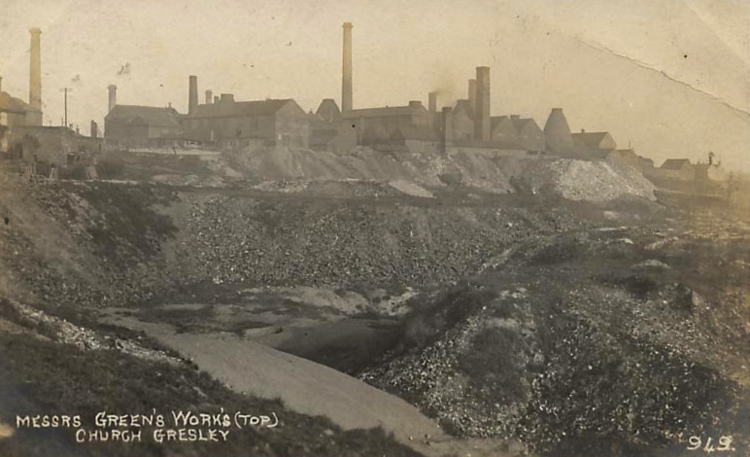
Notice how many “Old coal shafts” there are, even in this small area. Just after the war, there were up to 17 coal mines active in the area, as well as numerous vast open cast clay mines. Just try to imagine how small a human figure would be on this postcard, if those are full sized factory buildings in the background. Open cast clay mines were really gigantic…….

All of these activities, of course, left the entire area prey to subsidence. I found a very short article about this particular area on the internet. It said that

“…….the subsidence here was so severe the town’s plight became a national embarrassment. Schools, libraries and even entire streets were either propped up or knocked down as the town sank at an alarming rate.”

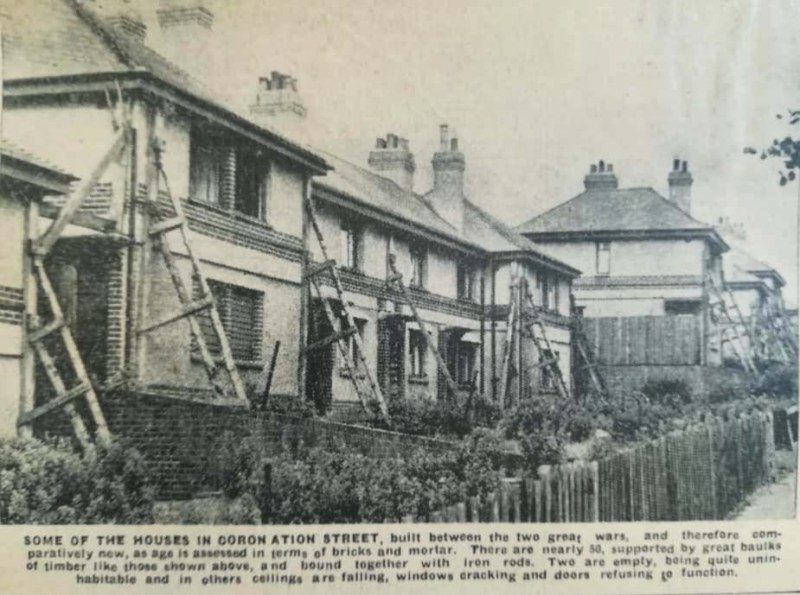
As a little boy in the late 1950s, we often used to drive up to Church Gresley to see the houses which had been damaged by the subsidence, which was produced by a 150-odd years of intensive coal mining. These houses were easily recognisable, being  propped up with huge beams of wood or extra long railway sleepers. Here are some of the less serious supports in a picture from a 1949 newspaper. I can remember enormously thick beams of wood when I saw them in the late 1950s. The houses must have been in an even worse state by then. Most of them had, in fact, been evacuated.:

The caption reads:

“SOME OF THE HOUSES IN CORONATION STREET” Built between the two great wars, and therefore comparatively new, as age is assessed in terms of bricks and mortar. There are nearly 50, supported by great baulks of timber, like those shown above and bound together with iron rods. Two are empty, being quite uninhabitable, and in others ceilings are falling, windows cracking and doors refusing to function.”

If the the houses were built in a coronation year, “between the two great wars” they can only date from 1936 and were thus only thirteen years old at  the time of the newpaper photograph. There is a very short video available.  The title refers to “Swadlincote” which is the name of the local area:

Thirty, forty years after my Dad had left Hastings Road School. I went to Hastings Road to take some photographs of the school. Alas, the buildings were no longer there, and had clearly fallen victim to the subsidence that I knew had claimed so many local houses. I began to investigate but I couldn’t find anybody who knew for certain the true detailed story of the demise of Hastings Road  School. Perhaps one day, the beams arrived, and the next day, before they could be put into position, the whole school fell down. That must have cheered up all those “collier lads”. Here’s the school today. Today’s pavement would have been directly in front of the school’s front wall:

21 Comments

Filed under Bomber Command, History, my Dad, Personal, Science

The Carvings in the Tower (1)

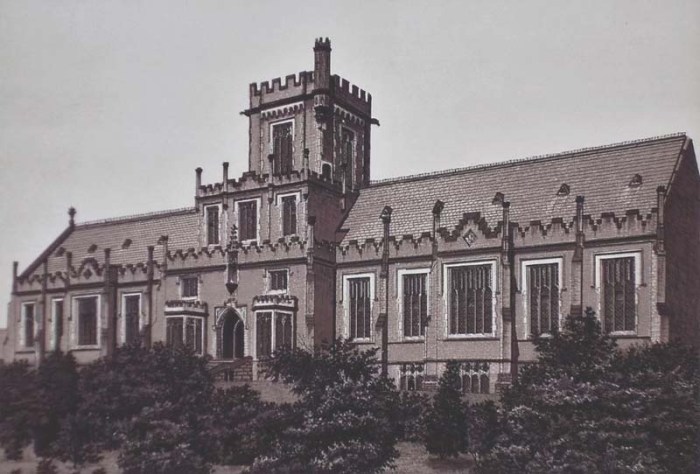
Nottingham High School has a very obvious high and splendidly Gothic tower, complete with a tiny turret. It totally dominates the skyline of the city. The tower was even mentioned by DH Lawrence in his first novel, “The White Peacock” as “the square tower of my old school.” A brand new flagpole was erected on the top to celebrate the Jubilee of Queen Victoria on Tuesday, June 21st 1887.

This tower has always been accessible to the boys, one way or another. For years, it played host to the deliberations of the School Prefects, and the beatings they inflicted. In May 1940, with England expecting to be invaded at any moment, the senior members of the OTC (Officers Training Corps) climbed up there and carved their names and their message to the future on a stone window sill. They are still there today, eighty odd years later:

“The following were members of the anti-parachutist squad May 20-21,1940 (being first to do so) RA Palmer, JS Gibson, DJ Furley, RM Gunther, RB Holroyd, RV Milnes, R Mellor, JMT Saunders”.

But who were these young men, and what happened to them during their lives? After all, they must are all be dead today. But, sadly, not every one of them even made it through to the end of the war.

Richard Vernon Milnes was born on March 29th 1923. His father, William Vernon Milnes, died when Richard was quite young. His wife, Florence Annie Milnes became the bread winner, working as a school teacher, one occupation which was more open to women than most at this time. The family were living at 8 Langar Close, in the triangle between Mansfield Road and Valley Road:

Richard entered the High School on September 20th 1934 as Boy No 5855. He was only eleven years of age and he was a Sir Thomas White Entrance Scholar. He went into Cooper’s House and Third Form A with Mr Gregg as his Form Master. There were 29 boys in the Form and Richard finished the year in second position.

Richard then moved into the Upper Fourth Form A with Mr Bridge.Here he is, in the darker blazer, looking fairly angry, as he often did:

(back row)  “Beaky” Bridge, “Wappy” Parsons, Reg Simpson, the future Test cricketer,  Arthur Mellows, the future paratrooper, killed in “Operation Plunder”, the crossing of the Rhine into Germany, 1945. (front row) Bruce “Farmer” Richardson, killed while defending the perimeter of Dunkirk so others could get onto the boats, 1940. John Louis Pilsworth, Prefect, and Eric James Dickenson, Captain of Cricket and of Rugby.

There were 29 in the Upper Fourth Form A and Richard was one of the four boys who were “not placed” in the end of the year examinations, absent, I would presume, for reasons of illness. Only six boys joined the Officers Training Corps that year but Richard was not one of them. During this year Richard wrote a poem which was published in the School Magazine. It was entitled “Winter”, and it was a lovely little poem for a boy of thirteen:

Winter

The wind goes whistling round the eaves,

Scattering far and wide the leaves.

The leafless oak-tree creaks and heaves.

Winter is here.

Clammy fog is swirling drearily,

Ghostly buildings looking eerily,

Cars are crawling, hooting, wearily.

Winter is here.

The snow is falling, smooth and white,

Covering the earth with a canopy bright,

Luminous in the pale moonlight.

Yes, winter is here.

During the following year of 1936-1937, Richard was with “Fishy” Roche in Lower Fifth Form A. The Form contained 31 boys of whom sixteen, including now Richard, were in the Officers Training Corps.

More about Richard next time.


16 Comments

Filed under cricket, History, military, Nottingham, The High School, Writing