
Having started my researches abou the Brincliffe Grammar School for Girls on Balmoral Road, I could not resist trying to find out more, and more, and more……..
Using my very sad collection of Kelly’s Directories of Nottingham, I was able to trace just a little bit of history, not so much for the Brincliffe School, but for the site where it would eventually be situated.
And so, in 1876, (the year of Custer’s Last Stand), on the corner of Balmoral Road and Forest Road, on the western side, was “Porter & Jones, boys’ school (Tudor House)”. In other words, the same building which would, one day in 1907, house Brincliffe Grammar School for Girls, had been, thirty years earlier, a private school run for profit, inside what had originally been a private house. The two partners in the business were Messrs Porter & Jones, and they had given the school the name of “Tudor House”.
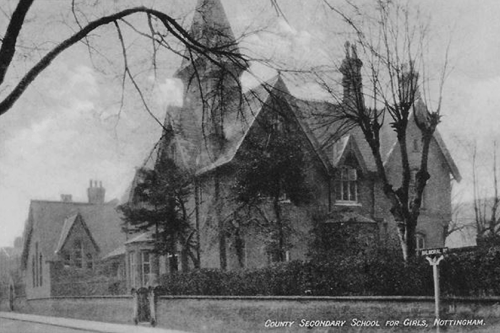
Three years later, in 1879, the entry reveals that Tudor House had become a boarding and day school and that, of the original partnership of Porter & Jones, Mr Gregory Porter seemed to be the Head Honcho.
In 1881, the house, now apparently the property of Mr Gregory Porter alone, was now No 25 Balmoral Road. No 23 is still standing, the house immediately to the left of the main entrance to the High School staff car park. In 1885, the situation was exactly the same. Tudor House, and Gregory Porter, were still in business. Here’s Nos 19, 21 and 23 today, complete with original Victorian sandstone wall:
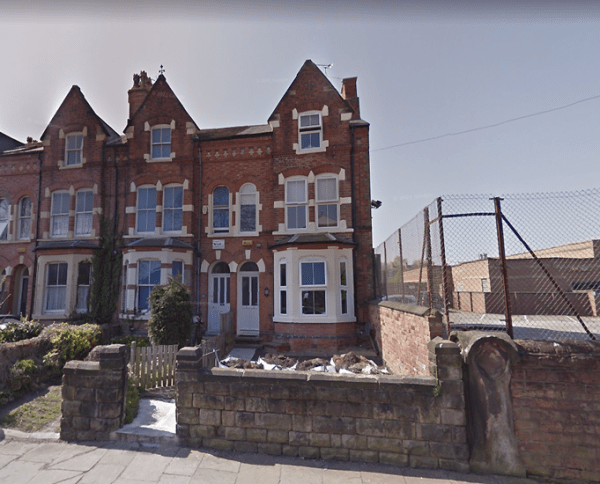
Alas, by 1891, Tudor House was no more, and the school became “a ladies’ school” for ladies. under its Headmistress, Miss Blanche Hall.
By 1894-1895, the Misses B. & K. Hall were running a boarding and day school at No 25. The house was now called “Brincliffe”. Why they had chosen this name, I do not know. Presumably, it refers to the “brink” or edge of a “cliff”, a reference perhaps to the small area of steeply sloping ground to the northwest of the Church Cemetery, overlooking the much flatter and much lower, Forest Recreation Ground.
Here is that “brink of a cliff”:

The slope is actually quite steep and, while not a cliff, it would have seemed a lot more precipitous 140 years ago because there were no trees then. The trees are quite young for trees, only around 80-100 years old. Here is a view inside the trees on a very familiar path down from the High School (and Brincliffe) :

The slope is certainly steep enough to sunbathe on. Here is a lovely Sunday afternoon with people in their Sunday best, relaxing around the long gone bandstand. See if you can solve “Where’s Walter?” and can you spot Robin Hood?
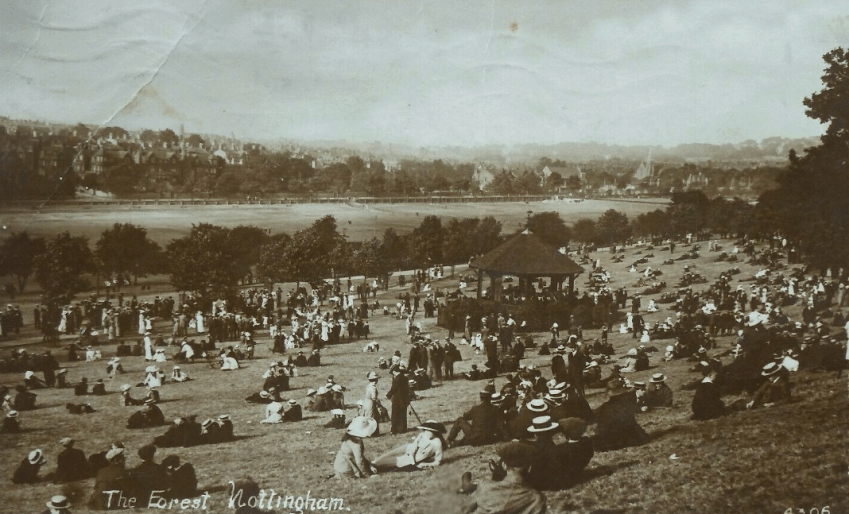
And here is the much lower flat area, which has always hosted any number of football/soccer pitches. In 1865, they had seen the birth of Nottingham Forest, nicknamed at the time, the “Garibaldi Reds”:

So, by 1894-1895, the Misses B. & K. Hall were running a boarding and day school at No 25. It was called “Brincliffe”. And now you know why!
By 1898-1899, “Brincliffe” had been acquired by the Misses Koppel & Hall. It was still No 25. In 1904, Miss Amy Koppel was running the boarding & day school on her own, the premises still with the same name and number.
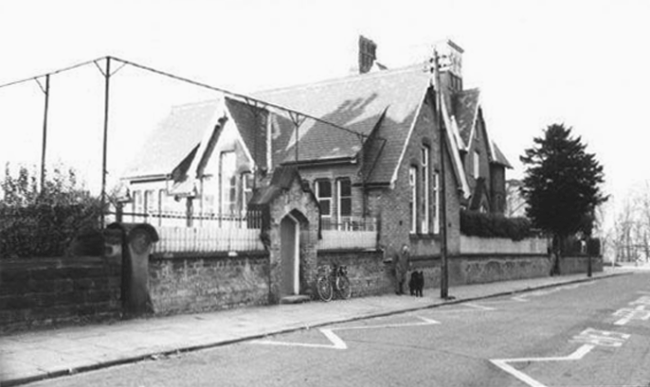
In 1907, the City Council made it a Girls’ Grammar School, but from 1913 onwards it is listed as just “Notts County Secondary School, Miss Sybil Randall, head-mistress”
I have not been able to find any pictures of the girls in their green blazers and Green Berets, “à la John Wayne”. That crumpled, baggy 1950s blazer is still the only thing I’ve found:

One final detail.
The very first mention of a school on the Brincliffe site was “Porter & Jones, boys’ school (Tudor House)”. We know this already, but one thing I did find was that in 1862, a Miss Sarah Porter was running a “school” on distant Woodborough Road. In 1864 she was named as Miss Sophia Elizabeth Porter, presumably the same person (or perhaps sisters), still in an un-numbered location on Woodborough Road. Unfortunately I have no directories available for the period 1864-1876.




 John Knifton