Tag Archives: Junkers Ju 88

The Murder of Leslie Howard (3)

Last time we were looking at how the airliner in which Leslie Howard, the film star, was returning to England, was shot down in the Bay of Biscay by the German Luftwaffe, resulting in the deaths of every single person on board, including the children. Here is some of Leslie Howard’s best work, taken from the now controversial “Gone with the Wind” :


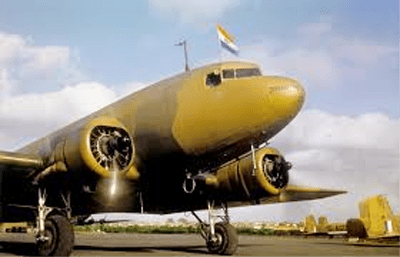
Since that first day of June 1943, there have been literally scores of theories put forward as to why Leslie Howard and the rest of the civilian passengers and crew of the DC-3 “Ibis” were all murdered in this callous fashion. Shot down into the waters of the cold Atlantic Ocean, while travelling to England in an aircraft which was unarmed and the property of a neutral country, namely the Netherlands. And this attack was clearly directed at somebody, because the attackers were eight Junkers Heavy Fighters, armed to the teeth and clearly, sent specifically to destroy this inoffensive DC-3 Dakota.
Leslie Howard’s business manager, Alfred Chenhalls was a fat, bald man who loved to smoke cigars and who occasionally drank alcohol in sensible quantities. It was extremely easy to mistake him for Winston Churchill. What do you think ? Did a German spy see Chenhalls get on the plane and immediatelyt telephone the German Embassy in Lisbon?

Which one is this?  Churchill or Chenhalls?
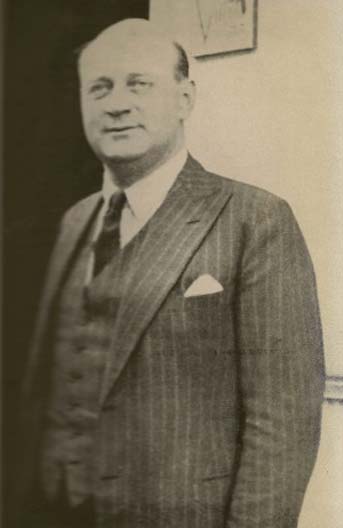
And is this the Prime Minister or a party going bon viveur, who liked nothing better than drinking the very best whisky in large quantities?

“Two bottles for each of us, barman !!! “
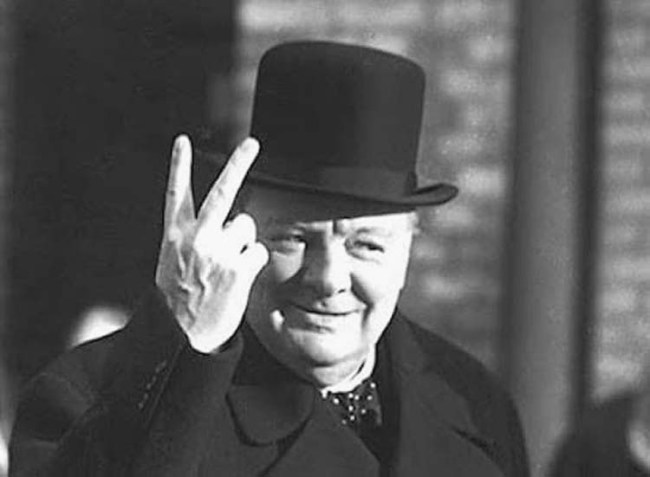
As we have seen elsewhere, Leslie Howard was not an English landowning gentleman, but a Hungarian Jew. He supposedly resembled Churchill’s bodyguard, Detective Inspector Walter Thompson. Similarly, Detective Inspector Thompson had the air of an archetypal English gentleman, self assured, self confident, upper class and, most of all, slim. Here’s Leslie Howard:
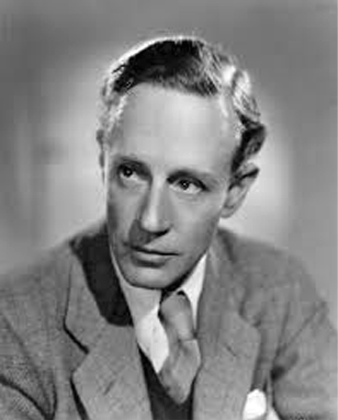
And here’s Walter Thompson, on the right:

There are other theories, of course.

How valid is the theory, though, that Leslie Howard was supposedly the virtual double of Sir Anthony Eden, England’s Foreign Secretary at the time? Here’s Eden at the age of around twenty, as a student at Oxford University……….
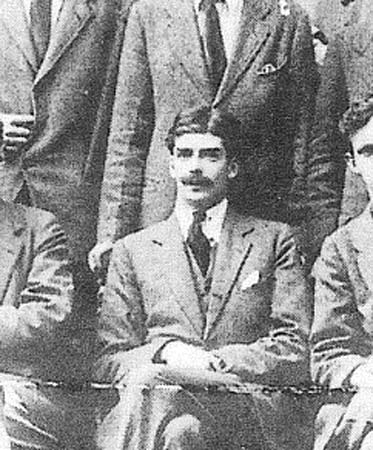
There is though, a bit of a giveaway which is tremendously helpful in any “Pick-out-Anthony-Eden” competition. The real Anthony Eden, for his entire adult life, had that stonking great moustache which he fixed into his nostrils at seven o’clock every morning and then didn’t take off until midnight.

And what about the idea, quite widespread at the time apparently, that the Germans thought that Leslie Howard and Reginald Mitchell, designer of the legendary Spitfire, were one and the same man? Leslie Howard we have already seen, and here’s the designer of what began its life as the Supermarine Shrew :

In my mind, the best fit is “Churchill and Thompson v Howard and Chenhalls”.  And we must not forget that the only images of Churchill or Leslie Howard seen by most of the attendees of the Dakota’s take-off from London would have been either crudely printed photographs from newspapers or perhaps slightly better quality pictures from magazines. Moving pictures would have been from Howard’s films, or for Churchill , the two minute Pathé News films shown in cinemas during the interval. In other words, confusion was a great deal easier in 1943 than it was in 2023.

It was by no means a completely ridiculous idea, therefore, to suggest that “Churchill–Chenhalls” was on that plane from Lisbon. And for the Germans, it was well worth organising an attempt to shoot down the plane, even if the Prime Minister was supposedly at an important conference in Algiers.

How easy it would have been to alert Berlin, who could then have contacted the fighter base, probably at Mérignac near Bordeaux in southern France, and then telling those eight Junkers Ju88C-6 heavy fighters to take off and intercept the DC-3. Such attacks were in actual fact very rare in the Bay of Biscay, so this particular Luftwaffe operation must surely have been for a specific reason, and for a specific and important target.

And now a whole second level of conspiracy theories swings into action. Perhaps British Intelligence invented the entire story of Churchill’s being on board “Ibis” that day, so that he could fly back home to England in his own private aeroplane, an Avro York. Here’s an excellent short film giving you all the relevant facts about the Avro York, which was basically a different fuselage, set on a pair of Lancaster wings:


There were plenty of people who believed this story that British Intelligence had told the Germans that Churchill was returning to England in the DC-3 that particular day, and that he would be refuelling near Lisbon. In this way, his Avro York would be able to return to London in peace, even if the Dakota finished up in pieces.

And so it goes on, round and round in ever decreasing circles with very little beyond well informed guesswork and random supposition. These are certainly very far from being guaranteed truths.

In 1943, the earliest rumours to surface were that “bon viveur” Alfred Chenhalls had actually been mistaken for Churchill by German agents as he walked out to the plane in Lisbon. Furthermore, this explanation is known to have been the one favoured by Churchill himself. At the same time, though, Churchill was certainly puzzled as to how German intelligence could possibly believe that he, with all the resources of the British Empire’s armed forces and those of the United States at his fingertips, should be reduced to travelling in an unarmed, relatively slow and vulnerable commercial airliner.

24 Comments

Filed under Aviation, Film & TV, History, military

Roy Cross, the world’s greatest artist

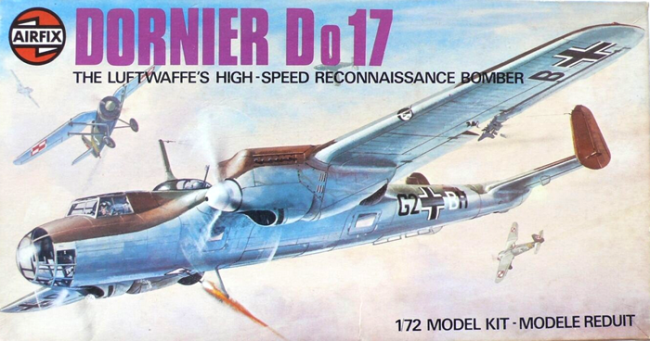
As a small boy of nine or ten, I was very keen on Airfix plastic kits. They came originally in see-through plastic bags with a folded piece of paper stapled over the open end of the bag. The instructions for making the kit were inside the folded paper.

The smallest Series 1 kits were one shilling and threepence, or perhaps one shilling and sixpence. Series Two were three shillings and Series Three were four shillings and sixpence. Series Four cost six shillings and Series Five seven shillings and sixpence. Series Six, of which for many years there was only one, the Short Sunderland, was twelve shillings and sixpence. At this time I used to get around two or three shillings pocket money per week. As life grew more sophisticated, Airfix decided to put most of their kits into boxes and to decorate them with illustrations of that particular aircraft in action. The absolute toppermost of the poppermost of the Airfix artists was a man called Roy Cross (born 1924). Let’s take a look at his talents as an artist.

After initially helping illustrate Eagle comic  Roy moved to Airfix in 1964 and started his career with the Dornier Do 217. Here is the box art:

Notice how he makes the Dornier’s opponents the Polish Air Force, something out of the ordinary. Below is the original drawing. Both illustrations featured on an auction website, where Roy’s first ever aircraft sketch was on sale for £790.

Let’s take a look at some more of Roy’s best work. Here’s a Series 1 Spitfire, with the plastic bag still in place and the model unmade.

Series 2 included the de Havilland Mosquito, the Fairey Battle and the Bristol Blenheim. This one is flown by the Free French Air Force. Roy’s work never seems to drop in standard:

This slideshow requires JavaScript.

A Series 3 kit might have been the Junkers Ju-88 and Heinkel III. A bigger box allowed him to make his pictures more and more complex. Notice again how he makes the Heinkel’s opponents somebody out of the ordinary, in this case the Soviet Red Air Force:

This slideshow requires JavaScript.

In Series 4 was the Vickers Wellington:

The mighty Avro Lancaster was in Series 5, as was the B-17 Flying Fortress. Notice how the very large box has enabled him to portray accurately the huge wingspan of both aircraft:

This slideshow requires JavaScript.

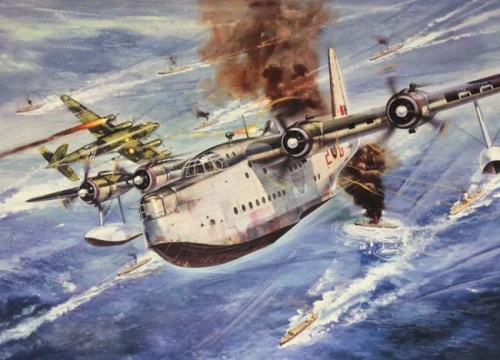
Here’s the Short Sunderland:

The Boeing B-29 Superfortress was of such a size that it probably was in Series 29. This box is big enough to portray a defensive “box” of B-29s, and a Japanese fighter:

I was not very good at making the kits, as I would be the first to confess. With biplanes such as the Roland Walfisch of World War I or the Handley Page HP 42, the 1930s airliner, I was hopeless at gluing the top wing to the bottom one and soon there were gluey fingerprints all over the place:

This slideshow requires JavaScript.

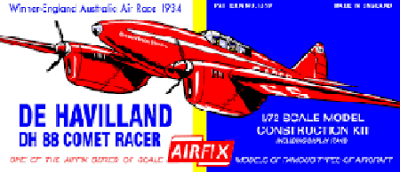
Quite a rare kit in my experience was the de Havilland DH.88 which won the race from England to Australia in 1934 with an official time of 70 hours 54 minutes 18 seconds. The raw plastic for it was bright red. I am not wholly sure if Roy Cross did this artwork. The kit may have appeared pre-1964:

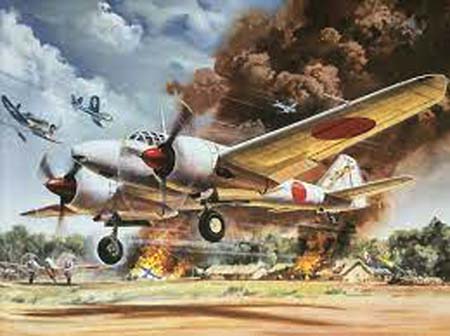
There are some kits that I would like to have made but never did.  There was the Mitsubishi “Dinah” which was reckoned to be the most aerodynamically perfect aircraft of World War II. This is one of Roy’s very best pieces of work in my opinion:

The Spitfires defending Darwin in the Northern Territory of Australia certainly couldn’t catch the Dinahs that flew high above them day after day.

The second kit I yearned for was the Angel Interceptor used in the TV series “Captain Scarlet”. That too, was a fairly rare kit during my modelling years:

I can’t bring this post to an end without showing you the last few masterpieces by Roy Cross. They are the B-25 Mitchell, with a choice of either a glazed or a solid nose:

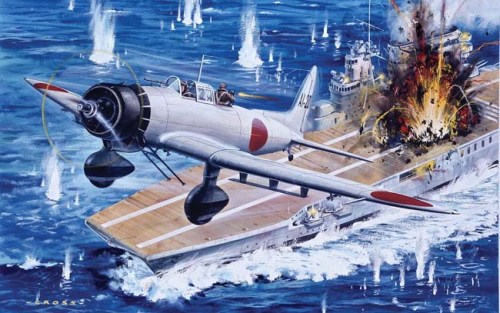
Here’s the Aichi “Val”, looking for all the world like a Stuka that’s put on a lot of weight:

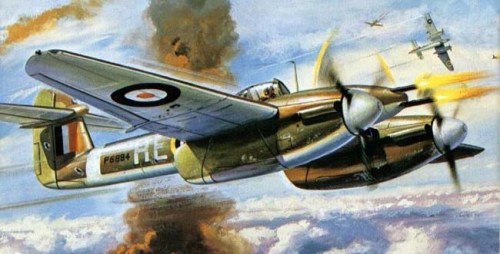
The Westland Whirlwind was a very advanced concept for 1938. It was one of the fastest combat aircraft in the world and with four Hispano-Suiza HS.404 20 mm autocannon in its nose, the most heavily armed. Prolonged problems with the Peregrine engines delayed everything and few Whirlwinds were built……only 116 in actual fact:

And let’s not forget the Blohm und Voss Bv 141 reconnaissance aircraft, one of the few aeroplanes ever to have had an asymmetrical structure. And yes, it flew very well, but was never produced in numbers because of the shortage of the engines of choice.

One last detail I found out about Roy Cross. He was apparently highly amused by the modern practice of taking his artwork, but photoshopping out any explosions and burning aircraft in case they upset anybody and reminded them what most of these aircraft were designed to do.

If you want to see more of Roy Cross’ art, then, please, use google images to sort out some pictures of other aircraft whose boxes he decorated. Roy may not be a famous artist, but his images of planes are irrevocably etched for ever in the memories of so many men of my age.

28 Comments

Filed under Aviation, Bomber Command, History, Humour, military, Pacific Theatre, Personal, the Japanese

The Battle of Britain (2)

Deep in the bowels of the RAF Museum at Hendon is the Battle of Britain section where the lighting is of a strange purple colour so that delicate ancient paint is not faded by direct sunlight. That’s an extra excuse for these rather weird photographs. First of all, the baddies, with that old favourite, the Junkers Ju 87 Stuka, an aircraft used in the blitzkrieg to dive bomb defenceless refugees:

This slideshow requires JavaScript.

Here’s a Heinkel He111 which was all right as a bomber but which didn’t carry a particularly significant bomb load. Even so, it performed well at Guernica, Rotterdam, London, Warsaw and half a hundred other places as the Germans invented the much criticised concept of “area bombing”.

This slideshow requires JavaScript.

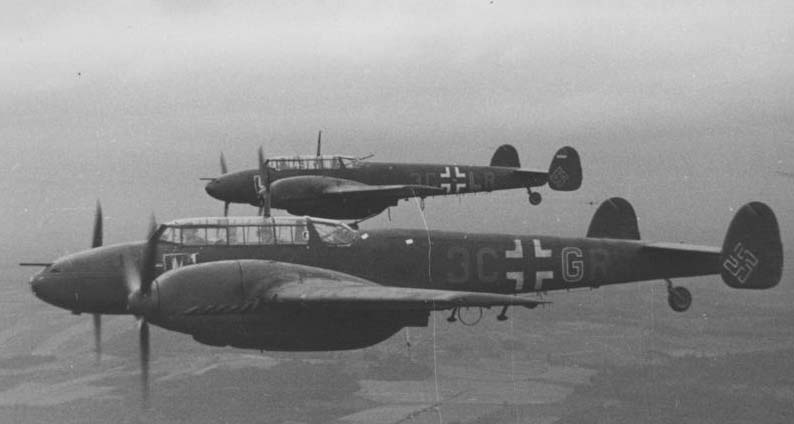
The fighters were the Messerschmitt Bf110, a rather slow aircraft for daylight use which would eventually finish up having to be escorted by better performing fighters:

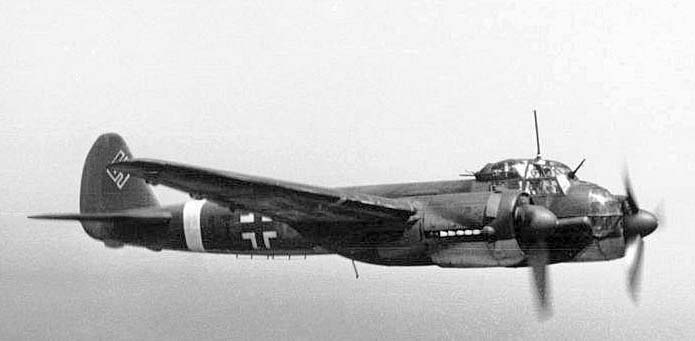
This is the Junkers Ju 88, a twin engined and very versatile aircraft which was arguably, a competent Bristol Blenheim or a poor man’s De Havilland Mosquito:

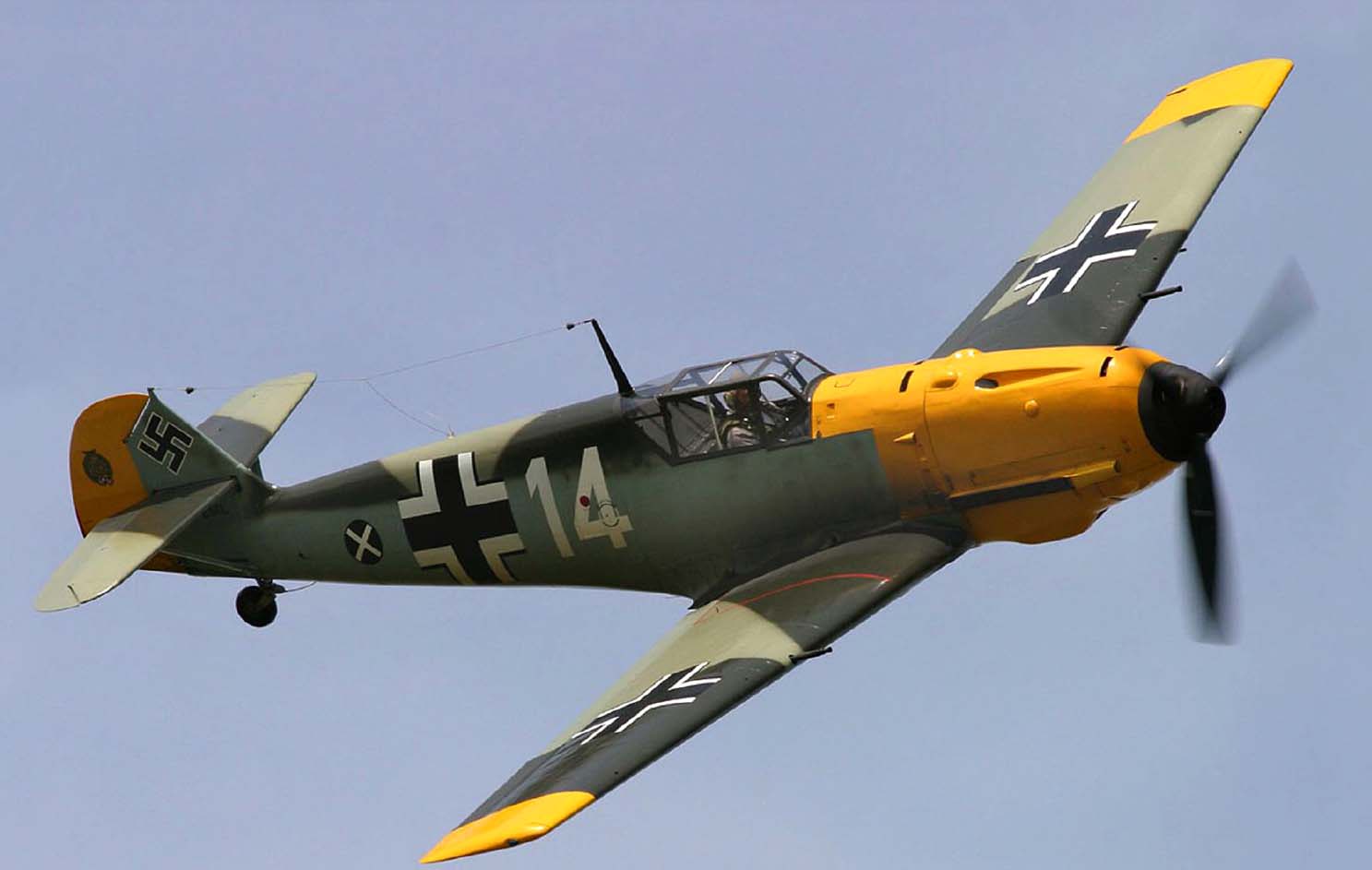
Last and certainly not least is the famous Messerschmitt Bf 109, a decent fighter, but an aging design which was prepared in response to a Reichsluftfahrtministerium specification of 1933. Bf 109s couldn’t carry enough fuel to fight for very long over Southern England. And a Spitfire, in theory, could always escape them by turning tightly inside them:

This slideshow requires JavaScript.

The Bf 109 at Hendon does not really allow you to stand back and get a decent general photograph. Here is one I found on the Internet. It certainly is a stunning photograph:

The Hendon individual is a Bf 109E-3 and it may have been painted as a yellow nosed member of Jagdgeschwader JG26, “The Abbeville Boys”. There must have been a little plaque in front of it, but I can’t remember what it said. Its detailed history can be accessed here.

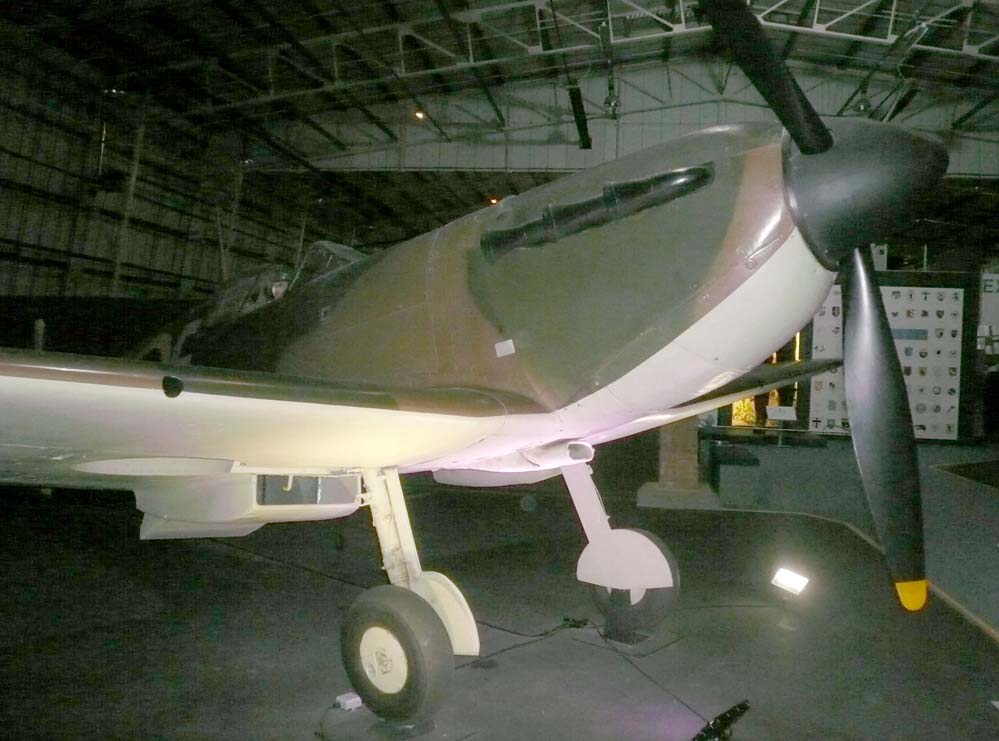
And in the blue corner…….the Supermarine Spitfire. Here’s my effort at a picture:

As one writer said,

“It was one of the most beautiful aircraft ever conceived with elegant, flowing lines that make it look perfect from every angle.”

And the most stunning Spitfire ever was the Mark I or Ia or the Mark IIa.

This gallery of photographs comes from the Internet. With a little bit of luck, you should be able to see what I mean about a beautiful aircraft:

This slideshow requires JavaScript.

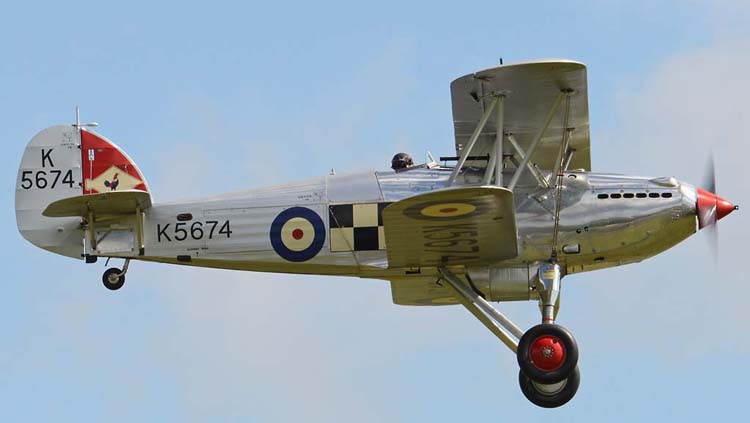
And there’s also a Hawker Hurricane, an aircraft which, as we all know, shot down more German aircraft in the Battle of Britain than the Spitfire. The scores were roughly 60% to 40%. The Hurricane was a design which looked backwards to its biplane ancestors, especially the Hawker Fury:

On the plus side the Hurricane was a lot easier to repair than its cooler cousin, the Spitfire. It was easier to make as well, 10,300 man hours rather than 15,200 for the Spitfire. And easier to make meant cheaper, of course. Here are my unworthy efforts:

This slideshow requires JavaScript.

And now some proper photographs:

This slideshow requires JavaScript.

And next time, the Old Nottinghamians make an appearance.


35 Comments

Filed under Aviation, History, Humour, Politics, The High School