Last time we finished with Mr Pat Collins’ “Giant Nottingham Geese, All Alive and Kicking” but some surprisingly exotic, and indeed, unusual, animals made their appearance at Goose Fair.
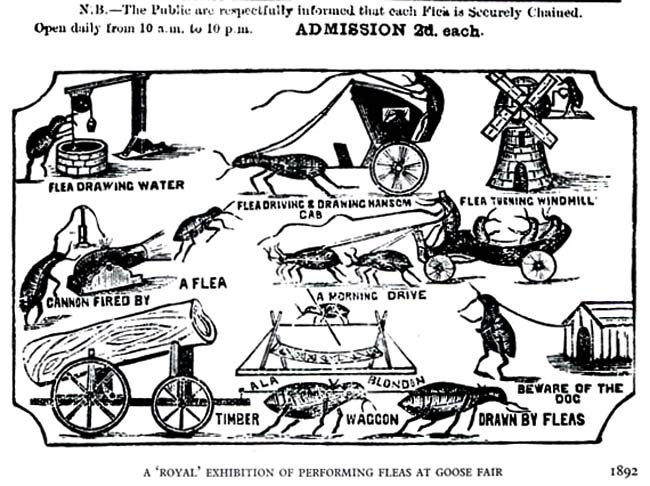
Smallest of them all were the performing fleas:
Look at what they could do:
And don’t worry:
“Each flea is Securely Chained”
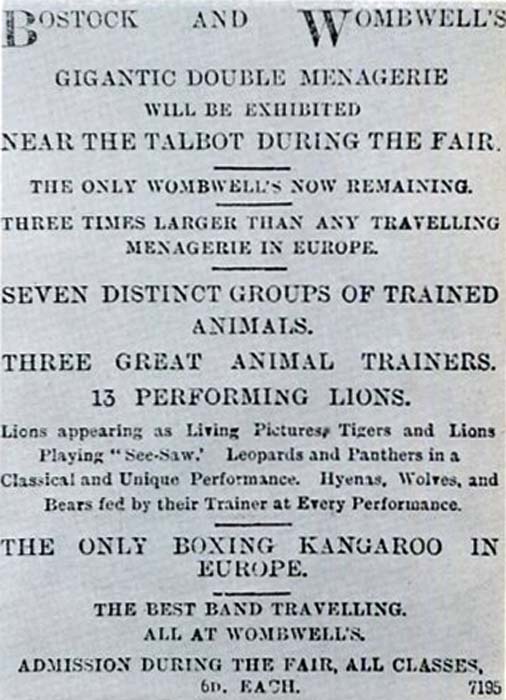
In 1899, for their last visit to Goose Fair, Bostock & Wombwell produced a special poster, which listed all of their animals.
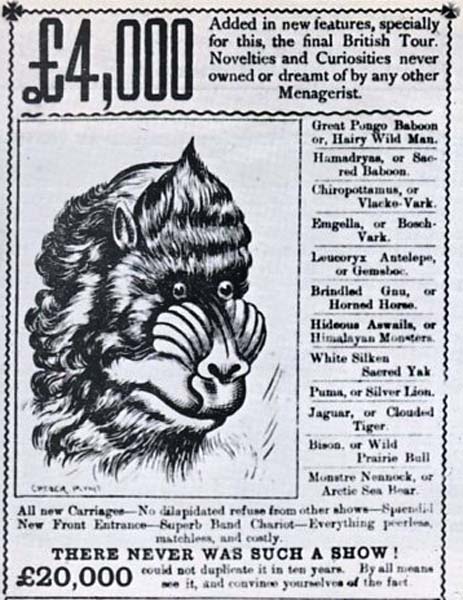
Their rivals, of course, boasted about their own animals which included “Novelties never owned or dreamt of by any other Menagerist.” There was the “Great Pongo Baboon”, the “Hamadryas, or Sacred Baboon”, the “Leucoryx Antelope or Gemsboc”, a “Brindled Gnu, or Horned Horse”, a “White Silken Sacred Yak”, a “Puma”, “Jaguar”, a “Bison, or Wild Prairie Bull” and the “Monstre Nennock”.
Here we are:
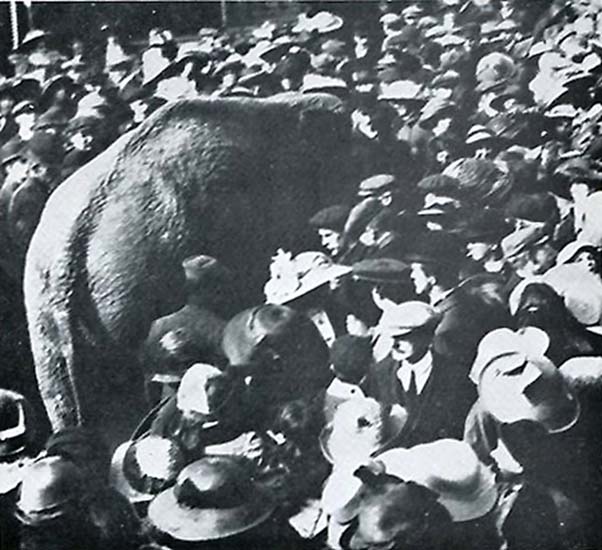
There was also a huge elephant christened “The Mighty Mastodon”. We still have photographs of him apparently pushing and shoving his way through the Goose Fair crowds, apparently unsupervised, making his way back home to his trailer. Don’t worry about safety, though. Only two years before the council were discussing whether it was dangerous to have brown bears in Upper Parliament Street. Talk about re-wilding!
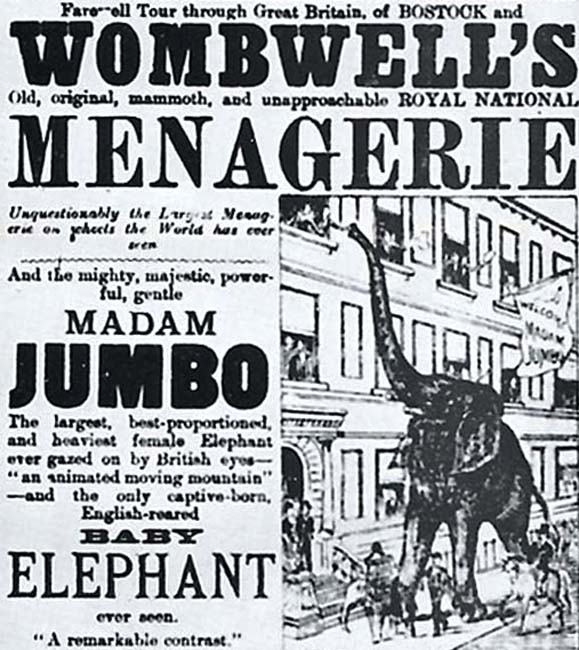
Even more frightening, apparently, was “Madam Jumbo”, an elephant of, well, elephantine proportions. It could actually lift people down from the second floor of the Post Office in Queen Street. Just look at the size of it. Look at the baby elephant in comparison, or the horse:
Amazingly, in King Street, “The Royal Monster Whale” was on exhibition for Goose Fair week, and for the week after that. It cost only threepence, with children half price. A “Royal Monster Whale” must have caused a great many difficulties for everybody, not just when it was delivered on a handcart, but in providing thousands of gallons of seawater in a city more than fifty miles from the sea. However, that may have been the least of their problems. As Monty Python so rightly said:
“Where are we going to get forty-four tons of plankton from every morning?”
An insoluble problem, unless, of course, “The Royal Monster Whale” was stuffed.
At least one lion at Goose Fair was personally supplied by the great Cecil Rhodes, the diamond billionaire who established the Rhodes Scholarships at Oxford University, the oldest graduate scholarships in the world. Every year, 102 full postgraduate scholarships are granted to students across the world. Here’s his lion, serving a life sentence by the look of it:
Sedgwick’s Menagerie had some baby lions, “Performing Elephants”, “Alphonso’s Group of Educated Lions”, “Lorenzo’s Performing and Talking Bears”, “Lorenzo’s Performing Wolves” and then you could see “Lorenzo performing with Nero and Brutus, the largest full-grown untameable African Forest Bred Lions”. Another threepence well spent, children half price.
One of Sedgewick’s chief attractions was “Blonko Bill”:
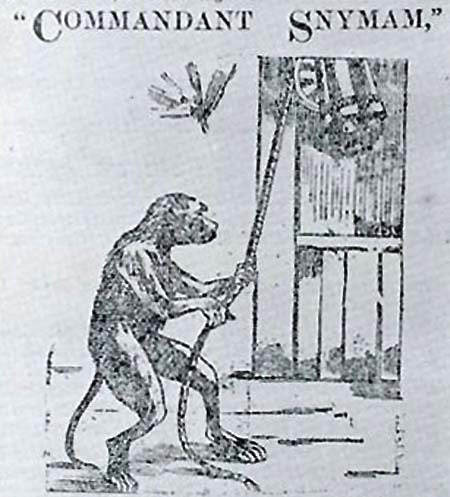
The first Goose Fair of the new twentieth century starred “the Mafeking Monkey”. During the Siege he had rung a bell every time the Boer artillery shelled the town:
I still don’t see what’s so smart about him, though. Every time the town is shelled, he rings a bell to tell people that they’re being shelled. How is that helpful?
Alongside “the Mafeking Monkey” were “Professor Burnett’s Fencing Booth and Military Tournament”, “Walls Electric Boer Warograph” and “Twigdon’s Electric Palace.” There was also a hairless or “rubber-skinned” mare from the Transvaal, a horse with a mane and tail 21 feet long, a giant horse over 20 hands high and a miniature horse and mule both only 24 inches high. In addition, there was the “smartest boxing kangaroo” in the world and, sadly, allocated to the animal section,”the giant negro Aaron Moore who is 8 feet in height.” In actual fact, Aaron is known to have been more like 7 feet 3 inches. He was from North Carolina, and, from the photographs I have seen, seems to have worn nearly all the time, a 9 inch high pillar box hat:
In the first part of this article, I demonstrated how Richard Mellers, the husband of Dame Agnes, was, at best, a fairly unscrupulous businessman. I ended by relating how, in 1507, Richard had received a pardon for having committed offenses against the statutes of weights and measures. This charge related to problems with the purity of his bells. The metal, apparently, was just not as valuable as he said it was. Richard’s pardon would have been granted because of his previous position as Mayor of Nottingham. A less prestigious person would have been in very, very, serious trouble:
Dame Agnes, of course, may well have known absolutely nothing whatsoever about any of this rather serious matter. Like many, many husbands over the centuries, Richard may have decided, quite simply, to tell her nothing at all about it. And if she did know about her husband’s cheating and double dealing, then, like many, many wives over the centuries, she may perhaps have turned a blind eye to it, hoping that one day her errant husband would rejoin the forces of light.
He didn’t though. At least not for long, because on or about Sunday, June 16th 1507, Richard Mellers died, with the ink on the pardon if not still wet, then certainly recognisably damp. I think Dame Agnes would have seen his sudden demise as a direct consequence of his previous wrongdoing. She must have thought that her husband’s death so soon after receiving a pardon was the true verdict from on high.
In more modern, medical, terms, Richard may well just have hastened a natural death by continually feeling guilty or by worrying too much about the outcome of the affair. He may, quite simply, have been a victim of early sixteenth century stress. Irrespective of the clinical truth, though, for a devout woman in Tudor times, these events must have seemed like a clear judgement from Heaven.
At the beginning of the sixteenth century, it would have been completely impossible for a sincere and devout Roman Catholic to be in any conceivable way ignorant of the rôle played by Hell in the scheme of things. How can Dame Agnes have possibly thought back about her husband’s life, misdemeanours and sudden death, and not have seen him as the proud possessor of a “Go straight to Hell, Do not pass Go, Do not collect a ticket to Heaven” card?
That must have been a very, very real fear in her mind.
Here’s how the Rock Combo “AC/DC” saw the situation, firstly on an album cover:
And then on stage:
More or less straightway after his death, therefore, Dame Agnes, the grieving widow, became a “vowess”. She resolved never to remarry, and instead to devote herself to the service of the church.
“a woman who has vowed chastity or devotion to a religious life; a nun”.
Other dictionaries tell pretty much the same tale. One other interesting detail about vowesses is given in “The Customs of Old England” by F. J. Snell. Writing about how a vowess would view her obligations, he states that:
“Whatever fasts a vowess might neglect as non-obligatory, it seems probable that she would not willingly forgo any opportunity of showing reverence to the Blessed Virgin.”
More of this later.
Immediately after her husband’s death, Dame Agnes tried to repay many of his victims. She literally gave them back the exact sums of money which she was worried they had lost to her husband.
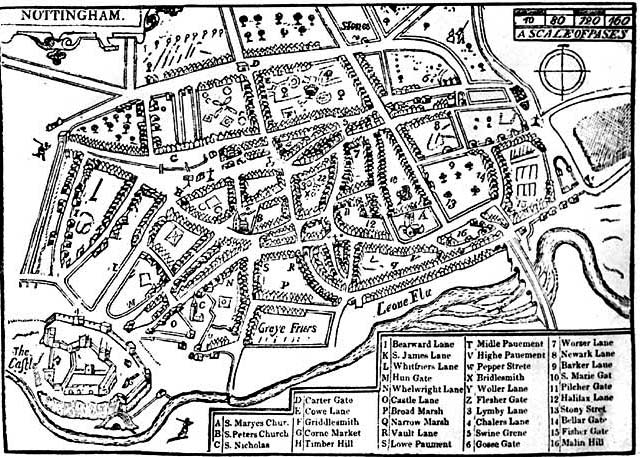
She then decided to spend the rest of Richard’s money on charitable causes. Most important of all, she decided to found a school. Or alternatively, she decided to fund a school which was already in existence and was clearly in need of financial assistance. She must have known that this one simple act would benefit the citizens of Nottingham in the long term, and make up for the occasions when, for short term gain, her late husband had cheated them. Here is the grateful city in 1610. St Mary’s church is marked with the letter “A”. Keep looking. It is there:
Before the official first day of her school, February 2nd 1513, there had already been eleven apparent references to a “Nottingham Grammar School” between 1289 and 1513. At this point in time, of course, it is impossible to tell what connection, if any, there is, with Dame Agnes’ school. Indeed, we do not even know if the eleven schools mentioned before 1513 have a continuous history, or whether they were all short lived affairs.
Having said that, though, Dame Agnes may well have decided to develop an ancient original grammar school into her own school. This original establishment may have depended solely on fees paid by the pupils. Dame Agnes perhaps thought it would be a good idea to establish a foundation, which would then ensure a much better financial future for the school. Equally, she may well have wished to take personal dcontrol of an older school, and then, as a loyal Catholic, to bring it under the control of St Mary’s Church.
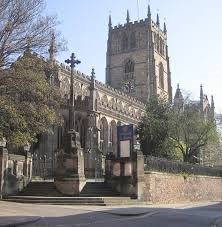
Whatever the details of founding, funding, refounding or whatever, from Dame Agnes’ point of view, the most important thing was that the school should remain closely linked to St Mary’s Church. This, of course, carries out the words of F. J. Snell. Her efforts with this school clearly showed that Dame Agnes would “not willingly forgo any opportunity of showing reverence to the Blessed Virgin”. Here is St Mary’s Church nowadays:
All this sounds like heresy now, of course, after a whole series of celebrations have commemorated the 500th Anniversary of the school, and books have been published, but these ideas are not actually mine own. In “The Nottinghamian” for 1924, for example, there was a clear connection stated in the school magazine between the older schools from before 1513 and the then Nottingham High School. Dr James Gow, the school’s greatest Headmaster, had died this particular year:
In his obituary, it was said that:
“he was appointed Headmaster of the Nottingham High School, an ancient Grammar School, already existing in the thirteenth century, and refounded and endowed by Dame Agnes Mellers, under a Charter of King Henry VIII, in 1513.”
These words are anonymous, but were most probably written by Mr “Sammy” Corner who had been the school’s Deputy Headmaster until his retirement in 1914. Mr Corner had spent much of his spare time researching school history and had become a great expert. Much of this knowledge was to appear in the school magazine which he edited for many years, and which at one point had contained a serialised history of the school. After his retirement, the plan was that Mr Corner would finish writing his history of the High School.
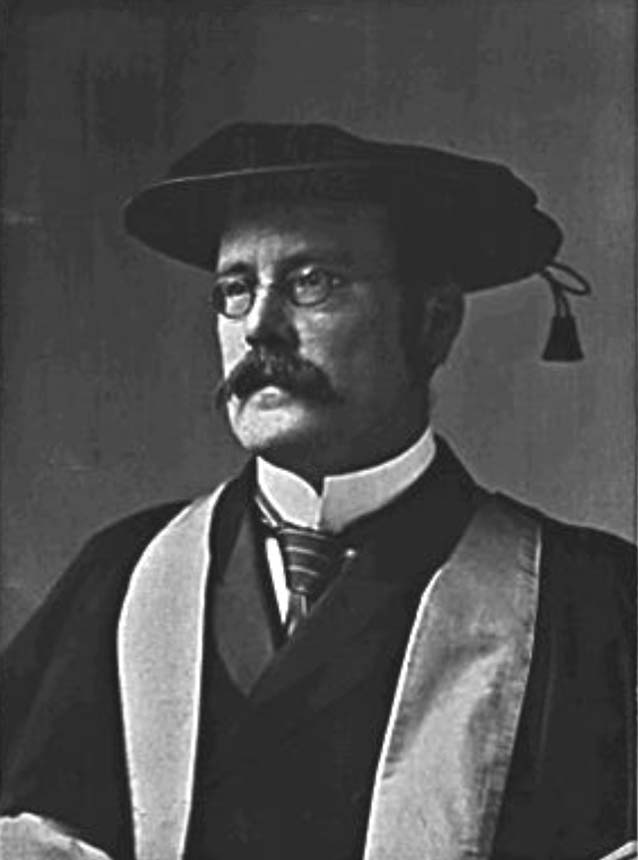
Alas, this popular member of staff was destined never to write his book, as the Great War broke out only a month after he was due to start work, and, despite his advanced age, Mr Corner went off to do his bit for the war effort. At the end of the conflict, Mr Corner moved from Nottingham to Croydon, but his life’s work was to remain forever uncompleted, a source of great regret, as he later told Mr Reynolds, the Headmaster, in a letter. This is the great Sammy Corner in 1913, showing off the school’s charter in the 400th anniversary celebrations in 1913:
On the afternoon of Monday, November 13th, 1933, similar ideas about the school’s history to those in Dr Gow’s obituary were being expressed by the Duke of Portland, when he performed the formal opening ceremony for two new High School buildings, the Gymnasium and the newly converted Library.
This very same interpretation was obviously still current around this time, when Mr.C.L.Reynolds, the Headmaster, wrote his own brief history of “The Buildings of Nottingham High School”. He described the events of 1513 as “…the re-foundation or endowment of the School by Dame Agnes Mellers.” Here is Mr Reynolds, seen with the prefects, in an unknown year, probably in the 1930s:
Furthermore, a document more contemporary to Dame Agnes’ time said that what Dame Agnes was doing was to “…unite, create and establishe a Free Scole” as if there were some definite connection between her school and the Nottingham schools of previous centuries. Similarly, she is referred to in a number of other early documents not as a “foundress” but as a “fundress”, as if she were building and strengthening what was already there.
How that fear of the “Go straight to Hell, Do not pass Go, Do not collect a ticket to Heaven” card must have haunted Dame Agnes. As well as her wonderful achievements with the school, she also laid down that a service of commemoration for her deceased husband should be held every year on June 16th. This latter date is thought to have been chosen because it was the Feast Day of St Richard of Gloucester. Interestingly enough, St Richard’s shrine in Chichester Cathedral, at this time, was a magnificently decorated and popular destination for the Tudor Pilgrim. Perhaps Dame Agnes had been there herself as a dedicated vowess:
The ceremony which Dame Agnes had requested was, of course, a solemn Roman Catholic mass for the soul of her dear departed husband. It is thought that this mass was probably celebrated for about thirty five years, until such services were abolished by order of the then king, Edward VI. This same type of mass may then possibly have been revived under the Catholic Queen Mary, but it certainly would have disappeared for ever when the Protestant Queen Elizabeth I came to the throne in 1558.
Even in the 1660s though, some hundred and fifty years after Dame Agnes, the students still went every Friday during the period of Lent, with their teachers, to visit St.Mary’s church, and kneel in front of the tombs of Richard and Agnes Mellers, and say prayers for their souls, and the souls of all their relatives. And even nowadays, every year on Founder’s Day, the congregation still says prayers for the souls of Dame Agnes, and more importantly perhaps, her husband, Richard. This is Founder’s Day in 1957, a beautiful backlit day:
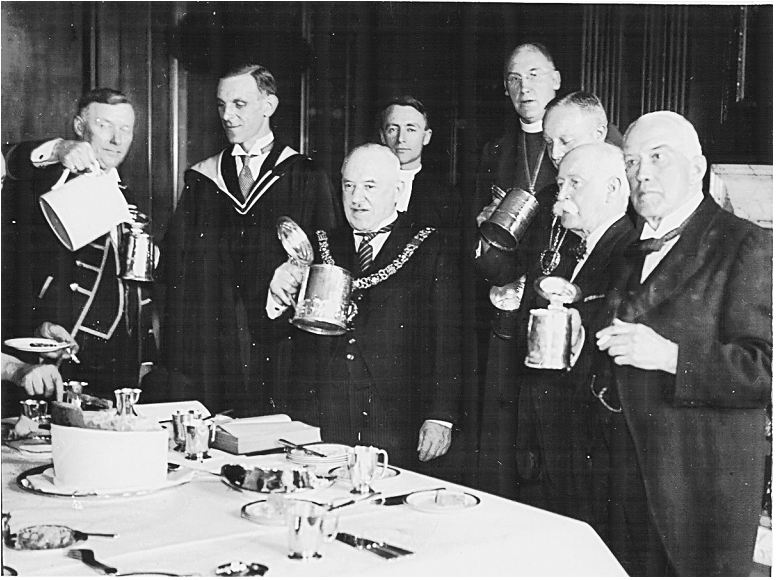
This is the Cheese and Ale Ceremony in the same year:
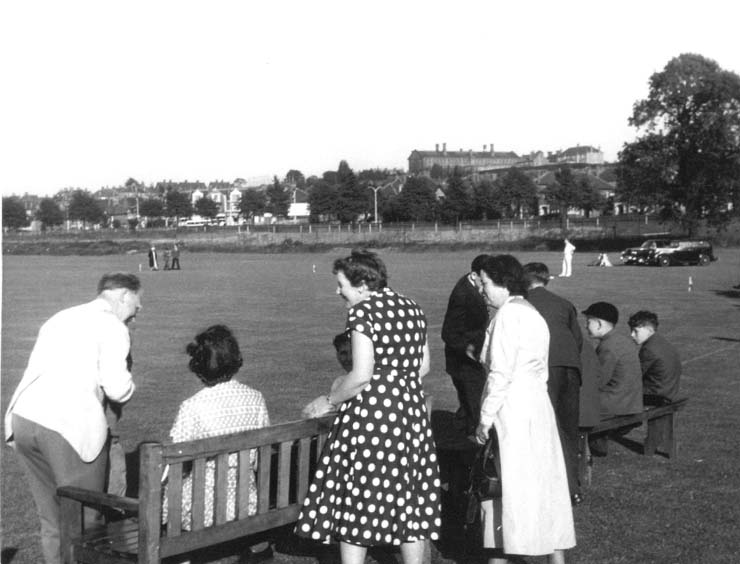
They’re going to get very drunk very quickly if they fill those tankards too frequently. Here is the traditional Cricket Match on that sunlit afternoon in 1957:
Having explored the history of the High School for more than twenty five years, I have always thought that the school’s beginnings are shrouded in mystery. For me, the High School has always been very like the Soviet Union:
“a riddle, wrapped in a mystery, inside an enigma”
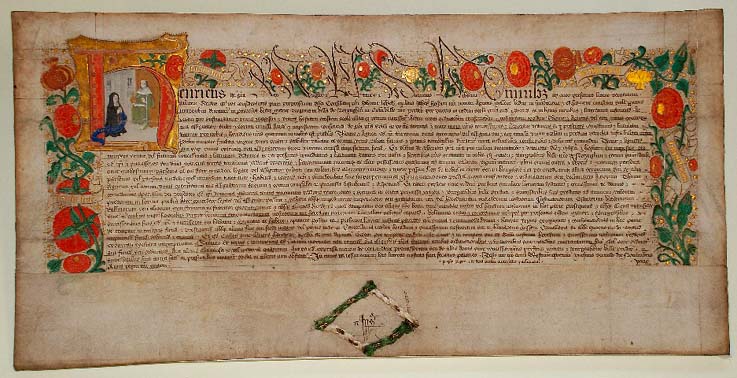
What do we know about the founder of the school, Dame Agnes Mellers, for example? What was she like as a person? There are a very few illustrations which are thought to be her. This is the school’s charter:
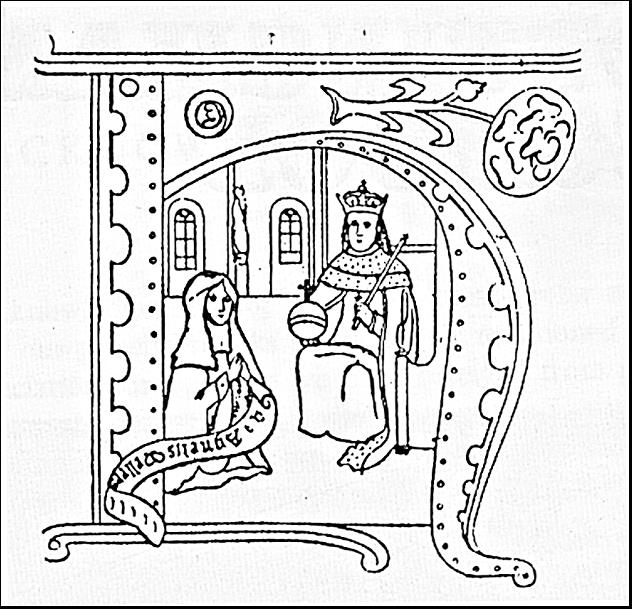
And here is a close-up of Dame Agnes and King Henry VIII:
This is the charter changed into a line drawing:
For me, there have always seemed to have been two enormously important motivating forces in her character. The first was her staunch religious faith as a Roman Catholic with a sincere love of Jesus Christ and the Catholic Church. Dame Agnes seems in many ways to have been an uncomplicated soul, who viewed the world in a simple direct way. She tried to be a good person, with the sincere belief that we should all try to make things better rather than worse, that we should do good things rather than evil and that we should always strive to be on the side of the Angels.
The second motivation for her was the love she had for her husband, Richard, which seems as sincere and unswerving as her love for the Church. Richard was, as his name suggests, a rich man. He was at one time or another, Sheriff of Nottingham (1472-1473), Chamberlain (1484-1485) and Royal Commissioner and Mayor of Nottingham (1499-1500 and again in 1506). In 1499, he is known to have given twenty shillings to help repair the Hethbeth Bridge, as Trent Bridge’s predecessor was called. Here is one of the last photographs ever taken of the old bridge before it was superseded by the present Trent Bridge. You can certainly see why it was easier for the river to freeze up in those days:
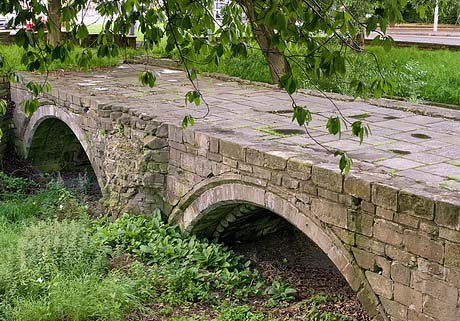
This is all that remains of the Hethbeth Bridge nowadays:
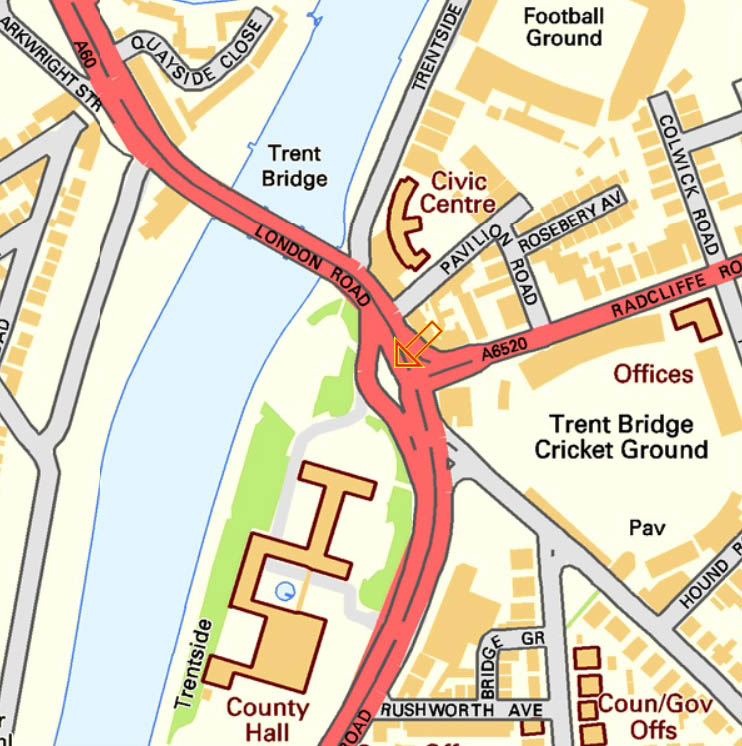
It is in the middle of a road island to the south of Trent Bridge. If you decide to take a look at it, be very careful of the traffic and use the proper crossings. Look for the (camouflaged) orange arrow in the centre of the (red) road junction:
Richard Mellers was a brazier, and probably a potter, and he had certainly dealt in metal pots and dishes. Most important of all, he owned the largest church bell-foundry in the region. The site of his premises has long disappeared, but its exact location is still known today.
From 1888 onwards, just a very few yards north of the city centre, steps began to clear away:
“a curious V-shaped slice of slum property…a most unhygienic and immoral neighbourhood and nothing good could be said for it”.
This slum clearance took a number of years, and resulted in the formation of King Street and Queen Street, the latter being opened on June 22nd, 1892.
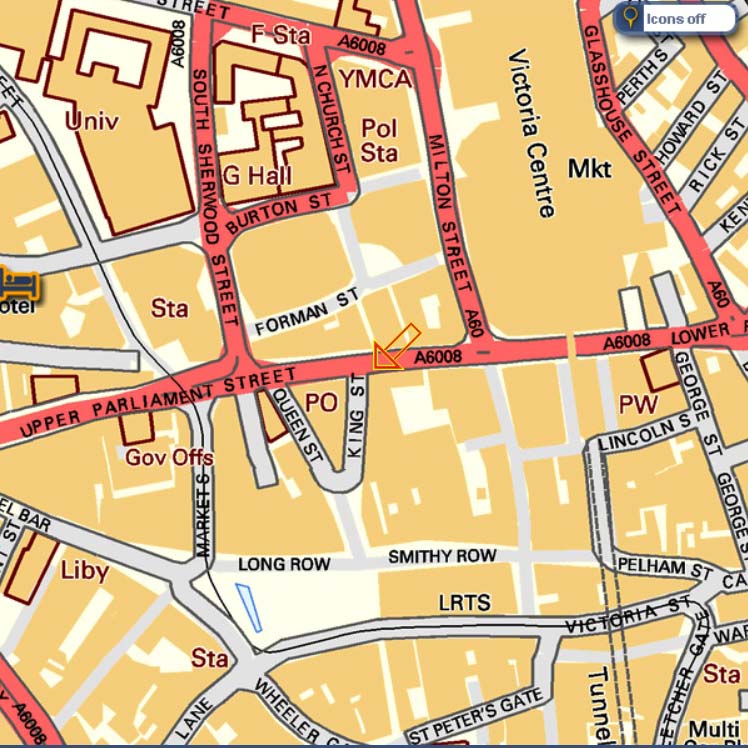
During this time, it was inevitable that, along with all the slums and all the undesirable features, a few other more reputable premises were destined to disappear. Among these was Richard Mellers’ Bell Foundry, which is known to have stood more or less exactly on the site of the present day Queen Street Post Office. The orange arrow points to the general area, and the letters PO stand for the purple edged Post Office:
Perhaps it was working so close to such an “immoral neighbourhood” that deflected Richard away from the straight and narrow. He had, for example, already paid out £20 to be the Mayor of Nottingham for twelve months. There wasn’t really much of the democratic process involved here, or indeed, much evidence of any genuine interest in the workings of democracy. That payment of £20, a rather sizeable sum of money by modern standards, may well have been the reason that, in the very same year, Richard had been so keen to do a good deed by paying for the upkeep of the ever ailing Hethbeth Bridge.
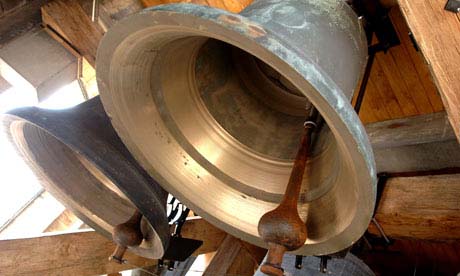
Richard was certainly widely known as a fairly unscrupulous businessman. During his lifetime, in his efforts to acquire great personal wealth, he certainly seems to have cheated many of his bell buying customers. In 1507, for example, we know that Richard had received a pardon for having committed offenses against the statutes of weights and measures. This charge is believed to have related to problems with the purity of his bells and the metal they contained. The pardon would only have been granted because of his previous position as Mayor of Nottingham. A less prestigious person would have been in very, very, serious trouble. These bells, though, are all 100% the real peal:
Today I begin a series of articles which will lead up to Hallowe’en.
A zombie’s dozen of ghostly tales.
They are all within my experience. That is to say, they may have happened to somebody else, but that somebody else then told me their tale directly, man to man.
The vast majority of these ripping yarns, though, actually happened to me.
Number One
The Vampire
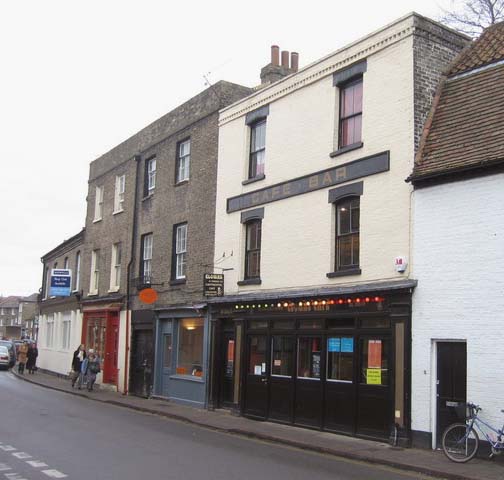
Over forty years ago, when I was a student, my friend Nick and I used to visit the Horse and Groom pub in King Street in Cambridge, on a far too regular basis:
One freezing cold foggy dark November night, we went over to our favourite drinking hole where we consumed perhaps a couple of pints, which was a far from an excessive amount for us. We then decided to return to college a little earlier than normal, to finish our evening in perhaps, rather more luxurious surroundings. It was still cold outside, and the fog was perhaps even thicker, as we walked back along a wide asphalt path which crossed the park. The wide asphalt path is designated by the narrow orange arrow:
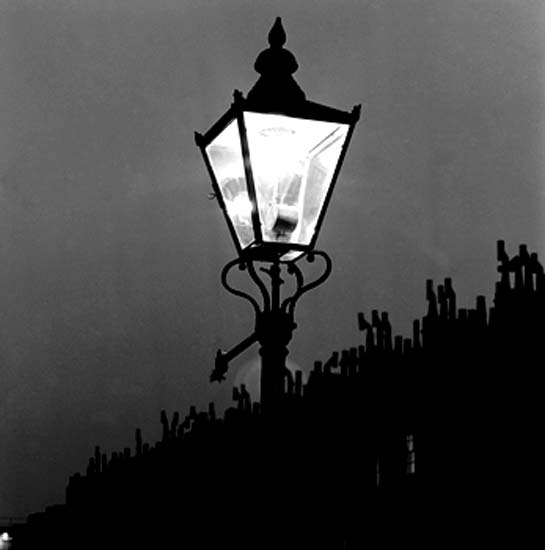
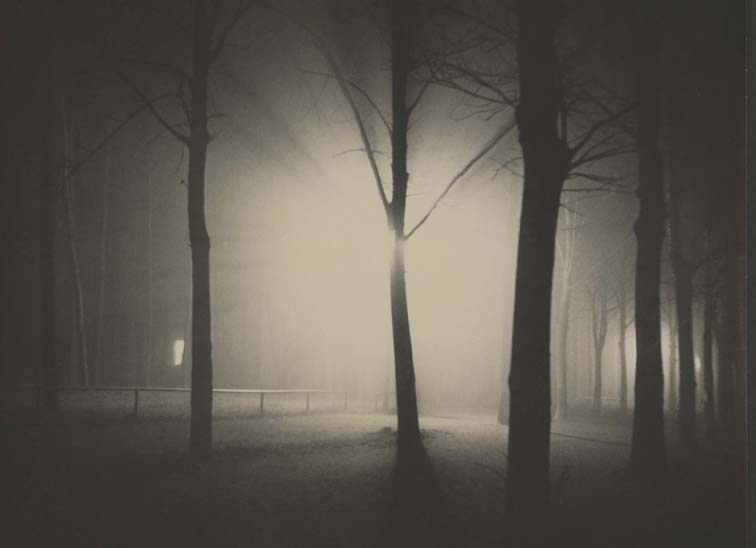
The path was absolutely straight and lit by a number of old Victorian street lights. They created pools of light perhaps eight or ten feet wide but, as the lights were about ten or twelve yards apart, there was still a lot of darkness there, not helped by the thickening fog:
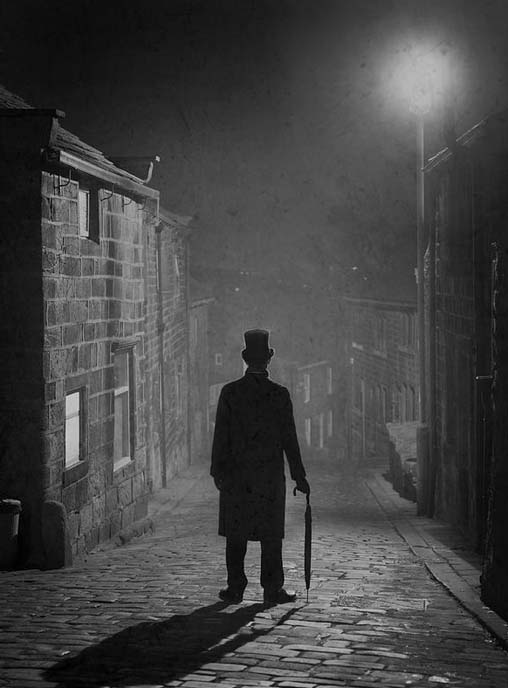
As we got out into the very middle of the park, we gradually became aware of the crisp click-clack-click noise of approaching footsteps, and the tip-tap-tip of a cane on the hard surface of the path. At first, we were unable to see anyone, but suddenly the stranger stepped out of the darkness into the pool of bright light provided by the street lamp.
He was in full evening dress, with dark hair. He carried a cane, and, most striking of all, he was wearing a sweeping black cloak. It was lined with what appeared to be bright red silk:
We watched open mouthed as he strode purposefully past us, and then back out into the darkness. The noise of his footsteps, and the tapping of his cane gradually became fainter and fainter until they finally disappeared into the darkness:
Number Two
The Time Travellers
I have always had a lot of trouble sleeping. In summer, I seemed always to wake up around four o’clo0ck and then find it impossible to get back to sleep again. That was one of the main reasons I started marking GCSE Papers every June and July. It was fairly well paid, and it always seemed a good way to make some money at a time when, in all probability, I would have been lying awake anyway.
In the late 1980s, therefore, I took to s1eeping on my own in the front bedroom. This seemed a good way to get a full night’s sleep before I got up at ten to five to brew some coffee and make a start on the vast piles of cassette tapes, all containing GCSE French Oral Examinations. At the time, our daughter was just two or three years old, and the last thing wanted was to interrupt my slumbers between ten o’clock and five o’clock the next morning.
One brilliantly bright sunlit summer’s morning, I woke up even earlier than normal, at around four o’clock. It was already well past dawn, and I was lying with my face towards the bright bay window:
The bedroom door was directly behind me, and as I gradually became more and more awake, I had the strongest feeling that somebody was standing behind me in the doorway, looking at me. The strongest feeling.
Somehow, I knew that I was going to have to pluck up courage to turn over and have zaa look to see if there was, in actual fact, anybody there. Slowly, slowly I was acquiring the courage to turn around.
Suddenly, I heard a child’s high pitched voice say, “There’s one in here, and he’s still asleep”. From the landing outside the bedroom came a female adult’s reply, “Come away, you’ll waken him.”
Then there was silence:
I turned over to look towards the bedroom door. There was nobody. I got up and had a look around all the rooms in the house. Nobody.
Then, just for a moment, I had the strangest feeling that I had just taken part in a Year 10 Social History class visit from the 25th Century. Walking around in what to them was the distant past. Our distant descendants in our house.
















 John Knifton