Tag Archives: sausages

Widdle (10)

The garden behind our house is rather peculiar in the sense that halfway between the house and the end of the garden there is a drop of some twelve or fifteen feet down to a lawn and a few trees. The soil below this little cliff is alluvial and black and of a stunning quality just as if it had been brought there from elsewhere

Personally, I have always felt that during one of the Ice Ages some 10,000-12,000 years ago, a raging torrent brought ice cold water from underneath a glacier and carried it away to what would one day become the River Trent. As it did so, it left us our mini-cliff , and, a hundred yards beyond our fence, a much smaller, non-raging not-a-torrent, called the Daybrook.

I haven’t any pictures of this cliff, but I do have one or two which show clearly the almost sheer drop down to the lawn. Here’s the first….

The white lines in the trees (on the right) are the window ledges of the bedrooms of the houses in the street below.

In the next photograph, you can see the garage of a house in the street below…….
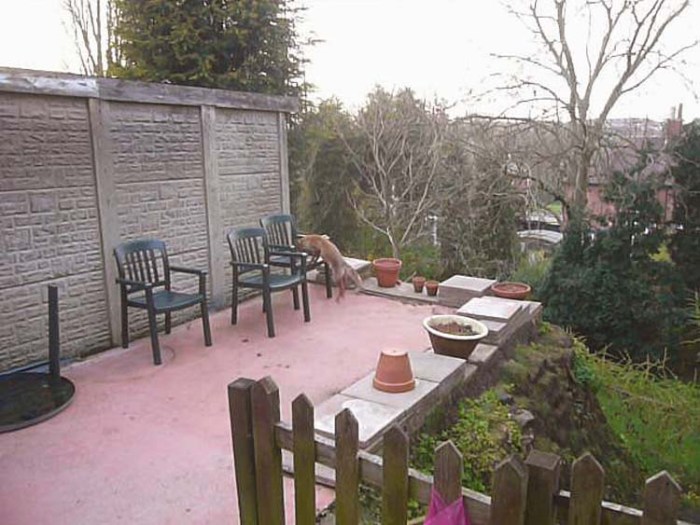
Because of this fifteen foot cliff,  my friend Widdle was faced with a slight problem in that he had to find a viable route up to the patio where he would be given one or two of the free sausages he enjoyed so much.

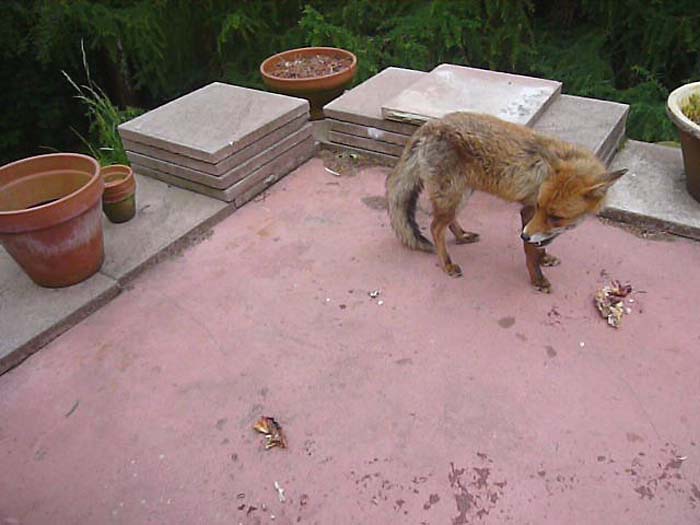
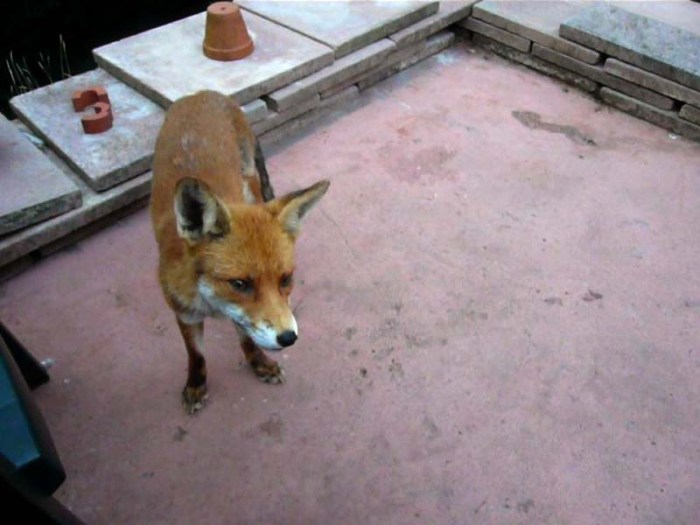
There were perhaps three main routes up to the patio. The first and most difficult was to come round the back of next door’s garage where he had to negotiate a path only six inches wide with a drop of some fifteen feet to the ground below. The drop is very obvious in this picture where Widdle turns silently from his precarious perch to the safer surface of the patio, the location of our garage before we had it demolished……..

Did you notice that Wisddle’s paw is perched in mid-air, twelve feet or more above next door’s lawn ?

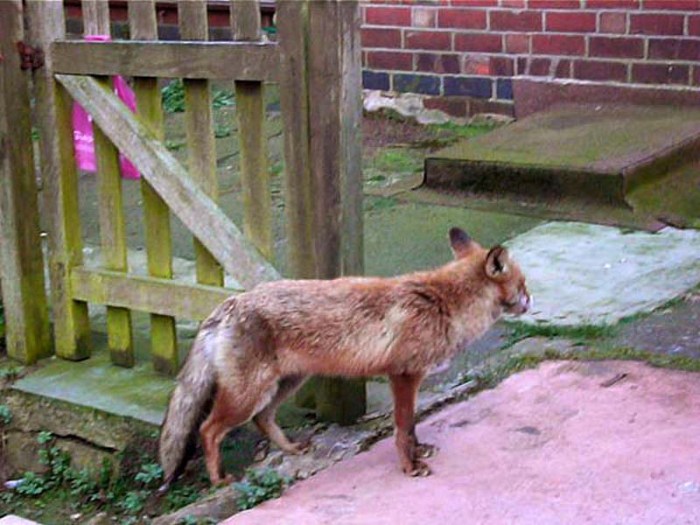
Alternatively Widdle could come across the lawn and then walk up the flight of steps which I myself had made when we first moved into our house some forty years previously. First of all, he might sit and wait on the luxuriant sward of a particularly damp lawn………
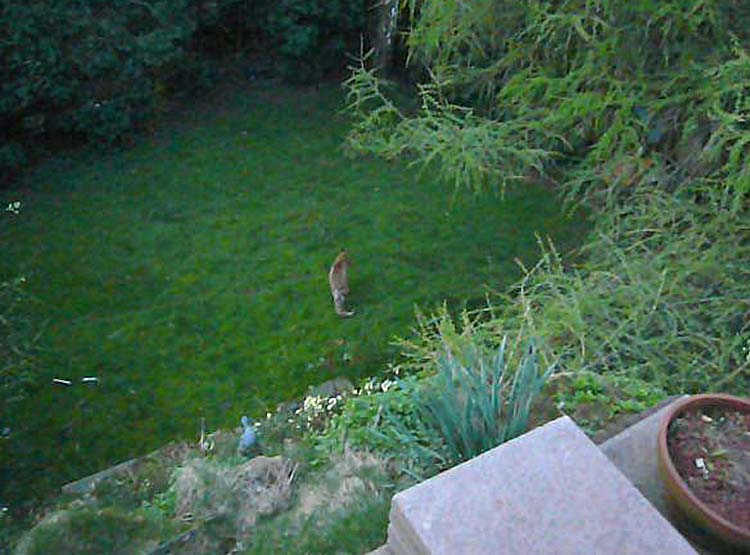
Or, he might just explore the grass, looking for anything interesting that he could take away with him…..

After checking the lawn thoroughly for discarded food, Widdle beats a determined path to the bottom of the steps…..
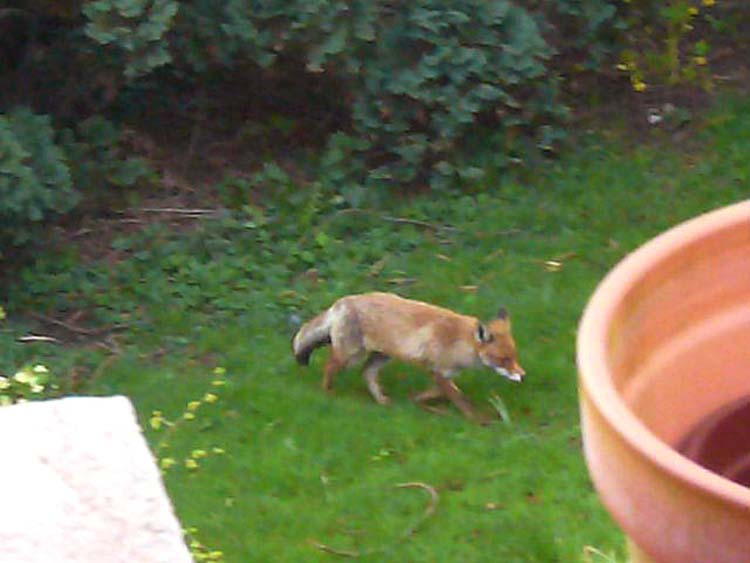
Once Widdle has made his way up to the top of the thirty nine steps, he can step out into Sausageland…..
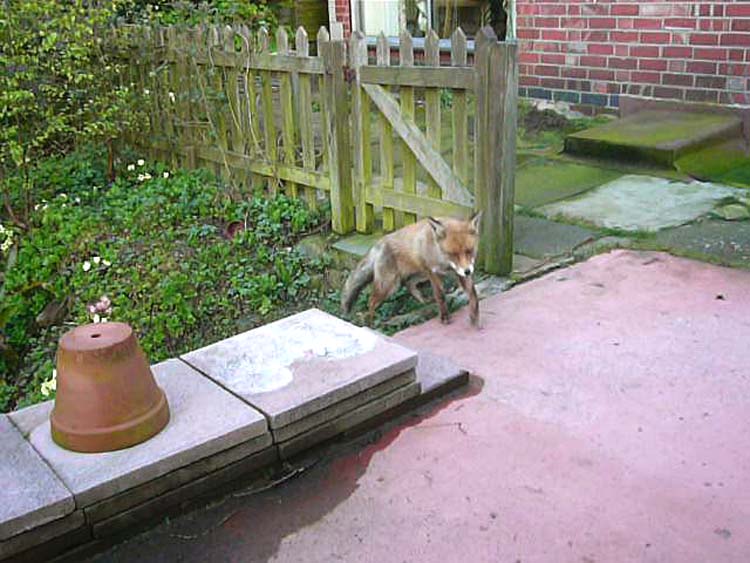
Where, with a little bit of luck, somebody would be sitting waiting for him, sausage in hand……

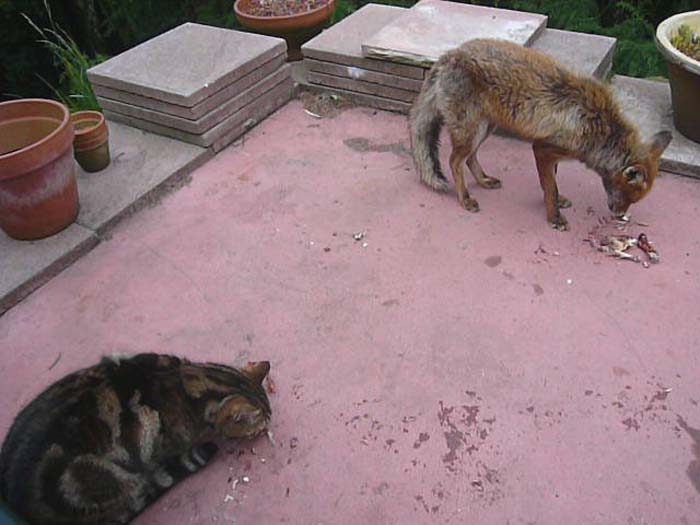
He might even meet an old friend, Yin Yang, the Killer Kat…..

16 Comments

Filed under My Garden, My House, Nottingham, Widdle, Wildlife and Nature

My best friend, Widdle (6)

The  colour and texture of a fox’s coat may vary due to the change in seasons.  It will be richer and denser in the colder months and lighter in the warmer months. To get rid of the dense winter coat, foxes moult once a year around April. The moult begins from the feet, up the legs, and then along the back, finishing with the neck and head.

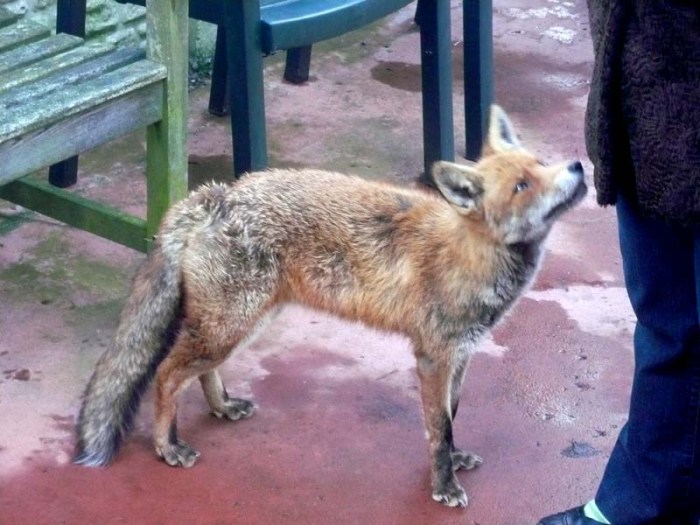
Widdle was a fox who came to us, apparently around two years old, one day in 2007. He was looking for affection and for help. He came to us from a desire to understand nice human beings, and most of all, for unlimited access to good quality sausages:

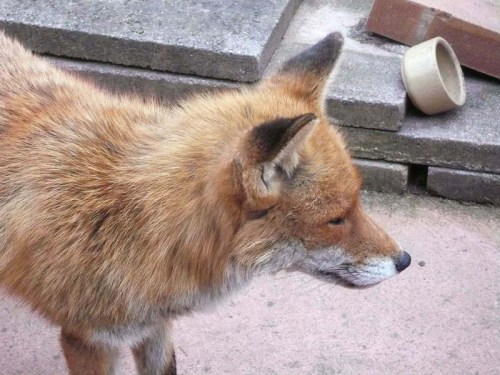
Over the three to four years that we knew Widdle, his appearance changed a great deal. He was certainly not always what our American friends call a “red fox”, because in the spring and summer months, he was the hapless victim of his single annual moult.

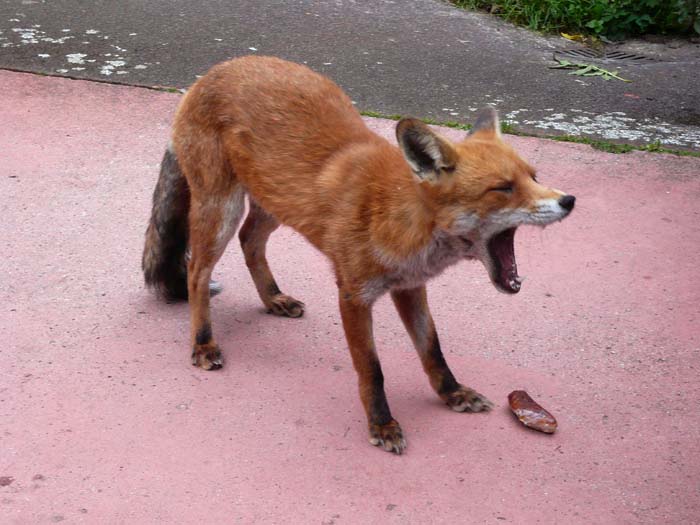
According to Wikipedia, quoted above, a fox’s moult “begins from the feet, up the legs, and then along the back”. Sometimes in June, in the middle of the moult, Widdle looked rather like he’d been down to the pub the night before, and had a few too many:

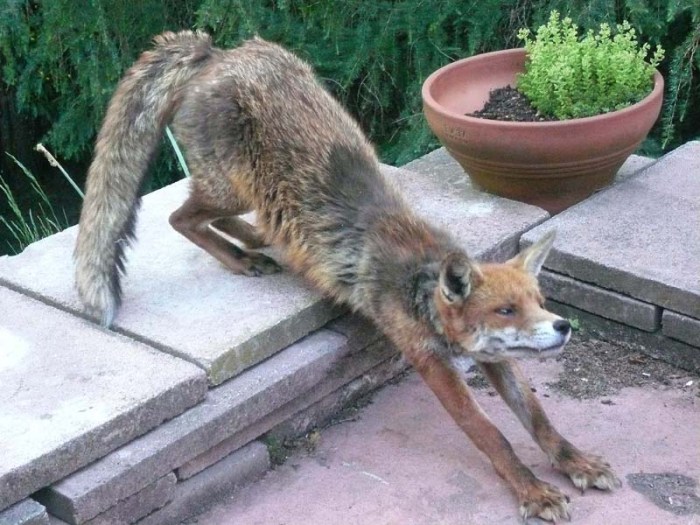
In May, he had tried stretching exercises, but that didn’t last long:

No, the only remedy is a couple of sausages. Or so we thought. It was actually more complicated than that.

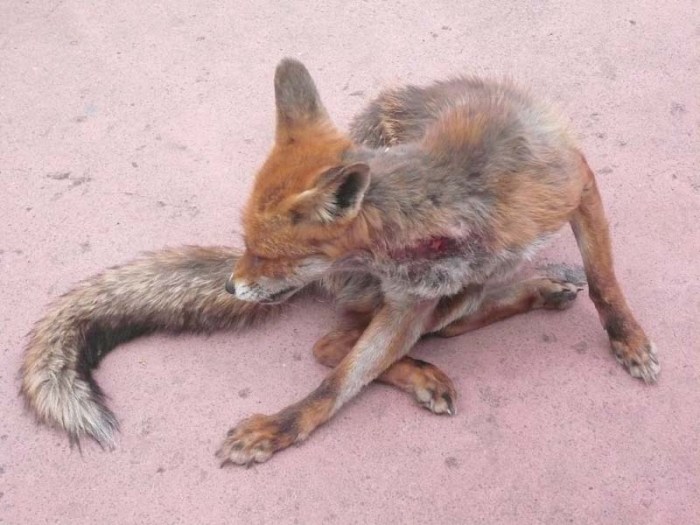
Widdle’s main problem with his coat was fleas, particularly during the moult. Here he is, scratching away. As far as we were aware, it was impossible for humans to be infected by fox fleas, and in up to four years with him, we never thought we had. I did once inquire about trying to give him something against fleas, but we were told it was pointless. Something for a dog and its fleas probably wouldn’t work. It might give him an allergic reaction and kill him. And, as soon as he went back to Mrs Widdle, he would be re-infected:

Male foxes fight quite a lot and here he is with part of his coat ripped off, I remember saying to him “That look’s a very painful wound.”, and he said “Well, you should have seen the other fella’.”

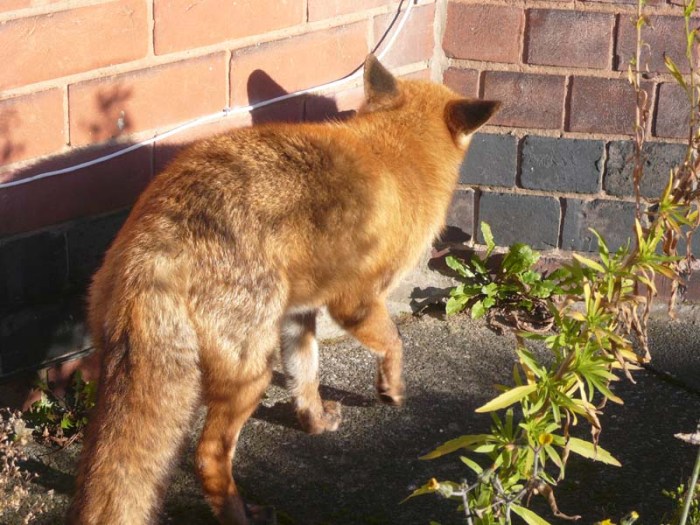
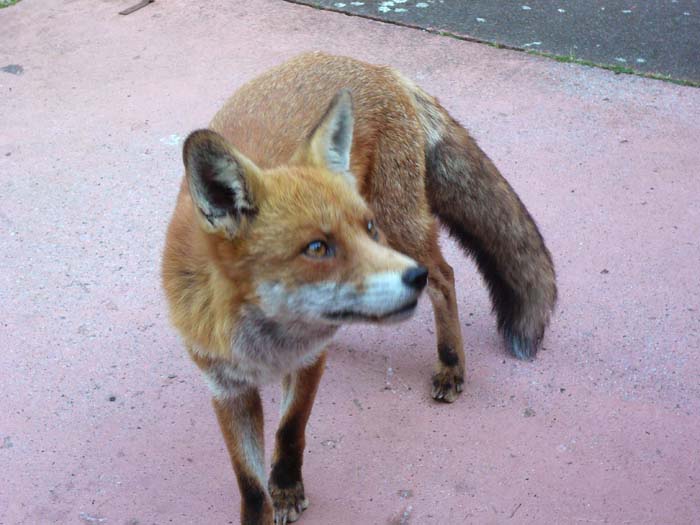
By winter, though, Widdle has acquired that magnificent coat that we all know and love. In this photograph, he shows that certainly as far as he is concerned, the neck is the last section to change.

Anyway, by early September, the transformation is complete. All that is missing is the white tip to his tail, which, as far as I recall,  Widdle never had. Well, not in full anyway:

And certainly, by November, it is as if he had been spray painted “fox-red”. He has lost all the black bits on his legs and the black and white stripes on the upper sides of his paws. He is Red Red Red:

The last picture comes from April 2010 when the very first signs of the Great Itching Time are beginning to appear. Even so, the coat still looks exceptionally thick and is standing on end to trap the warm air:


25 Comments

Filed under Humour, Nottingham, Personal, Widdle, Wildlife and Nature

My best friend, Widdle (5)

Last time,we were looking at what Widdle the Friendly Fox would eat and what he would turn his nose up at. Over time, we gradually built up a list of his likes and dislikes.

Physically, he was very thin and very wiry, but he was extremely strong for his size. If he pulled one end of a stick and you pulled the other, you could feel his muscles and his strength. Most of this came, in our opinion, because he wouldn’t eat bread or cakes. He wouldn’t eat curry or anything flavoured. He wouldn’t eat pizza. Even our local magpies wouldn’t eat pizza, incidentally. Widdle wouldn’t eat hamburgers, although we didn’t quite understand this. Perhaps he had his culinary standards. After all, the bar was set pretty high by our sausages (42% meat).

This photograph appears to show the biggest object Widdle ever managed to carry away. I have no idea what it was, but may have been a big bone or maybe some cut of meat that had gone past its sell-by date:

Raw bacon rind appears to be a delicacy in the fox world. Firstly, sniff what it is…

Don’t let it escape under any circumstances:


“A second piece? Don’t mind if I do!”

In the next picture, note the first piece of rind safely stashed on the floor. He didn’t find getting both in his mouth at the same time too easy!


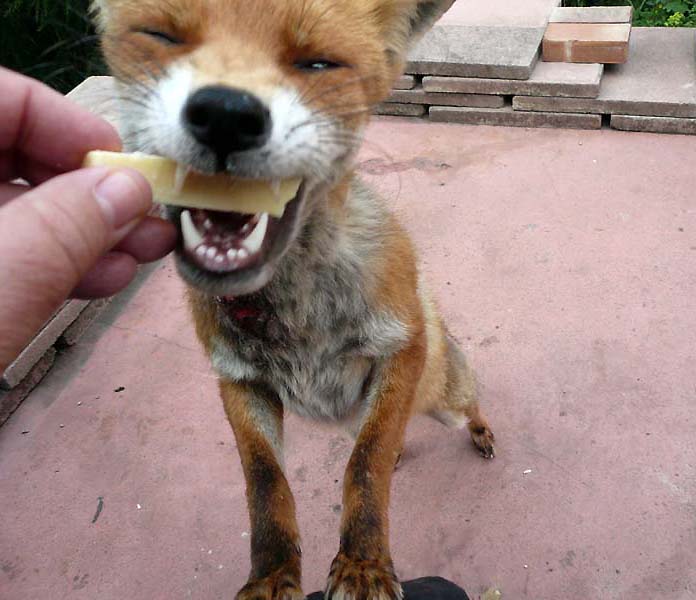
“Cheese is different. You have so many dreadful flavours in cheese. So make sure you sniff it first….”


“Take hold of it carefully. It may crumble and you might lose some.”

“Sniff the next piece carefully. Just because the first piece was cheddar, that doesn’t mean they all will be.”

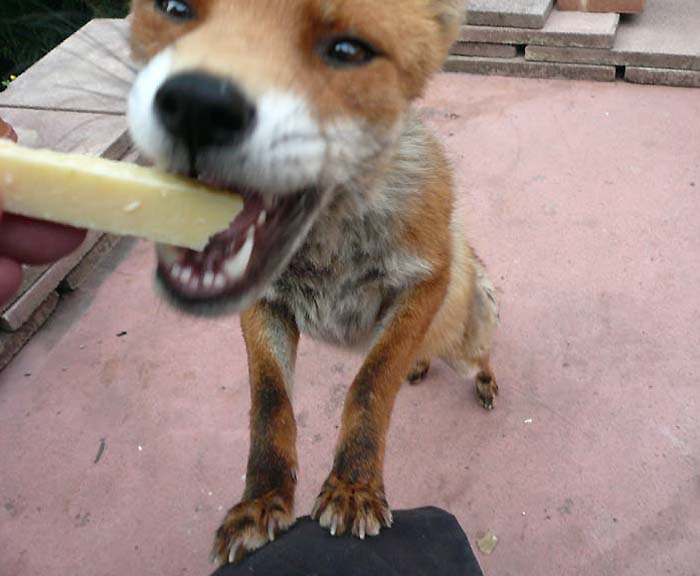
“Yes, it’s OK. I’ll take it, please. It’s good for the teeth, cheese!”

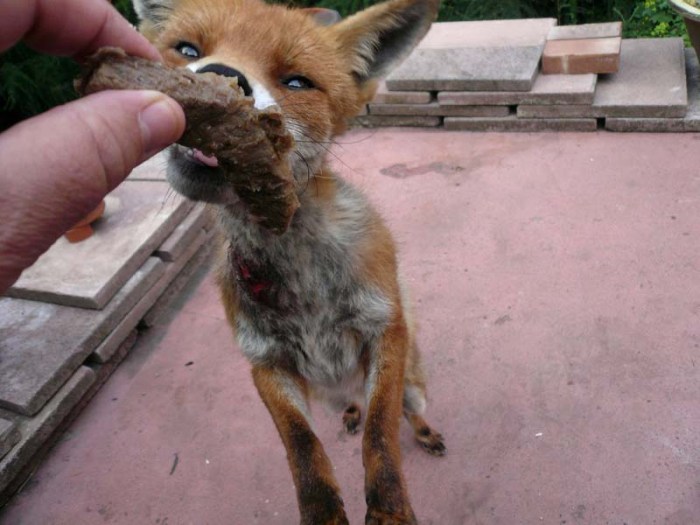
Not that Widdle would turn down proper meat.

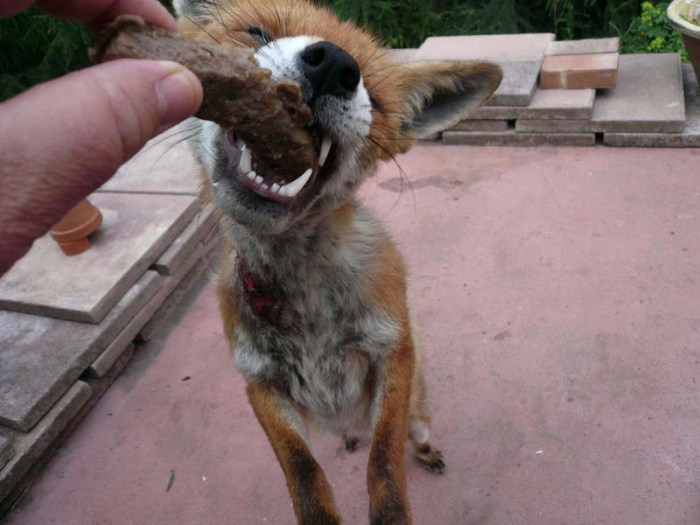
“Would I like a bit of steak? You bet I would!”

“Mmm. Lovely!”

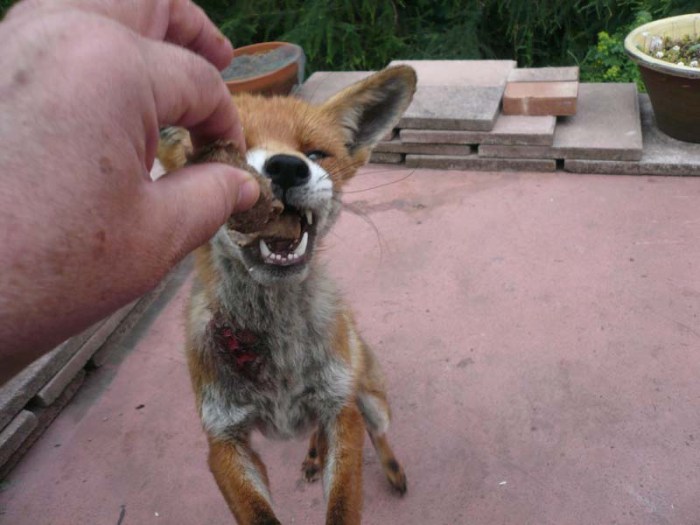
Watch what you’re doing. Fingers at your own risk!!”

Widdle usually took all the food that was offered to him. He filled his mouth up with sausages, bits of meat and so on, and took them back to Mrs Widdle in the den. She would eat some and share the rest with her cubs. The largest litter I ever saw in our garden was four, with No 4, the smallest one, perhaps only two thirds the size of the others. Mum and Dad taught them their table manners. Any transgression got a sharp nip on the backside to emphasise the point.

Notice how, in the last three photographs, Widdle has a great gaping wound on his chest. As I mentioned, male foxes frequently fight each other, and they bite their opponent’s muzzle and fore-limbs. I don’t know how Widdle acquired this particular wound, but it didn’t take long to heal up.

On four occasions, Widdle had bad injuries to one of his front legs and he could barely walk. In a wilder world, he would not have managed to hunt and he would have died, but his friends stepped in with Sausage-Aid and he got over it. That gave him five lives instead of the usual one, a minimum of four or five years of life compared to the usual two or three, and as many as fifteen cubs produced, instead of the usual figure of between none and four.

21 Comments

Filed under Humour, Nottingham, Personal, Widdle, Wildlife and Nature

My best friend, Widdle (4)

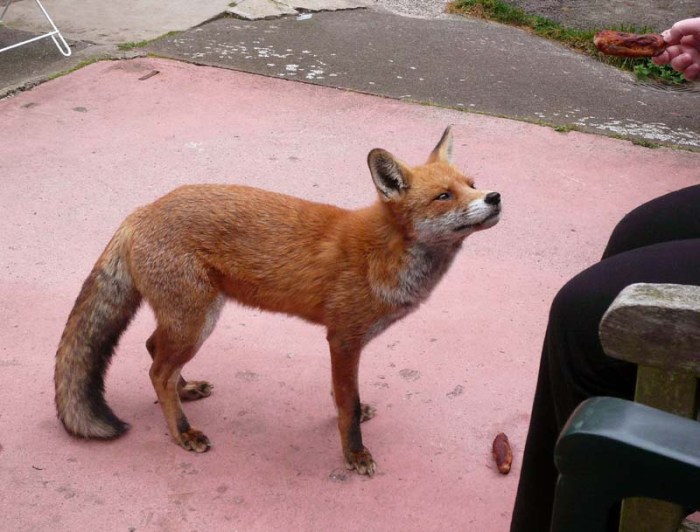
Between approximately 2007-2010, our family had a completely wild fox as a friend. When Widdle came to you like this, you knew that he had only one thought on his mind. Sausages!!

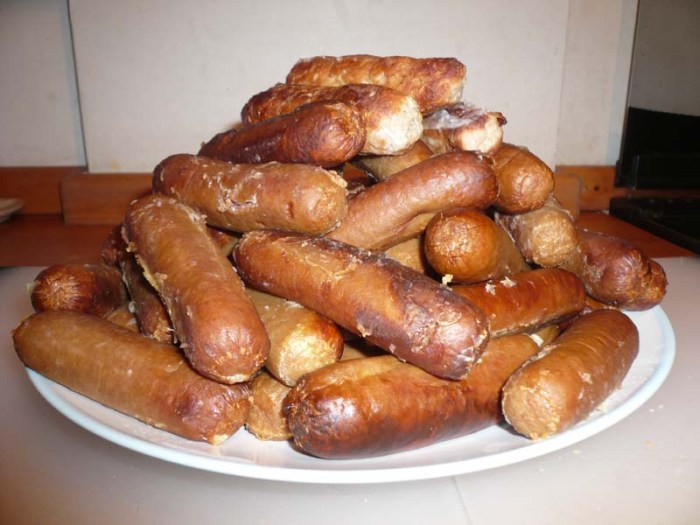
These are the brand he preferred. We used to buy them at a frozen food supermarket called Iceland. We wanted a cheap, but nourishing, sausage for our furry friend, so we looked round most of the butcher-type shops in our suburb of Nottingham and finally made the decision to buy at Iceland where the budget sausages were 42% meat, easily the highest percentage in the world for the budget sausage. Dog food was even more unbelievable. All of the cheaper ones I looked at were full of “ash”. I’d really like to know why!

And what type of ash was it, that was included in so many dogfoods? Surely not the ashes of former dog owners? :

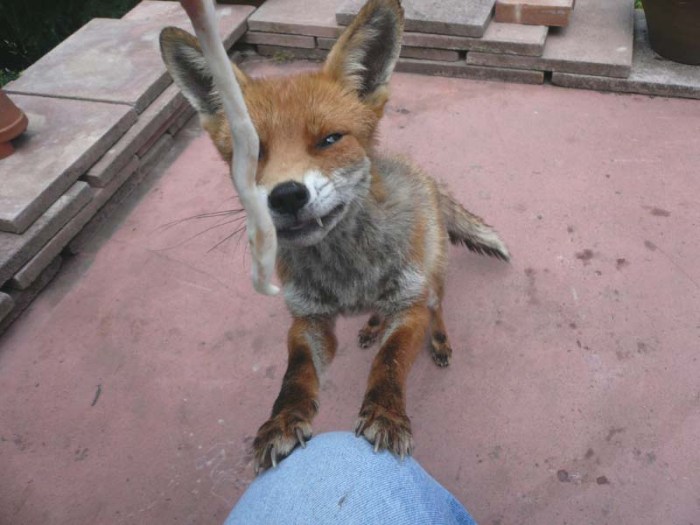
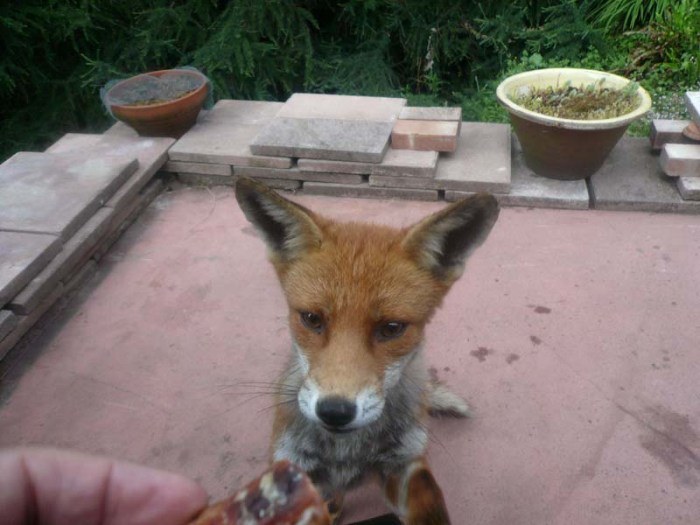
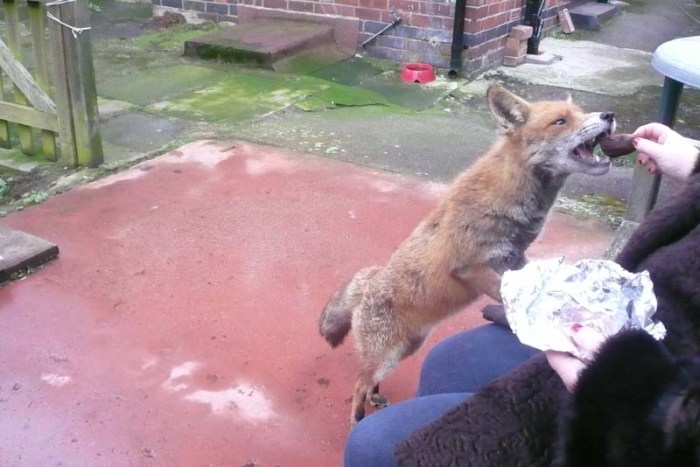
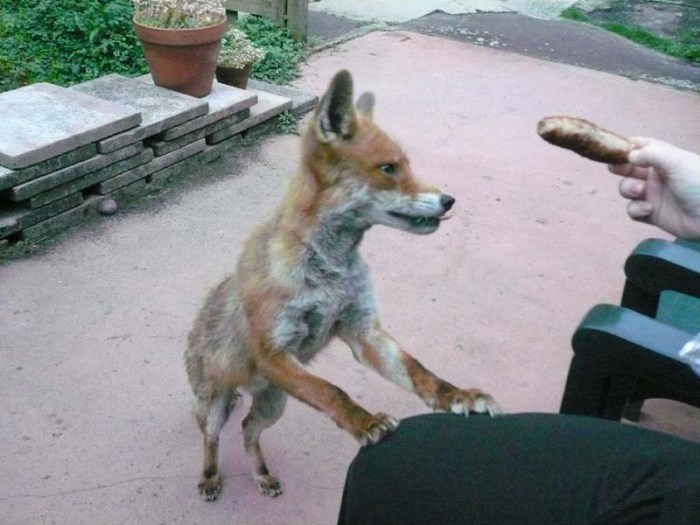
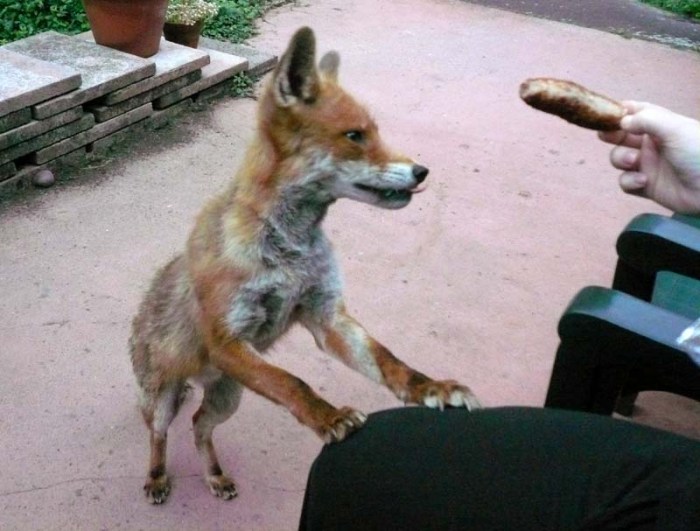
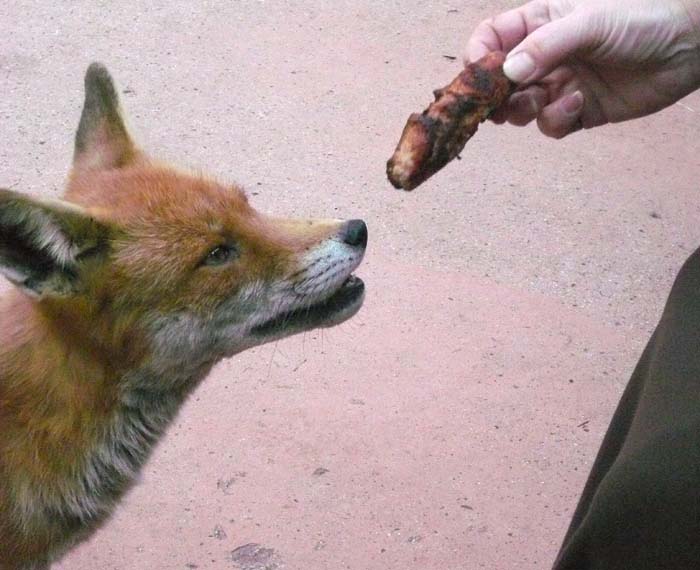
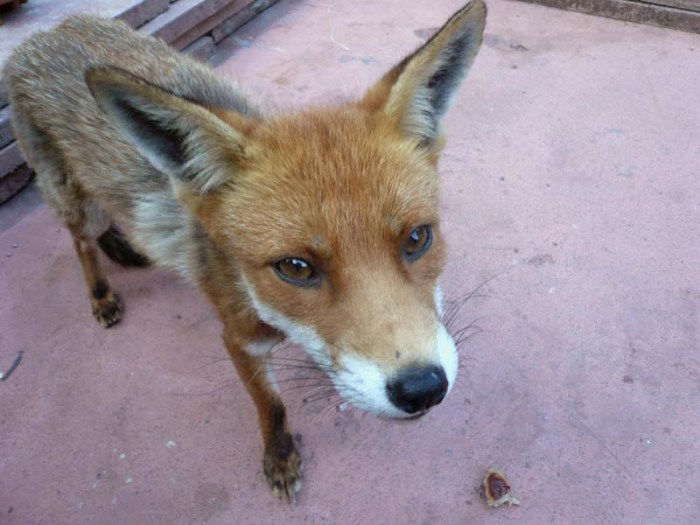
Sometimes Widdle was extremely polite, putting a fore-paw on each knee, showing you his pale brown eyes, and staring with a mixture of wistfulness and plain hunger:

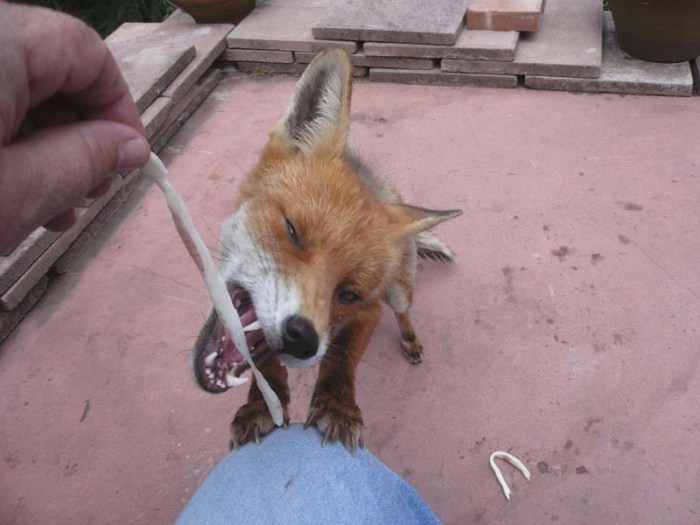
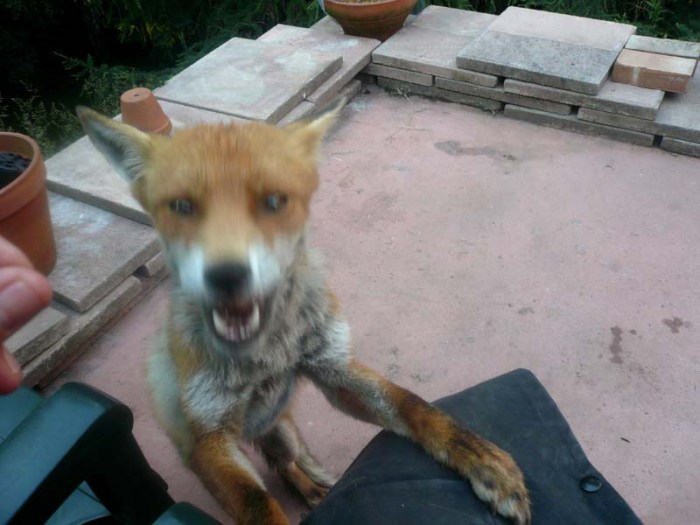
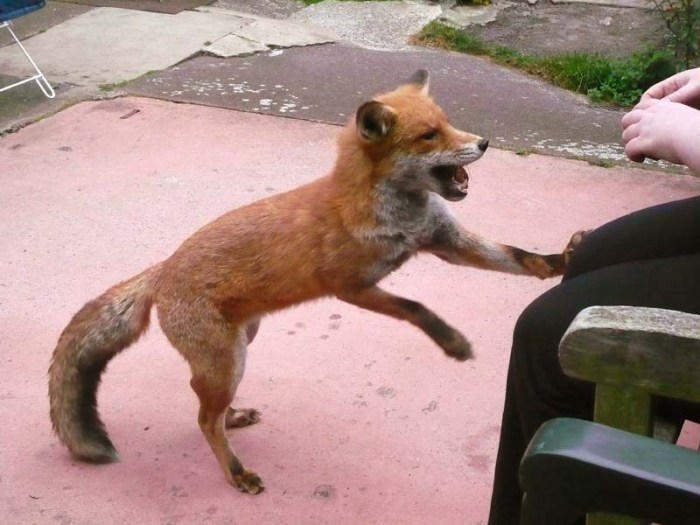
On other occasions, he was a lot more forthright, explaining with his pointy teeth, that he was pressed for time, so could you crack on with it, please? After all, we both know how it’s going to end:

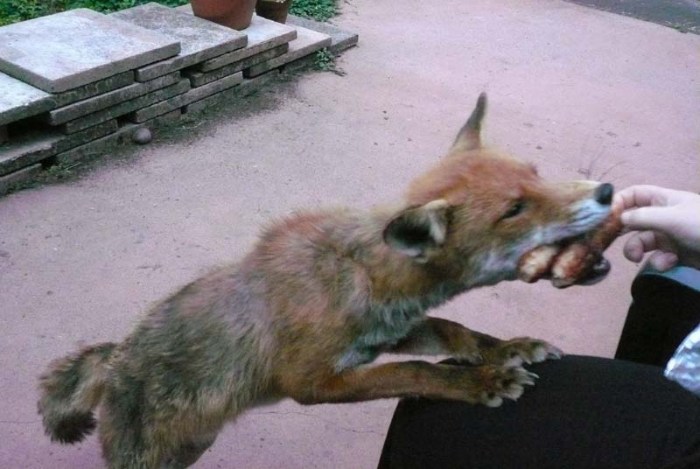
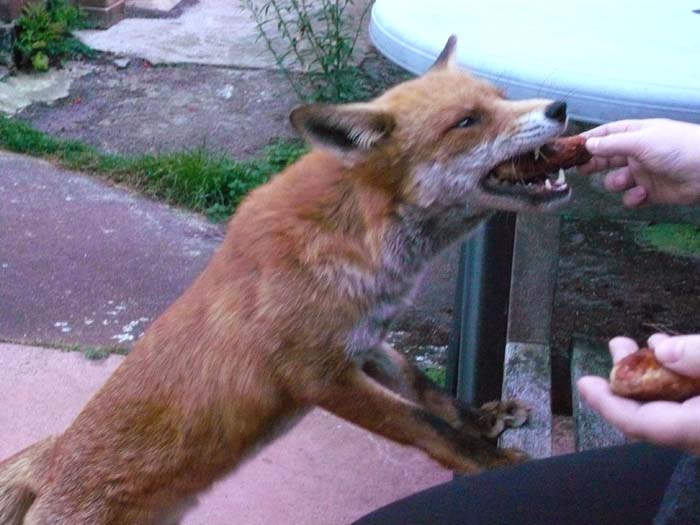
I wasn’t the only person who could feed him, but that perfect lunge was always his favourite method. Keep still and you were perfectly safe:

On occasion he was over excited and perhaps got some sausage stuck on his teeth. He would always want to clean it off straightaway:

He made several trips back to “The Den” to feed the family. On his last trip, the sausage or sausages were always for him, and he would get over excited and lick his lips in anticipation:

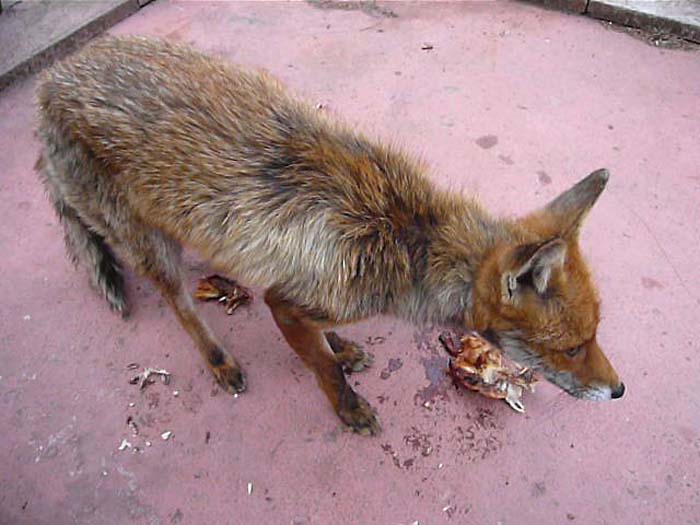
He was happy enough to eat leftovers. Here he has the carcass of a chicken, I think it is. Just look how, in this view, the early stages of his moult are easily visible:

This next picture comes seconds after the previous one. It catches Widdle in a strange pose. He has just heard a noise behind him and looks over to where the noise has come from. The angle makes it look as if he is being aggressive and snarling. But he isn’t. In actual fact, I never heard him make any noise of any kind. That pointy, sharp tooth is there though:

The noise came from next door’s cat, an old bruiser called Yin-Yang.  He was taken, as far as I know, as a young kitten, from a feral cat’s nest and brought up in a normal home. People always seem to think that foxes eat cats but Widdle and Yin-Yang didn’t ever take any notice of each other. Foxes are always extremely wary of a cat’s claws and the possibility of losing an eye in any fight with one.

Anyway, here they are, both sharing the same bits of the same chicken. Yin-Yang lived to be around seventeen or eighteen years old. He died in my daughter’s arms after some macho hero deliberately drove his car over him in front of our house. Yin-Yang was deaf, so he didn’t hear the car horn.


22 Comments

Filed under Humour, Nottingham, Personal, Widdle, Wildlife and Nature

My best friend, Widdle (2)

As you have seen in the first instalment of this story, the best animal friend I ever had was a fox called “Widdle”. He taught me more of value than 90% of my teachers ever did. And Widdle, he also learnt a little bit.

Widdle, of course, soon learnt which way his sausage was buttered.

The usual scenario was that he would be out on “Lone Hunter’s Patrol”, looking for geese and turkeys, hurtling round the gardens at top speed:

And then he would hear me calling his name :

And then he would come up the path to the patio

And then he’d let you know why he was here:

And then he’d take a sausage or two from you. He was quite prepared to touch you and he wasn’t afraid :

If he was hungry he would often eat the first one, but otherwise he would put it on the floor and then come for a second sausage. He could always be trusted to carry two sausages in his mouth, and as he grew older and more experienced, he managed to carry three. Here, he seems happy to take just two. As we human thick-heads eventually worked out, neither of them were for him:

Now for the second:

A very tricky manoeuvre :

And then it’s “Up, up and Away !!!

His wife, Mrs Widdle, will get her share of the two sausages, but only if the cubs, up to four of them usually, have had their fill. I was always 100% sure that in the rather extensive fox family, Widdle, the individual who provided all the food, was always the last to eat any.

A lesson for us all. And not just in sausage eating.


17 Comments

Filed under Humour, My Garden, My House, Personal, Widdle, Wildlife and Nature

My best friend, Widdle (1)

One summer’s day in 2007, I was sitting out on the patio when all of a sudden I looked down and there was an animal standing right next to me. It was a fox!! Latin name “Vulpes vulpes” for anybody who lives in a country where foxes are not known.

I said to him “What do you want?” “Are you hungry?” “Would you like some food?”

He looked back at me and I said, “Just stay there and I’ll go and fetch you something.”

And he stayed there and I went into kitchen, opened the door of the fridge and looked around.

Some milk. No, that’s cats.

Just a piece of apple and some cooked sausages.

That’s it. I’ll take him that. I picked up the apple and went out to feed him.

He was still there. I offered him the apple which he initially sniffed and then gave me a look of such disdain, as if to say,

“Hurry up and get back to your village. They’ll be missing their idiot.”

I went back to the fridge. I got a sausage and I took it out to him. He sniffed it and I put it on the floor. He picked it up in his mouth and off he went. Back into the beautiful green world of flowers, bushes and trees.

That sausage would be the first of literally thousands, with the occasional lump of beef, pork or chicken to stop him getting bored. I soon became an expert on sausages, their make-up, their price, their value for money. We used to buy them in some quantity. I remember once going through the checkout at Iceland (the frozen food supermarket chain, not the island nation). I was buying the usual six packets and the woman said “Do you like sausages then?”  and I replied “Not really, I feed them to a fox”.

And she looked at me with complete disdain as if to say….

“Hurry up and get back to your village. They’ll be missing their idiot.”

Little did she know, though, and little did I know, that very soon I would value our fox at ten times the value of almost all human beings. Being with him was like being with an extremely wise child who was always steps ahead of you. Somebody who could do amazing things that were as if he knew magic. Somebody who was always on his best behaviour. Who never hurt a fly. Who was a damn sight closer to God than I ever was. Here’s his four stage method to being given a sausage:

Stage 1            Look as if you’re hungry:

Stage 2           Reach for the Food of the Gods: sausage fried with extra fat :

Stage 3           Make that strange gesture with your lower jaw that is a basic part of “Talking Fox” but one which we never managed to  understand :

Stage 4    Show the kind humans your lovely brown eyes, and they’ll probably give you more sausages next time :

Sometimes, though, our new friend was nervous and he showed this by cocking his back leg against anything available, and squirting a tiny quantity of fox urine. He only did that when he was not 100% certain of our intentions, because we were human beings and potentially not as well behaved as he was. It gave him his name, though. We called him “Widdle”.

Over the next few weeks, we all grew to love him.

He was a gift from God. A wild creature who let us into his world for a few short years. We fed him morning and evening, day in, day out, and we saved his life several times. When he could not hunt because of injuries we saw to it that he was fed. Thanks to us, he had five lives.

We fed too, all of the minimum of 15 fox cubs that he raised. With a little bit of help from Mrs Widdle, of course.

25 Comments

Filed under Humour, My Garden, My House, Nottingham, Personal, Widdle, Wildlife and Nature

The Greed of the Few

A few months ago, I went into a Salvation Army charity shop, which was surprisingly crowded with people looking for second hand clothes.  I was able to buy a very large pile of old BBC wildlife magazines which dated back some six or seven years to around 2007. It was interesting to see that all the concerns those few short years ago such as worries about climate change, the loss of wildlife habitat and the extinction of various rare species were pretty much exactly the same as they are now.
It was extremely interesting, though, to read an article by a gentleman called Richard Mabey who at that time was the vice president of the Open Society.
Richard-Mabey- ccccccccccccccccccccMr.Mabey’s writing stood out from the rest as being so very different and so very perceptive. He wrote, for example, of the richness, the biodiversity, of the English language, which he said, prospers because of its very complexity and because so many words have so many different shades of meaning.
He then developed Charles Darwin’s phrase, the “Survival of the Fittest”. Quite rightly, he made the point that, in the past, this simplistic idea has been used to justify Communist oppression, worldwide slavery and the persecution of the Jews. Mr Mabey extended this idea though, to the present day, with the observation that the phrase is nowadays being used to excuse the ruthless greed that runs unchecked through the world economic system. One banker recently proclaimed, for example, that the forces of the free market are merely the “Survival of the Fittest”.
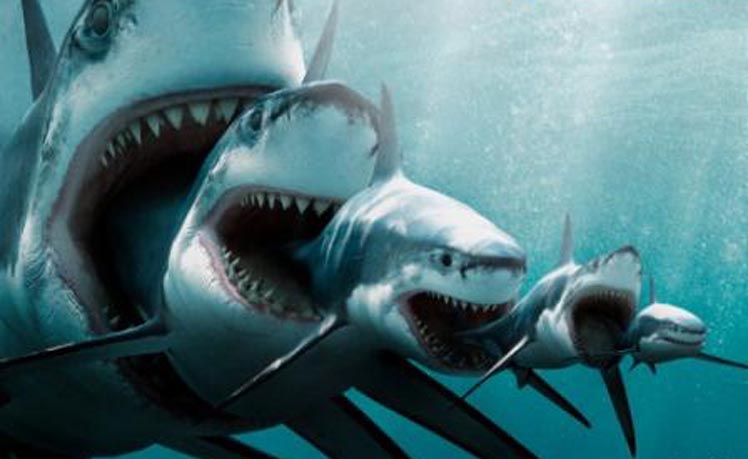
sharks xxxxxxxxxxxxxxxxxxxxxxxxxxxxxxxThe most interesting point then made though, is that in nature, predation apart, one member of a species will hardly ever prove its fitness by directly killing another, weaker, member of that species. Mr Mabey argued, for example, that few, if any, animals indulge in bloody combat. Birds do not physically fight each other, but compete with song. Snakes may wrestle, but they do not usually use their fangs, and deer will not prolong their potentially life-threatening arguments, if their opponent exposes his unprotected flanks in a gesture of surrender.
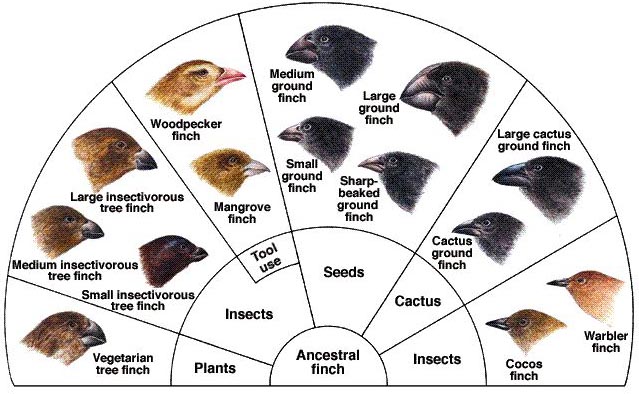
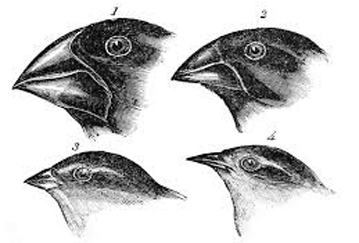
When Darwin observed his famous finches in the Galapagos Islands, the thirteen different types of bird were not trying to eliminate each other forever, but instead were living more or less happily alongside each other.
They may have had differently sized or shaped bills, but all the birds were capable of exploiting slightly different food sources. Some birds drank nectar from cactuses. Some birds ate cactus seeds. Some birds stripped bark or chewed leaves or sought out ticks to eat. But all of these creatures were managing to survive alongside each other.
fich fanccccccccccccccccccccccccccc
Different species will all be forced to fight their environment, but in the main, they are able to coexist together because of only slight differences between each one of them, differences which in the course of their lives, will always prevent direct competition.

darwin finches ccccccc
In contrast, as Richard Mabey points out, the lack of regulation in financial markets merely allows the ambition and greed of a very small, very privileged and very hostile few to flourish without limit and without restraint. The financial world is then dominated by a very small number of what in nature would be seen as an aggressive super species. And it is ridiculous, of course, to justify this sad situation by bringing Charles Darwin into the argument.
Darwin’s Theory of Evolution is the complete opposite of this. Evolution produces tens of thousands, if not more, separate species, all of which to a greater or lesser extent, can exist alongside each other.
And to apply Richard Mabey’s arguments to the everyday human sphere, it does not take a major genius to work out that we may eventually finish up with, for example, just three or four gigantic supermarkets who will be able to dictate completely what we should buy and what we should eat.
4 supermarkets_cccccccThere will be few specialist small businesses, selling their own spicy sausages made in the back of the shop, or cakes that the owner’s wife and family have made at home. There will be no handmade wooden toys for children, built by local craftsmen using their ideas as to what will be liked by their little customers. No health food shops selling organic food made by workers’ co-operatives. No butchers selling local meat and supporting local farmers by paying them a proper and decent price for what they have produced. No market stall which sells both British and Indian made fabrics, which young dressmakers can make into whatever they want.
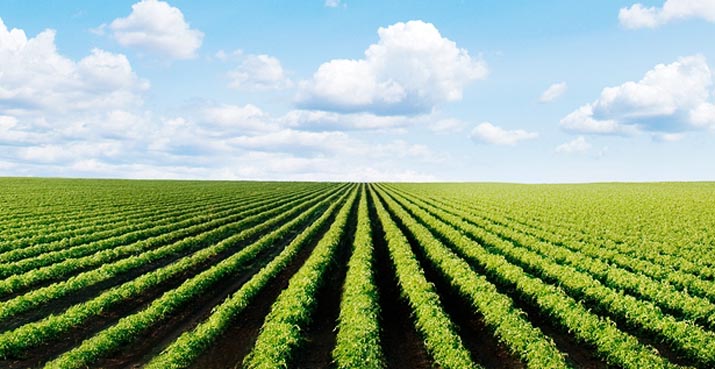
Farmers will be driven to abandon all idea of leaving untended spaces where wild animals, birds, insects and butterflies can live. How can they afford to do this when a major supermarket offers them just four pence for a cauliflower, a price recently quoted to me by a Cornish farmer?cultivated fieldTake it even further and we will have a situation where bankers, whatever their performance, will be able to award themselves gigantic bonuses every single year. Vast corporations will employ armies of people, the majority of whom will be earning the minimum wage, which is itself lower, of course, than the living wage.
And all this because of greed-stricken people, programmed only to make the maximum amount of money, with precious few reasons that they can remember about why they have to do it.


1 Comment

Filed under Politics, Science, Wildlife and Nature

Sausages for tea, and lots of ’em!

Last night I once again sat down to watch my heroes, the Hillbilly Hunters, set off in quest of monsters, this time to Hocking Hills, Ohio, in search of the legendary Hogzilla.

big castThis thousand pound porker is a hybrid of two closely related animals. His fierceness comes from the introduced feral pig that the Americans call by many different epithets, including the Russian Boar, the Razorback, or the enchanting “Pineywoods Rooter”.  His size comes from the huge, overfed and genetically modified farm pigs, such as we see in the fields as we drive north of Nottingham on the A614. The American equivalent is the beautifully deep red coloured “Duroc pig”.
Given his enormous size, his sharp, twelve inch long tusks and his desperately aggressive temperament, Hogzilla is a genuinely fearsome beast who will kill you if he can, and eat you if he is hungry.
The task is defined here…

http://www.youtube.com/watch?v=VNhWrVAlsMs
Here are the first stages of the final night hunt…

And, for the first time ever, SUCCESS!!!!!
“Hogzilla” is suddenly “Trapzilla”.

Within a couple of days, he will make 500lb  of sausages. Hurrah!!!

bill and knifexxxx
On a more serious note though, towards the end of the third video, Trapper make some very pertinent comments about the accuracy of the evidence given by even the most honest of eyewitnesses, especially when they are frightened.

Leave a comment

Filed under Cryptozoology, Humour, Nottingham, Wildlife and Nature