
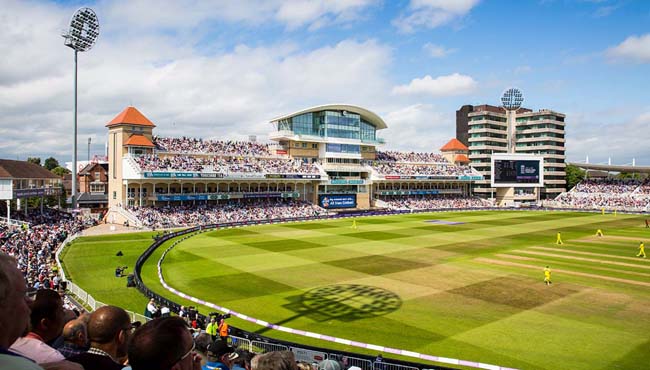
First class cricket has a very long history in England, and Nottinghamshire is one of the oldest counties. Teams of that name have, in fact, played cricket since at least 1835. During that time, they have played their home games at a world famous ground called Trent Bridge……
One of their most famous, and colourful, nineteenth century players was Mordecai Sherwin who was born in 1851 and died in 1910. In the wintertime, when cricket was impossible because of the weather, “Mordy”, an expert at catching a moving ball, actually played football for Notts County, the local football club. He was very agile and, despite weighing seventeen stones (238 pounds, 108 kilos), he always played as a goalkeeper. Even though he carried a lot of weight, every time that Notts County scored a goal, he would treat the crowd to a cartwheel.
In those days, goalkeepers could be barged into the net to score a goal, so Mordy’s weight frequently came in useful. On one famous occasion, the Blackburn Rovers outside right, Joe Lofthouse, barged him, but merely bounced off. Sherwin famously said:
“Young man, you’ll hurt yourself if you do that again.”
A little while later, Lofthouse tried his luck again, but Mordy stepped aside and Lofthouse collided with the goalpost and cut himself .
Mordy was much more famous, though, as a first class cricketer for his native county. He played 328 times for Nottinghamshire and three times for England in international “Test” matches. He scored 2362 runs as a batsman and as a wicketkeeper he caught 616 batsmen and stumped 227. We have not looked at stumpings but it is basically a way which only the wicketkeeper can use to dismiss the batsman. If the batsman tries to hit the ball but misses it, the wicketkeeper can catch it and knock the wicket over himself, but only if the batsman has wandered too far down the pitch, beyond the special white line, about a yard or so from the wicket. Here’s Mordecai. You can just about see the white line for stumpings…..

During Mordy’s golden years, one of Nottinghamshire’s most effective bowlers was called Francis “Frank” Joseph Shacklock (1861-1937). He played for Nottinghamshire from 1886-1893 and took around 120 wickets. In his entire career, playing also for Derbyshire, the MCC/Marylebone Cricket Club and Otago in New Zealand, he took 497 wickets.
It didn’t take me too long to find some examples of Frank Shacklock’s partnership with Mordy Sherwin as they played together for Nottinghamshire.
These scorecards come from the annually appearing almanac of cricket entitled “Wisden”. Here is part of the scorecard for a Nottinghamshire v Sussex game in July 1891:
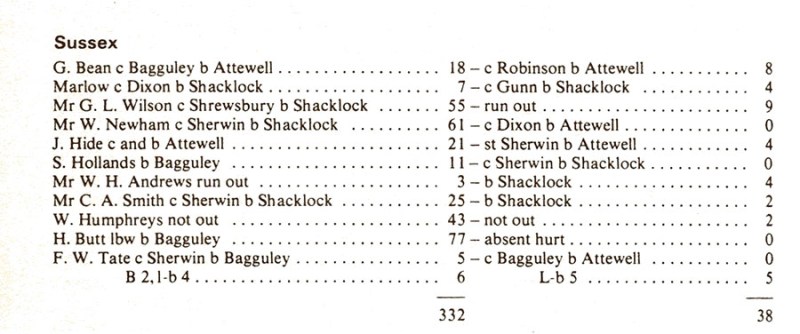
In this game, Shacklock managed eight wickets for 144 runs, with four in the first innings (in a a total of 332 runs by Sussex) and four more in the second (a pathetic 38). That is a remarkable difference in the two innings totals for Sussex. Below are the bowling statistics. Shacklock took his four wickets in the first innings at a cost of 117 runs but at a cost of only 27 runs in the second. :

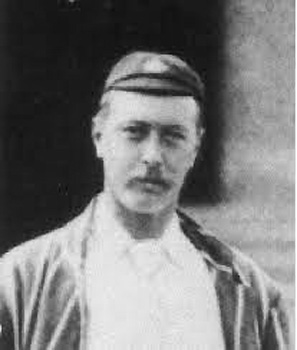
Here’s Frank Shacklock :
In this next game, Shacklock took nine wickets in the match, which was a fixture against Somerset in June 1892. First come the statistics for Nottinghamshire’s two innings, and then Somerset’s two innings. Look how many times the phrase “b Shacklock” appears, particularly in the second Somerset innings of just under one hundred……
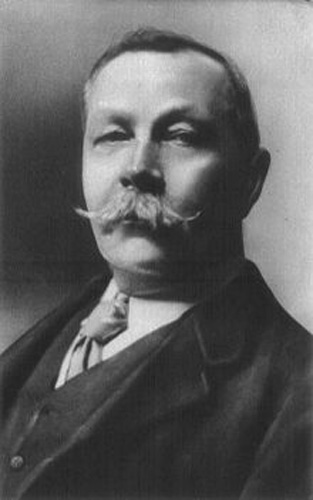
 A frequent visitor to watch Nottinghamshire cricket at Trent Bridge around this time was an up-and-coming young author called Arthur Conan Doyle. Arthur was a huge sports fan. He actually played in ten first class cricket matches with a highest score of 43 and just one wicket as a bowler, that of WG Grace, the greatest cricketer in the world at the time. Arthur enjoyed bodybuilding and he was an amateur boxer as well as a keen skier, a talented billiards player, a golfer and, in amateur football, a goalkeeper for Portsmouth FC, the predecessor of the present club. Here he is:
Arthur had enormous regard for the wicketkeeping skills of Mordecai Sherwin and the bowling skills of Frank Shacklock. He was very much taken with how frequently batsmen were out, “caught Sherwin bowled Shacklock”.
Arthur decided that he would commemorate the skills of these two cricketers in the forthcoming detective novel he was about to start writing. The book was to be called “A Study in Scarlet” and it would appear in 1887. The best idea, Arthur thought, would be to have “caught Sherwin bowled Shacklock” become an important part of the book. One way of doing this would be to use the two men’s names in the name of the book’s hero, by taking the first syllable from one cricketer’s surname and the second one from the second cricketr’s surname. An excellent idea, although his first effort was a very poor one, it must be said. Who could admire a detective with the first name “Shackwin” ?
And so…….Arthur Conan Doyle turned the name on its head, came up with “Sherlock”, and the famous detective, Sherlock Holmes, was born.
“But what’s the connection between Mordecai Sherwin, Frank Shacklock and a Victorian pub called the Grove”, I hear you all ask. Well, with the money he had made playing cricket, Mordecai Sherwin bought the Grove pub. I have only got a few photographs from its very last days…

…..but it would have been a nice pub during the last few years of Queen Victoria’s reign. And I cannot imagine that with a character like Mordecai in charge, his old pal rank Shacklock didn’t come along every now and again for some free ale!
Next time, two other major characters in Sherlock Holmes stories who arrived directly from a fine bowling performance at Lord’s, probably witnessed by Arthur Conann Doyle, who was a member of the Marylebone Cricket Club and who would have visited this famous old ground on many occasions.



 John Knifton