Before the sudden advent of the huge electric amusement machines around 1900, exotic animals were a firm favourite of the Goose Fair hordes………
The big problem, of course, was the fact that, in the desire to exhibit the most unusual animals, the owners of the animals would often end up by going to an animal market and buying a creature that they themselves could not identify. So sit back and enjoy my own attempts to work out what the unknown animal really was………
Let’s start with……..
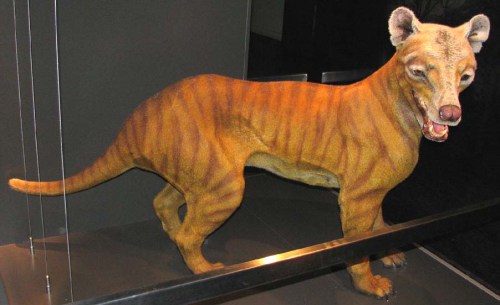
“Tiger Wolves direct from the Black Rocks of Abyssinia”. These were shown in Day’s “No 1 Royal Menagerie” in 1898 as a “Group of Wild and ferocious Tiger Wolves direct from the Black Rocks of Abyssinia”. Alongside them was a group of Baby Lions”.
There are wolves in Ethiopia, but they are red, so much so that they are also called “the Simien fox or Simien jackal or horse jackal”. Intriguingly, at this time, the name “Tiger-Wolf” was the accepted shortened form of “Tasmanian Tiger-Wolf”. This phrase was used to refer to the Thylacine, an unbelievably rare Australian animal to turn up in a fair in Nottingham. I really do wonder what these animals were!
A slightly less colourful one:
I think you’re getting the idea…..
Day’s “No 1 Royal Menagerie” also had “Blonko Bill, King of the Lion Tamers” working for them.” I have been unable to trace the meaning of “blonko”, although if ever a word sounded like Australian slang, this is it! The internet was no help. One site said it meant “kind, entertaining, handsome”, another said it meant “fat, fat, fat”.
In 1899, Bostock & Wombwell produced a special poster listing all of their animals, including the “Great Pongo Baboon, or Hairy Wild Man”. Intriguingly, “Pongo” is the scientific name for the orangutan, thought to be a close relative of Bigfoot, hence the “Hairy Wild Man” epithet:
This slideshow requires JavaScript.
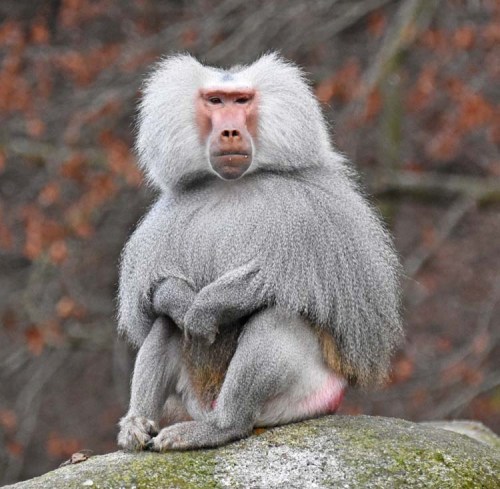
Another strange sounding animal on the Bostock & Wombwell poster was the “Hamadryas, or Sacred Baboon” although, ironically, it is very simple. The poster is referring to the Hamadryas Baboon from the Horn of Africa and the southwestern region of the Arabian Peninsula. You can just see the side of his bright scarlet posterior……
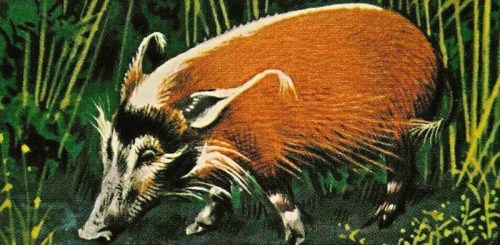
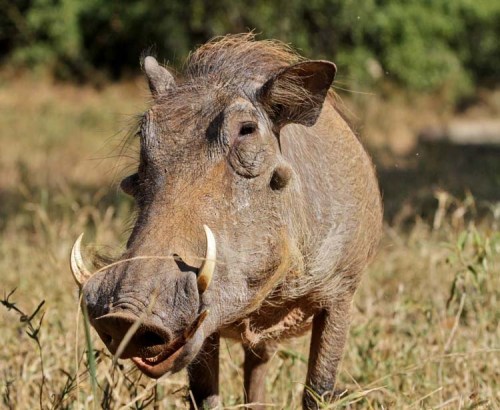
The same owners had a “Chiropottamus, or Vlacko-Vark” which is merely a sort of wild pig. It may be the Red River Hog, “a wild member of the pig family living in the Guinean and Congolian forests. Here’s the old Brooke Bond tea card from the “Wild Animals of Africa” collection….
Alternatively, it may be the warthog which is the “vlakvark” in Afrikaans…..
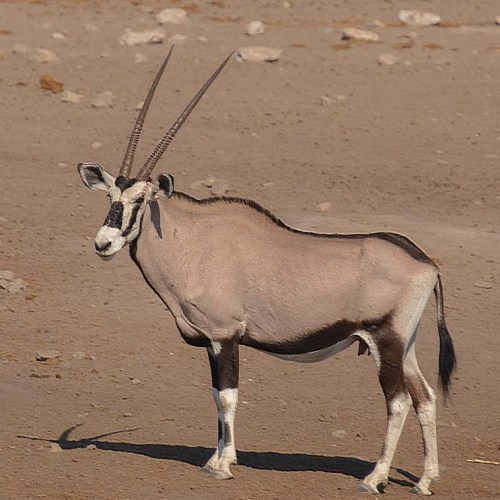
A “Leucoryx Antelope” sounds a very strange beast but it is also called the “Gemsboc” on the poster. And the “Gemsboc is the gemsbok, gemsbuck or South African oryx, native to the arid regions of Southern Africa, such as the Kalahari Desert. It is a very beautiful animal….
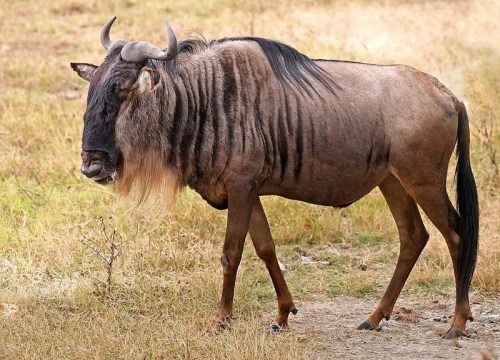
The “Brindled Gnu, or Horned Horse” is a lot easier, because we have all seen this strange word. Not totally unexpectedly, the Brindled Gnu is the blue wildebeest, also called the common wildebeest, the white-bearded wildebeest or the white-bearded gnu. It is one of the two species of wildebeest…..
The Bostock & Wombwell poster advertises a “White Silken Sacred Yak” which would have been a pure white yak. Nowadays, some 5% of the herds are white. They are regarded as an extremely auspicious animal since white represents light, a personification of the illumination of wisdom and the universal Buddha……
Some animals are very easy to sort out.
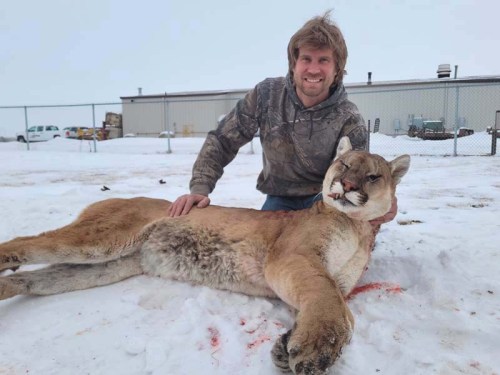
A “Puma or Silver Lion” was presumably a North American mountain lion, cougar or puma. Here’s a lovely picture of one of the first ever mountain lions to be found in North Dakota…..
A “Jaguar or Clouded Tiger” is nowadays called a “jaguar” or a “clouded leopard”……
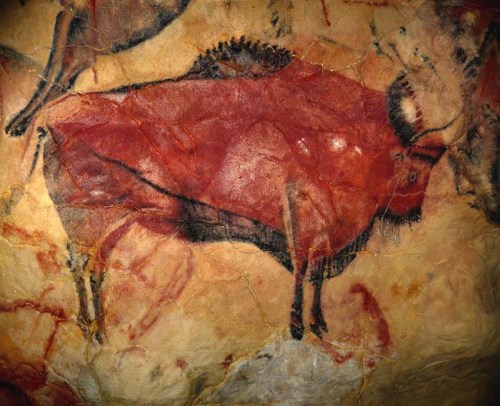
A “Bison, or Wild Prairie Bull” is most probably the North American bison…..
A “Monstre Nennock” sounds incomprehensible, but the alternate names give it away, with “Arctic Sea Bear” making it the polar bear. It would be nice to know what a nennock is, though. Incidentally, I’ve just turned my slides into digital photographs, photoshopped them to make them a little lighter and got rid of the hairs and general dirt. So, here is a nennock or two at Basel Zoo in Switzerland in 1979….
Two final animals though, are most intriguing. Just what were the “Hideous Aswaila”, or “Himalayan Monsters”? Were they a family group of yetis? I bet they were, but the people of the time did not know what yeti was…….
And last of all. What on earth were “Lorenzo’s Performing and Talking Bears”? Were they a family group of Bigfoots? Using their famous “Samurai Chatter” to pass comment about Nottingham and its inhabitants? Here’s a youtube video, and if you move swiftly to 4 minutes exactly, you’ll hear what “Samurai Chatter” is. At 4.40, you can hear the Bigfoot walking around the cabin. It’s really scary!
This is the third instalment of the story of the Beast of Ennerdale, a strange creature that rampaged across the Lake District in north western England in 1810. In five months, it killed almost 300 sheep, often just eating their soft organs and then lapping up their blood. The story of its ravages is told in the first two parts of this series:
Nowadays, we have almost an almost unbelievable ability to make contact with each other instantly right across the globe. Furthermore, we have immediate instant access to unbelievable amounts of knowledge and information.
Until very recently though, that was just not the case. There was no television. No radio. No access to books. Most people were illiterate, especially in the countryside. Nobody knew very much at all about natural history outside their own country. Contrast our situation with life outside London in 1198. Richard the Lionheart was the English king then, and he was the proud owner of his very own private zoo in the Tower of London. Richard had been on the Crusades and he must have known a little bit about some of the wildlife in the Middle East. Perhaps that was the reason that he had a pet crocodile in his collection of animals:
One day, the animal escaped. It somehow made its way to the marshes of north Essex. The reaction of the locals, of course, was that a dragon had come to visit them:
And what would the shepherds of the Lake District made of a giraffe? The very first one ever to be seen in England had only arrived on August 11, 1827, less than 200 years ago, and well after the début of the Beast of Ennerdale:
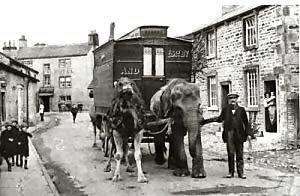
During the period of the Beast of Ennerdale, the whole country was visited by many travelling zoos. The cages were transported on wagons which were pulled around the countryside by horses. Conditions, of course, were appalling. The cages were cramped and the horses that pulled the wagons were grossly overworked. No animal rights in those days. The Church taught that animals had no souls, so what you did to them was simply irrelevant. Work them until they drop and then leave them to die. And then you can eat them.
The most famous of these travelling zoos was Wombwell’s Travelling Menagerie, which had a total of fifteen wagons and a large number of exotic animals. Wombwell bought them directly from ships as they arrived in England. They included elephants, giraffes, a gorilla, a hyena, a kangaroo, several leopards, a number of lions, llamas, monkeys, ocelots, onagers (what?), ostriches, panthers, various snakes, tigers, wildcats and zebras:
Wombwell had a number of snow leopards and his rhino was publicised as “the real unicorn of scripture”. Other faulty labelling is actually known to have cost him money. What he exhibited as a chimpanzee is now thought to have been the first ever Gorilla to be seen in Western Europe.
Here is a link to the story of George Wombwell told by Wikipedia. It really is worth a look, with some really funny anecdotes on offer:
All of these menageries were rather careless with their animals and escapes were not infrequent. In 1835, for example, a lion and a tigress escaped together and four people were killed. And that is what takes us back to the Beast of Ennerdale.
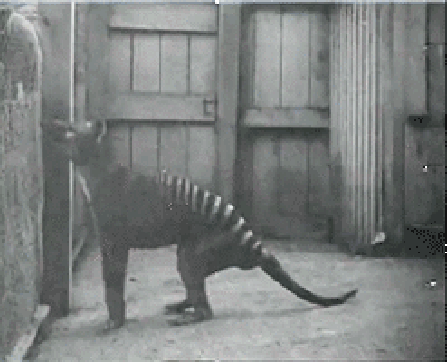
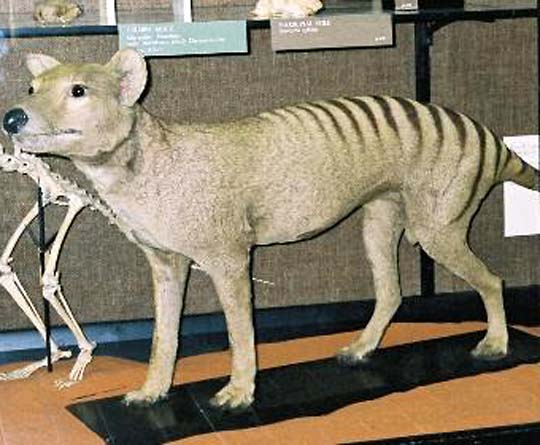
Apparently a number of the different travelling menageries had creatures which were exhibited as “tiger wolves”. Nowadays these animals are thought to have been thylacines, the so called “Tasmanian Tiger” or “Tasmanian Wolf”.
Here is a brief film, thanks to the Thylacine Museum:
The Museum also has a video where the extremely talented animal is apparently playing a piano, harpsichord type of thing:
So that is it! Mystery solved! The Beast of Ennerdale was an escaped Thylacine.
Nowadays, the Thylacine is extinct, of course. The last known specimen, “Benjamin”, died in captivity in Hobart Zoo on September 7th 1936:
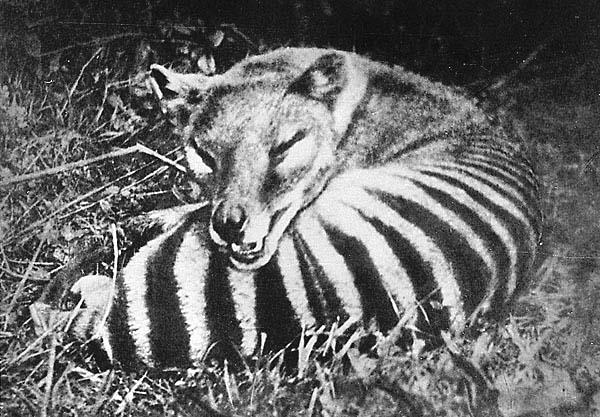
The Thylacine had dark stripes over its back and could be up to eight or nine feet in length:
It was a marsupial which looked vaguely like a wolf and it ate flesh. It preferred the softer flesh to tougher meat such as the muscles.
The Thylacine was an apex predator and it was mainly nocturnal. Its behaviour was just like the Beast of Ennerdale because it retreated to the hills and woodlands in the daytime, avoiding contact with humans. It spent the daylight hours in caves or hollow tree trunks, sleeping on twigs or plant stalks. At night, it hunted the open heathland:
Supposedly, back in the wilds of Tasmania, it happily preyed upon farmers’ sheep and poultry and apparently liked to drink the blood of its prey.
And with that information, I really thought that I had found a solution for the identity of the Beast of Ennerdale. I really did. I really, really did:
A second level of internet research, though, shows that more or less all of the answers which have been suggested by the many websites which discuss the Beast of Ennerdale are most probably entirely wrong. The explanation of an escaped Thylacine is a very neat one, but modern science just dismisses it totally and completely.
Firstly, the blood drinking story seems to have originated merely from a single account heard at second-hand by Geoffrey Smith (1881–1916) in a shepherd’s hut in Tasmania. Not exactly a proven piece of Thylacine behaviour, certainly not enough to identify this creature’s presence in Ennerdale.
And killing and/or eating sheep? Well not really, apparently. Modern studies have now shown that the creature had the jaws of a wimp, not a wolf. It couldn’t have dealt with a dead sheep. Advanced computer modelling in 2011 showed that its prey size limit would have been in the region of only five kilos, animals such as the tiny possum:
And here is a link to a second study from 2012, “Tasmanian tiger was no sheep killer”. These are not just amateurs’ guesses picked out of the air, of course. These are both scientific papers, published for the judgement of the zoological world. They would not have been published in reputable journals if they were not serious research carried out by serious scientists.
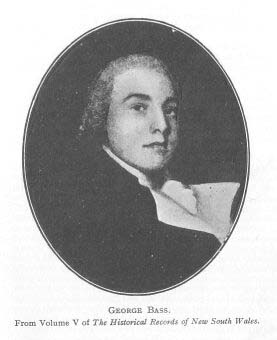
Instead, the Thylacine is seen nowadays as having been just a scapegoat for the widespread mismanagement of sheep farms in Tasmania. Furthermore, the killing of sheep was far more probably carried out by the European dogs which had first reached Tasmania in 1798 with the arrival of the explorer George Bass and a number of seal hunters:
These men’s sled dogs interbred and their offspring subsequently dispersed into the temperate rain forest of the island. Some dogs were befriended by the aborigines but the majority just went wild.
During the period when Europeans were first coming across the Thylacine, therefore, there was already a population of feral dogs in Tasmania. They are far more likely to have been the animals responsible for the killings of sheep on the island, rather than the Thylacine. It was just easier for Europeans to blame a weird new animal than “man’s best friend”.
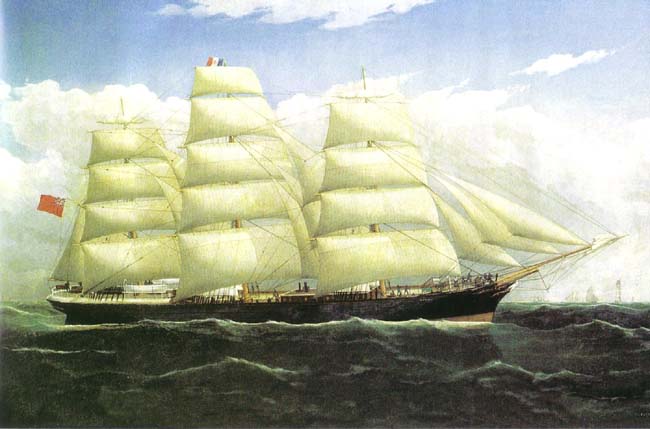
And what about the time schedule? How could a Thylacine have reached Cumberland for May 1810? At this time, the very best ships took a minimum of three months to reach Australia and a further three months to return to England:
The first thylacine had been seen by the French on May 13th 1792. They would not have told the English because, surprise, surprise, the two nations were at war with one another. More than ten years later, the Lieutenant Governor of Tasmania sent the first full description of the animal for publication in the Sydney Gazette of April 21st 1805:
At that time, it was not a particularly familiar animal to the European people on the island. In June 1805, five convicts escaped from the only recently established penal colony. The establishment’s pastor, Robert Knopwood, wrote in his journal on June 18th 1805, shortly after the convicts had been recaptured:
“Am engaged all the morn, upon business examining the 5 prisoners that went into the bush. They informed me that on 2 May when they were in the wood they see a large tyger that the dog they had with them went nearly up to it and when the tyger see the men which were about 100 yards away from it, it went away I make no doubt but here are many wild animals which we have not yet seen”
At this point, in 1805, no Thylacine had been captured. It had only been briefly glimpsed at a hundred yards’ range. Tasmania was the size of Ireland and more or less completely covered in forest, with only one small settlement of convicts. How on earth could a Thylacine have reached Ennerdale by 1810? Just look at the timetable:
“Captured in Tasmania, in 1806 at the earliest—shipped to Sydney—sent to England—didn’t die on the three month journey—bought by a zoo keeper in London—taken by horse drawn cart to the north (three or four weeks?)—escaped—seen in Cumberland, doing things we now know a Thylacine could not do”
Not very likely is it?
Anyway, here is a nice longer film of a Thylacine from LINCTasmania. It dates from 1964 and is a wonderful period piece, well worth watching, just for the accents and the product placement :
And finally, here are two videos about the Thylacine from my hero, MK Davis, the man who has been called “The Hippy from Mississippi”. He is a photographic analyst and is well worth your time. The first film is an analysis of a modern home movie, purporting to show an animal which may be a living, surviving Thylacine:
The second film from MK shows his thoughts on where Thylacines may survive nowadays:
And the Beast of Ennerdale? Well, the locals at the time thought it was a feral dog, and they may well have been right:
“No one knew to whom the dog had belonged, or whence he came ; but being of a mongrel breed, and excessively shy, it was conjectured he had escaped from the chain of some gipsy troop. He was a smooth-haired dog, of a tawny mouse colour, with dark streaks, in tiger fashion, over his hide ; and appeared to be a cross between mastiff and greyhound. Strongly built and of good speed, being both well fed and well exercised, his endurance was very great.”
On the other hand, unlike most dogs that I know, the Beast was never heard to bark, growl or howl. And why would you go to the considerable expense of stuffing the corpse and displaying it in Hutton’s Museum in Keswick if it were just “a cross between mastiff and greyhound”. Perhaps the Beast of Ennerdale was the Beast of Gévaudan on his holidays.
“C’était comme un chien, mais ce n’était pas un chien”…
















 John Knifton