Tag Archives: Woodville

Off to the Great War (Part One)

I have already mentioned in a previous blog post that my Grandfather, Will Knifton, emigrated to Canada in an unknown year before the Great War. Conceivably, he was with his elder brother, John Knifton, or more likely perhaps, John went across the Atlantic first and then Will joined him later on. I have only two pieces of evidence to go on.

Firstly, it is recorded that a John Knifton landed in Canada on May 9th 1907. His ship was the “Lake Manitoba” and he was twenty three years of age. His nationality is listed in the Canadian records as English.

On the other hand, I still have an old Bible belonging to my Grandfather, which says inside the front cover,

“the Teachers and Scholars of the Wesleyan Sunday School, Church Gresley, given to him as a token of appreciation for services rendered to the above School, and with sincerest wishes for his future happiness and prosperity. March 26th 1911.”

Whatever the truth of his arrival, Will lived at 266, Symington Avenue, Toronto. He then worked as a locomotive fireman on the Canadian Pacific Railways, between Chapleau, Ontario, right across the Great Plains to Winnipeg. He also talked many times of the town of Moose Jaw, although he never supplied any details that I can remember:

cab paint

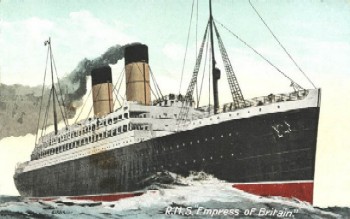
Will joined the Canadian Army on June 12th 1916 at the Toronto Recruiting Depôt. He sailed from Canada for the Western Front on July 16th 1916 on the “S.S.Empress of Britain”:
ss_empress_of_britain

For many years, Will had courted a local English girl called Fanny Smith, the daughter of Levi Smith, a labourer in a clay hole in the area around the village of Woodville, in South Derbyshire, where they all lived. Will wrote to her from Canada and then, during his time in the army, he sent her regular postcards from France. During his leaves from the front, he always returned to see her and they married on July 15th 1917:

This slideshow requires JavaScript.

I still have quite a few of Will’s postcards. He had clearly bought this postcard just before he left Canada for England and the Great War:

montrealbxxxxxxxxxxxxx

He used to speak enthusiastically about Montreal and especially about the famous Hôtel Frontenac:

Château_Frontenac_02

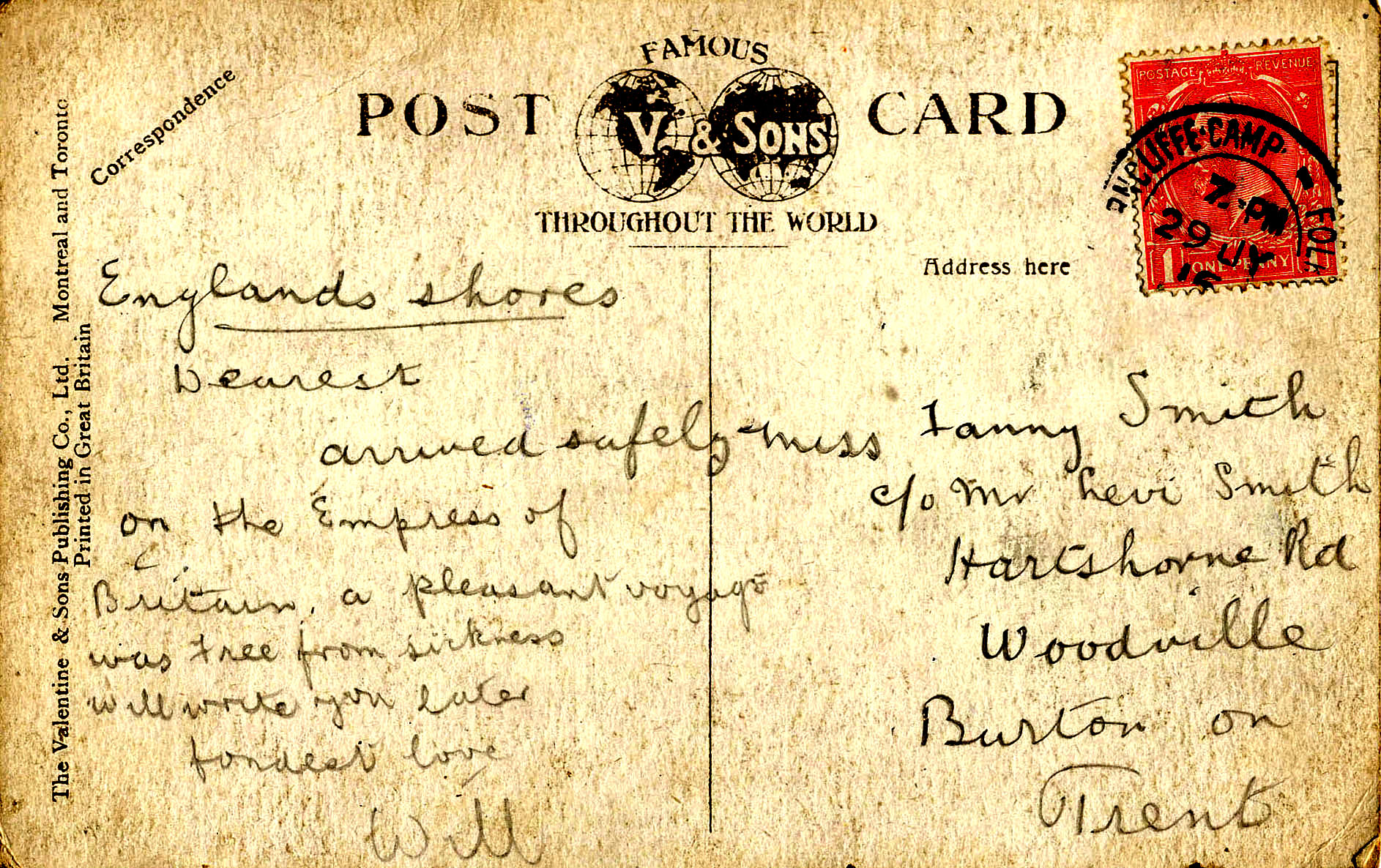
On July 25th, Will duly arrived in England, and was taken on strength into the army at Shorncliffe in Kent. He posted his postcard of Montreal soon after he arrived at Shorncliffe Camp in Folkestone, Kent, at 7.00 pm on July 27th 1916. Here is the back of it:
shrncliffe campxxxxxxxxxxxxxxxxx

The message reads:

Englands shores   Dearest, arrived safely on the Empress of Britain, a pleasant voyage was free from sickness will write you later fondest love Will”.

Notice how Will is beginning to become a Canadian with his unusual lack of a preposition in “will write you later”.

Shorncliffe Camp was where Will, and many other young men, were to train for France and the Western Front. Having mentioned the idea of being sick in his previous postcard, Will continues the romantic mood with a picture of the men and horses of the Canadian Field Artillery drilling hard on the parade ground:

canadian cannons sepiaxxxxxxxxxx

The reverse is here:

reverse of shoercliffexxxxxxxxxxxxxxxxxxxxxxx

Will manages to make a charming juxtaposition of “men and horses at drill with the big guns” and “Fondest thoughts” to his true love. (And she really was his true love.)

Will began his training at Shorncliffe on July 27th and he remained there until November 17th 1916. The schedule for basic training makes interesting reading nowadays. This particular week was the one ending June 5th 1915, and it is difficult to imagine that Will would have done anything substantially different just over a year later:

Monday 

(6.30-7.00 am)                          Squad drill without arms

(8.00-9.00 am)                         Physical Training

(9.00-9.30 am)                          Bayonet Fighting

(9.30-10.00 am)                        Rapid loading

(10.00-12.00 am)                      Company Training

afternoon                                 as for morning less ½ hour squad drill

Tuesday

morning                                   as for Monday

afternoon                                Entrenching  (2 Companies), remainder as for Monday

Night March

Wednesday

morning                                   as for Monday

afternoon                                 Entrenching  (2 Companies), remainder as for Monday

Thursday                                  all day                      Battalion field training

Friday 

morning                                    as for Monday

afternoon                                 as for Monday

Saturday 

morning                                   as for Monday, less afternoon (holiday)

(If this were a restaurant, you would only go there once, wouldn’t you?)

Will’s next postcard continues the hearts and flowers theme with a photograph of the men’s tents.

Will’s own tent is marked with a cross:

tentxxxxxxxxxxxxxxxxxxxxxxxxx

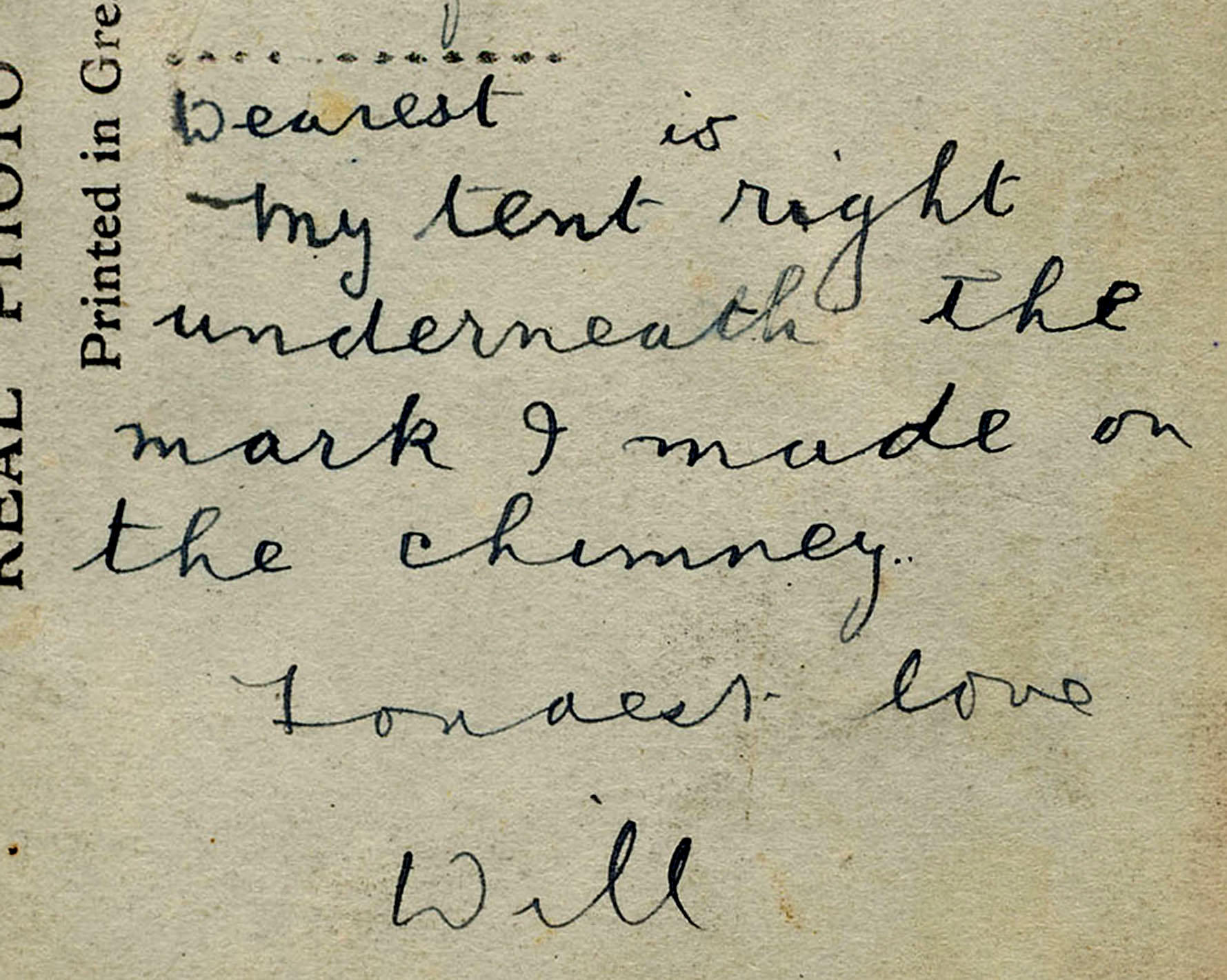
This is the reverse side of this postcard. Firstly, as Fanny received it:
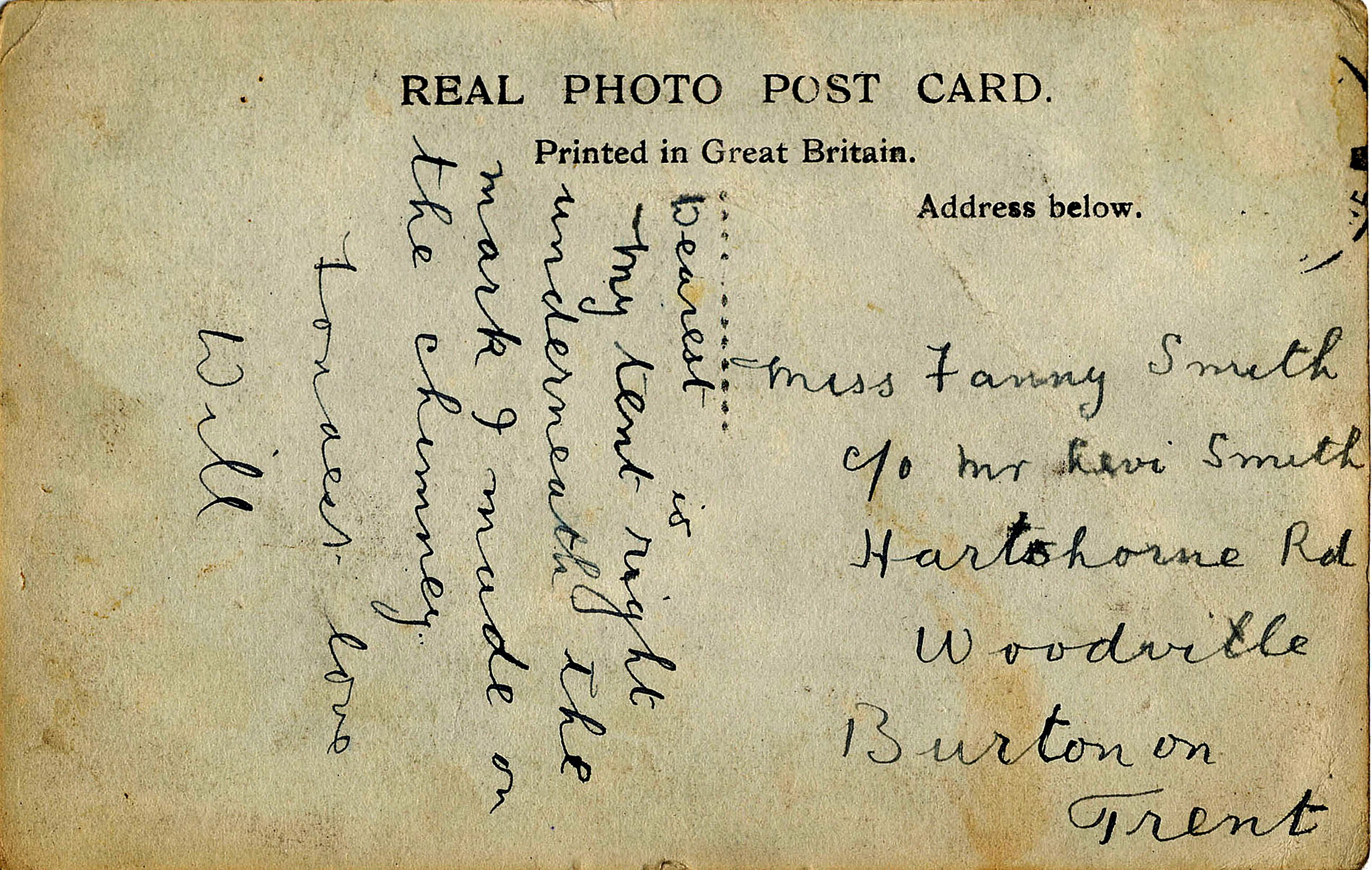
back of tentxxxxxxxxxxxxxxxxxxxxxxx

And here is the message enlarged:

back of tent2xxxxxxxxxxxxxxxxxxxxxxxxxxxx

Will remained at Shorncliffe until November 17th. He sent his girlfriend, or perhaps by now, his fiancée, some more post cards before he left. We will look at them in the near future.



22 Comments

Filed under Canada, France, History, Personal

Hallowe’en Nights (4) Three ghosts from my past

My father was called Fred Knifton. He lived from 1922-2003, for the most part in Hartshorne Road, Woodville, which is to the south of Derby and Nottingham, in the East Midlands.

This slideshow requires JavaScript.

Woodville at the time was a village of some 5,000 people. It was exactly on the edge of  a geological fault line, so to the west, coarse, heavy clay was mined in opencast quarries, and sewer pipes and drainpipes were manufactured. To the east there was no clay, but instead there were open green fields with Friesian cattle and tall hedges of hawthorn.

SLD_Herd ddddddd

Although as far as I know he never experienced any of the RAF’s many ghostly occurrences, Fred once told me that there was a well-known haunted hangar somewhere out there in East Anglia, possibly in Norfolk, where mechanics as they repaired aircraft late at night, would often hear dance music, even though of course, there was no orchestra within miles.

A modern day equivalent may well have been the occasion when I stood at the bathroom sink one summer’s morning, a good few years after Fred’s death, looking out over the roof tops of Nottingham. I was listening to “American Patrol” being played by the Glenn Miller Orchestra on a CD.

This moment suddenly gave me probably the most distinctive feeling of “déjà vu” I have ever had. I have wondered ever since whether my father had perhaps done exactly the same thing on some airbase in Lincolnshire on a long forgotten day some sixty or so years previously.

Strangely enough, for a man who always had so many tales to tell, ghosts and phantoms did not feature particularly highly in Fred’s repertoire, and I would struggle to think of any direct reference he ever made about the afterlife, although I am sure that he was aware of the alleged haunted house down near the Bull’s Head Inn in Hartshorne.

As a native of nearby Woodville, Fred would certainly have heard all the tales of the phantom attached to this large black and white timber framed Elizabethan house which stood between the old Georgian coaching inn and the Anglo-Saxon church in the middle of Hartshorne.

This slideshow requires JavaScript.

Apparently, the story was often told of how….

“A brave group of people, made curious by the many ghostly accounts of bumps in the night, had gone up into the attic, unvisited through many decades of neglect, and found furniture piled up across the entire room. On the inaccessible far wall of the room, there was a delicate but obvious print in the centuries old dust, the unmistakeable impression of a ghostly human hand. Nobody could possibly have penetrated the great mass of tables, chairs and rubbish stacked across the floor. It could only have been the work of a phantom. ”

In 1970, I experienced an extremely strange happening when I accompanied my father, Fred, down to his parents’ house at number 39, Hartshorne Road. Fred’s parents, Will and Fanny, had both recently died recently within a few months of each other in hospital at Burton-on-Trent, with Fanny remaining mercifully unaware of Will’s demise after more than sixty years of marriage.

This slideshow requires JavaScript.

Fred was paying regular visits to the property, presumably attempting little by little to clear the house out so that it could be resold. At the time, as a teenager of some sixteen  years of age, I was unaware of this, although, with the benefit of hindsight, I wish I had been, and I could perhaps have stopped Fred from throwing away so many of his father Will’s Great War souvenirs, such as his complete Canadian Army uniform, his German soldier’s leather belt and his extensive collection of German guns and ammunition.

We entered the deserted house through the front door, and as I walked along the hallway towards the kitchen, I distinctly heard the upstairs toilet flush. I turned round and asked Fred, who had been following me into the hall, how this could have happened, and who it could have been, given that we both knew that the house was locked up and empty.

Fred gave me some non-committal answer at the time, but afterwards, perhaps when he had regained his composure a little, he told me that, as he was some way behind me, he had been able to look up the stairs when he heard the sudden noise of the toilet being flushed. He had distinctly seen his recently deceased father, Will, walk out of the bathroom, across the landing and into the front bedroom.

My father Fred certainly knew the story about how an aging Mrs.Edwards had sadly passed away. This old lady had lived in the village a hundred yards further down Hartshorne Road from Fred’s own house, in a Victorian house next to the entrance of a factory making drainpipes.

Her old  friend, and our own family friend, Gertrude Betteridge, went down to Mrs.Edwards’  house to pay her respects and offer her condolences to her daughter, Margaret Edwards. The latter greeted Gertrude and showed her into the front room. Margaret then invited her guest to sit down on the settee while she went into the kitchen to make “a nice cup of tea”.

After a couple of minutes, as Gertrude sat there quietly and politely with the sunlight streaming brightly through the front windows, the door opened. It was not, however, Margaret with the expected tray of tea and biscuits, but Mrs.Edwards herself, exactly as she had been in life, who came in. She walked across the room to Gertrude completely normally, and quietly and calmly said to her, “Tell Margaret not to worry. I’m all right.” Then she turned and walked away, opened the front room door and disappeared back out into the hall, never to be seen again.


5 Comments

Filed under Aviation, Bomber Command, History, Personal