
A wonderful in-depth look at Bomber Command’s precursor to the “Shining Sword”, the Avro Lancaster.
Monthly Archives: September 2015
The Incredible Story of Frank Mahin, Volume I, 1887-1909
As well as John Francis Haseldine, another High School footballer has carved his initials on the stone mantelpiece of the ground floor fireplace between the General Office and the entrance to the Assembly Hall. This footballing vandal is “F.C.Mahin”.
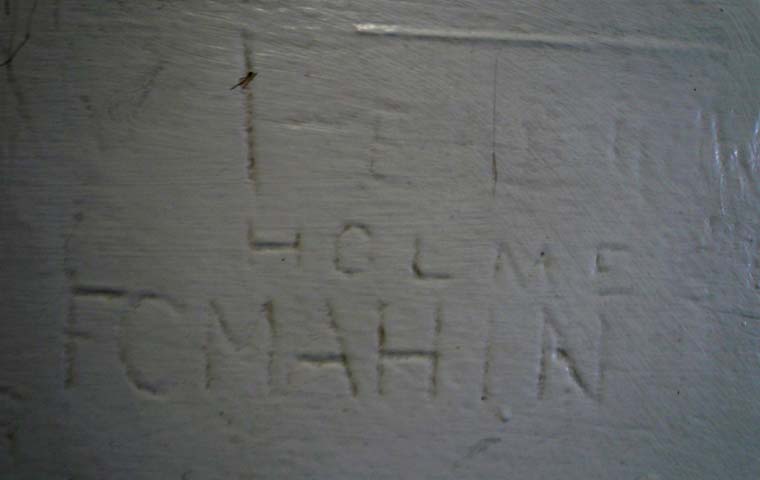
Frank Cadle Mahin is one of the most interesting of the school’s pupils. He was born on May 27th 1887, in Clinton, Iowa, the son of Frank W. Mahin, who was a retired United States Consular Officer at the time. Frank W. had graduated from Harvard University in 1877. Frank C.’s mother was Abbie Anna Cadle, who was born in Muscatine, Iowa, in 1857 to Cornelius Cadle and Ruth Lamprey.
This was Abbie’s second marriage. She had previously been married to Frank Mann with whom she had one child. With her second husband, Frank W., she had two more children, Frank C., and a daughter, Anna, who was born in 1880.
Anna was to meet a young English doctor during the family’s stay in Nottingham, and she remained with him after her parents eventually left England for Amsterdam in Holland. I have been unable to trace Anna’s husband’s surname, although he was to become Frank’s Uncle Alec. As an Englishman, Alec was to fight in the Great War well before Frank and his fellow Americans became involved in the hostilities. Alec was certainly in combat as early as 1915, and I believe that he survived the conflict. The year of Anna’s death has not been recorded. Her mother, Abbie, died in 1941 at the age of 84.
.
Frank Cadle Mahin entered the High School on September 15th 1902, at the age of fifteen. The Mahin family lived at 7, Sherwood Rise, on the opposite side of the Forest Recreation Ground from the High School. His father was by now the United States Consul in Nottingham. Look for the orange arrow:

Despite a comparatively short stay at the High School, Frank Junior seems to have been an accomplished sportsman, and appeared for the First XI at football in a fixture against Loughborough Grammar School on Wednesday, October 25th 1904 at Mapperley Park. The High School began very slowly and had quite a fright before they eventually ran out victors by 4-1. The team was M.J.Hogan, J.P.K.Groves, R.Cooper, R.E.Trease, R.G.Cairns, F.C.Mahin, H.E.Mills, S.D.M.Horner, R.B.Wray, L.W.Peters and P.G.Richards.
Frank played a second match on the afternoon of Saturday, December 3rd 1904. Again, it was at Mapperley Park against Notts. Magdala F.C. 2nd XI. The game finished in a 1-3 away win as:
“a weakened team, who ought really to have won, but did not play as well as they might have, against opponents who themselves were rather poor.”
This time the team was M.J.Hogan, R.B.Wray, R.Cooper, R.E.Trease, R.G.Cairns, F.C.Mahin, H.E.Mills, J.Henson, L.W.Peters, C.R.Attenborough and P.G.Richards.
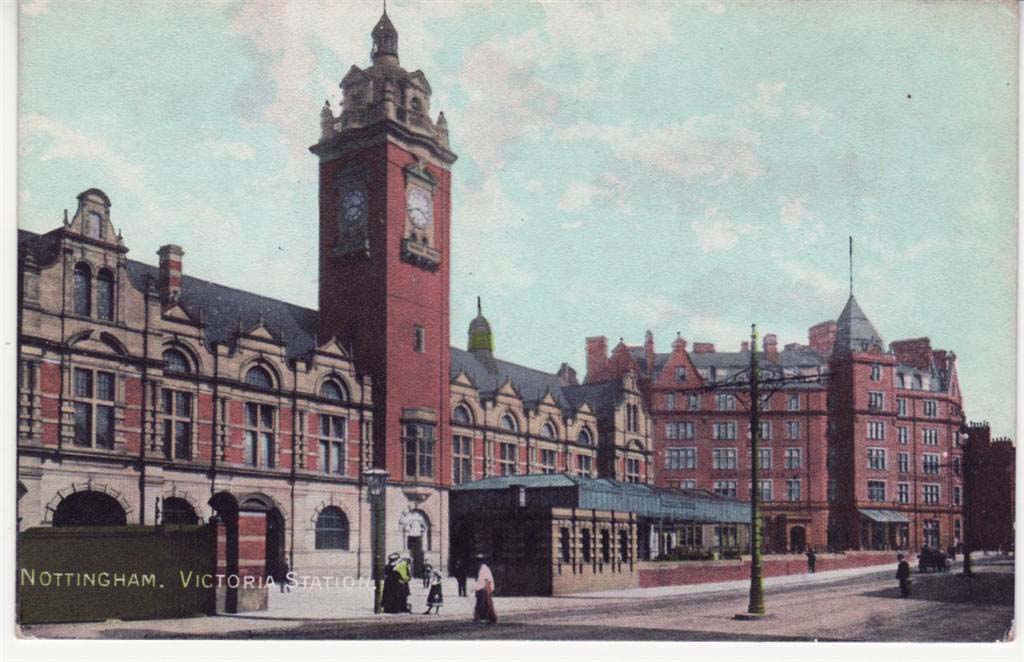
Frank’s only away game was against Worksop College at Worksop. The entire team doubtless travelled by steam train from Nottingham’s Victoria Station on the afternoon of Saturday, March 11th 1905:
According to the school magazine:
“The High School fielded a weakened team, but played well, and did not deserve to lose by such a wide margin as he 0-5 final result would suggest.”
The team was M.J.Hogan, J.P.K.Groves, W.E.Williams , F.C.Mahin, R.B.Wray, R.E.Trease, H.E.Mills, C.S.Robinson, S.D.M.Horner, L.W.Peters and P.G.Richards.
This photograph shows the First Team in the 1904-1905 season. It was taken at Mapperley Park Sports Ground, opposite the old Carrington Lido on Mansfield Road. Serjeant Holmes is present, and on the back row are S.D.M.Horner, C.F.R.Fryer, M.J.Hogan, R.E.Trease and J.P.K.Groves. Seated are R.G.Cairns, R.B.Wray, R.Cooper (Captain) and L.W.Peters, Seated on the grass are H.E.Mills and P.G.Richards. On the right is the so-called twelfth man, the reserve player, who is Frank Cadle Mahin. I believe that the photograph was taken on the afternoon of Wednesday, October 12th 1904, just before the High School played against Mr.Hughes’ XI. The School won 12-5, and we know that Cooper in defence was the outstanding player, but the whole team played well, and the forwards’ finishing was particularly deadly. This year, the team was amazingly successful. Their season began with victories by 5-4, 2-1, 23-0, 12-5, 9-0, 15-0, 3-1, 4-1, 11-0, 16-1. They had scored exactly 100 goals by November 3rd, in only ten games:

The detectives among you will notice that it is warm enough for the changing room windows to be open, and the design of the ball is very different from nowadays. Young Horner has forgotten his football socks, and, because this game marked his début for the side, Mr Fryer’s mother has not yet had the time to sew his school badge onto his shirt. Frank is, in actual fact, in the full school uniform of the time, which was a respectable suit or jacket, topped off with a neat white straw boater, with a school ribbon around it.
Frank also performed as a linesman, or assistant referee, in First XI football fixtures on several occasions in 1904-1905:
“Referees during the season were Mr.W.T.Ryles, Mr.R.E.Yates, Mr.M.R.Hughes and Mr.A.G.Onion. F.C.Mahin and K.M.Brace also performed as linesmen.”
Frank was perhaps a better cricketer than footballer, and he was, in actual fact, the regular captain of the Second XI at cricket.

This photograph shows the First XI cricket team, in an unrecorded year, probably 1905. The individuals are thought to be on the back row, Mr.A.G.Onion, (Groundsman and Coach), S.D.M.Horner, R.G.Cairns, C.F.R.Fryer, unknown and F.C.Mahin. In the middle row are P.G.Richards, L.W.Peters, W.G.Emmett (Captain), M.J.Hogan and R.B.Wray. Seated on the grass are J.P.K.Groves, H.E.Mills, and an unknown player.
In his time at the High School, Frank played for the First XI cricket team only sporadically. We know that he batted once in the 1904 season, and scored five runs, and then batted once more in 1905, and obtained the same score.
In addition, we also know that, on Saturday, June 24th 1905, which was School Sports Day, Frank dead-heated for first place in the Open Long Jump, managing a jump of fifteen feet nine inches, exactly the same distance as C.F.R.Fryer.
In the academic world, Frank won the Mayor’s Prize for Modern Languages, and, most significant of all, perhaps, he reached the rank of sergeant in the newly formed Officer Training Corps.
.
Frank left the High School in July 1905, and returned to the United States where he was in the Class of 1909 at Harvard University.
The university’s proud boast nowadays is that they produce the most highly paid university alumni in the United States:

Frank’s close contemporaries included Franklin Delano Roosevelt, and two sons of the current President of the time, Theodore Roosevelt. They were called Theodore and Kermit.
Both of these men had the same interest in the military as Frank. In 1917, Kermit Roosevelt, although he was obviously an American, joined the British Army to fight in Mesopotamia during the Great War. He was awarded a Military Cross on August 26, 1918. Theodore Roosevelt served as a Brigadier General in the United States Army during the Second World War. He died in France in 1944, a month after leading the first wave of troops onto Utah Beach during the Normandy landings. This brave act was to earn him the Medal of Honor. To me, it would seem ludicrous to suggest that they were not, at the very least, among Frank’s acquaintances at Harvard, if not friends.
Hopefully, Frank had little or no association with another famous member of the Class of 1909. This was Ernst Hanfstaengl, a prominent member of the German Nazi party in the 1920s and early 1930s. A close personal friend of the Führer, Hanfstaengl provided part of the finance for the publication of “Mein Kampf” and the Nazi Party’s official newspaper, the “Völkischer Beobachter“. Using his experience of Harvard football songs, he composed many Brownshirt and Hitler Youth marches and also claimed to have invented the “Sieg Heil” chant. Eventually, “Putzi” was to defect to the Allies and to work as part of President Roosevelt’s “S-Project”, providing information on some 400 prominent Nazis.
‘
During his time at Harvard, according to the Secretary’s Second Report on the Harvard College Class of 1909, Frank married Miss Carrie Knight Whitmore on December 10th 1906. Alas, the poor lady was to die on February 11th 1907. Details are lacking, unfortunately, but this was an era where women could die not only giving birth to a child, but even of morning sickness in the early part of a pregnancy. The same source reveals that Frank remarried on August 18th 1908 in New York, New York State. The lucky lady was called Miss Sasie Avice Seon.
Frank represented the University at football on a number of occasions. Here is one of them:

On November 30th 1906, Frank was selected as a goalkeeper against Columbia University:
“Tonight at 6 o’clock the University association football team will leave on the Fall River boat for New York, where they will play Columbia tomorrow afternoon at 2 o’clock. While in New York the team will stay at the Murray Hill Hotel. On Sunday, they will leave for Ithaca, play Cornell on Monday afternoon, and return to Cambridge that night. The following men, accompanied by Manager E. B. Stern ’07 and Assistant Manager P. Woodman ’08, will be taken: G. W. Biddle ’08, W. M. Bird ’08, P. Brooks ’09, E. N. Fales ’08, W. A. Forbush ’07, H. Green ’08, O. B. Harriman ’09, F. C. Mahin ’09, C. G. Osborne ’07, A. N. Reggio ’07, A. W. Reggio ’08, L. B. Robinson ’07, W. T. S. Thackara ’08.”
Further details followed in “The Crimson Banner”
The association football team will play its first game of the season with Columbia this afternoon at 2 o’clock on Alumni Field, New York. Individually the team is strong; but, as several of the men have only recently joined the squad, the team work is not well developed. Captain Thackara will be in the line-up today for the first team this year. Columbia finished second in the intercollegiate league last year and defeated Yale last week in a well-played game by the score of 4 to 0.
The line-up will be: HARVARD. COLUMBIA. Mahin, g. g., Graybill Green, l.f.b. r.f.b., Voskamp Thackara, r.f.b. l.f.b., Fairchild Biddle, l.h.b., r.h.b., deGarmendia A. W. Reggio, c.h.b. c.h.b., Dickson Bird, r.h.b. l.h.b., Rocour Forbush, l.o.f. r.o.f., Billingsley Brooks, l.i.f. r.i.f. Simpson Osborne, c.f. c.f., Hartog A. N. Reggio, r.i.f. l.i.f., Dwyer Robinson, r.o.f. l.o.f., Cutler
Tomorrow the team will leave for Ithaca, and will play Cornell on Monday afternoon, returning to Cambridge that night.
“The association football team defeated Columbia on Saturday at Alumni Field, New York, by the score of 1 to 0. With only ten men in the line-up, Columbia was unable to block the clever attack of the University team, and was on the defensive during most of the game. The single goal was scored in the first half after a series of speedy passes by the forwards to A. N. Reggio, who sent the ball into the net. Osborne, the University team’s centre forward, played an excellent game, and continually broke up the Columbia attack before it was fairly started. Two 30-minute halves were played.
Harvard vs. Cornell at Ithaca Today.
This afternoon, the team plays Cornell on Percy Field, Ithaca. Last month Cornell defeated Columbia by the score of 2 to 1, and has a fast, aggressive team.
The teams will line-up as follows: HARVARD CORNELL. Mahin, g. g., Wood Green, l.f.f. r.f.b., Van der Does de Bye Thackara, r.f.b. l.f.b., Sampaio Biddle, l.h.b. r.h.b., Malefski A. W. Reggio, c.h.b. c.h.b., Dragoshanoff Bird, r.h.b. l.h.b., Wilson Forbush, l.i.f. r.o.f., Van Bylevelt Brooks, l.i.f. r.i.f., Deleasse Osborne, c.f. e.f., MacDonald A. N. Reggio, r.i.f. l.i.f., Samirento Robinson, r.o.f. l.o.f., Chryssidy ”
On December 4th, Frank appeared against Cornell University:
“ITHACA, N. Y., Dec. 3.–On a field covered with snow the association football team defeated Cornell this afternoon on Percy Field, by the score of 5 to 1. In spite of the unfavorable conditions, the University team played well and showed a marked improvement in team work over the form in the Columbia game. Cornell’s defense was unable to check the hard attack of the University forwards, and but for the snow which made accurate shooting impossible, the score would have been larger. Of the five goals, Osborne made three, and Biddle and A. N. Reggio one each. Cornell’s goal came after a hard scrimmage in front of the net, following a kick out from the corner of the field. Two thirty-minute halves were played.
The summary follows: HARVARD. CORNELL. Mahin, g. g., Wood Green, l.f.f. r.f.b., Van der Does de Bye Thackara, r.f.b. l.f.b., Sampaio Brooks, l.h.b. r.h.b., Malefski A. W. Reggio, c.h.b. c.h.b., Dragoshanoff Bird, r.h.b. l.h.b., Wilson Forbush, l.o.f. r.e.f., Van Bylevelt Biddle, l.i.f. r.i.f., Delcasse Osborne, c.f. c.f., MacDonald A. N. Reggio, r.i.f. l.i.f., Samirento Robinson, r.o.f. l.o.f., Chryssidy
Score–Harvard, 5; Cornell, 1. Goals –Osborne, 3; Biddle, A. N. Reggio, Dragoshanoff. Time–30-minute halves.”
This is the Harvard team for an unknown match in the 1906-1907 season:

On December 8th, news came of an important game:
“The University association football team will play Haverford this afternoon at 2.30 o’clock in the Stadium. As neither team has been defeated this fall, the game today will decide the intercollegiate league championship.
The University team has improved steadily during the season and has developed an effective attack, as shown in the Cornell game last Monday. Haverford has a well-balanced, team of experienced players, many of whom played on last year’s championship team. Last month they defeated Columbia by the score of 2 to 1, while the University team defeated Columbia, 1 to 0.
The line-up will be: HARVARD. HAVERFORD. Mahin, g. g., Warner Kidder, l.f.b. r.f.b., Brown Green, r.f.b. l.f.b., Godley Thackara, l.h.b. r.h.b., Drinker A. W. Reggio, c.h.b. c.h.b., Rossmaessler Bird, r.h.b. l.h.b., Windele Brooks, l.o.f r.o.f. Bushnell A. N. Reggio, l.i.f. r.i.f., Furness Osborne, e.f. e.f., Baker Robinson, r.i.f. l.i.f., Shoemaker Biddle, r.o.f. l.o.f, Strode
The privileges of the Union are extended today to all Haverford men.
D. J. Pryer has been elected captain of the Brown University football team for next year.
The novice revolver shoot, finished last night, was won by M. R. Giddings ’08 with a score of 329 out of a possible 500.”
Frank duly appeared as the goalkeeper for Harvard on December 10th:
“The University association football team was defeated by Haverford on Saturday in the intercollegiate championship game by the score of 2 to 1. Haverford’s light forwards were very fast and displayed better team work than the University players, who depended almost entirely on individual work. On the defense, the University backs were not given enough assistance by the forwards.
For the University team, Brooks and A. N. Reggio played especially well. In spite of a constant guard of two Haverford players, Osborne played his usual good game. In the second half, several opportunities to score were lost by the University forwards through inaccurate kicking. Baker, Haverford’s centre forward, played brilliantly and was the most untiring player on the field.
Haverford won the toss and chose to defend the north goal with a strong wind behind them. During the first half, Baker made two goals, aided by fast team work on the part of the other forwards. Shortly after the beginning of the second period, A. N. Reggio scored Harvard’s only goal.
The summary follows: HARVARD. HAVERFORD. Mahin, g. g., Warner Thackara, l.f.b. r.f.b., Brown Kidder, r.f.b. l.f.b., Godley Brooks, l.h.b. r.h.b., Drinker A. W. Reggio, c.h.b. c.h.b., Rossmaessler Bird, r.h.b. l.h.b., Windele Forbush, l.o.f. r.o.f., Bushnell A. N. Reggio, l.i.f. r.i.f., Furness Osborne, c.f. c.f., Baker Robinson, r.i.f. l.i.f., Shoemaker Biddle, r.o.f. l.o.f., Strode
Score–Haverford, 2; Harvard, 1. Goals–Baker 2, A. N. Reggio. Referee–J. H. Fairfax-Luey. Linesmen–D. V. Leland ’10 and F. R. Leland ’10. Time–25-minute halves.”
On October 25th of that year, Frank had taken part in the university rowing:

This was in the “first bumping races” and Frank rowed for a crew called “Brentford”. The latter were classified as fifth out of six, in the third division out of three:
“Brentford–Stroke, C. L. Hathaway ’10; 7, J. F. Frye ’09; 6, J. A. Curtis ’10; 5, W. F. Doake ’09; 4, P. N. Case ’09; 3, I. E. Willis ’09; 2, F. C. Mahin ’09; bow, H. F. Bingham ’10; coxswain, E. B. Gillette ’10.
The full details were:
“This afternoon at 3.45 o’clock the first division of the Dormitory crews will race upstream over a one and three-eighths mile course, starting at the Boylston street bridge, and rowing up the river to the beginning of the long stretch, leading up to the Brighton bridge. A stake boat will be placed at this point and all the crews will finish at the same place. Immediately after, the second division will row over the same course, and as soon as the shells are returned, the third division will start. The divisions of the crews and the order in which they will start follows:
Division I–1, Claverly; 2, Mt. Auburn street; 3, Dunster-Dana-Drayton; 4, Randolph; 5, Westmorly; 6, Craigie-Waverley; 7, Russell.
Division II–1, Thayer; 2, First Holyoke; 3, Hampden; 4, Holworthy; 5, Perkins; 6, Matthews; 7, Weld.
Division III–1, Foxcroft-Divinity; 2, Grays; 3, Second Holyoke; 4, Hollis-Stoughton; 5, Brentford; 6, College House.
On the two days’ racing, which will follow, the order of the crews in the divisions will change; the crews securing a bump advancing in position, while the crews against which a bump is scored, will be put in the rear, one place for each bump.”
On March 17th 1906, Frank had volunteered to play cricket:
“At the meeting of candidates for the cricket team last night, the following handed in their names: W. P. Phillips 2L., R. M. Gummere 3G., N. L. Tilney ’06, C. G. Mayer 2L., C. G. Osborn ’07, A. W. Reggio ’08, R. N. Wilson 1G., A. N. Reggio ’06, H. R. Waters ’07, N. B. Groton ’07, T. E. Hambleton ’07, L. C. Josephs ’08, E. M. B. Roche ’09, A. E. Newbolt ’09, A. L. Hoffman ’09, F. C. Mahin ’09.
For the present the men will be divided into two squads, which will practice in the old baseball cage in the Gymnasium on alternate afternoons between 3.30 and 5 o’clock. Outdoor practice will begin as soon as the condition of the ground on Soldiers Field permits.”
Frank was really quite bored with life at Harvard though. He wanted to be a soldier. After two years of university life, he left Harvard to join the Regular Army, not as an officer, but as a private soldier. I will take up his fascinating tale in another blog post.
Filed under Football, History, Nottingham, The High School
The Packard Merlin Rolls-Royce Engine and Avro [Canadian] Lancaster Bomber
Have a look at what my French-Canadian friend, Pierre Lagacé had on his blog a few days ago. The fantastic artwork alone is worth your attention.

Research and article by Clarence Simonsen

This classic 1939 British poster celebrates fifty years of British aviation design and aircraft production, as the topless English lady looks to the beginning of her dark war-torn future. The next five war years will bring together the development of British and American aircraft and aero-engines which will effect combatant air forces until the end of the hostilities in May 1945. My story will be told by poster ads used in that time period, also demonstrating how the Canadian built Lancaster Mk. X bomber idea was created and constructed using North American engines and parts.

This pre-war British ad possibly appeared in 1938, when the first production Spitfire Mk. I fighters were delivered to No. 19 and 66 RAF Squadrons. The prototype Spitfire was fitted with the first Rolls-Royce Merlin engine and flew in March 1936, setting a world record of 342 mph [547.2…
View original post 3,617 more words
Filed under Uncategorized
RAF Elsham Wolds: Part Six: a few loose ends
While I was doing the researches for these sad and grim tales of Bomber Command, I came across a number of interesting details which I would like to share. Perhaps one or two loose ends might be tied up.
The first is only loosely connected with the collision of the two unfortunate Lancasters returning from Leipzig on February 20th 1944. I noticed that one of the casualties, Flying Officer Ronald Harry Fuller, was buried in Cambridge City Cemetery. Given that Cambridge is not particularly close to Marylebone in London, where Ronald lived, I decided to look up the details of this cemetery on the Internet. I was genuinely shocked by what I found about the war casualties there. Their names and most basic of details occupy fully an unbelievable 68 pages on the Commonwealth War Graves Commission website. Just enter the words “Cambridge City Cemetery” in the line marked “Cemetery or memorial” and press “Search”:

The very last page is grimly ironic. It lists four Australians, all of them obviously interred a long, long way from home.
One is from the Great War, George Ernest Young of Camberwell, Victoria, Australia. He was aged 28 and died only 12 days from the end of the conflict. The other three interments are all Second World War flyers:

Flight Sergeant George Louis Yensen was a Mid Upper Gunner aged just 20. He was killed on August 31st 1943 in a Short Stirling I of No. 1651 Heavy Conversion Unit of Bomber Command, Serial Number N6005,Squadron Letters probably F-D2. Here is a flight of three Stirlings:

The name of George’s unit means he must have perished well before his training for heavy bombers was even complete. George died along with eight other young trainees on board this aircraft. Two of them were from the Republic of Ireland. Apparently the plane took off from Downham Market near Cambridge at 9.30 pm. presumably just as the daylight was beginning to fade. Suddenly, ten minutes after takeoff, for no apparent reason, the aircraft banked steeply and then spun into the ground just a mile or so north of Shippea Hill on the Cambridgeshire-Suffolk border, and around seven miles from Ely. The orange arrow marks the crash site:

The next Australian, Alan Geoffry (sic) Young was 21 years old when he was killed. A member of the RAAF’s 460 Squadron, he was returning from a bombing raid on Stuttgart. His Lancaster was caught in a blizzard and crashed some ten miles south of Grantham at North Witham. All seven members of the crew were killed. By coincidence, young Alan perished on February 21st 1944, the very next day after the Leipzig raid which inspired the first of these articles:

Flight Sergeant Ian Bailey Yorkston was killed in an accident on March 4th 1945, flying in a Lancaster I, Serial Number PD431,Squadron Letters H4-V. Ian was in No. 1653 Heavy Conversion Unit RAF, and he was just 25 years of age. His parents were Christian missionaries and had worked in China where Ian grew up. Seven other young men perished in the crash. The plane had taken off from North Luffenham for a cross-country training flight at 11.30 in the morning, and returned to base at 4.00 pm. As the aircraft landed, it bounced quite severely. The pilot increased the power and prepared to go round for a second landing attempt. As it climbed away, the aircraft’s undercarriage hit an obstruction and then ploughed into the tops of several trees. It finally crashed near the village of Edith Weston, just four miles south east of Oakham in Rutland. The orange arrow marks the crash site:

This was not Ian Yorkston’s first crash. On August 18th 1944, with “D” Flight of No. 1651 Heavy Conversion Unit he was flying in a Short Stirling III, Serial Number LK519, Squadron Letters QQ-O. Taking off on a night exercise from Wratting Common at three minutes to ten the previous evening, the crew were returning at six minutes past two. They requested, and were given, permission to land, but then there were problems with the Stirling’s immensely lofty and complicated undercarriage:

For forty minutes, a tense dialogue took place between the aircraft and Flying Control. At three minutes to three, a garbled message came from the aircraft which was heard to contain the phrase “crash land”. The Stirling came in at tree top level, flying towards No 4 runway which already had a second Stirling parked on it, having suffered a burst tyre. In the resulting collision, the Trainee Pilot, Flight Sergeant Alan Woodbridge (aged 23) was killed. He was buried in his native village Up Nately, in Hampshire. Alan had himself already been in an accident on July 26th when a slightly misjudged landing resulted in part of the Stirling’s undercarriage being ripped off. Three weeks later, as we have seen, he was dead.
Ian Yorkston’s brother, Flying Officer Gordon Cameron Yorkston, was also killed, not in training though, but in combat with No. 251 Squadron. He was only 21 years of age when he perished on March 17th 1945, in the icy waters off Iceland. The squadron was tasked with carrying out Air Sea Rescue and Meteorological Flights out of Reykjavik This was only 13 days after his elder brother, Ian, had been killed. Gordon’s remains were never found and his sacrifice is commemorated on the Air Forces Memorial at Runnymede near Egham in Surrey. This memorial is dedicated to RAF personnel who died in World War II and who have no known grave anywhere in the world. Many were lost without trace. There are an amazing 20, 310 names on the memorial:

I actually found a website which listed all of the brothers who had died in service with the RAAF in World War Two. There were at least fifty pairs and included three Sandilands, three Eddisons and four brothers called Bernard. What a sacrifice to be asked to make!
The second final, grim, point concerns the unfortunate collision witnessed by Driver Marie Harris. This took place on December 16th 1943, as the two aircraft took off to bomb Berlin.
What I found really quite shocking was that there is another memorial very close by in what is actually only a very small area of Lincolnshire. It pays tribute to yet another crashed Lancaster, a plane from No 12 Squadron at RAF Wickenby, which was shot down by a German night intruder just before half past midnight in the early hours of March 4th 1945.

This was Lancaster PB476, Squadron letters PH-Y, and the brave young men remembered were the Flying Officer Nicholas Ansdell (Pilot, 21 years old, from Churt in Surrey), Flying Officer Alexander Hunter (Navigator, age 33, from Dunfermline, Scotland), Flying Officer Freddie Heath (Bombaimer, aged 22, from New Malden, Surrey), Sergeant Ronald Schafer, (Flight Engineer, aged 23 of Earley in Berkshire), Sergeant Robert Parry, (Wireless Operator, aged only 19 from Dagenham, Essex), Sergeant Arthur Walker, (Mid – Upper Gunner, aged only 20, of Risley, Derbyshire) and Sergeant William Mellor (Rear Gunner, aged just 19,from Hatherton, a hamlet in Cheshire.)
Here is the lane next to the field where the aircraft crashed and the monument on the left:

They were victims of a German night fighter initiative called “Unternehmen Gisela” or “Operation Gisela”
This involved large numbers of twin engined German night fighters, armed with Lichtenstein radar:
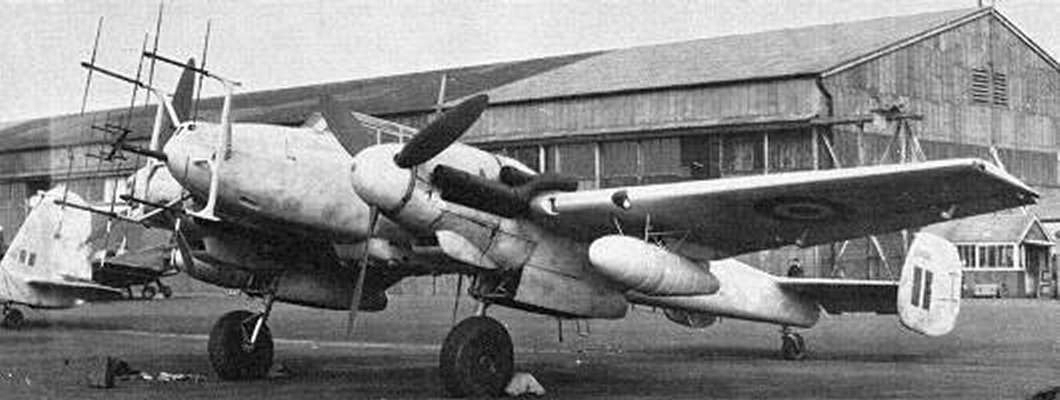
The aircraft left the Continent and flew across the North Sea to England in an effort to destroy as many of the vulnerable bombers as possible as they arrived back from Berlin:

The fighters flew at low level, under a storm front and in heavy rain, to remain under the British radar defences. They were then able to attack over a wide area, looking for RAF navigation lights and then flying underneath the bomber to make use of their upward pointing Schräge Musik twin cannons. In this case, the cannon are just behind the cockpit, clearly offset for some reason:

Around 25 Lancasters or other bombers were either destroyed or severely damaged in this operation. A total of 78 aircrew were killed and 17 civilians perished. The Germans lost 45 airmen.
One final word. All of the websites I have used can be reached through the links above. I could not have produced this article, however, without recourse to the superb books by W.R.Chorley. Their detail is almost unbelievable and I would urge anyone interested by the bomber war to think seriously of purchasing at least one of them. The books bring home just how many young men were killed in Bomber Command during the Second World War. When the first book arrived, my daughter thought it contained all the casualties for the whole war, but, alas, it was just 1944.
Filed under Aviation, Bomber Command, History, Politics


 John Knifton