Category Archives: Cryptozoology

Hallowe’en Nights (2) The Beast of Auxerre

After researching “The Beast of Gévaudan”, I was amazed to find that over the centuries, a large number of different areas of France have been ravaged by man-eating creatures, such as the monsters in the countryside around Auxerre, Lyon,  Orléans or the Vosges Mountains. On a number of occasions what was probably one single animal might even be called by several different names as it wandered widely around various places. «La Bête des Cévennes », « La Bête du Vivarais » or « La Bête du Gard », for example, were all one and the same monster.
The majority have always been considered wolves, although of course, in our time the wolf no longer seems to behave in this aggressive way. Strangely enough, for a substantial number of these less widely known beasts, the witnesses were often keen to say that it was a wolf but not an ordinary wolf like the ones which they saw virtually every single day. It may have had a wider muzzle, or a belly that dragged on the ground. It may have had pale or even white underparts. Ironically, this latter identification feature on its own actually excludes the wolf as a possibility.
All three of these details, of course, the muzzle, the belly and the underparts were  features of the “Beast of all Beasts” in Gévaudan.  The peasants, shepherds and shepherdesses were armed only with a stick, or a pole with a knife attached to it, because the lower classes were forbidden to carry firearms, which was the exclusive right of the nobility.  Agricultural workers, though, were all highly experienced  at identifying wolves. And lightly armed as they were, the population of the average administrative area in rural France in the eighteenth century might still kill a hundred wolves a year between them.
Nowadays, the wolf seems a much calmer animal. They have become extremely rare in Western Europe, and even in Eastern Europe they seem to be less dangerous than old oral traditions would have us believe. Furthermore, it is certainly a fact that only one person has ever been killed by wolves in North America, and even then the wolves involved had become over-habituated to Man through frequent feeding on a landfill site.
The process by which wolves are believed to have become man killers in France is described in a French Wikipedia article, entitled “Le Loup dans la culture européenne”…“The Wolf in European Culture”

….Thanks to the improvements made in the field of agriculture, Man ceaselessly extended his cultivated land and increased the area for his livestock at the expense of woods and forests. The Feudal System and hunting as a leisure pursuit constantly reduced the number of animals to hunt, and attacks by wolves became therefore increasingly frequent. Flocks of sheep were an easy prey item during a period when food was short.
In normal times the wolf does not attack Man and indeed, even when he is hungry he fears human beings, above all when he is forced to confront an upright enemy. Faced by a man, the wolf always backs down or just runs away. Nevertheless wolves in the Middle Ages used to follow men around when they were out at night walking between villages. The wolves always remained a certain distance away from them. Without doubt they were doing this to get food, thinking that the man must be hunting and that they could grab any unwanted food that was left behind. These stories of wolves which followed men at a distance, sometimes over dozens of kilometres, accentuated the phenomenon of fear of the wolf.
However, attacks by wolves on men were reported for the first time towards the end of the Middle Ages, from the time of the Hundred Years War onwards. These attacks also correlate with epidemics of rabies which can change a wolf’s behaviour completely.
At this time of famine the wolf might have started devouring the corpses left behind by the warring armies. Not rabid wolves, but wolves used to the taste of human flesh would have committed acts of predation towards weak human targets. These cases of predation disappeared around 1820 because of the disappearance of open air mass graves from this period onwards. There will always remain nevertheless a small number of isolated attacks linked to epidemics of rabies, but in this case the cause of the illness is easily identifiable.”

(My own translation)

Further ideas come from « Mikerynos » writing on his own excellent website. He sees the entire French population as having within them a deep seated fear of the wolf, much as other nations might have traditional fears of people of a different race or cultural background from themselves.

“Nowadays beasts still appear in the French countryside but they only kill sheep or other animals. The most famous of all was the Bête des Vosges in 1977.
Feral dogs, escaped zoo animals, animals trained by malicious pranksters and sometimes wolves are used to explain these episodes.
But the Old Demons are not yet ready to fade away. The arrival of Italian wolves in the Parc National du Mercantour has brought about the raising of a protective shield wall on the part of livestock farmers and hunters, who have not been at all afraid of introducing the question of the danger to human life, for in the collective subconscious of the whole French nation, some monstrous beast can still be seen lurking dimly behind these innocent wolves, which have absolutely no connection whatsoever with it.
Over the course of the centuries in France there have been many other episodes similar to the Beast of Gévaudan, even if they were less blood soaked. And the explanations are always exactly the same. Wolves are the guilty ones.

Biche-second blogpost cccc

Nowadays all zoologists are in complete agreement with each other that the wolf practically never attacks Man. Indeed on the contrary, the Wolf always flees from Man. The idea that a Wolf is a man eater is essentially a French one which has led some people to deduce that the wolves in France must be the only ones to exhibit such behaviour! In the same way the theme of the werewolf, a man who can change into a wolf, is above all a French one.  And The Beast who brings together both of these two themes is, in exactly the same way, as we already said, a very French concept.
In a word, though, it is the fear of untamed nature which shines through these themes, a fear which has become particularly focussed on certain species such as the wolf. Every animal attack which seems beyond rational explanation very quickly leads to gossip and rumours. The Beast of Gévaudan is not the only animal to have spread terror across France. There was “la Bête d’Evreux”  (1632-1633), “la Bête de Brives” (1783) and “la Bête du Cézailler” (1946-1951).
The most ferocious seem to have been “la Bête de l’Auxerrois” and “la Bête du Vivarais”.
The former appeared in 1731 and killed 28 victims. It was described as a tiger or a wolf. The “Bête féroce de Sarlat” was famous in Périgord from 1766 onwards. Its peculiarity was not to attack women but to kill exclusively men. In 1814 it was the turn of the « Bête féroce d’Orléans » to achieve a certain success. It ripped to pieces and devoured the poor inhabitants of the countryside, massacred entire families, destroyed and devastated everything which appeared in its path and carried out the most appalling carnage, if one is to believe the caption explaining an etching of the period. A lament was even written about it; the style is not too clever but we can imagine the fear of the audience who were listening to such verses. The official disappearance of the wolf from France came in 1937 when the very last one was killed in Limousin. Or more precisely, the Wolf was presumed extinct insofar as the breeding population was diminishing between 1930 and 1939.
From 1818 to 1829, more than 14,000 wolves were killed in France every year. That was the era of the appearance of the single shot rifle (1830) then there were repeating rifles and the double barrel shotgun. Firearms became henceforth extremely accessible and extremely effective. Wolves could be killed at a range of more than 100 metres. The number of hunting permits awarded just grew and grew. In parallel, the use of poison spread among wolf hunters: monkshood the wolf killer, added to ground glass, meadow saffron, a concoction with tamarack, water hemlock and nux vomica.”

(My own translation)

I have found it a fascinating idea that only two hundred or so years ago a highly developed European country like France could have been repeatedly ravaged by man-eating animals, whether they were wolves or, just plain, simple monsters of the type the Hillbilly Hunters chase after on a weekly basis in the TV show “Mountain Monsters”.
I intend therefore to bring these unknown creatures back into the public eye. Had they been active in an English speaking country, I am sure that they would be a lot more famous than they are now, although, of course, they do appear in a good many French websites on “la cryptologie”. The first one to feature, on a purely alphabetical basis, is the “Bête de l’Auxerrois ou la Bête de Trucy”….

Called by two alternative names, the “Beast of Auxerre” or the “Beast of Trucy” was either one or several man-eating animals which were behind an extensive series of attacks on humans. Nowadays, the tiny village is called “Trucy-L’Orgueilleux”.
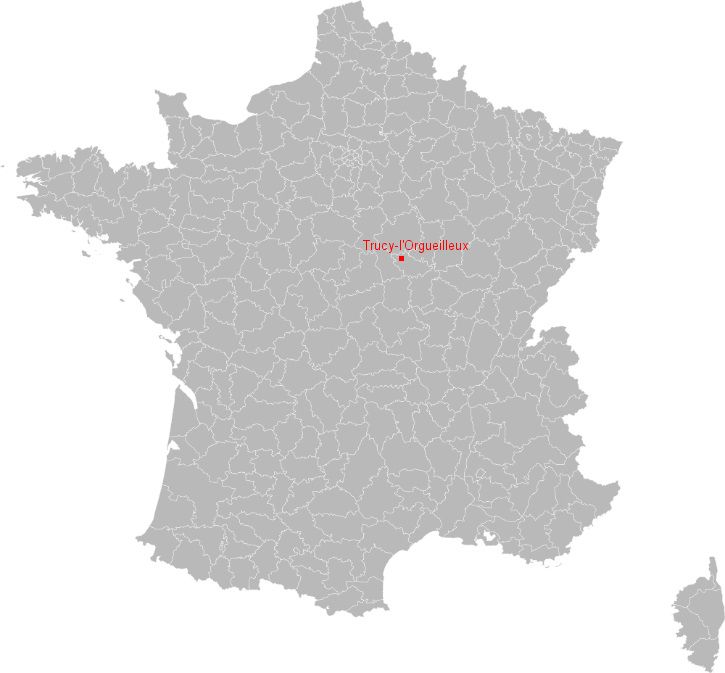
carte-Administrative-Trucy SECOND BLOGPOST

The first incident came in November 1731 when a young boy of 12 years old was working close to the wood of Trucy-sur-Yonne to the south of Auxerre with his mother. She managed to snatch him back from the carnivorous animal which was trying to devour him, but he died in her arms as they made their way back home.

SECOND BLOGPOST ccccc

Attacks then succeeded each other in such quick succession that King Louis XV offered a reward of £200 to whoever could kill the beast. Beats were organised and numerous wolves were killed. The poisoned carcasses of sheep were left out in the fields but the attacks continued, with young children the principal victims. The beast even ventured into the village of Mailly-la-ville and carried off a young child who was playing in front of his house. Trying to snatch him back from the beast’s fangs, his nurse was only able to recover one of his feet (or just one of his arms according to other witnesses).

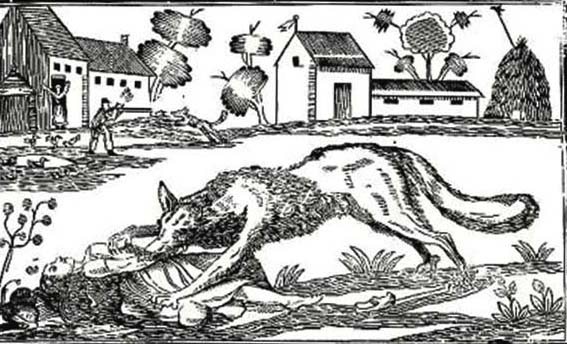
Illustrations of the “Beast of Auxerre” or the “Beast of Trucy” seem pretty well non-existent on the Internet. The engraving below appears on one website, but it is also featured elsewhere as being the  “Beast of Orléans”…
2653xxxxxxxxxxxxxxxxxxxxxxxx_small_1

In five months the local priest of Val-de-Mercy recorded 14 deaths due to the attacks of this carnivorous animal. By the end of the year 1734 a grand total of 28 victims had been listed. The animal supposedly killed a total of nine children, nine women and ten men according to the death certificates which have so far been located. In 1734 two wolves were killed in the course of a hunt and the attacks stopped shortly afterwards. There was however, no irrefutable concrete indication that either of these two animals was behind the attacks which had lasted for three desperate years. Contrary to the Beast of Gévaudan, these killings seem to have concerned as many men as women
In 1817 a second carnivorous beast ravaged the forest around Trucy for a few months, strangely, at the very same place as the animal from eighty years previously. One child was devoured close to Charentenay, another at Fouronnes and numerous people were injured. Poisoned sheep were placed close to the woods and the beast duly disappeared without leaving any trace whatsoever. No carcass was ever found but mercifully the attacks stopped.

This picture allegedly shows the “Beast of Auxerre” or the “Beast of Trucy” but it had previously been used in pamphlets about the Beast of Gévaudan.

bete-du-gevaudanzzzzzzz
For the attacks of 1731–1734, contemporary rumours talked of a werewolf, of several wolves and even of demons. The witnesses spoke of either a huge wolf or a tiger. Following the usual pattern, the witnesses’ descriptions indicated an animal that was “like a wolf” but which nobody thought was just an ordinary wolf. According to the experts nowadays the monster was probably some exotic wild animal which had escaped from its owner, but given the descriptions, it was most probably not a common-or-garden wolf.

Unlike the countryside though, in the towns, certainly, the majority of the people had little idea at all of what a wolf was like. Here is a contemporary picture of a wolf….

concept of wolf xxxxxx

For the second series of attacks in 1817, local talk was of a hyena although one statement described a mastiff dog with pointed ears.
It is always worth looking at a second account of what are clearly the same events

“In 1731 there appeared in the woods around Trucy, to the south of Auxerre, a beast which terrorised the region. The first attack was on a boy of twelve in November 1731, very close to the tiny village of Trucy-l’Orgueilleux. The number of victims quickly increased, with 17 in three years, of whom the majority were children. The king offered a reward of £200 to whoever could kill the beast but without result. The creature then continued its carnage until 1734 when it quite simply disappeared without anyone having been able to kill it despite numerous beats being organised. Overall it killed approximately 30 people, the majority of them children.
In 1817 it was a different beast which ravaged again the very same area of Mailly-la-ville and the Forest of Trucy. Described as a tiger or an enormous wolf, people finally concluded that it was a wolf of enormous size and particular ferocity. It killed 28 people (nine children, nine women and ten men) and was never killed despite numerous beats being organised and the poisoned carcasses of sheep being placed randomly in the surrounding area. Like its predecessor this animal just disappeared “back into Nature” so to speak.”

Clearly there has been some confusion between the two websites over victim totals, but it is always best to see at least two variations of the same story. If you want to see more than just these two then go to the French Google and search for either “La Bête de Trucy” or “la Bête de l’Auxerrois”.

Another website…..

 “…a mother grabbed her twelve year old son from the jaws of an enormous beast without managing, alas, to save him… After this they killed a number of wolves, but the beast continued to attack young children, women and men…… 28 victims were eventually listed. Then they killed a couple of wolves, and the attacks ceased. People talked of werewolves, of wolves gone mad, and even of Demons. Witnesses spoke of the “Beast like a Wolf” but actually “Not a Wolf”. The experts nowadays tend to speak of a wild animal, but seldom of a mere wolf.”

At least one other website which lists “The Monsters That Ravaged France” clearly places “La Bête de Trucy ou la Bête de l’Auxerrois” not in the category of the wolf but in that of the “bête mystérieuse”.
These same details are given by that great expert, « Mikerynos » in the very first article on the page….

“(Elle) est apparue en 1731 et a fait 28 victimes. Elle est décrite comme un tigre ou comme un loup.”

What is most striking about “La Bête de Trucy ou la Bête de l’Auxerrois”, though, is the sheer number of victims consumed. In English we say “as hungry as a wolf”. I don’t know if the French have an equivalent but if they do, it should probably relate to Trucy or Auxerre!
4 Comments

Filed under Cryptozoology, France, History, Science, Wildlife and Nature

Hallowe’en Nights (1) Black Shuck

Old Shuck, Black Shuck, or simply Shuck is the name of a huge, phantom black dog which roams, for the most part, the fields, fens and even beaches of East Anglia. The main areas are Norfolk and Suffolk, but there are also parts of Cambridgeshire and Essex which it is alleged to haunt.

fffffffffff

His name of Shuck may well come from the old Anglo-Saxon word “scaucca” or “scucca”  which means a “demon”, or possibly it is based on the local dialect word “shucky” meaning “shaggy” or “hairy”.
There are those who believe that Shuck derivers his name from the Black Hound owned by Odin.

Odin_DarkW1azzzzzzzzzzzzzzzzzzzzzzzzThis would be a very neat fit, given that the Vikings settled for the most part in the eastern parts of England. Unfortunately, there is little if any mention of any dog, black or otherwise, that Odin owned. He had an eight legged horse called Sleipnir, which gives us the present-day eight reindeer used by Santa Claus, although it may be more accurate to suggest a coffin which is usually borne to its final resting place by four pall-bearers, hence the eight legs. This fine modern statue is in Wednesbury, a town which obviously owes its name to Woden.

This slideshow requires JavaScript.

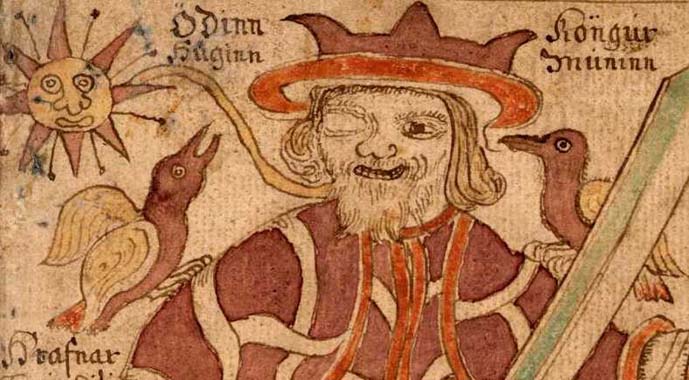
Odin had two ravens called Huginn and Muninn, who flew all over the world of Midgard, finding out information for their master. Huginn means thought and Muninn means memory or mind.

Odin_hrafnar xxxxxxxx

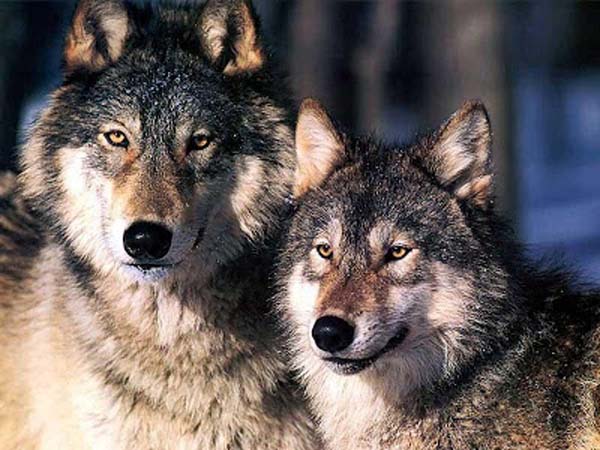
Odin did have two wolves called Geri and Freki, but I have been able to find little indication that he ever owned a dog.

2 wolvers zzzzzzzz

Such a domestic animal as a mere dog just would not have been big enough and fierce enough for the King of the Gods.
On the other hand, Odin was well known for leading “The Wild Hunt”, which in England seems usually to have been a mechanism for the pagan god to ride his sleigh across the storm tossed and windy night sky, pulled by faithful Sleipnir, chasing Christian sinners or the unbaptised, and then carrying them off in his huge sack.(another connection with dear old Santa Claus).Like any red-coated fox hunter, Odin would always use a pack of dogs, but in his case, it would invariably be the black Hounds of Hell. In pagan Scandinavia and northern Germany, this frightening event was called Odin’s Hunt. People who saw it and laughed at it would mysteriously vanish, presumably into Odin’s sack. Sincere believers were rewarded with gold.

hunt

In the wake of the passing storm, with which the Wild Hunt was often identified, a black dog would sometimes be found upon a neighboring heath. To remove it, it would need to be exorcised.

However, if it could not be removed in this way, the hound must be kept for a whole year and carefully tended. We shall see just how this relates to Black Shuck later on.

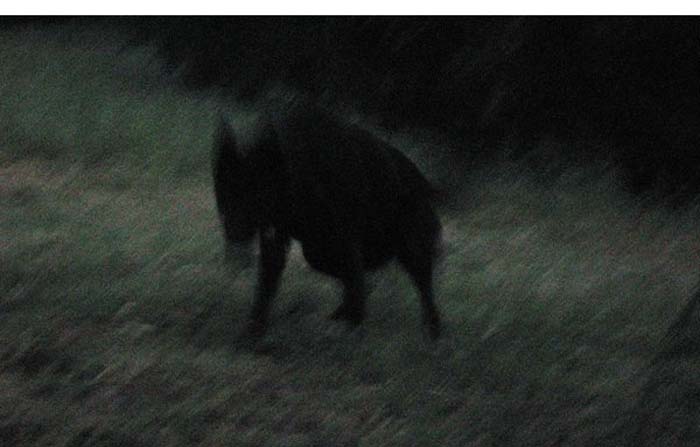
Black_Shuck_by_watchful_eye xxxxxxxxIn appearance, Shuck is generally jet black and can be of any size from that of, say, a black Labrador, up to that of a calf or even a horse. The more ancient the mention of Shuck, the weirder he tends to be. Nowadays, he usually has two large bright red shining eyes, but centuries ago he was often seen as a Cyclops with only one eye. He can also be invisible, so that you might just hear his footsteps in the road behind you, or hear the noise he makes as he walks across grass, or on some occasions in East Anglia, through the reed bed. Sometimes, all you will hear is just the noise of his chain scraping on the ground.


In his “Highways & Byways in East Anglia”, published in 1901, W. A. Dutt describes Shuck in these terms…

“He takes the form of a huge black dog, and prowls along dark lanes and lonesome field footpaths.

Although his howling makes the hearer’s blood run cold, his footfalls make no sound. You may know him at once, should you see him, by his fiery eye; he has but one, and that, like the Cyclops’, is in the middle of his head. But such an encounter might bring you the worst of luck: it is even said that to meet him is to be warned that your death will occur before the end of the year. So you will do well to shut your eyes if you hear him howling; shut them even if you are uncertain whether it is the dog fiend or the voice of the wind you hear. Should you never set eyes on our Norfolk (Hell Hound) you may perhaps doubt his existence, and, like other learned folks, tell us that his story is nothing but the old Scandinavian myth of the black hound of Odin, brought to us by the Vikings who long ago settled down on the Norfolk coast.”

Shuck is said to help travellers find their way, and can be protective towards people who are lost, particularly young children. Similarly, he likes to accompany women on their way home, acting as a protector, more helpful than threatening; Writing as recently as 2008, Dr. Simon Sherwood, of the University of Northampton Psychology Department, notes that “benign accounts of the dog become more regular towards the end of the 19th and throughout the 20th centuries”.

Sometimes he seems almost worthy of our pity…

“A seaside tale on East Anglian television a few years ago related the tale of a large black dog who was seen regularly on the beach near Cromer, always at the very edge of the breaking waves. When approached, he would just disappear into thin air. Observers were certain that he must have been a ghost dog, whose master had been drowned, and whom the poor dog was destined to search for through all eternity. Others explained him as being yet another appearance by East Anglia’s famous Black Dog, Old Shuck.”

In general, though, Shuck is more negative than positive. At the seaside, he can actually be rather sinister…

“Off the coast of Cromer a local child befriended a black dog and went swimming with him in the cold waters of the North Sea. While out over deep water the dog deliberately stopped the child from returning to land, in a clear attempt to drown him. The child is eventually saved by sailors who see what is happening. The dog, of course, is nowhere to be seen.”

Shuck, though, is usually a portent of ill omen , a harbinger of doom. Ivan Bunn,
who is a folklore specialist in East Anglia, and who has collected very many strange incidents over the years, has explained that usually, you would expect to die within a year of seeing Shuck. In southerly parts of Essex, you would expect almost immediate death. Alternatively, Shuck might terrify his victims, but they will continue to live normal lives. In some cases, a close relative of the observer, or a close friend, might die or become ill. If you tell anybody that you have seen Shuck, you will make these dreadful fates even more inevitable.
There are a huge number of sightings, even nowadays, of Black Shuck. Mr Bunn has well in excess of a hundred just for Norfolk and Suffolk and parts of some of the adjoining counties. On one occasion, a lady out walking in the moonlight in a country village thought that she had found her sister’s dog wandering off, and went to take hold of it to return to her house. As she reached down, Black Shuck shrank in size until he was as small as a tiny black kitten. Sixty years later that lady will still not go out on her own at night.

Another person, a man, was followed across the marshes on the North Norfolk coast. All he could hear was the sound of the phantom dog. Within a year, tragically, his son had unexpectedly died. Strangely enough, though, Shuck is not totally a ghost. On occasion he has left pawprints before disappearing into thin air, and in a famous episode in Suffolk, he left scorch marks on the door as he exited a church.

Apparently, the earliest mention of Black Shuck dates from 1450, and the arrest proclamation for the rebel Jack Cade, when he was accused of having “reared up the Devil in the semblance of a black dogge” at Dartford in Kent.

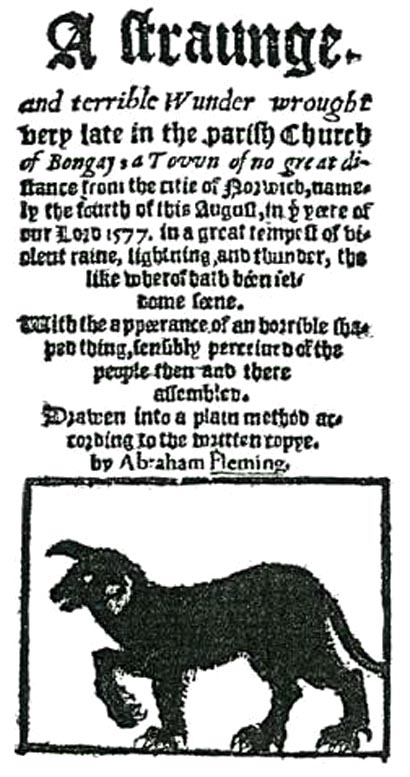
Here is one of two incidents which are particularly well known. There was “an exceeding great and terrible tempest” on August 4th 1577. A contemporary account,  “A Strange and Terrible Wunder” by the Reverend Abraham Fleming says that…

A_Staunge_and_terrible_Wunderxxxxxx


“There were assembled at the same season, to hear divine service and common prayer…in the parish church…of Bungay, the people thereabouts inhabiting…

SuffolkBungayStMaryextmain xxxxx

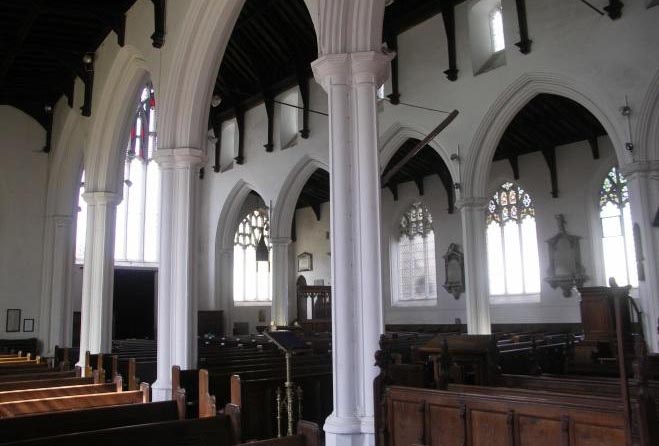
Immediately hereupon, there appeared to the congregation then and there present, in a most horrible likenesse, a dog as they might discerne it, of a black colour…This black dog, or the devil in such a likenesse…running all along down the body of the church with great swiftnesse, and incredible haste, among the people, in a visible form and shape, passed between two persons, as they were kneeling upon their knees…wrung the necks of them both at one instant clean backward, in so much that even at a moment where they kneeled, they strangely died…

SuffolkBungayStMaryint interior cccc
…the same black dog, still continuing and remaining in one and the self same shape, passing by another man of the congregation in the church, gave him such a gripe on the back, that he was presently drawn together and shrunk up, as he were a piece of leather scorched in a hot fire; or as the mouth of a purse or bag, drawn together with a string. The man…. died not, but it is thought he is yet alive…
…The Clerk of the said Church being occupied in cleansing of the gutter of the church, with a violent clap of thunder was smitten down, and beside his fall had no further harm…there are remaining in the stones of the Church, and likewise in the Church door which are marvellously torn, ye marks as it were of the black dog’s claws or talons. Beside that, all the wires, the wheels, and other things belonging to the Church, were broken in pieces…These things are reported to be true…”

One other chronicler claims that this was not Black Shuck’s only appearance that particular day. Allegedly, he visited another part of this tiny Suffolk market town and claimed two further victims.
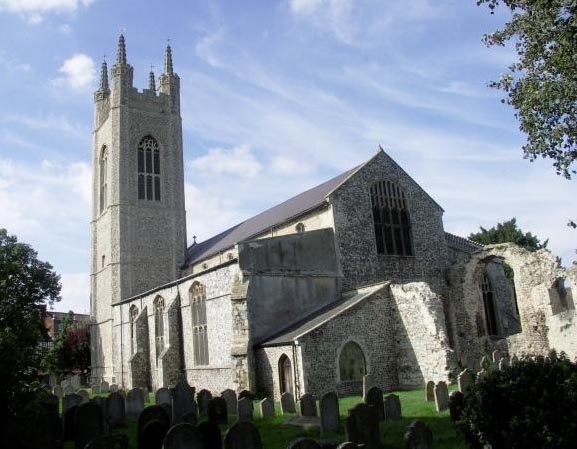
In Bungay, Shuck is reputed still to meander around the graveyard on dark nights. In addition, there are strange scratches on the door of St.Mary’s Church which were supposedly made by the Hell Hound when he attempted to pursue a victim who had taken refuge in the church. And like so many of the churches involved in the legend of Shuck, St.Mary’s has a square tower.
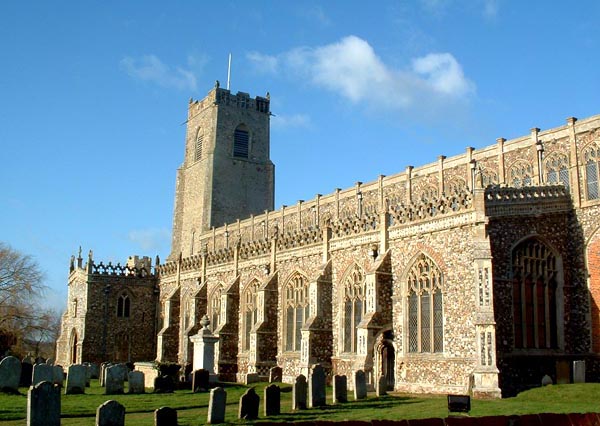
But back to that same day of August 4th 1577. Both the storm and Shuck fled the ten or so miles to nearby Blythburgh, and Holy Trinity Church …….

blthy air zz


“In like manner, into the parish church of another towne called Blythburgh…the black dog, or the devil in such a likenesse entered, in the same shape and placing himself uppon a main baulke or beam, suddenly he gave a swinge downe through ye church, and there also, as before, slew two men and a lad, and burned the hand of another person that was there among the rest of the company, of whom divers were blasted. This mischief thus wrought, he flew with wonderful force to no little feare of the assembly, out of the church in a hideous and hellish likeness.”

A more modern account tells it slightly differently…

“Black Shuck is said to have burst in through the doors of Holy Trinity Church to a clap of thunder.

blyth church xxxx

He ran up the nave, past a large congregation, killing a man and boy and causing the church steeple to collapse through the roof. As the dog left, he left scorch marks on the north door which can be seen at the church to this day.”

These scorch marks are still referred to by the locals as “the devil’s fingerprints”, and the whole event is remembered in the song…

“All down the church
in midst of fire,
the hellish monster flew,
and, passing onward to the choir,
he many people slew”

It must be said though, that the church records at Blythburgh do not necessarily tell the same demonic tale. The episode has certainly been recorded, but as a meteorological one with an extraordinarily violent thunderstorm.  In this story the two people were instantly killed when the bell tower of the church was stuck by the lightning. They had been aloft in the tower ringing the church bells in an effort to dispel the evil spirits which were causing the storm.
One interesting detail in the more dramatic version of the story is how when Shuck has finished racing through the congregation as they kneel in prayer he makes his demonic exit through the north door of the church. The North Door is traditionally the way in which evil forces may enter a church, because the north face of the church is considered to belong to Satan.

In general, churches were usually built to the north of any roads or paths, because the main entrance had to be on the south side. Since it was common for churches to be built on pagan sacred sites, non-Christian worshippers might still want to come and visit them, and they could then enter the church through the so-called “Devil’s door” in the “heathen” north side of the church. In my humble opinion there is probably some additional connection with the direction from which the Vikings came in the era when they ransacked so many English churches and monasteries.

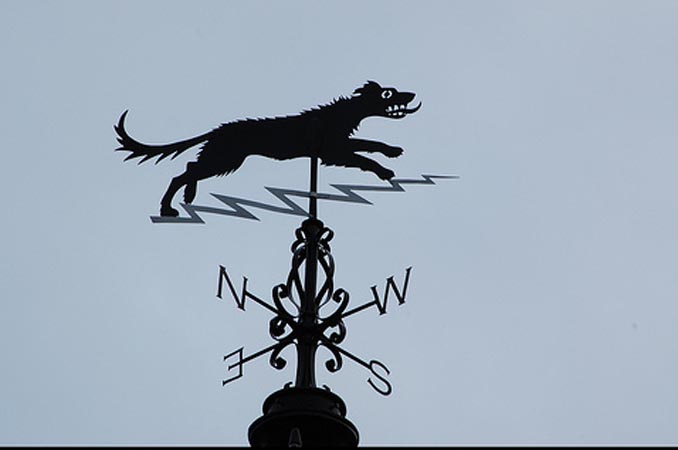
Once again, a church involved in the legend of this sinister black dog has a square tower. Whatever the real truth, though, Shuck has become an integral part of the everyday life of the little town of Bungay.

WEATHER VANE xxxxxx

He appears on the town’s coat of arms. His name has been used in various local business enterprises including a restaurant, and the annual “Black Dog Marathon” begins in the town. The nickname of the town’s football club is the “Black Dogs”.

This slideshow requires JavaScript.

And the Lowestoft band, the Darkness, have recorded a song about East Anglia’s most famous cryptic canid…

And what about Black Dogs in Nottinghamshire?  That is for another blogpost. In the meantime, content yourself with Mike W.Burgess’ amazingly detailed website.

2 Comments

Filed under Cryptozoology, History

Just what WAS the Beast of Gévaudan?

There is no shortage of theories as to the identity of the murderous beast I described recently,  la Bèstia de Gévaudan,which terrorised a whole province of France from 1764-1767, and claimed upwards of a hundred victims, mostly women and young girls. From what I have read, but above all, from what I have watched on “Youtube”,  basically, you will have to make your own  choice.

The creature was, therefore, perhaps a single enormous wolf, or maybe a number of wolves in a single pack, or even a large number of wolves in a number of separate packs.

Less fancifully, it could have been some type of enormous domestic dog, or perhaps even a wolf dog hybrid, perhaps with a red coloured mastiff involved. Its supposed invulnerability to bullets was because it wore the armoured hide of young boar.

It may have been a hyena although this species is thought to have been long extinct in Europe at this time. It has even been suggested that it was not a real animal, but a sex-crazed serial killer who dressed in a fur costume, pretending to be a wolf. In the same vein, it was perhaps a werewolf with a penchant for hunting women and young girls.

An initial, perhaps simplistic approach, is quite simply to look at pictures of the beast, and to compare it with photographs of the most likely candidates, and then to make up your own mind.

Firstly, here are some pictures of the beast itself. You need to bear in mind that they are unlikely to have been drawn directly from a witness descriptions, and that many of them may have been mere copies of the work of other artists. Furthermore, at this time, it was accepted practice to draw animals in a very stylised fashion, rather than in the more accurate zoological one. Because of this, therefore, the head and limbs are often out of proportion, and the body is frequently too large for a small head and legs. In many pictures, the artist sought to portray an unknown animal by reaching into his knowledge of Heraldry…


This slideshow requires JavaScript.

Here are some photographs of wolves. I have deliberately picked what I consider to be the largest individuals, and to provide illustrations of animals in poses which are hopefully similar to those in the engravings of the beast.

This slideshow requires JavaScript.

Here are some photographs of what are usually called wolf dog hybrids. Having looked at a much larger number of them on the Internet, I do feel that most can be dismissed immediately because an ordinary person would think that they were pure bred wolves. They are only noticeably different when crossed with a very distinctive breed of dog.

This slideshow requires JavaScript.

Many cryptozoologists favour the hyena. Certainly, a number of the original drawings from the eighteenth century are titled as being “la Bèstia de Gévaudan, the hyena”.  Many of them, even the most wolf-like, have their flanks covered with either stripes or spots.
This picture was allegedly drawn by the killer of the second beast, Jean Chastel.

drawn chastel

Here are some pictures of the striped hyena.

This slideshow requires JavaScript.

And here are some pictures of the spotted hyena.

This slideshow requires JavaScript.

Basically, you pay your euros, and you take your choice.
As blogposts cannot be of infinite length, let me summarise the fors and againsts of all the possibilities as I see them.

A wolf or wolves?

This is the mot acceptable of a very large number of  explanations. Certainly, the prints found were deemed to be those of a wolf. Monsieur Antoine de Beauterne who was to kill the first animal, the Wolf of Chazes, said that there was « aucune différence avec le pied d’un grand loup » “no difference with the pawprint of a large wolf”

BUT…

Wolves do not normally attack Man. The locals used to kill around 700 wolves every year, so they all knew what a wolf looked like and could defend themselves against them. All the witnesses were adamant that the animal was not a wolf, but an animal that they did not know. That is why it was immediately christened “la bèstia”. Neither can wolves have a white breast and underparts, as a large number of witnesses said in their descriptions and, indeed, as is portrayed in many of the contemporary illustrations. Only a hybrid animal could exhibit this pattern of coloration.

Wolves do not strip the clothes off their victims, neither do they decapitate their prey.

After the Wolf of Chazes was killed, the deaths did not stop.

A rabid wolf?

An animal  diseased in this way would not have been afraid of Man, but it would certainly have died well before the three year period was  up. A number of rabid wolves? Isn’t that possibly stretching the argument a little?

A hyena?

The animal would certainly have been unknown to the inhabitants of the area. Members of the French nobility, however, frequently indulged themselves by importing exotic animals such as lions and tigers into the country, and we know that hyenas were brought into France at this time. So too, hyenas are supposedly relatively easy to train, or at least, easier than you might expect! Whether this would extend to converting them into fearless and ferocious attack animals is a different matter, however.
Hyenas are certainly capable of decapitating their prey. I have been unable to ascertain if they take the clothes off their victims, although I would have thought that they might have needed opposable thumbs for any particularly intricate garments.

BUT…

the second beast to be killed, the Bête de Chastel, did not have enough teeth to be a hyena. This creature was, without doubt, a canid of some description, according to the King’s Notary, Roch Étienne Marin, the man who carried out what appears to be an extraordinarily thorough autopsy. On the other hand, the creature was also examined by the famous Comte de Buffon, an extremely famous scientist and naturalist of the day, whose ideas were to have a great influence on Charles Darwin. Buffon pronounced it to be a very large wolf.

skulls ccccccc

The Striped Hyena, which resembles most closely perhaps, la Bèstia, does not hunt but scavenges. The Spotted Hyena does  hunt for itself, but nobody has ever really mentioned spots as a feature of la Bèstia.
In one of his blogposts, C.R. Rookwood suggests another exotic solution. He suggests that la Bèstia was a  mesonychid, a prehistoric mammal related to present day whales. They were very large predators with huge heads, long tails, and hooves instead of feet. The largest was Andrewsarchus mongoliensis, known only from its skull, minus the jawbone: for this reason, illustrations of its colour are, for the most part, just well informed guesswork. The structure of the animal is based on the other members of the family, whose skeletal structure is better known.

This slideshow requires JavaScript.

This animal does fit quite closely the description given by many of the peasants who saw la Bèstia. A few of the reports did mention hooves instead of feet, although the creature may well have been described as having hooves to emphasise its connection with the Devil.

BUT…

How could a gigantic, fierce, flesh eating mammal have survived from a prehistoric era until the eighteenth century, without anybody noticing it?

A human serial killer?

Humans can remove dead people’s clothes. Humans can decapitate their victims. Some bizarre serial killers would enjoy the chance to mask their activities behind the depredations of a very large trained carnivore.

BUT…

All the reports by eye witnesses say that only an animal was involved. This idea of a human serial killer can only be maintained  if mutilated bodies were found and there were no eye witnesses who saw an animal attacking them. Only in the Cantal area, apparently, were these circumstances fulfilled.
Of late, many people have  become increasingly concerned by the involvement of Jean Chastel in this marvellous enigma. Jean, a farmer and inn-keeper in the province of Gévaudan, and his son Jean-Antoine, have come under suspicion because when both of them were imprisoned for a period  because of their aggressive attitude to two of Francois Antoine’s gamekeepers, the number of attacks by the monster diminished noticeably.

chastel 2 ccccccc
It has therefore been put forward that la Bèstia was the result of Jean’s crossing either his own or his son’s red-coloured mastiff with a wolf, and then subsequently training it to kill. Almost all the evidence is perforce circumstantial, but much of it is quite compelling.
The creature may have been, therefore, a particularly  aggressive hybrid, which Jean-Antoine Chastel trained to have no fear of human beings, but instead to attack and to kill them. Witnesses have said that if its attacks were met with strong resistance, la Bèstia would retreat fifty yards or so, then sit and wait, as if sizing up the situation, before finally returning to the fray. This has been  taken to be the behaviour of a trained animal, unafraid of its opponent, rather than a wild one, whose natural instinct in an equal contest would have been to save itself by fleeing. Furthermore, witnesses thought that la Bèstia was driven not by hunger but by its own fury and an innate aggressiveness. It could also be more agile and jump much higher than a normal dog.
According to hunters in the eighteenth and nineteenth centuries, crosses between dogs and wolves were invariably very varied in appearance with dark or light tinges, sometimes marked with yellow or white or striped a little like a zebra. This, of course, agrees with many of the eye witness descriptions of la Bèstia.
Here are some pictures of mastiffs, although it is very difficult to know exactly what they looked like two and a half centuries ago. Nowadays, they simply don’t look particularly fierce….


Here is an English Mastiff around 1700.
mastiff 1700 ccccccc

If we are going down the road of wolf-dog hybrids, then I was quite attracted to a long extinct breed of German bulldog, or Bullenbeisser…

Bullenbeisser extinct ccccccccc

On the other hand, others have said that no successful interbreeding of a Mastiff, or Mastiff type dog, has ever been successfully carried out with a wolf, even though such a hybrid might explain the colours noted by many witnesses.
From the summer 1764 to its death in 1767, la Bèstia wandered over vast distances in almost no time whatsoever. Perhaps the two Chastel were conveying their creature around the province by some artificial means…an explanation of the high frequency of attacks spread over a not inconsiderable area.
On many occasions, people reported the apparent invulnerability of the creature when either stabbed or shot at. It has been suggested that it was wearing some kind of body armour made from the skin of a wild boar. Many witnesses told of the creature being shot several times by experienced hunters, and not being affected by it. Other witnesses spoke of its entrails hanging down after it was stabbed. Could this have been the strapping for some kind of home made armour?
When it was killed, la Bèstia died in the parish of La Besseyre Saint Mary, where Jean Chastel and his son lived. Perhaps they felt that they were about to be discovered, so they shot the creature and then manufactured a tale of heroism and religious devotion to snatch a glorious propaganda victory from the jaws of ignominious discovery and defeat.
As to why the two Chastel would want to kill so many of the people in the area where they lived, that remains a matter of pure guesswork. Certainly, Jean Chastel was supposed to have been an unpopular loner, and given his previous record of various episodes of fairly serious criminal behaviour, he may well have been a man who the locals disliked and feared in equal measure.
Perhaps les Chastel, père et fils were rejected and hated by local women and children, and then took their massive revenge on them, like those American teenagers who return to their High School and kill everybody they can. Perhaps they were sexual psychopaths who enjoyed killing and eating women and little girls.

One further detail which may be of significance is that the loud, belligerent and generally anti-social behaviour of the father, Jean Chastel, seems to have changed profoundly from May 16th 1767 onwards. On this date, in the village of Septols, Marie Denty was attacked in a little lane near her house, right under the eyes of her parents, and killed, just before her twelfth birthday. Supposedly, she and Jean Chastel were very close friends and he doted on her like the grand-daughter he never had. Now he was “fou de douleur”, “mad with grief”, and seemed about to lose his sanity. Perhaps, les Chastel and their appalling pet had killed by mistake. Certainly, his ne’er-do-well son, Antoine, seemed suddenly to be released from an evil spell, and he turned straightway to God. Jean spent his time in pure pursuits such as prayer, confession and penitence. For his redemption to be complete, he and he alone had to be the man who finally killed la Bèstia. According to which sources you believe, in best werewolf killer tradition, he made some silver bullets. Or perhaps, he made them from molten lead which had had a statue of the Virgin Mary dipped into it. Or perhaps he made them from the medals of the Virgin Mary which he wore on his hat. Whatever the case, he certainly had them blessed at a religious ceremony.

The manner in which he killed the creature is extremely suspicious, and could very easily be interpreted as a tale told merely to satisfy contemporary religious feelings, and to exonerate a man who is not bravely hunting down a ferocious killer beast, but who is, instead, shooting it through the head in its kennel before the locals find out it is actually his beloved pet, and then string him up from the nearest tree. The following account I have translated from the French Wikipédia

“On June 19th, the Marquis d’Apcher decides to organise a beat around Mont Mouchet in the wood of la Ténazeire. He is accompanied by a few neighbours as volunteers including Jean Chastel reputed to be an excellent hunter. The latter finds himself at a place called la Sogne d’Auvers,  a crossroads where he sees the animal go past. Chastel fires at it, and manages to wound on the shoulder. Quickly the marquis’ dogs arrive to finish off the beast.”
“As regards this rifle shot, Legend has preserved the romanticised words of the priest Pierre Pourcher which he used to say came from tale told by his family, “When the beast came along, Chastel was saying prayers to the Holy Virgin. He recognised it straightaway, but through a feeling of piety and confidence in the Mother of God, he wanted to finish his prayers. Afterwards, he closes his prayerbook, folds his glasses up, puts them in his pocket and takes his rifle. In an instant he kills the beast which had been waiting for him.”

“A week after the destruction of the beast by Jean Chastel,on June 25th, a female wolf which according to several witness accounts used to accompany the beast itself was killed by Sir Jean Terrisse, one of the hunters His Grace de la Tour d’Auvergne.  He received £78 as a reward.”

Perhaps they were acting on behalf of somebody else. The usual favourite is Jean-François-Charles de La Molette, the Count of Morangiès. He may have wanted to destabilise the area, so that he could take over when the revolution inevitably came.  There were others. The Church wanted to teach the King and the members of the  intelligentsia of the time that free thinking is frowned uon by God….

“Return to the Ways of the Lord or face the Hound of Hell”

As I said before, basically, you pay your euros, and you take your choice.

I had just finished my investigations about la Bèstia de Gévaudan, and had made up my own mind that all the devastation could be attributed, without necessarily knowing the real motivation behind it, to Jean Chastel and his son Antoine.
And then I bought “Real Wolfmen: True Encounters in Modern America” by Linda S. Godfrey. I was enjoying reading this interesting and innovative book, when I stumbled upon page 93 which was about the Wampus Cat of Ariton in Alabama.

“The man who wrote me was disturbed by unidentifiable animal sounds while camping on his ten acres on the Pea River near Ariton, which lies about half an hour’s drive south of the picturesquely named town of Smut Eye. His normally rambunctious standard poodle refused to leave the safety of his trailer that afternoon, and the man was having a cup of tea at about 5.00 p.m. when he heard loud rustling sounds coming from outside the camper.”
“As he peered out the camper window he noticed a large black furred animal with a doglike face surveying his campsite on all fours. It was bigger than his standard poodle and, he said, “Looks like a cross between an ugly collie and an even uglier lab.” Weirdly, it sported a white chest.”
“The creature ambled nonchalantly through the camp and when it jumped over a fallen tree, the man saw that it had a long, sinuous tail like that of a cougar. He reported the creature to the area game warden who said that while she didn’t know what it was, others have reported seeing it, too!”

You can pursue this interesting hunt for truth a lot further if you have any knowledge of French. There are three exceptionally good videos about la Bèstia which can be found on a tourist website for the Auvergne region. They are well worth your time, and seem to portray this most baffling of stories in a fairly reasonable and sensible way. Un, deux et trois.
If you want to see even more videos about la Bèstia, then go to this website which is the French equivalent of “Youtube”. If you search for “la Bête du Gévaudan”, you will find a huge number of films, varying from 15 or 20 seconds long to an hour or more. On the first page, there are eighteen different videos, a further eighteen on the second page, and any number of pages after that.

Bonne chance! And don’t be put off by having to practice your French!

55 Comments

Filed under Criminology, Cryptozoology, France, History, Science, Wildlife and Nature

Sausages for tea, and lots of ’em!

Last night I once again sat down to watch my heroes, the Hillbilly Hunters, set off in quest of monsters, this time to Hocking Hills, Ohio, in search of the legendary Hogzilla.

big castThis thousand pound porker is a hybrid of two closely related animals. His fierceness comes from the introduced feral pig that the Americans call by many different epithets, including the Russian Boar, the Razorback, or the enchanting “Pineywoods Rooter”.  His size comes from the huge, overfed and genetically modified farm pigs, such as we see in the fields as we drive north of Nottingham on the A614. The American equivalent is the beautifully deep red coloured “Duroc pig”.
Given his enormous size, his sharp, twelve inch long tusks and his desperately aggressive temperament, Hogzilla is a genuinely fearsome beast who will kill you if he can, and eat you if he is hungry.
The task is defined here…

http://www.youtube.com/watch?v=VNhWrVAlsMs
Here are the first stages of the final night hunt…

And, for the first time ever, SUCCESS!!!!!
“Hogzilla” is suddenly “Trapzilla”.

Within a couple of days, he will make 500lb  of sausages. Hurrah!!!

bill and knifexxxx
On a more serious note though, towards the end of the third video, Trapper make some very pertinent comments about the accuracy of the evidence given by even the most honest of eyewitnesses, especially when they are frightened.

Leave a comment

Filed under Cryptozoology, Humour, Nottingham, Wildlife and Nature

The Beast of Gévaudan: a real monster

Last week I watched my heroes, the six Hillbilly Hunters, chase vainly after the Hell Hound of Pike County, Kentucky. As a European, though, I could not possibly be unaware of this fearsome creatures’s striking similarity to the so-called “Beast of Gévaudan”, or, in Occitan, the language spoken by the ordinary people in this area of France at the time, “La Bèstia de Gavaudan”.
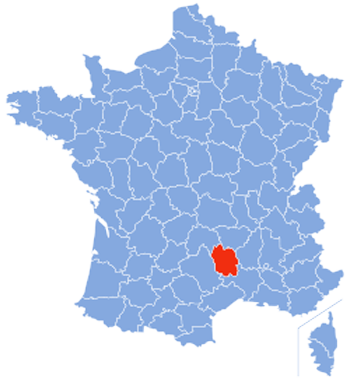
Whichever language is used, this is the historical name given to the creature which ravaged an area of up to 300 square miles in the province of Gévaudan, in the Margeride Mountains in south central France.
250px-Lozère-Position_svgIn those distant days, between May 1764 and June 1767, this entire area was completely agricultural, and it was common practice once winter ended, to send the herds of cattle or flocks of sheep up into the spring and summer pastures in the high mountains. In an era long before mass communication, news was slow to emerge from the region of an epidemic of killings by an unknown but huge creature. This animal preyed for the most part, usually in broad daylight, on the young boys and girls who were sent up into the mountains for months on end to look after their father’s animals. Sometimes its prey was the women who lived in lonely cottages and tiny villages, often as they tended their animals or gathered crops in open fields. These three categories constituted, of course, the easiest of targets. They were made even easier by years of failed harvests and famine during the period preceding the first appearance of La Bèstia. Indeed, during the many huge beats which were to be organised during the following months, a whole succession of high ranking officials from Paris were all astonished to see the peasants who were taking part, fainting and  falling over, passing out from malnutrition and the physical effort involved in walking for any distance across fields or through woods.

The creature, for the most part, ignored men, and likewise cattle, sheep and goats. After the kill it would disappear into the dense patches of forest scattered across the granite plateaux and grass covered hills.
The number of victims differs according to sources. One study estimated there were 210 attacks, with 113 deaths and 49 injuries. Nearly a hundred of the victims killed were partly eaten. However, other sources put the number of fatalities at between sixty and a hundred, mostly defenceless children, or perhaps adult women, with more than thirty victims injured. Attempts have been made to compile full lists of his victims’ names. Click on “Attacks” on the left hand side of the webpage.

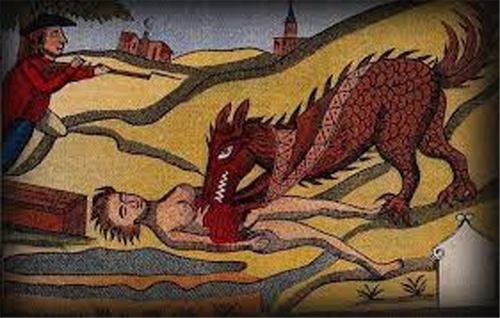
Here are some contemporary illustrations of the creature, nearly all of which depict girls or young women as the victims.

This slideshow requires JavaScript.


According to those who saw the attacks, the monster had formidable teeth and an immense tail. In general, La Bèstia resembled a wolf but it was huge, between a calf and a horse in size. Overall, its fur was said to be unusual in colouration, mostly red, but its back was streaked with black. It had a large doglike head, a snout like a wolf and a mouthful of large teeth. Its small straight ears lay close to its head, and it had a strong neck and a wide chest. The tail was immensely long, and somewhat like that of a panther. People who were struck by the tail said that it was a blow of considerable force. One or two witnesses said La Bèstia had cloven hooves, or that the end of its four limbs was tipped with a hoof. Others said the claws were so heavy that they merely resembled hooves.
Here is one early depiction of the creature. The text at the top of the illustration below means…

“This is the figure of the Monster which is ravaging Gévaudan. This animal is of the size of a young bull. It attacks by preference women and children. It drinks their blood, cuts off their head, and takes it away. £2,700 is promised to whoever kills this animal.”

(My own translation)

-Figure_du_monstre_qui_désole_le_Gevaudan

This is an entry in an unknown parish record…

another burial
« L’an 1764 et le 1er juillet, a été enterrée, Jeane Boulet, sans sacremens, ayant été tuée par la bette féroce, présans Joseph Vigier et Jean Reboul. »
“In the Year 1764, on the first of July, was buried, Jeane Boulet, without the Last Sacraments, having been killed by the ferocious beast, present Joseph Vigier et Jean Reboul.”

(My own translation)

My knowledge of Old French is limited, and I do not know whether the spellings are correct for 1764, or whether the priest was writing the words as he would have said them. They would certainly not be correct by modern standards of orthography.
Here is a legal document taken from the parish records in the village of Rocles, with the graphic description of the death of a little girl called Magdeleine Mauras, a victim of the Beast of Gévaudan…

page

“On the 30th day of the month of September in the Year 1764, Magdeleine Mauras was buried, the daughter of the late Jean and Pagès from Pierrefiche. She was about 12 years old and staying with her uncle John Baptiste Mauras from a place called Thorts in this parish. Her body was found on the 29th day of the month, gnawed on the neck and the breast by the ferocious beast which has been ravaging through this diocese for five months. It ripped her throat out when she was coming back to herd her uncle’s cattle homeward at 4.30 in the evening.”

naked ladies

“The rest of her body, which was lacking an arm, ripped off and consumed by the said beast, was laid in the cemetery of this parish of Rocles in the tomb of the ancestors of her father. Present at this were Jean TF, Jean, Jean-Pierre Bouet and Pierre Martin, the son of the late Antoine, from the place called Thorts, all of them illiterate.
I made these enquiries, the Priest at Aubignac.”

  (My own translation)

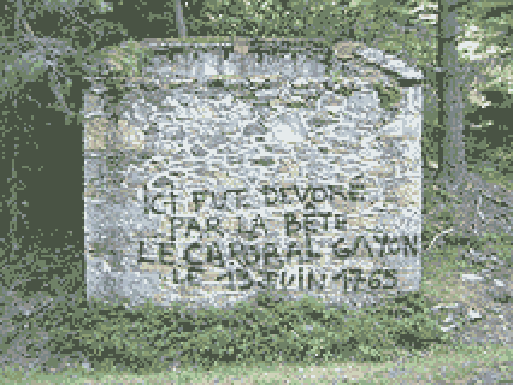
At least one grave of a victim remains…

grave
The French means

“Here was devoured by the Beast Carobal Gayon, June 13th 1765”

He must have been one of the very few adult male victims.
The horrific method of killing victims by ripping their throats out was frequently used by the Beast. Not surprisingly, the government eventually undertook to rid the area of this ferocious creature.

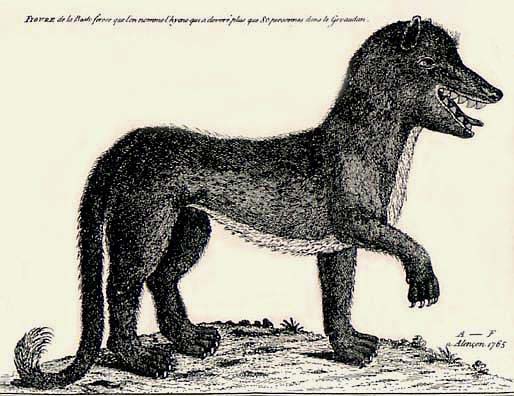
One of the first to try his luck, in October 1764, was Captain Duhamel and his dragoons from Clermont. They did not have an enormous amount of success, and the dragoons themselves were extremely unpopular with the people of the region, as they frequently damaged their crops, and refused to pay for their lodging when billeted with local families. Duhamel was supposedly responsible for this picture of La Bèstia…

Gevaudanwolf xxxxxxDuhamel’s written description said that the monster had the chest of a leopard, the legs and feet of a bear and the ears of a wolf. He thought the animal was some kind of hybrid, but considered that its father was a lion. He did not know what the mother had been. He, like d’Enneval and his son, who were to succeed him in March 1765, refused to believe that it was just an ordinary wolf.

It was January 12, 1765, when twelve year old Jacques Portefaix and his little group of seven friends were attacked by La Bèstia. After several assaults, they drove off the monster by staying grouped together. The encounter came to the attention of King Louis XV who gave rewards to all of these gallant young men. including Jacques Portefaix who was given enough for his education. The King then decreed that the French state would help find and kill the monster.

At this time, of course, the population of France believed that Louis was king by Divine Right. In other words, he was directly appointed by God. Clearly, if Louis could not protect his people from the ravages of an animal that was initially supposed to be merely a large wolf, then questions would certainly be asked about his suitability to rule the country in the face of what might easily be called a punishment sent from God.

Three weeks later, therefore, a concerned King sent two professional wolf-hunters, Jean Charles Marc Antoine Vaumesle d’Enneval and his son Jean-François, to Gévaudan. They arrived on February 17, 1765, bringing eight bloodhounds trained to hunt wolves. Over the next four months father and son hunted wolves believing that eventually they would surely kill the beast. The attacks, however, continued and they were eventually to lose their jobs. D’Enneval père had previously been considered “l’un des meilleurs chasseurs de loups qui ait jamais existé“, “one of the finest wolf hunters who had ever existed”. He had killed some 1,200 wolves in his lifetime, the majority of which, amazingly by today’s standards, were in the  Normandy region. His final departing judgement, though, was that, whatever La Bèstia was, it was no wolf.

On June 22 1765, therefore, Monsieur Antoine de Beauterne, the king’s arquebus bearer and Lieutenant of the Hunt arrived. They began immediately to organise beats by the local people, and set about the same policy of killing as many wolves as they possibly could,  in the hope that one of them would turn out to be La Bèstia.


On September 20, 1765, Monsieur Antoine, as he was universally now known, killed his third and largest wolf measuring 31 inches high at the shoulder, 5 feet 7 inches long, and weighing 130 pounds. The wolf was named Wolf of Chazes after the nearby Abbey of Chazes. Strangely, though, this shooting did not take place where the Beast had ever killed anybody, and indeed, it had never been seen there previously.
Antoine_de_Beauterne

Monsieur Antoine  stated officially:

“We never saw a big wolf that could be compared to this one. This could be the fearsome beast that has caused so much damage.”

The animal was identified as the culprit by attack survivors who recognised the scars on its body inflicted by victims defending themselves. The wolf was stuffed and sent to Paris where Monsieur Antoine was received as a hero, receiving a large sum of money as well as titles and awards.
wolf of hunter 1
And then, OH NO!! Very soon, and certainly from the month of November onwards, there were rumours of fresh attacks. They continued throughout the whole of 1766, and then twelve year old Marie Denty was attacked and devoured  on May 16th 1767.
On June 19th, 1767, a hunt was organized by a well intentioned local nobleman, the Marquis d’Apcher,
JeanJosephd'Apchier
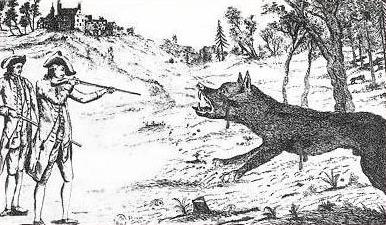
The supposed second beast was duly killed by a local hunter named Jean Chastel. The death of this creature seems finally to have marked the end of these appalling attacks in this benighted region of France.

jean 999

Writers later introduced the idea that Chastel had shot the creature with blessed silver bullets of his own manufacture. This was probably so that it would fit in more exactly with the largely twentieth century tales told about werewolves, particularly in the cinema.

Upon being opened, the animal’s stomach was shown to contain human remains. Like the first creature, this second wolf was sent to Paris, but, because it had decomposed so badly and was extremely smelly, nobody was particularly interested. Even so, what seems a very thorough autopsy was carried out by the King’s Notary, Roch Étienne Marin.

One television programme, Australia’s “Animal X”, stated that this picture shows, according to Chastel himself, the animal that he shot.

drawn chastel

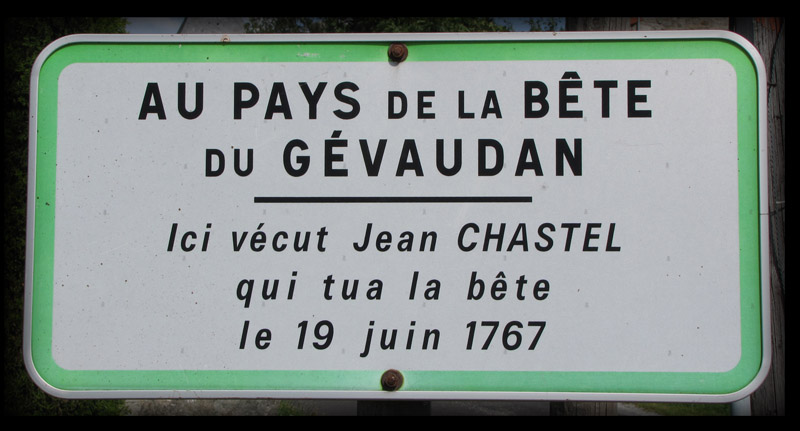
Jean Chastel is nowadays commemorated as the saviour of the region. His signature is preserved, and so is his rifle…


His house is prominently labelled…

chastel_002
The French means

“In the country of the Beast of Gévaudan  Here lived Jean Chastel who killed the beast on June 19th 1767. ”

He has a statue…

chastel 2
There are, as you might expect, any number of explanations of the identity of the Beast of Gévaudan. I will look at as many of these as I can in another blogpost.
One thing, however, remains indisputably true: La Bête du Gévaudan  was only too real, and terrified thousands of people for a good three years.
Nowadays, La Bèstia is much more in favour. He has numerous statues dedicated to him…

This slideshow requires JavaScript.


He has his very own website
He also can be googled, and any number of sites put forward their own interpretation of events.
Un, deux, trois, quatre, cinq, six, sept, huit, neuf, dix, onze

If you can read French, the best website is the French version of Wikipedia, “numéro sept”

The Beast is on Youtube.


He is also on Twitter  and on Facebook where, hopefully, he no longer eats his friends.

8 Comments

Filed under Cryptozoology, France, History, Science, Wildlife and Nature

Mountain Monsters: “I am a Marine and I will get the job done”

This week, the Hillbilly Hunters set off to Pike County, in Kentucky, in search of the legendary Hell Hound.

gang with trap
This infernal creature was first reported as far back as 1939, and reports continued throughout the 1940s. They came mostly from the moonshiners who were working their magic, way back in the woods, in log cabins. There were so many reports of the beast that a bounty of $20 was posted, and incredibly, this generous reward was duly collected when a hunter managed to kill one of the creatures. Unfortunately nobody could identify the corpse, and sadly, no trace, either physical or photographic, seems to have survived.

The first four members of the Hillbilly Hunters arrive in this cattle raising area, and they soon ascertain the facts. Firstly, the Hell Hound is actually blue because of its nocturnal habits, and it seems to have some kind of mane. It is about four feet tall at the shoulder and between seven and nine feet long. It is a creature which seems to have lost all fear of Man, and is using the tractor trails through the cornfields to get closer to the farmers’ barns and outbuildings. A Hell Hound  then be quite capable of dragging off an adult cow.

drawing
The team are shown a Black Angus calf by the worried farmer who owns it. The poor animal has enormous wounds on its back, which seem to me like no  predator that I recognise. They appear to be symmetrical, and I think careful thought should be given to the idea that they may have been carried out with a knife by the member of some crazy cult.

A second farmer, Drew, shows us his video, which he took looking through a stand of trees towards a small barn, from which HH duly emerges. I do feel that experienced photo analysis from a person who has talents in this field might well be able to establish what creature this may be. I am clearly no expert in the wildlife of Kentucky but as an English outsider, I might even put suggest that what Drew saw was a very large wild boar.

The last two to arrive are the enfants terribles of the programme, Willy and Wild Bill, who now has some fluffy dice dangling charmingly from the mirror of his vehicle, put there by his mother-in-law.

diceThe two of them quickly make what looks to be an extremely strong trap from long lengths of local bamboo.

Wild Bill immediately steals the show as he mimes shaving himself with a macheté. “ I spent time or two trying to bust out of the old jailhouse, never figured I’d be building one.”

Quite extraordinarily, Wild Bill, having climbed the tree for the trap, then sees HH on the far side of the field. He sets off on the chase, brandishing his macheté. He gets a glimpse of him… “He’s a dandy big’un.” Is he fast? “ He can put her down the old canyon”. Bill measures his height and puts his hand out, “He stands about yay tall.”

marine

In the night hunt, the team hears growls and roars and they find where HH takes his cows to dismantle. It is awash with blood and fat and goo.
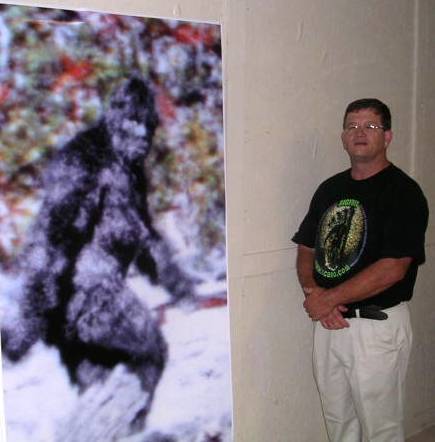
Standing next to a greenhouse which is brightly illuminated from the inside, they see the blurred shadow of an animal, presumably HH, come hurtling past them at huge speed. They chase after him, and three of the group manage to physically touch him, probably the first time he’s ever been literally in contact with Man. They may not manage to capture HH, but their determination remains as strong as ever.

“I am on his ass and I wanna get him.”
“I wanna put the old heat on his hide.”
“I’ll see if I can’t get his old hide on the wall. ”
But as Willy says philosophically though, “He lives to be hunted another day.”

The usual discussion then follows…

I gain fantastic enjoyment from the Big Six. Their program remains enormously entertaining, and is certainly the highlight of my viewing week. I try always to watch it twice, as on first viewing, you can miss many informative details.

I know from various sources on the Internet, that there are many people out there who seem to be ferociously upset by this program. As I’ve repeatedly said, I think the programme is marvellous. I do not think it makes anybody look like an idiot, either a local inhabitant, a Hillbilly Hunter or, hopefully, a reviewer.

And whether or not you believe in the Hell Hound of Pike County, Kentucky, there will always be doubt in your mind, because so many similar creatures have been seen across the world.

In one of my future blog posts, I will be talking about the Beast of Gévaudan, which ravaged the bleak highlands of central France some 250 years ago. It is an established fact that this animal killed many people, perhaps in excess of a hundred. Eyewitnesses, of course, varied in their descriptions, but none of them seems really  to be describing a known animal.


Here in England we have our very own Hell Hound, an enormous black dog, with red eyes, who is called “Old Shuck”. He is never a very nice doggy to meet with, as he usually foretells the imminent demise of the person who sees him.

beast_main

This charming little chap may well figure in another blog post in the future.

Above all, though, until next time, never forget the company motto, “I am a Marine and I will get the job done.”

12 Comments

Filed under Cryptozoology

“The Nottingham Lion Saga”

Originally, it was the “Surrey Puma” which had caused all the fuss throughout the 1960s. The first possible sightings had been recorded in 1959, but by the mid-sixties, at Godalming Police Station alone, 362 reports were received over a two-year period.  And then, in August 1966, a former police photographer took a pale, blurry grainy snap which he claimed showed the Surrey Puma at Worplesdon, near Guildford. The photo was published in the “News of the World”, and showed an animal almost surprised by the fuss.
surrey puma original
It was enough to get the local plods out of the chip shop, though, and out on patrol…


They found little (if anything). Ten years later, in the very early morning of July 29th 1976, the focus was very much on the Queen of the Midlands, the beautiful City of Nottingham…
nottingham_councilhall_0
Not on the stone lions on the Council House, the rendez-vous point of countless lovers since they were placed there by the Third Reich School of Architecture in the late 1920s…


Not even the local ice hockey team…..
??????????????????????????
But rather on a country lane a few miles from the city centre. It must have been a very countrified area at the time, with lots of now disappeared open fields, and the grassy expanses of the airstrip at Tollerton, the rather grandiosely named “Nottingham Airport”. It was one of the two years of extreme drought in the mid-1970s, and it was….

“…shortly after 6am, 29 July 76, when two milkmen were delivering to a bungalow opposite the entrance to Nottingham airport on Tollerton Lane between Nottingham and Tollerton. Different accounts put it at  15 or 50 yards away from the men; they were in no doubt: “We both saw together what to us us was certainly a lion….its head down and its tail had a bushy end. It was walking slowly away from us.”

It is unclear whether it was a male or a female, but presumably they would have said “lioness” if that was what they had seen.

This slideshow requires JavaScript.


It must have been difficult to be mistaken though even at fifty yards’ range.

“They watched it walk around the edge of a field, then called the police from the bungalow. By nightfall, the police mounted a huge search, with dogs, guns, loud hailers and a helicopter, in the Tollerton and West Bridgford areas. The police also said they had calls from people telling of the mysterious restlessness of their pets on the night of the 28/29th; and a local farmer at Clipstone, near Cotgrave, reported ‘strange paw prints’ on his land.”

As is often the case…

“The police found nothing. They checked zoos and private lion-owners within 100 miles, but ‘no-one appears to have lost a lion.’ They said they were taking at least 15 sightings seriously. The hunt hit a turning point in its second day when a sighting at Radcliffe-on-Trent turned out to be somebody’s Great Dane. At the same time a sighting came in from Bassingfield. One of the reports was from as far away as Norfolk by a couple who said they saw a lion in a lay-by at Lowdham (a country village near Nottingham) but did not report it they didn’t think they’d be believed. Yet despite these sightings, the police were getting disappointed by the lack of anything positive. As in the ‘Surrey Puma’ cases, the lack of any killed livestock, no pets missing etc as there would be if there were a lion conventionally on the loose. The milkmen were rechecked and both (David Crowther and David Bentley) were unshaken in their belief that they had actually seen a lion.”

How different from the present day. I cannot imagine that there are too many zoos or private lion-owners within a hundred miles of Nottingham nowadays. It is certainly strange, though, that the two milkmen were adamant about what they had seen…

“On the third day of the hunt, reports were still coming into West Bridgford, the nerve-centre of the operations. One caller heard something big crashing through Bunny Woods, and another heard something in a copse near Trent Lane church at East Bridgford. In fact, the police were obliged to maintain the alert.
Martin Lacey, a former Nottingham zoo owner, enters the fray, saying all the noisy activity has driven the lion into hiding, and offers the use of his lion-hunting Rhodesian ridgeback hounds.”

rhodesian
Just as the press were losing interest in the ‘Nottingham Lion’ the story receives a shot in the rump.

“John Chisholm, a doctor of Normanton-on-the-Wolds, near Tollerton, saw a large animal trying to break through some undergrowth to get to a stream on the evening of 1st Aug, while he was walking near his home. When he returned home he and his wife watched it leave the area from their upstairs window. Police said they were following up several other sightings in the same area.”

Curiouser and curiouser….

“2nd Aug police searching the A610 at Temple Lake, near Kimberley, found a large tortoise on the embankment. They were unable to trace any owner so they adopted it.”

The saga continued…

“The dailies for the next day (3rd) run the story of Dr.Chisholm’s sighting. Naturally in everybody’s eyes the fact that he is a deputy coroner makes the sighting more impressive and believable. (The police were) now 98% certain that there was an animal in the area…..

By the 6th Aug the lack of results was telling on the police. They issued a statement saying they no longer believed there was a lion at large despite 65 reported sightings in the last 8 days. They said that they proved to be mistakes, large dogs, and even a large brown paper bag.”

This slideshow requires JavaScript.

After this negative statement, the police announce three more reports of it in the Plumtree and Normanton areas.

It is rather difficult to sort out this East Midlands X-file. If we accept that the two milkmen were not liars, however, and they had not just misidentified somebody’s Great Dane, it would make a lot more sense of they saw a lioness…

With the benefit of 38 years’ hindsight, I suspect that what they actually saw was

In other words, a common-or-garden “Alien Big Cat”

Nowadays, of course, nobody would think twice about claims of seeing a so-called “Alien Big Cat” in this area south of Nottingham, even though it is probably a lot more built-up than it used to be.

I recently saw a TV programme which claimed that there were two identifiable big cat territories centred on Rutland Water, giving a long list of the many different places in the area where animals had been seen. There have been suggestions, too, that these cats, whatever they may be, are making use of disused railway lines to travel around, possibly even penetrating into the suburbs of large cities, rather like foxes have done in the past.

Some ABCs are reported as melanistic…

black panther

But do be careful over the question of size, however…

diagram

Otherwise your claims to the Nottingham Evening Post may leave you looking more than a little stupid…

tomcat
But it’s not all over yet… there are still lions out there, back in 1976…

“No sooner had the Nottingham mystery been killed off, it turns up over 70 miles away just south of York. On the night of the 9th Aug, Alan Pestall was on his way to his local walking down the moonlit main street of Thorganby, when a black shadow crossed in front of him, by the church. He thought it was a dog and spoke to it.

Then I realised it had a cat’s face and a long tail. It was about 3 to 4ft long and nearly 3ft high. Before I had a chance to run, it leaps over a fence and was away over the fields.’

He kept walking slowly to the pub, believing if he hurried or turned it would attack him. Police took his story seriously and mounted a search on the 10th, but found no sign of a lion.”

A police spokesman said

“We have no reason to connect this report with the recent sightings of a lion in Nottinghamshire.”

Almost thirty years later, it was the turn of Norfolk’s Boys in Blue to take on the Killer Menace of the Big Cats..

Thankfully, perhaps, Alan Partridge kept out of it.


The picture of the Rhodesian Ridgebacks is used by kind permission of Jackie Ellis whose website is http://www.zejak.co.uk/. Even if you don’t particularly like dogs, there are some lovely cute puppies there…and the bonus is that they’ll protect you from the Nottingham Lion!


13 Comments

Filed under Cryptozoology, Film & TV, History, Nottingham, Wildlife and Nature

The Headless Horror of Grafton County, West Virginia

I’ve just finished watching another episode of “Mountain Monsters”.  This time our hillbilly hunters pursue the Headless Monster of Grafton County, West Virginia, and discover his revolting culinary habits.

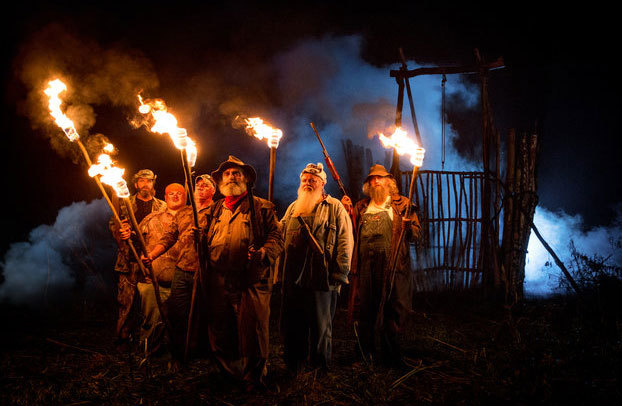
Here is the team……..
big cast
In charge is Trapper, with Jeff as researcher, Willy as trap builder, Buck is the rookie, Huckleberry is the security expert, and the absolute star of the show is Wild Bill. Anything is possible for an ex-Marine.


It didn’t take very much googling to find some original reports from way back in the day. The webpage is entitled “The Grafton Monster sightings of 1965

I have copied and pasted the best contributions to save you the trouble of looking for them, and because they are just so interesting.

Kurt McCoy, from Morgantown, West Virginia, wrote…

“I recently ran across reports of “monster sightings” in the Grafton area, back in June of 1965. Robert Cockrell apparently wrote two articles for the Sentinel about the sightings, one of which was his own.
The “monster” was described as being between seven and nine feet tall with white or light gray skin, “slick like a seal’s”. There were several sightings, but not much publicity and the events have been all but completely forgotten.
Now, since it’s roughly 50 years since those sightings, and given the popularity, and tourist/commercial value that has been given to other better known West Virginia “monsters” (like the Flatwoods “Green Monster” and Pt. Pleasant’s “Mothman”, it seems like a not altogether awful thing to try to preserve and record whatever information can still be gleened about Grafton’s weirdest visitor.
So, anybody remember hearing about the Grafton Monster? Any relative, friends, or neighbors who saw it? Any actual witnesses out there?
If so, let’s hear about it!”

A second contribution from Kurt was…

“The original Grafton Monster sighting was on June 16th, 1964. A newspaper reporter rounded the bend coming on to Riverside Drive and saw a huge white, living Thing on the grass by the river. The Monster was described as having slick skin like a seal’s and no apparent head. The witness sped away, but returned later with two friends and found nothing but grass matted down by the river bank. As they investigated the scene, however, a strange whistling sound seemed to follow them about. The original witness had no intention of reporting the incident for fear of ridicule, but word leaked out from the two friends and, grudgingly, a brief report of the sighting was published in the local newspaper (The Statesman? have to check the notes on that).
Almost immediately there was a wild “monster craze” with bumper to bumper traffic along Riverside drive and dozens of people roaming about the town armed with shotguns, crowbars, baseball bats and other potentially harmful toys. The local authorities, understandably unhappy with this potential disaster, did everything possible to dampen the monster mania. The newspaper printed a follow up story maintaining that the whole thing was just a misidentification of someone pushing a pile of white boxes on a hand cart. The hysteria died down and the whole thing was soon forgotten.
The original witness continued to investigate, however, and found about twenty other witnesses whole described seeing something almost identical to what he saw. A week earlier a man in Morgantown had seen an identical beast in the Mon (sic). The reporter exchanged letters with Gray Barker about the incident (those letters are in the Gray Barker Collection in Clarksburg). Eventually the ridicule and official resistance proved too much and the reporter dropped his investigation–and refuses to talk about it to this very day.
The newspaper reports are real–you can find them on microfilm. The incident was real, whether or not the Monster was.”

Woodsman, of Saint Joseph, Missouri, wrote…

“I have seen the creature called “The Grafton Monster” several times when I was a young man and it is very real. My first encounter I was with my Father cutting wood. We had finished and we’re loading the truck, when our two dogs started barking. We stood there and listened, something was walking, getting closer. My Dad told me to get the gun from the cab (He carried a double barrel 10 gauge with 00 buckshot).Whatever it was had picked up it’s pace and continued toward us. All we knew for sure was, it was big and wasn’t scared of us, the dogs or the chainsaws .It stopped about 50-55 yards from us in the tree’s and went quiet. My Dad pulled both hammers back and stood in front of me, told me to be ready. The next thing that happened I’ll never forget. It stepped out, looked at us, took 3 strides in our direction, turned and walked back into the tree line. That was my first sighting of the beast and I’ll never forget it. My 2nd encounter was about 2 months later at night, fishing alone.”

The Headless Horror is not always quite as headless as he is portrayed. It’s more a question of poor posture, apparently…

wpid-wp-1397870811302


Our heroes prepare for the hunt…

They talk to a rather scared eye witness…

prepareing

Both Trapper and Buck get the chance to try out some of the local goo…

Afterwards, there follows a reasonable post-match examination of events, although I would have liked more attention to have been paid to what appeared to be excellent thermal images from the special camera.

Unfortunately, at the end of the day, our heroes are left with no physical evidence of their huge adversary. Personally, I wish that they had captured the Headless Horror’s Hat…

black_top_hat

“Mountain Monsters” is on Animal Planet Channel every Thursday at 10.00 p.m. (Sky 523).

3 Comments

Filed under Cryptozoology, Film & TV

Mountain Monsters: a hillbilly hunting a hillbilly!

My favourite TV programme at the moment is called “Mountain Monsters”. The cast are, in their own words, hillbilly hunters, who pursue unknown animals in the Appalachian Mountains, and attempt to capture them. The film footage which they have managed to take constitutes some of the most dramatic and  convincing evidence of Bigfoot in recent years.
Episodes are aired at 10.00 p.m. every Thursday on Animal Planet Channel (Sky 523 in the UK). Here is the team….
big cast
In charge is Trapper, the team leader…
trapper
Sometimes he wears a trapper’s hat…
trapper_hat
There is Jeff, the researcher…
jeff-headlee-mountain-monsters
Willy, the trap builder…
_willy
Buck, the rookie, who is given all the jobs which involve getting wet or covered in mud…
buck the rookie
Huckleberry is responsible for security…
huckleberry_da
The irrepressible Wild Bill is, as they say, a real character. He is the expert tracker, a superb tree climber, and a man who believes anything is possible if you are an ex-Marine.
wild_bill
In a previous episode they managed to take a trail-cam photo of the Ohio Grassman. He is the Bigfoot type of creature in that particular state, and the size of the pile of earth in the photograph makes him at least eight or nine feet tall.
big grassman1+1
Close up, he really is quite strange…
enormous grassman2
This week our intrepid heroes set out to hunt down the Yahoo, who lives in Nicholson County, West Virginia.
yahoo drawing

During the pursuit, they see every possible indication of the presence of a Bigfoot-type animal. These creatures regularly break down trees to mark their territory, and warn away trespassers…
tre break 2a
They find three sets of enormous footprints, presumably Daddy Yahoo, Mummy Yahoo and Baby Yahoo…

This slideshow requires JavaScript.


They stumble upon a carefully constructed Yahoo nest…
nest
They hear tree knockings and see a farmer’s video of the creature:

Wild Bill and Willy build a trap…
making traps
It is quite an  undertaking to work on the enormous trap needed for a creature of this size and strength:

http://www.youtube.com/watch?v=dX2hcJPKwIw
In the subsequent thrilling night hunt, everyone sees the creature clearly on a thermal camera, they hear its thundering roar and it breaks down a number of fully grown trees down as a threat display.
bigfoot-cr-colorado-010
This is a scary episode, a group of men alone with a creature of unbelievable strength:

And it’s nice to have a relaxing chat about it afterwards!:

You might well argue, of course, that Bigfoot is merely a man in a suit, but as a genuine bona fide monster, he has certainly been around for quite a while. Supposedly, he harassed Lewis and Clark nearly two hundred years ago.
Lewis-and-Clark harassed

Perhaps the best attitude is that of the B.F.R.O ….

“For more than 400 years people have reported seeing large, hair-covered, man-like animals in the wilderness areas of North America. Sightings of these animals continue today,  often by people of unimpeachable character. For over seventy years, people have been finding, photographing, and casting sets of very large human-shaped tracks. Most are discovered by chance in remote areas. These tracks continue to be found to this day. The cultural histories of many Native American and First Nation peoples include stories about non-human “peoples” of the wild. Many bear a striking resemblance to the hairy man-like creatures reported today. There is, however, much disagreement as to what these facts mean. To many, these facts, taken together, suggest the presence of an animal, probably a primate, which exists today in very low population densities. If true, this species, having likely evolved alongside humans, became astonishingly adept at avoiding human contact through a process of natural selection. To others, these same facts point to a cultural phenomenon kept alive today through a combination of the misidentification of known animals, wishful thinking, and the deliberate fabrication of evidence. The BFRO, and its members, take the former view.”

If you find Sasquatch an interesting topic, you will soon become fascinated, as I have, by mild mannered M.K.Davis, the so-called “hippy from Mississippi”.

mk2c

In his working life he was a photographic analyst in the astronomical world, but in his spare time, he has turned his interpretative skills to the many different trail cam videos of Bigfoot, and in particular, to the Patterson-Gimlin film:

I thank you for your time.


17 Comments

Filed under Cryptozoology, Film & TV