Category Archives: Football

Notts £100 million striker (1877-1891) (second half)

In my previous blogpost about Harry Cursham, the Notts County superstar, I wrote for the most part about his exploits in the F.A.Cup. At the time, the F.A.Cup was the only official competition in existence for football clubs. Apart from international matches, which, with just four countries, permitted only three games per season, Harry could only play in friendly games until some bright spark invented the Football League in 1888.

Here is an abridged version of Harry’s exploits in friendly fixtures. For me, the most wonderful things are the evocative names of some of those long defunct clubs.

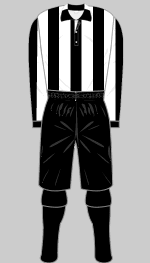
In 1877-1878, Harry scored a hat trick on his début at home against Stoke (4-1), and five goals in an away game against Manchester (6-0). He got four in an 8-2 victory over Derby Grammar School, and also appeared in an amazing 1-10 defeat at Southwell. Harry would have worn this kit:
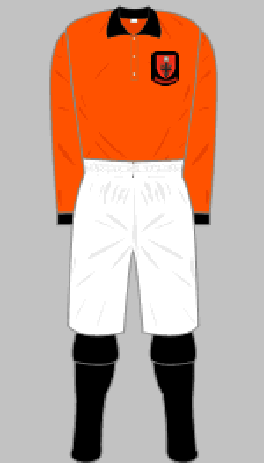
notts_county_1877-1878

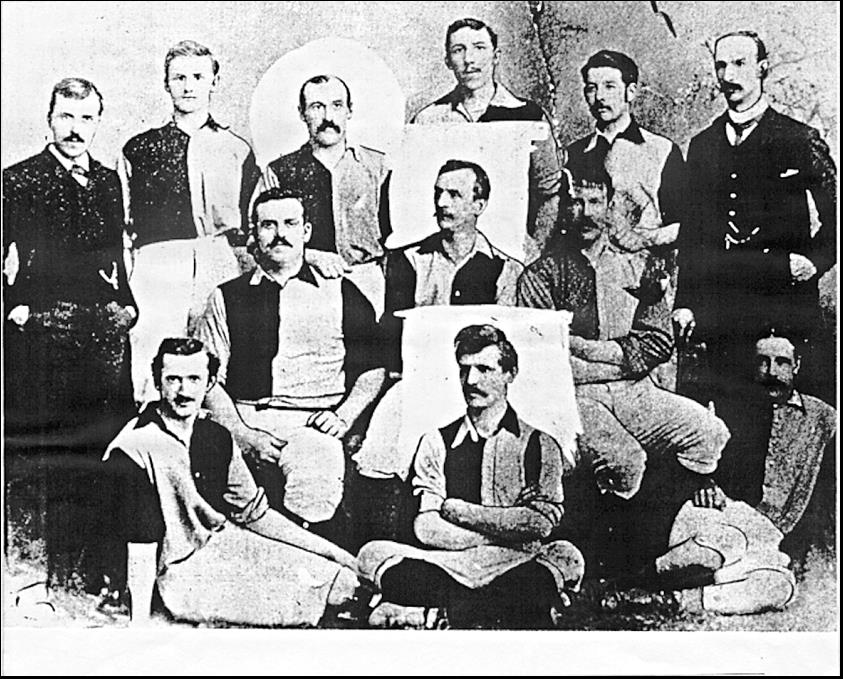
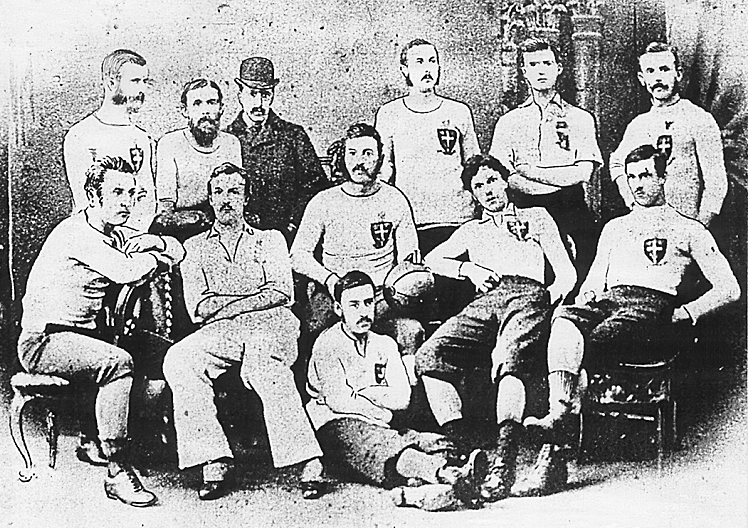
The photograph below shows the Notts.County team which played a prestige friendly against Queens’ Park, of Glasgow, Scotland, on November 18th 1877 at Hampden Park.

(back row) Erasmus Keely, Fred Rothera, Arthur Ashwell (Umpire), Harold Greenhalgh, Harry  Cursham, George Seals. (front row) Richard Greenhalgh, Arthur Cursham, Ernest Greenhalgh, Tom Oliver, S.Keely. Henry Jessop is sitting on the floor. As well as Harry, Arthur Ashwell, Arthur Cursham, Henry Jessop, Tom Oliver and George Seals were all ex-High School pupils:
q park

In 1880-1881, Harry scored 13 goals in 10 appearances, including five at home to Sheffield (8-1), a game in which fellow Old Nottinghamian Harold Morse scored the other three goals. He scored five more goals in what was then Notts’ record winning margin, namely 15-1 at home to Newark.

In 1881-1882, Harry produced 21 goals in just 15 appearances. By now an outside left, he scored four at home to Staveley (7-0) and Derby Midland (7-2), and four more away to Pilgrims (5-1). He scored twos at home to the Old Carthusians (5-1) and the Sheffield Club (5-1) and away to Nottingham Forest (5-0). At one point, he managed 16 goals in six consecutive games (1-2-2-2-4-4 ). In addition, the scorers of three goals in a 5-0 victory over the Sheffield Club remain unknown, as do all the goalscorers in a 13-0 rout of Grantham. It is surely beyond credence that Harry did not score at least once in this particular game.

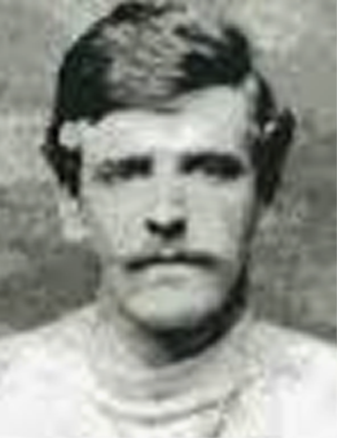
In 1882-1883, he scored 29 goals in 16 appearances. Having moved to centre forward, he opened the season with six goals against a Local Clubs’ XI (10-1) and scored four at home to Stoke (5-0) with four away at Sheffield (8-2). He got a hat trick in a 10-0 home win over Mitchell St.George’s, and scored twos at home against Sheffield (8-1), Liverpool Ramblers (3-1),Walsall (7-2) and Wednesbury Old Athletic (6-1) and away against Aston Villa (2-1). At one point, Harry managed 16 goals in five games (6-2-2-4-2 ). The scorers remain unknown in a 5-1 victory at Stoke:
harry 1

The 1883-1884 season produced 22 goals in 21 appearances. Playing mainly as an outside left, Harry scored four goals in a 5-1 victory over Padiham, and hat tricks at home to Sheffield Attercliffe (6-2) and Brentwood (3-2). He got twos in a 6-1 home victory over the South of England and in a 4-1 home win against Great Lever.

The following season of 1884-1885, he was to score 19 goals in just 22 appearances, with four in an 8-0 home victory over Derby Midland, and twos at home to Sheffield (6-2), Notts Rangers (6-2), Corinthians (3-2), and, most important of all, against Nottingham Forest, in a 3-2 home victory. He played this season mostly as an outside left, but in January, Harry missed the games against Blackburn Olympic (1-1) and Preston North End (2-3), as he was in mourning for his brother, Arthur, who, having recently emigrated, had died in Pera, Florida on Christmas Eve at the age of only 32, of what was variously called malarial fever or yellow fever. In the game against Blackburn Olympic, the County team all wore black crêpe armbands as a mark of respect. Here is the Olympic team:
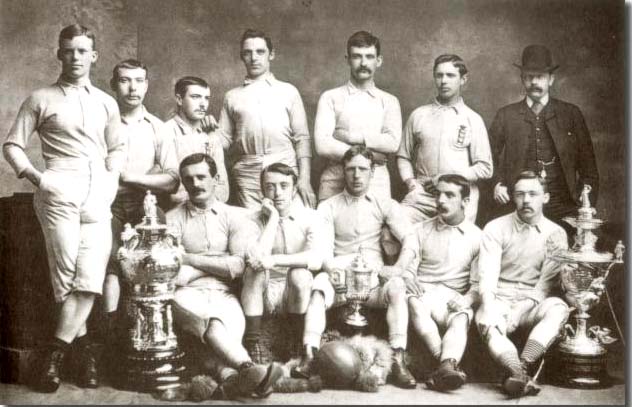
blackburn1886

Immediately before the start of this season, “Mercutio”, in his “Nottingham Football Annual”, had described Harry Cursham as:

“A grand forward. Plays on either wing, and has distinguished himself in the centre. Is at his best perhaps on the left, in which position he frequently evokes admiration by the brilliancy of his runs. A splendid shot at goal, and altogether one of the best men of the day.”

In 1885-1886 Harry managed hat tricks at home to West Bromwich Albion (4-3) and Nottingham Forest (5-0). The next season there were 15 goals in 23 games as Harry, by now back at inside left, scored goals steadily throughout the season. He cannot, though, have enjoyed Notts’ narrow 0-14 defeat at the hands of Preston North End, “The Invincibles”, who were to win the first ever Football League Championship in 1888-1889. They were one of the greatest teams in the history of the Football League:
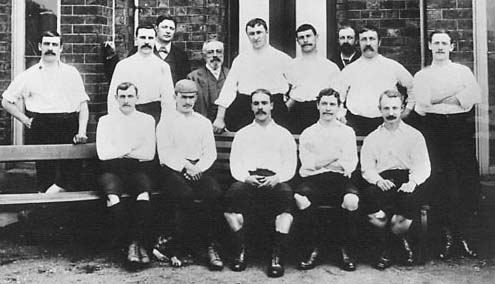
preston-north-end-1889-514

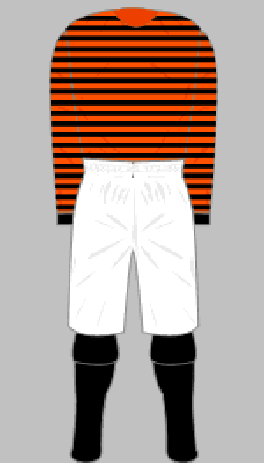
In the last season before the establishment of the Football League, 1887-1888, Harry, now operating at either left or right full back scored only 2 goals in 19 games. They both came in a 4-0 home victory over Grimsby Town, one of only three games in the forward line. Here is the Notts kit from 1888-1890:notts_county_1880-1890
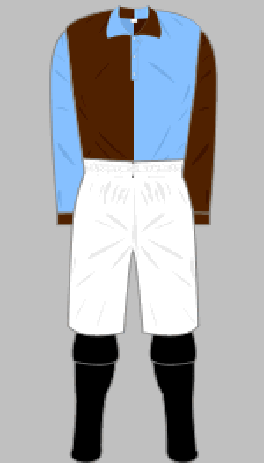
In 1888-1889, Harry, still a right back, became one of the small number of High School boys to have played League football. He played eight times and his two goals came when he reverted to centre forward, in home victories over West Bromwich Albion (2-1) and Wolverhampton Wanderers (3-0). The latter effort, scored after two goals from Ted May, was his last goal for Notts County.

In matches other than F.A.Cup ties, therefore, Harry managed a minimum of 158 goals in 183 appearances. When the F.A.Cup ties are added in, his career total becomes a phenomenal 235 goals in 202 appearances. In very many games, of course, the scorers’ names have been lost and we have no means of knowing if that total of 235 is too low.

On March 18th 1882, Harry refereed the friendly match between Nottingham Forest and a Trent-Wanderers Combination. In this match, Forest’s goalkeeper, John Sands, came out of goal, and scored a goal, surely one of the first times that this had ever happened in football history.

Some years after this, Harry refereed the friendly game between Nottingham Forest and Notts Rangers (0-2), one of the Nottingham’s first ever matches under floodlights. The game kicked off at 8 p.m., on Monday, March 25th 1889. The lighting was provided by Wells lights, fourteen of which were set up around the ground. Powered by oil, they provided, in theory, some 14,000 candlepower each. More than 5,000 spectators were attracted to this unusual game.

Given his amazing record as a goalscorer, Harry was to play for England on several occasions:
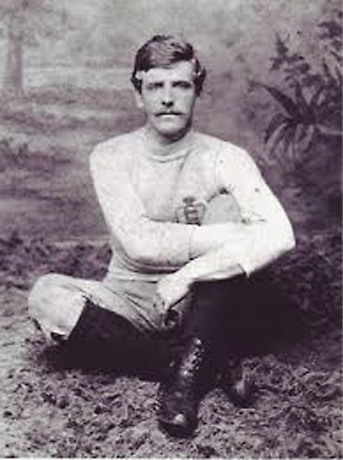
h cursham

He made his début in 1880 as an outside right, a late replacement in the team as England beat Wales by 3-2 at Wrexham. In 1882, he played as outside left in a record away performance at Belfast in Ireland. Harry scored one goal of England’s thirteen, without reply from the Irish. Here are the Irish, looking very dapper:
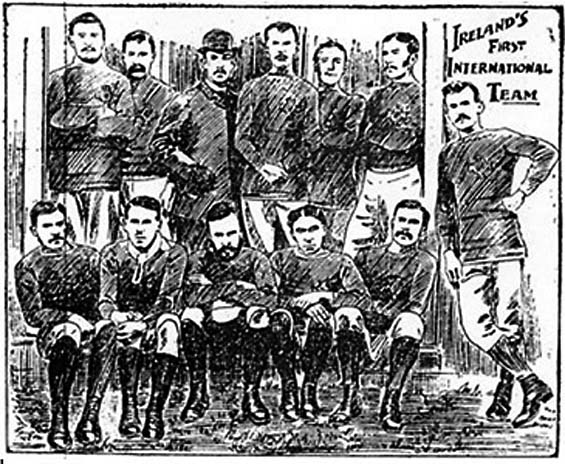
M014Ire1882Ire 13-0

Later that year he played as a left half against Scotland in Glasgow, a game the English lost, rather unluckily, by five goals to one. Can you spot the fresh faced Harry in the picture below?
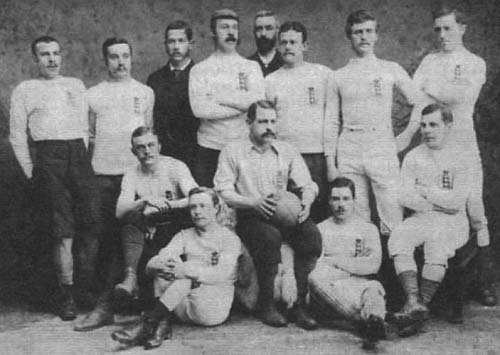
sco 5 eng 1

This particular game was refereed by the splendidly named official, Mr Segar R Bastard. Crowds were to recognise his offspring in innumerable matches down the years.

Harry then scored one goal as England lost by 3-5 to Wales at Wrexham. In February, 1883, he celebrated being in the same England team as his Old Nottinghamian brother, Arthur, by scoring a goal in a 5-0 revenge victory over the Welsh.  In the same month, as an outside left, he helped England beat the Irish by 7-0 at Liverpool. In March 1883, he again appeared with his brother Arthur, this time as a left half, losing to Scotland by 2-3 at Sheffield.

This is the England team which played against Scotland at Sheffield on March 10th 1883. It contained three Notts County players, and two Old Nottinghamians, one of whom, Harry Cursham, is seated second from the left on the middle row. His brother, Arthur Cursham, may be the player seated on the left of the front row, and half back Stuart Macrae is possibly the player at the right hand end of the middle row. Readers may wish to look at other pictures of Notts County, and decide for themselves !
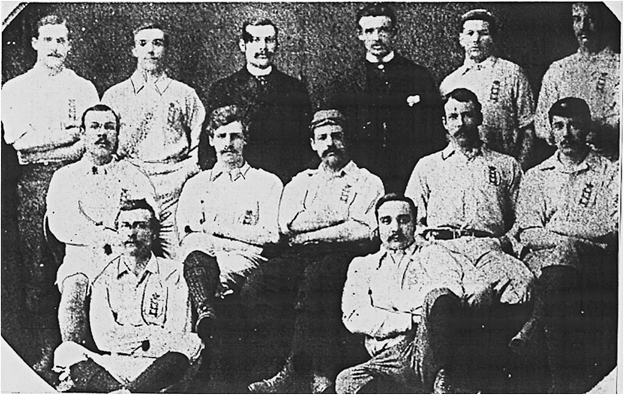
eng v sco 1883

On February 25th 1884, as outside left, Harry scored a hat-trick in England’s 8-1 victory over Ireland in Belfast. This was his last game for England, and he had scored five goals in eight appearances at this level. This remains the record number of England international caps by a Notts County player. What a pity there were only three games per season. What a pity Harry Cursham never played against Andorra, San Marino, Liechtenstein or Gibraltar. What goals Harry would have scored!

After leaving Notts County, Harry played an unrecorded number of games for Grantham:
Grantham_Town_FC_logoOn March 12th 1891, Harry appeared for the Nottingham High School Old Boys at the Gregory Ground, in their fixture against the current High School First Team. Not surprisingly, perhaps, the Old Boys won by 3-1, with Harry getting their second goal midway through the second half. In 1896, Harry, along with Tinsley Lindley, was invited to play in the first ever “Gentlemen versus Players” game, a prestigious friendly, which would help to make absolutely clear to all the working class spectators the rigid class differences and privileges in force in the hierarchical society of the time. To both men’s credit, they refused the opportunity, preferring to watch a local derby match, Forest v County.

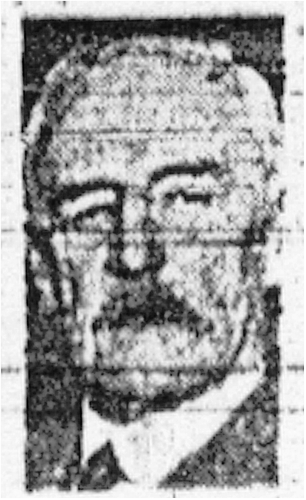
By 1929, Harry was living at “The Firs”, Holme Pierrepoint:
old man

Harry passed away peacefully there on Wednesday, August 6th 1941, at the age of eighty-two. He was survived by his widow, and his daughter, Mrs.R.S.Challands. Harry had two sons. One, Curzon, was a solicitor, while the other son, Francis George, was a Major in the 8th Battalion of the Sherwood Foresters during the Great War. He was tragically killed in an accident on active service at Aldershot on August 31st 1918, at the age of only twenty-nine.

Harry’s funeral took place at Holme Pierrepont Parish Church on Saturday, August 9th 1941:

church hpp xxxxxxx

His old friend, the Archdeacon J.P.Hales took the service, assisted by Canon A.D.Allen, the Rector of the parish. Harry was buried behind the church. Harry’s wife, Frances Anne Elizabeth, was to pass away on March 8th 1946, at the age of eighty-two. She was buried with her husband:
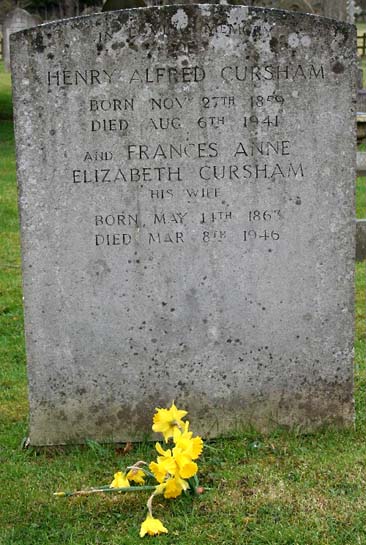
grave

Only ten metres away from these two graves lies Harry’s other son, Curzon. He lived to a ripe old age, dying on June 17th 1981 just three weeks short of his 94th birthday. His wife, Sheila Moorhouse Cursham (1891-1968) is interred with him. Next to Harry and Frances lies his son, Francis:
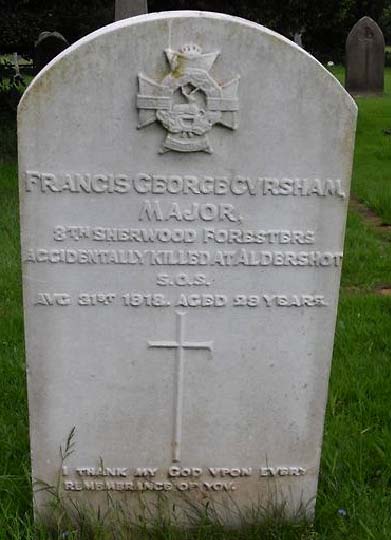
son cursham-granve-a

By the way, the illustrations of the old football kits came from the best ever website for the soccer nerd and all the boys who had more than twenty different Subbuteo teams. New Brighton Tower 1898? Oh, yes.
11 Comments

Filed under Football, History, Nottingham, The High School

Notts £100 million striker (1877-1891) (first half)

Harry Cursham has scored more goals in the F.A Cup competition than any other soccer player in history.

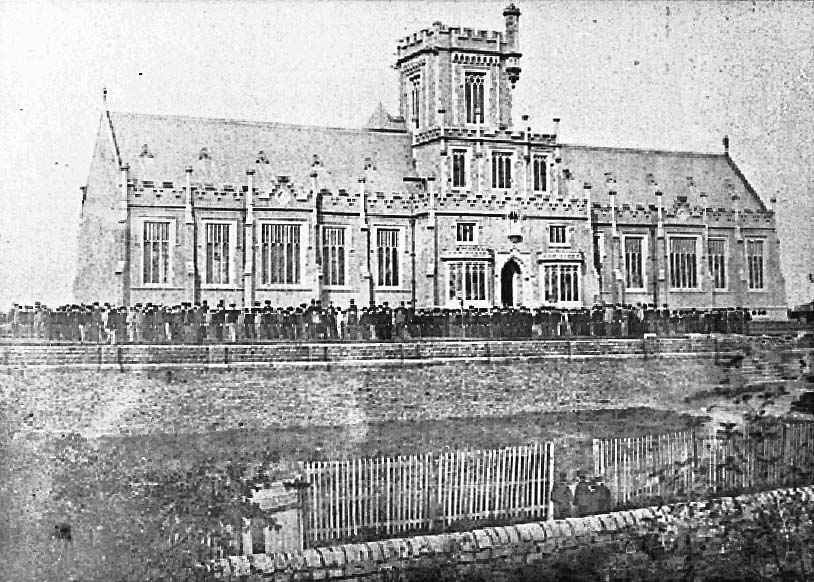
Harry was born at Wilford Grange near Nottingham on November 27th 1859, one of the five sons of William George Cursham, a solicitor. He entered the High School at the age of nine on January 18th 1869, on the same day as his brother, Charles. Harry had three brothers in total. Like him, they all attended the High School. They were Arthur William Cursham, (born 1853), Charles Lambert Cursham, (born 1858), and William Cursham (born 1862). Here is the High School of Harry’s day:

first day

During his school career Harry played for the High School First Team, but only a very few editions of the school magazine, “The Forester”, have survived from this period. Unfortunately, the very few match reports are not particularly detailed, and there is no mention of Harry as a footballer.

Harry does appear as an athlete.  He won a 100 yards’ race for boys under eleven at the Annual Athletic Sports in September 1870. This major event in the social calendar of Victorian Nottingham took place at Trent Bridge, with the crowd entertained throughout the two days by the regimental band of the Robin Hood Rifles. “Cursham ii” won “a capital race” for second place, narrowly beating Brewill, “who ran remarkably well for so small a boy” by about two yards. It was only after the end of the race that the apparently easy winner, Anderson, was disqualified for being over age, thus leaving Harry in first place.

After leaving in 1875, Harry transferred to Repton School as a boarder. He remained there until Christmas 1876, and represented the school at both football and cricket. Harry returned to Nottingham in 1877 and joined Notts County for the 1877-1878 season. Both he, and his brother, Arthur, soon became very great favourites with the crowd. Harry was too young to have worn Notts’ wonderful “convict kit”:

notts_county_1872-1873

On November 3rd 1877, “…these splendidly built players…”, Harry and elder brother, Charles, played for County in their first ever F.A.Cup tie, against the Sheffield Club, for whom Arthur Cursham made an appearance. Arthur, of course, was normally a Notts County player. The match took place at Trent Bridge, and was drawn 1-1. Arthur scored for Sheffield, and Charles for Notts County. The County team included at least four Old Nottinghamians, namely Harry Cursham, Charles Cursham, Thomas Oliver, George Seals, and, possibly, Henry Jessop as a fifth.

In the replay, Arthur scored twice for Sheffield, and County lost 0-3, but Harry was seen as a promising débutant during the season, appearing in the prestigious friendly against Scottish club, Queen’s Park, at Hampden.

Harry soon became a high scoring forward, and scored well in excess of 200 goals in thirteen seasons. “The Football Annual” described him as…

“…one of the best forwards of the day, plays brilliantly on either wing but is particularly effective on the left.”

Elsewhere, he is described as having been:

“…at home on either wing or in the centre, and had good dribbling skills.”

In the 1880s, a third source said that Harry was

“…the most versatile player Notts had during that period, for he was at home anywhere, and was an indispensable member of the English eleven.”

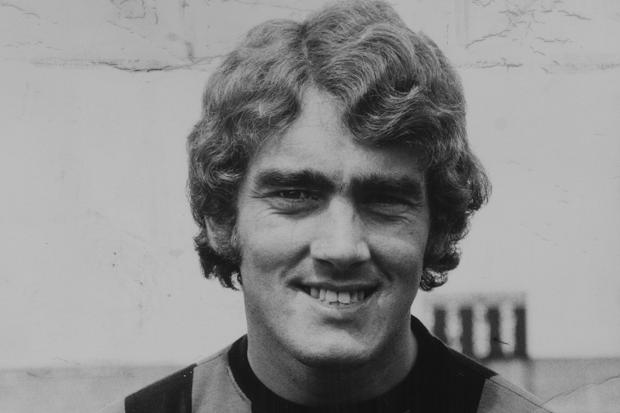
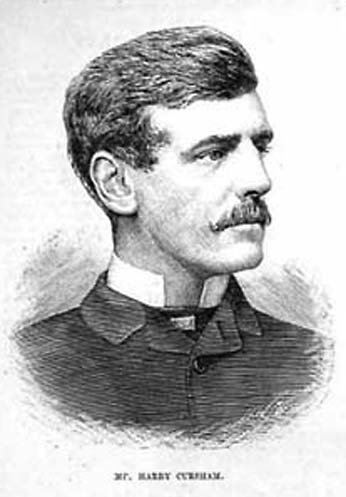
Here is our hero:

cursham

On November 16th 1878, Harry played for Notts County in their First Round F.A.Cup tie against Nottingham Forest at Beeston Cricket Ground, Nottingham Forest having waived their right to host the game. The fact that the Forest Recreation Ground was public land meant that it was impossible to charge admission money. Forest won 3-1, in front of a crowd of some 500 spectators, with goals from Turner, Goodyer and Smith. The attendance was the highest ever recorded for a football match in Nottingham. Special excursion trains were used to take them out of the City.

On November 11th 1880, Harry returned to the High School, and appeared on the Forest for the School First XI  against the Bank. The match took place on a “merit half-holiday”, and the High School fielded six Old Boys, including Harry and Charles Cursham. The Bank’s team was formidable, with several “players of no small note in the local football world”. The game was fast and even, but the the High School’s players were on top form. They ran out the eventual winners by 4-1.

By now Harry had already played for England on one occasion, against Wales at Wrexham on March 15th 1880. As far as I can trace, this game against the Bank is the only occasion on which a current England international represented the High School in any sport.

In the 1881-1882 season, Harry played in the F.A.Cup tie between Notts County and Wednesbury Strollers, a game controversially refereed by Leonard Lindley, the brother of Tinsley Lindley. The visitors led by 2-0 at the interval, but an own goal, and two each from Arthur and Harry Cursham looked to have given Notts a 5-3 victory. Wednesbury were not happy though, with the fact that they had two hotly contested goals awarded against them, by a referee from the same town as their opponents. He was also a personal friend of the Notts County players. Wednesbury Strollers protested to the F.A., who ordered the first ever replay, on a neutral ground, with a neutral referee. This idea of a neutral referee was one which was soon to become fundamental to cup competitions, not just in England, but the whole world over.

The replay took place at Derby and the result was Notts County 11 Wednesbury Strollers 1. Official records state that Harry scored six goals, but he himself claimed throughout his life that he had got nine, explaining that the referee had confused him with his two brothers, Arthur and Charles. Nine goals in a single game would, over a century later, still remain a record for the F.A.Cup. This total was equalled by Ted MacDougall for Bournemouth against Margate in the First Round on Nov 20th 1971, but it has never been beaten:

ted macdouygall

By now, Harry was centre forward for County, and he continued his remarkable goal scoring feats. In the F.A.Cup in 1882-1883, County defeated the Sheffield Club  by 6-1, before beating Phoenix Bessemer of Rotherham by 4-1, and Sheffield Wednesday by the same score. They were then drawn against Aston Villa, with Notts County hanging on grimly to a 4-3 winning margin, Harry having grabbed a hat-trick. Villa protested, however, that in the dying minutes, Harry had fisted out what would have been an equalising goal. Harry appeared before the F.A. to discuss the “long-arm incident”. He explained that the goalkeeper had been hidden behind him, and that it must have been his hand that had knocked away the ball. Obviously, the F.A. were not used to dealing with High School boys, and their far-fetched excuses, and Harry was believed.

Here is the team photo for the semi-final. At least three of the players were surprise choices, and were pasted into the photograph later on:

county semi final

(back row) Arthur Ashwell (Umpire), Johnny Dixon, Herbert Emmitt, Billy Gunn, Harry Moore, Alf Dobson (second row) Mordecai Sherwin, Arthur Cursham, Stuart Macrae (front row) Charley Dobson, Harry Cursham, H.Chapman (his first name remains apparently unknown. Surely not Herbert?)

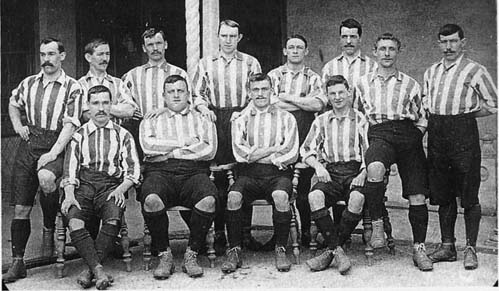
Arthur Ashwell, Arthur Cursham , Johnny Dixon and Harry were all ex-High School boys. In those days, the goalkeeper could be pushed physically into the net, so it paid him to maintain a healthy pie intake. Mordecai Sherwin (16 stone) though, had a long way to go to keep up with 22-stone Fatty Foulke in this Sheffield United team of 1901:

Sheffield_United_FC_1901_team

In the semi-final, Harry scored, but Notts County lost 1-2 against the Old Etonians, who included Lord Kinnaird, and Percy de Paravicini:

In 1883-1884, Harry scored a hat trick against Sheffield Heeley in the first round and then grabbed the winner in a fifth round tie against “The Swifts”. Along with Old Nottinghamian, John Dixon, Harry appeared in the semi-final against Blackburn Rovers but Notts County lost by the only goal of the game, as their goalkeeper, sixteen stone Mordecai Sherwin, was easily barged into the back of the net.

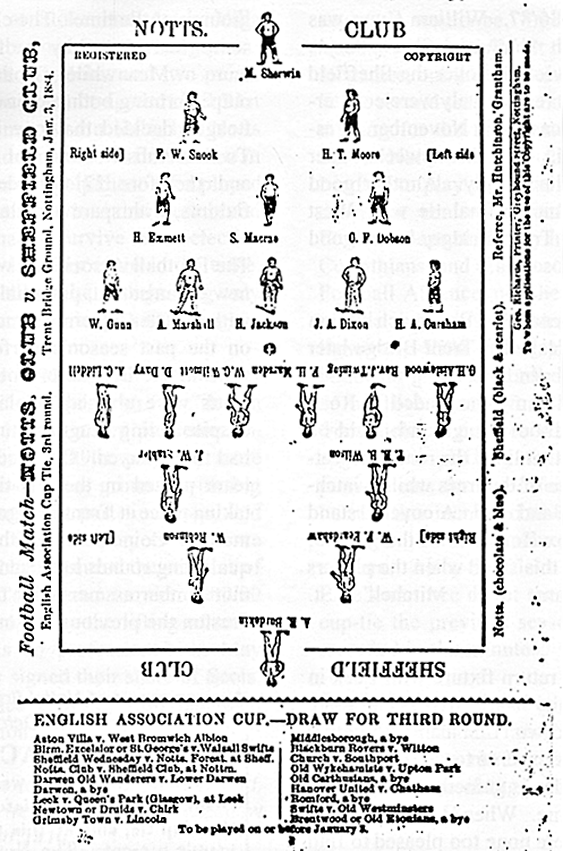
This is Notts’ oldest programme, against the Sheffield Club at Trent Bridge on January 3rd 1885,  watched by 5,000 spectators:

programme

The Old Nottinghamians in the team were Frederick Snook, Harry Jackson, Johnny Dixon and Harry Cursham. The game ended in a 5-0 victory, with County’s goals coming from Dobson, Gunn, Harry Jackson, Harry Cursham and Marshall.

On October 24th 1885, Harry scored four goals in County’s record F.A.Cup victory, a 15-0 rout of Rotherham Town in the First Round at Trent Bridge. Later that year, Harry Cursham appeared in a Sixth Round F.A.Cup tie against the previous season’s beaten finalists, Queen’s Park of Glasgow. The match was played at Trent Bridge before 17,000 spectators, many people having arrived by carriage  from early morning onwards. By the end of normal time the game was poised evenly at 2-2, but the Scottish captain refused to play extra time, because he claimed that the crowd had encroached onto the playing surface and delayed the end of the match. County duly kicked off, unopposed, and kicked the ball into the empty net. The F.A., however, ordered a replay at Derby, where Queen’s Park grabbed the winner in the second half. They duly went on to the final, where they lost to Blackburn Rovers.

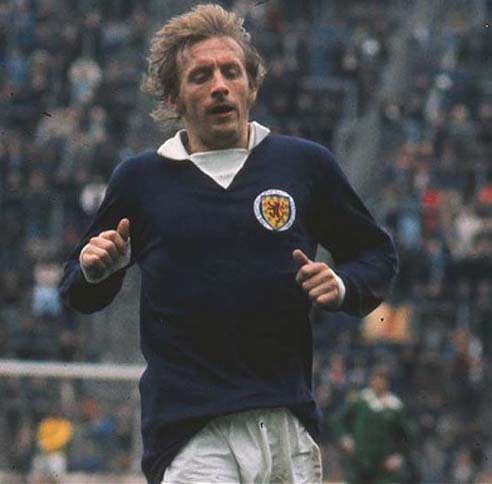
Harry Cursham’s overall total in the F.A.Cup remains the all time goal scoring record. In his career, he managed an official 49 goals, or an unofficial 52 goals, both of which totals have only ever been approached by the peerless Denis Law (41):

law_2779943b

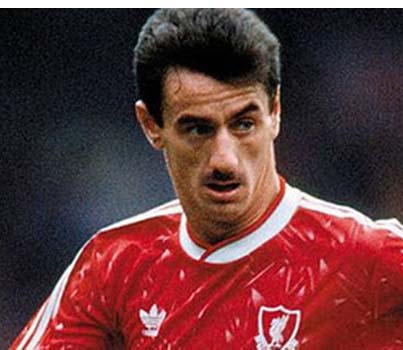
and the man who said that playing for Juventus was just like living in a foreign country, Ian Rush (42).

ian-rush-

In addition, many readers may feel that the two goals he scored in the original, void, game against Wednesbury Strollers should be incorporated in the overall total, giving Harry a record 54 goals in the F.A.Cup. Harry’s full F.A.Cup scoring record was…

Nov  3rd 1877         Notts County v  Sheffield                                     1-1               (1)
Nov  4th 1880         Notts County v Derbyshire F.C                          4-4              (2)
Nov  27th 1880       Notts County v Derbyshire F.C                          4-2              (2)
Nov  24th 1881       Notts County v Wednesbury Strollers               5-2              (2)
Dec  10th 1881        Notts County v Wednesbury Strollers              11-1              (6/9)
Jan   14th 1882       Notts County v Aston Villa                                   1-4              (1)
Nov  4th 1882         Notts County v Sheffield Club                             6-1              (2)
Dec 27th 1882        Notts County v Phoenix Bessemer                     4-1               (1)
Feb 12th 1883         Notts County v Sheffield Wednesday                4-1               (1)
Mar 3rd 1883          Notts County v Aston Villa                                  4-3              (3)
Mar 17th 1883        Notts County v Old Etonians                               1-2               (1)
Nov 10th 1883        Notts County v Sheffield Heeley                         3-1               (3)
Dec 15th 1883         Notts County v Grantham                                   4-0               (2)
Feb  9th 1884          Notts County v Swifts                                           1-1                (1)
Feb 14th 1884         Notts County v Swifts                                           1-0                (1)
Dec 6th 1884           Notts County v Staveley                                       2-0               (1)
Jan 3rd 1885           Notts County v Sheffield Club                             5-0               (1)
Feb 21st 1885          Notts County v Queens’ Park                              2-2                (1)
Oct 24th 1885         Notts County v Rotherham Town                     15-0               (4)
Nov 21st 1885         Notts County v Sheffield Club                             8-0               (1)
Dec 12th 1885        Notts County v Notts Rangers                              3-0               (3)
Oct 30th 1886        Notts County v Basford Rovers                           13-0              (1)
Nov 13th 1886        Notts County v Notts Rangers                              3-3               (1)
Nov 20th 1886       Notts County v Notts Rangers                              5-0               (3)
Dec 11th 1886         Notts County v Staveley                                         3-0               (1)
Jan 29th 1887        Notts County v Great Marlow                               5-2               (3)
Feb 19th 1887         Notts County v West Bromwich  Albion             1-4               (1)
Dec  8th 1888         Notts County v Staveley                                         3-1               (1)

Fittingly, Harry scored in his last ever F.A.Cup game as Notts County’s centre forward:

Feb 28th 1891        Notts County v Sunderland                                   3-3                (1)
Semi-final tie, played at Bramall Lane

This gave Harry an unprecedented career total of 52 goals in 44 F.A.Cup ties (or 54 in 45, if the first game against Wednesbury Strollers is incorporated in the totals.).

There has, of course, been criticism of the strength of the opposition against which Harry scored his F.A.Cup goals. It is worth mentioning, however, that, as an amateur, he may have chosen not to play in some cup ties where he would surely have scored even more goals…

1887-1888              Notts County  v Lincoln Ramblers                        9-0
1888-1889              Notts County  v Eckington                                      4-1
1888-1889              Notts County  v Beeston St.John’s                        4-2
1888-1889              Notts County  v Old Brightonians                         2-0

The F.A.Cup Ties against Eckington and Beeston St.John’s were both contested by Notts County’s reserve side. Harry may well have considered it beneath his dignity to play in these games, even though at this time he was by no means a regular First Team player. Harry also missed the Fourth Round of the F.A.Cup in 1884-1885. This was a 4-1 away win over Walsall Swifts, which took place in front of 5,000 spectators on January 4th 1885. Harry was unfortunately away on honeymoon, having got married in Wilford Church on January 20th. His team mates presented him with a silver plate to mark the occasion:

newsapaper

Harry’s last appearance for County in the F.A.Cup is linked extremely closely with his last appearance in the Football League on February 10th 1891, playing as a right full back, in a 4-0 home victory over Burnley. Harry had not appeared in the First Team for over two years, but the regular right back, Tom McLean, was injured, and the Team Management Committee decided to recall Harry.

The reason for this unexpected decision is that County had reached the Sixth Round of the F.A.Cup and had been drawn at home to Stoke. If Tom McLean was still injured, then Harry would be the ideal replacement. He was an older player, experienced with big games and large crowds.

In actual fact, Tom McLean was to return for the Stoke game, which County won by a single goal. McLean’s injury, however, must have flared up again, as Harry returned to the First Team for his last ever appearance in the F.A.Cup, on February 28th 1891, when he played as a right full back in the semi-final tie against Sunderland. The game was at Bramall Lane, and ended 3-3. Fittingly, some 25,000 spectators watched Harry play for the last time. By now, their kit was the familiar:

notts_county_1890-1900

For the replay, Harry was again replaced by Tom McLean. Tom’s injury cannot have healed properly, however, since he did not get into the team for the Final.

Neither did Harry, who was replaced by Alex “Sandy” Ferguson, a Scotsman from Rangers, who had played only twice previously. County’s only fixture before the Final was a League game against Blackburn Rovers, who would be County’s opponents in the Final. Notts won this League game with great ease, by 7-1. They then chose to keep the same side for the F.A.Cup Final at the Kennington Oval, and were never even remotely in the game. Blackburn won 3-1 with consummate ease:

blackburn-rovers-vs-notts-county-f-a-cup-final-1891_i-G-46-4625-3MOFG00Z

Perhaps the Team Management Committee wished that they had kept faith with Harry, who was surely the man for the big occasion. What a way it would have been to finish off his glorious career, winning the F.A.Cup for the first time ever. It was not until 1894 that Notts County finally won the F.A.Cup. And by one of life’s incredible ironies, it was on the day of the Final against Bolton Wanderers that the Nottingham Football News was able to announce the tragically premature death of Alex “Sandy” Ferguson, who had by now moved on to Newark Town.

By the way, the illustrations of the two football kits come from the best ever website for the soccer nerd and all the boys who had more than twenty different Subbuteo teams. New Brighton Tower 1898? Oh, yes.


7 Comments

Filed under Football, History, Humour, Nottingham, The High School

The Incredible Story of Frank Mahin, Volume I, 1887-1909

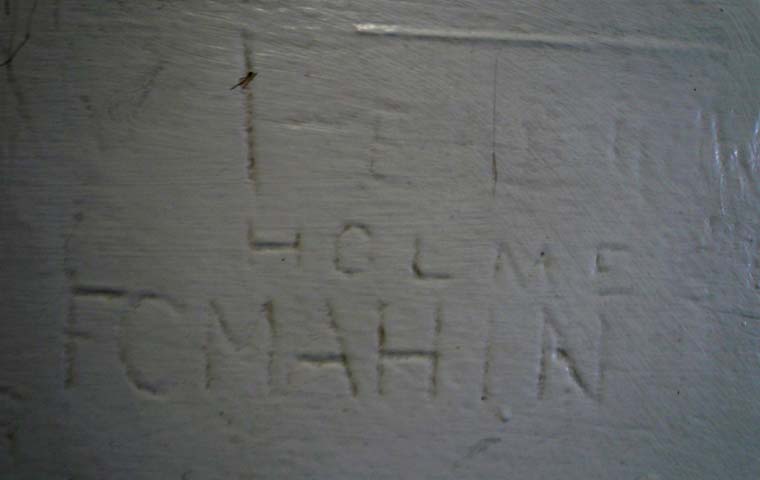
As well as John Francis Haseldine, another High School footballer has carved his initials on the stone mantelpiece of the ground floor fireplace between the General Office and the entrance to the Assembly Hall. This footballing vandal is “F.C.Mahin”.

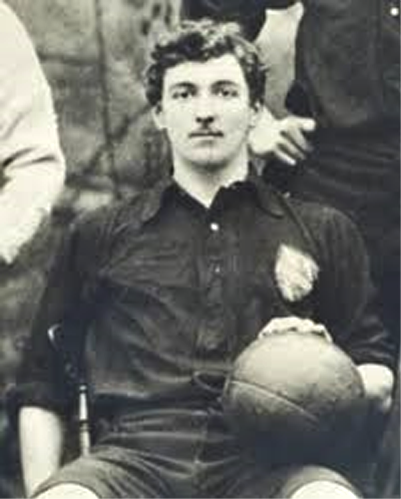
mahin cccccc
Frank Cadle Mahin is one of the most interesting of the school’s pupils. He was born on May 27th 1887, in Clinton, Iowa, the son of Frank W. Mahin, who was a retired United States Consular Officer at the time. Frank W. had graduated from Harvard University in 1877. Frank C.’s mother was Abbie Anna Cadle, who was born in Muscatine, Iowa, in 1857 to Cornelius Cadle and Ruth Lamprey.
This was Abbie’s second marriage. She had previously been married to Frank Mann with whom she had one child. With her second husband, Frank W., she had two more children, Frank C., and a daughter, Anna, who was born in 1880.

Anna was to meet a young English doctor during the family’s stay in Nottingham, and she remained with him after her parents eventually left England for Amsterdam in Holland. I have been unable to trace Anna’s husband’s surname, although he was to become Frank’s Uncle Alec. As an Englishman, Alec was to fight in the Great War well before Frank and his fellow Americans became involved in the hostilities. Alec was certainly in combat as early as 1915, and I believe that he survived the conflict. The year of Anna’s death has not been recorded. Her mother, Abbie, died in 1941 at the age of 84.
.
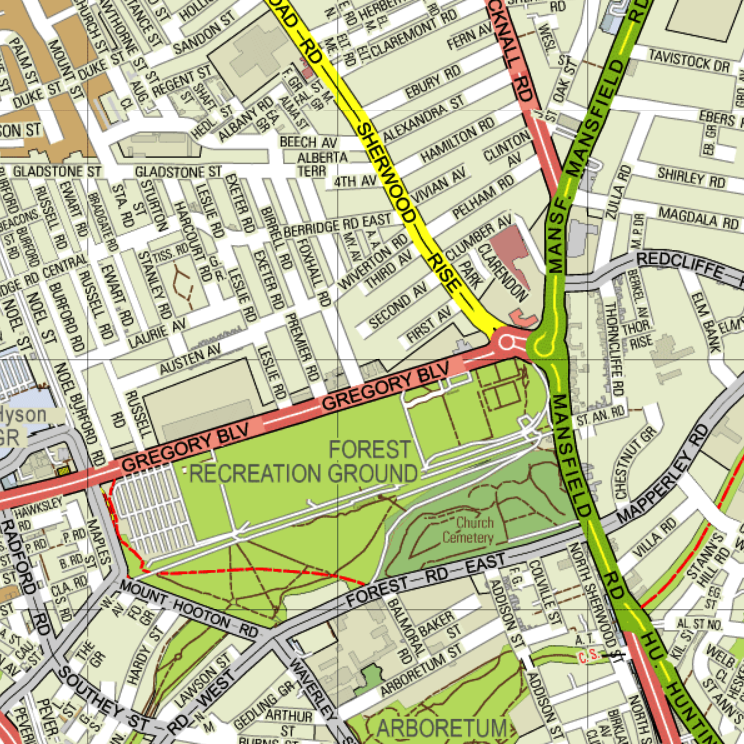
Frank Cadle Mahin entered the High School on September 15th 1902, at the age of fifteen. The Mahin family lived at 7, Sherwood Rise, on the opposite side of the Forest Recreation Ground from the High School. His father was by now the United States Consul in Nottingham. Look for the orange arrow:

Untitled
Despite a comparatively short stay at the High School, Frank Junior seems to have been an accomplished sportsman, and appeared for the First XI at football in a fixture against Loughborough Grammar School on Wednesday, October 25th 1904 at Mapperley Park. The High School began very slowly and had quite a fright before they eventually ran out victors by 4-1. The team was M.J.Hogan, J.P.K.Groves, R.Cooper, R.E.Trease, R.G.Cairns, F.C.Mahin, H.E.Mills, S.D.M.Horner, R.B.Wray, L.W.Peters and P.G.Richards.
Frank played a second match on the afternoon of Saturday, December 3rd 1904. Again, it was at Mapperley Park against Notts. Magdala F.C. 2nd XI. The game finished in a 1-3 away win as:
“a weakened team, who ought really to have won, but did not play as well as they might have, against opponents who themselves were rather poor.”

This time the team was  M.J.Hogan, R.B.Wray, R.Cooper, R.E.Trease, R.G.Cairns, F.C.Mahin, H.E.Mills, J.Henson, L.W.Peters, C.R.Attenborough and P.G.Richards.
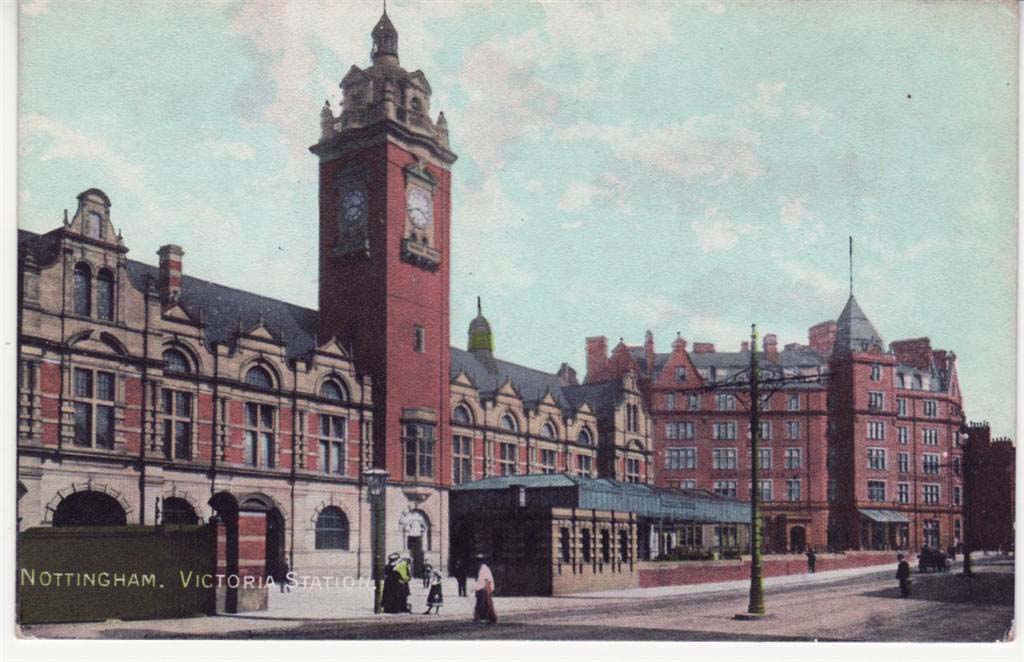
Frank’s only away game was against Worksop College at Worksop. The entire team doubtless travelled by steam train from Nottingham’s Victoria Station on the afternoon of Saturday, March 11th 1905:

Nottingham_Victoria_Station_3

According to the school magazine:

“The High School fielded a weakened team, but played well, and did not deserve to lose by such a wide margin as he 0-5 final result would suggest.”

The team was M.J.Hogan, J.P.K.Groves, W.E.Williams , F.C.Mahin, R.B.Wray, R.E.Trease, H.E.Mills, C.S.Robinson, S.D.M.Horner, L.W.Peters and P.G.Richards.

This photograph shows the First Team in the 1904-1905 season. It was taken at Mapperley Park Sports Ground, opposite the old Carrington Lido on Mansfield Road. Serjeant Holmes is present, and on the back row are S.D.M.Horner, C.F.R.Fryer, M.J.Hogan, R.E.Trease and J.P.K.Groves. Seated are R.G.Cairns, R.B.Wray, R.Cooper (Captain) and L.W.Peters, Seated on the grass are H.E.Mills and P.G.Richards. On the right is the so-called twelfth man, the reserve player, who is Frank Cadle Mahin. I believe that the photograph was taken on the afternoon of Wednesday, October 12th 1904, just before the High School played against Mr.Hughes’ XI. The School won 12-5, and we know that Cooper in defence was the outstanding player, but the whole team played well, and the forwards’ finishing was particularly deadly. This year, the team was amazingly successful. Their season began with victories by 5-4, 2-1, 23-0, 12-5, 9-0, 15-0, 3-1, 4-1, 11-0, 16-1. They had scored exactly 100 goals by November 3rd, in only ten games:

mahin @ carrington

The detectives among you will notice that it is warm enough for the changing room windows to be open, and the design of the ball is very different from nowadays. Young Horner has forgotten his football socks, and, because this game marked his début for the side, Mr Fryer’s mother has not yet had the time to sew his school badge onto his shirt. Frank is, in actual fact, in the full school uniform of the time, which was a respectable suit or jacket, topped off with a neat white straw boater, with a school ribbon around it.

Frank also performed as a linesman, or assistant referee, in First XI football fixtures on several occasions in 1904-1905:

“Referees during the season were Mr.W.T.Ryles, Mr.R.E.Yates, Mr.M.R.Hughes and Mr.A.G.Onion. F.C.Mahin and K.M.Brace also performed as linesmen.”

Frank was perhaps a better cricketer than footballer, and he was, in actual fact, the regular captain of the Second XI at cricket.

cricket team

This photograph shows the First XI cricket team, in an unrecorded year, probably 1905. The individuals are thought to be on the back row, Mr.A.G.Onion, (Groundsman and Coach), S.D.M.Horner, R.G.Cairns, C.F.R.Fryer, unknown and F.C.Mahin.  In the middle row are P.G.Richards, L.W.Peters, W.G.Emmett (Captain), M.J.Hogan and R.B.Wray. Seated on the grass are J.P.K.Groves, H.E.Mills, and an unknown player.
In his time at the High School, Frank played for the First XI cricket team only sporadically. We know that he batted once in the 1904 season, and scored five runs, and then batted once more in 1905, and obtained the same score.
In addition, we also know that, on Saturday, June 24th 1905, which was School Sports Day, Frank dead-heated for first place in the Open Long Jump, managing a jump of fifteen feet nine inches, exactly the same distance as C.F.R.Fryer.
In the academic world, Frank won the Mayor’s Prize for Modern Languages, and, most significant of all, perhaps, he reached the rank of sergeant in the newly formed Officer Training Corps.

.
Frank left the High School in July 1905, and returned to the United States where he was in the Class of 1909 at Harvard University.

The university’s proud boast nowadays is that they produce the most highly paid university alumni in the United States:

harvard-university-brandxxxxxxxx

Frank’s close contemporaries included Franklin Delano Roosevelt, and two sons of the current President of the time, Theodore Roosevelt. They were called Theodore and Kermit.

Both of these men had the same interest in the military as Frank.  In 1917, Kermit Roosevelt, although he was obviously an American, joined the British Army to fight in Mesopotamia during the Great War. He was awarded a Military Cross on August 26, 1918. Theodore Roosevelt served as a Brigadier General in the United States Army during the Second World War. He died in France in 1944, a month after leading the first wave of troops onto Utah Beach during the Normandy landings.  This brave act was to earn him the Medal of Honor. To me, it would seem ludicrous to suggest that they were not, at the very least, among Frank’s acquaintances at Harvard, if not friends.

Hopefully, Frank had little or no association with another famous member of the Class of 1909. This was Ernst Hanfstaengl, a prominent member of the German Nazi party in the 1920s and early 1930s. A close personal friend of the Führer, Hanfstaengl provided part of the finance for the publication of “Mein Kampf”  and the Nazi Party’s official newspaper, the “Völkischer Beobachter“. Using his experience of Harvard football songs, he composed many Brownshirt and Hitler Youth marches and also claimed to have invented the “Sieg Heil” chant. Eventually, “Putzi” was to defect to the Allies and to work as part of President Roosevelt’s “S-Project”, providing information on some 400 prominent Nazis.

During his time at Harvard, according to the Secretary’s Second Report on the Harvard College Class of 1909, Frank married Miss Carrie Knight Whitmore on December 10th 1906. Alas, the poor lady was to die on February 11th 1907. Details are lacking, unfortunately, but this was an era where women could die not only giving birth to a child, but even of morning sickness in the early part of a pregnancy. The same source reveals that Frank remarried on August 18th 1908 in New York, New York State. The lucky lady was called Miss Sasie Avice Seon.

Frank represented the University at football on a number of occasions. Here is one of them:

in goal 1908
On November 30th 1906, Frank was selected as a goalkeeper against Columbia University:

“Tonight at 6 o’clock the University association football team will leave on the Fall River boat for New York, where they will play Columbia tomorrow afternoon at 2 o’clock. While in New York the team will stay at the Murray Hill Hotel. On Sunday, they will leave for Ithaca, play Cornell on Monday afternoon, and return to Cambridge that night. The following men, accompanied by Manager E. B. Stern ’07 and Assistant Manager P. Woodman ’08, will be taken: G. W. Biddle ’08, W. M. Bird ’08, P. Brooks ’09, E. N. Fales ’08, W. A. Forbush ’07, H. Green ’08, O. B. Harriman ’09, F. C. Mahin ’09, C. G. Osborne ’07, A. N. Reggio ’07, A. W. Reggio ’08, L. B. Robinson ’07, W. T. S. Thackara ’08.”

Further details followed in “The Crimson Banner

The association football team will play its first game of the season with Columbia this afternoon at 2 o’clock on Alumni Field, New York. Individually the team is strong; but, as several of the men have only recently joined the squad, the team work is not well developed. Captain Thackara will be in the line-up today for the first team this year. Columbia finished second in the intercollegiate league last year and defeated Yale last week in a well-played game by the score of 4 to 0.
The line-up will be: HARVARD.  COLUMBIA. Mahin, g.  g., Graybill Green, l.f.b.  r.f.b., Voskamp Thackara, r.f.b.  l.f.b., Fairchild Biddle, l.h.b.,  r.h.b., deGarmendia A. W. Reggio, c.h.b.  c.h.b., Dickson Bird, r.h.b.  l.h.b., Rocour Forbush, l.o.f.  r.o.f., Billingsley Brooks, l.i.f.  r.i.f. Simpson Osborne, c.f.  c.f., Hartog A. N. Reggio, r.i.f.  l.i.f., Dwyer Robinson, r.o.f.  l.o.f., Cutler
Tomorrow the team will leave for Ithaca, and will play Cornell on Monday afternoon, returning to Cambridge that night.

Frank did well:

“The association football team defeated Columbia on Saturday at Alumni Field, New York, by the score of 1 to 0. With only ten men in the line-up, Columbia was unable to block the clever attack of the University team, and was on the defensive during most of the game. The single goal was scored in the first half after a series of speedy passes by the forwards to A. N. Reggio, who sent the ball into the net. Osborne, the University team’s centre forward, played an excellent game, and continually broke up the Columbia attack before it was fairly started. Two 30-minute halves were played.
Harvard vs. Cornell at Ithaca Today.
This afternoon, the team plays Cornell on Percy Field, Ithaca. Last month Cornell defeated Columbia by the score of 2 to 1, and has a fast, aggressive team.
The teams will line-up as follows: HARVARD  CORNELL. Mahin, g.  g., Wood Green, l.f.f.  r.f.b., Van der Does de Bye Thackara, r.f.b.  l.f.b., Sampaio Biddle, l.h.b.  r.h.b., Malefski A. W. Reggio, c.h.b.  c.h.b., Dragoshanoff Bird, r.h.b.  l.h.b., Wilson Forbush, l.i.f.  r.o.f., Van Bylevelt Brooks, l.i.f.  r.i.f., Deleasse Osborne, c.f.  e.f., MacDonald A. N. Reggio, r.i.f.  l.i.f., Samirento Robinson, r.o.f.  l.o.f., Chryssidy ”

On December 4th, Frank appeared against Cornell University:

“ITHACA, N. Y., Dec. 3.–On a field covered with snow the association football team defeated Cornell this afternoon on Percy Field, by the score of 5 to 1. In spite of the unfavorable conditions, the University team played well and showed a marked improvement in team work over the form in the Columbia game. Cornell’s defense was unable to check the hard attack of the University forwards, and but for the snow which made accurate shooting impossible, the score would have been larger. Of the five goals, Osborne made three, and Biddle and A. N. Reggio one each. Cornell’s goal came after a hard scrimmage in front of the net, following a kick out from the corner of the field. Two thirty-minute halves were played.
The summary follows: HARVARD.  CORNELL. Mahin, g.  g., Wood Green, l.f.f. r.f.b.,  Van der Does de Bye Thackara, r.f.b.  l.f.b., Sampaio Brooks, l.h.b.  r.h.b., Malefski A. W. Reggio, c.h.b.  c.h.b., Dragoshanoff Bird, r.h.b.  l.h.b., Wilson Forbush, l.o.f.  r.e.f., Van Bylevelt Biddle, l.i.f.  r.i.f., Delcasse Osborne, c.f.  c.f., MacDonald A. N. Reggio, r.i.f.  l.i.f., Samirento Robinson, r.o.f.  l.o.f., Chryssidy
Score–Harvard, 5; Cornell, 1. Goals –Osborne, 3; Biddle, A. N. Reggio, Dragoshanoff. Time–30-minute halves.”

This is the Harvard team for an unknown match in the 1906-1907 season:

sophomore 07-08

On December 8th, news came of an important game:

“The University association football team will play Haverford this afternoon at 2.30 o’clock in the Stadium. As neither team has been defeated this fall, the game today will decide the intercollegiate league championship.
The University team has improved steadily during the season and has developed an effective attack, as shown in the Cornell game last Monday. Haverford has a well-balanced, team of experienced players, many of whom played on last year’s championship team. Last month they defeated Columbia by the score of 2 to 1, while the University team defeated Columbia, 1 to 0.
The line-up will be: HARVARD.  HAVERFORD. Mahin, g.  g., Warner Kidder, l.f.b.  r.f.b., Brown Green, r.f.b.  l.f.b., Godley Thackara, l.h.b.  r.h.b., Drinker A. W. Reggio, c.h.b.  c.h.b., Rossmaessler Bird, r.h.b.  l.h.b., Windele Brooks, l.o.f  r.o.f. Bushnell A. N. Reggio, l.i.f.  r.i.f., Furness Osborne, e.f.  e.f., Baker Robinson, r.i.f.  l.i.f., Shoemaker Biddle, r.o.f.  l.o.f, Strode
The privileges of the Union are extended today to all Haverford men.
D. J. Pryer has been elected captain of the Brown University football team for next year.
The novice revolver shoot, finished last night, was won by M. R. Giddings ’08 with a score of 329 out of a possible 500.”

Frank duly appeared as the goalkeeper for Harvard on December 10th:

“The University association football team was defeated by Haverford on Saturday in the intercollegiate championship game by the score of 2 to 1. Haverford’s light forwards were very fast and displayed better team work than the University players, who depended almost entirely on individual work. On the defense, the University backs were not given enough assistance by the forwards.
For the University team, Brooks and A. N. Reggio played especially well. In spite of a constant guard of two Haverford players, Osborne played his usual good game. In the second half, several opportunities to score were lost by the University forwards through inaccurate kicking. Baker, Haverford’s centre forward, played brilliantly and was the most untiring player on the field.
Haverford won the toss and chose to defend the north goal with a strong wind behind them. During the first half, Baker made two goals, aided by fast team work on the part of the other forwards. Shortly after the beginning of the second period, A. N. Reggio scored Harvard’s only goal.
The summary follows: HARVARD.  HAVERFORD. Mahin, g.  g., Warner Thackara, l.f.b.  r.f.b., Brown Kidder, r.f.b.  l.f.b., Godley Brooks, l.h.b.  r.h.b., Drinker A. W. Reggio, c.h.b.  c.h.b., Rossmaessler Bird, r.h.b.  l.h.b., Windele Forbush, l.o.f.  r.o.f., Bushnell A. N. Reggio, l.i.f.  r.i.f., Furness Osborne, c.f.  c.f., Baker Robinson, r.i.f.  l.i.f., Shoemaker Biddle, r.o.f.  l.o.f., Strode
Score–Haverford, 2; Harvard, 1. Goals–Baker 2, A. N. Reggio. Referee–J. H. Fairfax-Luey. Linesmen–D. V. Leland ’10 and F. R. Leland ’10. Time–25-minute halves.”

On October 25th of that year, Frank had taken part in the university rowing:

highest-paid-alumni-harvard-zzzzzzzzz

This was in the “first bumping races” and Frank rowed for a crew called “Brentford”. The latter were classified as fifth out of six, in the third division out of three:

“Brentford–Stroke, C. L. Hathaway ’10; 7, J. F. Frye ’09; 6, J. A. Curtis ’10; 5, W. F. Doake ’09; 4, P. N. Case ’09; 3, I. E. Willis ’09; 2, F. C. Mahin ’09; bow, H. F. Bingham ’10; coxswain, E. B. Gillette ’10.

The full details were:

“This afternoon at 3.45 o’clock the first division of the Dormitory crews will race upstream over a one and three-eighths mile course, starting at the Boylston street bridge, and rowing up the river to the beginning of the long stretch, leading up to the Brighton bridge. A stake boat will be placed at this point and all the crews will finish at the same place. Immediately after, the second division will row over the same course, and as soon as the shells are returned, the third division will start. The divisions of the crews and the order in which they will start follows:
Division I–1, Claverly; 2, Mt. Auburn street; 3, Dunster-Dana-Drayton; 4, Randolph; 5, Westmorly; 6, Craigie-Waverley; 7, Russell.
Division II–1, Thayer; 2, First Holyoke; 3, Hampden; 4, Holworthy; 5, Perkins; 6, Matthews; 7, Weld.
Division III–1, Foxcroft-Divinity; 2, Grays; 3, Second Holyoke; 4, Hollis-Stoughton; 5, Brentford; 6, College House.
On the two days’ racing, which will follow, the order of the crews in the divisions will change; the crews securing a bump advancing in position, while the crews against which a bump is scored, will be put in the rear, one place for each bump.”

On March 17th 1906, Frank had volunteered to play cricket:

“At the meeting of candidates for the cricket team last night, the following handed in their names: W. P. Phillips 2L., R. M. Gummere 3G., N. L. Tilney ’06, C. G. Mayer 2L., C. G. Osborn ’07, A. W. Reggio ’08, R. N. Wilson 1G., A. N. Reggio ’06, H. R. Waters ’07, N. B. Groton ’07, T. E. Hambleton ’07, L. C. Josephs ’08, E. M. B. Roche ’09, A. E. Newbolt ’09, A. L. Hoffman ’09, F. C. Mahin ’09.
For the present the men will be divided into two squads, which will practice in the old baseball cage in the Gymnasium on alternate afternoons between 3.30 and 5 o’clock. Outdoor practice will begin as soon as the condition of the ground on Soldiers Field permits.”

Frank was really quite bored with life at Harvard though. He wanted to be a soldier. After two years of university life, he left Harvard to join the Regular Army, not as an officer, but as a private soldier. I will take up his fascinating tale in another blog post.

21 Comments

Filed under Football, History, Nottingham, The High School

The Officer Training Corps 1915 Part Three

This photograph shows the Officer Training Corps in 1915. You might be forgiven for thinking that they are all far too young to have left the school, to have immediately joined the army, trained as officers, gone to the Western Front and then been killed. But you would be wrong. Three of the twelve were to be lost, although this is a much better casualty rate than the rugby team of Boxing Day, 1913. On the other hand, though, it is still a staggering 25%!

Previously, I have written about the eventual fate of the teachers, and I have talked about the fate of the three boys who were destined to die in the Great War. This time I will try to fill in the gaps in our knowledge of the remaining nine boys, all of whom, you will be pleased to know, came back home from the  fields of Flanders.

Once again, here are the names. On the back row of the photograph are, left to right, F.A.Bird, J.R.Coleman, D.J.Clarkson, J.Marriott, A.W.Barton, G.R.Ballamy, S.I.Wallis and W.D.Willatt.

On the front row are, left to right, L.W.Foster, V.G.Darrington, Second Lieutenant J.L.Kennard, Captain G.F.Hood, Second Lieutenant L.R.Strangeways, G.James and R.I.Mozley:

otc 1915

If J.Marriott was John Marriott, then a wild guess says that his father, or perhaps even grandfather, may have been Frank Marriott, an Old Boy of the school who played First XI football from 1868 at least, and then played nine times for Notts County between 1872-1874. Frank’s own father was John Marriott, a victualler, of Warser Gate in Nottingham. In England, a victualler was the keeper of an inn, a tavern or a restaurant, who had a licence to sell alcohol.

G.R.Ballamy was the brother of Harold William Ballamy, the Captain of Football in 1912. The family lived at 17a, Gedling Grove, Nottingham. I will be writing a blogpost about Harold Ballamy in the future. This is the family’s house in Gedling Grove, which nowadays is just behind the northbound High School tram stop:

ballamy 2

S.I.Wallis left the High School for the Army. He became a Lieutenant in the Sikhs/Pioneers and then a Captain in the same unit. He was also at various times, a Captain in the Indian Army Reserve of Officers and the King’s Royal Rifle Corps.

On May 29th 1915, William Donald Willatt was to play for the 2nd XI cricket team against Derby Grammar School 2nd XI. He scored five runs before he was out to Shellard leg before wicket. William was the school Fives champion on one occasion, a title also won by his brother, Victor Guy Willatt. Fives was a Victorian and Edwardian version of Squash, using a fingerless leather glove to bash a ball made of cork, gutta percha and leather. Not a game for softies! Here is the school Fives Court:

best fives

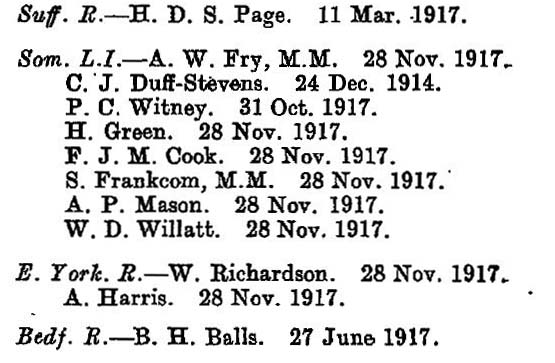
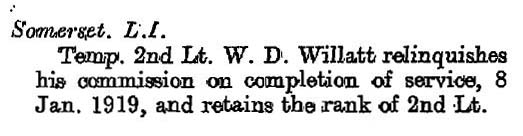
In partnership with a fellow pupil, Roy Henderson, William was later to start a school magazine called “The Highvite”. By Henderson’s own admission, it was “a pretty dreadful magazine”, and it only survived because it was financed by a variety of different adverts. The two enterprising young men went round to canvas support from local companies, shops such as Sisson & Parker and many other businesses. This screen capture shows the moment William was promoted to temporary Second Lieutenant in the Somerset Light Infantry:

Capture   willatt xxxxxxxxAt the end of the war, he could walk away:

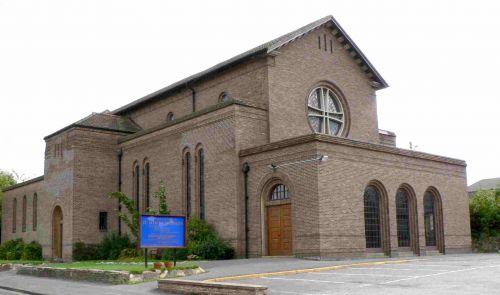
Capture   willatt.JPG  two zzzzzzzzzzzzzzzzzEventually, William became the Vicar of St.Martin’s, Sherwood:

church

At this time, he was living in West Bridgford. In 1949, a W.D.Willatt became Vicar of Edwalton, a post which he held until 1955. This was presumably the same man.

G.James has proved difficult to trace and I have found out very little about him. In the 1912-1913 football season, he played at left half or right half for the 1st XI. The School Magazine reported that he:

 “Plays a good defensive game sometimes, but completely fails to help the attack.”

A year later, in 1913-1914, he played more or less exclusively as a right half. We also have his contributions to what seems a heated debate about various matters of school discipline. At this time, the Prefects were more or less in charge of this aspect of school life:

“On April 29th 1915, at 4.15 p.m., all of the Prefects met to discuss a “revision of the rules of discipline”. With reference to Rule 18, G.James suggested that attendance at the Officer Training Corps be made compulsory. This was seconded by School Captain, L.M.Clark, and carried unanimously. J.H.Boyd, the Captain of School Cricket, then suggested that games also be made compulsory. Again, the motion was carried unanimously.”

Young James was obviously a young man well ahead of his time, because he then went on to put forward the idea that three afternoons a week should be allocated to games, or perhaps two to games and one to military training:

“Unfortunately, his idea was not supported, the rest of the Prefects thinking that this would involve a too sweeping reform of the school time table.”

Presumably, from a logistical point of view, even with perhaps four afternoons available, it would have been completely impossible for a large proportion of the High School, which now numbered almost five hundred boys, all to play sport simultaneously, at a sports ground designed to accommodate perhaps only a hundred boys at a time.

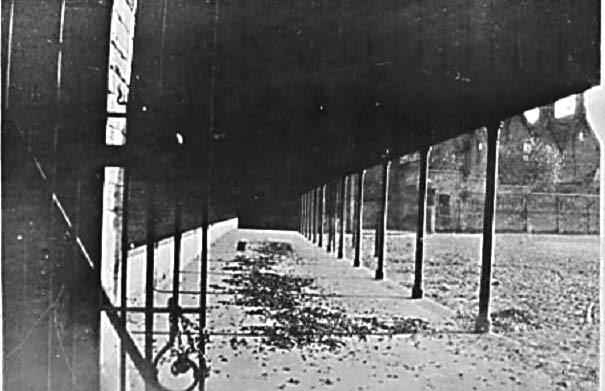
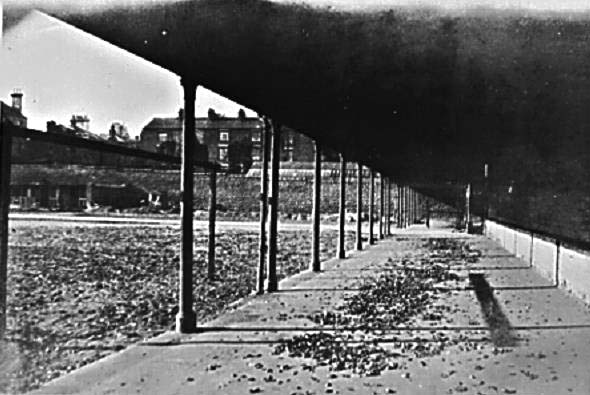
L.W.Foster, or Lancelot Wilson Foster, to give him his full name, remains a figure about whom I have discovered just unrelated snippets. Before the Great War, the Fifth Form, (Year 11), always used to play their football under cover, in the sheds tucked under the Forest Road wall. They were noted for kicking the ball against the wall in an effort to get past their opponent. The Fifth Form usually played mainly in the eastern half of the sheds:

onexxxxxxxxxxxxxxxxxxxxxxxxxxx

This is the view in the other direction:

one west

Among these fifteen and sixteen year old boys, Lancelot Foster was remembered as a particularly good full back. In 1915, Roy Henderson, of “Highvite” fame, arranged a summer camp at a farm near Grantham in Lincolnshire. Six boys, all members of his father’s church, went with him. They were all Prefects, and comprised three pairs of friends, Harold Connop and Francis Bird, Thomas Wright and Lancelot Foster, and John Boyd and Roy Henderson.

In the Great War, Lancelot Wilson Foster became Lieutenant Foster of the 9th Battalion of the Sherwood Foresters He survived the carnage and in 1929, was living in Buglawton Vicarage, Cheshire, presumably as the vicar.

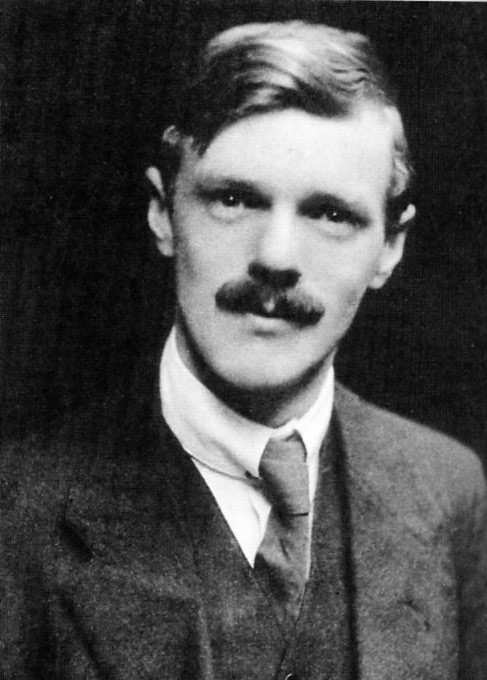
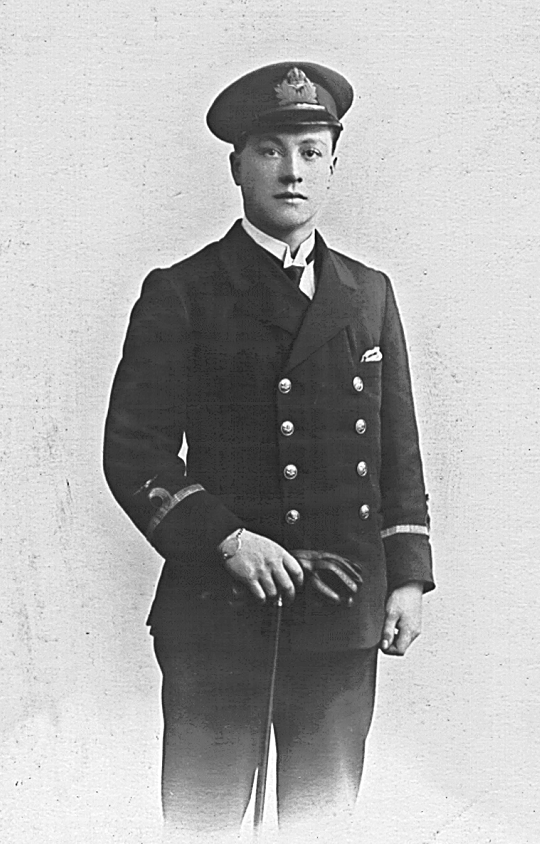
Victor George Darrington, lived at “The Limes” in Eastwood. He was born on November 25th 1896 and entered the High School on September 23rd 1909, at the age of twelve. His father was William Darrington, the Schoolmaster at the School House in Eastwood. As such, he must surely have taught the young D.H.Lawrence, who was born and bred in this mining village, before continuing his education at the High School in September 1898. Perhaps William Darrington was the person who encouraged the budding young author to sit for a scholarship to the High School:

dh-lawrence

From 1938 to 1939, William was Mayor of Eastwood:

EastwoodShops4s zzzzzzzzzzzzzzzzzzzzzzzz

Victor was in the team which won the Football Eights competition in 1912. He was a regular member of the First Team in the 1913-1914 season, playing at either centre half or left half. The decision having been taken to switch from football to rugby in the Spring Term of 1915, the First and Second Football Teams played their last ever fixtures during the Autumn Term of 1914. At this sad time, Victor duly became the last High School Captain of Football until 1968. During this Autumn Term, Victor was also the Captain of the School.

Not surprisingly, perhaps, given that there was an imminent change of sport in the offing, neither of the two football teams seems to have had their hearts in it, and their results were very disappointing. The Nottinghamian does not appear to have listed any of the players who took part. After the demise of football, Victor was to become the school’s first Captain of Rugby, a post he was to retain during the following season of 1915-1916.

During the Great War, Victor became a Lieutenant, firstly in the Royal Field Artillery, and then in the newly formed Royal Air Force:

T0Badge-Front

He was wounded on May 30th 1916, and then again on September 29th of the same year. He survived the conflict, and in 1922, was awarded a Diploma in Forestry at Oxford. Victor returned to Nottinghamshire, and in 1929, he was still living at “The Limes”, in Eastwood.

I will be writing a blogpost about Victor George Darrington in the future.


3 Comments

Filed under Football, France, History, Nottingham, The High School

The Officer Training Corps 1915 Part Two

This photograph shows the High School Officer Training Corps in 1915. I have previously written about what happened to the teachers in the years after this iconic photograph was taken.

This time I want to write about the fates of some of the boys. You might be forgiven for thinking that these twelve individuals are all far too young to have left the school, joined the army, trained as officers, gone to the Western Front and then been killed. But you would be wrong. Three of these young men were to perish. And this, tragically, is a much better casualty rate than the rugby team of Boxing Day, 1913. On the other hand, though, it is still a staggering 25%!

otc 1915

On the back row of the photograph are, left to right, F.A.Bird, J.R.Coleman, D.J.Clarkson, J.Marriott, A.W.Barton, G.R.Ballamy, S.I.Wallis and W.D.Willatt.

On the front row are, left to right, L.W.Foster, V.G.Darrington, Second Lieutenant J.L.Kennard, Captain G.F.Hood, Second Lieutenant L.R.Strangeways, G.James and R.I.Mozley.

I have not been able to find information on all of the boys in this photograph, but here is what I have come up with:

In January 1918, the school magazine, “The Highvite” carried a list of the school prefects, with their nicknames. They included the Captain of the School, F.A.Bird (Dicky) and A.W.Barton (Fuzzy). Both of them feature in the photograph.

They seem to have been very good friends and we have already noted their advertisement “for poisons, the quality of which was endorsed by Mr.Strangeways”. I know nothing further of Mr Bird except that his first name was Francis and he was the best friend of Harold Arno Connop, a Flight Sub-Lieutenant in the Royal Naval Air Service, who was killed at Dunkirk on Sunday, March 31st 1918:

connop zzzzzzzzzzzzzzzzzz

Arthur Willoughby, “Fuzzy”, Barton had an unbelievably varied life. In his last year at the High School, he was Captain of the School and during the First World War, he became a Second Lieutenant in the Royal Engineers Signal Service, until he was demobilised in December 1918.

Arthur then went to Cambridge University to study Physics and helped Lord Rutherford to split the atom. He became a top flight football referee and officiated in the only football match that Adolf Hitler ever watched. I will be telling you his story in another blogpost (Fuzzy Barton, not Adolf Hitler).

Arthur had been, however, the recipient of a gangster type extortion racket in the early part of his school career. The Prefects’ Book records that on Tuesday, October 27th 1908:

“…A meeting was held at 2.30 p.m. in the Library. All the prefects were present. M.M.Lyon was reported for bullying A.W.Barton during the preceding day. He had tried to make Barton accompany him home & as Barton refused, he dragged him along Forest Road towards Waverley St. Lyon also hit Barton with the knob of his umbrella on his head just behind the ear. This blow had raised a big lump on Barton’s head. Lyon only allowed Barton to go home on receiving a promise that he would bring him a penny in the afternoon. As Barton did not bring the money, Lyon thrashed him again in the afternoon.

Lyon admitted the offence, & was treated as a first offender & received 6 strokes.
On the next day, however, Mr Woodward told the school captain that Lyon had treated other boys in a similar way, & had obtained 2d, from J.B.Cooper. Dr.Turpin stated that he had warned Lyon previously, & threatened him with expulsion on a repetition of the offence. Mr Dark had also complained about Lyon’s bullying propensities. H.J.Hoyte reported Lyon at the end of the summer term for swearing, but Lyon had not been punished as he was away from School. Taking all this into consideration, the prefects offered Lyon the alternative of 15 strokes or expulsion by the Doctor. Lyon chose the strokes.”

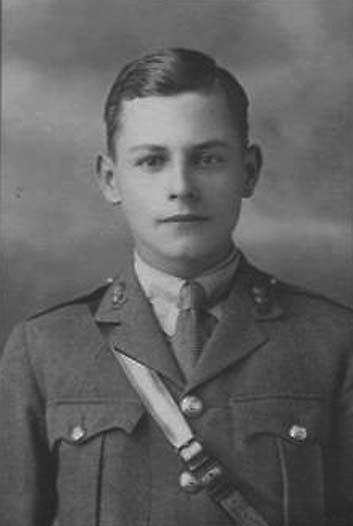
Richard Inger Mozley was born on May 10th 1898, the son of Albert Henry and Laura Mozley. He entered the High School on January 14th 1908, at the age of nine.

In the School Register his address is given as Grosvenor Avenue, Mapperley Park (1908), and then later, “Hollies”, Burton Joyce, Nottingham. One other website gives the family address as 17a, Woodborough Road, Nottingham. His father, Albert Mozley, was a Coal Merchant.

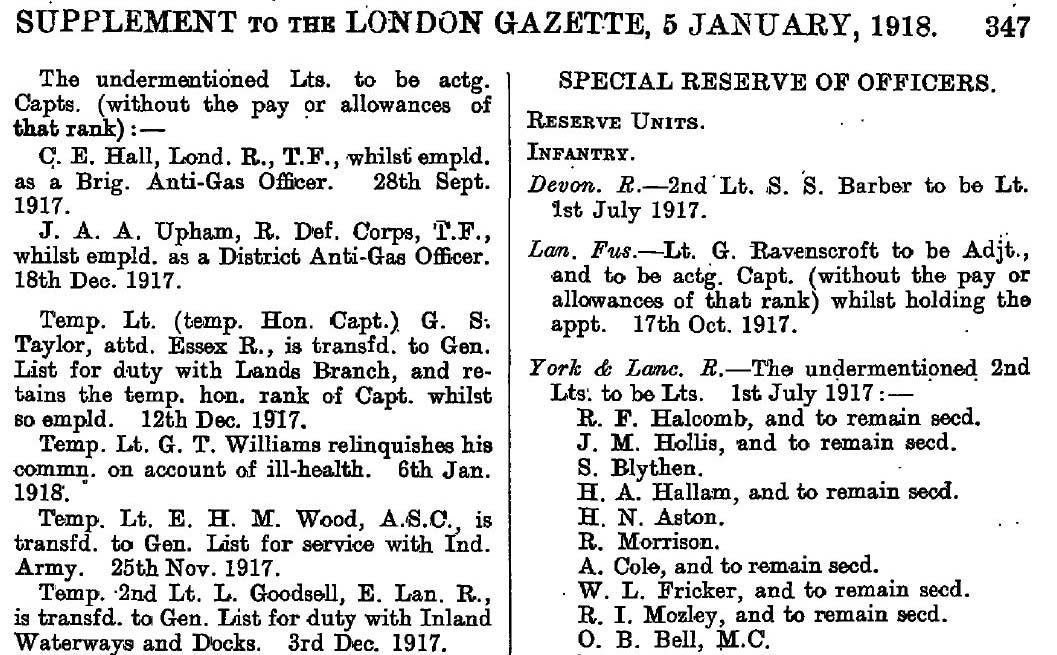
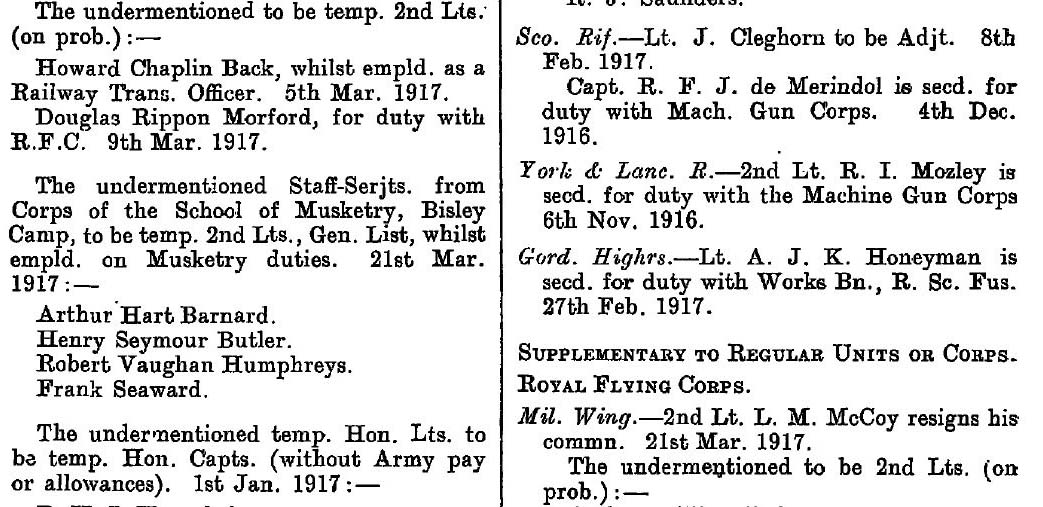
Richard was a Sergeant in the O.T.C. and, as such, was recommended for a commission in the Army both by Captain Hood and by the Headmaster, Dr G.S.Turpin.  Richard had already applied himself to the O.T.C. of the 3rd Battalion of the Sherwood Foresters, but they were already vastly oversubscribed, and he duly joined the 3rd York & Lancaster Regiment.

Capture gazette mozley aaaaaaa

He was then attached to the 36th Battalion of the Machine Gun Corps (Infantry):

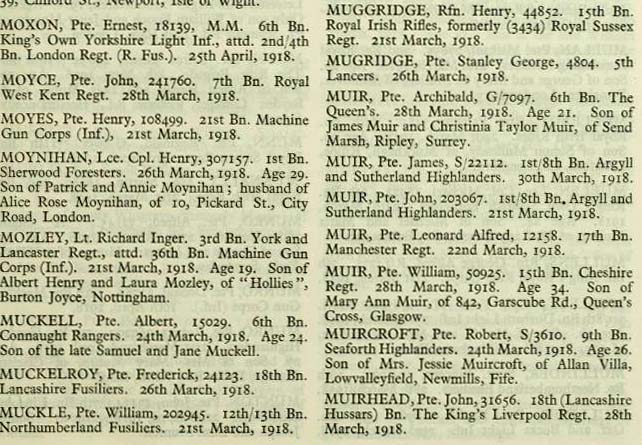
Capture gazette mozley 2  zzzzzz

During the course of “Operation Michael”, the Germans’ last do-or-die effort to win the war before the Americans began to influence the outcome of the conflict, Richard’s unit was assigned to defend the Forward Zone. Richard himself was stationed in the forward trenches, but he and his colleagues were quickly overwhelmed by the sheer weight of numbers of the enemy. They perished more or less to a man.

mozley_1 xxxxxxxxxxxxxxxxxxxxxx

Richard was listed as missing, presumed killed, on March 21st 1918. At the time he was nineteen years of age:

capture mozley cvbnm

By the time he died, he was living in Hoveringham and his parents remained at the “Hollies”, Burton Joyce. In due course, a letter arrived from Sergeant Crenston:

“When Lt. Mozley came back to the Coy. in Dec. last, he took charge of “A” Section and I being the section Sgt. was nearly always with Mr. Mozley and when in the line that terrible morning 21st March Mr. Mozley, myself and about 19 others were in the same position and dugout, the most forward position of the Division, 4 guns with us; at about 4:30 the barrage started. We were being pounded most cruel with gas and high explosive shells but we stuck it till about 9 when your son was hit …… a piece of shell penetrated Mr. Mozley’s right breast …… I helped to bandage your son and asked him to get down to the dressing station a short distance away (it was a nasty wound and it would have got him home) but no, he refused to go, saying I will see it through Sergeant.”
“Now this splendid spirit and example inspired us all and setting our teeth we all determined to stand by to the end …… The first indication we got of the German approach was a death scream from one of the boys and after that my memory is nearly a blank for we all seemed to work by machinery, Mr. Mozley and self took up positions with revolvers and did our best, we were however surrounded by the Germans, a bomb or shell burst amongst us and I found myself with a wound in the back feeling dizzy”.
“Now as to what happened to your son I cannot say”.

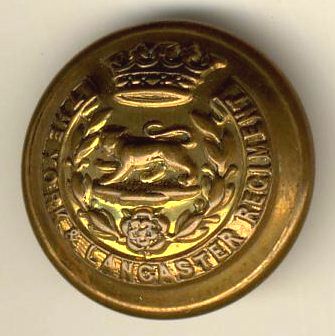
Richard has no known grave and is remembered on the Pozières Memorial. This was one of his buttons:

button mozley

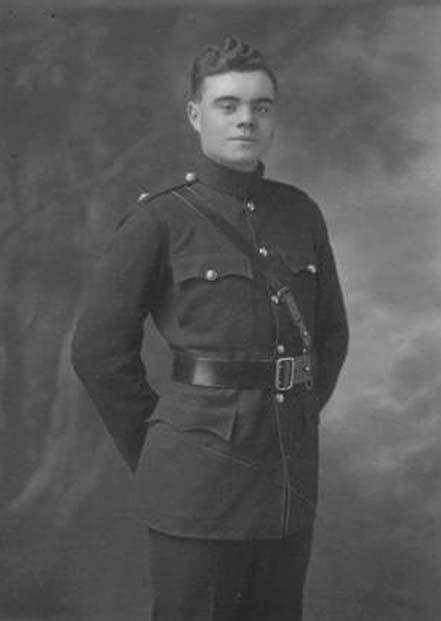
John Roberts Coleman was the son of John Bowley Coleman and Florence Annie Coleman of 29, Derby Grove, Lenton Sands, Nottingham. His father was a schoolmaster. John was born on April 16th 1899 and he entered the High School on September 23rd 1909 at the age of ten. He was a Foundation Scholar in both 1911 and 1914. He left in July 1916 and became a Second Lieutenant in the Special Brigade of the Royal Engineers. In the era before antibiotics, he died of pneumonia in Tourcoing, after the end of hostilities, on November 26th 1918. He was only nineteen years of age, and this fresh faced young man had seen so very little of the world beyond mud, blood and death.

coleman zzzzzz
He is buried in Pont-Neuville Communal Cemetery in Tourcoing.

Donald James Clarkson was born on May 11th 1899. He was son of James Clarkson, whose occupation was listed as “a manager”, and his mother was called Alice. The family lived at “Wyndene”, which is now Number 52, Caledon Road, Sherwood. He entered the High School on September 23rd 1909, at the age of ten. He was always known by his many friends as “Pug” because of his upturned nose.

clarkson zzzzzzz

Donald played for the Football 1st XI as a goalkeeper during the last ever term of the sport at the High School. He was a replacement for Roy Henderson, who, by his own admission “..did horribly.., conceding eight goals… for the First Team in an away game at Trent College.” Both of them were in the Fifth Form, Year 11, at the time. In one unrecorded year, Donald was also the High School Fives champion. This is the Fives Court, which was demolished during the 1980s.

best fives

The only other specific mention of him that I have been able to find is in a rather surreal report about a meeting of the Debating Society on Saturday, February 27th 1915, when the school magazine stated that “Mr.Barber was glad Mr.Clarkson had a long arm.” Perhaps you had to be there.

Donald left in December 1915, and then seems to have gone to University College, Nottingham where he immediately joined their Officer Training Corps. After that, he went to the Royal Military Academy at Sandhurst where, in his passing out examination in early 1918, he was placed first of all the candidates in the college and was awarded the King’s Sword and the King’s Medal.

On April 23rd 1918, Donald became a Second Lieutenant in the 1/6th Battalion of the Sherwood Foresters.

Capture commission clarkson

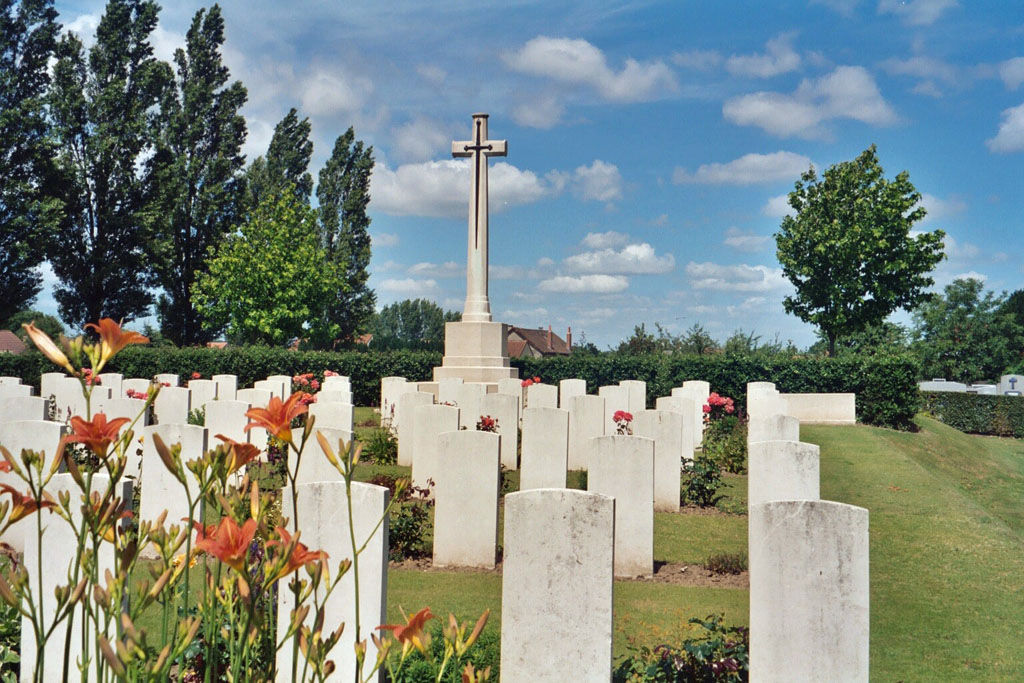
Just four months later, Donald was killed in action on August 9th 1918.  He is buried in Fouquières Churchyard Extension in France.  This cemetery is in the village of Fouquières-les-Béthune, about one kilometre to the south-west of Béthune in the Pas-de-Calais.

clarkson grasveyard

Donald’s death is commemorated on the memorial of University College, Nottingham’s Officer Training Corps as well as the High School’s war memorial.

Like the two other casualties in the photograph of the OTC, he was just nineteen years of age.

I was a teacher in the High School for thirty eight years. Neither there, nor in the rest of my life, do I ever recollect knowing anybody who was called “Clarkson”. On the Commonwealth War Graves Commission website, a simple search for any casualty with the surname “Clarkson”, in the Great War, in the Army, yields 226 results.

8 Comments

Filed under Aviation, Football, France, History, Nottingham, Politics, The High School

The Officer Training Corps 1915 Part One

This photograph shows the Officer Training Corps in 1915. You might be forgiven for thinking that they are all far too young to have left the High School, to have immediately joined the army, trained as officers, gone to the Western Front and then been killed. But you would be wrong. This time, it was only three dead out of twelve though, and this represents a much better casualty rate than the rugby team of Boxing Day, 1913. On the other hand, though, it is still a staggering 25%!

otc 1915

On the back row of the photograph are, from left to right, F.A.Bird, J.R.Coleman, D.J.Clarkson, J.Marriott, A.W.Barton, G.R.Ballamy, S.I.Wallis and W.D.Willatt.

On the front row are, from left to right, L.W.Foster, V.G.Darrington, Second Lieutenant J.L.Kennard, Captain G.F.Hood, Second Lieutenant L.R.Strangeways, G.James and R.I.Mozley.

In 1915, the High School, according to the anonymous writer of some reminiscences about school life at the time, was a place:

“…dominated by the War and its effects. Masters disappeared and were replaced by women teachers, the Officer Training Corps underwent intensive training, and the School Flag seemed to be constantly at half-mast for Old Boys, many of whom had left us only a few months before.”

Only a year earlier, before August 1914, the O.T.C. had been poorly equipped and they frequently complained of the lack of equipment, both rifles and bayonets. Over the course of the war, however, the O.T.C. was to take on a much greater importance. According to the “History of the Corps”, written fifty years later by a member of staff, Mr.A.G.Duddell:

“By 1913 the O.T.C. had become a well-established organisation in the school, and while it had exchanged its picturesque uniform, of which the wide-awake hat with green puggaree and plume of black feathers was a striking feature, for the more conventional khaki tunic with flat peaked cap, knee-breeches and puttees, it had also become a contingent of the Officers’ Training Corps (Junior Division)…The reality of war brought a great increase in numbers, and gave urgency to the training ; parties of cadets were taken for camps at Barton-in-Fabis and field exercises were carried out on the Gotham Hills. Field Days then, and for many years after, were held at Ramsdale Park, and as no transport was available in the early days, much of the time, and energy, was used for the five mile long march out and back. Later the position was eased, but at first only by special trams between the Forest and Daybrook Square. Another handicap of those earlier days was the state of the School playground, the surface of which consisted of the raw sandstone rock, with a covering of loose sand. Uneven at all times, from dust in dry weather, it became a quagmire after rain.”

The senior officers in the O.T.C., Mr Leggett of the Preparatory School and Mr Lloyd Morgan, were among the first to join up in 1914, becoming Captain and Lieutenant, in the 11th Service Battalion of the Sherwood Foresters and the 2nd Battalion of the Cambridgeshire Regiment respectively. The school magazine hoped that:

“they will both have a “smack” at the enemy and return safely again.”

Ironically, Messrs Leggett and Morgan had been the two prime movers in favour of the school’s switch from football to rugby in December 1914. Here is one of the oldest photographs of a school rugby team that I have been able to find. It was taken around 1924:

rugger xxxxx

Presumably, if they had got to the Front in time, Messrs Leggett and Morgan would have been able to encourage the soldiers during the Christmas Truce to forget the football and play rugby across no-man’s-land.

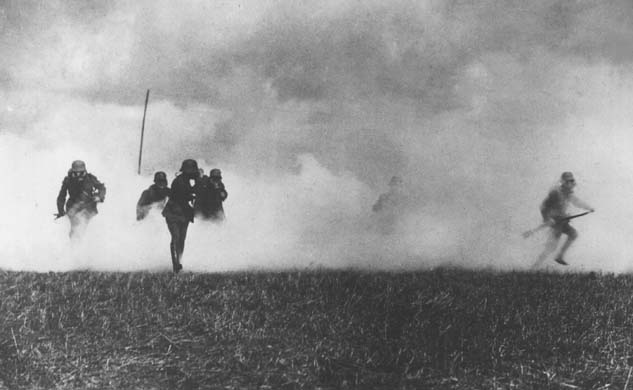
As soon as they left, the O.T.C. was taken over by Captain Hood, assisted by Mr Kennard. I could not write a biography of Captain Hood, but I can recount one or two occasions when his name was on people’s lips. He had come to the school in 1908 as a teacher of Chemistry, or “Stinks” as it was nicknamed at this time. Mr Hood’s own nickname was “Freddy”, although I have been unable to trace his real first name. After three years in charge of the O.T.C., he finally received his very own chance to have “a “smack” at the enemy”, although by now it was a rather unsporting enemy who was using phosgene, chlorine and any other “Stinks” that could kill human beings in large numbers. Luckily though, the call came as late as July of 1918 so the chances are that Captain Hood may not have seen a lot of action during his spell with the Royal Engineers. A more sinister interpretation would be that when the Royal Engineers sent for somebody with a degree in Chemistry, they themselves were the ones trying to manufacture poison gas in larger quantities and at a faster rate than the Germans:

16-Gas-Attack-Getty

In 1925, the School was feeling the financial pinch and seems to have been, on occasion, extremely strapped for cash. Mr Hood, along with Mr Betts, offered to install electric lighting in part of the school while their classes were taking examinations. The offer was eagerly accepted, presumably in the days before that fateful phrase, “Health and Safety” had quite the ring to it that it has now.

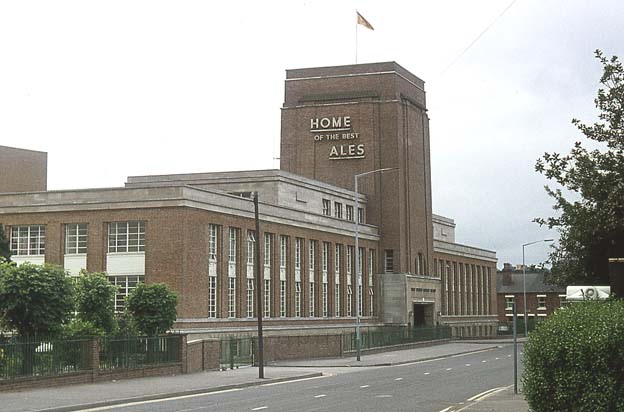
A few years later, Mr Hood must have become a pastoral tutor, since, on Monday, July 6th 1931, in an effort to improve the general behaviour of one Burton of 2C, he put in him detention for receiving “too many detentions”.  On Tuesday, April 5th 1932, Mr Hood, accompanied by Mr Houghton, took a group of thirty boys to visit the Home Brewery in Daybrook. They saw the entire brewing process, from barley to the finished product. At the end of the visit, the boys were given sandwiches and soft drinks, while the delighted teachers “sampled the real stuff”:

home alse zzzzzzzz

In July 1946, Mr Hood retired after decades of service to the school. After 38 years as a dedicated teacher, his departure was marked in the school magazine by a warm tribute and farewell which lasted for just a line and a half of print, and must have been quite a bit short of one word for every year.

Second Lieutenant J.L.Kennard had the first name Joseph. He had come to the school in November 1910, and had previously been a teacher in Switzerland. He was a famous sportsman, having captained Lancashire at rugby, and having played for the North of England in an England trial. Here he is, on the left, with Mr Onion the groundskeeper and the First XV after the Great War in 1926-1927:

1926 xxxxxxxxxxxxxxxxxxx

Inside the classroom, Mr Kennard was a teacher of Modern Languages and his nickname was “Guts”. When Mr E.P.Gaskin, the Head of Languages, retired in July 1927, he was succeeded by Mr Kennard. Around this time, Mr Kennard became the Housemaster of Mellers.

When war again came knocking at the school doors in 1939, the school had enormous difficulties carrying on with the ordinary day-to-day teaching because a large number of classrooms were being used by the men of the South Notts Hussars. By the Spring Term of 1940, Mr Kennard, along with Mr Duddell, came up with an emergency schedule, which allowed a full timetable of lessons to be taught, although every form had to spend one day per week at the Games Field, with normal classes in the mornings and then games in the afternoon:

sp day

The masters, who in many cases were forced to commute the mile and a half between the main school and the Games Field by bicycle, were somewhat less than happy with this situation. In 1941 when Mr Goddard retired, Mr Kennard was appointed Second Master. He had himself retired as the school rugby coach in 1939, although he was soon forced to resume these duties at the age of sixty by the absence of younger members of staff who were away in the forces. Mr Kennard finally retired in 1947.  After a splendidly long retirement, he died on Sunday, January 5th 1969, at the age of eighty-seven, after a short illness:

“sentiment had little place in his character, and his guiding principles were devotion to duty, loyal service and firm discipline”

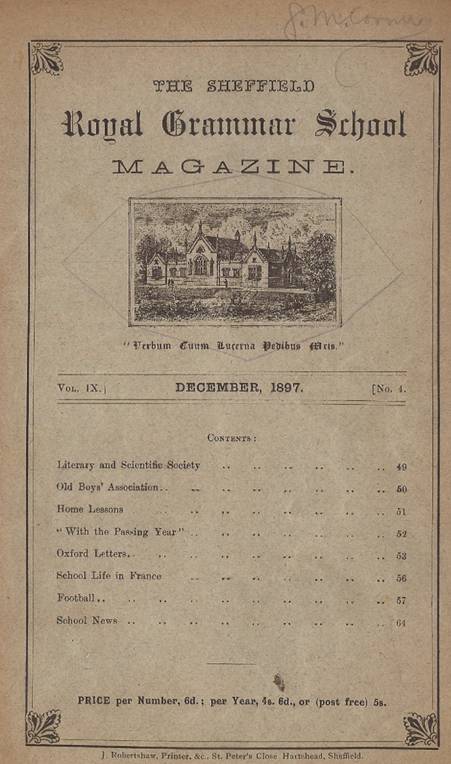
Second Lieutenant L.R.Strangeways had come to the High School in 1908 as just Leonard Ralph Strangeways. He was a teacher of Classics and had been educated at Sheffield Royal Grammar School:

sheffield magazine

By late 1916, he was helping to produce food for the starving population of a U-boat beleaguered Britain:

“An area of some three quarters of an acre was cultivated by the boys at Woodthorpe. Despite being a “very uncompromising clay dump”, it was eventually to produce much fresh food. One member of staff, Mr Strangeways, a Classics teacher, dug so energetically that he “not only shattered one spade in sunder, and so bent another that it was impossible to discern which side was which, but also succeeded in unearthing an ancient Roman broom.”

Two years later, in January 1918, “The Highvite” carried the humorous story about two prefects and one teacher:

“Barton, Bird and Co Ltd. had an advertisement for poisons, the quality of which was endorsed by Mr Strangeways.”

Mr Strangeways left the school in 1918. He went to Bury Grammar School where he was Headmaster from 1919-1936. The school still has its Strangeways Library.

In my next blog post about this photograph, I will try to find out what happened to the boys in the years after it was taken.


10 Comments

Filed under Football, France, History, Nottingham, The High School

Staff v Prefects Football Match Christmas 1980 (3)

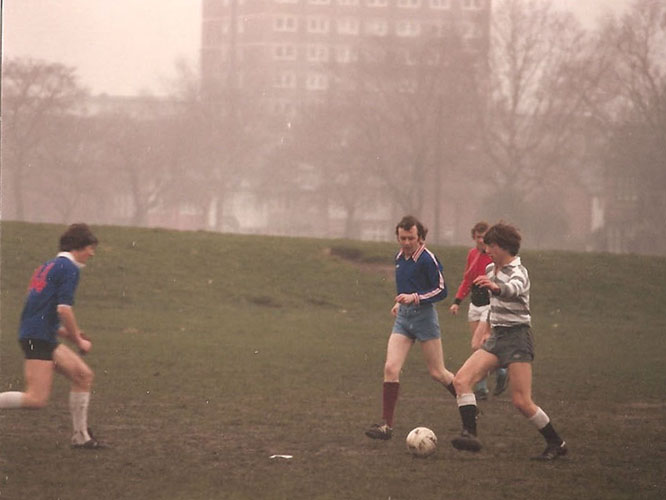
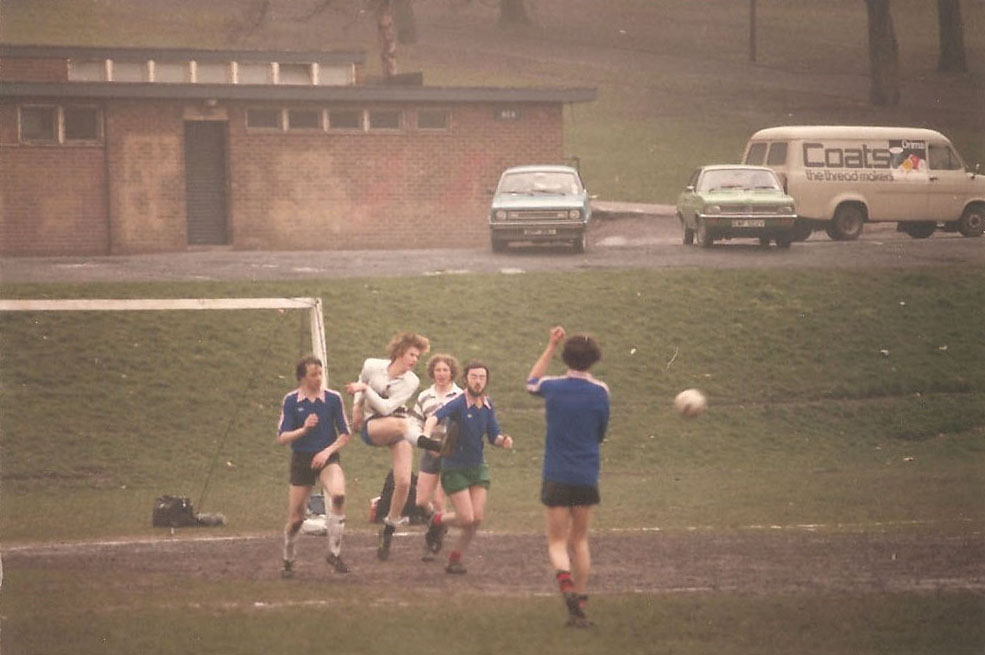
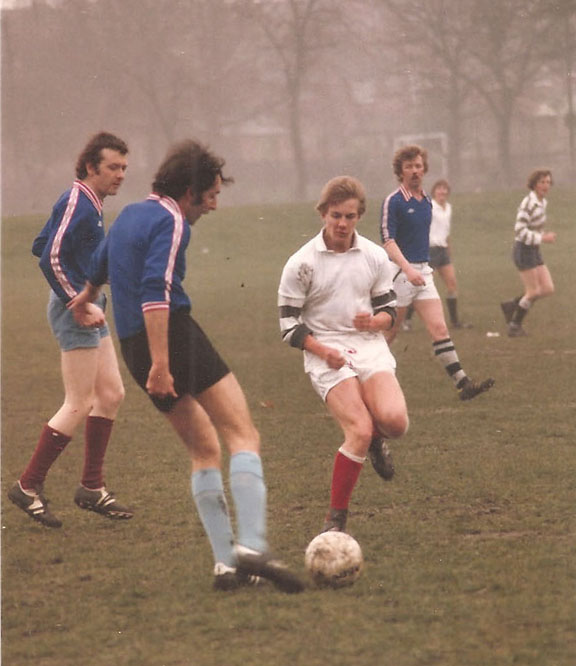
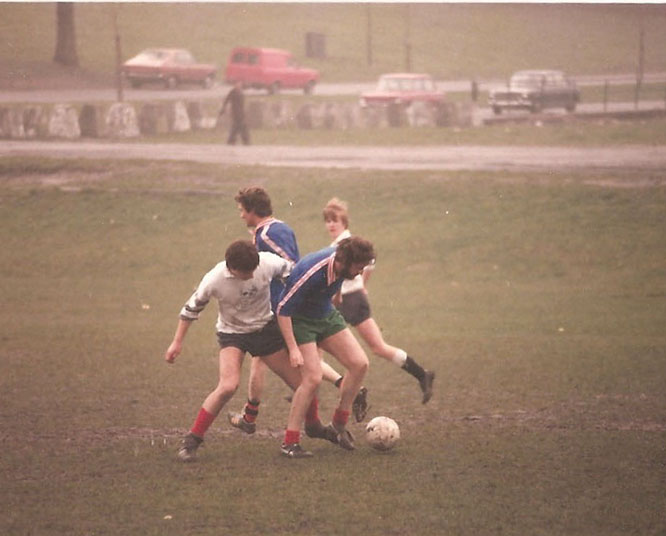
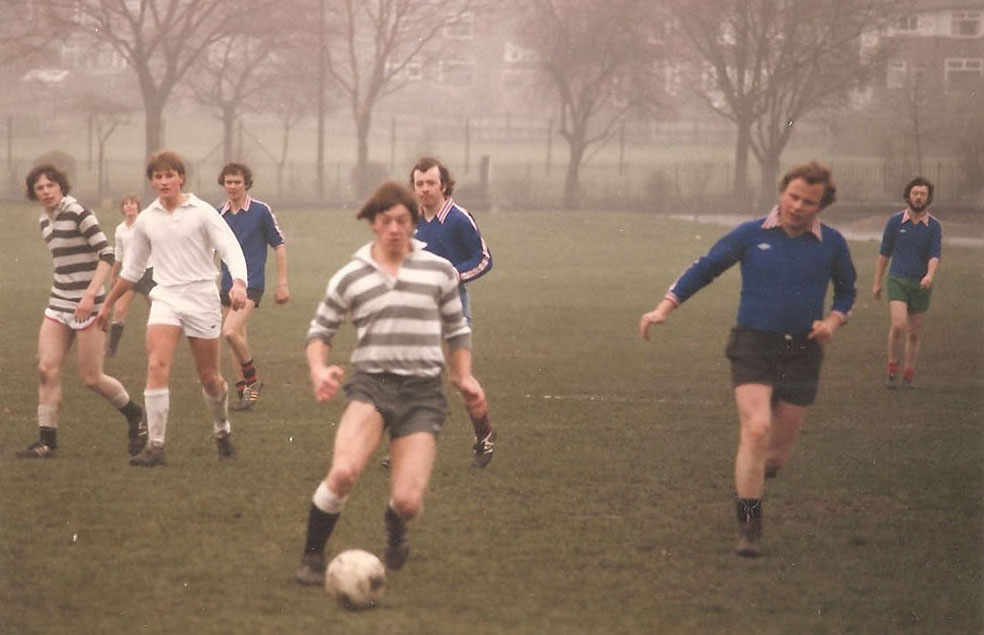
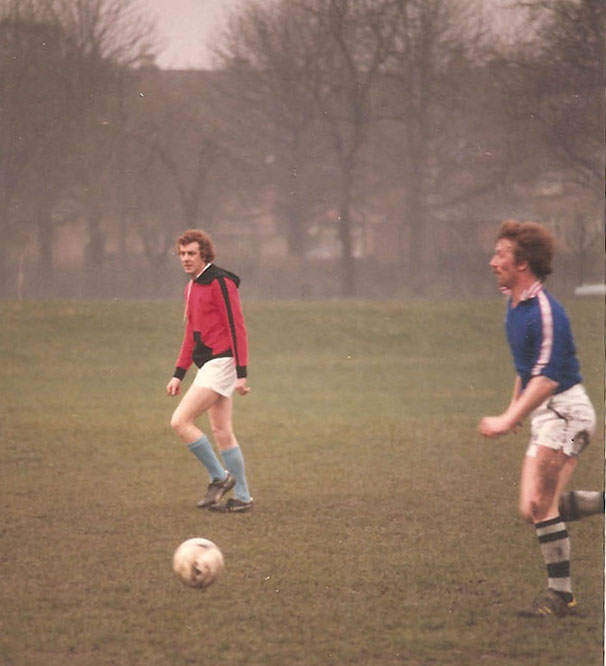
These are the last four of the ten photographs I found recently of the Teachers v School Prefects football match.  This keenly fought fixture took place probably just before Christmas in 1980, give or take a year either way. My beautiful new wife was watching the game, armed with my camera, if I remember correctly.
This first photograph shows myself and Ron Gilbert, the ex-Chemistry teacher who retired recently. We look as if we are holding a quick debate about who is going to chase after the ball:

PHOTO A

The second photograph shows the then Head of Music, Stephen Fairlie, and the red shirted referee, Richard Willan. Red Fourteen is a Prefect playing in a staff shirt to make up the numbers. Incidentally, the staff are playing in the shirts normally worn by the school Second Eleven Football Team. These, in their turn, were, for reasons that must surely remain unknown now for ever, the second, change, strip of Sunderland A.F.C.

PHOTO B

The third photograph shows three members of staff. Number Three on the right with his back to the camera is Paul Morris, the now retired Physics teacher. I myself am Number Two in the middle and Number One is Andrew Ayres, a native of Hartlepool if I remember correctly, a young teacher of Chemistry and a colleague of Ron Gilbert. Andrew moved on to Wisbech Grammar School in Cambridgeshire, where he became the senior tutor and examinations officer as well as continuing as a chemistry teacher. He retired in July, 2014. Once again, the Prefects will have to remain nameless:

PHOTO C

The final picture shows Stephen Fairlie, the then Head of Music, as Number One on the left, and Bob Howard, Geography teacher and Best Man at our wedding, as Number Three on the right. In the centre is Number Two, Phil Eastwood, who was the then Head of Chemistry. Phil is a very keen supporter of Manchester City and that is where, I would imagine, his socks came from:

PHOTO D

I would like to finish these three blog posts with a piece of medieval poetry. Medieval French poetry, no less. Well, from 1533. It was written by François   Villon. (You can click on both names)
The days when I knew about such things are very distant, but ironically, that is the whole point of the poem:

Dictes moy où, n’en quel pays,

Tell me where, in which country

Est Flora, la belle Romaine ;

Is Flora, the beautiful Roman;

Archipiada, né Thaïs,

Archipiada, born Thaïs,

Qui fut sa cousine germaine;

Who was her first cousin;
Echo, parlant quand bruyt on maine

Echo, speaking when one makes noise

Dessus rivière ou sus estan,

Over river or on pond,

Qui beauté eut trop plus qu’humaine?

Who had a beauty too much more than  human ?

.

Mais où sont les neiges d’antan!    

Oh, where are the snows of yesteryear!


Où est la très sage Heloïs,

Where is the very wise Heloise,

Pour qui fut chastré et puis moyne

For whom was castrated, and then made a monk

Pierre Esbaillart à Sainct-Denys?

Pierre Abelard in Saint-Denis ?

Pour son amour eut cest essoyne.

For his love he suffered this sentence.

Semblablement, où est la royne

Similarly, where is the Queen

Qui commanda que Buridan

Who ordered that Buridan

Fust jetté en ung sac en Seine?

Be thrown in a sack into the Seine?


Mais où sont les neiges d’antan!    

Oh, where are the snows of yesteryear!


La royne Blanche comme ung lys,

The queen Blanche, white, as a lily

Qui chantoit à voix de sereine;

Who sang with a Siren’s voice;

Berthe au grand pied, Bietris, Allys;

Bertha of the Big Foot, Beatrix, Aelis;

Harembourges qui tint le Mayne,

Erembourge who ruled over the Maine,

Et Jehanne, la bonne Lorraine,

And Joan of Arc the good woman from Lorraine

Qu’Anglois bruslerent à Rouen;

Whom the English burned in Rouen ;
Où sont-ilz, Vierge souveraine ?

Where are they, oh sovereign Virgin?

.

Mais où sont les neiges d’antan!         

Oh, where are the snows of yesteryear!


Prince, n’enquerez de sepmaine

Prince, do not ask me in the whole week

Où elles sont, ne de cest an,

Where they are – neither in this whole year,

Qu’à ce refrain ne vous remaine:

Lest I bring you back to this refrain:

Mais où sont les neiges d’antan!         

Oh, where are the snows of yesteryear!

7 Comments

Filed under Football, France, History, Humour, Literature, Nottingham, Personal, The High School

Staff v Prefects Football Match Christmas 1980 (2)

These are three more of the ten photographs I found recently of the teachers playing the School Prefects at football, or soccer as some might call it. The photographs show a game from the early 1980s, when my wife took a few pictures of the match.

This photograph shows the Staff goalkeeper kicking the ball downfield. This is the legendary Chris Mann, a young chap from Liverpool with the accent to match. He eventually left the High School to go to teach at Staffordshire University, where he remains to this day, as far as I know. The last time I heard, he was doing very well as the Senior Lecturer in the School of Engineering (Maths & Statistics) in the Faculty of Computing, Engineering and Sciences:

PHOTO A

This photograph shows myself shielding the ball against a defender. In just a second, I will pass it on to the other player in blue, who is Paul Morris, the now retired Physics teacher:

PHOTO B

This final picture shows proceedings when players are perhaps beginning to get a little tired. There are four blue shirted members of staff on view. I am Number Four counting from the left and Paul Morris is Number One. Number Two is the then Head of Music, Stephen Fairlie, a young man far too gentle to be playing football. Not long after this game, in 1985, he was to found the Nottingham Youth Orchestra which still continues in existence to this very day:

PHOTO C

Player Number Three is Ron Gilbert, an ex-Chemistry teacher who retired recently, and whose first love was actually Rugby Union, but he was always a very good sport, and willing to turn out for the staff when the occasion arose.
Yet again, I am not able to recognise any of the Prefects who, by now, must be in their early fifties with not just children but, conceivably, grandchildren.

14 Comments

Filed under Football, History, Humour, Nottingham, Personal, The High School

Staff v Prefects Football Match Christmas 1980 (1)

At the end of either the Christmas Term or the Easter Term or sometimes both, there used to be a tradition of the Teachers playing the School Prefects at football, or soccer as some call it. The very first one took place as far back as the evening of Monday, March 9th 1959. The staff triumphed by a single goal.  Nowadays, Health and Safety Regulations have put paid to such risky and dangerous pursuits.

The game used to take place here, on the Forest Recreation Ground:

forest


When I was a lot younger and a lot, lot, thinner, I used to play in such games, and these photographs show a match from the early 1980s. I was newly married and my beautiful young wife, as one of, admittedly, very few spectators, was given a camera and the freedom to take a few pictures. In total, there were only ten, because in those days, there were no digital cameras, and people were not in the habit of shooting hundreds, if not thousands, of photographs on the off chance that three or four might be good ones.
This first photograph shows my good self in the blue shirt and green shorts. The other player in blue is Paul Morris, a teacher of Physics, who, like myself, retired within the last two years. Everybody else is a Prefect, although I am sorry to say that I could not put a name to any of them.

PHOTO A

This photograph shows a young red haired gentleman playing for the staff team and running off with the ball into attack. He is Bob Howard who had been Best Man at our wedding. To his left, in red, is Richard Willan, one of Bob’s colleagues in the Geography Department. Richard retired in the same year as myself.

- PHOTO B

This final picture shows my unbelievably thin self, still in my green, blue and red outfit. I somehow seem to have acquired a mop of curly, dark brown hair, instead of the white ensemble I now have. On the right, in front of the goalpost is Best Man Bob Howard. The other player in blue is not a member of staff, but, presumably, a Prefect playing for the Staff Team to make up the numbers. Again, I could not name any of the opposition, but I do recognise a couple of the spectators. The red haired young man with the non-regulation brown scarf is Dave Beech who played for the school First Eleven at football on around half a dozen occasions when I was the team manager. To the left of him is Russell Poole, a superb young cricketer, whose Dad used to come down every games day to the Games Field to coach cricket to the more talented young players.

PHOTO C


6 Comments

Filed under Football, History, Humour, Nottingham, Personal, The High School

Casualty rates in the Great War

Years ago I wrote a worldwide best-selling book about the history of football in the High School from 1870-1914.(Just kidding). In the foreword, I revealed the identity of the Old Boy who had won an Olympic Gold Medal for the United Kingdom at Association Football. I made public which Old Boy had scored more goals in a single F.A.Cup tie than any other player in the history of the competition. I listed the eight Old Boys who had played international football for England. I recalled the Old Boy whose refereeing in an F.A.Cup tie led the F.A. to introduce the concept of the neutral referee, an idea which has spread worldwide since that biased performance. I described an occasion when the High School goalkeeper let in the winning goal as a protest against the refereeing of the game, and the day when the referee refused to give a penalty because “penalty kicks were unknown in amateur football”. The reader could find out which team lost 0-13 and did not get the ball into the opposition half at any point during the game. In another fixture, against Nottingham Asylum, “the presence of so many lunatics unnerved the school team, for it did not come up to its normal form.”  I remembered the day when “The School Six defeated the Masters by three goals to one. The masters, who, like Hamlet, were somewhat “fat and scant of breath”, then demanded to play two fat men extra, to compensate for their want of nimbleness. This unfortunate challenge was accepted, and the School won again by ten goals to one.”

Overall,  this book provided many examples of extraordinary, and, indeed, often amusing events on the football pitches of Victorian and Edwardian England.

villa-cup

When I first started my researches, looking through issue after issue of, firstly, “The Forester’, and then “The Nottinghamian”, it seemed that this would ever be the case. Here was a football spectators’ paradise, where goals rained into the net in every single game, as Leicester Wyggeston School  were beaten by 23-0 on two separate occasions. Deadly goal poachers scored hat tricks past defenders made slow-witted by heavy leather boots, and referees, and their decisions, grew ever more eccentric by the year.


My suspicions, though, were initially aroused by the story of William Norman Hoyte who was at the High School from 1904-1913, when he won an Open Scholarship to Jesus College, Cambridge to read Natural Sciences. William represented his college at rowing and appeared in the Second May Boat. His studies, and his rowing, though, were interrupted by his military service as a Lieutenant in the Sherwood Foresters in the Great War. He was a very brave young man and won the Military Cross twice. When he returned to Jesus College in 1919, though, he was unable to continue with his rowing. After the appalling carnage of the Great War, William Norman Hoyte M.C. and Bar was Jesus College’s only remaining rower from the pre-war years. All the rest had been killed.

zzzzzz   Massengrab_

Morbid curiosity then caused me to wonder what were the eventual fates of those familiar names whose footballing deeds were recorded in perpetuity in their School Magazine, especially those who would have been of an age to have been sucked into the flesh shredding maelstrom of the Great War. where, on average, every single metre of trench was to be hit by a total of one ton of explosives. What I found, quite frankly, astounded me, and I do not feel that any reader, safe from harm, here at the beginning of the twenty first century, can begin to comprehend either the numbers of men involved in this war, or the enormous casualties which the nation suffered.

somme

During the Great War, for example, British forces lost 887,711 men killed and 1,663,570 men wounded. Of these 118,941 were officers. The British Empire had casualties of 1,244,589, with French deaths counted at 1,737,800. Italy lost 1,737,800 me killed and the Russians 3,394,369. Germany had 2,800,720 killed, the Austro-Hungarian Empire 2,081,200 and the Ottoman Empire 3,271,844. The United Kingdom lost as many as 2.20% of its total population, the French 4.39% and the Germans 4.32%.

zzzzzz-Ypres-necropole-

In individual battles, the loss of human life could be even more astounding. On the first day of the Battle of the Somme, on July 1st 1916, the 8th Division lost 218 of its 300 officers at Ovillers in just two hours. Of 8,500 other ranks, 5,274 men perished. On this single day, the total casualties of the British Army were 57,470 men. German casualties were just over 300. In the first three days of the Battle of the Somme, the average daily casualties per division were 101 officers and 3,320 men. During the second week, 10,000 men a day were lost, and for the remaining four or five months of the campaign, casualty rates were in the range of 2,500 men per day. Overall, this battle was to cost the lives of 420,000 British and Commonwealth troops, with a total of 220,000 French casualties. German losses remain unknown but were at least 450,000, and may have reached 600,000. In the photograph below, the tiny squares are all graves:

zzzzzz -Douaumont_ossuary3

Nor is this necessarily an isolated set of statistics. In the Second Battle of Ypres, in April 1915, the 149th Brigade lost over three quarters of their complement, a total of some 42 officers and 1,912 men. The 10th Brigade more or less ceased to exist, losing 73 officers and 2,346 men. In the Third Battle of Ypres, between August and November 1916, British infantry repeatedly advanced against German machine gunners, with casualties totalling 244,897. On the second day of the Battle of Loos, twelve battalions, numbering some 10,000 men, attacked the German machine guns. In just over three hours, 385 officers were lost, along with 7,681 men. On July 31st 1917, when the 1/1st Hertfordshires attacked the Langemarck Line, every single officer was a casualty and eleven of them were killed. The other ranks suffered 459 casualties and drafts of men had to be made to rebuild the battalion. Not until May 1918 was the 1/1st Hertfordshire Regiment fully reconstituted by absorbing thirty officers and 650 men from 6th Bedfordshire Regiment. In the Battle of Aubers Ridge, General Rawlinson, irritated with the lack of progress, complained to his Brigadier-Generals,

“Where are the Sherwood Foresters ?  Where are the Sherwood Foresters? ”

Brigadier-General Oxley replied, “They are lying out in no-man’s-land, sir, and most of them will never stand again.” Many of these particular casualties, especially the Lieutenants and Second Lieutenants, may well have been Old Nottinghamians, but nowadays, there is no way of being any more precise than that.

zzzz ertyuio

One thing of which we are certain is that Robert George Hopewell played in the High School First Team from 1897-1899. Robert was the son of Noah and Margaret Hopewell, of Old Basford and the devoted husband of Gladys Eleanor Hopewell.  They lived at West Brook in Mansfield, Robert was killed at Thiepval during the Battle of the Somme on September 3rd 1916, at the age of 33. A stretcher-bearer’s description of Thiepval in 1916 has survived to the present day…

“The trenches were knee-deep in glueing mud and it was the hardest work I have ever done…The banks on each side were full of buried and half-buried corpses and the stench was appalling. As one was carrying a wounded man down, one perhaps got stuck in the mud and staggered whilst one extricated oneself or was extricated. You put out a hand to steady yourself, the earth gave way and you found that you were clutching the blackened face of a half-buried German.”

Revelon, gefallener Deutscher

Nowadays, Thiepval is the scene of a huge memorial dedicated to those British soldiers who have no known grave. There are 73,000 names listed on it.

zzzzzz b Morgen53

Thomas Cripwell Wilson was an Old Nottinghamian who served as a Private in the 2nd Canadian Mounted Rifles Battalion. He was the son of Thomas and Mary Carr Wilson, of 5, Mount Hooton Terrace, Forest Road, just a five minute walk from the High School. Thomas was wounded in 1915, but returned to France in 1917.

wilson

He was killed in action in November of that same year. His war could be described in equally frank terms…

“All those picturesque phrases of war writers are dangerous because they show nothing of the individual horror, nothing of the fine personalities suddenly smashed into red beastliness, nothing of the sick fear that is tearing at the hearts of brave boys…a thing infinitely more terrible than physical agony.”

The earliest High School football players to be involved in the Great War were four boys who played in the 1891-1892 season, namely Blackwall, Hadfield, Senior and Wallis.

Ten years later, the 1901-1902 season was to provide a full team, eleven brave individuals called Constantine, Cooper, Cullen, Emmett, Hore, Johnson, Marrs, Millward, Settle, Watson and Woollatt.

By 1913-1914, even more footballers were destined to risk their lives on the Western Front. They were now a full tem with a generous selection of substitutes, including Barber, Boyd, Cleveland, Fleet, Harlow, Hind, Lyon, Munks, Nidd, Page, Parr, Prince, Sadler, Taylor, Telford, A.G.Wilson and W.M.Wilson.

Old Nottinghamians, both footballers and non-footballers, volunteered in huge numbers for the Great War. At least one thousand five hundred boys and staff went willingly from a comfortable, safe, and usually well-off  family background in Nottingham, to what was arguably the bloodiest war in human history.

This slideshow requires JavaScript.

11 Comments

Filed under Football, France, History, Nottingham, Politics, The High School