Category Archives: France

The Christmas Truce (a review, excerpts and my own thoughts)

I have decided to examine the Christmas Truce by quoting the words of the men who were there in that late December of 1914. I found these quotations in a book which I originally bought many years ago when it was first published, I should think, to commemorate the 80th anniversary of the Christmas Truce in 1994. The book is called, naturally enough, “Christmas Truce” and this is the edition I have…

book
The authors are Malcolm Brown and Shirley Seaton. The volume is still there on Amazon in an updated edition and I would expect to find it on many other Internet book selling sites. It is a wonderfully written and extremely moving book which I would recommend to you wholeheartedly. It tells so very well the story of a brief poignant moment during the fire and fury of the Western Front. This book certainly inspired me to go deeper into this wonderful event. It is also now available in a more up to date edition, and is required reading for every student of the Great War, of whatever nationality.

new edition

There are many soldiers quoted in the book and I have used a good number of them, with a few abridgements here and there. Quite simply, the tales they told were so moving that I found it virtually impossible to select only a tiny few to use. The book, of course, provides many, many more of them and goes into great detail about what exactly transpired that cold and frosty day in late December 1914. I do hope, though, that you will enjoy these brief extracts from a book that I still look at regularly today, some twenty years after I bought it:

“Several of my chums had been able to get hold of two small Christmas trees complete with candles, to be mounted on the parapet of the trenches, while others dragged planks with them, usually used in the battle against water and mud. As was usual at that time, having settled in the trenches, we just fired the occasional shot from our outposts to let the enemy know we would not let ourselves be surprised.”

*****

On Christmas Eve we got the order to go into the trenches. The day before we had celebrated Christmas in our rest quarters with the civilian people and their children who were presented with chocolate, bonbons and cake. It was all in good humour.
Then at darkness we marched forward to the trenches like Father Christmas with parcels hanging from us. All was quiet. No shooting. Little snow. We posted a tiny Christmas tree in our dugout – the company commander, myself the lieutenant, and the two orderlies. We placed a second lighted tree on the breast work.
Then we began to sing our old Christmas songs “Silent Night Holy Night” and “O Du Fröhliche”, a German Christmas carol.

*****

It was a beautiful moonlit night, frost on the ground, white almost everywhere; and about seven or eight in the evening there was a lot of commotion in the German trenches. And then they sang “Silent night”, “Stille Nacht”. I shall never forget it.  It was one of the highlights of my life. I thought, “What a beautiful tune”.

*****

Suddenly a man from my company reported, “The English are letting off fireworks”. And sure enough across the way from us, the enemy trenches were lit up with fires and rockets and so on. We then made a few banners reading “Happy Christmas” with a couple of candles behind and a couple on top.

*****

I was gazing towards the German lines and thinking what a very different sort of Christmas Eve this was from any I have experienced in the past. In the ordinary way of things, my father would have been making rum punch from an old family recipe, which had been written out by his grandfather, and was kept, of all places, in the Family Bible! Earlier, after the evening meal, we would have decorated the living rooms and hall with traditional greenery, and would now be looking forward to wishing one another a Happy Christmas, and toasting the occasion in the results of my father’s labours. Instead of this, here was I, standing in a waterlogged trench, in a muddy Flemish field, and staring out over the flat, empty and desolate countryside, with no signs of life……
Then suddenly lights began to appear along the German parapet, which were evidently makeshift Christmas trees, adorned with lighted candles!  Then our opponents began to sing “Stille Nacht, heilige Nacht”. They finished their carol so we sang “The First Nowell”, and when we finished they began clapping; and then they struck up another favourite of theirs, “O Tannenbaum”. And so it went on. First the Germans would sing and then we would sing one of ours, until when we started up “O come all ye faithful” the Germans immediately joined in singing the same hymn to the Latin words “Adeste fideles”. And I thought, well, this was really a most extraordinary thing – two nations both singing the same carol in the middle of a war.

Christmas_Truce_1914_IWM_HU_35801

When I got back to the trenches after dark on Christmas Eve I found the Germans had got little Christmas trees burning all along the parapet of the trench. Meanwhile, unknown to us, two officers  got out of their trench and walked halfway to the German trench and were met by two German officers. They talked away quite civilly and actually shook hands!

*****

I have just been through one of the most extraordinary scenes imaginable. Tonight is Christmas Eve. Firing was going on all the time and the enemy’s machine guns were firing at us. Then about seven o’clock the firing stopped. I was reading the paper and the mail was being dished out. It was reported that the Germans had lighted their trenches up. I went out and they shouted “No shooting” and then somehow the scene became a peaceful one. All our men got out of the trenches and sat on the parapet, the Germans did the same, and they talked to one another in English and broken English. I got onto the top of the trench and talked German and asked them to sing a German folk song, then our men sang and each side clapped and cheered the other. Pope and I walked across and held a conversation with the German officer in command. He presented me to his officer. I gave permission to bury some German dead and we agreed to have no shooting until midnight tomorrow. We talked together, ten or more Germans gathered around. I was almost in their lines within a yard or so. We saluted each other, he thanked me for permission to bury his dead, and we fixed up how many men will do it, and that otherwise both sides must remain in the trenches.

Then we wished one another good night and a Happy Christmas and parted with a salute. I got back to the trench and the Germans sang “Die Wacht am Rhein”. Our men sang “Christians Awake”, and with a good night we all got back into our trenches. It was a lovely moonlight night, the German trenches with small lights on them, and the men on both sides gathered in groups on the parapets. At times we heard the guns in the distance  but about us is absolute quiet. I allowed one or two men to go out and meet a German or two halfway. They exchanged cigars and smoked and talked. The officer I spoke to hopes we should do the same on New Year’s Day. I said “Yes if I am here”.

Trucecigarette

I felt I must sit down and write the story of this Christmas Eve before I went to lie down. If one gets through this show it will be a Christmas Time to live in one’s memory. I am just going for a walk round the trenches to see all is well. Good night.

*****

The Germans came out, and we gravely saluted each other. I then pointed to nine dead Germans lying in midfield and suggested burying them. We gave them some wooden crosses, and soon the men were on the best of terms and laughing.

*****

 There was no firing, so each side began gradually showing more of themselves and then two of their men came halfway and called for an officer. I went out and found they were willing to have an Armistice for four hours and to carry our dead men back halfway for us to bury. Then both sides came out, shook hands, wished each other compliments of the season, and had a chat. A strange sight between two hostile lines.

*****

I was in the 2nd Battalion of the Westphalian Infantry Regiment 15. On Christmas Day, at about eleven o’clock, there was a continuous waving of a white flag from the English trench. Soon afterwards a number of Englishmen climbed out and came towards our front. My commander, Baron von Blomberg, ordered me to find out what the Englishmen wanted. I  went out of the trench and we heard that it was the wish of the Englishman to bury their dead and they asked us to cease enemy action for an adequate period. What were we to do? Time was short. Major von Blomberg therefore decided that there should be a local Armistice until one o’clock in the afternoon, telling the Englishman that their dead must be buried by that time.

*****

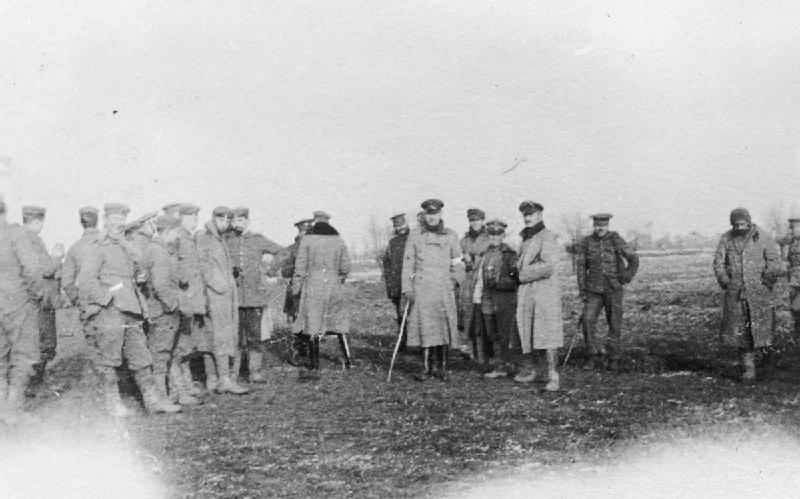
We then had a most wonderful joint burial service.  Our padre arranged the prayers and Psalms and an interpreter wrote them out in German. They were read first in English by our padre and then in German by a boy who was studying for the ministry. It was an extraordinary and most wonderful sight. The Germans formed up on one side, the English on the other, the officer standing in front, every head bare. Yes, I think it was a sight one will never see again. The ground between the two lines of trenches was soon swarming with men and officers of both sides, shaking hands and wishing each other a Happy Christmas.
Christmas_Truce_1914

“No Man’s Land was full of parties of British and Germans laughing and talking together.
By breakfast time, nearly all our men were between the trenches, and were the greatest pals. In the middle of the war we had a Merry Christmas.”

*****

When morning came both sides shook hands and exchanged gifts. We were given corned beef, tea and cigarettes. They were mad about our cigars. I thought it would be a good idea to get rid of my uniform’s black metal shoulder titles, so I swapped them for very nice German belt with brass buttons and the words “God mitt Uns” on it, and I used that all through the rest of the wall to keep my trousers up.

1304254501_got_mit_uns_by_daliscar-d3fbgkq

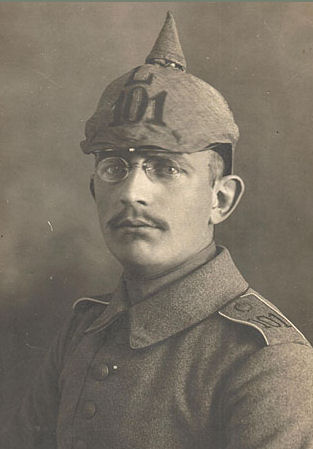
I spotted a German officer, and being a bit of a collector, I intimated to him that I’d taken a fancy to some of his buttons. We then agreed to do a swap. I brought out my wire clippers and, with a few deft snips, removed a couple of his buttons. I then gave him two of mine. One soldier swapped bully beef for a pointed German helmet.
Pickelhaube

The helmet achieved fame as on the following day a voice called out “I want to speak to the officer.” He continued, “Yesterday I swapped my helmet for the bully beef. I have an important inspection tomorrow. You lend me my helmet, and I will bring it back afterwards.” The loan was made and the agreement kept, sealed with some extra bully beef. I had a drink of rum off one of the Saxons and then I drank his health. He nearly shook my hand off.

*****

All the morning we have been fraternising, singing songs. I have spoken to and exchanged greetings with a colonel, staff officers and several company officers. We have just knocked off a dinner, and have arranged a meeting afterwards.

*****

Captain Berryman came running up with the news that the Germans were out of their trenches  Sure enough I found a number sitting on the parapet of No. 2 Company’s trench, and also out in front of No. 1 Company. They were trying to converse with our men and giving them cigarettes, biscuits and boxes of cigars. As I could speak German I conversed with them. They all belonged to the 16th Regiment. They seemed very jolly as if they had just had a good dinner. One of them said to me that there must be “Friede auf der Erde”,  “Peace on Earth” on this day, being Christmas Day.
xmasPloegstreet-xxxxxxx

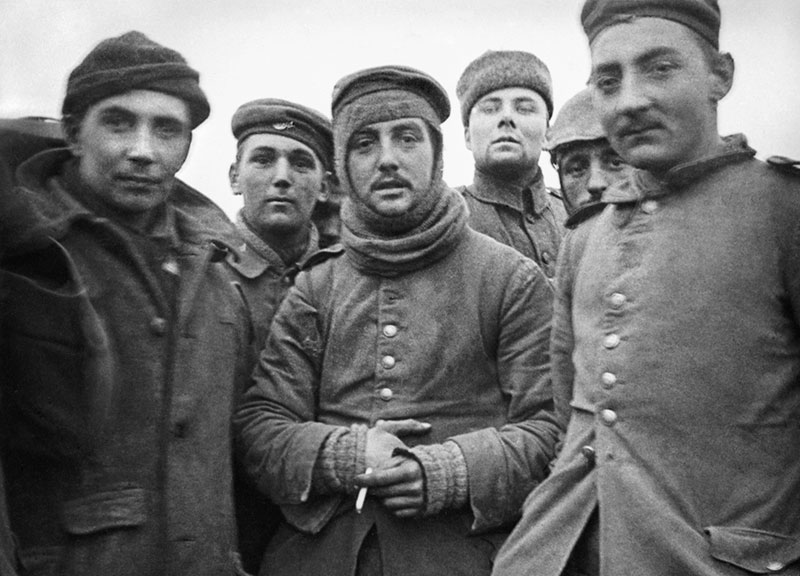
In the middle of No Man’s Land I met two English, one Indian and one German officer of the neighbouring company; we shook hands, wished each other a Merry Christmas, and then we exchanged some small presents like plum pudding, cakes, whisky, brandy, and so did our men. For an hour both sides walked about between the two lines of trenches, talking and laughing, swapping tobacco and cigarettes, biscuits etc….You would never believe that we have been fighting for weeks.

truce 1

One of the Germans asked me if I would like to bury a few dead Indians that were lying about their trenches. My chum and I set to work and buried about a dozen of them. All the Germans looked very fit. They were also very well clothed and looked well fed. One of their officers, a captain, clasped his hands together and looked towards heaven and said, “My God, why cannot we have peace and let us all go home!”

*****

A couple of bright sparks from the Staffordshire Regiment appeared – one clad in a tail coat, black trousers, and an old battered silk hat , the other decked out in blouse and skirt, an old bonnet and a broken umbrella. They paraded up and down and were joined by another joker who had found a broken bicycle with almost square wheels, which he trundled up and down. Many of the Germans had costumes on which had been taken from the houses nearby, and one fellow had a blouse, skirt, top hat and umbrella. My own platoon sergeant added a good deal to the Christmas party by going out to meet the Germans wearing a large skirt; this led to some earthy Teutonic byplay and caused plenty of laughs.
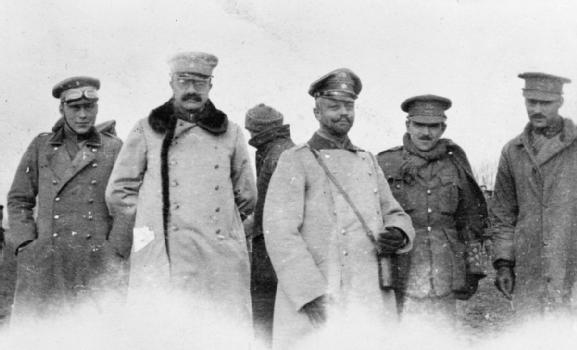
standard

We heard them singing and shouting in their trenches, and about midday they began lifting up hats on sticks and then they showed their heads, and then their bodies and finally they climbed out of their trenches into the open! Of course we could not shoot them in cold blood like that. We could hardly believe our eyes; we were just about to open fire when one of our officers gave us the order to unload our rifles. Seeing the Germans without any rifles, we stood up and answered them. Then they started to cheer. One of their men shouted out, “Here’s some cigars for you. Come and fetch them.” They shouted, “Come on, we will not fire on you.” The fellow who threw the cigars then came down off the top of his trench and picked up the box again, and started to walk over towards our trenches. Seeing this I climbed over the parapet of our trench to meet him. When we met in the middle he handed me the cigars and said, “A Happy Christmas to you”. I hardly knew what to do at first, but I shook hands with him and wished him the compliments of the season.
As soon as the Germans saw us shake hands they cheered like mad. They then started to come towards our trench.
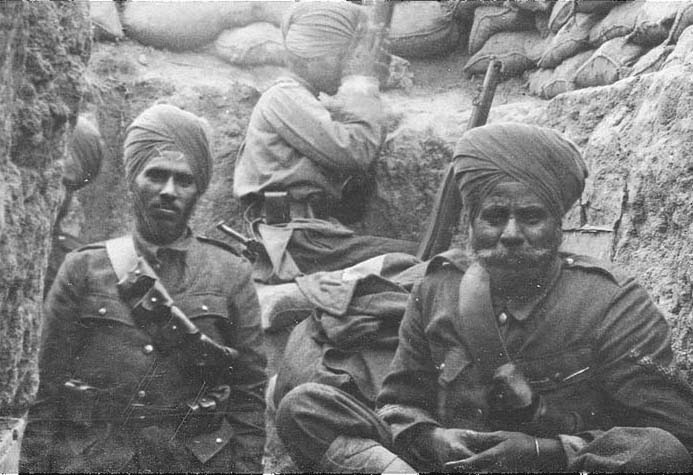
indians

Our boys, all Indians by the way, started out to meet them as well. The scene that followed can hardly be described. To see our greatest enemy shaking hands with our Indian troops and giving them cigars and cigarettes was a sight I shall never forget.

Captain, come out, the British have started waving. There is no shooting, and our men are doing the same”. I rushed out and saw a strange unforgettable picture. The soldiers who were standing upright on top of their trenches without their weapons, shouting “Merry Christmas”. Some soldiers had advanced into No Man’s Land. They met in the middle, shook hands, talked and strolled about.…… They were trying to talk to our men and they were giving them biscuits and boxes of cigars.

*****

An officer amused us very much by clearing some soldiers away from his machine gun emplacement, but he finally had his photo taken arm in arm with one of our officers.

*****

Coming across from the German trenches was a solitary German, carrying a white flag high above his head. Having come about halfway he suddenly stopped and waited. Then one of our men went out to meet him, to bring him into our lines. Unfortunately the German had not been blindfolded, and he had to be made a prisoner of war. He protested and was awfully upset, but he had seen behind our lines. (The luckiest man I have heard of for a good while. The whole of 1915, 1916, 1917 and 1918 in a British POW camp!)
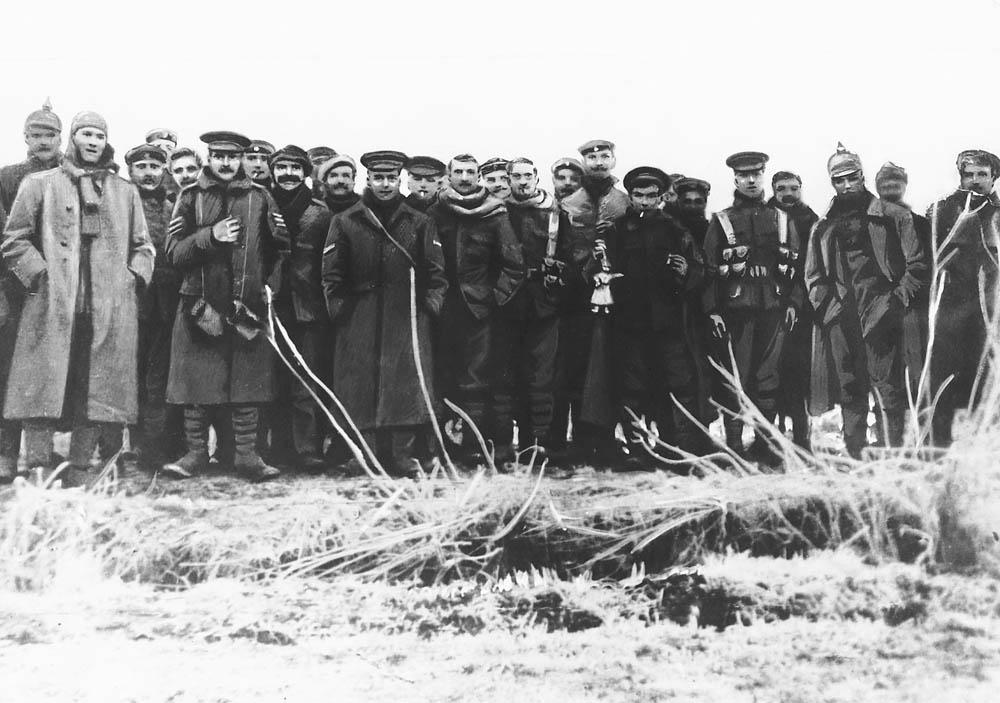
Christmasxxxxxxx truce

The Germans sent in a party with a white flag. Our bloody fool of a sentry brings one German in without blindfolding him and, of course, he had to be made a prisoner-of-war.

*****

The German officers were taking photographs of mixed groups. One German brought us copies to send to the English newspapers. We  had our photographs taken by a German who was the proud possessor of a small camera. There were Indians and Germans shaking hands when he pulled the shutter.
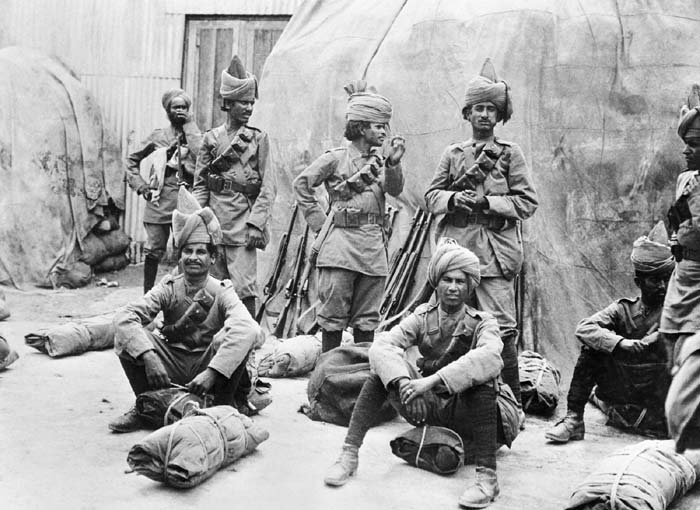
indians 2
He took a photograph of three of our officers and three of their officers; our officers were placed between theirs. Suddenly one of the Germans ran back to his trench and presently appeared with a large camera. I posed in a mixed group for several photographs. No doubt framed editions of this photograph are now on some German mantelpiece!.

*****

“Dear Mother, I am writing from the trenches. It is 11 o’clock in the morning. Beside me is a coke fire, opposite me a ‘dug-out’ (wet) with straw in it. The ground is sloppy in the actual trench, but frozen elsewhere. In my mouth is a pipe presented by the Princess Mary. In the pipe is tobacco. Of course, you say. But wait. In the pipe is German tobacco. Haha, you say, from a prisoner or found in a captured trench. Oh dear, no! From a German soldier. Yes a live German soldier from his own trench. Yesterday the British & Germans met & shook hands in the Ground between the trenches, & exchanged souvenirs, & shook hands. Yes, all day Xmas day, & as I write. Marvellous, isn’t it?”

*****

Suddenly a Tommie came with a football and then began a football match. We marked the goals with our caps. Teams were quickly established and the Fritzes beat the Tommies 3-2.

*****

The regiment actually had a football match with the Saxons, who beat them 3-2.

*****

“A” company played against the enemy with an old tin for a ball: they won 3-2!

*****

Some of our boys tied up a sandbag and used it as a football, while a party of Germans enjoyed themselves sliding on a little frozen pond. Soon there were dozens kicking a made up football about in No Man’s Land.

*****

In the sector of the Argyll and Sutherland Highlanders, “it was recorded that a game was played and according to a letter  published by the Glasgow News, the Scots won by  4–1.

*****

He toured Britain last year with the Leipzig team and beat Glasgow Celtic 1-0. All day we walked to and fro with newspapers and our little photographs and parted, regretting that it was our duty to fight each other.

*****

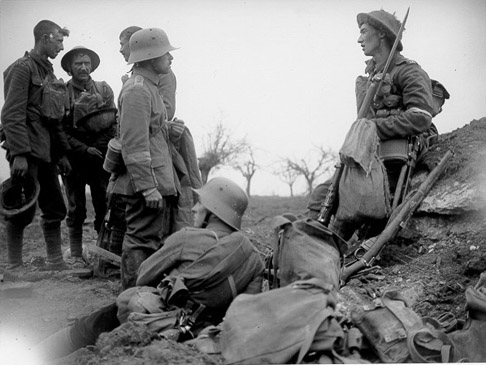
Men from the 1st Battalion came out from their trenches to play football. The Royal Welch Fusiliers played the German Battalion 371. The Germans won 2–1.
Christmas%20truce%202014-41-124316

As the fog lifted the Germans were playing football. We  climbed out of the trench armed with an entrenching tool handle and a jam tin and played rounders.

*****

We had a football out in front of the trenches and asked the Germans to send a team to play us but it had been freezing all night and it was a ploughed field so their officers stopped them doing it.

*****

A match against a German team (described as “Prussians and Hanovers”) was played near Ypres near the border of Belgium and France.

*****

The Lancashire Fusiliers, based near Le Touquet on the northern French coast, played a match against German soldiers using a ration tin as the “ball”.

*****

Captain Sir Edward Hulse reported “a sing-song which ended up with ‘Auld lang syne’ which we all, English, Scots, Irish, Prussians, Wurttenbergers, etc, joined in. It was absolutely astounding, and if I had seen it on a cinematograph film I should have sworn that it was faked!

*****

The ball appeared from somewhere, I don’t know where, but it came from their side, it wasn’t from our side. They made up some goals and one fellow went in goal and then it was just a general kickabout. I should think there were about a couple of hundred taking part. I had a go at the ball. I was nineteen. Everybody seemed to be enjoying themselves. There was no ill will between us. There was no referee, and no score. It was simply a mêlée. We had a rare old jolly vacation, which included football, in which the Germans took part.

sr_french_marines_01

On Christmas Day 1914 there was an Armistice between us and the enemy. A comrade of our company held up a sign with the inscription “Fröhliche Weinachten” (Merry Christmas). The English immediately responded in like manner. An English soldier shouted to us in imperfect German, asking if we wanted to remove the dead between the lines. We came to an agreement and our men climbed over the parapet, as did some of the English. Afterwards the Englishmen asked us to sing some Christmas songs. An English soldier came towards as and exchanged cigarettes and chocolate. The sight of opposing troops chatting to each other along a stretch of several hundred metres was a very strange one. As darkness fell both sides went back to their trenches. Such attempts at fraternisation have hardly been approved by the High Command; they remain, however, a wonderful testament to the human spirit.

*****

I gave them cigarettes and was given a box of tobacco which I will send home as a souvenir of  the most extraordinary event of the whole war – a soldiers’ truce without any higher sanction by officers and generals. We strolled up and down for about half an hour, shook hands, said goodbye, saluted and returned to our lines.

*****

And finally, the  very best one of all…

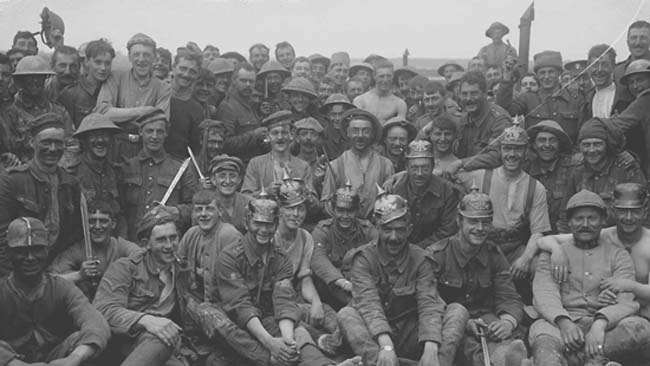
It was just the sort of day for peace to be declared. It would have made such a good finale. I should have liked to have suddenly heard an immense siren blowing. Everybody to stop and say “What was that? Siren blowing again: the appearance of a small figure running across the frozen mud and waving something. He gets closer – a telegram boy with a message! He hands it to me. With trembling fingers I open it: “War off, return home – George. King” Cheers! But no, it was a nice, fine day, that was all.
happy_soldiers_wwi

For me the Christmas Truce has always been the most wonderful achievement ever by ordinary working-class men, many of whom would never have even seen a German or an Englishman before the Great War broke out. And despite all the appalling self-serving jingoism in the newspapers, after just four months of  slaughter, both armies of ordinary men were ready to recognise that they had far more in common with their so-called enemies than they might previously have been allowed to know. The warmth and humanity of these men shines through still, even a century after the event. “Merry Christmas” or should I say “Fröhliche Weinachten”?
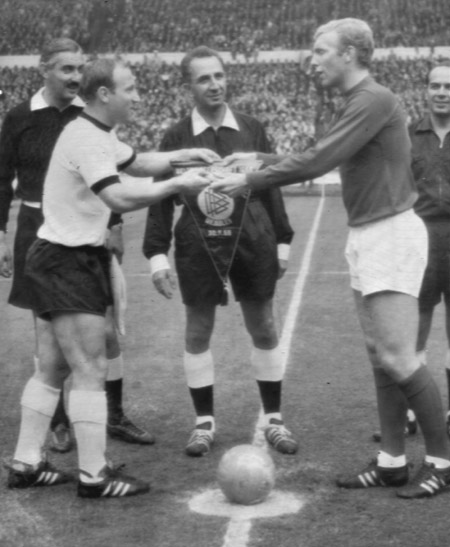
SportTo commemorate the hundredth anniversary of the impromptu football matches played in No Man’s Land during the Christmas Truce of December 1914, both English and German football supporters have come together this year, 2014, in the spirit of Christmas friendship. The highlight of the weekend-long meeting was a seminar entitled “The Referee”.

English supporters were able to show their German friends how it is possible for the referee to award a goal even though a tiny and almost insignificant proportion of the ball may not have completely crossed the line.

This slideshow requires JavaScript.

Our German friends were able to show how a referee, if he decides the ball is of the wrong colour or has been made by the wrong manufacturer, can refuse to award a goal, even though the ball may have crossed the line by several metres.

This slideshow requires JavaScript.

At the end of a wonderful day of comparing beers and consuming Christmas food, a collection was taken to fund methods of helping the referees of England-Germany games during the next century.

zzzzzz guide_dog_

1 Comment

Filed under France, History, Personal, Politics

Hallowe’en Nights (2) The Beast of Auxerre

After researching “The Beast of Gévaudan”, I was amazed to find that over the centuries, a large number of different areas of France have been ravaged by man-eating creatures, such as the monsters in the countryside around Auxerre, Lyon,  Orléans or the Vosges Mountains. On a number of occasions what was probably one single animal might even be called by several different names as it wandered widely around various places. «La Bête des Cévennes », « La Bête du Vivarais » or « La Bête du Gard », for example, were all one and the same monster.
The majority have always been considered wolves, although of course, in our time the wolf no longer seems to behave in this aggressive way. Strangely enough, for a substantial number of these less widely known beasts, the witnesses were often keen to say that it was a wolf but not an ordinary wolf like the ones which they saw virtually every single day. It may have had a wider muzzle, or a belly that dragged on the ground. It may have had pale or even white underparts. Ironically, this latter identification feature on its own actually excludes the wolf as a possibility.
All three of these details, of course, the muzzle, the belly and the underparts were  features of the “Beast of all Beasts” in Gévaudan.  The peasants, shepherds and shepherdesses were armed only with a stick, or a pole with a knife attached to it, because the lower classes were forbidden to carry firearms, which was the exclusive right of the nobility.  Agricultural workers, though, were all highly experienced  at identifying wolves. And lightly armed as they were, the population of the average administrative area in rural France in the eighteenth century might still kill a hundred wolves a year between them.
Nowadays, the wolf seems a much calmer animal. They have become extremely rare in Western Europe, and even in Eastern Europe they seem to be less dangerous than old oral traditions would have us believe. Furthermore, it is certainly a fact that only one person has ever been killed by wolves in North America, and even then the wolves involved had become over-habituated to Man through frequent feeding on a landfill site.
The process by which wolves are believed to have become man killers in France is described in a French Wikipedia article, entitled “Le Loup dans la culture européenne”…“The Wolf in European Culture”

….Thanks to the improvements made in the field of agriculture, Man ceaselessly extended his cultivated land and increased the area for his livestock at the expense of woods and forests. The Feudal System and hunting as a leisure pursuit constantly reduced the number of animals to hunt, and attacks by wolves became therefore increasingly frequent. Flocks of sheep were an easy prey item during a period when food was short.
In normal times the wolf does not attack Man and indeed, even when he is hungry he fears human beings, above all when he is forced to confront an upright enemy. Faced by a man, the wolf always backs down or just runs away. Nevertheless wolves in the Middle Ages used to follow men around when they were out at night walking between villages. The wolves always remained a certain distance away from them. Without doubt they were doing this to get food, thinking that the man must be hunting and that they could grab any unwanted food that was left behind. These stories of wolves which followed men at a distance, sometimes over dozens of kilometres, accentuated the phenomenon of fear of the wolf.
However, attacks by wolves on men were reported for the first time towards the end of the Middle Ages, from the time of the Hundred Years War onwards. These attacks also correlate with epidemics of rabies which can change a wolf’s behaviour completely.
At this time of famine the wolf might have started devouring the corpses left behind by the warring armies. Not rabid wolves, but wolves used to the taste of human flesh would have committed acts of predation towards weak human targets. These cases of predation disappeared around 1820 because of the disappearance of open air mass graves from this period onwards. There will always remain nevertheless a small number of isolated attacks linked to epidemics of rabies, but in this case the cause of the illness is easily identifiable.”

(My own translation)

Further ideas come from « Mikerynos » writing on his own excellent website. He sees the entire French population as having within them a deep seated fear of the wolf, much as other nations might have traditional fears of people of a different race or cultural background from themselves.

“Nowadays beasts still appear in the French countryside but they only kill sheep or other animals. The most famous of all was the Bête des Vosges in 1977.
Feral dogs, escaped zoo animals, animals trained by malicious pranksters and sometimes wolves are used to explain these episodes.
But the Old Demons are not yet ready to fade away. The arrival of Italian wolves in the Parc National du Mercantour has brought about the raising of a protective shield wall on the part of livestock farmers and hunters, who have not been at all afraid of introducing the question of the danger to human life, for in the collective subconscious of the whole French nation, some monstrous beast can still be seen lurking dimly behind these innocent wolves, which have absolutely no connection whatsoever with it.
Over the course of the centuries in France there have been many other episodes similar to the Beast of Gévaudan, even if they were less blood soaked. And the explanations are always exactly the same. Wolves are the guilty ones.

Biche-second blogpost cccc

Nowadays all zoologists are in complete agreement with each other that the wolf practically never attacks Man. Indeed on the contrary, the Wolf always flees from Man. The idea that a Wolf is a man eater is essentially a French one which has led some people to deduce that the wolves in France must be the only ones to exhibit such behaviour! In the same way the theme of the werewolf, a man who can change into a wolf, is above all a French one.  And The Beast who brings together both of these two themes is, in exactly the same way, as we already said, a very French concept.
In a word, though, it is the fear of untamed nature which shines through these themes, a fear which has become particularly focussed on certain species such as the wolf. Every animal attack which seems beyond rational explanation very quickly leads to gossip and rumours. The Beast of Gévaudan is not the only animal to have spread terror across France. There was “la Bête d’Evreux”  (1632-1633), “la Bête de Brives” (1783) and “la Bête du Cézailler” (1946-1951).
The most ferocious seem to have been “la Bête de l’Auxerrois” and “la Bête du Vivarais”.
The former appeared in 1731 and killed 28 victims. It was described as a tiger or a wolf. The “Bête féroce de Sarlat” was famous in Périgord from 1766 onwards. Its peculiarity was not to attack women but to kill exclusively men. In 1814 it was the turn of the « Bête féroce d’Orléans » to achieve a certain success. It ripped to pieces and devoured the poor inhabitants of the countryside, massacred entire families, destroyed and devastated everything which appeared in its path and carried out the most appalling carnage, if one is to believe the caption explaining an etching of the period. A lament was even written about it; the style is not too clever but we can imagine the fear of the audience who were listening to such verses. The official disappearance of the wolf from France came in 1937 when the very last one was killed in Limousin. Or more precisely, the Wolf was presumed extinct insofar as the breeding population was diminishing between 1930 and 1939.
From 1818 to 1829, more than 14,000 wolves were killed in France every year. That was the era of the appearance of the single shot rifle (1830) then there were repeating rifles and the double barrel shotgun. Firearms became henceforth extremely accessible and extremely effective. Wolves could be killed at a range of more than 100 metres. The number of hunting permits awarded just grew and grew. In parallel, the use of poison spread among wolf hunters: monkshood the wolf killer, added to ground glass, meadow saffron, a concoction with tamarack, water hemlock and nux vomica.”

(My own translation)

I have found it a fascinating idea that only two hundred or so years ago a highly developed European country like France could have been repeatedly ravaged by man-eating animals, whether they were wolves or, just plain, simple monsters of the type the Hillbilly Hunters chase after on a weekly basis in the TV show “Mountain Monsters”.
I intend therefore to bring these unknown creatures back into the public eye. Had they been active in an English speaking country, I am sure that they would be a lot more famous than they are now, although, of course, they do appear in a good many French websites on “la cryptologie”. The first one to feature, on a purely alphabetical basis, is the “Bête de l’Auxerrois ou la Bête de Trucy”….

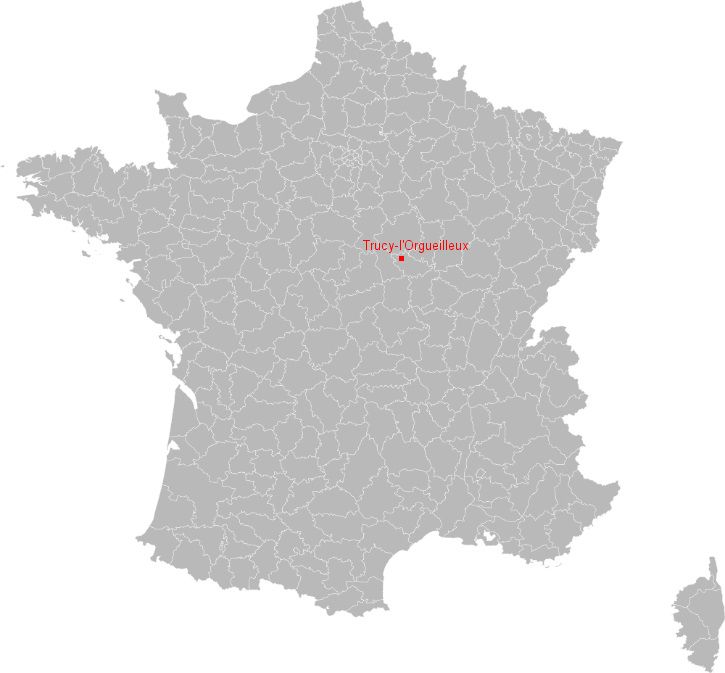
Called by two alternative names, the “Beast of Auxerre” or the “Beast of Trucy” was either one or several man-eating animals which were behind an extensive series of attacks on humans. Nowadays, the tiny village is called “Trucy-L’Orgueilleux”.

carte-Administrative-Trucy SECOND BLOGPOST

The first incident came in November 1731 when a young boy of 12 years old was working close to the wood of Trucy-sur-Yonne to the south of Auxerre with his mother. She managed to snatch him back from the carnivorous animal which was trying to devour him, but he died in her arms as they made their way back home.

SECOND BLOGPOST ccccc

Attacks then succeeded each other in such quick succession that King Louis XV offered a reward of £200 to whoever could kill the beast. Beats were organised and numerous wolves were killed. The poisoned carcasses of sheep were left out in the fields but the attacks continued, with young children the principal victims. The beast even ventured into the village of Mailly-la-ville and carried off a young child who was playing in front of his house. Trying to snatch him back from the beast’s fangs, his nurse was only able to recover one of his feet (or just one of his arms according to other witnesses).

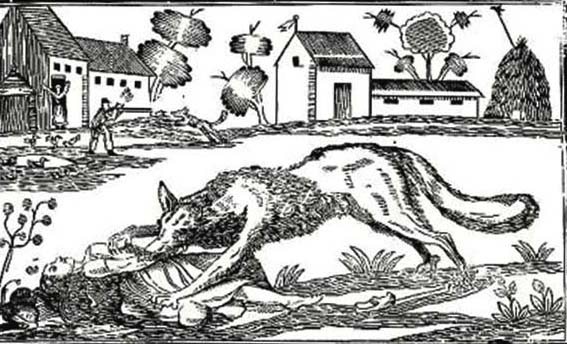
Illustrations of the “Beast of Auxerre” or the “Beast of Trucy” seem pretty well non-existent on the Internet. The engraving below appears on one website, but it is also featured elsewhere as being the  “Beast of Orléans”…

2653xxxxxxxxxxxxxxxxxxxxxxxx_small_1

In five months the local priest of Val-de-Mercy recorded 14 deaths due to the attacks of this carnivorous animal. By the end of the year 1734 a grand total of 28 victims had been listed. The animal supposedly killed a total of nine children, nine women and ten men according to the death certificates which have so far been located. In 1734 two wolves were killed in the course of a hunt and the attacks stopped shortly afterwards. There was however, no irrefutable concrete indication that either of these two animals was behind the attacks which had lasted for three desperate years. Contrary to the Beast of Gévaudan, these killings seem to have concerned as many men as women
In 1817 a second carnivorous beast ravaged the forest around Trucy for a few months, strangely, at the very same place as the animal from eighty years previously. One child was devoured close to Charentenay, another at Fouronnes and numerous people were injured. Poisoned sheep were placed close to the woods and the beast duly disappeared without leaving any trace whatsoever. No carcass was ever found but mercifully the attacks stopped.

This picture allegedly shows the “Beast of Auxerre” or the “Beast of Trucy” but it had previously been used in pamphlets about the Beast of Gévaudan.

bete-du-gevaudanzzzzzzz
For the attacks of 1731–1734, contemporary rumours talked of a werewolf, of several wolves and even of demons. The witnesses spoke of either a huge wolf or a tiger. Following the usual pattern, the witnesses’ descriptions indicated an animal that was “like a wolf” but which nobody thought was just an ordinary wolf. According to the experts nowadays the monster was probably some exotic wild animal which had escaped from its owner, but given the descriptions, it was most probably not a common-or-garden wolf.

Unlike the countryside though, in the towns, certainly, the majority of the people had little idea at all of what a wolf was like. Here is a contemporary picture of a wolf….

concept of wolf xxxxxx

For the second series of attacks in 1817, local talk was of a hyena although one statement described a mastiff dog with pointed ears.
It is always worth looking at a second account of what are clearly the same events

“In 1731 there appeared in the woods around Trucy, to the south of Auxerre, a beast which terrorised the region. The first attack was on a boy of twelve in November 1731, very close to the tiny village of Trucy-l’Orgueilleux. The number of victims quickly increased, with 17 in three years, of whom the majority were children. The king offered a reward of £200 to whoever could kill the beast but without result. The creature then continued its carnage until 1734 when it quite simply disappeared without anyone having been able to kill it despite numerous beats being organised. Overall it killed approximately 30 people, the majority of them children.
In 1817 it was a different beast which ravaged again the very same area of Mailly-la-ville and the Forest of Trucy. Described as a tiger or an enormous wolf, people finally concluded that it was a wolf of enormous size and particular ferocity. It killed 28 people (nine children, nine women and ten men) and was never killed despite numerous beats being organised and the poisoned carcasses of sheep being placed randomly in the surrounding area. Like its predecessor this animal just disappeared “back into Nature” so to speak.”

Clearly there has been some confusion between the two websites over victim totals, but it is always best to see at least two variations of the same story. If you want to see more than just these two then go to the French Google and search for either “La Bête de Trucy” or “la Bête de l’Auxerrois”.

Another website…..

 “…a mother grabbed her twelve year old son from the jaws of an enormous beast without managing, alas, to save him… After this they killed a number of wolves, but the beast continued to attack young children, women and men…… 28 victims were eventually listed. Then they killed a couple of wolves, and the attacks ceased. People talked of werewolves, of wolves gone mad, and even of Demons. Witnesses spoke of the “Beast like a Wolf” but actually “Not a Wolf”. The experts nowadays tend to speak of a wild animal, but seldom of a mere wolf.”

At least one other website which lists “The Monsters That Ravaged France” clearly places “La Bête de Trucy ou la Bête de l’Auxerrois” not in the category of the wolf but in that of the “bête mystérieuse”.
These same details are given by that great expert, « Mikerynos » in the very first article on the page….

“(Elle) est apparue en 1731 et a fait 28 victimes. Elle est décrite comme un tigre ou comme un loup.”

What is most striking about “La Bête de Trucy ou la Bête de l’Auxerrois”, though, is the sheer number of victims consumed. In English we say “as hungry as a wolf”. I don’t know if the French have an equivalent but if they do, it should probably relate to Trucy or Auxerre!

4 Comments

Filed under Cryptozoology, France, History, Science, Wildlife and Nature

Just what WAS the Beast of Gévaudan?

There is no shortage of theories as to the identity of the murderous beast I described recently,  la Bèstia de Gévaudan,which terrorised a whole province of France from 1764-1767, and claimed upwards of a hundred victims, mostly women and young girls. From what I have read, but above all, from what I have watched on “Youtube”,  basically, you will have to make your own  choice.

The creature was, therefore, perhaps a single enormous wolf, or maybe a number of wolves in a single pack, or even a large number of wolves in a number of separate packs.

Less fancifully, it could have been some type of enormous domestic dog, or perhaps even a wolf dog hybrid, perhaps with a red coloured mastiff involved. Its supposed invulnerability to bullets was because it wore the armoured hide of young boar.

It may have been a hyena although this species is thought to have been long extinct in Europe at this time. It has even been suggested that it was not a real animal, but a sex-crazed serial killer who dressed in a fur costume, pretending to be a wolf. In the same vein, it was perhaps a werewolf with a penchant for hunting women and young girls.

An initial, perhaps simplistic approach, is quite simply to look at pictures of the beast, and to compare it with photographs of the most likely candidates, and then to make up your own mind.

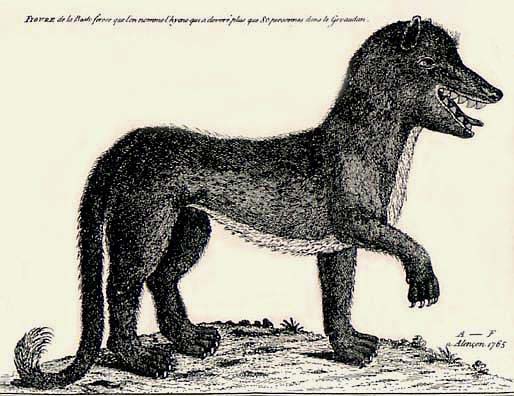
Firstly, here are some pictures of the beast itself. You need to bear in mind that they are unlikely to have been drawn directly from a witness descriptions, and that many of them may have been mere copies of the work of other artists. Furthermore, at this time, it was accepted practice to draw animals in a very stylised fashion, rather than in the more accurate zoological one. Because of this, therefore, the head and limbs are often out of proportion, and the body is frequently too large for a small head and legs. In many pictures, the artist sought to portray an unknown animal by reaching into his knowledge of Heraldry…


This slideshow requires JavaScript.

Here are some photographs of wolves. I have deliberately picked what I consider to be the largest individuals, and to provide illustrations of animals in poses which are hopefully similar to those in the engravings of the beast.

This slideshow requires JavaScript.

Here are some photographs of what are usually called wolf dog hybrids. Having looked at a much larger number of them on the Internet, I do feel that most can be dismissed immediately because an ordinary person would think that they were pure bred wolves. They are only noticeably different when crossed with a very distinctive breed of dog.

This slideshow requires JavaScript.

Many cryptozoologists favour the hyena. Certainly, a number of the original drawings from the eighteenth century are titled as being “la Bèstia de Gévaudan, the hyena”.  Many of them, even the most wolf-like, have their flanks covered with either stripes or spots.
This picture was allegedly drawn by the killer of the second beast, Jean Chastel.

drawn chastel

Here are some pictures of the striped hyena.

This slideshow requires JavaScript.

And here are some pictures of the spotted hyena.

This slideshow requires JavaScript.

Basically, you pay your euros, and you take your choice.
As blogposts cannot be of infinite length, let me summarise the fors and againsts of all the possibilities as I see them.

A wolf or wolves?

This is the mot acceptable of a very large number of  explanations. Certainly, the prints found were deemed to be those of a wolf. Monsieur Antoine de Beauterne who was to kill the first animal, the Wolf of Chazes, said that there was « aucune différence avec le pied d’un grand loup » “no difference with the pawprint of a large wolf”

BUT…

Wolves do not normally attack Man. The locals used to kill around 700 wolves every year, so they all knew what a wolf looked like and could defend themselves against them. All the witnesses were adamant that the animal was not a wolf, but an animal that they did not know. That is why it was immediately christened “la bèstia”. Neither can wolves have a white breast and underparts, as a large number of witnesses said in their descriptions and, indeed, as is portrayed in many of the contemporary illustrations. Only a hybrid animal could exhibit this pattern of coloration.

Wolves do not strip the clothes off their victims, neither do they decapitate their prey.
After the Wolf of Chazes was killed, the deaths did not stop.
A rabid wolf?

An animal  diseased in this way would not have been afraid of Man, but it would certainly have died well before the three year period was  up. A number of rabid wolves? Isn’t that possibly stretching the argument a little?

A hyena?

The animal would certainly have been unknown to the inhabitants of the area. Members of the French nobility, however, frequently indulged themselves by importing exotic animals such as lions and tigers into the country, and we know that hyenas were brought into France at this time. So too, hyenas are supposedly relatively easy to train, or at least, easier than you might expect! Whether this would extend to converting them into fearless and ferocious attack animals is a different matter, however.
Hyenas are certainly capable of decapitating their prey. I have been unable to ascertain if they take the clothes off their victims, although I would have thought that they might have needed opposable thumbs for any particularly intricate garments.

BUT…

the second beast to be killed, the Bête de Chastel, did not have enough teeth to be a hyena. This creature was, without doubt, a canid of some description, according to the King’s Notary, Roch Étienne Marin, the man who carried out what appears to be an extraordinarily thorough autopsy. On the other hand, the creature was also examined by the famous Comte de Buffon, an extremely famous scientist and naturalist of the day, whose ideas were to have a great influence on Charles Darwin. Buffon pronounced it to be a very large wolf.

skulls ccccccc

The Striped Hyena, which resembles most closely perhaps, la Bèstia, does not hunt but scavenges. The Spotted Hyena does  hunt for itself, but nobody has ever really mentioned spots as a feature of la Bèstia.
In one of his blogposts, C.R. Rookwood suggests another exotic solution. He suggests that la Bèstia was a  mesonychid, a prehistoric mammal related to present day whales. They were very large predators with huge heads, long tails, and hooves instead of feet. The largest was Andrewsarchus mongoliensis, known only from its skull, minus the jawbone: for this reason, illustrations of its colour are, for the most part, just well informed guesswork. The structure of the animal is based on the other members of the family, whose skeletal structure is better known.

This slideshow requires JavaScript.

This animal does fit quite closely the description given by many of the peasants who saw la Bèstia. A few of the reports did mention hooves instead of feet, although the creature may well have been described as having hooves to emphasise its connection with the Devil.

BUT…

How could a gigantic, fierce, flesh eating mammal have survived from a prehistoric era until the eighteenth century, without anybody noticing it?

A human serial killer?

Humans can remove dead people’s clothes. Humans can decapitate their victims. Some bizarre serial killers would enjoy the chance to mask their activities behind the depredations of a very large trained carnivore.

BUT…

All the reports by eye witnesses say that only an animal was involved. This idea of a human serial killer can only be maintained  if mutilated bodies were found and there were no eye witnesses who saw an animal attacking them. Only in the Cantal area, apparently, were these circumstances fulfilled.
Of late, many people have  become increasingly concerned by the involvement of Jean Chastel in this marvellous enigma. Jean, a farmer and inn-keeper in the province of Gévaudan, and his son Jean-Antoine, have come under suspicion because when both of them were imprisoned for a period  because of their aggressive attitude to two of Francois Antoine’s gamekeepers, the number of attacks by the monster diminished noticeably.

chastel 2 ccccccc
It has therefore been put forward that la Bèstia was the result of Jean’s crossing either his own or his son’s red-coloured mastiff with a wolf, and then subsequently training it to kill. Almost all the evidence is perforce circumstantial, but much of it is quite compelling.
The creature may have been, therefore, a particularly  aggressive hybrid, which Jean-Antoine Chastel trained to have no fear of human beings, but instead to attack and to kill them. Witnesses have said that if its attacks were met with strong resistance, la Bèstia would retreat fifty yards or so, then sit and wait, as if sizing up the situation, before finally returning to the fray. This has been  taken to be the behaviour of a trained animal, unafraid of its opponent, rather than a wild one, whose natural instinct in an equal contest would have been to save itself by fleeing. Furthermore, witnesses thought that la Bèstia was driven not by hunger but by its own fury and an innate aggressiveness. It could also be more agile and jump much higher than a normal dog.
According to hunters in the eighteenth and nineteenth centuries, crosses between dogs and wolves were invariably very varied in appearance with dark or light tinges, sometimes marked with yellow or white or striped a little like a zebra. This, of course, agrees with many of the eye witness descriptions of la Bèstia.
Here are some pictures of mastiffs, although it is very difficult to know exactly what they looked like two and a half centuries ago. Nowadays, they simply don’t look particularly fierce….


Here is an English Mastiff around 1700.
mastiff 1700 ccccccc

If we are going down the road of wolf-dog hybrids, then I was quite attracted to a long extinct breed of German bulldog, or Bullenbeisser…

Bullenbeisser extinct ccccccccc

On the other hand, others have said that no successful interbreeding of a Mastiff, or Mastiff type dog, has ever been successfully carried out with a wolf, even though such a hybrid might explain the colours noted by many witnesses.
From the summer 1764 to its death in 1767, la Bèstia wandered over vast distances in almost no time whatsoever. Perhaps the two Chastel were conveying their creature around the province by some artificial means…an explanation of the high frequency of attacks spread over a not inconsiderable area.
On many occasions, people reported the apparent invulnerability of the creature when either stabbed or shot at. It has been suggested that it was wearing some kind of body armour made from the skin of a wild boar. Many witnesses told of the creature being shot several times by experienced hunters, and not being affected by it. Other witnesses spoke of its entrails hanging down after it was stabbed. Could this have been the strapping for some kind of home made armour?
When it was killed, la Bèstia died in the parish of La Besseyre Saint Mary, where Jean Chastel and his son lived. Perhaps they felt that they were about to be discovered, so they shot the creature and then manufactured a tale of heroism and religious devotion to snatch a glorious propaganda victory from the jaws of ignominious discovery and defeat.
As to why the two Chastel would want to kill so many of the people in the area where they lived, that remains a matter of pure guesswork. Certainly, Jean Chastel was supposed to have been an unpopular loner, and given his previous record of various episodes of fairly serious criminal behaviour, he may well have been a man who the locals disliked and feared in equal measure.
Perhaps les Chastel, père et fils were rejected and hated by local women and children, and then took their massive revenge on them, like those American teenagers who return to their High School and kill everybody they can. Perhaps they were sexual psychopaths who enjoyed killing and eating women and little girls.

One further detail which may be of significance is that the loud, belligerent and generally anti-social behaviour of the father, Jean Chastel, seems to have changed profoundly from May 16th 1767 onwards. On this date, in the village of Septols, Marie Denty was attacked in a little lane near her house, right under the eyes of her parents, and killed, just before her twelfth birthday. Supposedly, she and Jean Chastel were very close friends and he doted on her like the grand-daughter he never had. Now he was “fou de douleur”, “mad with grief”, and seemed about to lose his sanity. Perhaps, les Chastel and their appalling pet had killed by mistake. Certainly, his ne’er-do-well son, Antoine, seemed suddenly to be released from an evil spell, and he turned straightway to God. Jean spent his time in pure pursuits such as prayer, confession and penitence. For his redemption to be complete, he and he alone had to be the man who finally killed la Bèstia. According to which sources you believe, in best werewolf killer tradition, he made some silver bullets. Or perhaps, he made them from molten lead which had had a statue of the Virgin Mary dipped into it. Or perhaps he made them from the medals of the Virgin Mary which he wore on his hat. Whatever the case, he certainly had them blessed at a religious ceremony.

The manner in which he killed the creature is extremely suspicious, and could very easily be interpreted as a tale told merely to satisfy contemporary religious feelings, and to exonerate a man who is not bravely hunting down a ferocious killer beast, but who is, instead, shooting it through the head in its kennel before the locals find out it is actually his beloved pet, and then string him up from the nearest tree. The following account I have translated from the French Wikipédia

“On June 19th, the Marquis d’Apcher decides to organise a beat around Mont Mouchet in the wood of la Ténazeire. He is accompanied by a few neighbours as volunteers including Jean Chastel reputed to be an excellent hunter. The latter finds himself at a place called la Sogne d’Auvers,  a crossroads where he sees the animal go past. Chastel fires at it, and manages to wound on the shoulder. Quickly the marquis’ dogs arrive to finish off the beast.”
“As regards this rifle shot, Legend has preserved the romanticised words of the priest Pierre Pourcher which he used to say came from tale told by his family, “When the beast came along, Chastel was saying prayers to the Holy Virgin. He recognised it straightaway, but through a feeling of piety and confidence in the Mother of God, he wanted to finish his prayers. Afterwards, he closes his prayerbook, folds his glasses up, puts them in his pocket and takes his rifle. In an instant he kills the beast which had been waiting for him.”

“A week after the destruction of the beast by Jean Chastel,on June 25th, a female wolf which according to several witness accounts used to accompany the beast itself was killed by Sir Jean Terrisse, one of the hunters His Grace de la Tour d’Auvergne.  He received £78 as a reward.”

Perhaps they were acting on behalf of somebody else. The usual favourite is Jean-François-Charles de La Molette, the Count of Morangiès. He may have wanted to destabilise the area, so that he could take over when the revolution inevitably came.  There were others. The Church wanted to teach the King and the members of the  intelligentsia of the time that free thinking is frowned uon by God….

“Return to the Ways of the Lord or face the Hound of Hell”

As I said before, basically, you pay your euros, and you take your choice.

I had just finished my investigations about la Bèstia de Gévaudan, and had made up my own mind that all the devastation could be attributed, without necessarily knowing the real motivation behind it, to Jean Chastel and his son Antoine.
And then I bought “Real Wolfmen: True Encounters in Modern America” by Linda S. Godfrey. I was enjoying reading this interesting and innovative book, when I stumbled upon page 93 which was about the Wampus Cat of Ariton in Alabama.

“The man who wrote me was disturbed by unidentifiable animal sounds while camping on his ten acres on the Pea River near Ariton, which lies about half an hour’s drive south of the picturesquely named town of Smut Eye. His normally rambunctious standard poodle refused to leave the safety of his trailer that afternoon, and the man was having a cup of tea at about 5.00 p.m. when he heard loud rustling sounds coming from outside the camper.”
“As he peered out the camper window he noticed a large black furred animal with a doglike face surveying his campsite on all fours. It was bigger than his standard poodle and, he said, “Looks like a cross between an ugly collie and an even uglier lab.” Weirdly, it sported a white chest.”
“The creature ambled nonchalantly through the camp and when it jumped over a fallen tree, the man saw that it had a long, sinuous tail like that of a cougar. He reported the creature to the area game warden who said that while she didn’t know what it was, others have reported seeing it, too!”

You can pursue this interesting hunt for truth a lot further if you have any knowledge of French. There are three exceptionally good videos about la Bèstia which can be found on a tourist website for the Auvergne region. They are well worth your time, and seem to portray this most baffling of stories in a fairly reasonable and sensible way. Un, deux et trois.
If you want to see even more videos about la Bèstia, then go to this website which is the French equivalent of “Youtube”. If you search for “la Bête du Gévaudan”, you will find a huge number of films, varying from 15 or 20 seconds long to an hour or more. On the first page, there are eighteen different videos, a further eighteen on the second page, and any number of pages after that.

Bonne chance! And don’t be put off by having to practice your French!

55 Comments

Filed under Criminology, Cryptozoology, France, History, Science, Wildlife and Nature

The Beast of Gévaudan: a real monster

Last week I watched my heroes, the six Hillbilly Hunters, chase vainly after the Hell Hound of Pike County, Kentucky. As a European, though, I could not possibly be unaware of this fearsome creatures’s striking similarity to the so-called “Beast of Gévaudan”, or, in Occitan, the language spoken by the ordinary people in this area of France at the time, “La Bèstia de Gavaudan”.
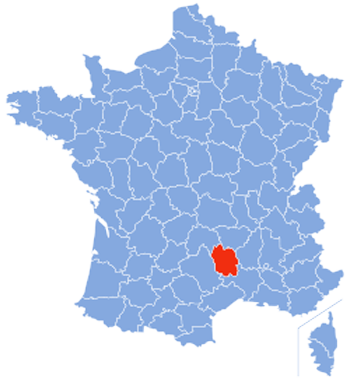
Whichever language is used, this is the historical name given to the creature which ravaged an area of up to 300 square miles in the province of Gévaudan, in the Margeride Mountains in south central France.
250px-Lozère-Position_svgIn those distant days, between May 1764 and June 1767, this entire area was completely agricultural, and it was common practice once winter ended, to send the herds of cattle or flocks of sheep up into the spring and summer pastures in the high mountains. In an era long before mass communication, news was slow to emerge from the region of an epidemic of killings by an unknown but huge creature. This animal preyed for the most part, usually in broad daylight, on the young boys and girls who were sent up into the mountains for months on end to look after their father’s animals. Sometimes its prey was the women who lived in lonely cottages and tiny villages, often as they tended their animals or gathered crops in open fields. These three categories constituted, of course, the easiest of targets. They were made even easier by years of failed harvests and famine during the period preceding the first appearance of La Bèstia. Indeed, during the many huge beats which were to be organised during the following months, a whole succession of high ranking officials from Paris were all astonished to see the peasants who were taking part, fainting and  falling over, passing out from malnutrition and the physical effort involved in walking for any distance across fields or through woods.

The creature, for the most part, ignored men, and likewise cattle, sheep and goats. After the kill it would disappear into the dense patches of forest scattered across the granite plateaux and grass covered hills.
The number of victims differs according to sources. One study estimated there were 210 attacks, with 113 deaths and 49 injuries. Nearly a hundred of the victims killed were partly eaten. However, other sources put the number of fatalities at between sixty and a hundred, mostly defenceless children, or perhaps adult women, with more than thirty victims injured. Attempts have been made to compile full lists of his victims’ names. Click on “Attacks” on the left hand side of the webpage.

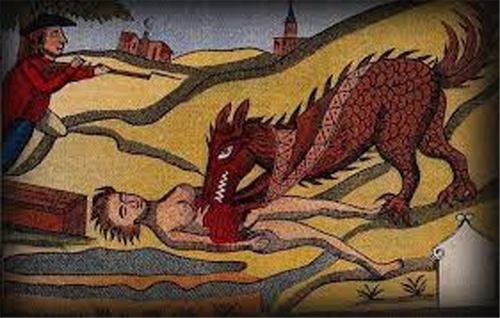
Here are some contemporary illustrations of the creature, nearly all of which depict girls or young women as the victims.

This slideshow requires JavaScript.


According to those who saw the attacks, the monster had formidable teeth and an immense tail. In general, La Bèstia resembled a wolf but it was huge, between a calf and a horse in size. Overall, its fur was said to be unusual in colouration, mostly red, but its back was streaked with black. It had a large doglike head, a snout like a wolf and a mouthful of large teeth. Its small straight ears lay close to its head, and it had a strong neck and a wide chest. The tail was immensely long, and somewhat like that of a panther. People who were struck by the tail said that it was a blow of considerable force. One or two witnesses said La Bèstia had cloven hooves, or that the end of its four limbs was tipped with a hoof. Others said the claws were so heavy that they merely resembled hooves.
Here is one early depiction of the creature. The text at the top of the illustration below means…

“This is the figure of the Monster which is ravaging Gévaudan. This animal is of the size of a young bull. It attacks by preference women and children. It drinks their blood, cuts off their head, and takes it away. £2,700 is promised to whoever kills this animal.”

(My own translation)

-Figure_du_monstre_qui_désole_le_Gevaudan

This is an entry in an unknown parish record…

another burial
« L’an 1764 et le 1er juillet, a été enterrée, Jeane Boulet, sans sacremens, ayant été tuée par la bette féroce, présans Joseph Vigier et Jean Reboul. »
“In the Year 1764, on the first of July, was buried, Jeane Boulet, without the Last Sacraments, having been killed by the ferocious beast, present Joseph Vigier et Jean Reboul.”

(My own translation)

My knowledge of Old French is limited, and I do not know whether the spellings are correct for 1764, or whether the priest was writing the words as he would have said them. They would certainly not be correct by modern standards of orthography.
Here is a legal document taken from the parish records in the village of Rocles, with the graphic description of the death of a little girl called Magdeleine Mauras, a victim of the Beast of Gévaudan…

page

“On the 30th day of the month of September in the Year 1764, Magdeleine Mauras was buried, the daughter of the late Jean and Pagès from Pierrefiche. She was about 12 years old and staying with her uncle John Baptiste Mauras from a place called Thorts in this parish. Her body was found on the 29th day of the month, gnawed on the neck and the breast by the ferocious beast which has been ravaging through this diocese for five months. It ripped her throat out when she was coming back to herd her uncle’s cattle homeward at 4.30 in the evening.”

naked ladies

“The rest of her body, which was lacking an arm, ripped off and consumed by the said beast, was laid in the cemetery of this parish of Rocles in the tomb of the ancestors of her father. Present at this were Jean TF, Jean, Jean-Pierre Bouet and Pierre Martin, the son of the late Antoine, from the place called Thorts, all of them illiterate.
I made these enquiries, the Priest at Aubignac.”

  (My own translation)

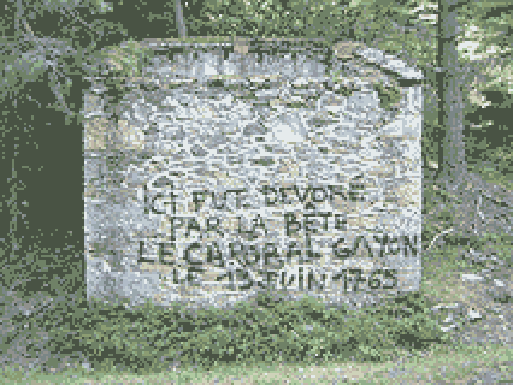
At least one grave of a victim remains…

grave
The French means

“Here was devoured by the Beast Carobal Gayon, June 13th 1765”

He must have been one of the very few adult male victims.
The horrific method of killing victims by ripping their throats out was frequently used by the Beast. Not surprisingly, the government eventually undertook to rid the area of this ferocious creature.

One of the first to try his luck, in October 1764, was Captain Duhamel and his dragoons from Clermont. They did not have an enormous amount of success, and the dragoons themselves were extremely unpopular with the people of the region, as they frequently damaged their crops, and refused to pay for their lodging when billeted with local families. Duhamel was supposedly responsible for this picture of La Bèstia…

Gevaudanwolf xxxxxxDuhamel’s written description said that the monster had the chest of a leopard, the legs and feet of a bear and the ears of a wolf. He thought the animal was some kind of hybrid, but considered that its father was a lion. He did not know what the mother had been. He, like d’Enneval and his son, who were to succeed him in March 1765, refused to believe that it was just an ordinary wolf.

It was January 12, 1765, when twelve year old Jacques Portefaix and his little group of seven friends were attacked by La Bèstia. After several assaults, they drove off the monster by staying grouped together. The encounter came to the attention of King Louis XV who gave rewards to all of these gallant young men. including Jacques Portefaix who was given enough for his education. The King then decreed that the French state would help find and kill the monster.

At this time, of course, the population of France believed that Louis was king by Divine Right. In other words, he was directly appointed by God. Clearly, if Louis could not protect his people from the ravages of an animal that was initially supposed to be merely a large wolf, then questions would certainly be asked about his suitability to rule the country in the face of what might easily be called a punishment sent from God.

Three weeks later, therefore, a concerned King sent two professional wolf-hunters, Jean Charles Marc Antoine Vaumesle d’Enneval and his son Jean-François, to Gévaudan. They arrived on February 17, 1765, bringing eight bloodhounds trained to hunt wolves. Over the next four months father and son hunted wolves believing that eventually they would surely kill the beast. The attacks, however, continued and they were eventually to lose their jobs. D’Enneval père had previously been considered “l’un des meilleurs chasseurs de loups qui ait jamais existé“, “one of the finest wolf hunters who had ever existed”. He had killed some 1,200 wolves in his lifetime, the majority of which, amazingly by today’s standards, were in the  Normandy region. His final departing judgement, though, was that, whatever La Bèstia was, it was no wolf.

On June 22 1765, therefore, Monsieur Antoine de Beauterne, the king’s arquebus bearer and Lieutenant of the Hunt arrived. They began immediately to organise beats by the local people, and set about the same policy of killing as many wolves as they possibly could,  in the hope that one of them would turn out to be La Bèstia.


On September 20, 1765, Monsieur Antoine, as he was universally now known, killed his third and largest wolf measuring 31 inches high at the shoulder, 5 feet 7 inches long, and weighing 130 pounds. The wolf was named Wolf of Chazes after the nearby Abbey of Chazes. Strangely, though, this shooting did not take place where the Beast had ever killed anybody, and indeed, it had never been seen there previously.
Antoine_de_Beauterne

Monsieur Antoine  stated officially:

“We never saw a big wolf that could be compared to this one. This could be the fearsome beast that has caused so much damage.”

The animal was identified as the culprit by attack survivors who recognised the scars on its body inflicted by victims defending themselves. The wolf was stuffed and sent to Paris where Monsieur Antoine was received as a hero, receiving a large sum of money as well as titles and awards.
wolf of hunter 1
And then, OH NO!! Very soon, and certainly from the month of November onwards, there were rumours of fresh attacks. They continued throughout the whole of 1766, and then twelve year old Marie Denty was attacked and devoured  on May 16th 1767.
On June 19th, 1767, a hunt was organized by a well intentioned local nobleman, the Marquis d’Apcher,
JeanJosephd'Apchier
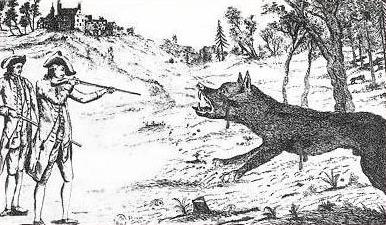
The supposed second beast was duly killed by a local hunter named Jean Chastel. The death of this creature seems finally to have marked the end of these appalling attacks in this benighted region of France.

jean 999

Writers later introduced the idea that Chastel had shot the creature with blessed silver bullets of his own manufacture. This was probably so that it would fit in more exactly with the largely twentieth century tales told about werewolves, particularly in the cinema.

Upon being opened, the animal’s stomach was shown to contain human remains. Like the first creature, this second wolf was sent to Paris, but, because it had decomposed so badly and was extremely smelly, nobody was particularly interested. Even so, what seems a very thorough autopsy was carried out by the King’s Notary, Roch Étienne Marin.

One television programme, Australia’s “Animal X”, stated that this picture shows, according to Chastel himself, the animal that he shot.

drawn chastel

Jean Chastel is nowadays commemorated as the saviour of the region. His signature is preserved, and so is his rifle…


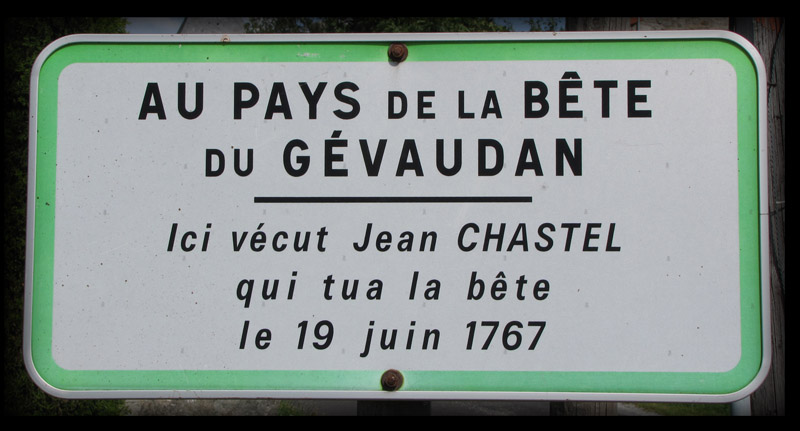
His house is prominently labelled…

chastel_002
The French means

“In the country of the Beast of Gévaudan  Here lived Jean Chastel who killed the beast on June 19th 1767. ”

He has a statue…

chastel 2
There are, as you might expect, any number of explanations of the identity of the Beast of Gévaudan. I will look at as many of these as I can in another blogpost.
One thing, however, remains indisputably true: La Bête du Gévaudan  was only too real, and terrified thousands of people for a good three years.
Nowadays, La Bèstia is much more in favour. He has numerous statues dedicated to him…

This slideshow requires JavaScript.


He has his very own website
He also can be googled, and any number of sites put forward their own interpretation of events.
Un, deux, trois, quatre, cinq, six, sept, huit, neuf, dix, onze

If you can read French, the best website is the French version of Wikipedia, “numéro sept”

The Beast is on Youtube.


He is also on Twitter  and on Facebook where, hopefully, he no longer eats his friends.

8 Comments

Filed under Cryptozoology, France, History, Science, Wildlife and Nature

My Grandad in the First World War

My grandfather had a very eventful journey through the First World War. He joined the Canadian Army on June 12th 1916, and fought at Vimy Ridge, Passchaendale and the Somme. The highlight, though, was when he married his childhood sweetheart, on July 15th 1917,  I am writing this account on his 97th wedding anniversary.

Will has left an enormous amount of material behind him, including a piece of German shrapnel, his leather dog tags, and a piece of camouflaged fabric he cut off the wing of a German aircraft which had crashed in front of him in no-man’s-land.

He was, as can be judged from the surviving photographs, a hard man. He was one of what must have been the thousands of impoverished Englishmen who all set off to make their fortune in the distant reaches of the British Empire

A1 hard man

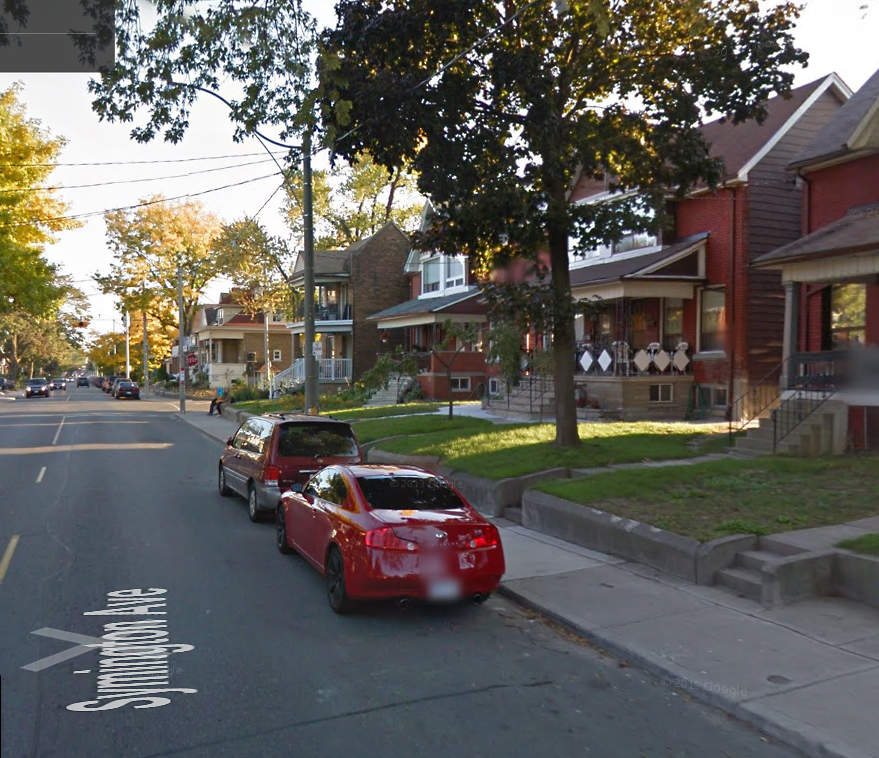
He lived at 266, Symington Avenue, Toronto.

symington avenue

He was employed as a locomotive fireman on an enormous Canadian Pacific Railways train, number 2528, which ran between Chapleau, Ontario, right across the Great Plains to Winnipeg. In this picture, Will is actually in the cab of the giant locomotive…

cab paint

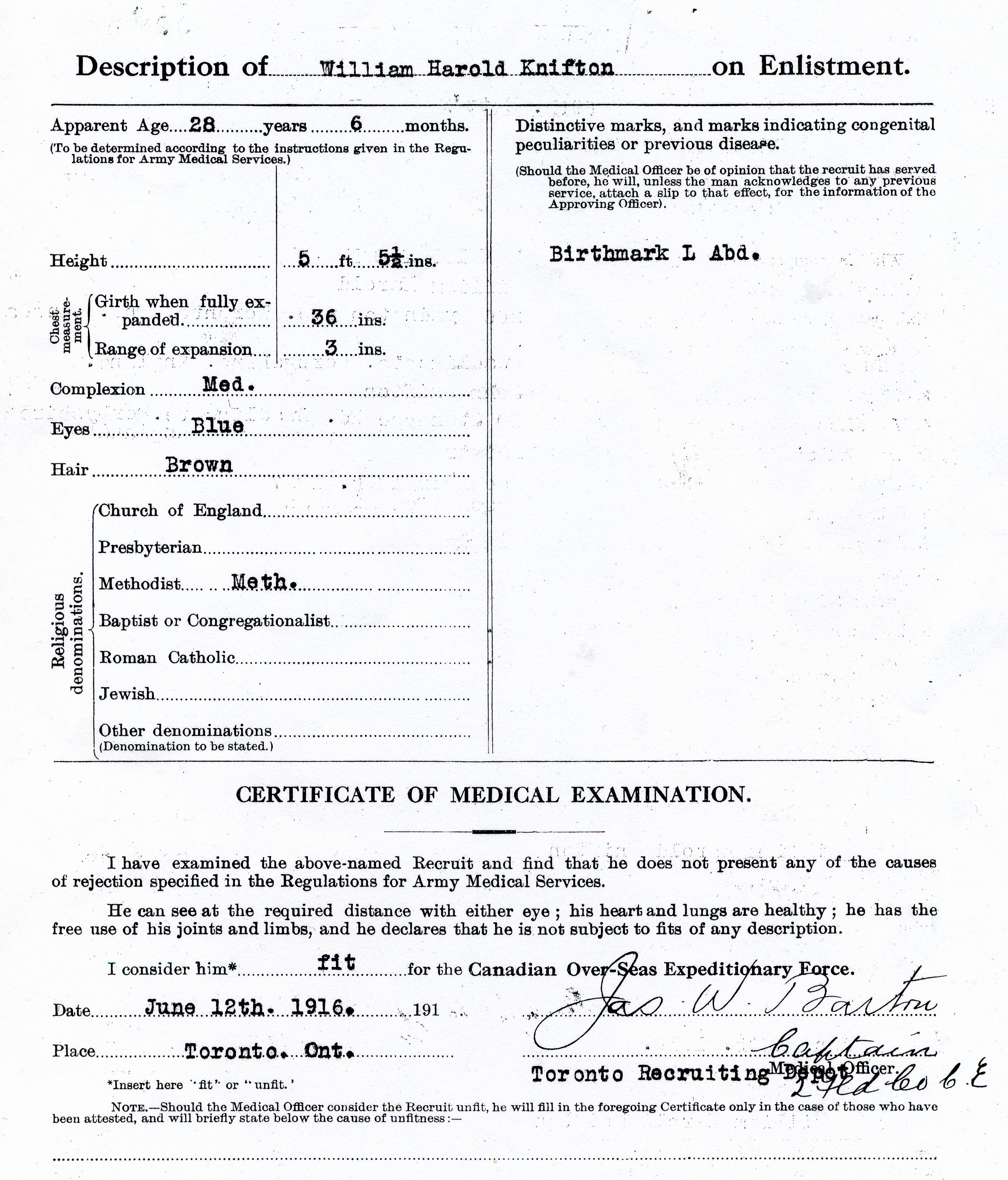
Will was to join the Canadian Army at the Toronto Recruiting Depot on June 12th 1916. He weighed 123½ pounds, and was considered by Captain J.W.Barton to be fit enough to join the Canadian Over-Seas Expeditionary Force.

physical

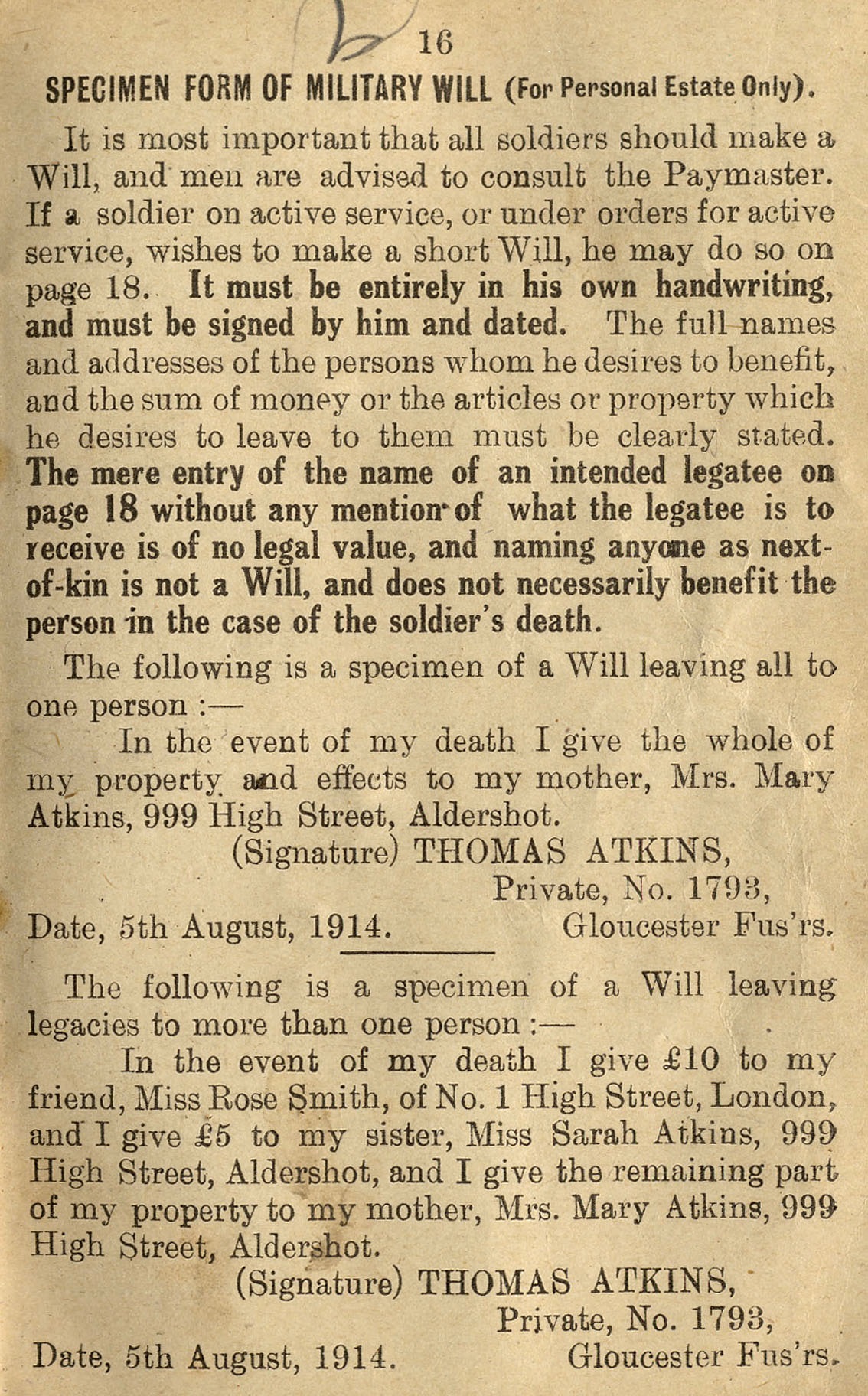
On July 6th 1916, he made a will, witnessed by the Orderly Room clerks, Messrs Irving and Smith. Judging by the small print, this document was eventually to make Mrs Mary Atkins of 999, High Street, Aldershot, a very rich woman indeed, particularly after the Battle of the Somme.

will

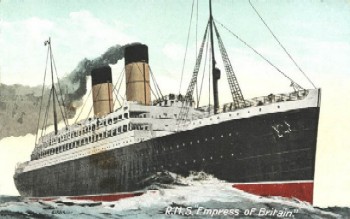
Will sailed from Canada to the Western Front on July 16th 1916 on the “S.S.Empress of Britain”.

ss_empress_of_britain

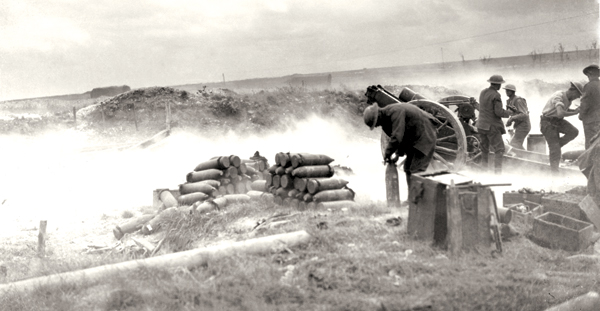
On July 25th, he arrived in England, and was taken on strength at Shorecliffe in Kent. On November 23rd 1916, he arrived in France and went straight into the 69th Overseas Battery of the Canadian Field Artillery, where he was eventually to become a Gunner.

WWI-C-GBS034

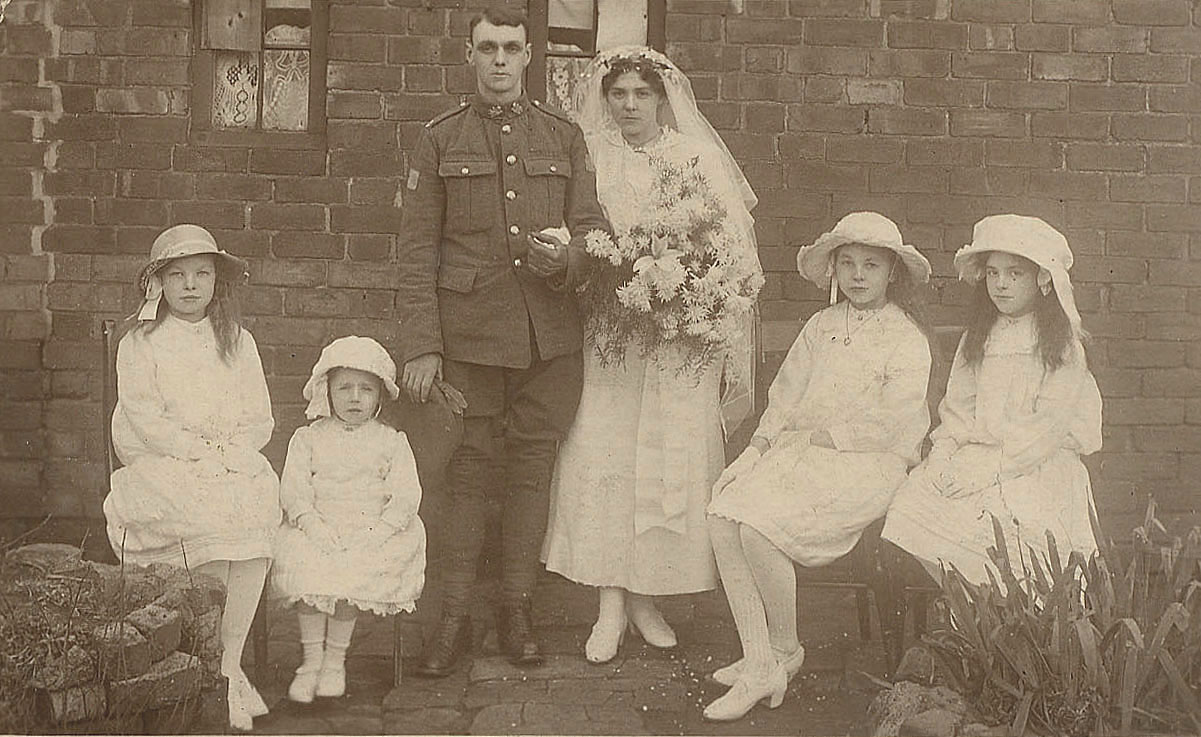
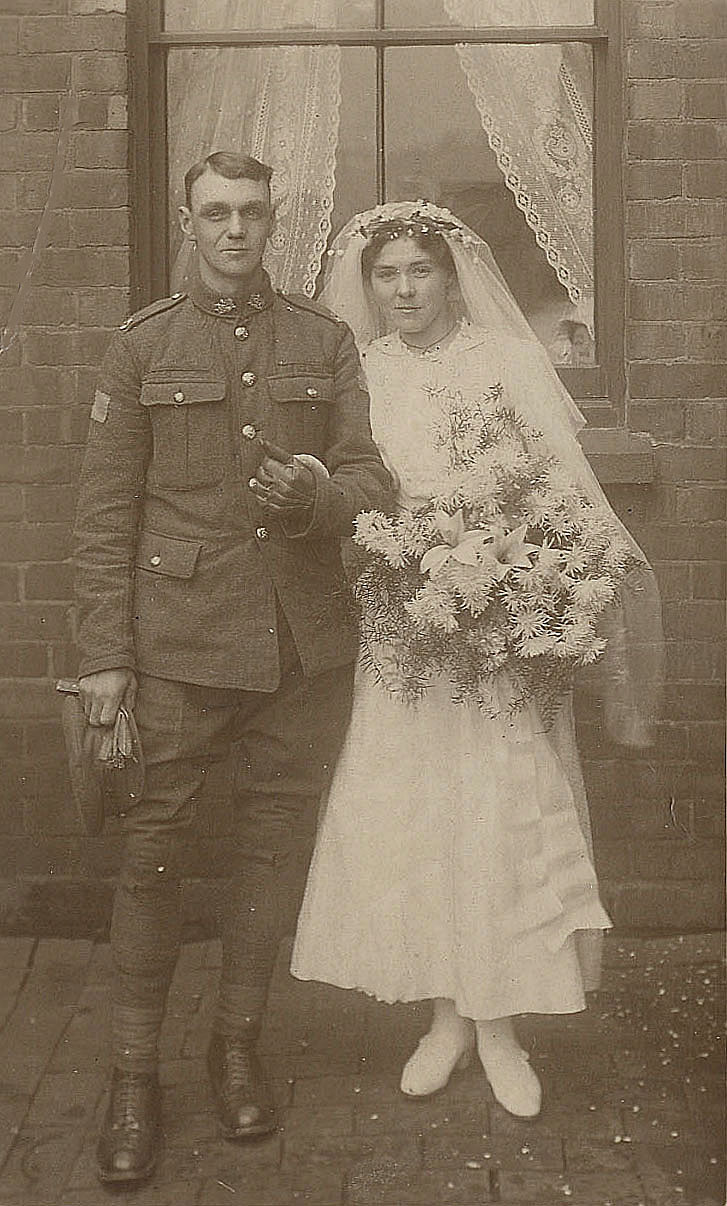
In the early part of his military career, Will seems to have earned some fifteen Canadian dollars per month, which then appears to have risen eventually to thirty dollars in 1917 and 1918. Perhaps the most significant event in Will’s war service was being given permission to marry, back in the sunny and rather more safe, South Derbyshire. The happy day was July 15th 1917…

marriage 2


marriage 1

When I was a boy, my grandfather spoke to me not of wedding dresses, though, but of events in the war. He talked of having fought at Bapaume, at either Pozières Wood or Polygon Wood, and above all, at Vimy Ridge.

WWI-B-V023-600x467

Canadian author Pierre Burton writes wonderfully of

“…soldiers, trapped in the horrors of a silly and senseless war and enduring almost indescribable conditions”.

But at the same time, it was the day when a fledgling nation came of age, when a colony became an independent nation……

“On a chill Easter Monday in 1917, with a blizzard blowing in their faces, the four divisions of the Canadian Corps in France did what neither the British, nor the French armies had been able to do in more than two years of fighting.

They seized and held the best-defended German bastion on the Western Front – a muddy scarp known as the Vimy Ridge. The French, who had lost 150,000 men trying to take the ridge, didn’t believe it could be done. Nor did the Germans; even the British were sceptical. But the Canadians triumphed!

They went over the top at dawn. By lunchtime, most of the ridge was in their hands – at a cost of ten thousand casualties. ”                                                                 (Pierre Burton)

canadian_graves b w

This is the Canadian Memorial, at the top of the ridge…

imagesV23ORIUB

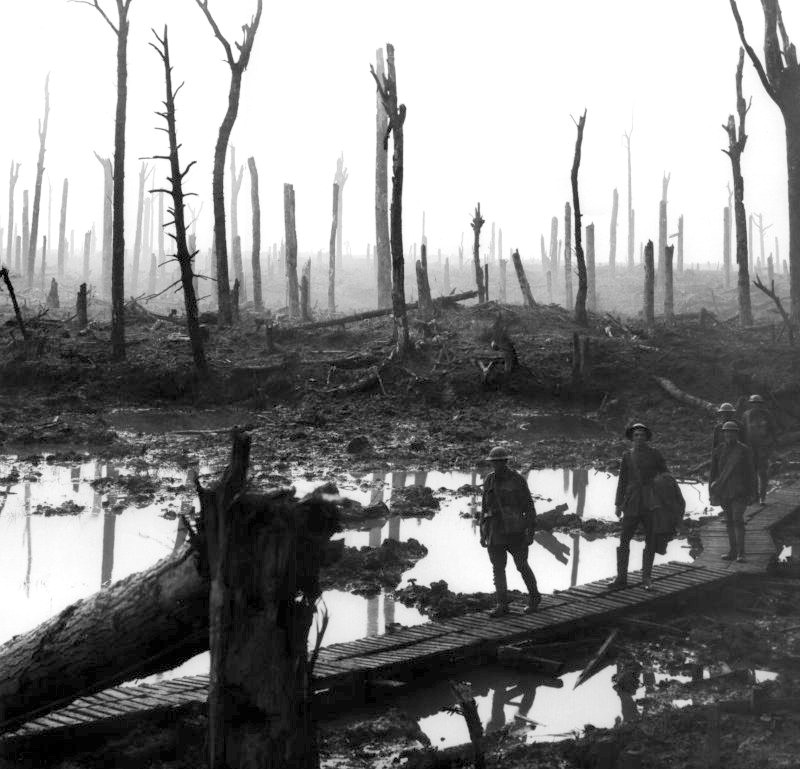
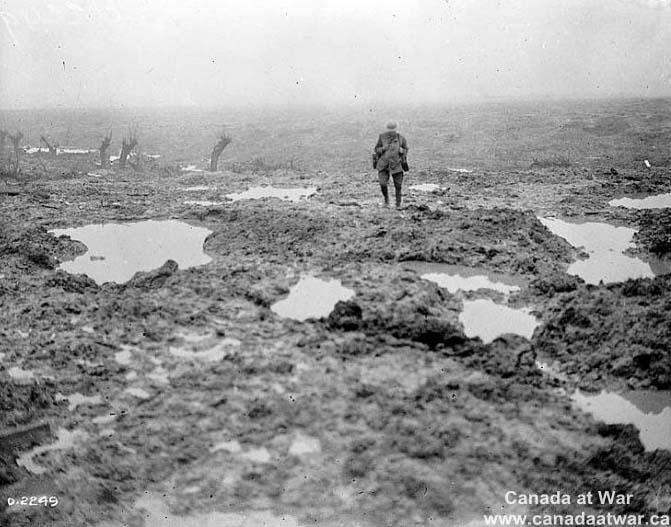
Will was certainly a veteran of Passchendaele in 1917, and in 1918, I believe, fought in the Somme area where blood soaked battles had taken place some two years earlier….

Chateau_Wood_Ypres_1917pdale_mud

In later life, of course, Will was to become profoundly deaf. It is tempting to think that the very first steps in this unfortunate process began with the enormous volume of noise he must have experienced in the Canadian artillery during the First World War.

ii-gun-300-cp-861262

Will finally left France for the last time, and proceeded to England, via the French port of Le Havre. He was finally discharged from the army on May 23rd 1919.

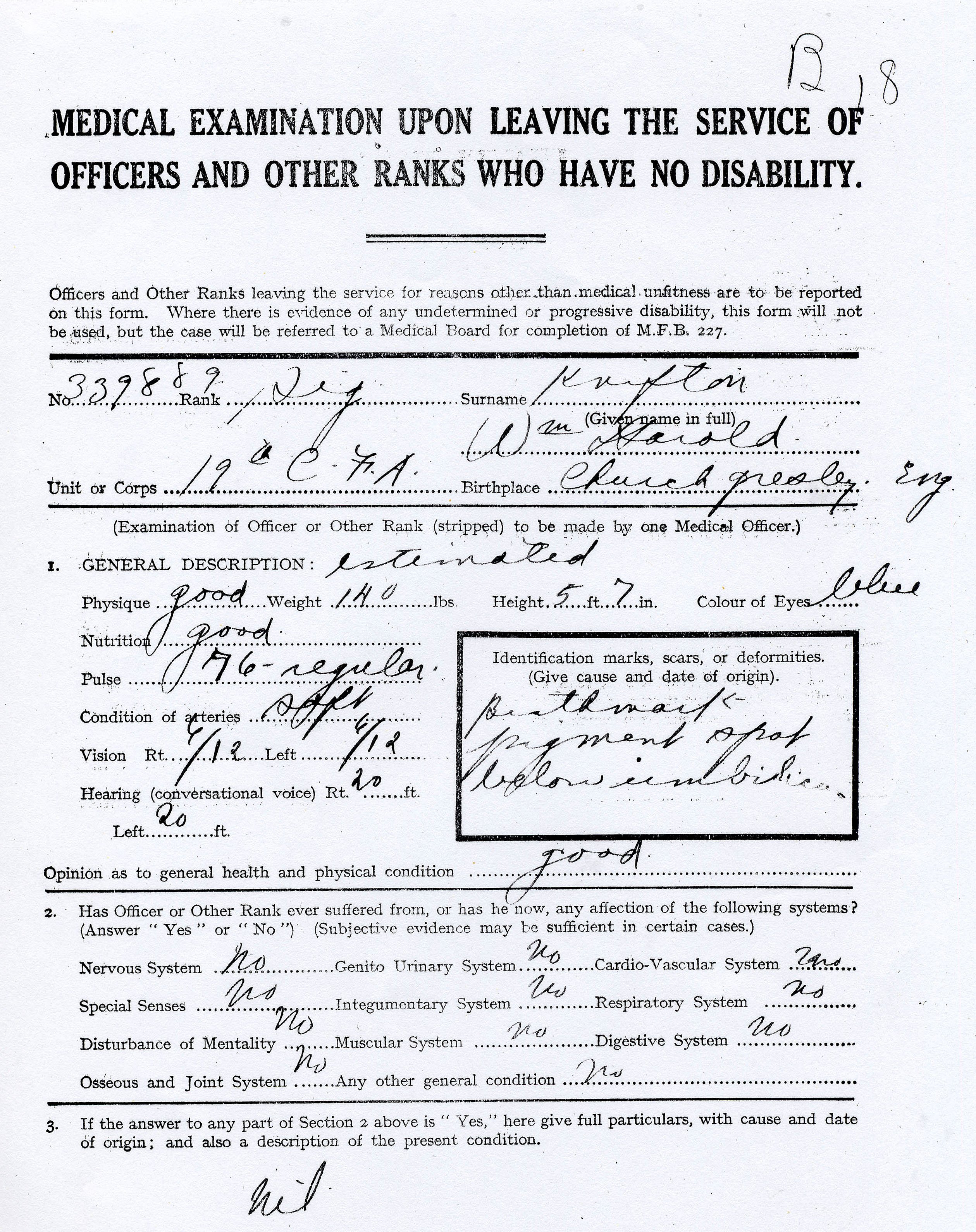
From his medical examination, he had put on some sixteen pounds during his time in the army, and now weighed a hundred and forty pounds, a glowing testimony to the quality of the food in the Canadian Over-Seas Expeditionary Force. He had also apparently grown half an inch taller.

medical after war

Still, at least Will did actually come back home safe and sound. It was not a speedy process, however. It was six months before he was no longer a soldier.

On March 4th and 5th 1919, at Kinmel Park in Denbighshire, north Wales, Canadian troops had rioted against their dreadful living conditions, sick of the constant, apparently pointless delays, and longing to be allowed to go home at last back to their families in Canada. The rioters were fired upon by British troops.

Five brave Canadians were killed and 23 were wounded. It was one of 13 mutinous riots by Canadian troops, all for exactly that same reason.

_45533022_kinmelgraves_466

Records of Canadian soldiers in the First World War can be accessed online at the Library and Archives Canada website.

For my grandfather, two pages are viewable. I know from my own experience, though, that if you pay your money, you will have access to page after page of  extremely interesting material.

15 Comments

Filed under Canada, France, History, Personal