Category Archives: Humour

Why no statue ? (3)

Last time I wrote about statues erected years ago to what we could well call “dubious heroes”. A monarch who was the Number One Slaver in the world. A president who kept slaves even in a country where everybody knew “that all men are created equal”.

I certainly feel that, if there are largish numbers of people who do not want statues of a particular person,  then so be it. Such men will then be gradually forgotten rather than commemorated by a statue and in this way be kept alive artificially.

Recently we have seen various groups of people smashing statues down, and even in one case throwing them into the harbour. But there does not necessarily have to be violence or hooliganism involved. Sometimes the local people can decide for themselves about a statue.

After James II was thrown out in the “Glorious Revolution” of 1688, various groups of people tried to put the Stuarts back on the throne of England. It all came to a head in 1745 when a Scottish army marched on London.  By 1746, though, their dream was shattered. The Duke of Cumberland had fought and won the decisive Battle of Culloden. The Highland Scots,  the vast majority of them Jacobites, and their army, were completely destroyed.
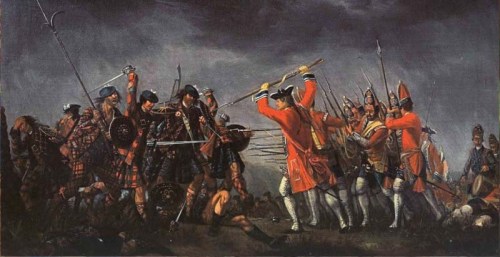
No mercy was shown. British soldiers killed all of the wounded Highlanders left on the battlefield. When Cumberland realised that a wounded man near him was a Jacobite, he told Major James Wolfe to kill him. The latter refused and a soldier completed the job.

In the Highlands, every single person thought  to be a rebel was killed and over a hundred in total were hanged. Villages were burned. Farm animals were stolen. In other words, it was not very different from the arrival of the Wehrmacht or the SS in a Russian village in 1941. Here is the great man:

Not everybody in Georgian England thought the same way, though. In 1770 an equestrian statue of the Duke of Cumberland was erected in Cavendish Square in London to honour his exploits. Little regard had been paid, though, to the direction in which His Lordship should face. And sure enough, after a century of looking up a horse’s backside, the locals got fed up and in 1868 the statue had to be taken down.

One hundred and forty years later, a woman came up with a wonderful idea. She was a Korean artist called Mekyoung Shin. She constructed a life size statue of the Duke and put it back on the empty plinth. But her statue was made of soap and it gradually melted away, limb by limb:
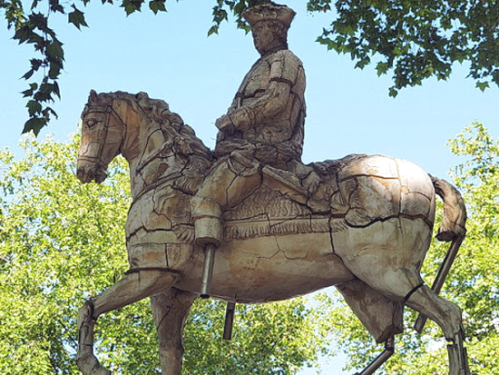
To my mind, this idea of making statues of “dubious” people out of soap and then just letting them dissolve in the rain is an excellent one and should be encouraged widely.

We’ve already looked at Lord Nelson, and he would be an ideal candidate for a soap statue. And he was a sailor, so he must have liked water. Here he is:

But what about people who have reformed? Is it OK to erect statues to them?

Nowadays, Benjamin Zephaniah is a famous poet:

When he was a teenage boy, Benjamin Zephaniah, by his own admittance, was a member of a gang in Birmingham. He was a thief, he was a pickpocket, he was a burglar, he was a liar, he stole cars, he was violent and he took part in an attack on a gay man. He went to Borstal and to prison. But then, through poetry, he turned his life round. He now has 16 honorary degrees, he is Professor of Poetry at Brunel University and he narrowly lost the ballot for Professor of Poetry at Oxford.

Should we have statues to those who have reformed like Benjamin? Of course we should, and in his case, it should be placed outside whichever prison where he served half of his sentence, in such a way that it looks outwards to his future.

And finally one or two other rules. Every single statue should be retired after 200 years and auctioned off. Every city’s statues should be subject to a regular review to make sure their ethnic origin is not 100% white or male, and that there are a fair number of other categories represented.

And no famous sportsmen or women to feature. If statues of such people are needed, the fans themselves should pay. Or in the case of footballers, the football clubs they play for.

The only sportsperson to get a statue will have overcome great handicaps to become successful:

This slideshow requires JavaScript.


Next time, we will look at the people who have never had a statue erected to them.

picture of soap statue borrowed from urben 75


22 Comments

Filed under Criminology, History, Humour, Literature, military, Politics

Poems in “The Nottinghamian” School Magazine 1922-1946 (1)

All the poems in this particular selection have a flavour of the Second World War. Preparations seem to have started as early as 1922, the year when the eccentric and beloved caretaker, universally known as “Robert”, retired.

Almost totally deaf and a great favourite of the boys, Robert would have his own poems printed and then distributed around the school. Unfortunately, only one of them appears to have survived. On this occasion, he celebrates the school’s Cadet Corps, preparing slowly but surely  for the next world war:

“If you look through them gates

You’ll see Captain Yates

A-drilling of boys by the score.

So come on, my lads

Get leave of your dads

And join the High School Corps.”

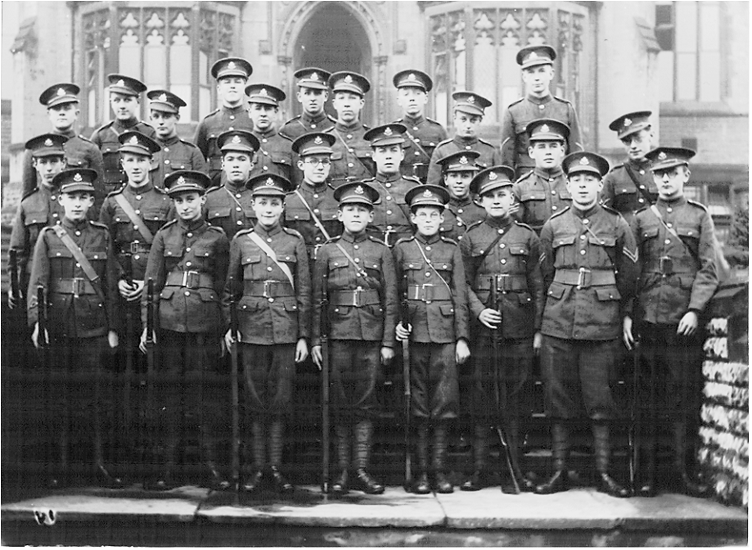
And here is the High School Corps:

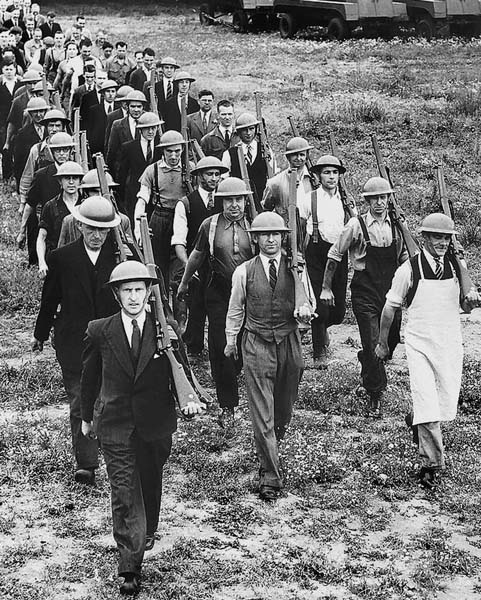
The next poem appeared in December 1943. It celebrates the Home Guard, the amateur soldiers, either too young or too old for the real army, who were tasked with defeating the invading Germans. It was written by Timothy John Norfolk DEAVILLE (aged 9) who was the son of the Reverend R Deaville, the vicar of St Andrew’s on nearby Mapperley Road:

The Home Guard

“Daddy’s in the Home Guard,

He’s helping win the war.

He’s donned a khaki uniform

Just as he did before.


He hasn’t won a medal yet,

He hopes he will do soon.

He’s only been a sergeant

This very afternoon.


His comp’ny’s got a kitten,

He helps to feed it now.

It claws him every morning

And makes him call out, “Ow!”


I’m glad he’s got promotion,

He has more leisure hours.

Commander says he’s clever

(He’s quite a friend of ours).


He hasn’t shot a German yet,

He wants to get a chance.

If “Jerry” tries his funny tricks

He’ll lead them quite a dance.”

Can you spot TV’s Mr Brown in this photograph of an unknown Home Guard unit?

If you remember the song, Mr Brown goes off to town on the 8.21. But he comes home each evening and he’s ready with his gun :

This next poem appeared in April 1945, and it was written by David Brian Bowler of the Science Sixth. It has a bit of a laugh at the various amateur organisations set up by the school to push the Huns straight back into the sea. “J.T.C.” is the Junior Training Corps, L.D.V. stood for the Local Defence Volunteers (or as they were usually called, “Look, duck and vanish”) and the H.G. is the Home Guard.

I don’t know what happened to young David, but I did find two companies where a “David Brian Bowler” is named as a director, shareholder or secretary. They were “Acem Geotechniques Limited” and “Bowler Geotechnical Pty Ltd”, both of them operating in Queensland and Papua & New Guinea.

The poem is called:

“Epic”

“In the grim days they feared the Hun

Would come by air or sea;

At the first observation point

They posted the J.T.C.


Through the chill nights with unknown sounds

Of foes they could not see

They waited, hoping for the chance

To give them ‘ell D.V.


And from those hearty pioneers

By way of L.D.V.,

With drill and guards and tireless work

Came the High School H.G.


First to stand up, last to stand down,

Wherever you may be,

Salute to you, the best of luck,

And thanks to the School H.G.”

Here’s the final parade of the nation’s various Home Guard units, before they were stood down for ever on December 3rd 1944 before being completely disbanded on December 31st 1945.

In December 1940, the Nottinghamian contained a poem entitled

“ODE TO ELSTON (ACCOMPANIED BY WOODPIGEON)”

The title referred to the many boys who took part in a scheme organised by Mr Palmer and Mr Beeby, whereby Sixth Formers went off to work at three different agricultural locations, for the most part helping to get the harvest in. One farm was at Elston, a small village south west of Newark-on-Trent, another was at Car Colston north east of Bingham and the third was at Honey Lane Farm at Farndon which is also near Newark-on-Trent. On other occasions, boys went to a farm camp at Dowsby, just the far side of Grantham.  Ooooh   aargh:

“ODE TO ELSTON (ACCOMPANIED BY WOODPIGEON)”

‘S nice to be in the country

When summer suns are glowing ;

‘S nice to milk the brown cows—

‘S nice.

Cycle out to farmyard

Six o’clock in morning ;

Sweat and sweat and drink tea—

S’wet.


‘S nice to ‘staak’ the barley,

‘S nice to pick the oats,

‘S nice to staak the wheat,

‘S nice !


‘S nice to load the ‘cow-muck’ ?

‘S nice to pump the water ?

‘S nice to be in country

But it’s nicer to be in town !

The poem was written by Philip Blackburn of 6 Classics. He left the school in 1941 with a Studentship for Classics at University College, Nottingham, and a Nottingham Co-operative Society Scholarship of £25 per annum.

23 Comments

Filed under History, Humour, Literature, military, Nottingham, The High School

Why no statue ? (2)

Last time, I talked of how men who were once famous but who had evil hidden deep in their souls can live on artificially through their statues. Without that statue, such men would soon be forgotten in the dustbin of history.

I would rather emulate John Hickenlooper, the Governor of Colorado, who, in 2014, told the descendants of those murdered by Colonel Chivington and his men at Sand Creek in 1864:

“We should not be afraid to criticize and condemn that which is inexcusable ……. We will not run from this history.”

And in 2015, construction of a memorial to the Sand Creek Massacre victims began.

And I certainly feel that, if there are people who do not want to have statues of these “dubious heroes”, who do not want to be reminded of their ancestors’ suffering, then so be it. And, by this method, such men will gradually fade away rather than be kept alive artificially by a statue.

An excellent example would be Werner von Braun. Operation Paperclip made him an American citizen, along with 1600 of his fellow scientists. These were the people who helped to mastermind manned space flight and the landing on the moon. An ordinary person might want a statue.

I can think of a few Jews who wouldn’t though. And Russians, and Poles or any other East European descendants of the ones who died, as tens of thousands of slave workers perished building concrete bunkers, blast proof shelters, and rocket launching ramps all over the island of Peenemünde. If these people feel strongly enough, then no statue.

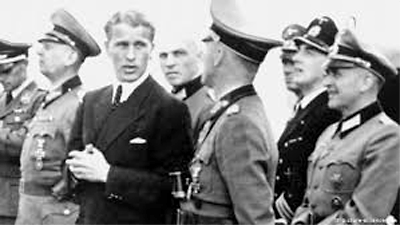
Back then, of course, von Braun was known as SS Sturmbannführer von Braun. And here is the SS Sturmbannführer with high ranking Nazis:

Here he is with the highest ranking Nazi of all. The SS Sturmbannführer is dressed as a civilian, middle of the next to back row:

This one is more difficult, but von Braun is behind Himmler, dressed up in his all black SS uniform:

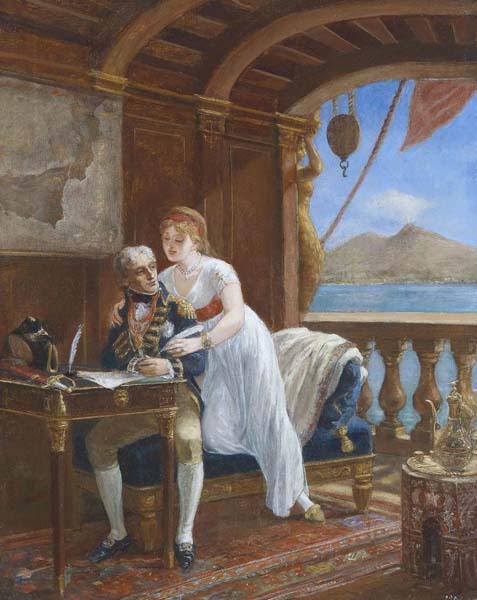
We’re not in the slightest bit short of people in this category. Lord Nelson was an excellent naval commander with a 100% belief in the British Empire. But by 1801, Nelson, already married to the unfortunate Mrs Frances Nelson, was living with another woman, Emma Hamilton. She was not his wife, and he shouldn’t have been living with her. In actual fact, she was the wife of one of his closest friends, Sir William Hamilton.

There will be a lot of men nowadays who will not be too bothered about Nelson’s little foibles, but I bet there are a lot of women who would not want a statue of him staring them in the face, especially in the nation’s capital city.

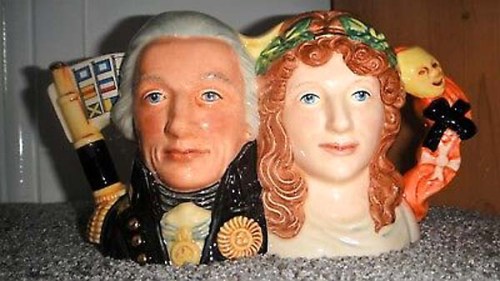
I wonder who bought more of these satirical jugs? Men or women?

High on the list of people from this period who have shocking sides to their character is Lord Byron, the Romantic poet. Not that he couldn’t knock out some famous poems when he put his mind to it:

She walks in beauty, like the night
Of cloudless climes and starry skies;
And all that’s best of dark and bright
Meet in her aspect and her eyes”

Or, perhaps more famous, “The Destruction of Sennacherib”

“The Assyrian came down like the wolf on the fold,
And his cohorts were gleaming in purple and gold;
And the sheen of their spears was like stars on the sea,
When the blue wave rolls nightly on deep Galilee.

Like the leaves of the forest when Summer is green,
That host with their banners at sunset were seen:
Like the leaves of the forest when Autumn hath blown,
That host on the morrow lay withered and strown.”

Lord Byron, though, ought to encounter a great deal of difficulty having a statue erected to him, and I don’t mean just his dress sense:

George Gordon Byron, the Sixth Baron Byron, was allegedly England’s greatest poet. Yet, it has been written that “By our own modern standards he was probably a paedophile and certainly a rapist, at least of the statutory kind.”

The evidence for these charges include the fact that Byron had an infatuation with a shapely fifteen year-old Greek boy, Lukas Chalandritsanos and spent enormous sums of money on him.

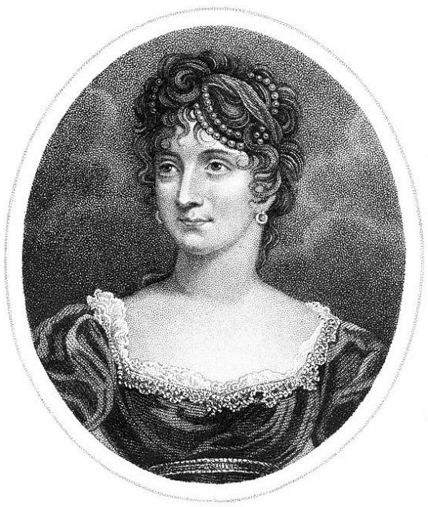
He had already had an incestuous relationship with Augusta Leigh, his own half-sister. Here she is:

Augusta gave birth to Elizabeth Medora Leigh, who was widely thought to be Byron’s child. Three days after the birth, Byron visited Augusta and the baby. He reported later to a friend, Lady Melbourne:

“It is not an Ape and if it is – that must be my fault.”

There was a widely held belief at the time that a child born of incest would be an ape.

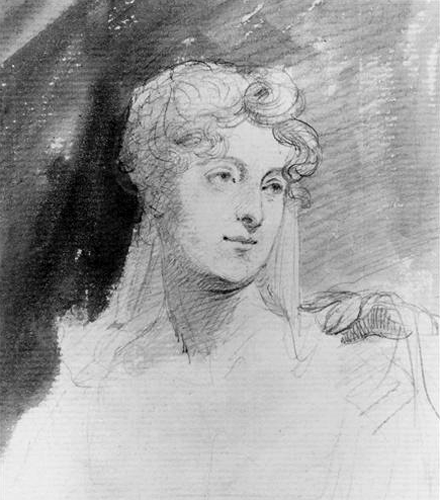
Byron’s wife was Anne Isabella Noel Byron, 11th Baroness Wentworth and Baroness Byron, Here she is:

Evidence from a servant says that Byron raped his wife only days before she gave birth to their daughter, Ada. And then he raped her again only days after she had given birth.

In those days, of course, a husband could not be refused by his wife. What would now be considered rape was just a gentleman exercising his conjugal rights. But by today’s standards, actions like that are repulsive, especially so soon either before or after the poor woman has given birth.

Byron’s appalling arrogance was equally in evidence in his love affair with Claire Clairmont. Here she is:

Claire gave birth to a daughter, Allegra, but Byron immediately forbade her all access to her child, whom he sent away to a convent. She died there aged five.

And to think that I criticised the baddies in the TV series “Poldark” as not being true to life!

20 Comments

Filed under Aviation, Bomber Command, Criminology, History, Humour, military, Politics, Science, war crimes

What would you do ? (12) The Solution

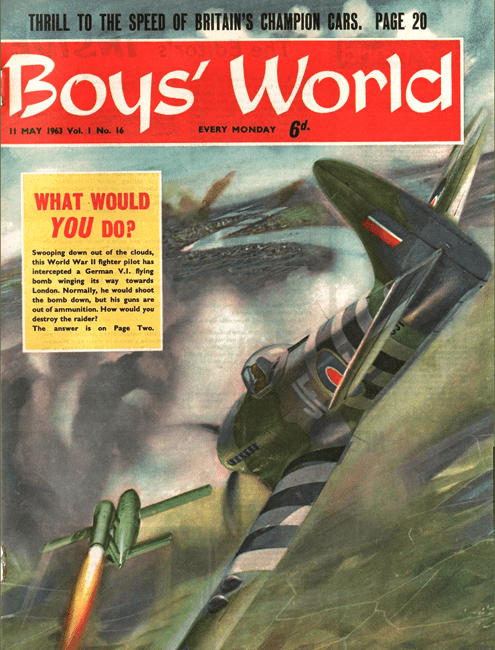
“What would you do ?” used to figure on the cover of a boys’ comic called “Boys’ World”. This was a publication, obviously, aimed at boys, and first appeared on January 26th 1963. There were 89 issues before the comic was merged with Eagle in 1964. The last issue of “Boys’ World” came out on October 3rd 1964.

I used to buy “Boys’ World”, and this was mainly for the front cover which always featured a kind of puzzle. It was called “What would you do ?” and was based on somebody being in what Ned Flanders would call “A dilly of a pickle”. Here’s the situation:

And here is the puzzle:

And as we turn quickly to page two, we find out that:

“There is only one thing the fighter pilot can do. Sweeping down out of his dive he flies alongside the V.I., maintaining the same speed. Then, he gently manoeuvres his wing-tip under the wingtip of the deadly bomb. With a gentle pull on his stick, he turns his plane away, his wing whipping the V.1. over. Its delicate gyro-compass thrown off-course, the bomb hurtles earthward, to explode harmlessly in open countryside.”

So now you know!!

The people who throw around their accusations  about Bomber Command, aiming them chiefly at Bomber Harris, as if he was the Number One in the RAF rather than someone subject to a whole chain of superior officers and politicians, they forget both the V-1 and the V-2, which were pilotless and aimed only in the most general of terms. The V-1s were all aimed at Target 42, London, and more precisely, Tower Bridge. They never hit Tower Bridge or even got particularly close. V-2s were even more random and indiscriminate. In efforts ordered personally by Hitler to blow up the bridge over the Rhine at Remagen, no V-2 got within 900 yards but they did hit Cologne (still German at the time).

The statistics are not very precise but 22,880 V-1s were fired at targets in England (8,892) and Belgium (11,988). Around 4,000 V-2s were launched at targets in England (c 1,400) and Belgium (2,342). The main target in Belgium was the port of Antwerp. Hitler was determined to deny its use to the Allies. Overall,  V-weapons killed approximately 18,000 people in England and Belgium. Nearly all of them were  civilians.

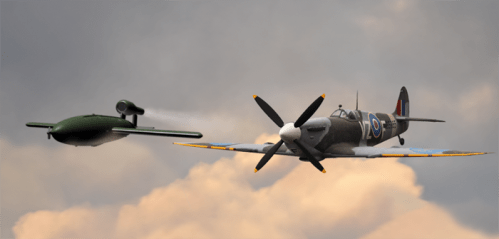
Here’s a V-1 and a Spitfire playing nicely:

And here’s a V2 setting off to annihilate as many civilians as possible in London. It was designed by SS Sturmbannführer Werner von Braun, soon to be an American citizen and certainly not a war criminal responsible for the deaths of tens of thousands of slave workers, most of them Russian or East European, particularly Poles. Hopefully though, like the Führer, he loved his dog:

18 Comments

Filed under Aviation, Criminology, History, Humour, military, Science, war crimes

Famous Adverts of Filmland (2)

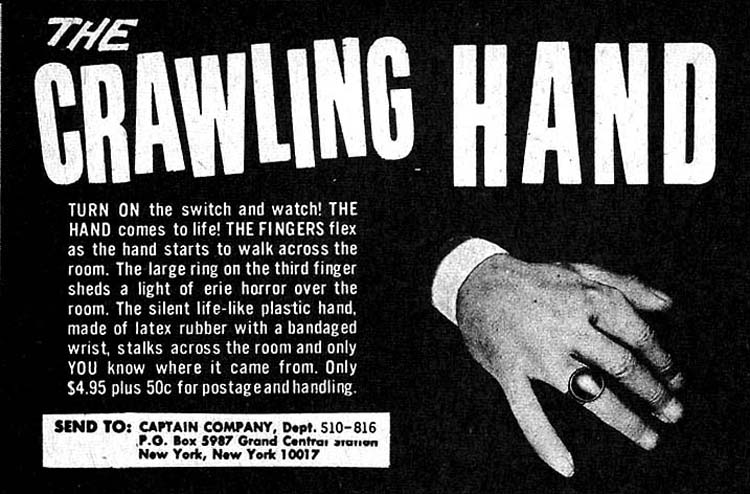
Last time I talked about the American magazines which appeared in Albert Taylor’s newsagent’s shop from time to time during the early 1960s. They all had one thing in common. They had advertisements for what we all thought were rather bizarre products which were largely unobtainable in England. On the other hand, had a lorry arrived in our village, full of “Crawling Hands”, we would have been fighting each other for the chance to purchase this amazing toy for only $4.95, plus an extremely reasonable 50c for postage and handling:

Wow and double wow!! It walks across the room and the ring on the third finger sheds light over the floor. What a bargain.  I wondered how much $5.45 in 1960 might be worth today. Well, it’s between $45-$50. In English money, that’s around £34-£37. I repeat. What a bargain!

I’m not so sure about the next one though.  A whistle for dogs?

What kind of trick is that? You can’t hear it but the dog can? What rubbish. How do you know if it works?

And how will you know the dog has heard it if he is habitually disobedient? And why should he obey a whistle that you cannot hear when he can pretend he hasn’t heard it and you are none the wiser?? He’ll just carry on in the same old way and you’ve wasted your money.

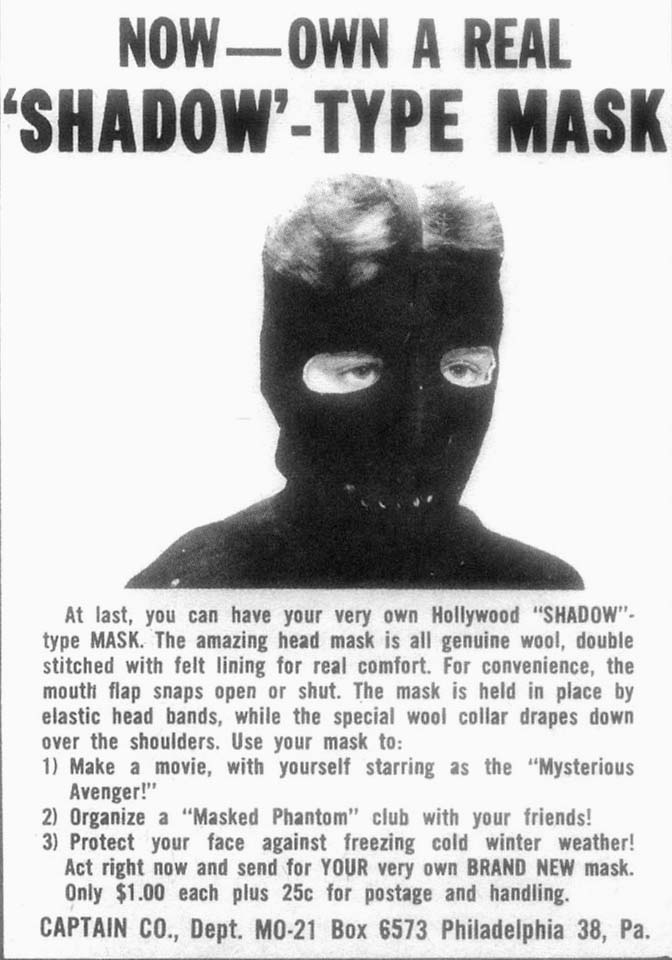
This is a much better product. While my friends join the Boy Scouts, I can put on my black mask and become a member of the Judean People’s Front, or perhaps the Judean Popular People’s Front, or even the Popular Front of Judea.

What have the Romans ever done for us ? “Romanes eunt domus“:

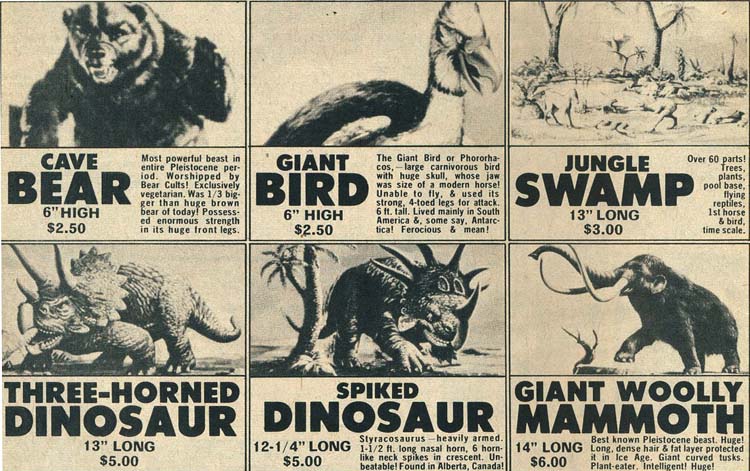
As an adult, I can see now that the majority of the adverts appeal, for the most part, to two categories of customer. The first category is that of the person who is perhaps less intelligent, shall we say? He does not know the names of the simplest dinosaurs. He needs pictures to distinguish between a cave BEAR and a Giant BIRD, or between a GIANT WOOLLY MAMMOTH and a thirteen inch long JUNGLE SWAMP :

In the intelligent section of the magazine, however, much more technical language is used. And if you’re intelligent enough to know what a Styracosaurus is, you’ll definitely want one with a wind up motor :

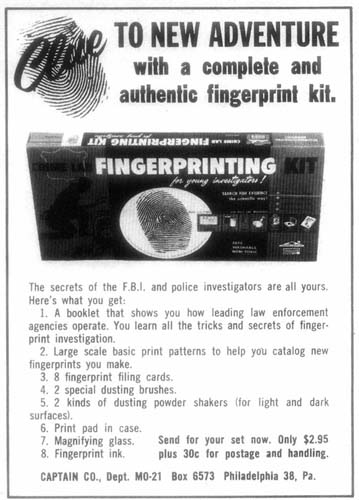
It isn’t the most intelligent kind of person, though, who will pay money for an authentic fingerprint kit, but is unaware that it will be completely useless without access to the FBI fingerprint database and three years at Police College:

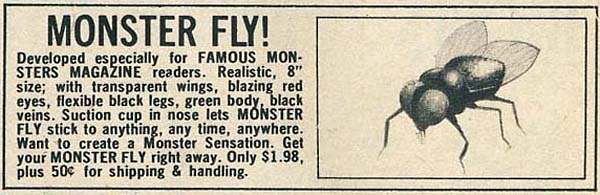
Other adverts just offer products for customers who want to frighten people. They want to scare the living daylights out of the last few friends they have. Perhaps they’ll do it with a monster fly:

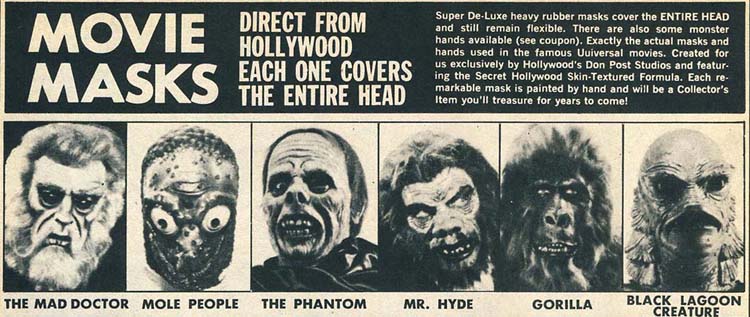
They’d like a mask that makes them look like their movie heroes:

Or, the only full colour advert that I could find, a zombie mask:

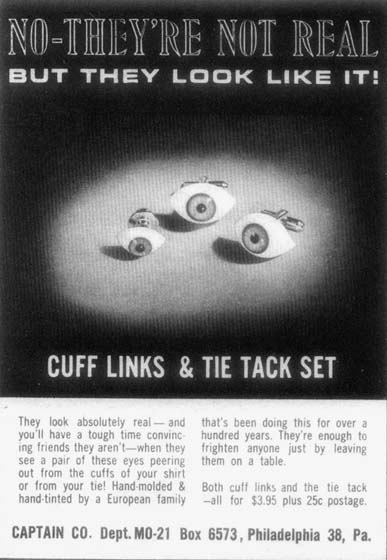
Presumably, they will wear their mask with their eyeball cufflinks:

And what a slogan.

“NO–THEY’RE NOT REAL, BUT THEY LOOK LIKE IT !

Surely that has a future with a publicity hungry plastic surgeon. It’s certainly better than this excessively subtle 1950s ad :

I borrowed that advert from a website which boasts 39 more. Take a look. It certainly shows how attitudes towards women have altered over the years.

Or have they?

24 Comments

Filed under Criminology, Film & TV, History, Humour, My House, Personal, Science, Wildlife and Nature, Writing

Famous Adverts of Filmland (1)

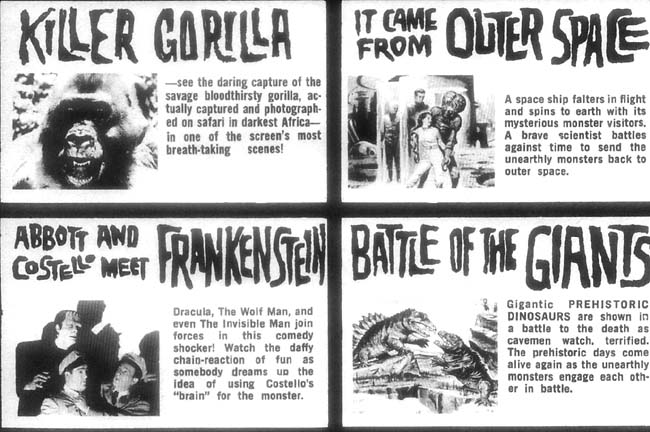
In our little village in the early 1960s, all of the various American magazines which appeared from time to time in Albert Taylor’s newsagent’s shop had one thing in common. They had advertisements for products which were largely unobtainable in England. I don’t know if this was in the aftermath of World War II or because of rationing, but none of the shops around where we lived had giant monster feet for sale, and neither did they have giant inflatable snakes.

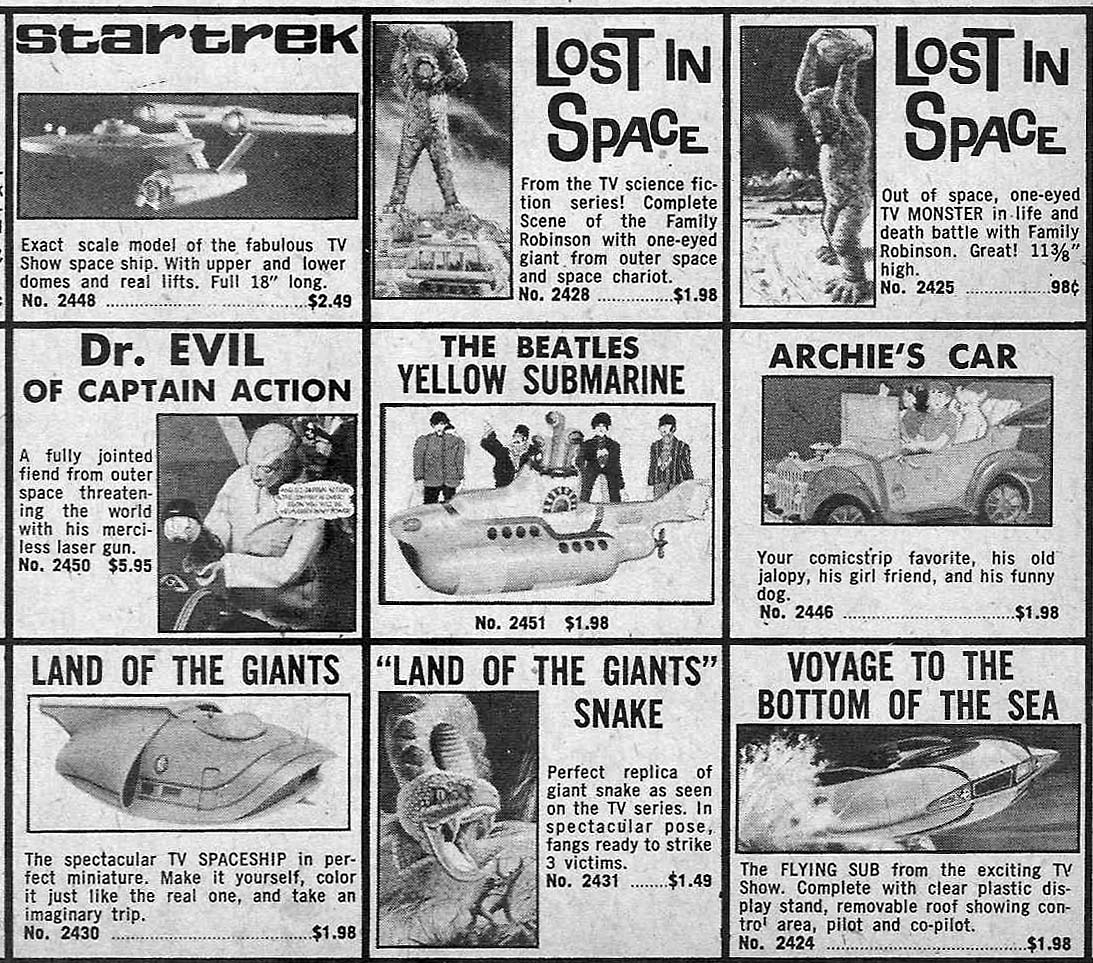
If truth be told, very few of these American adverts had any relevance to our lives in a grey Midlands mining village. They showed us television programmes we could not watch. We had never seen “Land of the Giants”, still less his snake, and “Voyage to the Bottom of the Sea”, “Star Trek”, “Lost in Space”, all of these were still in a distant future. Well, four years or so in the future:

Furthermore, nobody I knew had the money for a film projector, still less the facilities to accommodate a “Killer Gorilla”:

Mind you, I would have been pretty happy to have received an astronaut space suit, even if no size is mentioned at any point. Just look at the blurb:

“Elastic air compression chambers run the entire length of both arms and legs and along the sides of the body. These chambers are easily inflated with any hand pump or gas station air pump through the three air hoses and air lock valves.”

Wow! Elastic air compression chambers !! And three air hoses !!!

And only a limited number available. How many’s “a limited number”? Four million?


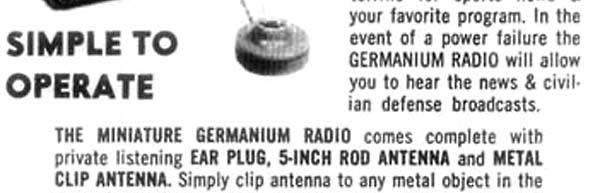
Some of the things advertised you absolutely could not live without, of course. Just take a look at this radio.  And what does that mean?……..“It does not connect to any source of power”.

Beyond the usual claims, of course, the radio may even be useful during a nuclear war:

“In the event of a power failure the GERMANIUM RADIO will allow you to hear the news & civil defense broadcasts”.

Wow !!No Dirty Commie’s ever going to creep up on you.

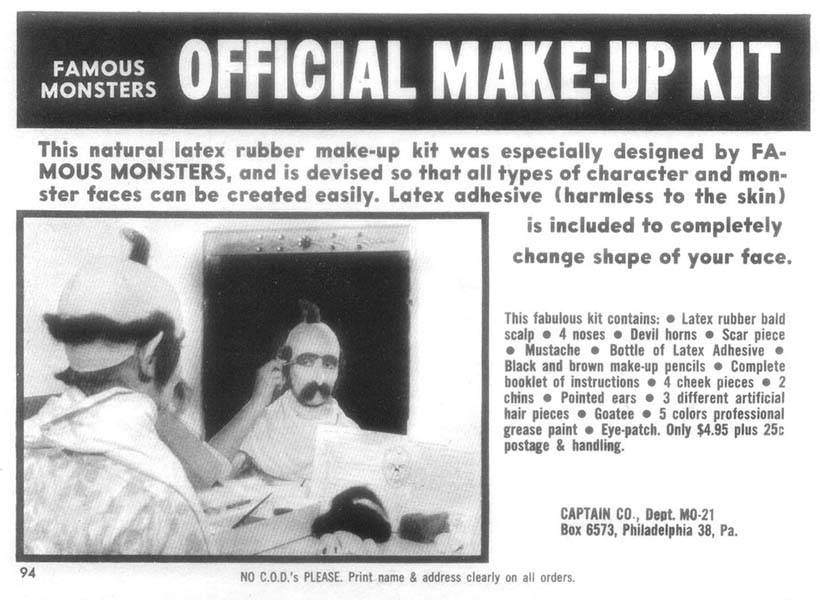
Finally, my favourites. The first is the official make up kit, as used by Olivia de Havilland in “Gone with the Wind”:

If you follow soccer, you’ll recognise the man in the mirror as Arturo Vidal who used to play in midfield for Juventus, Bayern Munich  and FC Barcelona and has now moved on to Inter Milan.

My second favourite is a handy inflatable ten foot plastic snake:

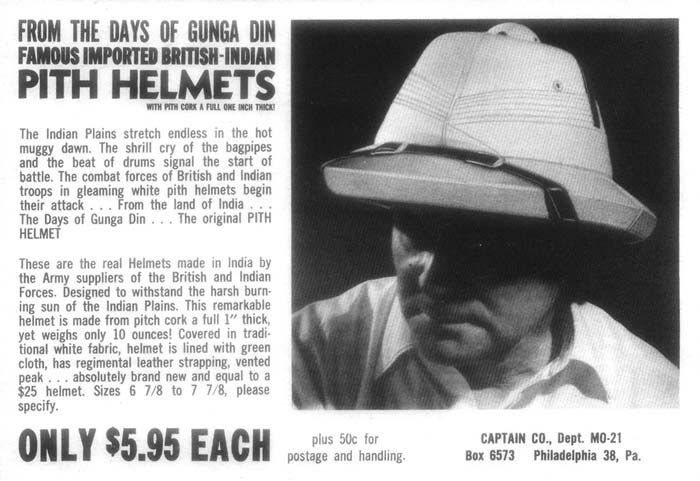
And most of all, back to the days of the Raj with your very own pith helmet. It’s never too late to revive the British Empire:

Mind you, if you do want to revive gin and tonics on the verandah, you may want to buy one of these. A snip at the price at $19.95.

Just look at the address you have to write to, if you want a live monkey. It’s Grand Central Station, New York. I bet if you paid a little bit extra for a clever one, he’d catch the train, get off in your town and then walk round to your house.

15 Comments

Filed under Film & TV, History, Humour, Personal, Writing

What would you do ? (10) The Solution

“What would you do ?” used to figure on the cover of a boys’ comic called “Boys’ World”. This was a publication, obviously, aimed at boys, and first appeared on January 26th 1963. There were 89 issues before the comic was merged with Eagle on October 3rd 1964.

I used to buy “Boys’ World”, and this was mainly for the front cover which always featured a kind of puzzle.

It was called “What would you do ?” and was based on somebody being in what Ned Flanders would call “A dilly of a pickle”. Here’s the situation, as always, explained in the coloured box:

So, you’ve finally been promoted to Rear-Admiral in the US Navy, and you are in charge of a squadron of ships in the Pacific Ocean. It is World War Two and you have just spotted an enemy fleet on the horizon in the growing darkness. They are on their way to invade a nearby island.

You MUST attack but the Japanese fleet has greater fire-power than you have and your chances of defeating it seem slim. What orders would you give, as you sail in to attack?

And the answer is on page 2 and here it is:

So, you order your squadron to manœuvre as per the diagram on the back of my packet of cigarettes. Steaming in the dark, the Japanese suddenly found the head of their column confronted by the American squadron broadside.  The Americans were able to bring all their guns to bear, while the Japanese were only able to fire forward, with their foremost ships. Outgunned , the Japs fled.

Well, well, well. How many of you got that one correct? I know I didn’t. Certainly the most difficult one so far.


29 Comments

Filed under cricket, Film & TV, History, Humour, Literature, military, Pacific Theatre, Personal, the Japanese

What would you do ? (10) The Puzzle

“What would you do ?” used to figure on the cover of a boys’ comic called “Boys’ World”. This was a publication, obviously, aimed at boys and first appeared on January 26th 1963. There were 89 issues before the comic was merged with Eagle in 1964. The last issue of “Boys’ World” came out on October 3rd 1964.

This is issue No 18 which came out on May 25th 1963. This was the day that the idea of amateur and professional players in cricket was abolished—and rightly so. It was also the Saturday when Mike Myers was born:

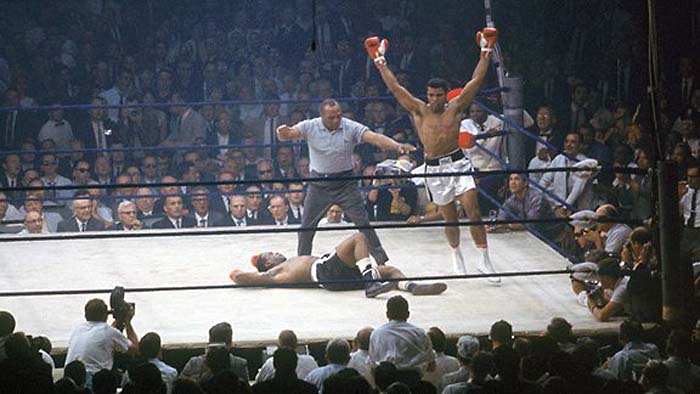
In 1965 it was the day when Muhammad Ali knocked out Sonny Liston in the first round of their world heavyweight title rematch in Lewiston, Maine:

I used to buy “Boys’ World”, and this was mainly for the front cover which always featured a kind of puzzle. It was called “What would you do ?” and was based on somebody being in what Ned Flanders would call “A dilly of a pickle”. Here he is again:

And here’s this particular front cover:

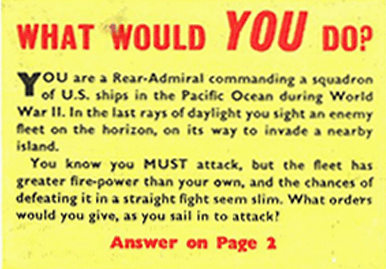
The yellow box sets the scene, and the task is for you to solve the situation. This time, there’s a white circle  to worry about,which explains that the Japanese ships are in two columns.

Perhaps you might like to write your idea in the “Comments” section.

Here’s the yellow box enlarged:

And in case you are reading this box through a glass, darkly, or perhaps you are colour blind, there is some good news for you. You’ve been promoted to Rear-Admiral in the US Navy, and you are in charge of a squadron of ships in the Pacific Ocean. It is World War Two and the last rays of daylight have just lit up an enemy fleet on the horizon. They are on their way to invade a nearby island.

You know that you MUST attack but the Japanese fleet has greater fire-power than your own and your chances of defeating it in a straight fight seem slim. What orders would you give, as you sail in to attack?

And don’t cheat by asking an expert!!!

For what it’s worth, my squadron will switch all their lights off, and then join onto the two Japanese lines. Our two front ships will torpedo their back two ships. Then our next to front ships will torpedo their next to back ships, and so on, until  we have sunk the lot. Then I will be writing to the Head of the US Navy to tell him that we need more than one torpedo per boat.


24 Comments

Filed under cricket, Film & TV, History, Humour, Literature, military, Pacific Theatre, Personal, the Japanese

The Supermarine Walrus (5)

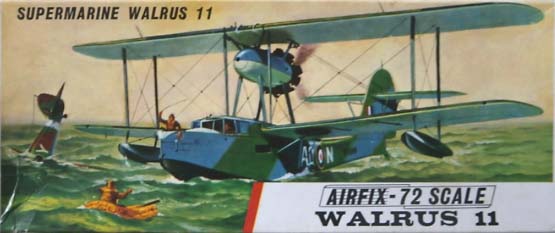
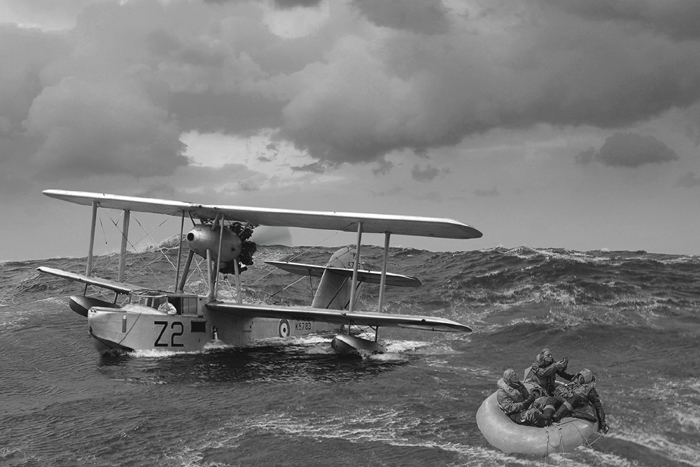
Here is the Airfix kit of the Walrus:

Assembly tended to be a rather fiddly process for an impatient young boy. I, for one, was completely unable to stick the numerous struts into the bottom wing, and then wait overnight while everything dried, so that the struts could then be lined up accurately with the holes in the top wing. If you didn’t do this, of course, you finished up with a very tricky sticky situation with an ever increasing amount of glue spreading from the top of the tube to clumsy little fingers to the flat surfaces of the wings.

And finally….

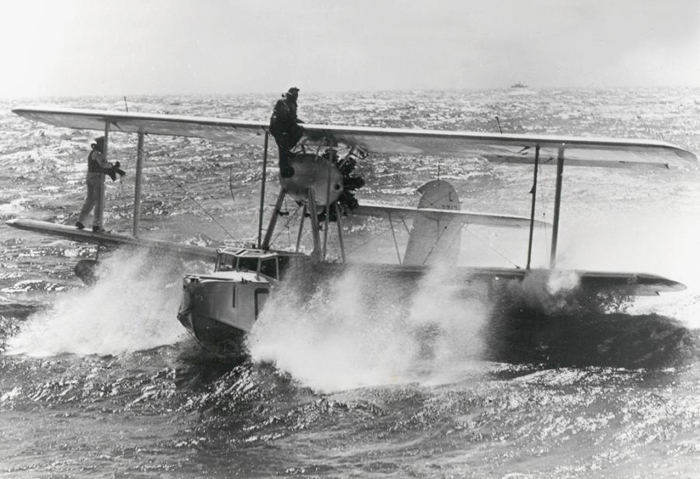
The Walrus was sometimes known as the “Steam-pigeon”, the name coming supposedly from the steam produced by water striking the hot Pegasus engine. Usually, though, its nickname was the “Shagbat”.

People ask, of course, “What is a shagbat?” Well, according to a book I found about British military aircraft, a shagbat was…

“a legendary bird, whose reputedly ever-decreasing circular flightpath had its own inevitable conclusion”.

So….. is there any other definition of a shagbat.? Well, I don’t think there is, but I can offer you a couple of twos for you to add together and produce at least fifty-five.

First of all, as a verb, “shag” is a word beloved of young men down the pub, and means “to have sex,” I tried very hard to think up some examples, but none of them were suitable, although the one about the hole in the fence was jolly funny. The Urban Dictionary expressed it very well, however:

“Used by people who think the term “making love” is too innocent and ” f**** ” is too coarse.”

And what does the “bat” bit mean? This I found in a second on-line dictionary:

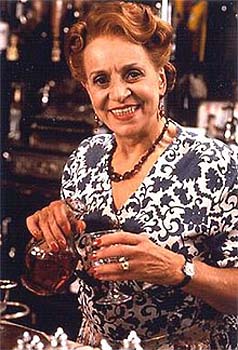
“Any annoying post-menopausal woman, but especially one who applies a considerable amount of make-up….She may even scare small children with her appearance. An example would be “I try to be nice to the old bat.”:

Put the two words together and you have “shagbat”. The sort of woman you wake up with after a wild Saturday night in a small town whose name you cannot, for the moment, remember:

24 Comments

Filed under Aviation, History, Humour

Famous Monsters of Filmland (2)

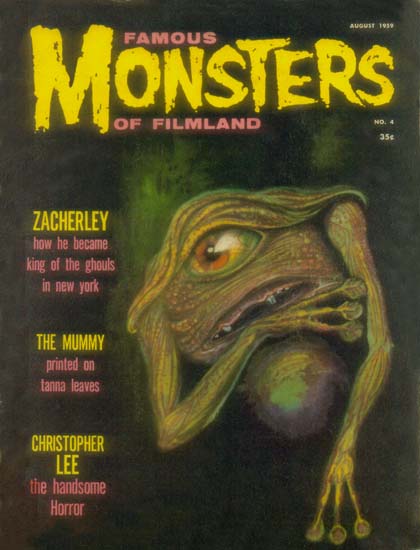
I thought I’d cheer you all up with a few more covers from the American  horror film magazine from the 1960s called “Famous Monsters of Filmland”. There was nothing subtle about them. Here’s Boris Karloff, real name William Pratt, as “The Mummy”:

And here’s the long forgotten film star Duncan ‘Dean’ Parkin in the long forgotten film, “The War of the Colossal Beast”:

They’re all here. King Kong. And tonight, it’s Kentucky Fried Pterodactyl. Save me a wing :

And here’s Lon Chaney senior in the silent film of “The Phantom of the Opera”, still the best version to watch:

And here’s the little Martian guy from “War of the Worlds”, and I don’t mean Tom Cruise. This is the 1953 version, one of my favourite sci-fi films ever, produced by George Pal, one of my favourite sci-fi directors ever:

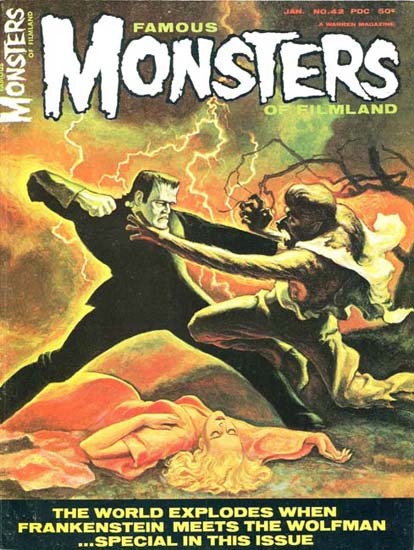
This is a very stylised cover based on the film “Frankenstein meets the Wolf Man” Note the damsel in distress and her gravity defying bosoms:

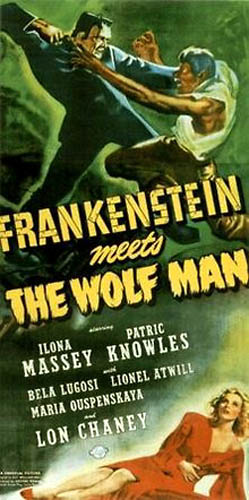
Having said that, it is arguable that the magazine cover does no more than echo the feel of the original film poster:

In a strange twist the two protagonists are played by Lon Chaney junior (the original Wolf Man, and completely expected) and Bela Lugosi (playing Frankenstein’s monster, an incredible piece of irony, given that Lugosi rejected the chance to be Frankenstein’s monster in the original film and let Boris Karloff take the role. Apparently, the monster wasn’t worthy of his acting talents).

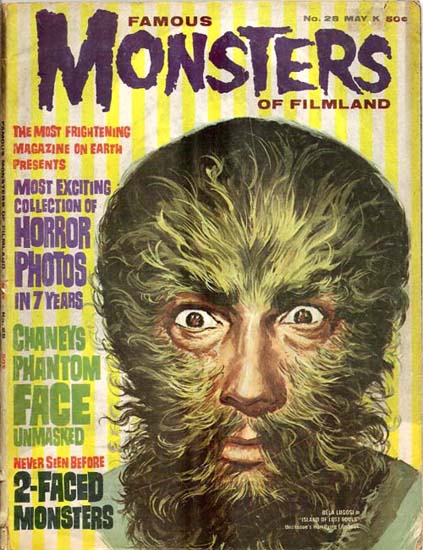
Here are two wonderful Wolf Men (or Werewolves, or perhaps even Werewolfs). (Or even Wolf People). They look as if some buffoon has put them through the wrong cycle in the washing machine. This is the first one:

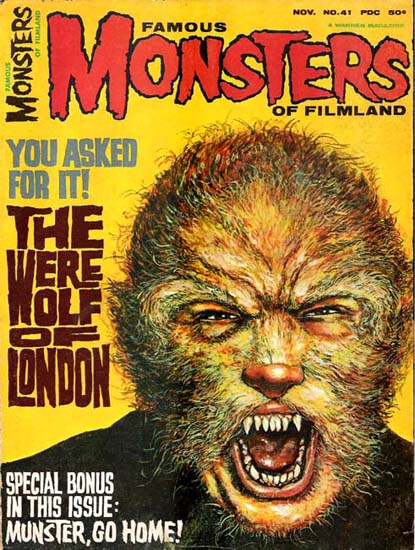
And here’s his younger brother. What a strange dental arrangement:

Here’s “The Monster from the Black Lagoon”, wishing he’d never used that cheap moisturising cream  :

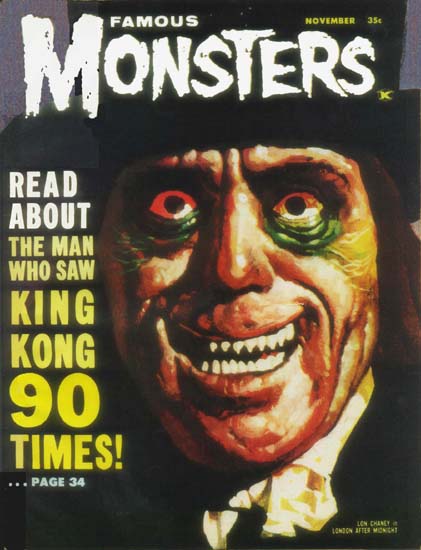
This cover is about the silent film that does not exist any more in its fullest form, “London after Midnight”. It is available only in a reconstructed version. It looks like it’s back to strange dental arrangements again:

Not all of the artwork is good. Here’s a daubed Frankenstein, painted with a brush big enough to clean the garage out with:

Only the covers of the magazines are in colour, but there are some very striking black and white photographs inside. I have chosen some characters from my favourite horror films, the old 1930s Universal productions:

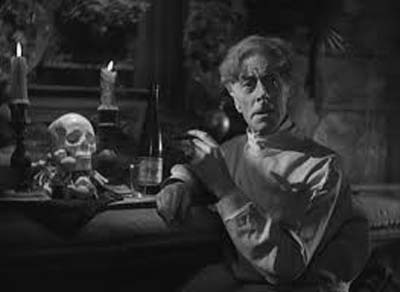
Here’s Doctor Pretorius. The man with all the best lines:

His toast:    “To a new world of gods and monsters! “

And:     “Do you like gin? It’s my only weakness. “

And:   “Have a cigar – they’re my only weakness! “

And then, in the mausoleum when the Frankenstein monster makes a sudden unexpected appearance:

“And I thought I was alone!”

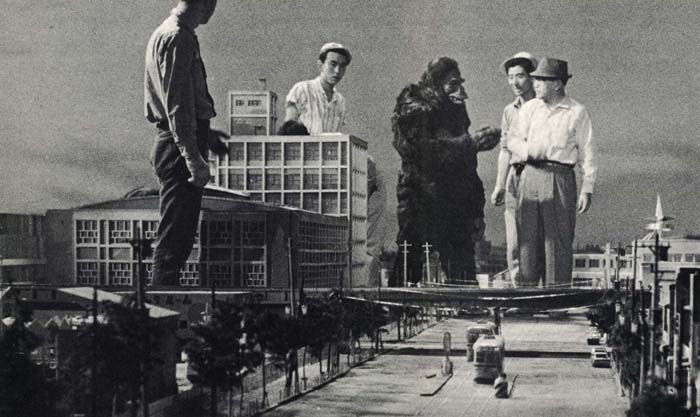
And here’s the studio where Godzilla trashes Tokyo on a daily basis. Occasionally his Monkey Mate, King Kong, comes along to help him. The original film, “King Kong v Godzilla”, of course, was voted “Best Film for a late night beer drinking session” for eighteen consecutive years:

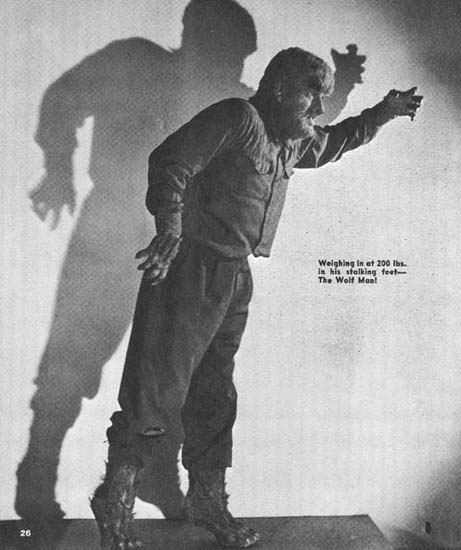
And finally, John Cleese’s entry in the Christmas Competition at the Ministry of Silly Werewolves:


30 Comments

Filed under Film & TV, History, Humour, Personal, Writing